


 |
市場調查報告書
商品編碼
2120404
菲律賓發電EPC:市場佔有率分析、產業趨勢與統計及成長預測(2026-2031年)Philippines Power Generation EPC - Market Share Analysis, Industry Trends & Statistics, Growth Forecasts (2026 - 2031) |
||||||

※ 本網頁內容可能與最新版本有所差異。詳細情況請與我們聯繫。
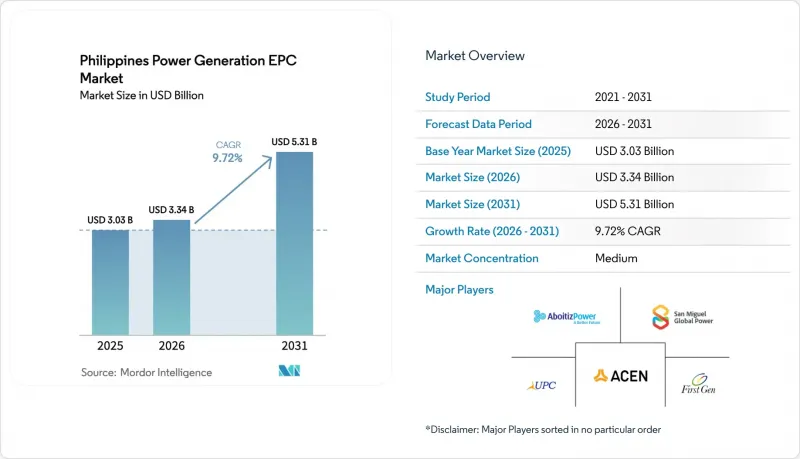
根據 Mordor Intelligence 預測,菲律賓發電 EPC 市場規模將從 2025 年的 30.3 億美元和 2026 年的 33.4 億美元成長到 2031 年的 53.1 億美元,2026 年至 2031 年的年複合成長率(CAGR)為 9.72%。
本報告按技術(火力發電、核能、可再生能源)、發電容量範圍(100兆瓦以下、100-499兆瓦、500兆瓦以上)和最終用戶(受監管的電力公司、獨立發電商、工業私營發電商、公共部門和國有企業)進行細分。市場規模和預測均以美元計價。
菲律賓發電EPC市場的趨勢與洞察
快速的都市化和數位經濟的發展正在推動電力需求的成長。
2024年,隨著馬尼拉大都會區向鄰近省份擴張,以及業務流程外包(BPO)中心24小時不間斷的製冷負荷,電力消耗量成長了6.2%,達到108兆瓦時。備用容量正在下降,預計到2025年4月,呂宋島的電網備用容量僅1850兆瓦,接近黃色預警閾值。這種情況迫使電力公司加快取得新的發電容量。到2025年,甲米地省和拉古納省的超大規模資料中心將需要450兆瓦的電力,到2028年這項需求可能會翻倍。這將改變白天的用電負載曲線,有利於採用EPC(工程、採購和施工)模式,將太陽能發電的發電時間與下午的用電高峰期相匹配。 2024年,家用空調的普及率上升至38%,進一步增加了白天的用電高峰,而電池輔助的太陽能發電可以有效地滿足這項需求。此電力發展計畫的目標是到2030年新增15吉瓦發電裝置容量,相當於每年2.1吉瓦的工程量。這將加重當地勞動力負擔,同時使那些能夠跨區域調動資源的承包商受益。
棉蘭老島-維薩亞斯電網的互聯互通是新EPC訂單的催化劑。
2024年投入使用的450兆瓦棉蘭老島-維薩亞斯海底電纜,取消了棉蘭老島計畫先前被迫接受的折扣,使該計畫的內部收益率提高了1.8個百分點,並重啟了一個擱置已久的1.2吉瓦可再生能源計畫。位於呂宋島的獨立電力生產商現在可以整合跨島嶼的購電協議,從而降低交易對手風險,並促成規模更大、更經濟的EPC合約。在維薩亞斯群島,雨季期間大量水力發電的進口能力緩解了季節性價格波動,並提高了15年期購電協議的資金籌措潛力。政府已累計350億菲律賓披索,用於在2027年前新增1000兆瓦的裝置容量,進一步將整個群島整合到一個統一的EPC競標市場中。能夠管理跨島嶼物流的承包商,相比習慣於單點施工的競爭對手,獲得了成本優勢。
電網瓶頸對新建發電設施造成了輸出限制的風險。
2024年,由於呂宋島北部與帕奈島-內格羅斯島之間主幹輸電線路的輸電能力不足,電網營運商削減了120吉瓦時(相當於總發電量的2.1%)的可再生能源發電。獨立發電商(IPP)無法獲得損失電力的補償,而工程總承包(EPC)承包商的預測顯示,發電量將減少3-5%,這將降低其內部收益率。原計劃於2024年動工、耗資170.9億菲律賓披索的500千伏主幹輸電線路建設已被推遲至2026年,導致北伊羅戈省和卡加延省1200兆瓦的電力供應中斷。 230千伏特的帕奈島-內格羅斯島聯網線路目前僅以95%的運轉率運行,迫使柴油發電機組投入使用,從而削弱了新太陽能發電競標的獲利能力。 2025 年能源監管委員會 (ERC) 的一項指令要求制定一個具有約束力的里程碑的 10 年擴建藍圖,但與地方政府的土地權利糾紛仍未解決,導致項目成本持續上漲高達 12%。
細分市場分析
在菲律賓的發電EPC市場,預計到2025年,可再生能源支出將佔總支出的68.5%,並在2031年之前以14.9%的複合年成長率成長。太陽能發電佔總支出的55%,這主要得益於價值40億美元、裝置容量3.5吉瓦的「Terra Solar」專案合約。陸域風電佔30%,其中大部分集中在北伊羅戈省和吉馬拉斯省。浮體式太陽能發電佔15%,儘管土地取得困難,但仍在快速發展,其容量係數比地面安裝式太陽能發電高出8%。
至2025年,火力發電廠將佔投資總額的28%,並以每年3.2%的適度速度擴張。液化天然氣(LNG)項目,例如裝置容量為420兆瓦的聖加布里埃爾項目,顯示透過整合再氣化終端和聯合循環燃氣渦輪機,可以確保高盈利能力。由於政府的禁令,新建燃煤發電廠的計畫已被凍結,而核能發電仍處於考慮階段。儘管2024年與Ultra Safe Nuclear Corporation簽署了一份合作備忘錄,核電專案仍保持著一定的活力,但缺乏監管基礎。如果沒有快速的政策推進,未來十年核能發電將不會對菲律賓電力EPC市場的規模產生實質影響。
其他好處:
- Excel格式的市場預測(ME)表
- 3個月的分析師支持
目錄
第1章:引言
- 研究假設和市場定義
- 調查範圍
第2章:調查方法
第3章執行摘要
第4章 市場狀況
- 市場概覽
- 設備產能預測
- 初級能源消耗概述
- 市場促進因素
- 快速的都市化和數位經濟的發展正在推動電力需求的成長。
- 加速核准可再生能源服務合約(2023-2025 年)
- 棉蘭老島-維薩亞斯走廊的電網連接訂單EPC(工程、採購和施工)合約開闢了新的途徑。
- 新參與企業超大規模資料中心市場的企業(Google、亞馬遜、Meta)正在簽訂公司間的購電協議 (PPA)。
- 一個創新的液化天然氣發電中心,可實現混合式EPC(工程、採購和施工)工作範圍。
- 水力水庫上的模組化浮體式太陽能發電工程
- 市場限制因素
- 電網瓶頸會為新建設專案帶來發電受限的風險。
- 披索疲軟推高了進口EPC(工程、採購和施工)設備的成本。
- 在地採購法規的模糊性導致合約簽署延遲。
- 地熱資源權益糾紛阻礙了現有發電廠的改造升級。
- 供應鏈分析
- 監管環境與政府政策
- 技術展望
- 波特五力模型
- PESTLE分析
第5章 市場規模與成長預測
- 透過技術
- 熱
- 核能
- 可再生能源
- 按發電能力範圍
- 小於 100 兆瓦(分散式能源、微電網)
- 100~499 MW
- 500兆瓦或以上
- 最終用戶
- 受監管的公共產業
- 獨立發電商(IPP)
- 工業私人發電
- 公共部門和國營企業
第6章 競爭情勢
- 市場集中度
- 策略趨勢(併購、聯盟、購電協議)
- 市場佔有率分析(主要公司的市場排名和佔有率)
- 公司簡介
- UPC Renewables
- Bronzeoak Philippines
- Black & Veatch Corporation
- JGC Philippines Inc.
- AECOM
- Fluor Corporation
- Aboitiz Power Corporation
- San Miguel Global Power Holdings
- First Gen Corporation
- ACEN Corporation
- DM Consunji Inc.(DMCI Power)
- Mitsubishi Power(MHI)
- Siemens Energy AG
- Sumitomo Corporation
- Hyundai Engineering Co., Ltd.
- POSCO E&C
- China Energy Engineering Corp.(CEEC)
- Power Construction Corp. of China(PowerChina)
- KEPCO Engineering & Construction
- Toyo Engineering Corporation
第7章 市場機會與未來展望
According to Mordor Intelligence, the Philippines power generation EPC market size is projected to expand from USD 3.03 billion in 2025 and USD 3.34 billion in 2026 to USD 5.31 billion by 2031, registering a CAGR of 9.72% between 2026 to 2031.
This report is Segmented by Technology (Thermal, Nuclear, and Renewables), Capacity Band (Up To 100 MW, 100 To 499 MW, and Above 500 MW), and End-User (Regulated Utilities, Independent Power Producers, Industrial Captive Power, and Public Sector and SOE). The Market Sizes and Forecasts are Provided in Terms of Value (USD).
Philippines Power Generation EPC Market Trends and Insights
Rising Electricity Demand From Rapid Urbanization And Digital-Economy Growth
Electricity consumption jumped 6.2% in 2024 to 108 terawatt-hours as Metro Manila extended into neighboring provinces and business-process outsourcing hubs ran round-the-clock cooling loads. Reserve margins are thinning; the Luzon grid logged only 1,850 megawatts of reserves in April 2025, near the yellow-alert threshold, which is pushing utilities to lock in new capacity faster. Hyperscale data centers in Cavite and Laguna already required 450 megawatts in 2025 and could double that by 2028, converting daily load curves and favoring solar EPC timelines that align with peak afternoon demand. Household air-conditioning penetration rose to 38% in 2024, adding to daytime peaks that battery-backed solar can manage efficiently. The Power Development Plan targets 15 gigawatts of fresh capacity by 2030, translating into an annual engineering workload of 2.1 gigawatts that stretches local labor pools and benefits contractors with regional mobilization capability.
Grid Interconnection Of Mindanao-Visayas Corridors Unlocking New EPC Orders
The 450-megawatt Mindanao-Visayas submarine cable, energized in 2024, erased the discount that Mindanao projects once accepted, lifting project internal rates of return by 1.8 percentage points and resurrecting 1.2 gigawatts of shelved renewables. Luzon-based independent power producers can now aggregate offtake across islands, reducing counterparty risk and enabling bigger, more economical EPC scopes. Visayas can import hydro-rich power during rainy months, flattening seasonal price swings and improving the bankability of 15-year power-purchase agreements. A follow-on upgrade to 1,000 megawatts by 2027 is budgeted at PHP 35 billion and will further integrate the archipelago into a unified EPC bidding space. Contractors able to manage multi-island logistics gain a cost edge over rivals accustomed to single-site execution.
Transmission Bottlenecks Causing Curtailment Risk For New Builds
Grid operators curtailed 120 gigawatt-hours of renewable output in 2024, equal to 2.1% of total generation, because key corridors in Northern Luzon and the Panay-Negros link ran out of headroom. Independent power producers receive no payment for lost energy, so EPC pro formas now assume a 3-5% deration, trimming internal rates of return. A PHP 17.09 billion 500-kilovolt backbone originally slated for 2024 slipped to 2026, stranding 1,200 megawatts in Ilocos Norte and Cagayan. The 230-kilovolt Panay-Negros interconnection operates at 95% utilization, forcing diesel dispatch that erodes the economics of fresh solar bids. A 2025 Energy Regulatory Commission directive orders a 10-year expansion roadmap with binding milestones, yet right-of-way disputes with local governments remain unresolved and continue to inflate project costs by up to 12%.
Other drivers and restraints analyzed in the detailed report include:
- Corporate PPAs By Hyperscale Data-Center Entrants
- Modular Floating Solar Projects On Hydropower Reservoirs
- Peso Depreciation Inflating Imported EPC Equipment Costs
For complete list of drivers and restraints, kindly check the Table Of Contents.
Segment Analysis
Renewables commanded 68.5% of 2025 spending within the Philippines' power generation EPC market and are forecast to grow at a 14.9% CAGR through 2031. Solar comprised 55% of that total, led by the 3.5-gigawatt Terra Solar contract valued at USD 4 billion, while onshore wind held 30%, concentrated in Ilocos Norte and Guimaras. Floating solar captured 15% and is scaling rapidly as land access tightens, with capacity factors running 8% higher than ground-mount benchmarks.
Thermal plants accounted for 28% of the 2025 investment and are expanding modestly at 3.2% per year. Liquefied-natural-gas projects such as the 420-megawatt San Gabriel facility show how integrating regasification terminals with combined-cycle turbines secures premium margins. Coal additions are frozen under a government moratorium, and nuclear remains exploratory; a 2024 memorandum with Ultra Safe Nuclear Corporation keeps the topic alive but lacks a regulatory backbone. Absent swift policy progress, nuclear will not materially influence the Philippines' power generation EPC market size this decade.
Complete Report Scope:
- By Technology
- Thermal
- Nuclear
- Renewables
- By Capacity Band
- Up to 100 MW (DER, micro-grid)
- 100 to 499 MW
- Above 500 MW
- By End-User
- Regulated Utilities
- Independent Power Producers
- Industrial Captive Power
- Public Sector and SOE
List of Companies Covered in this Report:
- UPC Renewables
- Bronzeoak Philippines
- Black & Veatch Corporation
- JGC Philippines Inc.
- AECOM
- Fluor Corporation
- Aboitiz Power Corporation
- San Miguel Global Power Holdings
- First Gen Corporation
- ACEN Corporation
- DM Consunji Inc. (DMCI Power)
- Mitsubishi Power (MHI)
- Siemens Energy AG
- Sumitomo Corporation
- Hyundai Engineering Co., Ltd.
- POSCO E&C
- China Energy Engineering Corp. (CEEC)
- Power Construction Corp. of China (PowerChina)
- KEPCO Engineering & Construction
- Toyo Engineering Corporation
Additional Benefits:
- The market estimate (ME) sheet in Excel format
- 3 months of analyst support
TABLE OF CONTENTS
1 Introduction
- 1.1 Study Assumptions & Market Definition
- 1.2 Scope of the Study
2 Research Methodology
3 Executive Summary
4 Market Landscape
- 4.1 Market Overview
- 4.2 Installed Capacity Outlook
- 4.3 Primary-Energy Consumption Snapshot
- 4.4 Market Drivers
- 4.4.1 Rising electricity demand from rapid urbanisation & digital-economy growth
- 4.4.2 Fast-track approval of renewable-energy service contracts (2023-25)
- 4.4.3 Grid interconnection of Mindanao-Visayas corridors unlocking new EPC orders
- 4.4.4 Corporate PPAs by hyperscale data-center entrants (Google, Amazon, Meta)
- 4.4.5 Novel LNG-to-power hubs enabling hybrid EPC scopes
- 4.4.6 Modular floating solar projects on hydropower reservoirs
- 4.5 Market Restraints
- 4.5.1 Transmission bottlenecks causing curtailment risk for new builds
- 4.5.2 Peso depreciation inflating imported EPC equipment costs
- 4.5.3 Local content rule ambiguities delaying contract awards
- 4.5.4 Geothermal resource-rights disputes hindering brown-field repowering
- 4.6 Supply-Chain Analysis
- 4.7 Regulatory Landscape & Government Policies
- 4.8 Technological Outlook
- 4.9 Porter's Five Forces
- 4.9.1 Bargaining Power of Suppliers
- 4.9.2 Bargaining Power of Buyers
- 4.9.3 Threat of New Entrants
- 4.9.4 Threat of Substitutes
- 4.9.5 Competitive Rivalry
- 4.10 PESTLE Analysis
5 Market Size & Growth Forecasts
- 5.1 By Technology
- 5.1.1 Thermal
- 5.1.2 Nuclear
- 5.1.3 Renewables
- 5.2 By Capacity Band
- 5.2.1 Up to 100 MW (DER, micro-grid)
- 5.2.2 100 to 499 MW
- 5.2.3 Above 500 MW
- 5.3 By End-User
- 5.3.1 Regulated Utilities
- 5.3.2 Independent Power Producers
- 5.3.3 Industrial Captive Power
- 5.3.4 Public Sector and SOE
6 Competitive Landscape
- 6.1 Market Concentration
- 6.2 Strategic Moves (M&A, Partnerships, PPAs)
- 6.3 Market Share Analysis (Market Rank/Share for key companies)
- 6.4 Company Profiles (includes Global level Overview, Market level overview, Core Segments, Financials as available, Strategic Information, Products & Services, and Recent Developments)
- 6.4.1 UPC Renewables
- 6.4.2 Bronzeoak Philippines
- 6.4.3 Black & Veatch Corporation
- 6.4.4 JGC Philippines Inc.
- 6.4.5 AECOM
- 6.4.6 Fluor Corporation
- 6.4.7 Aboitiz Power Corporation
- 6.4.8 San Miguel Global Power Holdings
- 6.4.9 First Gen Corporation
- 6.4.10 ACEN Corporation
- 6.4.11 DM Consunji Inc. (DMCI Power)
- 6.4.12 Mitsubishi Power (MHI)
- 6.4.13 Siemens Energy AG
- 6.4.14 Sumitomo Corporation
- 6.4.15 Hyundai Engineering Co., Ltd.
- 6.4.16 POSCO E&C
- 6.4.17 China Energy Engineering Corp. (CEEC)
- 6.4.18 Power Construction Corp. of China (PowerChina)
- 6.4.19 KEPCO Engineering & Construction
- 6.4.20 Toyo Engineering Corporation
7 Market Opportunities & Future Outlook
- 7.1 White-space & Unmet-need Assessment

 石油及天然氣EPC市場規模、佔有率、成長、全球產業分析、區域趨勢及2026-2034年預測
 美國電力EPC:市場佔有率分析、行業趨勢和統計數據、成長預測(2026-2031年)泰國電力EPC:市場佔有率分析、產業趨勢與統計及成長預測(2026-2031年)越南電力EPC:市場佔有率分析、產業趨勢與統計及成長預測(2026-2031年)
 電力EPC市場規模、佔有率和成長分析:按電源、服務類型、專案類型、應用、最終用戶、合約類型和地區分類-2026-2033年產業預測英國電力EPC:市場佔有率分析、產業趨勢與統計、成長預測(2026-2031年)
 電力EPC市場-全球產業規模、佔有率、趨勢、機會、預測:按類型、組件、地區和競爭對手分類,2021-2031年
 工程師/ EPC-E的參與
 電力EPC市場(涵蓋發電廠和輸配電基礎設施):按發電方式、服務、設備和區域分類
 2026年全球電力EPC市場報告