


 |
市場調查報告書
商品編碼
2113196
泰國電力EPC:市場佔有率分析、產業趨勢與統計及成長預測(2026-2031年)Thailand Power EPC - Market Share Analysis, Industry Trends & Statistics, Growth Forecasts (2026 - 2031) |
||||||

※ 本網頁內容可能與最新版本有所差異。詳細情況請與我們聯繫。
據 Mordor Intelligence 稱,2026 年泰國電力 EPC 市場規模估計為 29.6 億美元,預計在預測期(2026-2031 年)內將以 2.51% 的複合年成長率成長,到 2031 年達到 33.5 億美元。
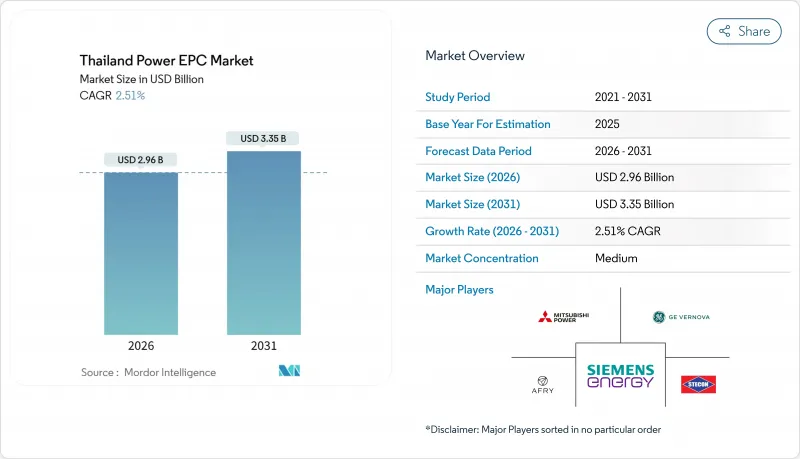
本報告將電力工程總承包(EPC)分為兩類:發電EPC(按技術類型分類,包括火力發電、核能和可再生能源;按容量範圍分類,包括100兆瓦以下、100-499公共產業和500兆瓦以上;按終端用戶市場規模和預測均以美元計價。
泰國電力EPC市場的趨勢與洞察
政府支持的PDP 2022-2037年資本支出計劃
這項價值2.9兆泰銖(約850億美元)的規劃發展計畫(PDP)承諾在2037年將可再生能源採用率提高到51%,並逐步淘汰亞臨界燃煤電廠,以保障電力生產、輸送和分配的穩定需求。該計畫設定了氫氣混燒目標,到2026年達到5%,到2035年達到20%。為此,EPC(工程、採購和施工)競標必須獲得能夠處理混合氣體供應的燃燒設備的預認證,例如三菱電力公司位於羅勇府和春武里府的5300兆瓦模組化聯合循環發電廠,該電廠已於2024年投入運作。泰國國家電力局(EGAT)投資219億泰銖擴建主幹網的計劃,旨在提升對500千伏輸電線路和數位化變電站的投資價值,以便將離岸風力發電輸送到東部經濟走廊(EEC)的高負載地區。雖然這項長期計畫可以緩解訂單波動,但也凸顯了燃料結構風險,因為預計到 2030 年,燃氣發電仍將佔裝置容量的 60% 以上。
工業和資料中心領域的電力需求快速成長。
2024年,共提交了46個資料中心項目,總投資額達1,680億泰銖(約49億美元),其中90%集中在東部經濟走廊(EEC)內。預計從2026年1月起,還將新增2,000兆瓦的直接購電協議(PPA)容量。光是亞馬遜網路服務(AWS)、谷歌和TikTok三家公司就計劃建造IT負載超過400兆瓦的超大規模園區,這加速了太陽能發電+電池儲能系統(BESS)以及500千伏輸電線路的訂單成長。 Digital Edge和B.Grimm正在建造100兆瓦的園區,而CtrlS在2025年投資150億泰銖,用於運作其150兆瓦的資料中心專案。 2024年,該走廊的工業電力消耗量年增4.2%(而全國平均增幅為2.1%),這使得原定於2028年進行的變電站升級改造提前進行。這一激增帶動了微電網EPC專案的增加,半導體和電動車電池工廠安裝了5-20兆瓦的自用太陽能發電設備,以穩定成本並提高運轉率。
冗長的環境影響評估(EIA)和授權程序
泰國的環境影響評估(EIA)體係要求國家環保署(ONEP)、各省辦事處以及公眾聽證會參與其中,導致大型太陽能和風能計畫的核准流程長達12至24個月。在離岸風力發電區域,許可證核准預計將推遲至2026年底,這將導致基礎工程和風機合約的進度被打亂。位於呵叻府的一座200兆瓦太陽能發電廠因農民反對而停滯,農民擔心會對土壤造成影響,該計畫原計劃於2024年啟動。南部地區的風電開發商被要求進行額外的海洋生物調查以安撫相關人員,導致工程延長9個月。雖然2025年50兆瓦以下的項目可以走快速核准途徑,但這僅適用於泰國電力EPC市場的一小部分。
細分市場分析
到2025年,火力發電將佔泰國EPC總承包業務的63.8%,主要得益於國內天然氣供應和液化天然氣進口。屆時,泰國火電廠EPC市場規模將達20.1億美元。三菱電力公司1400兆瓦的欣康聯合循環燃氣渦輪機電廠(Hinkon CCGT)已於2025年1月投入運作,該電廠採用效率高達61%的新一代燃氣渦輪機,並採用5%的氫氣混燒技術。泰國可再生再生能源裝置容量將以5.8%的複合年成長率成長。在泰國電力EPC市場,一旦離岸風力發電建設啟動,可再生能源的佔有率預計將穩步成長,但缺乏本地基礎工程技術以及供應鏈的不足仍然是限制因素。
成本趨勢因技術而異。外匯波動導致渦輪機價格上漲10-12%,對火力發電廠的EPC利潤率帶來壓力;而光學模組供應過剩預計到2025年面板價格將下降15%,從而擴大了太陽能發電的利潤空間。離岸風力發電開發商需要組成合資企業以滿足40%的在地採購要求,這可能會增加基礎設施建設成本(BOP),但有利於國內造船廠的技術轉移。鑑於泰國國家電力局(EGAT)的目標是到2035年實現20%的氫氣摻混比例,維修現有設施以適應氫氣發電雖然是一個小眾但成長迅速的競標項目。
其他好處:
- Excel格式的市場預測(ME)表
- 3個月的分析師支持
目錄
第1章:引言
- 研究假設和市場定義
- 調查範圍
第2章:調查方法
第3章執行摘要
第4章 市場狀況
- 市場概覽
- 市場促進因素
- 政府支持的PDP 2022-2037年資本支出計劃
- 工業和資料中心電力需求快速成長
- 根據 AEDP 2022 制定的可再生能源目標正在推動 EPC(工程、採購和施工)的採用。
- 鼓勵電網現代化(智慧變電站、高壓直流輸電系統)的獎勵
- 離岸風電試點區能夠實現數吉瓦規模的EPC合約。
- 東協電網的跨境交易正在促進輸電EPC項目的發展。
- 市場限制因素
- 環境影響評估和授權程序延長
- 政策利率上升導致企劃案融資成本上升。
- 進口設備的外匯波動
- 當地民眾反對為可再生能源計畫徵地
- 供應鏈分析
- 監理情勢
- 技術展望
- 波特五力模型
- PESTLE分析
第5章 市場規模與成長預測
- 發電EPC
- 透過技術
- 火力發電
- 核能
- 可再生能源
- 按容量範圍
- 小於 100 兆瓦(分散式能源、微電網)
- 100~499 MW
- 500兆瓦或以上
- 最終用戶
- 受監管的公共產業
- 獨立發電機
- 工業私人發電
- 公共部門和國營企業
- 透過技術
- 輸配電 (T&D) EPC
第6章 競爭情勢
- 市場集中度
- 策略趨勢(併購、聯盟、購電協議)
- 市場佔有率分析(主要公司的市場排名和佔有率)
- 公司簡介
- Sino-Thai Engineering & Construction PCL
- Mitsubishi Power(Mitsubishi Heavy Industries Ltd.)
- Siemens Energy AG
- GE Vernova
- AFRY(Poyry PLC)
- Black & Veatch Corp.
- Marubeni Corp.
- Toshiba Energy Systems & Solutions Corp.
- B.Grimm Power PCL
- DP Cleantech Group
- Toyo-Thai Corp. PCL
- Ital-Thai Development PCL
- Ratch Group PCL
- CK Power PCL
- Chiyoda Corp.
- Doosan Enerbility
- Larsen & Toubro Ltd.
- Worley Ltd.
- Sumitomo Corp.
- Power Construction Corporation of China(PowerChina)
第7章 市場機會與未來展望
According to Mordor Intelligence, the Thailand power EPC market size is estimated at USD 2.96 billion in 2026, and is expected to reach USD 3.35 billion by 2031, at a CAGR of 2.51% during the forecast period (2026-2031).
This report is Segmented by Power Generation EPC [Technology (Thermal, Nuclear, and Renewables), Capacity Band (Up To 100 MW, 100 To 499 MW, and Above 500 MW), and End-User (Regulated Utilities, Independent Power Producers, Industrial Captive Power, and Public Sector and SOE)], and Power Transmission and Distribution (T&D) EPC. The Market Sizes and Forecasts are Provided in Terms of Value (USD).
Thailand Power EPC Market Trends and Insights
Government-Backed PDP 2022-2037 Capital-Expenditure Pipeline
The THB 2.9 trillion (USD 85 billion) PDP commits 51% renewable penetration by 2037 and phases out subcritical coal, anchoring steady demand for generation, transmission, and distribution packages. Hydrogen co-firing targets of 5% in 2026 and 20% in 2035 compel EPC bidders to pre-qualify combustors that can accept blended gas, as seen in Mitsubishi Power's 5,300 MW Rayong-Chonburi modular complex commissioned in 2024. EGAT's THB 21.9 billion backbone expansion shifts value toward 500 kV lines and digital substations that evacuate offshore-wind output to EEC load centers. The long-run program flattens order volatility yet crystallizes fuel-mix risk because gas stays above 60% of installed capacity through 2030.
Rapid Growth in Industrial and Data-Center Electricity Demand
Forty-six data-center filings worth THB 168 billion (USD 4.9 billion) in 2024 clustered 90% of requests in the EEC, adding 2,000 MW of direct PPA capacity from January 2026. Amazon Web Services, Google, and TikTok alone plan hyperscale campuses exceeding 400 MW IT load, accelerating solar-plus-BESS and 500 kV line awards. Digital Edge and B.Grimm are building a 100 MW campus, while CtrlS activated 150 MW in 2025 at THB 15 billion spend. Industrial electricity in the corridor grew 4.2% year-on-year in 2024 versus 2.1% nationwide, pulling forward substation upgrades originally slated for 2028. The surge lifts microgrid EPC volumes as estates deploy 5-20 MW captive solar arrays to stabilize tariffs and uptime for semiconductor and EV-battery plants.
Lengthy EIA and Permitting Timelines
Thailand's EIA regime requires ONEP, provincial offices, and public hearings, extending utility-scale solar and wind approvals to 12-24 months. Offshore-wind zones face permit decisions only by late 2026, pushing foundation and turbine contracts beyond initial schedules. Solar farms in Nakhon Ratchasima met farmer resistance over perceived soil impacts, stalling 200 MW in 2024. Southern wind developers ordered extra marine-biology studies to placate fisheries, adding nine months to timelines. A 2025 fast-track path for <50 MW projects exists but covers only a fraction of the Thailand power EPC market.
Other drivers and restraints analyzed in the detailed report include:
- Renewable-Energy Targets Under AEDP 2022 Steering EPC Uptake
- Grid-Modernization Incentives (Smart Substations, HVDC Links)
- High Project-Finance Costs Amid Rising Policy Rates
For complete list of drivers and restraints, kindly check the Table Of Contents.
Segment Analysis
Thermal generation accounted for 63.8% of the 2025 EPC value, anchored by domestic gas supply and LNG imports. The Thailand power EPC market size for thermal plants reached USD 2.01 billion in 2025. Mitsubishi Power's 1,400 MW Hin Kong CCGT, commissioned in January 2025, illustrates next-generation 61%-efficiency turbines that already co-fire 5% hydrogen. Renewable capacity is poised for a 5.8% CAGR as AEDP mandates 32 GW of new solar by 2030. The Thailand power generation EPC market share held by renewables should rise steadily once offshore wind breaks ground, yet local foundation expertise and supply-chain gaps remain barriers.
Cost dynamics diverge across technologies. Turbine prices rose 10-12% on currency moves, squeezing thermal EPC spreads, while photovoltaic module oversupply shaved 15% off 2025 panel quotes, widening solar margins. Offshore wind developers must joint-venture to satisfy 40% local content, potentially lifting balance-of-plant costs but embedding knowledge transfer that benefits domestic yards. Hydrogen-ready retrofits represent a niche yet growing bid line as EGAT seeks 20% blending by 2035.
Complete Report Scope:
- Power Generation EPC
- By Technology
- Thermal
- Nuclear
- Renewables
- By Capacity Band
- Up to 100 MW (DER, micro-grid)
- 100 to 499 MW
- Above 500 MW
- By End-User
- Regulated Utilities
- Independent Power Producers
- Industrial Captive Power
- Public Sector and SOE
- By Technology
- Power Transmission and Distribution (T&D) EPC
List of Companies Covered in this Report:
- Sino-Thai Engineering & Construction PCL
- Mitsubishi Power (Mitsubishi Heavy Industries Ltd.)
- Siemens Energy AG
- GE Vernova
- AFRY (Poyry PLC)
- Black & Veatch Corp.
- Marubeni Corp.
- Toshiba Energy Systems & Solutions Corp.
- B.Grimm Power PCL
- DP Cleantech Group
- Toyo-Thai Corp. PCL
- Ital-Thai Development PCL
- Ratch Group PCL
- CK Power PCL
- Chiyoda Corp.
- Doosan Enerbility
- Larsen & Toubro Ltd.
- Worley Ltd.
- Sumitomo Corp.
- Power Construction Corporation of China (PowerChina)
Additional Benefits:
- The market estimate (ME) sheet in Excel format
- 3 months of analyst support
TABLE OF CONTENTS
1 Introduction
- 1.1 Study Assumptions & Market Definition
- 1.2 Scope of the Study
2 Research Methodology
3 Executive Summary
4 Market Landscape
- 4.1 Market Overview
- 4.2 Market Drivers
- 4.2.1 Government-backed PDP 2022-2037 capital-expenditure pipeline
- 4.2.2 Rapid growth in industrial & data-centre electricity demand
- 4.2.3 Renewable-energy targets under AEDP 2022 steering EPC uptake
- 4.2.4 Grid-modernisation incentives (smart sub-stations, HVDC links)
- 4.2.5 Offshore-wind pilot zones unlocking multi-GW EPC contracts
- 4.2.6 ASEAN Power Grid cross-border trading catalysing transmission EPC
- 4.3 Market Restraints
- 4.3.1 Lengthy EIA & permitting timelines
- 4.3.2 High project-finance costs amid rising policy rates
- 4.3.3 Currency-exchange volatility on imported equipment
- 4.3.4 Local opposition to land acquisition for RE projects
- 4.4 Supply-Chain Analysis
- 4.5 Regulatory Landscape
- 4.6 Technological Outlook
- 4.7 Porter's Five Forces
- 4.7.1 Threat of New Entrants
- 4.7.2 Bargaining Power of Suppliers
- 4.7.3 Bargaining Power of Buyers
- 4.7.4 Threat of Substitutes
- 4.7.5 Competitive Rivalry
- 4.8 PESTLE Analysis
5 Market Size & Growth Forecasts
- 5.1 Power Generation EPC
- 5.1.1 By Technology
- 5.1.1.1 Thermal
- 5.1.1.2 Nuclear
- 5.1.1.3 Renewables
- 5.1.2 By Capacity Band
- 5.1.2.1 Up to 100 MW (DER, micro-grid)
- 5.1.2.2 100 to 499 MW
- 5.1.2.3 Above 500 MW
- 5.1.3 By End-User
- 5.1.3.1 Regulated Utilities
- 5.1.3.2 Independent Power Producers
- 5.1.3.3 Industrial Captive Power
- 5.1.3.4 Public Sector and SOE
- 5.1.1 By Technology
- 5.2 Power Transmission and Distribution (T&D) EPC
6 Competitive Landscape
- 6.1 Market Concentration
- 6.2 Strategic Moves (M&A, Partnerships, PPAs)
- 6.3 Market Share Analysis (Market Rank/Share for key companies)
- 6.4 Company Profiles (includes Global level Overview, Market level overview, Core Segments, Financials as available, Strategic Information, Products & Services, and Recent Developments)
- 6.4.1 Sino-Thai Engineering & Construction PCL
- 6.4.2 Mitsubishi Power (Mitsubishi Heavy Industries Ltd.)
- 6.4.3 Siemens Energy AG
- 6.4.4 GE Vernova
- 6.4.5 AFRY (Poyry PLC)
- 6.4.6 Black & Veatch Corp.
- 6.4.7 Marubeni Corp.
- 6.4.8 Toshiba Energy Systems & Solutions Corp.
- 6.4.9 B.Grimm Power PCL
- 6.4.10 DP Cleantech Group
- 6.4.11 Toyo-Thai Corp. PCL
- 6.4.12 Ital-Thai Development PCL
- 6.4.13 Ratch Group PCL
- 6.4.14 CK Power PCL
- 6.4.15 Chiyoda Corp.
- 6.4.16 Doosan Enerbility
- 6.4.17 Larsen & Toubro Ltd.
- 6.4.18 Worley Ltd.
- 6.4.19 Sumitomo Corp.
- 6.4.20 Power Construction Corporation of China (PowerChina)
7 Market Opportunities & Future Outlook
- 7.1 White-space & Unmet-need Assessment

 石油及天然氣EPC市場規模、佔有率、成長、全球產業分析、區域趨勢及2026-2034年預測
 美國電力EPC:市場佔有率分析、行業趨勢和統計數據、成長預測(2026-2031年)菲律賓發電EPC:市場佔有率分析、產業趨勢與統計及成長預測(2026-2031年)越南電力EPC:市場佔有率分析、產業趨勢與統計及成長預測(2026-2031年)
 電力EPC市場規模、佔有率和成長分析:按電源、服務類型、專案類型、應用、最終用戶、合約類型和地區分類-2026-2033年產業預測英國電力EPC:市場佔有率分析、產業趨勢與統計、成長預測(2026-2031年)
 電力EPC市場-全球產業規模、佔有率、趨勢、機會、預測:按類型、組件、地區和競爭對手分類,2021-2031年
 工程師/ EPC-E的參與
 電力EPC市場(涵蓋發電廠和輸配電基礎設施):按發電方式、服務、設備和區域分類
 2026年全球電力EPC市場報告