


 |
市場調查報告書
商品編碼
2120294
歐洲膠原蛋白:市場佔有率分析、產業趨勢與統計及成長預測(2026-2031)Europe Collagen - Market Share Analysis, Industry Trends & Statistics, Growth Forecasts (2026 - 2031) |
||||||

※ 本網頁內容可能與最新版本有所差異。詳細情況請與我們聯繫。
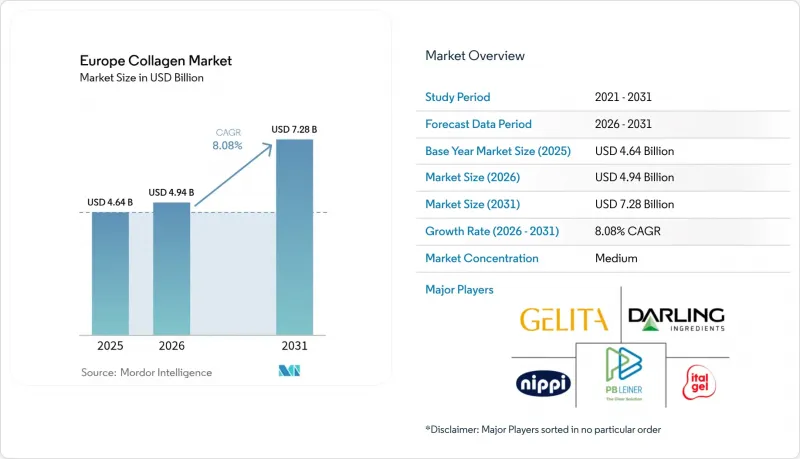
根據 Mordor Intelligence 預測,歐洲膠原蛋白市場規模預計將在 2025 年達到 46.4 億美元,2026 年達到 49.4 億美元,到 2031 年達到 72.8 億美元,2026 年至 2031 年的複合年成長率為 8.08%。
歐洲消費者正從對症藥物轉向結合皮膚病學和營養科學的預防性營養美容方法,這推動了各個年齡層對口服膠原蛋白的需求。
本報告按原料(動物源性、海洋源性)、形態(粉末、液體)、應用領域(食品飲料、膳食補充劑、個人護理及化妝品、藥品、動物飼料)和地區(德國、英國、義大利、法國、西班牙、荷蘭及其他歐洲國家)進行細分。市場預測以美元計價。
歐洲膠原蛋白市場的趨勢與洞察
隨著社會老化,人們正在尋求關節護理以及皮膚、骨骼和頭髮健康的解決方案。
歐洲人口結構的變化,尤其是60歲及以上人口相對於勞動年齡人口的快速成長,正在影響人們對營養補充品的需求。人們的關注點正從綜合維他命轉向特定的功能性成分。世界衛生組織(WHO)的數據顯示,預計2030年,全球60歲以上人口將達到14億,比2019年增加34%。在歐洲,低出生率和預期壽命的延長是造成此趨勢的重要因素。隨著整形外科專家擴大推薦含有II型膠原蛋白肽的關節保健配方,以減少對非類固醇消炎劑的依賴,此類產品的需求也不斷成長。贏創計畫於2024年2月推出Vecollage Fortify L,這是一款旨在改善關節活動的液態膠原蛋白肽。該產品的上市得到了臨床證據的支持,這些證據表明,每日攝取10克水解膠原膠原蛋白可在12週內改善軟骨合成指標。膠原蛋白在提升肌膚彈性和保濕方面的功效尤其吸引50歲以上的女性,她們將其視為一種非侵入性的美容替代方案。雖然膠原蛋白在頭髮和骨骼健康方面的應用仍在發展中,但相關研發投入巨大,尤其是在將膠原蛋白與生物素、二氧化矽和維生素D3結合以達到協同增效效果的配方方面。
向預防醫學和整體健康轉型
德國、法國和荷蘭的醫療保健系統正在評估預防性營養干預的保險報銷模式。這些監管方面的進步正在推動以維持健康而非治療疾病為目的的膠原蛋白補充劑的發展。這種轉變的驅動力是慢性肌肉骨骼疾病帶來的經濟壓力,這些疾病對歐洲醫療保健系統造成了沉重的負擔。政策制定者越來越重視預防措施,以延緩這些疾病的發生。消費者也開始採用將膠原蛋白與益生菌、適應原和植物蛋白結合的整體健康概念。這一趨勢標誌著產品從單一成分補充劑轉向多功能組合產品的轉變。 Gerita 在 12 月的歐洲食品配料展 (Fi Europe) 上推出了 OPTIBAR 和 PeptENDURE,突顯了這一趨勢。這些膠原蛋白肽專為運動營養和恢復而設計,旨在兼顧運動表現提升和預防保健。此外,隨著遠距遠端醫療和個人化營養的日益普及,D2C(直接面對消費者)品牌現在能夠提供膠原蛋白產品以及基於 DNA 的飲食建議。這種策略使品牌能夠繞過傳統零售通路,從而獲得更高的利潤率。
關於動物源膠原膠原蛋白的福利和來源的倫理問題
德國和英國的動物福利計劃組織呼籲零售商對其遵守歐盟關於牲畜保護的98/58/EC指令的情況進行審核。這將對無法證明其人道處置方式的品牌構成聲譽風險。來自集約化育肥場的牛牛膠原蛋白正面臨道德意識較強的消費者的抵制,他們傾向於選擇草飼和有機認證的產品,即使這些產品價格更高。由於宗教和文化限制,豬膠原蛋白面臨更大的挑戰。穆斯林和猶太人往往避免食用豬肉製品,這限制了其在倫敦、巴黎和柏林等多元化都市區的市場滲透率。微發酵和重組膠原蛋白技術等技術進步,例如Gerita和Gertor的合作,展現了複製相同胺基酸序列的非動物性替代品的潛力。然而,截至2026年,商業化規模生產仍面臨成本障礙。提高透明度的舉措,包括基於區塊鏈的從農場到成品的可追溯性,正在成為一種競爭優勢。然而,高昂的實施成本仍是小規模供應商面臨的一大挑戰。隨著18至35歲的年輕消費者將永續性和動物福利置於價格之上,圍繞膠原蛋白採購的倫理考量變得日益重要。預計這種人口結構的變化將持續影響籌資策略直至2031年。
細分市場分析
由於成熟的牛和豬供應鏈以及比海洋來源替代品低30-50%的成本優勢,預計到2025年,動物源膠原膠原蛋白將佔歐洲市場規模的66.14%。富含I型和III型膠原膠原蛋白的牛膠原蛋白在關節健康和運動營養領域佔據主導地位。而以高甘氨酸含量著稱的豬膠原膠原蛋白則因其優異的吸收性能(源於其肽鏈短小和I型膠原蛋白濃度高)而備受青睞。受永續性發展需求以及人們普遍認為海洋來源膠原膠原蛋白因其肽鏈短小和I型膠原蛋白濃度高而具有更佳吸收性的推動,預計到2031年,海洋來源膠原蛋白的複合年成長率將達到9.31%。
西班牙、義大利和法國等沿海國家正利用漁業產品生產海洋膠原膠原蛋白,從而減少廢棄物並符合水產養殖管理委員會 (ASC) 和海洋之友 (FoS) 等組織的認證標準。這些認證使其產品能夠在北歐市場以溢價銷售。微發酵和重組膠原蛋白生產等新興技術可望成為第三類膠原蛋白原料。儘管這些技術仍處於商業化初期,但它們有望打破傳統的「動物源與海洋源」二元對立,在不依賴動物源原料的情況下提供相同的胺基酸組成。例如,Gelita 和 Geltor 之間的合作就凸顯了該領域的進展。
其他好處:
- Excel格式的市場預測(ME)表
- 3個月的分析師支持
目錄
第1章:引言
- 研究假設和市場定義
- 調查範圍
第2章:調查方法
第3章執行摘要
第4章 市場狀況
- 市場概覽
- 市場促進因素
- 隨著社會老化,人們正在尋求關節護理、皮膚、骨骼和頭髮健康的解決方案。
- 向預防醫學和整體健康方法的過渡
- 人們對「由內而外滋養美麗」的營養化妝品越來越感興趣。
- 潔淨標示產品和天然產品越來越受歡迎。
- 膠原蛋白和胜肽技術生物利用度的進展
- 過渡到使用高吸收率、永續的海洋膠原蛋白蛋白原料。
- 市場限制因素
- 關於動物福利和動物源膠原膠原蛋白來源的倫理問題
- 來自牛、豬或海洋生物來源。
- 嚴格遵守法規和新食品核准流程
- 膳食補充劑的口味、香氣和質地相關問題
- 價值鏈分析
- 監理展望
- 波特五力模型
第5章 市場規模與成長預測
- 按原料
- 動物源性
- 海洋來源
- 按形式
- 粉末
- 液體
- 透過使用
- 食品/飲料
- 營養補充品
- 個人護理化妝品
- 製藥
- 動物飼料
- 按地區
- 德國
- 英國
- 義大利
- 法國
- 西班牙
- 荷蘭
- 波蘭
- 比利時
- 瑞典
- 其他歐洲國家
第6章 競爭情勢
- 市場集中度
- 策略趨勢
- 市場排名分析
- 公司簡介
- Gelita AG
- Darling Ingredients Inc.
- PB Leiner
- Italgel Srl
- Nippi Incorporated
- Lapi Gelatine SpA
- Collagen Solutions Plc
- DSM-Firmenich
- Symrise AG
- Weishardt Group
- Gelnex
- Lonza Group Ltd.
- BioCell Technology LLC
- Jellagen Ltd
- CollaSwiss
- Medichema GmbH
- Evonik Industries AG
- Essentia Protein Solutions
- PB Gelatins
- NovaColl
第7章 市場機會與未來展望
According to Mordor Intelligence, the Europe collagen market size is projected to be USD 4.64 billion in 2025, USD 4.94 billion in 2026, and reach USD 7.28 billion by 2031, growing at a CAGR of 8.08% from 2026 to 2031.European consumers are increasingly transitioning from reactive pharmaceutical solutions to preventive nutricosmetic routines that combine dermatology with nutrition science, which is driving demand for ingestible collagen across various age groups.
This report is Segmented by Source (Animal-Based, and Marine-Based), Form (Powder, and Liquid), Application (Food and Beverages, Dietary Supplements, Personal Care and Cosmetics, Pharmaceuticals, Animal Nutrition), and Geography (Germany, United Kingdom, Italy, France, Spain, Netherlands, Rest of Europe). The Market Forecasts are Provided in Terms of Value (USD).
Europe Collagen Market Trends and Insights
Aging population seeking joint care, skin, bone, and hair health solutions
Europe's demographic shift, characterized by the rapid growth of the 60-plus age group compared to the working-age population, is influencing supplement demand. The focus is shifting from multivitamins to targeted functional ingredients. According to data from the World Health Organization (WHO), by 2030, the global population aged 60 or older will reach 1.4 billion, representing a 34% increase from 2019 . Europe is contributing significantly to this trend due to low fertility rates and increased life expectancy. Joint-health formulations containing Type II collagen peptides are gaining popularity as orthopedic specialists increasingly recommend them to reduce reliance on non-steroidal anti-inflammatory drugs. In February 2024, Evonik plans to launch Vecollage Fortify L, a liquid collagen peptide aimed at improving joint mobility. This launch is supported by clinical evidence showing that a daily intake of 10 grams of hydrolyzed collagen can enhance cartilage synthesis markers within 12 weeks. Claims related to skin elasticity and dermal hydration are particularly appealing to the 50-plus female demographic, who view collagen as a non-invasive alternative to cosmetic procedures. While applications for hair and bone health are still emerging, they are attracting research and development investments, especially in formulations combining collagen with biotin, silica, and vitamin D3 for synergistic benefits.
Shift toward preventive healthcare and holistic wellness approaches
National health systems in Germany, France, and the Netherlands are evaluating reimbursement models for preventive nutrition interventions. These regulatory developments support collagen supplements positioned for wellness maintenance rather than disease treatment. This shift is driven by financial pressures, as chronic musculoskeletal conditions place a significant burden on European healthcare systems. Policymakers are increasingly focusing on preventive measures to delay the onset of such conditions. Consumers are also adopting holistic wellness routines that integrate collagen with probiotics, adaptogens, and plant-based proteins. This trend signifies a move from single-ingredient supplementation to multi-functional product combinations. Gelita highlighted this development by presenting OPTIBAR and PeptENDURE at Food Ingredients Europe (Fi Europe) in December. These collagen peptides are tailored for sports nutrition and recovery, addressing the intersection of performance enhancement and preventive care. Furthermore, the expansion of telemedicine and personalized nutrition applications is enabling direct-to-consumer brands to offer collagen products alongside DNA-based dietary recommendations. This strategy bypasses traditional retail channels, allowing brands to achieve higher profit margins.
Ethical concerns over animal-derived collagen welfare and sourcing
Animal-welfare advocacy groups in Germany and the United Kingdom (UK) are urging retailers to audit collagen supply chains for compliance with European Union (EU) Directive 98/58/EC on livestock protection. This has created reputational risks for brands unable to demonstrate humane slaughter practices. Bovine collagen sourced from cattle raised in intensive feedlots is facing boycotts from ethically conscious consumers, who prefer grass-fed or organic certifications despite their higher costs. Porcine collagen faces additional challenges due to religious and cultural restrictions, as Muslim and Jewish populations avoid porcine-derived products, limiting its market penetration in diverse urban centers such as London, Paris, and Berlin. Technological advancements, such as precision fermentation and recombinant collagen technologies, exemplified by Gelita's collaboration with Geltor, present opportunities for animal-free alternatives that replicate identical amino-acid sequences. However, as of 2026, commercial-scale production remains cost-prohibitive. Transparency initiatives, including blockchain-enabled traceability from farm to finished product, are emerging as competitive advantages. Nevertheless, the high implementation costs pose challenges for smaller suppliers. The ethical considerations surrounding collagen sourcing are becoming increasingly significant as younger consumers (aged 18 to 35) prioritize sustainability and animal welfare over price. This demographic shift is expected to influence sourcing strategies through 2031.
Other drivers and restraints analyzed in the detailed report include:
- Growing preference for beauty-from-within nutricosmetics
- Rising popularity of clean-label and natural products
- Allergenic risks from bovine, porcine, or marine sources
For complete list of drivers and restraints, kindly check the Table Of Contents.
Segment Analysis
Animal-based collagen is projected to account for 66.14% of the European market volume in 2025, supported by well-established bovine and porcine supply chains and cost advantages ranging from 30% to 50% compared to marine alternatives. Bovine collagen, which is rich in Type I and Type III collagen, dominates applications in joint health and sports nutrition. Meanwhile, porcine collagen, known for its high glycine content, is preferred in cosmetic formulations aimed at improving skin elasticity. Marine-based collagen is anticipated to grow at a compound annual growth rate (CAGR) of 9.31% through 2031, driven by sustainability requirements and its perceived superior absorption due to smaller peptide sizes and a high concentration of Type I collagen.
Coastal nations such as Spain, Italy, and France are utilizing byproducts from the fishing industry to produce marine collagen, thereby reducing waste and adhering to certifications like the Aquaculture Stewardship Council and Friend of the Sea. These certifications enable premium pricing opportunities in Northern European markets. Emerging technologies, including precision fermentation and recombinant collagen production, represent a potential third category of collagen sources. Although still in the early stages of commercialization, these technologies could disrupt the traditional animal-versus-marine dichotomy by offering identical amino acid profiles without relying on animal inputs. For instance, Gelita's collaboration with Geltor highlights advancements in this area.
Complete Report Scope:
- By Source
- Animal-based
- Marine-based
- By Form
- Powder
- Liquid
- By Application
- Food and Beverages
- Dietary Supplements
- Personal Care and Cosmetics
- Pharmaceuticals
- Animal Nutrition
- By Geography
- Germany
- United Kingdom
- Italy
- France
- Spain
- Netherlands
- Poland
- Belgium
- Sweden
- Rest of Europe
List of Companies Covered in this Report:
- Gelita AG
- Darling Ingredients Inc.
- PB Leiner
- Italgel S.r.l.
- Nippi Incorporated
- Lapi Gelatine S.p.A.
- Collagen Solutions Plc
- DSM-Firmenich
- Symrise AG
- Weishardt Group
- Gelnex
- Lonza Group Ltd.
- BioCell Technology LLC
- Jellagen Ltd
- CollaSwiss
- Medichema GmbH
- Evonik Industries AG
- Essentia Protein Solutions
- PB Gelatins
- NovaColl
Additional Benefits:
- The market estimate (ME) sheet in Excel format
- 3 months of analyst support
TABLE OF CONTENTS
1 INTRODUCTION
- 1.1 Study Assumptions and Market Definition
- 1.2 Scope of the Study
2 RESEARCH METHODOLOGY
3 EXECUTIVE SUMMARY
4 MARKET LANDSCAPE
- 4.1 Market Overview
- 4.2 Market Drivers
- 4.2.1 Aging population seeking joint-care, skin, bone, and hair health solutions
- 4.2.2 Shift toward preventive healthcare and holistic wellness approaches
- 4.2.3 Growing preference for beauty-from-within nutricosmetics
- 4.2.4 Rising popularity of clean-label and natural products
- 4.2.5 Advancements in collagen bioavailability and peptide technology
- 4.2.6 Shift to sustainable marine collagen sources with higher absorption
- 4.3 Market Restraints
- 4.3.1 Ethical concerns over animal-derived collagen welfare and sourcing
- 4.3.2 Allergenic risks from bovine, porcine, or marine sources
- 4.3.3 Stringent regulatory compliance and novel food approval
- 4.3.4 Taste, odor, and texture issues in supplements
- 4.4 Value Chain Analysis
- 4.5 Regulatory Outlook
- 4.6 Porter's Five Forces
- 4.6.1 Threat of New Entrants
- 4.6.2 Bargaining Power of Buyers
- 4.6.3 Bargaining Power of Suppliers
- 4.6.4 Threat of Substitute Products
- 4.6.5 Intensity of Competitive Rivalry
5 MARKET SIZE AND GROWTH FORECASTS (VALUE)
- 5.1 By Source
- 5.1.1 Animal-based
- 5.1.2 Marine-based
- 5.2 By Form
- 5.2.1 Powder
- 5.2.2 Liquid
- 5.3 By Application
- 5.3.1 Food and Beverages
- 5.3.2 Dietary Supplements
- 5.3.3 Personal Care and Cosmetics
- 5.3.4 Pharmaceuticals
- 5.3.5 Animal Nutrition
- 5.4 By Geography
- 5.4.1 Germany
- 5.4.2 United Kingdom
- 5.4.3 Italy
- 5.4.4 France
- 5.4.5 Spain
- 5.4.6 Netherlands
- 5.4.7 Poland
- 5.4.8 Belgium
- 5.4.9 Sweden
- 5.4.10 Rest of Europe
6 COMPETITIVE LANDSCAPE
- 6.1 Market Concentration
- 6.2 Strategic Moves
- 6.3 Market Ranking Analysis
- 6.4 Company Profiles (includes Global-level Overview, Market-level Overview, Core Segments, Financials (if available), Strategic Information, Market Rank/Share, Products and Services, Recent Developments)
- 6.4.1 Gelita AG
- 6.4.2 Darling Ingredients Inc.
- 6.4.3 PB Leiner
- 6.4.4 Italgel S.r.l.
- 6.4.5 Nippi Incorporated
- 6.4.6 Lapi Gelatine S.p.A.
- 6.4.7 Collagen Solutions Plc
- 6.4.8 DSM-Firmenich
- 6.4.9 Symrise AG
- 6.4.10 Weishardt Group
- 6.4.11 Gelnex
- 6.4.12 Lonza Group Ltd.
- 6.4.13 BioCell Technology LLC
- 6.4.14 Jellagen Ltd
- 6.4.15 CollaSwiss
- 6.4.16 Medichema GmbH
- 6.4.17 Evonik Industries AG
- 6.4.18 Essentia Protein Solutions
- 6.4.19 PB Gelatins
- 6.4.20 NovaColl
7 MARKET OPPORTUNITIES AND FUTURE OUTLOOK

 全球膠原蛋白市場,2026-2030年
 2026年重組人源化膠原膠原蛋白全球市場報告
 印度膠原蛋白:市場佔有率分析、產業趨勢與統計及成長預測(2026-2031)英國膠原蛋白:市佔率分析、產業趨勢與統計及成長預測(2026-2031)南美洲膠原蛋白:市場佔有率分析、產業趨勢與統計及成長預測(2026-2031 年)亞太地區膠原蛋白:市佔率分析、產業趨勢與統計及成長預測(2026-2031)
 無端肽膠原蛋白市場規模、佔有率和成長分析:按原料、純化形式、應用、最終用戶和地區分類-2026-2033年產業預測
 膠原蛋白市場:2026-2032年全球市場預測(依膠原蛋白類型、原料、形態、萃取製程、等級、應用及銷售管道)
 膠原蛋白市場-全球產業規模、佔有率、趨勢、機會與預測:按產品、原料、應用、地區和競爭格局分類,2021-2031年
 植物來源膠原蛋白市場:依原料、產品類型、應用、功能、通路和地區分類。