


 |
市場調查報告書
商品編碼
2113685
南美洲膠原蛋白:市場佔有率分析、產業趨勢與統計及成長預測(2026-2031 年)South America Collagen - Market Share Analysis, Industry Trends & Statistics, Growth Forecasts (2026 - 2031) |
||||||

※ 本網頁內容可能與最新版本有所差異。詳細情況請與我們聯繫。
根據Mordor Intelligence的數據顯示,2026年南美洲膠原蛋白市值為1.1838億美元,高於2025年的1.1525億美元。預計從2026年到2031年,該市場將以5.49%的複合年成長率成長,到2031年達到1,605.3億美元。
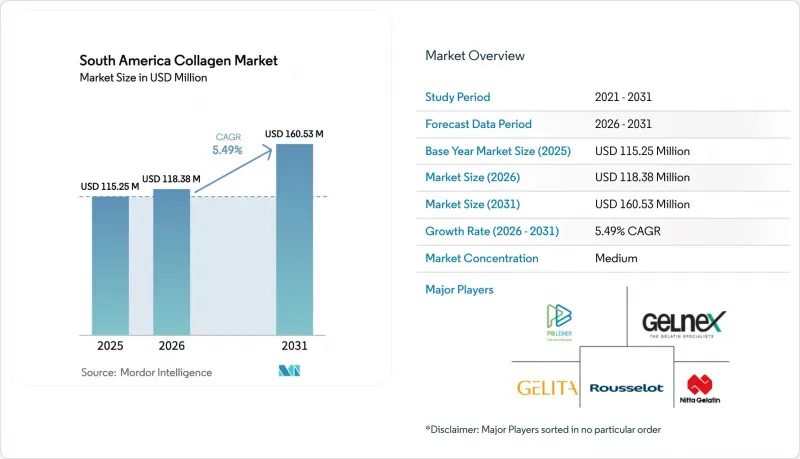
本報告按原料(動物源性和海洋源性)、形態(粉末和液體)、應用領域(食品飲料、膳食補充劑、個人護理和化妝品、藥品、動物飼料)以及地區(巴西、阿根廷和其他南美國家)進行細分。市場預測以美元計價。
南美洲膠原蛋白市場趨勢與洞察
消費者對富含蛋白質的機能性食品和飲料的需求日益成長。
聖保羅和布宜諾斯艾利斯的都市區消費者越來越認知到膠原蛋白是一種便捷的蛋白質來源,它不僅富含宏量營養素,還具有關節支持和皮膚保濕等功能性益處。這一趨勢與拉丁美洲「隨時隨地營養」的趨勢相符。在巴西,機能飲料市場正經歷兩位數的成長,這主要得益於製造商將水解膠原蛋白肽添加到面向忙碌商務人士的即飲產品中。 GELITA 提供「RTE-JELLY」和「RTE-DRINK」等產品,這些產品可快速溶解於冷飲中。這項創新技術使品牌能夠在不影響感官品質的前提下,增強果汁、冰沙和運動飲料的功能性。除了飲料領域,烘焙產品和點心棒也蘊藏著巨大的成長潛力。在這些產品中添加膠原蛋白胜肽不僅可以改善口感和水分保持,還有助於滿足每日蛋白質攝取量目標。 Lucero 的「Peptan」品牌產品在其巴西工廠生產,凸顯了該成分的高生物利用度。攝取的膠原蛋白肽中約有57%會在數小時內轉化為遊離胺基酸,43%會轉化為二肽和三肽。這使得膠原蛋白成為極其高效的蛋白質來源,尤其適用於運動營養產品和代餐食品。膠原蛋白兼具宏量營養素和生物活性成分的雙重功能,使其區別於常見的乳清蛋白和大豆蛋白,也因此在機能性食品市場中擁有較高的價格。
膠原蛋白營養補充品的廣泛應用
巴西和阿根廷的消費者擴大透過藥局和電商平台購買膠原蛋白補充劑。推動這一成長的主要因素是宣傳膠原蛋白益處的宣傳活動,例如改善皮膚彈性、強健指甲和提升關節舒適度。 Europharma 於 2021 年推出了其補充劑“Fortis”,每月面向超過 40 萬名醫生。該公司將這款非處方產品作為治療關節炎和軟骨軟化症的處方級解決方案進行銷售。 Europharma 已在巴西國內市場佔有了一席之地,該市場年銷售額約為 2.4 億雷亞爾,併計劃在三年內實現 4,500 萬雷亞爾(約 900 萬美元)的銷售額。 2024 年 2 月,巴西製造商 GelcoPEP 在一項隨機、單盲、安慰劑對照試驗中證實了水解膠原蛋白(I 型和 III 型)的功效。一項研究發現,連續180天每日服用10克膠原蛋白的受試者,指甲強度增加了88%,掉髮減少了78%。相較之下,安慰劑組在這兩項指標的改善率僅47%。這項臨床證據不僅支持了產品的市場宣傳,還有助於與私人醫療保險公司就保險膠原蛋白範圍進行談判,這可能會加速中等收入消費者對該產品的需求。此外,阿根廷2024號決議於2024年8月生效,正式批准膠原蛋白和水解膠原膠原蛋白作為膳食補充劑的合格成分,符合《阿根廷食品法典》(Codigo Alimentario Argentino)的規定。該決議消除了先前限制產品上市的監管模糊之處。
醫用級和食品膠原蛋白均需經過嚴格的監管批准。
2023年3月,巴西國家衛生監督局(ANVISA)根據其第751/2022號法規,建立了膠原蛋白醫療設備分級風險分類系統。植入式或全身可吸收產品被歸類為III類或IV類,需要上市許可、詳細的技術文件、生物相容性測試和良好生產規範(GMP)認證,所有這些都必須通過現場審核進行檢驗。 III類和IV類醫療設備的核准有效期為10年,但需要透過提交最新的臨床證據進行續期,這將為製造商帶來持續的成本。在巴西沒有法人資格的外國製造商必須在巴西指定一名註冊官員。該註冊官員承擔更多行政職責,包括管理技術文件、確保標籤使用葡萄牙語以及監督上市後監管。 2024年,阿根廷國家藥品醫療器材管理局(ANMAT)簡化了I類和II類醫療設備的進口程序。然而,高風險膠原蛋白產品仍需要數月的漫長審查期。 2025年11月,Senasa第859/2025號決議修訂了膠原蛋白和明膠的定義,使其符合歐洲藥典和美國藥典的標準。雖然這項變更將簡化出口認證流程,但國內生產商需要修改產品配方並重新貼標,以符合更新後的規範。因此,醫用膠原蛋白從研發到上市將延遲12至24個月,這將阻礙中小企業將其應用於製藥和再生醫學領域。
細分市場分析
預計到2025年,動物源膠原膠原蛋白將佔南美市場銷售額的65.21%,凸顯了該地區與全球牛肉和豬肉供應鏈的深度融合。 2024年,巴西和阿根廷合計加工了超過320萬噸牛肉,生產出諸如皮、骨和結締組織等產品特定成分,這些成分對於明膠和膠原蛋白的提取至關重要。然而,海鮮膠原蛋白正以7.89%的複合年成長率快速成長,養殖魚皮因其對「更純淨」肽的需求而日益受到消費者的青睞。坦巴廷加魚明膠的硬度高達263布魯姆,已被證明適用於軟糖和膠囊的生產。永續性認證和魚素飲食的日益普及正在推動高階水產品消費,為南美洲膠原蛋白市場帶來了光明的前景。
豬膠原膠原蛋白在動物性產品中佔據著獨特的地位,其使用受到某些消費群組宗教飲食限制的影響。儘管如此,其優異的氨基酸組成和凝膠強度使其成為藥用膠囊的首選材料。 2024年3月,繼薩爾瓦多和美國之後,英國批准從巴西進口豬明膠和膠原蛋白。薩爾瓦多和美國此前已於同年稍早批准了進口。此舉可能導致供應轉向更高價值的國際市場,並減少國內供應。阿根廷國家農業技術研究所(INTA)正在推動一項生物活性胜肽項目,旨在從肉類中提取膠原蛋白。預計到2025年,該計畫的技術成熟度將達到4-5級,這體現了公共部門致力於將普通產品提升為功能性成分的努力。雖然海洋膠原膠原蛋白對於價格敏感型消費者來說價格極其昂貴(通常比牛蛋白貴 200-300%),但它卻能為那些重視純度和永續性,並且願意為此支付合理價格的富裕都市區消費者提供差異化優勢。
其他好處:
- Excel格式的市場預測(ME)表
- 3個月的分析師支持
目錄
第1章:引言
- 研究假設和市場定義
- 調查範圍
第2章:調查方法
第3章執行摘要
第4章 市場狀況
- 市場概覽
- 市場促進因素
- 消費者對富含蛋白質的機能性食品和飲料的需求日益成長。
- 膠原蛋白營養補充品的廣泛應用
- 化妝品和個人護理市場越來越關注抗衰老活性成分。
- 牛和魚類產品的種類繁多,降低了原料成本。
- 注射型膠原蛋白在再生醫學的新應用
- 生物經濟支持措施,以有效利用農業和工業廢棄物
- 市場限制因素
- 醫用級和食品膠原蛋白均需經過嚴格的監管批准。
- 過度依賴進口高性能膠原蛋白
- 低收入群體對價格的敏感度
- 採購和加工優質膠原蛋白原料高成本。
- 供應鏈分析
- 監理展望
- 波特五力模型
第5章 市場規模與成長預測
- 來源
- 動物源性
- 海洋來源
- 按形式
- 粉末
- 液體
- 透過使用
- 食品/飲料
- 營養補充品
- 個人護理化妝品
- 製藥
- 動物飼料
- 按地區
- 巴西
- 阿根廷
- 其他南美國家
第6章 競爭情勢
- 市場集中度
- 策略趨勢
- 市場排名分析
- 公司簡介
- Rousselot(Darling Ingredients)
- Gelita AG
- PB Leiner(Tessenderlo Group)
- Nitta Gelatin Inc.
- Gelnex
- JBS SA(Novaprom)
- Weishardt Group
- Nippi Inc.
- Collagen Solutions Plc
- Amicogen Inc.
- Giant Nutrition SA
- Connoils LLC
- Nutripeptin SA
- GelcoPEP
- BioCell Technology LLC
- Taia Gelatina SAS
- Italgel Srl
- Lapi Gelatine SpA
- Titan Biotech Ltd.
- Lonza Group AG
第7章 市場機會與未來展望
According to Mordor Intelligence, South America collagen market size is valued at USD 118.38 million in 2026, growing from the 2025 value of USD 115.25 million, and is forecast to reach USD 160.53 billion by 2031, at a 5.49% CAGR over 2026-2031.
This report is Segmented by Source (Animal-Based and Marine-Based), Form (Powder and Liquid), Application (Food and Beverages, Dietary Supplements, Personal Care and Cosmetics, Pharmaceuticals, and Animal Nutrition), and Geography (Brazil, Argentina, and the Rest of South America). The Market Forecasts are Provided in Terms of Value (USD).
South America Collagen Market Trends and Insights
Growing Demand for Protein-Rich Functional Foods and Beverages
Urban consumers in Sao Paulo and Buenos Aires are increasingly identifying collagen as a convenient protein source that provides both macronutrient density and functional benefits, such as joint support and skin hydration. This trend aligns with the broader Latin American shift toward on-the-go nutrition. In Brazil, the functional beverage segment has achieved double-digit growth, driven by manufacturers incorporating hydrolyzed collagen peptides into ready-to-drink formats that cater to busy professionals. GELITA offers products like RTE-JELLY and RTE-DRINK, which dissolve rapidly in cold liquids. This innovation enables brands to enhance juices, smoothies, and sports drinks without compromising their sensory qualities. Beyond beverages, bakery items, and snack bars present a growing opportunity. Collagen peptides in these products not only improve texture and moisture retention but also contribute to meeting daily protein requirements. Rousselot's Peptan brand, produced at its Brazilian facility, emphasizes the ingredient's bioavailability. Approximately 57% of consumed collagen peptides convert into free amino acids, while 43% transform into di- and tri-peptides within hours. This positions collagen as a highly efficient protein source, particularly for sports nutrition and meal-replacement products. Collagen's dual functionality, combining macronutrient and bioactive properties, sets it apart from standard whey or soy proteins, supporting its premium pricing in the functional food market.
Rising Adoption of Collagen-Based Nutraceutical Supplements
Consumers in Brazil and Argentina are increasingly purchasing collagen supplements through pharmacies and e-commerce platforms. This growth is primarily driven by awareness campaigns emphasizing collagen's benefits, such as improved skin elasticity, stronger nails, and enhanced joint comfort. Eurofarma launched its Fortice supplement in 2021, targeting over 400,000 doctors monthly. The company markets the over-the-counter product as a prescription-like solution for arthritis and chondromalacia. Eurofarma aims to generate BRL 45 million (USD 9 million) in revenue within three years, establishing a niche in Brazil's domestic market, which is valued at approximately BRL 240 million annually. In February 2024, Brazilian producer GelcoPEP demonstrated the effectiveness of hydrolyzed collagen (types I and III) in a randomized, single-blind, placebo-controlled trial. Participants who consumed 10 grams daily for 180 days reported an 88% improvement in nail resistance and a 78% reduction in hair loss, compared to 47% for both outcomes in the placebo group. This clinical evidence not only supports marketing claims but also aids reimbursement discussions with private health insurers, potentially accelerating adoption among middle-income consumers. In a key regulatory development, Argentina's Resolution 2/2024, effective August 2024, officially approved collagen and hydrolyzed collagen as permissible ingredients in dietary supplements under the Codigo Alimentario Argentino. This decision resolves previous regulatory ambiguities that had limited product launches.
Stringent Regulatory Approvals for Medical and Food-Grade Collagen
In March 2023, ANVISA's RDC 751/2022 established a tiered risk classification system for collagen-based medical devices. Implantable or systemically absorbed products are classified as Class III or IV, requiring marketing authorization, detailed technical dossiers, biocompatibility testing, and Good Manufacturing Practices certification, which must be verified through on-site audits. Approvals for Class III and IV devices remain valid for 10 years but must be renewed with updated clinical evidence, resulting in recurring costs for manufacturers. Foreign manufacturers without a legal entity in Brazil are required to appoint a Brazil Registration Holder. This entity handles technical file management, ensures labeling in Portuguese, and oversees post-market surveillance, increasing administrative responsibilities. In 2024, Argentina's ANMAT simplified import procedures for Class I and II medical devices. However, higher-risk collagen products still face lengthy review timelines of several months. In November 2025, Senasa's Resolution 859/2025 revised the definitions of collagen and gelatin to align with European Pharmacopoeia and USP standards. While this change facilitates export certification, it also requires domestic producers to reformulate or re-label their products to meet the updated specifications. As a result, medical-grade collagen now faces a 12-to-24-month delay from development to market entry, discouraging smaller firms from pursuing pharmaceutical or regenerative medicine applications.
Other drivers and restraints analyzed in the detailed report include:
- Expanding Cosmetics and Personal-Care Focus on Anti-Aging Actives
- Emerging Use of Injectable Collagen in Regenerative Medicine
- High Costs of Sourcing and Processing High-Quality Collagen Raw Materials
For complete list of drivers and restraints, kindly check the Table Of Contents.
Segment Analysis
In 2025, animal-based collagen led South America's market, accounting for 65.21% of the revenue, highlighting the region's strong integration into global beef and pork supply chains. In 2024, Brazil and Argentina together processed over 3.2 million tonnes of beef, generating by-products such as hides, bones, and connective tissues essential for gelatin and collagen extraction. However, marine collagen is growing rapidly, with a 7.89% CAGR, as aquaculture skins appeal to consumers seeking "cleaner" peptides. Tambatinga fish gelatin, with an impressive 263 Bloom strength, has proven its viability for gummies and capsules. The increasing popularity of sustainability labels and pescatarian diets is driving premium spending on marine products, signaling a positive outlook for South America's collagen market.
Porcine collagen occupies a niche within the animal-based segment, limited by religious dietary restrictions in certain consumer groups. Nevertheless, its valued amino acid profile and gel strength make it a preferred option for pharmaceutical capsules. In March 2024, the UK approved imports of Brazilian porcine gelatin and collagen, joining El Salvador and the US, which had granted approvals earlier that year. This development could shift supplies toward higher-value international markets, potentially reducing domestic availability. Argentina's Instituto Nacional de Tecnologia Agropecuaria (INTA) has advanced a bioactive peptides project to extract collagen from meat by-products. By 2025, the project reached a technology readiness level of 4-5, reflecting public-sector efforts to upgrade commodity by-products into functional ingredients. Although marine collagen's premium pricing-often 200-300% higher than bovine alternatives-limits its reach in price-sensitive segments, it serves as a differentiation tool for brands targeting affluent urban consumers who are willing to pay for perceived purity and sustainability.
Complete Report Scope:
- By Source
- Animal-based
- Marine-based
- By Form
- Powder
- Liquid
- By Application
- Food and Beverages
- Dietary Supplements
- Personal Care and Cosmetics
- Pharmaceuticals
- Animal Nutrition
- By Geography
- Brazil
- Argentina
- Rest of South America
List of Companies Covered in this Report:
- Rousselot (Darling Ingredients)
- Gelita AG
- PB Leiner (Tessenderlo Group)
- Nitta Gelatin Inc.
- Gelnex
- JBS S.A. (Novaprom)
- Weishardt Group
- Nippi Inc.
- Collagen Solutions Plc
- Amicogen Inc.
- Giant Nutrition S.A.
- Connoils LLC
- Nutripeptin SA
- GelcoPEP
- BioCell Technology LLC
- Taia Gelatina SAS
- Italgel S.r.l.
- Lapi Gelatine S.p.A.
- Titan Biotech Ltd.
- Lonza Group AG
Additional Benefits:
- The market estimate (ME) sheet in Excel format
- 3 months of analyst support
TABLE OF CONTENTS
1 INTRODUCTION
- 1.1 Study Assumptions and Market Definition
- 1.2 Scope of the Study
2 RESEARCH METHODOLOGY
3 EXECUTIVE SUMMARY
4 MARKET LANDSCAPE
- 4.1 Market Overview
- 4.2 Market Drivers
- 4.2.1 Growing Demand for Protein-Rich Functional Foods and Beverages
- 4.2.2 Rising Adoption of Collagen-Based Nutraceutical Supplements
- 4.2.3 Expanding Cosmetics and Personal-Care Focus on Anti-Aging Actives
- 4.2.4 Abundant Bovine and Fish By-Products Lowering Raw-Material Costs
- 4.2.5 Emerging Use of Injectable Collagen in Regenerative Medicine
- 4.2.6 Bio-Economy Incentives for Valorising Agro-Industrial Waste
- 4.3 Market Restraints
- 4.3.1 Stringent Regulatory Approvals for Medical and Food-Grade Collagen
- 4.3.2 Heavy Reliance on Imports for Advanced Collagen
- 4.3.3 Price Sensitivity Among Lower-Income Groups
- 4.3.4 High Costs of Sourcing and Processing High-Quality Collagen Raw Materials
- 4.4 Supply Chain Analysis
- 4.5 Regulatory Outlook
- 4.6 Porter's Five Forces
- 4.6.1 Threat of New Entrants
- 4.6.2 Bargaining Power of Buyers/Consumers
- 4.6.3 Bargaining Power of Suppliers
- 4.6.4 Threat of Substitute Products
- 4.6.5 Intensity of Competitive Rivalry
5 MARKET SIZE AND GROWTH FORECAST (VALUE)
- 5.1 By Source
- 5.1.1 Animal-based
- 5.1.2 Marine-based
- 5.2 By Form
- 5.2.1 Powder
- 5.2.2 Liquid
- 5.3 By Application
- 5.3.1 Food and Beverages
- 5.3.2 Dietary Supplements
- 5.3.3 Personal Care and Cosmetics
- 5.3.4 Pharmaceuticals
- 5.3.5 Animal Nutrition
- 5.4 By Geography
- 5.4.1 Brazil
- 5.4.2 Argentina
- 5.4.3 Rest of South America
6 COMPETITIVE LANDSCAPE
- 6.1 Market Concentration
- 6.2 Strategic Moves
- 6.3 Market Ranking Analysis
- 6.4 Company Profiles (includes Global-level Overview, Market-level Overview, Core Segments, Financials (if available), Strategic Information, Market Rank/Share, Products and Services, Recent Developments)
- 6.4.1 Rousselot (Darling Ingredients)
- 6.4.2 Gelita AG
- 6.4.3 PB Leiner (Tessenderlo Group)
- 6.4.4 Nitta Gelatin Inc.
- 6.4.5 Gelnex
- 6.4.6 JBS S.A. (Novaprom)
- 6.4.7 Weishardt Group
- 6.4.8 Nippi Inc.
- 6.4.9 Collagen Solutions Plc
- 6.4.10 Amicogen Inc.
- 6.4.11 Giant Nutrition S.A.
- 6.4.12 Connoils LLC
- 6.4.13 Nutripeptin SA
- 6.4.14 GelcoPEP
- 6.4.15 BioCell Technology LLC
- 6.4.16 Taia Gelatina SAS
- 6.4.17 Italgel S.r.l.
- 6.4.18 Lapi Gelatine S.p.A.
- 6.4.19 Titan Biotech Ltd.
- 6.4.20 Lonza Group AG
7 MARKET OPPORTUNITIES AND FUTURE OUTLOOK

 全球膠原蛋白市場,2026-2030年
 2026年重組人源化膠原膠原蛋白全球市場報告
 印度膠原蛋白:市場佔有率分析、產業趨勢與統計及成長預測(2026-2031)英國膠原蛋白:市佔率分析、產業趨勢與統計及成長預測(2026-2031)亞太地區膠原蛋白:市佔率分析、產業趨勢與統計及成長預測(2026-2031)歐洲膠原蛋白:市場佔有率分析、產業趨勢與統計及成長預測(2026-2031)
 無端肽膠原蛋白市場規模、佔有率和成長分析:按原料、純化形式、應用、最終用戶和地區分類-2026-2033年產業預測
 膠原蛋白市場:2026-2032年全球市場預測(依膠原蛋白類型、原料、形態、萃取製程、等級、應用及銷售管道)
 膠原蛋白市場-全球產業規模、佔有率、趨勢、機會與預測:按產品、原料、應用、地區和競爭格局分類,2021-2031年
 植物來源膠原蛋白市場:依原料、產品類型、應用、功能、通路和地區分類。