

 |
市場調查報告書
商品編碼
2113233
亞太地區膠原蛋白:市佔率分析、產業趨勢與統計及成長預測(2026-2031)Asia Pacific Collagen - Market Share Analysis, Industry Trends & Statistics, Growth Forecasts (2026 - 2031) |
||||||

※ 本網頁內容可能與最新版本有所差異。詳細情況請與我們聯繫。
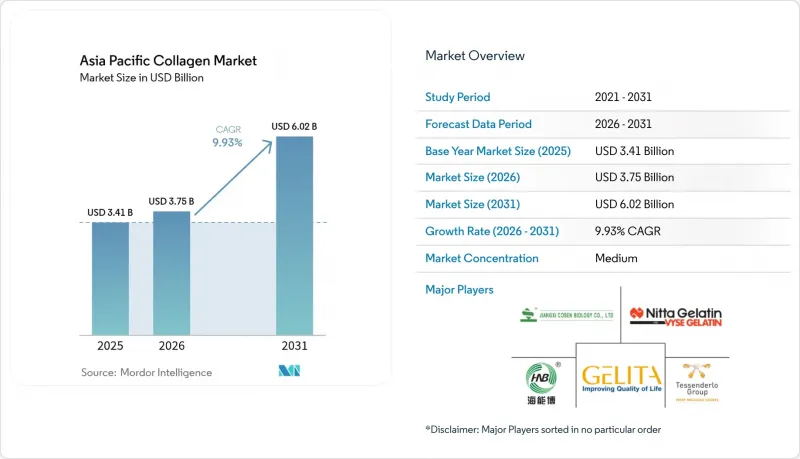
據 Mordor Intelligence 稱,2025 年亞太地區膠原蛋白市值為 34.1 億美元,預計到 2031 年將從 2026 年的 37.5 億美元成長至 60.2 億美元,預測期(2026-2031 年)複合年成長率為 9.93%。
本報告按原料(動物源性、海洋源性)、最終用戶/應用(食品飲料、膳食補充劑、個人護理及化妝品、藥品、動物飼料)和地區(日本、中國、印度、澳洲及其他亞太地區)進行細分。市場預測以美元計價。
亞太地區膠原蛋白市場趨勢及洞察。
消費者對健康和保健產品的需求日益成長
隨著全部區域健康經濟的持續擴張,膠原蛋白在功能性營養領域的應用日益廣泛,其用途已超越了傳統的美容領域。此外,該地區的人均收入預計將顯著成長,從2024年的17,440美元增至2029年的23,260美元。經濟成長推動了對預防性醫療保健的投資,為高階膠原蛋白產品的蓬勃發展奠定了堅實的基礎。這些產品旨在解決關節健康、皮膚彈性和骨骼密度等關鍵健康問題。消費者越來越願意為有可靠科學根據的膠原蛋白配方支付更高的價格。這一趨勢為能夠透過同行評審的研究有效證明其產品臨床功效並確保符合監管健康標籤要求的供應商帶來了巨大的利潤空間。
老齡化社會正在尋求關節護理解決方案。
在亞太地區已開發市場人口結構發生顯著變化的背景下,針對關節保健的膠原蛋白產品需求持續穩定成長。根據世界銀行2024年的數據,日本65歲以上人口占總人口的30%。日本是一個高度老化的社會,已成為測試和開發創新解決方案的關鍵市場。例如,樂敦製藥的「MOCOLA」品牌,憑藉其獨特的20毫升膠原蛋白飲料和維生素片組合,有效滿足了老年消費者的偏好。這種模式凸顯了產品形態創新在應對高齡化社會的重要性。除日本外,中國和韓國也出現了類似的趨勢,嬰兒潮世代逐漸老化,成為市場成長的主要驅動力。這些消費者擁有大量財富,高度重視健康和保健,並推動了高階市場的發展。這些地區對臨床有效的關節保健產品的需求表明,滿足這一人群的特定需求日益重要。
來自其他蛋白質的競爭
像Rawga這樣的公司正在透過開發VC-H1——一種從植物細胞壁延伸蛋白中提取的植物膠原膠原蛋白——推動膠原蛋白來源的重大創新。該產品旨在複煞車物膠原蛋白的三肽結構和分子量,提供了與天然膠原蛋白高度相似的植物來源替代品。同時,贏創透過在生物技術領域的巨額投資和創新,在精準發酵技術領域取得了顯著進展。這些努力正在創造可擴展且永續的傳統膠原蛋白替代品,以應對人們日益成長的對環境影響和飲食限制的擔憂。此外,這些技術在大規模應用時可望降低生產成本,使其具有經濟可行性。因此,傳統的膠原蛋白供應商面臨越來越大的應對壓力。他們正致力於透過強調更高的生物利用度、確保臨床療效證據以及針對特定應用來使產品差異化。這些方面凸顯了天然膠原蛋白的獨特優勢,特別是其複雜的基質特性,而這些特性尚未被合成替代品完全複製。
細分市場分析
預計到2031年,海洋來源膠原膠原蛋白的複合年成長率將達到10.28%,並在2025年超過目前市場領先的動物來源膠原蛋白62.55%的市場佔有率。這反映出消費者偏好正轉向永續和低致敏性替代品。根據佛羅裡達大學IFAS EDIS的數據,泰聯集團對海洋來源膠原膠原蛋白的投資及其對循環經濟的承諾表明,海鮮產業的這一產品領域在解決永續性問題的同時,也創造了增值收入來源。動物來源膠原膠原蛋白憑藉其成熟的價值鏈和成本優勢,在功能性優勢超過永續性溢價的、價格敏感型市場領域,仍佔據主導地位。
海洋膠原蛋白產業受益於魚皮加工和去細胞技術的進步,與牛和豬源膠原蛋白相比,這些技術提高了生物利用度並降低了致敏性。在印尼和馬來西亞等穆斯林人口眾多的市場,由於疾病傳播風險較低且宗教飲食限制較少,法律規範越來越傾向於使用海洋來源的原料。然而,受捕撈法規和季節性供應條件的影響,海洋膠原蛋白面臨供應鏈的限制,導致價格波動,與供應更穩定的動物源膠原蛋白相比,其在大眾市場的滲透率較低。
其他好處:
- Excel格式的市場預測(ME)表
- 3個月的分析師支持
目錄
第1章:引言
- 研究假設和市場定義
- 調查範圍
第2章:調查方法
第3章執行摘要
第4章 市場狀況
- 市場概覽
- 市場促進因素
- 消費者對健康和保健產品的需求日益成長,
- 社會老化加劇了人們對關節護理解決方案的擔憂。
- 拓展應用範圍至抗老乳霜及其他美容產品。
- 萃取、加工和配方方面的技術進步。
- 向永續海洋膠原蛋白蛋白原料過渡
- 研究和生產創新的進展
- 市場限制因素
- 替代蛋白的競爭
- 嚴格的監管合規和認證要求
- 對過敏原和宗教飲食限制的擔憂
- 採購和加工優質膠原蛋白原料的成本很高。
- 供應鏈分析
- 監理展望
- 波特五力模型
第5章 市場規模與成長預測
- 來源
- 動物源性
- 海洋來源
- 最終用戶/特定應用程式
- 食品/飲料
- 營養補充品
- 個人護理化妝品
- 製藥
- 動物飼料
- 按地區
- 日本
- 中國
- 印度
- 澳洲
- 其他亞太國家
第6章 競爭情勢
- 市場集中度
- 策略趨勢
- 市場排名分析
- 公司簡介
- Gelita AG
- Rousselot/Peptan
- Nitta Gelatin Inc.
- Darling Ingredients
- Thai Union Ingredients
- Nestle Health Science(Vital Proteins)
- TCI Co. Ltd.
- Titan Biotech Ltd.
- Hangzhou Nutrition Biotechnology
- Shiseido Co. Ltd.
- AmorePacific Corp.
- Weishardt Group
- Cargill-Beauty & Health Solutions
- Ori Bionature(Malaysia)
- Nature's Bounty(Co. of The Bountiful Co.)
- Optimum Nutrition(Glambia)
- GNC Holdings
- The Clorox Company(NeoCell)
- Verisol/Gelita brand
- Collagen Solutions plc
第7章 市場機會與未來展望
According to Mordor Intelligence, the Asia Pacific collagen market size was valued at USD 3.41 billion in 2025 and estimated to grow from USD 3.75 billion in 2026 to reach USD 6.02 billion by 2031, at a CAGR of 9.93% during the forecast period (2026-2031).
This report is Segmented by Source (Animal-Based, Marine-Based), End User/Application (Food & Beverages, Dietary Supplements, Personal Care & Cosmetics, Pharmaceuticals, Animal Nutrition), and Geography (Japan, China, India, Australia, Rest of Asia Pacific). The Market Forecasts are Provided in Terms of Value (USD).
Asia Pacific Collagen Market Trends and Insights
Increasing Consumer Demand for Health and Wellness Products
As the wellness economy continues to expand across the Asia Pacific region, collagen is increasingly being utilized in functional nutrition, extending its applications beyond traditional beauty-related uses. Furthermore, per capita income in the region is expected to grow significantly, rising from USD 17,440 in 2024 to a projected USD 23,260 by 2029. This economic growth is driving a shift toward preventive health investments, creating a strong foundation for the adoption of premium collagen products. These products are specifically designed to address key health concerns such as joint health, skin elasticity, and bone density maintenance. Consumers are demonstrating a growing willingness to pay higher prices for collagen formulations that are supported by robust scientific evidence. This trend offers substantial margin expansion opportunities for suppliers who can effectively demonstrate the clinical efficacy of their products through peer-reviewed research and ensure compliance with regulatory health claims.
Ageing Population Seeking Joint-Care Solutions
As developed APAC markets experience significant demographic shifts, the demand for joint-care collagen applications continues to grow steadily. According to the World Bank data from 2024, 30% of people in Japan were above the age of 65. Japan, characterized by its advanced aging society, serves as a pivotal market for testing and developing innovative solutions. For instance, Rohto Pharmaceutical's MOCOLA brand has introduced a unique combination of 20ml collagen drinks and vitamin tablets, effectively addressing the consumption preferences of elderly consumers. This approach highlights the importance of format innovation in catering to the aging population. Beyond Japan, similar trends are emerging in China and South Korea, where aging baby boomers are becoming key drivers of market growth. These consumers, equipped with substantial accumulated wealth and a strong focus on health and wellness, are fostering the development of premium market segments. The demand for clinically-validated joint health formulations in these regions underscores the growing importance of addressing the specific needs of this demographic group.
Competition from Alternative Proteins
Companies like Rawga are driving significant innovation in collagen sourcing by developing VC-H1, a vegetable collagen derived from plant cell wall extensin. This product is specifically designed to replicate the tripeptide structure and molecular weight of animal collagen, offering a plant-based alternative that closely mimics its natural counterpart. At the same time, Evonik is making strides in precision fermentation through substantial investments and advancements in biotechnology. These efforts are creating scalable and sustainable alternatives to traditional collagen, addressing growing concerns about environmental impact and dietary restrictions. Additionally, these technologies hold the potential to reduce production costs when implemented at scale, making them economically viable. Consequently, traditional collagen suppliers are facing mounting pressure to adapt. They are focusing on differentiating their offerings by emphasizing superior bioavailability, securing clinical validation, and targeting specialized applications. These areas highlight the unique advantages of natural collagen, particularly its complex matrix properties, which synthetic alternatives have yet to fully replicate.
Other drivers and restraints analyzed in the detailed report include:
- Rising Applications in Anti-Aging Creams and Other Beauty Products
- Technological Advancements in Extraction, Processing, and Formulation
- Stringent Regulatory Compliance and Certification Requirements
For complete list of drivers and restraints, kindly check the Table Of Contents.
Segment Analysis
Marine-based collagen accelerates at a 10.28% CAGR through 2031, outpacing the animal-based segment's market-leading 62.55% share in 2025, reflecting consumer preference shifts toward sustainable and hypoallergenic alternatives. Thai Union's marine collagen investments and circular economy initiatives demonstrate how fishing industry byproducts create value-added revenue streams while addressing sustainability concerns, according to the University of Florida IFAS EDIS. Animal-based collagen maintains dominance through established supply chains and cost advantages, particularly in price-sensitive market segments where functional benefits outweigh sustainability premiums.
The marine collagen segment benefits from technological advances in fish skin processing and decellularization techniques that enhance bioavailability while reducing allergenicity risks compared to bovine and porcine alternatives. Regulatory frameworks increasingly favor marine sources due to lower disease transmission risks and reduced religious dietary restrictions, particularly in Muslim-majority markets like Indonesia and Malaysia. However, marine collagen faces supply chain constraints from fishing industry regulations and seasonal availability, creating price volatility that limits mass-market penetration compared to consistently available animal-based alternatives.
Complete Report Scope:
- By Source
- Animal-based
- Marine-based
- By End User / Application
- Food & Beverages
- Dietary Supplements
- Personal Care & Cosmetics
- Pharmaceuticals
- Animal Nutrition
- By Geography
- Japan
- China
- India
- Australia
- Rest of Asia Pacific
List of Companies Covered in this Report:
- Gelita AG
- Rousselot / Peptan
- Nitta Gelatin Inc.
- Darling Ingredients
- Thai Union Ingredients
- Nestle Health Science (Vital Proteins)
- TCI Co. Ltd.
- Titan Biotech Ltd.
- Hangzhou Nutrition Biotechnology
- Shiseido Co. Ltd.
- AmorePacific Corp.
- Weishardt Group
- Cargill - Beauty & Health Solutions
- Ori Bionature (Malaysia)
- Nature's Bounty (Co. of The Bountiful Co.)
- Optimum Nutrition (Glambia)
- GNC Holdings
- The Clorox Company (NeoCell)
- Verisol / Gelita brand
- Collagen Solutions plc
Additional Benefits:
- The market estimate (ME) sheet in Excel format
- 3 months of analyst support
TABLE OF CONTENTS
1 INTRODUCTION
- 1.1 Study Assumptions & Market Definition
- 1.2 Scope of the Study
2 RESEARCH METHODOLOGY
3 EXECUTIVE SUMMARY
4 MARKET LANDSCAPE
- 4.1 Market Overview
- 4.2 Market Drivers
- 4.2.1 Increasing consumer demand for health and wellness products,
- 4.2.2 Ageing population seeking joint-care solutions
- 4.2.3 Rising Applications in Anti-Aging Creams and Other Beauty Products
- 4.2.4 Technological advancements in extraction, processing, and formulation
- 4.2.5 Shift toward sustainable marine collagen sources
- 4.2.6 Rising Innovation in research and production
- 4.3 Market Restraints
- 4.3.1 Competition from alternative proteins
- 4.3.2 Stringent regulatory compliance and certification requirements
- 4.3.3 Concerns over allergenicity and religious dietary restrictions
- 4.3.4 High costs of sourcing and processing high-quality collagen raw materials
- 4.4 Supply Chain Analysis
- 4.5 Regulatory Outlook
- 4.6 Porter's Five Forces
- 4.6.1 Threat of New Entrants
- 4.6.2 Bargaining Power of Buyers/Consumers
- 4.6.3 Bargaining Power of Suppliers
- 4.6.4 Threat of Substitute Products
- 4.6.5 Intensity of Competitive Rivalry
5 MARKET SIZE AND GROWTH FORECAST
- 5.1 By Source
- 5.1.1 Animal-based
- 5.1.2 Marine-based
- 5.2 By End User / Application
- 5.2.1 Food & Beverages
- 5.2.2 Dietary Supplements
- 5.2.3 Personal Care & Cosmetics
- 5.2.4 Pharmaceuticals
- 5.2.5 Animal Nutrition
- 5.3 By Geography
- 5.3.1 Japan
- 5.3.2 China
- 5.3.3 India
- 5.3.4 Australia
- 5.3.5 Rest of Asia Pacific
6 COMPETITIVE LANDSCAPE
- 6.1 Market Concentration
- 6.2 Strategic Moves
- 6.3 Market Ranking Analysis
- 6.4 Company Profiles (includes Global-level Overview, Market-level Overview, Core Segments, Financials (if available), Strategic Information, Market Rank/Share, Products & Services, Recent Developments)
- 6.4.1 Gelita AG
- 6.4.2 Rousselot / Peptan
- 6.4.3 Nitta Gelatin Inc.
- 6.4.4 Darling Ingredients
- 6.4.5 Thai Union Ingredients
- 6.4.6 Nestle Health Science (Vital Proteins)
- 6.4.7 TCI Co. Ltd.
- 6.4.8 Titan Biotech Ltd.
- 6.4.9 Hangzhou Nutrition Biotechnology
- 6.4.10 Shiseido Co. Ltd.
- 6.4.11 AmorePacific Corp.
- 6.4.12 Weishardt Group
- 6.4.13 Cargill - Beauty & Health Solutions
- 6.4.14 Ori Bionature (Malaysia)
- 6.4.15 Nature's Bounty (Co. of The Bountiful Co.)
- 6.4.16 Optimum Nutrition (Glambia)
- 6.4.17 GNC Holdings
- 6.4.18 The Clorox Company (NeoCell)
- 6.4.19 Verisol / Gelita brand
- 6.4.20 Collagen Solutions plc
7 MARKET OPPORTUNITIES AND FUTURE OUTLOOK

 2026年重組人源化膠原膠原蛋白全球市場報告
 無端肽膠原蛋白市場規模、佔有率和成長分析:按原料、純化形式、應用、最終用戶和地區分類-2026-2033年產業預測
 膠原蛋白市場:2026-2032年全球市場預測(依膠原蛋白類型、原料、形態、萃取製程、等級、應用及銷售管道)
 膠原蛋白市場-全球產業規模、佔有率、趨勢、機會與預測:按產品、原料、應用、地區和競爭格局分類,2021-2031年
 植物來源膠原蛋白市場:依原料、產品類型、應用、功能、通路和地區分類。
 2026-2034年全球去端肽膠原市場規模、佔有率、趨勢和成長分析報告2026年全球膠原蛋白市場報告
 膠原蛋白市場規模、佔有率、趨勢和預測:按原料、產品、應用和地區分類,2026-2034年
 膠原蛋白原料市場規模、佔有率及成長分析(依原料來源、產品類型、應用、形態及地區分類)-產業預測(2026-2033 年)未變性 II 型膠原蛋白市場按來源、形式、劑量、最終用途、分銷管道和應用分類——全球預測,2026-2032 年