


 |
市場調查報告書
商品編碼
2119598
歐洲清算所和結算機構:市場佔有率分析、行業趨勢和統計數據以及成長預測(2026-2031 年)Europe Clearing Houses And Settlements - Market Share Analysis, Industry Trends & Statistics, Growth Forecasts (2026 - 2031) |
||||||

※ 本網頁內容可能與最新版本有所差異。詳細情況請與我們聯繫。
根據 Mordor Intelligence 估計,歐洲清算和結算市場在 2025 年的價值為 2.05 千兆美元,預計到 2031 年將達到 2.24 千兆美元,而 2026 年為 2.08 千兆美元,在預測期(2026-2031 年成長率為 1.52%)。
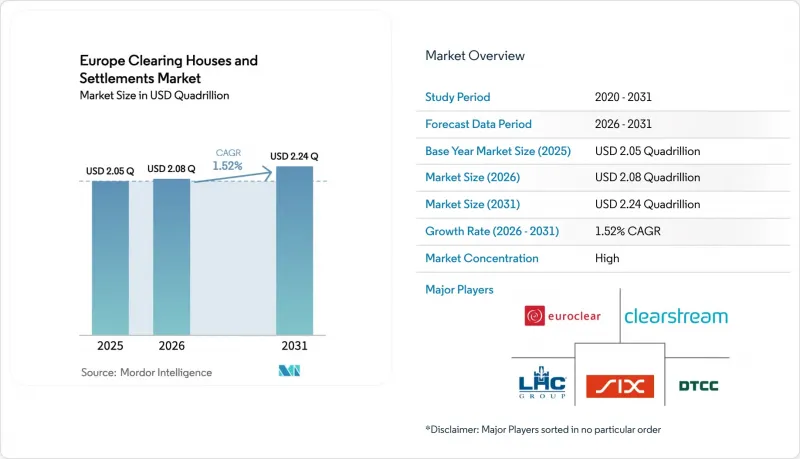
本報告按類型(出境清算所、入境清算所)、服務(TARGET2、SEPA、EBICS 及其他)、參與者類型(銀行、投資和清算仲介、支付服務供應商(PSP) 及其他)以及國家/地區(英國、德國、法國、西班牙、義大利、北歐國家、其他歐洲國家)進行分類。市場預測以美元計價。
歐洲清算和結算市場的趨勢和見解
強制過渡到T+1支付方式將推動基礎設施現代化。
2025年1月,歐洲證券及市場管理局(ESMA)確認,所有歐盟交易所必須在2027年10月11日前採用T+1結算機制。這將是自TARGET2-Securities運作以來規模最大的營運變革。領先的中央證券存管機構Euroclear和Clearstream正投入大量資金以提升直通式處理(STP)能力。這些升級旨在應對結算週期縮短帶來的挑戰。相關人員預計,這些措施將顯著降低結算違約率。特別是,更短的結算週期有望改善流動性管理和營運效率。此外,更短的交易後處理時間將提高抵押品周轉率,為能夠近乎即時地整合保證金和結算的清算機構創造新的商機。隨著這一轉變,買方機構被迫在數小時內實現交易確認自動化,從而加速了整個價值鏈對標準化ISO 20022通訊的需求。
歐洲央行整合 TARGET 服務,提高了跨國效率。
歐元體系抵押品管理系統(ECMS)於2025年6月開始運作,它將各國抵押品池整合到單一平台,並將TARGET服務範圍擴展至丹麥國家銀行,使其能夠處理丹麥克朗(DKK)。即時抵押品流動性取代了先前分散的雙邊協議,使主要銀行的跨境處理成本降低了15%至20%。基於TIPS的即時結算系統現在可以在幾秒鐘內完成歐元(EUR)和丹麥克朗(DKK)的結算,為清算所開闢了一條新的服務線,使其能夠調整日內流動性。歐洲央行的藍圖預計,到2027年將引入歐元區以外的其他貨幣,這可能會導致交易量發生變化,並減少對傳統代理行網路的使用。這項一體化基礎設施也為數位歐元支付奠定了技術基礎,進一步提升了泛歐清算平台的戰略重要性。
對舊有系統的依賴制約了現代化進程。
許多歐洲銀行仍然依賴運行在大型主機上的、已有數十年歷史的 COBOL 核心系統,這使得它們向 ISO 20022 標準的遷移變得複雜,並阻礙了直通式處理 (STP) 效率優勢的發揮。德意志銀行在 2024 年第三季宣布,由於其結算引擎的深度整合問題,其全面過渡將推遲到 2026 年。業內估計表明,與遷移相關的累積成本給二級和三級金融機構帶來了過重的財務負擔。熟練 COBOL 程式設計師的短缺推高了人事費用,延緩了專案完成日期,並帶來了更多營運挑戰。此外,結算機構必須維護雙協定閘道以適應遷移,這削弱了全面採用 ISO 20022 標準所帶來的網路效率優勢。這種雙協議要求凸顯了效率低下的問題,使遷移過程更加複雜,並給金融生態系統內的資源帶來了額外的壓力。
細分市場分析
到2025年,對外清算將佔歐洲清算結算市場佔有率的55.74%,這反映了其在處理大量跨國交易方面所展現出的規模經濟效益。隨著T+1規則下國內結算複雜性的增加,預計對內清算對歐洲清算結算市場規模的貢獻將以7.32%的複合年成長率成長。對外清算提供者可以透過標準化的工作流程和多幣種風險引擎降低邊際處理成本,從而為泛歐交易公司提供具有競爭力的價格。相較之下,對內清算業者即使交易量較低,也能憑藉其對當地法規的熟悉以及在特定資產類別方面的專業知識,證明收取高額費用的合理性。歐洲央行實施的ECMS統一了抵押品工作流程,在一定程度上抵消了對內清算面臨的規模經濟劣勢,同時實現了結合本地服務和跨境業務的混合模式。
客戶對能夠無縫匯總對外和對內風險敞口的整合式風險儀錶板的需求日益成長,促使主要平台供應商推出清算即服務 (CaaS) 模組。目前,技術預算正被分配給人工智慧 (AI) 驅動的預測分析,以識別日內流動性緊張點。由於英國脫歐,對外交易量進一步增加,英國公司紛紛透過歐盟樞紐處理歐元計價的衍生性商品,從而擴大了法蘭克福和巴黎的交易量。同時,北歐對內機構正利用其強大的國內數位化優勢,吸引區域股票和綠色債券清算業務。競爭的前沿正在轉向高價值抵押品最佳化和綜合報告,如果對外和對內機構能夠整合其在這些領域的能力,預計它們將獲得顯著的市場佔有率。
其他好處:
- Excel格式的市場預測(ME)表
- 3個月的分析師支持
目錄
第1章:引言
- 研究假設和市場定義
- 調查範圍
第2章:調查方法
第3章執行摘要
第4章 市場狀況
- 市場概覽
- 市場促進因素
- 歐盟各市場強制過渡到T+1支付週期。
- 歐洲央行主導整合 TARGET 服務,正在促進直接處理。
- 歐洲ETF和衍生性商品交易量的快速成長,使得集中清算成為必要。
- 巴塞爾協議III最後階段的抵押品規則正在促進初始保證金的流入。
- 歐盟分散式帳本技術試點計畫下的基於分散式帳本技術的智慧合約支付試點項目
- 對ESG相關回購和抵押品最佳化服務的需求不斷成長。
- 市場限制因素
- 傳統的 COBOL 核心系統正在延緩 ISO 20022 的採用。
- 歐洲證券及市場管理局(ESMA)的系統重要性測試表明,集中注意力的風險增加。
- 英國脫歐後英國EMIR 3.0與歐盟EMIR 3.0的差異
- 小規模證券結算機構(CSD)實施TARGET即時支付結算系統(TIPS)的成本很高
- 價值供應鏈分析
- 監理情勢
- 技術展望
- 波特五力模型
第5章 市場規模與成長預測
- 按類型
- 對外清算所
- 入境清算機構
- 按服務
- TARGET2
- SEPA
- EBICS
- 其他
- 依參與者類型
- 銀行
- 投資和清算仲介
- 支付服務供應商(PSP)
- 其他
- 按地區
- 英國
- 德國
- 法國
- 西班牙
- 義大利
- 比荷盧經濟聯盟(比利時、荷蘭、盧森堡)
- 北歐國家(丹麥、芬蘭、冰島、挪威、瑞典)
- 其他歐洲國家
第6章 競爭情勢
- 市場集中度
- 策略趨勢
- 市佔率分析
- 公司簡介
- Euroclear
- Clearstream(Deutsche Borse Group)
- LCH Group(London Stock Exchange Group)
- SIX x-clear
- Euronext Securities
- DTCC EuroCCP
- BME Clearing
- Keler CCP
- CC&G(Cassa di Compensazione e Garanzia)
- Eurex Clearing
- ICE Clear Europe
- Nasdaq Clearing
- LME Clear
- Monte Titoli
- Athens Exchange CSD
- EuroCCP NV
- OMX Clearing
- Skandinaviska Enskilda Banken CSD
- CME CE Clearing Europe
第7章 市場機會與未來展望
According to Mordor Intelligence, the European clearing houses and settlements market size was valued at USD 2.05 quadrillion in 2025 and estimated to grow from USD 2.08 quadrillion in 2026 to reach USD 2.24 quadrillion by 2031, at a CAGR of 1.52% during the forecast period (2026-2031).
This report is Segmented by Type (Outward Clearing House and Inward Clearing House), by Service (TARGET2, Sepa, Ebics, and Other Services), by Participant Type (Banks, Investment & Clearing Brokers, Payment Service Providers (PSPs), and Others), and by Country (United Kingdom, Germany, France, Spain, Italy, Nordics, and Rest of Europe). The Market Forecasts are Provided in Terms of Value (USD).
Europe Clearing Houses And Settlements Market Trends and Insights
Mandatory Migration to T+1 Settlement Drives Infrastructure Modernization
ESMA confirmed in January 2025 that all EU trading venues must adopt T+1 settlement by October 11, 2027, creating the single largest operational overhaul since TARGET2-Securities went live. Euroclear and Clearstream, two prominent central securities depositories, have allocated substantial financial resources to enhance straight-through-processing capabilities. These upgrades are designed to address the challenges posed by compressed settlement timelines. Industry stakeholders project that these advancements will lead to a measurable reduction in settlement failures, particularly as shorter settlement cycles contribute to improved liquidity management and operational efficiency. Faster post-trade windows also intensify collateral turnover, presenting fresh revenue opportunities for clearing houses that can integrate margin and settlement in near real time. The transition compels buy-side firms to automate trade affirmation within hours, accelerating demand for standardized ISO 20022 messaging across the entire value chain.
ECB TARGET Services Consolidation Enhances Cross-Border Efficiency
The Eurosystem Collateral Management System (ECMS) launched in June 2025, merging national collateral pools into a single platform and extending TARGET services to Danmarks Nationalbank for DKK processing. Real-time collateral mobility replaces a patchwork of bilateral agreements, cutting cross-border processing costs by 15-20% for major banks. Instant-payment rails built on TIPS now settle both EUR and DKK within seconds, spawning new service lines for clearing houses able to orchestrate intraday liquidity. The ECB roadmap foresees onboarding additional non-eurozone currencies by 2027, potentially diverting volumes away from legacy correspondent networks. A unified infrastructure also lays technical foundations for digital euro settlement, intensifying the strategic relevance of pan-European clearing platforms.
Legacy System Dependencies Constrain Modernization Pace
Many European banks still rely on mainframe COBOL cores dating back decades, complicating ISO 20022 conversion efforts and throttling straight-through processing gains. Deutsche Bank disclosed in Q3 2024 that full migration will extend into 2026 because of deep integration touchpoints with payment engines. According to industry estimates, the cumulative costs associated with migration are exerting a disproportionate financial burden on tier-2 and tier-3 lenders. The declining availability of skilled COBOL programmers is driving up labor expenses and extending project completion timelines, creating additional operational challenges. Furthermore, clearing houses are required to maintain dual-protocol gateways to accommodate the transition, which diminishes the anticipated network efficiency benefits of universal ISO 20022 adoption. This dual-protocol requirement highlights inefficiencies and adds complexity to the migration process, further straining resources within the financial ecosystem.
Other drivers and restraints analyzed in the detailed report include:
- Pan-European ETF Growth Accelerates Central Clearing Demand
- Basel III Implementation Reshapes Collateral Management
- Post-Brexit Rule Divergence Complicates Cross-Border Clearing
For complete list of drivers and restraints, kindly check the Table Of Contents.
Segment Analysis
Outward clearing houses captured 55.74% of the European clearing houses and settlements market share in 2025, reflecting their scale advantages in processing high-volume cross-border trades. The European clearing houses and settlements market size contribution from inward clearing is projected to climb at a 7.32% CAGR as domestic settlement complexities mount under T+1 rules. Outward providers benefit from standardized workflows and multi-currency risk engines that lower marginal processing costs, enabling competitive pricing for pan-European trading firms. Inward operators, by contrast, capitalize on local regulatory familiarity and niche asset-class expertise, justifying premium fees on lower volumes. ECB's ECMS rollout harmonizes collateral workflows, neutralizing some scale disadvantages for inward houses and enabling hybrid models combining local presence with cross-border reach.
Clients increasingly demand consolidated risk dashboards that aggregate outward and inward exposures seamlessly, prompting leading platforms to offer "clearing-as-a-service" modules. Technology budgets now allocate to artificial-intelligence-driven predictive analytics that spot intraday liquidity pinch points. Brexit has further amplified outward volume as UK firms route euro-denominated derivatives via EU hubs, boosting Frankfurt and Paris traffic. Meanwhile, Nordic inward houses leverage strong domestic digitization to attract regional equities and green bond clearing. The competitive frontier is shifting toward value-added collateral optimization and integrated reporting, areas where outward and inward houses that converge capabilities stand to gain a disproportionate share.
Complete Report Scope:
- By Type
- Outward Clearing House
- Inward Clearing House
- By Service
- TARGET2
- SEPA
- EBICS
- Other Services
- By Participant Type
- Banks
- Investment & Clearing Brokers
- Payment Service Providers (PSPs)
- Others
- By Geography
- United Kingdom
- Germany
- France
- Spain
- Italy
- BENELUX (Belgium, Netherlands, Luxembourg)
- NORDICS (Denmark, Finland, Iceland, Norway, Sweden)
- Rest of Europe
List of Companies Covered in this Report:
- Euroclear
- Clearstream (Deutsche Borse Group)
- LCH Group (London Stock Exchange Group)
- SIX x-clear
- Euronext Securities
- DTCC EuroCCP
- BME Clearing
- Keler CCP
- CC&G (Cassa di Compensazione e Garanzia)
- Eurex Clearing
- ICE Clear Europe
- Nasdaq Clearing
- LME Clear
- Monte Titoli
- Athens Exchange CSD
- EuroCCP N.V.
- OMX Clearing
- Skandinaviska Enskilda Banken CSD
- CME CE Clearing Europe
Additional Benefits:
- The market estimate (ME) sheet in Excel format
- 3 months of analyst support
TABLE OF CONTENTS
1 Introduction
- 1.1 Study Assumptions & Market Definition
- 1.2 Scope of the Study
2 Research Methodology
3 Executive Summary
4 Market Landscape
- 4.1 Market Overview
- 4.2 Market Drivers
- 4.2.1 Mandatory migration to T+1 settlement cycles across EU markets
- 4.2.2 ECB-led consolidation of TARGET-Services raising straight-through processing
- 4.2.3 Rapid growth of pan-European ETF & derivatives volumes requiring central clearing
- 4.2.4 Basel III end-game collateral rules boosting initial-margin flows
- 4.2.5 Pilots of DLT-based smart-contract clearing under the EU DLT-Pilot Regime
- 4.2.6 Rising demand for ESG-linked repo & collateral optimisation services
- 4.3 Market Restraints
- 4.3.1 Legacy COBOL core-systems delaying ISO 20022 adoption
- 4.3.2 Heightened concentration-risk flagged by ESMA systemic-importance tests
- 4.3.3 Post-Brexit divergence between UK EMIR 3.0 and EU EMIR 3.0
- 4.3.4 Smaller CSD participants' high integration costs for TARGET-Instant Payment Settlement (TIPS)
- 4.4 Value / Supply-Chain Analysis
- 4.5 Regulatory Landscape
- 4.6 Technological Outlook
- 4.7 Porter's Five Forces
- 4.7.1 Threat of New Entrants
- 4.7.2 Bargaining Power of Suppliers
- 4.7.3 Bargaining Power of Buyers
- 4.7.4 Threat of Substitutes
- 4.7.5 Competitive Rivalry
5 Market Size & Growth Forecasts
- 5.1 By Type
- 5.1.1 Outward Clearing House
- 5.1.2 Inward Clearing House
- 5.2 By Service
- 5.2.1 TARGET2
- 5.2.2 SEPA
- 5.2.3 EBICS
- 5.2.4 Other Services
- 5.3 By Participant Type
- 5.3.1 Banks
- 5.3.2 Investment & Clearing Brokers
- 5.3.3 Payment Service Providers (PSPs)
- 5.3.4 Others
- 5.4 By Geography
- 5.4.1 United Kingdom
- 5.4.2 Germany
- 5.4.3 France
- 5.4.4 Spain
- 5.4.5 Italy
- 5.4.6 BENELUX (Belgium, Netherlands, Luxembourg)
- 5.4.7 NORDICS (Denmark, Finland, Iceland, Norway, Sweden)
- 5.4.8 Rest of Europe
6 Competitive Landscape
- 6.1 Market Concentration
- 6.2 Strategic Moves
- 6.3 Market Share Analysis
- 6.4 Company Profiles (includes Global level Overview, Market level overview, Core Segments, Financials as available, Strategic Information, Market Rank/Share for key companies, Products & Services, and Recent Developments)
- 6.4.1 Euroclear
- 6.4.2 Clearstream (Deutsche Borse Group)
- 6.4.3 LCH Group (London Stock Exchange Group)
- 6.4.4 SIX x-clear
- 6.4.5 Euronext Securities
- 6.4.6 DTCC EuroCCP
- 6.4.7 BME Clearing
- 6.4.8 Keler CCP
- 6.4.9 CC&G (Cassa di Compensazione e Garanzia)
- 6.4.10 Eurex Clearing
- 6.4.11 ICE Clear Europe
- 6.4.12 Nasdaq Clearing
- 6.4.13 LME Clear
- 6.4.14 Monte Titoli
- 6.4.15 Athens Exchange CSD
- 6.4.16 EuroCCP N.V.
- 6.4.17 OMX Clearing
- 6.4.18 Skandinaviska Enskilda Banken CSD
- 6.4.19 CME CE Clearing Europe
7 Market Opportunities & Future Outlook
- 7.1 Tokenised-securities clearing frameworks under ESMA sandbox
- 7.2 Cross-border real-time mobility of digital-asset collateral between UK & EU CCPs

 清算所和結算機構:市場佔有率分析、行業趨勢和統計數據、成長預測(2026-2031 年)支付與結算:市場佔有率分析、產業趨勢與統計、成長預測(2026-2031)英國支付與清算:市佔率分析、產業趨勢與統計、成長預測(2026-2031)
 2026年全球清算結算市場報告即時支付:市場佔有率分析、產業趨勢與統計、成長預測(2026-2031)
 支付監控市場規模、佔有率和成長分析:按組件、部署模式、應用、最終用戶和地區分類-2026-2033年產業預測
 全球支付監控市場
 清算結算系統市場預測至2034年:按交易後功能、支援的資產類別、基礎設施類型、部署方式和最終用戶分類的全球分析2026年全球補丁編配平台市場報告
 即時支付市場分析及至2035年預測:依類型、產品、服務、技術、組件、應用、最終用戶、部署模式及類型分類