


 |
市場調查報告書
商品編碼
2099068
即時支付:市場佔有率分析、產業趨勢與統計、成長預測(2026-2031)Instant Payments - Market Share Analysis, Industry Trends & Statistics, Growth Forecasts (2026 - 2031) |
||||||

※ 本網頁內容可能與最新版本有所差異。詳細情況請與我們聯繫。
根據 Mordor Intelligence 預測,即時支付市場規模預計將從 2025 年的 32.16 兆美元成長到 2026 年的 36.98 兆美元,到 2031 年達到 75.13 兆美元,2026 年至 2031 年的複合成長率為 15.23%。
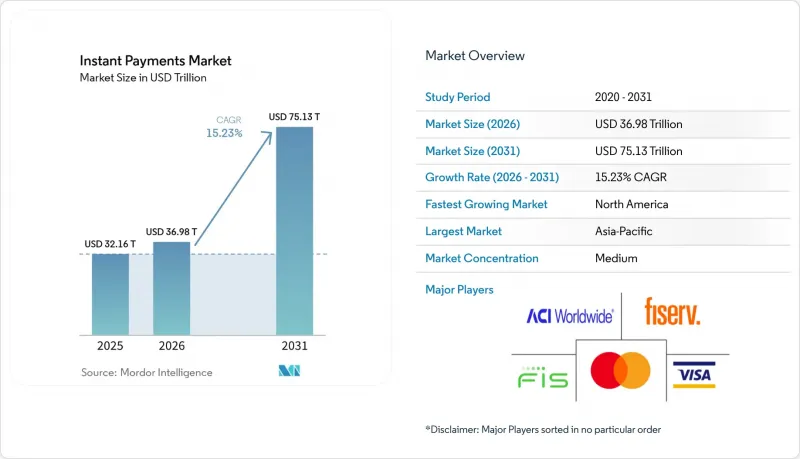
本報告按支付流向(例如,國內即時支付)、終端用戶細分(例如,消費者/零售商、微型/小型和中型企業 (MSME))、應用場景(例如,銀行間轉帳)和地區(北美、南美、歐洲、亞太、中東和非洲)進行分類。市場預測以美元計價。
全球即時支付市場趨勢及洞察
強制性即時支付將加速該方案的推廣應用。
監管義務是即時結算市場需求的最強推動要素之一,其普及速度遠超自願定價或商業性獎勵。歐盟已強制要求歐元區支付服務供應商在2025年1月前啟用即時結算收款功能,並在2025年10月前啟用即時結算轉帳功能,同時要求即時轉帳費用不得超過標準轉帳費用。下一階段的實施範圍將擴展至歐洲經濟區(EEA)內的非歐元區服務供應商,收款義務將於2027年1月前完成,轉帳義務將於2027年7月前完成,從而進一步擴大合規範圍。隨著2025年10月的實施,收款人準備情況的驗證也提前進行。這意味著將引入更嚴格的帳戶檢驗要求,同時提高結算速度。這項監管模式對即時結算市場意義重大,因為它將即時結算從一項競爭優勢提升為眾多服務提供者的基本服務要求。
零售市場對無摩擦支付和發票支付的需求
消費者行為的變化也正在擴大即時支付市場的潛在客戶群。尤其值得注意的是,用戶希望資金在領取工資、支付帳單、向錢包充值以及在商店付款時都能以相同的速度流動。需求不再局限於點對點 (P2P) 支付,因為家庭現在也希望能夠快速獲得工資、保險賠償、退款和其他有時效性的收入。這種轉變正在將即時支付基礎設施融入結構化的資金流中,而資金到帳的時間直接影響收款人的現金可用性。在歐洲,主導錢包的帳戶間支付模式也正向商業領域滲透。 Wero 正在將使用者從傳統的本地應用程式轉移到電子商務和 POS 系統,並將其業務擴展到這些領域。這一趨勢正在推動即時支付市場的發展,使即時支付不再局限於偶爾的緊急轉賬,而是成為一種日常習慣。
詐騙風險和已通過核准推播付款(APP)詐騙。
由於交易速度極快,付款後幾乎沒有追回損失的空間,詐欺仍然是即時支付市場中最明顯的營運風險之一。在英國,支付系統監管機構於2024年10月7日推出了一項強制性框架,用於處理因APP(已通過核准轉帳)詐騙造成的退款,最高賠償額為85,000英鎊,並規定匯款方和收款方共同承擔責任。這迫使支付鏈中的雙方都投資於更強大的控制系統。在歐洲,歐洲理事會於2026年4月發布的支付服務監管草案(作為妥協方案)提案,根據第83條強制進行交易監控,並對違規行為追究直接責任,這表明類似的控制政策正在歐洲各地實施。因此,即時欺詐管理正從一項輔助功能轉變為付款管道設計的核心要求。這種壓力可能會延緩即時支付市場的服務部署,並增加營運成本。對於仍依賴多個支付管道的獨立詐欺防制工具的金融機構而言,這種影響將特別顯著。
細分市場分析
2025年,國內支付將佔據即時支付市場佔有率的92.89%,而跨國支付預計將在2026年至2031年間以22.73%的複合年成長率成長。這一細分錶明,UPI、PIX、FedNow、RTP和SEPA Instant等國內支付方案在其各自的國內市場已根深蒂固。國內市場的規模得益於監管、銀行業廣泛參與以及諸如個人轉帳和發票支付等常見應用情境。跨境資金流動雖然基數小規模,但通常涉及更高價值的交易,包括匯款、金融資金轉移、供應商付款和貿易相關匯款。這意味著,即使只有少數高價值交易路徑實現完全即時化,即時支付市場也能帶來相當可觀的經濟價值。
這項過渡的法律和操作框架正日趨具體。歐洲中央銀行(ECB)於2026年5月通過了ECB/2026/11號指導方針,將「單腿即時信用轉帳」(One-Leg-Out 即時 Credit Transfer)納入通膨保值債券(TIPS),為歐元區使用央行貨幣進行即時結算奠定了正式基礎。印度和新加坡已推出「UPI-PayNow」服務,印度也與馬來西亞、菲律賓、泰國和新加坡一起加入了國際清算銀行(BIS)的「Nexus」項目,該項目旨在促進更廣泛的多邊合作。 2026年6月,美國銀行宣布透過SWIFT和CashPro為企業和機構投資者提供跨國即時結算解決方案。這表明,各大銀行開始將跨國即時結算視為一種商業性產品,而非未來的選擇。隨著這些合作的深入,能夠管理跨多個國家結算網路的連接、數據檢驗和協調的即時結算服務提供者將更受青睞。
區域分析
到2025年,亞太地區將佔據即時支付市場56.63%的佔有率,成為以金額為準最大的區域中心。印度仍然是關鍵中心之一,預計到2025年,其統一支付介面(UPI)的交易量將達到每月近150億筆,並透過參與UPI-PayNow和國際清算銀行(BIS)的Project Nexus項目,不斷擴大其互聯互通。中國的CIPS(中國即時支付系統)也持續發展,預計到2024年,其年交易量將達到175.49兆元人民幣(約24.45兆美元),到2025年底,將有193家直接參與機構和1573家間接參與機構涵蓋124個國家。在東南亞,印尼、泰國、馬來西亞、越南、新加坡和日本等市場正透過東協支付合作(ASEAN Payments Cooperation)建構更強大的區域基礎,包括QR碼和高速支付的互通性。澳洲和韓國也在加強在該地區的地位,擁有成熟的數位支付環境,並持續積極參與廣泛的互通性討論。
預計2026年至2031年,北美地區的即時支付市場將以21.45%的複合年成長率成長,成為成長最快的地區。該地區的強勁成長勢頭源於其“雙軌結構”,即即時支付系統(RTP)和聯邦即時支付系統(FedNow)都在不斷發展,並在消費者、中小企業和機構資金流動中形成不同的使用模式。 2026年聯邦即時支付系統(FedNow)的高平均支付量顯示其在企業和高價值轉帳領域的重要性日益凸顯,而即時支付系統(RTP)則繼續與傳統的零售和商業使用模式緊密相連。在墨西哥,SPEI正在深化其市場佈局,而加拿大的即時支付系統現代化專案也將在預測期內保持關鍵地位。在南美洲,巴西繼續透過PIX推動區域市場的發展。同時,哥倫比亞的Bre-B於2025年10月推出,其底層技術由ACI Worldwide提供,自運作以來已處理超過5億筆交易,這表明一旦基礎設施到位,國內支付方案就能迅速擴張。
歐洲仍然是即時支付市場最重要的地區之一,因為相關法規正在直接重塑支付經濟格局和服務提供者的義務。歐盟的即時支付框架規定了收付款的義務,強制要求費用均衡,並計劃在2027年之前擴大歐元區以外歐洲經濟區(EEA)服務提供者的准入範圍。該地區也在擴大金融機構的覆蓋範圍,阿爾巴尼亞、蒙特內哥羅和北馬其頓將於2025年10月全面加入單一歐元支付區(SEPA)。在中東,阿拉伯聯合大公國的Aani公司報告稱,截至2026年4月,其用戶數已達1,250萬,並宣布其轉帳處理速度可達3秒。 2026年2月,Montran被選為Aani國際匯款閘道的服務供應商。非洲的重要性也不斷提升,預計到2024年,將有36個即時支付系統在31個國家運作,處理640億筆交易(總額達2兆美元)。這表明,即時支付市場不再集中在銀行業最成熟的地區。
其他好處:
- Excel格式的市場預測(ME)表
- 3個月的分析師支持
目錄
第1章:引言
- 研究假設和市場定義
- 調查範圍
第2章:調查方法
第3章執行摘要
第4章 市場狀況
- 市場概覽
- 市場促進因素
- 即時支付的強制實施正在加速新型支付方式的普及。
- 零售業對「無摩擦支付」和「發票支付」的需求
- 加速跨境匯款和企業間貿易結算的努力
- 核心銀行和支付基礎設施的現代化
- ISO 20022 和 API編配降低了整合的障礙。
- 嵌入式金融拓展了即時支付的應用場景。
- 市場限制因素
- 詐騙風險和已通過核准推送支付詐騙風險
- 對傳統核心銀行系統的依賴導致實施延誤。
- 國內方案與跨境方案之間的互通性差距
- 7x24小時結算中的商家流動性和異常處理成本
- 價值鏈分析
- 監理情勢
- 技術展望
- 波特五力分析
第5章 市場規模與成長預測
- 按支付串流
- 國內即時支付
- 即時跨境支付
- 按最終用戶細分
- 一般消費者/零售
- 微型、小規模和中型企業(MSMEs)
- 大型公司/企業
- 政府/公共部門
- 按用例
- 銀行間轉帳
- 商家/商店支付與電子商務支付
- 發票付款和定期付款
- 薪資、工資和支付結算
- 供應商/廠商/B2B商業支付
- 政府徵收、撥款、補貼和付款
- 其他銀行間轉賬
- 按地區
- 北美洲
- 美國
- 加拿大
- 墨西哥
- 南美洲
- 巴西
- 阿根廷
- 其他南美國家
- 歐洲
- 英國
- 德國
- 法國
- 義大利
- 西班牙
- 其他歐洲國家
- 亞太地區
- 印度
- 中國
- 日本
- 韓國
- 澳洲
- 東南亞(新加坡、馬來西亞、泰國、印尼、越南、菲律賓)
- 中東和非洲
- 阿拉伯聯合大公國
- 沙烏地阿拉伯
- 南非
- 奈及利亞
- 北美洲
第6章 競爭情勢
- 市場集中度
- 策略趨勢
- 市佔率分析
- 公司簡介
- ACI Worldwide, Inc.
- FIS
- Fiserv, Inc.
- Visa Inc.
- Mastercard Incorporated
- Finastra
- Montran Corporation
- Volante Technologies Inc.
- SWIFT
- Worldline
- Adyen NV
- PayPal Holdings, Inc.
- Stripe, Inc.
- Temenos AG
- Nexi SpA
- Bottomline Technologies, Inc.
- Tietoevry Corporation
- FSS
- Jack Henry and Associates, Inc.
- The Clearing House Payments Company LLC
- National Payments Corporation of India
第7章 市場機會與未來展望
According to Mordor Intelligence, the instant payments market size is expected to increase from USD 32.16 trillion in 2025 to USD 36.98 trillion in 2026 and reach USD 75.13 trillion by 2031, growing at a CAGR of 15.23% over 2026-2031.
This report is Segmented by Payment Flow (Domestic Instant Payments, and More), by End-User Segment (Consumers / Retail, Micro, Small and Medium Enterprises (MSMEs), and More), by Use-Case Coverage (Account-To-Account Transfers, and More), by Geography (North America, South America, Europe, Asia-Pacific, and the Middle East and Africa). The Market Forecasts are Provided in Terms of Value (USD).
Global Instant Payments Market Trends and Insights
Real-Time Settlement Mandates Accelerate Scheme Adoption
Regulatory mandates have become one of the strongest demand drivers in the instant payments market, driving faster adoption than voluntary pricing or commercial incentives. The European Union required euro-area payment service providers to receive instant payments by January 2025 and to send them by October 2025, while also requiring that fees for instant transfers do not exceed fees for standard credit transfers. The next phase of the rollout reaches non-Euro Area providers in the EEA, with receiving obligations due by January 2027 and sending obligations due by July 2027, which extends the compliance cycle deeper into the region. The October 2025 implementation also advanced verification of payee readiness, which means higher payment speed is being introduced alongside stronger account validation expectations. This regulatory model matters for the instant payments market because it elevates instant settlement from a competitive feature to a baseline service requirement for a wide range of providers.
Retail Demand for Frictionless Checkout and Bill Payments
Consumer behavior is also widening the addressable base of the instant payments market, especially as users expect funds to move at the same pace across payroll, bill payment, wallet funding, and merchant checkout. Demand no longer comes only from peer-to-peer use, because households now expect fast access to wages, claims, refunds, and other time-sensitive receipts. That shift is pulling instant rails into structured financial flows, where timing directly affects recipients' cash availability. In Europe, wallet-led account-to-account payment models are also moving into commerce, as Wero has migrated users from earlier local apps and is extending into e-commerce and point-of-sale environments. This pattern supports the instant payments market by expanding recurring everyday use rather than limiting real-time payments to occasional urgent transfers.
Scam Risk and Authorized Push Payment Fraud Exposure
Fraud remains one of the clearest operating risks for the instant payments market because payment speed leaves little room for post-settlement recovery. In the United Kingdom, the Payment Systems Regulator brought APP scam reimbursement into a mandatory framework from October 7, 2024, with a GBP 85,000 cap and shared liability between sending and receiving providers, which forces both sides of the payment chain to invest in stronger controls. In Europe, the draft Payment Services Regulation published through Council compromise texts in April 2026 proposed mandatory transaction monitoring under Article 83 and direct liability for non-compliance, which points to a similar control direction across the region. Real-time fraud management is therefore moving from a supporting function into a core requirement of payment platform design. This pressure can slow rollout and raise operating costs in the instant payments market, especially for institutions that still rely on separate fraud tools across multiple rails.
Other drivers and restraints analyzed in the detailed report include:
- Cross-Border Push for Faster Remittances and B2B Trade Payments
- ISO 20022 and API Orchestration Reduce Integration Friction
- Legacy Core Banking Dependencies Slow Rollout
For complete list of drivers and restraints, kindly check the Table Of Contents.
Segment Analysis
Domestic payments accounted for 92.89% of the instant payments market share in 2025, while cross-border payments are forecast to expand at a 22.73% CAGR from 2026 to 2031. That split shows how deeply national schemes such as UPI, PIX, FedNow, RTP, and SEPA Instant are embedded in home markets. The domestic scale has been built through regulation, broad participation from the banking sector, and familiar use cases such as person-to-person transfers and bill settlement. Cross-border flows still start from a smaller base, but they usually carry higher values because they include remittances, treasury movements, supplier payments, and trade-related transfers. This means the instant payments market can deliver disproportionate economic value even with a limited number of high-value corridors becoming fully real-time.
The legal and operating framework for this shift is now becoming more concrete. The ECB's May 2026 adoption of Guideline ECB/2026/11 for the integration of One-Leg-Out Instant Credit Transfer into TIPS provides a formal basis for euro-leg cross-border instant settlement in central bank money. India and Singapore had already operationalized UPI-PayNow, and India joined the BIS Project Nexus with Malaysia, the Philippines, Thailand, and Singapore for broader multilateral interlinking. In June 2026, Bank of America announced a cross-border real-time payments solution for corporate and institutional clients via SWIFT and CashPro, signaling that large banks now see cross-border instant settlement as a commercial product rather than a future option. As these linkages deepen, the instant payments market is likely to favor providers that can manage corridor connectivity, data validation, and orchestration across multiple domestic rail networks.
Complete Report Scope:
- By Payment Flow
- Domestic Instant Payments
- Cross-Border Instant Payments
- By End-User Segment
- Consumers / Retail
- Micro, Small and Medium Enterprises (MSMEs)
- Large Enterprises / Corporates
- Government and Public Sector
- By Use Case
- Account-to-Account Transfers
- Merchant / Point-of-Sale and E-commerce Payments
- Bill Payments and Recurring Payments
- Salary, Wage and Disbursement Payments
- Supplier / Vendor / B2B Commercial Payments
- Government Collections, Benefits, Subsidies and Disbursements
- Other Account-to-Account Payments
- By Geography
- North America
- United States
- Canada
- Mexico
- South America
- Brazil
- Argentina
- Rest of South America
- Europe
- United Kingdom
- Germany
- France
- Italy
- Spain
- Rest of Europe
- Asia-Pacific
- India
- China
- Japan
- South Korea
- Australia
- South East Asia (Singapore, Malaysia, Thailand, Indonesia, Vietnam, and Philippines)
- Middle East and Africa
- United Arab Emirates
- Saudi Arabia
- South Africa
- Nigeria
- North America
Geography Analysis
Asia-Pacific accounted for 56.63% of the instant payments market in 2025, making it the largest regional center by value. India remains one of the key anchors, with UPI processing close to 15 billion transactions per month in 2025 and extending connectivity through UPI-PayNow and its participation in the BIS Project Nexus. China's CIPS also continues to scale, with 2024 annual volume reaching CNY 175.49 trillion, equivalent to USD 24.45 trillion, and participation widening to 193 direct and 1,573 indirect institutions across 124 countries by the end of 2025. Southeast Asia is building an additional regional layer through ASEAN payment connectivity, including QR and fast payment interlinking among markets such as Indonesia, Thailand, Malaysia, Vietnam, Singapore, and Japan. Australia and South Korea also strengthen the region's position because both operate digitally mature payment environments and remain active in broader interoperability discussions.
North America is projected to grow at a 21.45% CAGR from 2026 to 2031, making it the fastest-growing regional part of the instant payments market. The region's momentum comes from its dual-rail structure, where RTP and FedNow are both expanding and are shaping different usage patterns across consumer, SME, and institutional flows. FedNow's high average payment values in 2026 indicate growing relevance for corporate and higher-value transfers, while RTP remains closely associated with established retail and business usage patterns. Mexico adds depth through SPEI, and Canada's Real-Time Rail modernization program remains an important addition within the forecast period. In South America, Brazil continues to anchor regional activity through PIX, while Colombia's Bre-B, launched in October 2025 and powered by ACI Worldwide, has processed more than 500 million transactions since go-live, showing how quickly national schemes can scale once infrastructure is in place.
Europe remains one of the most consequential regions for the instant payments market because regulation is directly reshaping payment economics and the obligations of providers. The EU instant payments framework established receiving and sending mandates, required fee parity, and extended the adoption path to non-eurozone EEA providers through deadlines in 2027. The region is also broadening institution coverage, as Albania, Montenegro, and North Macedonia operationalized SEPA membership in October 2025. In the Middle East, the UAE's Aani reported 12.5 million users in April 2026 and the ability to process transfers in 3 seconds, while Montran was selected in February 2026 to support Aani's international remittance gateway. Africa is also becoming more relevant, with 36 active instant payment systems across 31 countries processing 64 billion transactions worth USD 2 trillion in 2024, indicating that the instant payments market is no longer concentrated in the most mature banking regions.
- ACI Worldwide, Inc.
- FIS
- Fiserv, Inc.
- Visa Inc.
- Mastercard Incorporated
- Finastra
- Montran Corporation
- Volante Technologies Inc.
- SWIFT
- Worldline
- Adyen N.V.
- PayPal Holdings, Inc.
- Stripe, Inc.
- Temenos AG
- Nexi S.p.A.
- Bottomline Technologies, Inc.
- Tietoevry Corporation
- FSS
- Jack Henry and Associates, Inc.
- The Clearing House Payments Company L.L.C.
- National Payments Corporation of India
Additional Benefits:
- The market estimate (ME) sheet in Excel format
- 3 months of analyst support
TABLE OF CONTENTS
1 INTRODUCTION
- 1.1 Study Assumptions and Market Definition
- 1.2 Scope of the Study
2 RESEARCH METHODOLOGY
3 EXECUTIVE SUMMARY
4 MARKET LANDSCAPE
- 4.1 Market Overview
- 4.2 Market Drivers
- 4.2.1 Real-Time Settlement Mandates Accelerate Scheme Adoption
- 4.2.2 Retail Demand for Frictionless Checkout and Bill Payments
- 4.2.3 Cross-Border Push for Faster Remittances and B2B Trade Payments
- 4.2.4 Bank Modernization of Core and Payments Infrastructure
- 4.2.5 ISO 20022 and API Orchestration Reduce Integration Friction
- 4.2.6 Embedded Finance Expands Instant Payout Use Cases
- 4.3 Market Restraints
- 4.3.1 Scam Risk and Authorized Push Payment Fraud Exposure
- 4.3.2 Legacy Core Banking Dependencies Slow Rollout
- 4.3.3 Interoperability Gaps Across Domestic and Cross-Border Schemes
- 4.3.4 Merchant Liquidity and Exception-Handling Costs in 24/7 Settlement
- 4.4 Value Chain Analysis
- 4.5 Regulatory Landscape
- 4.6 Technological Outlook
- 4.7 Porter's Five Forces Analysis
- 4.7.1 Threat of New Entrants
- 4.7.2 Bargaining Power of Suppliers
- 4.7.3 Bargaining Power of Buyers
- 4.7.4 Threat of Substitutes
- 4.7.5 Competitive Rivalry
5 MARKET SIZE and GROWTH FORECASTS
- 5.1 By Payment Flow
- 5.1.1 Domestic Instant Payments
- 5.1.2 Cross-Border Instant Payments
- 5.2 By End-User Segment
- 5.2.1 Consumers / Retail
- 5.2.2 Micro, Small and Medium Enterprises (MSMEs)
- 5.2.3 Large Enterprises / Corporates
- 5.2.4 Government and Public Sector
- 5.3 By Use Case
- 5.3.1 Account-to-Account Transfers
- 5.3.2 Merchant / Point-of-Sale and E-commerce Payments
- 5.3.3 Bill Payments and Recurring Payments
- 5.3.4 Salary, Wage and Disbursement Payments
- 5.3.5 Supplier / Vendor / B2B Commercial Payments
- 5.3.6 Government Collections, Benefits, Subsidies and Disbursements
- 5.3.7 Other Account-to-Account Payments
- 5.4 By Geography
- 5.4.1 North America
- 5.4.1.1 United States
- 5.4.1.2 Canada
- 5.4.1.3 Mexico
- 5.4.2 South America
- 5.4.2.1 Brazil
- 5.4.2.2 Argentina
- 5.4.2.3 Rest of South America
- 5.4.3 Europe
- 5.4.3.1 United Kingdom
- 5.4.3.2 Germany
- 5.4.3.3 France
- 5.4.3.4 Italy
- 5.4.3.5 Spain
- 5.4.3.6 Rest of Europe
- 5.4.4 Asia-Pacific
- 5.4.4.1 India
- 5.4.4.2 China
- 5.4.4.3 Japan
- 5.4.4.4 South Korea
- 5.4.4.5 Australia
- 5.4.4.6 South East Asia (Singapore, Malaysia, Thailand, Indonesia, Vietnam, and Philippines)
- 5.4.5 Middle East and Africa
- 5.4.5.1 United Arab Emirates
- 5.4.5.2 Saudi Arabia
- 5.4.5.3 South Africa
- 5.4.5.4 Nigeria
- 5.4.1 North America
6 COMPETITIVE LANDSCAPE
- 6.1 Market Concentration
- 6.2 Strategic Moves
- 6.3 Market Share Analysis
- 6.4 Company Profiles (includes Global Level Overview, Market Level Overview, Core Segments, Financials as available, Strategic Information, Market Rank/Share, Products and Services, Recent Developments)
- 6.4.1 ACI Worldwide, Inc.
- 6.4.2 FIS
- 6.4.3 Fiserv, Inc.
- 6.4.4 Visa Inc.
- 6.4.5 Mastercard Incorporated
- 6.4.6 Finastra
- 6.4.7 Montran Corporation
- 6.4.8 Volante Technologies Inc.
- 6.4.9 SWIFT
- 6.4.10 Worldline
- 6.4.11 Adyen N.V.
- 6.4.12 PayPal Holdings, Inc.
- 6.4.13 Stripe, Inc.
- 6.4.14 Temenos AG
- 6.4.15 Nexi S.p.A.
- 6.4.16 Bottomline Technologies, Inc.
- 6.4.17 Tietoevry Corporation
- 6.4.18 FSS
- 6.4.19 Jack Henry and Associates, Inc.
- 6.4.20 The Clearing House Payments Company L.L.C.
- 6.4.21 National Payments Corporation of India
7 MARKET OPPORTUNITIES and FUTURE OUTLOOK
- 7.1 White-Space and Unmet-Need Assessment

 歐洲清算所和結算機構:市場佔有率分析、行業趨勢和統計數據以及成長預測(2026-2031 年)清算所和結算機構:市場佔有率分析、行業趨勢和統計數據、成長預測(2026-2031 年)支付與結算:市場佔有率分析、產業趨勢與統計、成長預測(2026-2031)英國支付與清算:市佔率分析、產業趨勢與統計、成長預測(2026-2031)
 2026年全球清算結算市場報告
 支付監控市場規模、佔有率和成長分析:按組件、部署模式、應用、最終用戶和地區分類-2026-2033年產業預測
 全球支付監控市場
 清算結算系統市場預測至2034年:按交易後功能、支援的資產類別、基礎設施類型、部署方式和最終用戶分類的全球分析2026年全球補丁編配平台市場報告
 即時支付市場分析及至2035年預測:依類型、產品、服務、技術、組件、應用、最終用戶、部署模式及類型分類