


 |
市場調查報告書
商品編碼
2119193
支付與結算:市場佔有率分析、產業趨勢與統計、成長預測(2026-2031)Payments and Settlements - Market Share Analysis, Industry Trends & Statistics, Growth Forecasts (2026 - 2031) |
||||||

※ 本網頁內容可能與最新版本有所差異。詳細情況請與我們聯繫。
據 Mordor Intelligence 稱,支付和清算市場的規模預計將從 2025 年的 2.47 兆美元擴大到 2026 年的 2.62 兆美元,到 2031 年達到 3.7 兆美元,2026 年至 2031 年的複合年成長率為 7.12%。
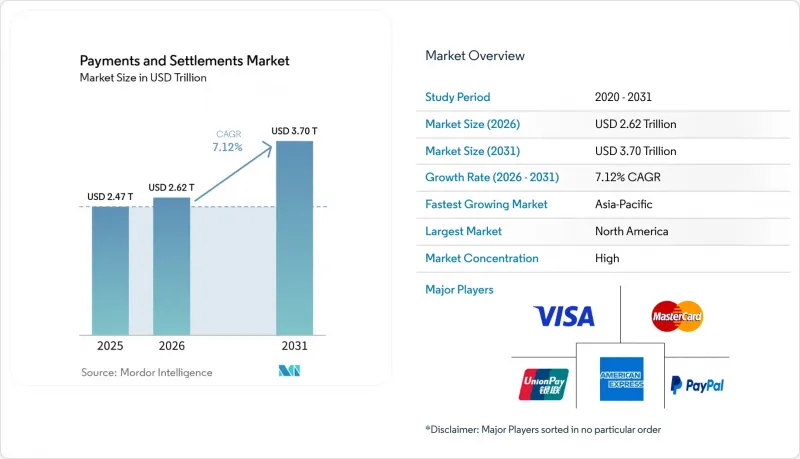
本報告按支付方式(銀行卡、電子錢包、其他)、支付類型(國內、跨境)、交易類型(B2B、C2B、B2C、C2C)、終端用戶行業(零售/電商、其他)、支付網路基礎設施(銀行卡、ACH、RTGS、即時支付、SWIFT、DLT)以及地區(北美、北美、歐洲、亞太、中東和中東地區。預測值以美元計價。
全球支付及清算市場趨勢及洞察
跨境商務和數位市場的擴張
隨著數位商務的蓬勃發展,跨境支付服務的需求日益成長,尤其是那些費用透明、結算時間可預測的服務。如果商家無需為每個支付通道重新建立支付和資金管理流程,即可在新國家/地區提供服務,那麼全球支付和清算市場將從中受益。雖然傳統的代理銀行系統可以支援全球擴張,但當國內轉帳造成大部分延遲時,其有效性仍然有限。國際清算銀行(BIS)已將延長高速支付系統的運作和擴大系統間的互聯互通確定為改善其82個司法管轄區跨境支付的關鍵措施。 2026年3月,SWIFT與70多家金融機構合作推出了零售框架,指出國內「最後一公里」轉帳佔端到端結算總時間的75%。這使得國內基礎建設改革對於服務國際商家的企業而言,與網路層面的速度同等重要。
政府主導的即時支付網路加速了銀行間支付的普及。
政府營運的即時支付系統可透過提供低成本的銀行間轉賬,直接改變商家的支付經濟格局。預計到2025年,印度的統一支付介面(UPI)將處理2,285億筆交易,同年巴西的支付資訊交換系統(PIX)將處理798億筆交易,凸顯了公共支付基礎設施的規模。到2025年下半年,PIX將佔巴西零售支付交易的54.7%,這表明免手續費的支付網路可以取代日常交易中的銀行卡使用。在美國,FedNow預計到2025年將涵蓋1,800家參與機構,處理8,534億美元的支付,但其營運模式與公共支付網路的設計有所不同。因此,全球支付和清算市場既包括可以設定費用條件的公共系統,也包括必須平衡參與者獎勵的私人系統。支付主權也在推動國內支付網路的發展,尤其是在那些希望在保持與區域支付走廊連接的同時實現國內控制的國家。
支付詐騙、帳戶劫持、已通過核准推送支付詐騙
即時支付給反詐騙帶來了挑戰,因為資金會在金融機構來得及干預之前轉移。已通過核准推送支付詐騙正是利用了這個特性,誘騙客戶批准看似合法的付款。根據 TransUnion 預測,儘管報告的金額低於上一年,但到 2025 年,全球整體帳戶盜用造成的損失預計將超過 150 億美元。報告指出,將有 600 萬消費者受到影響,受害者人數增加了 18%。因此,在支付和清算市場中,身分驗證、監控和客戶保護必須被視為支付的核心功能,而不僅僅是可選項。賠償要求和相關措施可能會給缺乏成熟詐欺偵測能力的小規模服務提供者帶來更大的成本壓力。
細分市場分析
到2025年,卡片付款將佔支付和清算市場的37.7%。這得益於廣泛的應用網路和令牌化認證,使得銀行卡的使用範圍擴展到了數位錢包。銀行卡網路仍然提供關於授權、爭議管理和詐欺責任的既定規則。在美國,到2025年,主要銀行卡網路的總交易額將達到11.46兆美元。數位錢包和跨帳戶支付允許消費者透過應用程式和銀行帳戶進行支付,從而與基於銀行卡的經濟模式競爭。因此,全球支付和清算產業並非以單一替代方案取代銀行卡,而是在支付和清算流程中增加更多選擇。
數位資產、穩定幣和代幣化支付預計到2031年將以16.3%的複合年成長率成長,成為該領域成長最快的細分市場。這種支付方式不僅在個人加密貨幣交易中越來越受歡迎,在機構投資者中也日益普及。根據Visa的報告,該公司的穩定幣支付項目運行在九個區塊鏈上,預計到2026年4月,每年交易額將達到70億美元。傳統的銀行轉帳、先買後付(BNPL)和嵌入式信用仍然是部分支付方式。先買後付(BNPL)服務不僅作為獨立的消費產品提供,而且還擴大整合到零售和旅遊支付軟體中。
到2025年,國內支付將佔支付和清算市場的72.5%。這是因為國內零售和商業活動的規模仍然遠大於國際支付流量。此外,國內系統往往規則較簡單、參與者較透明、處理成本較低。跨境支付預計到2031年將以9.2%的複合年成長率成長,這主要得益於支付鏈路速度加快、支付通道數位化以及金融管理工具的引入,從而降低了交易摩擦。金融穩定理事會(FSB)於2026年3月啟動了一項新的公私合營實施階段,以推動二十國集團(G20)跨境支付計畫。該計劃優先考慮營運可靠性和協作實施,而非孤立的技術試點計畫。隨著各個國內系統轉型為功能完善的商業通道,這些努力將惠及全球支付和清算市場。
由印度、印尼、馬來西亞、菲律賓、新加坡和泰國中央銀行參與的「Nexus計畫」預計將於2025年獲得法人資格。該框架旨在支援高速支付系統之間的多邊合作。在國內支付網路互聯互通的市場中,成本和支付延遲的降低速度可以比僅依賴代理銀行的市場更快。因此,商家和負責人需要能夠在國內即時代幣化支付網路之間路由交易的系統。全球支付和清算行業正擴大採用“支付編配平台”,這些平台能夠在不影響客戶體驗的前提下實現上述選擇。
區域分析
北美地區憑藉著較高的銀行卡使用率和不斷發展的即時支付生態系統,預計到2025年將佔該地區市場佔有率的34.5%。 FedNow將在2025年透過1,800家註冊機構處理8,534億美元的支付交易。清算所的RTP網路將在2026年第一季處理4,800億美元的交易,而美國兩大支付網路都已將交易限額設定為1,000萬美元。由於這些支付網路採用私營模式,銀行仍需明確的商業性理由才能大規模採用和使用這些網路。加拿大的開放銀行計畫或有助於推動銀行間轉帳。
預計到2031年,亞太地區的複合年成長率將達到9.9%,在全球支付和清算市場中位居各地區之首。印度的統一支付介面(UPI)預計在2025年處理2,285億筆交易,年增33%。中國正著力發展國內主導的支付基礎設施,其中包括於2025年9月在上海啟用的「數位人民幣國際營運中心」。日本的無現金支付比例預計在2025年達到58%,超過政府設定的目標。印尼、越南、泰國、馬來西亞和新加坡也積極推動區域高速支付網路的協調建設。
在歐洲,批發和企業支付系統正在發展,但零售支付仍分散在各國不同的支付體系中。瑞典銀行於2026年4月開始遷移到新的轉帳基礎設施,並計劃於2026年11月全面過渡到統一支付系統。 Wero於2025年下半年在德國推出,並於2026年擴展到法國和比利時。在南美洲,PIX在2025年下半年佔巴西零售支付交易的54.7%。在中東和非洲,國內支付基礎設施和區域間互通性正在擴展,包括海灣國家與數位化專案相關的支付功能。
其他好處
- Excel格式的市場預測(ME)表
- 3個月的分析師支持
目錄
第1章:引言
- 研究假設和市場定義
- 調查範圍
第2章:調查方法
第3章執行摘要
第4章 市場狀況
- 市場概覽
- 市場促進因素
- 跨境商務和數位市場的擴張
- 透過政府主導的即時支付網路,加速銀行間支付的普及。
- 數位貨幣轉帳和嵌入式支付服務的成長
- 實現基於 ISO 20022 的自動化富數據支付
- 將支付主權與可互通的國內支付網路連結起來
- 市場限制因素
- 支付詐騙、帳戶劫持、已通過核准推送支付詐騙
- 跨境合規和資料傳輸法規零碎化
- 傳統結算時間和流動性要求
- 支付系統中未標準化的 API、識別碼和資料標準。
- 價值和供應鏈分析
- 監理情勢
- 技術展望
- 利用人工智慧(AI)和機器學習最佳化支付。
- 支付編配和智慧交易路由
- 數位身分、通行金鑰、生物識別
- 波特五力分析
第5章 市場規模與成長預測
- 透過支付方式
- 卡片付款(金融卡、信用卡、預付)
- 數位錢包和行動支付
- 帳戶間結算和即時結算
- 傳統銀行轉賬
- 後付費(先買後付)和嵌入式信用
- 數位資產、穩定幣、代幣化支付
- 其他付款方式
- 按付款方式
- 國內的
- 跨境
- 按交易類型
- 企業對企業 (B2B) 支付
- 消費者對企業 (C2B) 支付
- 企業對消費者 (B2C) 支付
- 個人對個人 (C2C) 支付
- 按最終用戶行業分類
- 零售與電子商務
- 銀行和金融服務
- 衛生保健
- 飯店、旅遊和旅遊業
- 政府/公共部門
- 教育
- 交通運輸與出行
- 製造和工業服務
- 專業服務/商業服務
- 其他行業
- 透過支付網路基礎設施
- 卡網路支付
- 自動清算系統 (ACH) 支付
- 即時全額結算
- 高速/即時支付系統
- 代理銀行和基於SWIFT的結算
- 支付系統的互聯
- 代幣化和分散式帳本支付
- 按地區
- 北美洲
- 美國
- 加拿大
- 墨西哥
- 南美洲
- 巴西
- 阿根廷
- 其他南美國家
- 歐洲
- 英國
- 德國
- 法國
- 義大利
- 西班牙
- 其他歐洲國家
- 亞太地區
- 中國
- 日本
- 印度
- 韓國
- 澳洲
- 印尼
- 泰國
- 馬來西亞
- 新加坡
- 越南
- 其他亞太國家
- 中東和非洲
- 沙烏地阿拉伯
- 阿拉伯聯合大公國
- 土耳其
- 南非
- 埃及
- 其他中東和非洲國家
- 北美洲
第6章 競爭情勢
- 市場集中度
- 策略趨勢
- 市佔率分析
- 公司簡介
- Visa Inc.
- Mastercard Incorporated
- China UnionPay Co., Ltd.
- American Express Company
- PayPal Holdings, Inc.
- Fiserv, Inc.
- Fidelity National Information Services, Inc.
- Global Payments Inc.
- Adyen NV
- Stripe, Inc.
- Block, Inc.
- Worldline SA
- Ant Group Co., Ltd.
- Apple Inc.
- Google LLC
- Amazon.com, Inc.
- Juspay Technologies
- Wise plc
- Western Union Holdings, Inc.
- MoneyGram International, Inc.
- Airwallex(Hong Kong)Limited
- JP Morgan Chase & Co.
第7章 市場機會與未來展望
According to Mordor Intelligence, the payments and settlements market size is expected to increase from USD 2.47 trillion in 2025 to USD 2.62 trillion in 2026 and reach USD 3.70 trillion by 2031, growing at a CAGR of 7.12% over 2026-2031.
This report is Segmented by Mode of Payment (Card, Wallets, and More), Payment Type (Domestic, Cross-Border), Transaction Type (B2B, C2B, B2C, C2C), End-User (Retail and E-Commerce, and More), Settlement Rail and Infrastructure (Card, ACH, RTGS, Instant, SWIFT, DLT), and Geography (North America, South America, Europe, Asia-Pacific, MEA). Forecasts are Provided in Terms of Value (USD).
Global Payments and Settlements Market Trends and Insights
Expansion of Cross-Border Commerce and Digital Marketplaces
Digital commerce is increasing the demand for payment services that can settle across borders with clear fees and predictable delivery times. The global payments and settlements market benefits when merchants can serve new countries without having to rebuild checkout and treasury processes for each corridor. Legacy correspondent banking can support global reach, but it remains less effective where domestic delivery creates most of the delay. The BIS identified longer operating hours for fast-payment systems and broader interconnections among them as major actions to improve cross-border payments across 82 jurisdictions. Swift introduced a retail framework in March 2026 with more than 70 financial institutions, while noting that domestic last-mile delivery accounted for 75% of total end-to-end payment time. This makes domestic infrastructure reform as important as network-level speed for providers serving international merchants.
Government Instant-Payment Rails Accelerating Account-to-Account Adoption
Government-operated instant-payment systems can directly alter merchant payment economics by offering low-cost account-to-account transfers. India's UPI processed 228.5 billion transactions in 2025, while Brazil's PIX processed 79.8 billion transactions in the same year, underscoring the scale of public payment infrastructure. PIX represented 54.7% of Brazil's retail payment transactions in the second half of 2025, which indicates that a zero-fee rail can displace card use in everyday payments. In the United States, FedNow reached 1,800 enrolled institutions and settled USD 853.4 billion during 2025, although its operating model differs from public rail designs. The global payments and settlements market, therefore, includes both public systems that can set fee conditions and private systems that must balance participant incentives. Payment sovereignty also supports domestic rail links, especially where countries want local control while still connecting to regional payment corridors.
Payment Fraud, Account Takeover, and Authorized Push-Payment Scams
Real-time payments create a difficult fraud-control problem because funds can move before an institution has time to intervene. Authorized push-payment scams exploit this feature by persuading a customer to approve a payment that appears legitimate. Account-takeover losses exceeded USD 15 billion globally in 2025, even as the reported value declined from the prior year, according to TransUnion. The same release stated that 6 million consumers were affected, a 18% increase in the number of victims. The payments and settlements market must therefore treat verification, monitoring, and customer protection as core payment functions rather than optional additions. Reimbursement requirements and related policy responses can place greater cost pressure on smaller providers that lack mature fraud-detection capabilities.
Other drivers and restraints analyzed in the detailed report include:
- Growth of Digital Remittances and Embedded Payouts
- ISO 20022 Enabling Rich-Data Payment Automation
- Fragmented Cross-Border Compliance and Data-Transfer Rules
For complete list of drivers and restraints, kindly check the Table Of Contents.
Segment Analysis
Card payments accounted for 37.7% of the payments and settlements market in 2025, supported by broad acceptance networks and tokenized credentials that extend card use into digital wallets. Card networks still provide established rules for authorization, dispute management, and fraud liability. In the United States, combined purchase volume across the largest card networks reached USD 11.46 trillion in 2025. Digital wallets and account-to-account payments compete with card-based economics by enabling consumers to pay via applications or bank accounts. The global payments and settlements industry is therefore not replacing cards with a single alternative but adding more choices to the checkout and settlement stack.
Digital assets, stablecoins & tokenised payments are forecast to expand at a 16.3% CAGR through 2031, the fastest growth rate within this segmentation. This mode is being used more often for institutional settlement than for retail cryptocurrency activity alone. Visa reported that its stablecoin settlement program operated across 9 blockchains and reached a USD 7 billion annualized run rate in April 2026. Traditional bank transfers, buy-now-pay-later services, and embedded credit remain part of the payment mix. Buy now, pay later offerings are increasingly built into retail and travel checkout software, rather than being offered only as separate consumer products.
Domestic payments held 72.5% of the payments and settlements market in 2025 because local retail and business activity remains much larger than international payment flows. Domestic systems also tend to have simpler rules, known participants, and lower processing costs. Cross-border payments are forecast to grow at a 9.2% CAGR through 2031 as faster payment links, corridor digitization, and treasury tools reduce friction. The FSB began a new public-private implementation phase in March 2026 to advance the G20 cross-border payments program. This work prioritizes operational reliability and shared implementation over isolated technical pilots. The global payments and settlements market can benefit when these initiatives turn separate domestic systems into usable commercial corridors.
Project Nexus became a legal entity in 2025 through the participation of the central banks of India, Indonesia, Malaysia, the Philippines, Singapore, and Thailand. The arrangement is designed to support multilateral links between fast-payment systems. Markets with linked domestic rails can reduce cost and settlement delays more quickly than markets that rely only on correspondent banking. Merchants and treasury managers consequently need systems that can route transactions among domestic, real-time, and tokenized rails. The global payments and settlements industry is increasingly adopting payment orchestration platforms that make these choices without disrupting the customer experience.
Complete Report Scope:
- By Mode of Payment
- Card Payments (Debit, Credit, Prepaid)
- Digital Wallets & Mobile Money
- Account-to-Account & Instant Payments
- Traditional Bank Transfers
- Buy Now, Pay Later & Embedded Credit
- Digital Assets, Stablecoins & Tokenised Payments
- Other Payments
- By Payment Type
- Domestic
- Cross-Border
- By Transaction Type
- Business-to-Business Payments
- Consumer-to-Business Payments
- Business-to-Consumer Payments
- Consumer-to-Consumer Payments
- By End-User Industry
- Retail and E-Commerce
- Banking and Financial Services
- Healthcare
- Hospitality, Travel, and Tourism
- Government and Public Sector
- Education
- Transportation and Mobility
- Manufacturing and Industrial Services
- Professional Services and Business Services
- Other Industries
- By Settlement Rail and Infrastructure
- Card-Network Settlement
- Automated Clearing House Settlement
- Real-Time Gross Settlement
- Fast / Instant Payment Systems
- Correspondent Banking and SWIFT-Based Settlement
- Payment-System Interlinking
- Tokenized and Distributed-Ledger Settlement
- By Geography
- North America
- United States
- Canada
- Mexico
- South America
- Brazil
- Argentina
- Rest of South America
- Europe
- United Kingdom
- Germany
- France
- Italy
- Spain
- Rest of Europe
- Asia-Pacific
- China
- Japan
- India
- South Korea
- Australia
- Indonesia
- Thailand
- Malaysia
- Singapore
- Vietnam
- Rest of Asia-Pacific
- Middle East and Africa
- Saudi Arabia
- United Arab Emirates
- Turkey
- South Africa
- Egypt
- Rest of Middle East and Africa
- North America
Geography Analysis
North America held a 34.5% regional share in 2025, supported by high card usage and a developing instant-payment ecosystem. FedNow settled USD 853.4 billion in 2025 across 1,800 enrolled institutions. The Clearing House RTP network processed USD 480 billion in the first quarter of 2026, with both major United States rails using a USD 10 million transaction limit. Private operating models mean that banks still need a clear commercial reason to adopt and use those rails at scale. Canada's open banking work can support account-to-account initiation.
Asia-Pacific is forecast to grow at a 9.9% CAGR through 2031, the fastest regional rate in the global payments and settlements market. India's UPI processed 228.5 billion transactions in 2025, a 33% increase from the prior year. China is developing payment infrastructure with a strong domestic-control approach, including the Digital Renminbi International Operations Center, launched in Shanghai in September 2025. Japan's cashless payment ratio reached 58% in 2025, exceeding its government target. Indonesia, Vietnam, Thailand, Malaysia, and Singapore are also progressing through regional fast-payment connections.
Europe has advanced wholesale and corporate payment systems, but retail payments remain divided among national schemes. Swedish banks began migrating to a new credit-transfer infrastructure in April 2026, with a wider batch-payment migration planned for November 2026. Wero began rolling out in Germany in late 2025 and is expanding to France and Belgium in 2026. In South America, PIX reached 54.7% of retail payment transactions in Brazil during the second half of 2025. The Middle East and Africa are expanding domestic payment infrastructure and regional interoperability, including payment capabilities connected with Gulf digitization programs.
List of Companies Covered in this Report:
- Visa Inc.
- Mastercard Incorporated
- China UnionPay Co., Ltd.
- American Express Company
- PayPal Holdings, Inc.
- Fiserv, Inc.
- Fidelity National Information Services, Inc.
- Global Payments Inc.
- Adyen N.V.
- Stripe, Inc.
- Block, Inc.
- Worldline SA
- Ant Group Co., Ltd.
- Apple Inc.
- Google LLC
- Amazon.com, Inc.
- Juspay Technologies
- Wise plc
- Western Union Holdings, Inc.
- MoneyGram International, Inc.
- Airwallex (Hong Kong) Limited
- J.P. Morgan Chase & Co.
Additional Benefits:
- The market estimate (ME) sheet in Excel format
- 3 months of analyst support
TABLE OF CONTENTS
1 INTRODUCTION
- 1.1 Study Assumptions and Market Definition
- 1.2 Scope of the Study
2 RESEARCH METHODOLOGY
3 EXECUTIVE SUMMARY
4 MARKET LANDSCAPE
- 4.1 Market Overview
- 4.2 Market Drivers
- 4.2.1 Expansion of Cross-Border Commerce and Digital Marketplaces
- 4.2.2 Government Instant-Payment Rails Accelerating Account-to-Account Adoption
- 4.2.3 Growth of Digital Remittances and Embedded Payouts
- 4.2.4 ISO 20022 Enabling Rich-Data Payment Automation
- 4.2.5 Payment Sovereignty and Interoperable Domestic-Rail Linkages
- 4.3 Market Restraints
- 4.3.1 Payment Fraud, Account Takeover, and Authorized Push-Payment Scams
- 4.3.2 Fragmented Cross-Border Compliance and Data-Transfer Rules
- 4.3.3 Legacy Settlement Windows and Liquidity Requirements
- 4.3.4 Inconsistent API, Identifier, and Data Standards Across Payment Systems
- 4.4 Value and Supply-Chain Analysis
- 4.5 Regulatory Landscape
- 4.6 Technological Outlook
- 4.6.1 Artificial Intelligence and Machine-Learning Payment Optimization
- 4.6.2 Payment Orchestration and Intelligent Transaction Routing
- 4.6.3 Digital Identity, Passkeys, and Biometric Authentication
- 4.7 Porter's Five Forces Analysis
- 4.7.1 Threat of New Entrants
- 4.7.2 Bargaining Power of Suppliers
- 4.7.3 Bargaining Power of Buyers
- 4.7.4 Threat of Substitutes
- 4.7.5 Competitive Rivalry
5 MARKET SIZE AND GROWTH FORECASTS
- 5.1 By Mode of Payment
- 5.1.1 Card Payments (Debit, Credit, Prepaid)
- 5.1.2 Digital Wallets & Mobile Money
- 5.1.3 Account-to-Account & Instant Payments
- 5.1.4 Traditional Bank Transfers
- 5.1.5 Buy Now, Pay Later & Embedded Credit
- 5.1.6 Digital Assets, Stablecoins & Tokenised Payments
- 5.1.7 Other Payments
- 5.2 By Payment Type
- 5.2.1 Domestic
- 5.2.2 Cross-Border
- 5.3 By Transaction Type
- 5.3.1 Business-to-Business Payments
- 5.3.2 Consumer-to-Business Payments
- 5.3.3 Business-to-Consumer Payments
- 5.3.4 Consumer-to-Consumer Payments
- 5.4 By End-User Industry
- 5.4.1 Retail and E-Commerce
- 5.4.2 Banking and Financial Services
- 5.4.3 Healthcare
- 5.4.4 Hospitality, Travel, and Tourism
- 5.4.5 Government and Public Sector
- 5.4.6 Education
- 5.4.7 Transportation and Mobility
- 5.4.8 Manufacturing and Industrial Services
- 5.4.9 Professional Services and Business Services
- 5.4.10 Other Industries
- 5.5 By Settlement Rail and Infrastructure
- 5.5.1 Card-Network Settlement
- 5.5.2 Automated Clearing House Settlement
- 5.5.3 Real-Time Gross Settlement
- 5.5.4 Fast / Instant Payment Systems
- 5.5.5 Correspondent Banking and SWIFT-Based Settlement
- 5.5.6 Payment-System Interlinking
- 5.5.7 Tokenized and Distributed-Ledger Settlement
- 5.6 By Geography
- 5.6.1 North America
- 5.6.1.1 United States
- 5.6.1.2 Canada
- 5.6.1.3 Mexico
- 5.6.2 South America
- 5.6.2.1 Brazil
- 5.6.2.2 Argentina
- 5.6.2.3 Rest of South America
- 5.6.3 Europe
- 5.6.3.1 United Kingdom
- 5.6.3.2 Germany
- 5.6.3.3 France
- 5.6.3.4 Italy
- 5.6.3.5 Spain
- 5.6.3.6 Rest of Europe
- 5.6.4 Asia-Pacific
- 5.6.4.1 China
- 5.6.4.2 Japan
- 5.6.4.3 India
- 5.6.4.4 South Korea
- 5.6.4.5 Australia
- 5.6.4.6 Indonesia
- 5.6.4.7 Thailand
- 5.6.4.8 Malaysia
- 5.6.4.9 Singapore
- 5.6.4.10 Vietnam
- 5.6.4.11 Rest of Asia-Pacific
- 5.6.5 Middle East and Africa
- 5.6.5.1 Saudi Arabia
- 5.6.5.2 United Arab Emirates
- 5.6.5.3 Turkey
- 5.6.5.4 South Africa
- 5.6.5.5 Egypt
- 5.6.5.6 Rest of Middle East and Africa
- 5.6.1 North America
6 COMPETITIVE LANDSCAPE
- 6.1 Market Concentration
- 6.2 Strategic Moves
- 6.3 Market Share Analysis
- 6.4 Company Profiles (includes Global Level Overview, Market Level Overview, Core Segments, Financials as available, Strategic Information, Market Rank/Share, Products and Services, Recent Developments)
- 6.4.1 Visa Inc.
- 6.4.2 Mastercard Incorporated
- 6.4.3 China UnionPay Co., Ltd.
- 6.4.4 American Express Company
- 6.4.5 PayPal Holdings, Inc.
- 6.4.6 Fiserv, Inc.
- 6.4.7 Fidelity National Information Services, Inc.
- 6.4.8 Global Payments Inc.
- 6.4.9 Adyen N.V.
- 6.4.10 Stripe, Inc.
- 6.4.11 Block, Inc.
- 6.4.12 Worldline SA
- 6.4.13 Ant Group Co., Ltd.
- 6.4.14 Apple Inc.
- 6.4.15 Google LLC
- 6.4.16 Amazon.com, Inc.
- 6.4.17 Juspay Technologies
- 6.4.18 Wise plc
- 6.4.19 Western Union Holdings, Inc.
- 6.4.20 MoneyGram International, Inc.
- 6.4.21 Airwallex (Hong Kong) Limited
- 6.4.22 J.P. Morgan Chase & Co.
7 MARKET OPPORTUNITIES AND FUTURE OUTLOOK
- 7.1 White-Space and Unmet-Need Assessment

 歐洲清算所和結算機構:市場佔有率分析、行業趨勢和統計數據以及成長預測(2026-2031 年)清算所和結算機構:市場佔有率分析、行業趨勢和統計數據、成長預測(2026-2031 年)英國支付與清算:市佔率分析、產業趨勢與統計、成長預測(2026-2031)
 2026年全球清算結算市場報告即時支付:市場佔有率分析、產業趨勢與統計、成長預測(2026-2031)
 支付監控市場規模、佔有率和成長分析:按組件、部署模式、應用、最終用戶和地區分類-2026-2033年產業預測
 全球支付監控市場
 清算結算系統市場預測至2034年:按交易後功能、支援的資產類別、基礎設施類型、部署方式和最終用戶分類的全球分析2026年全球補丁編配平台市場報告
 即時支付市場分析及至2035年預測:依類型、產品、服務、技術、組件、應用、最終用戶、部署模式及類型分類