


 |
市場調查報告書
商品編碼
2119209
英國支付與清算:市佔率分析、產業趨勢與統計、成長預測(2026-2031)United Kingdom Payments and Settlements - Market Share Analysis, Industry Trends & Statistics, Growth Forecasts (2026 - 2031) |
||||||

※ 本網頁內容可能與最新版本有所差異。詳細情況請與我們聯繫。
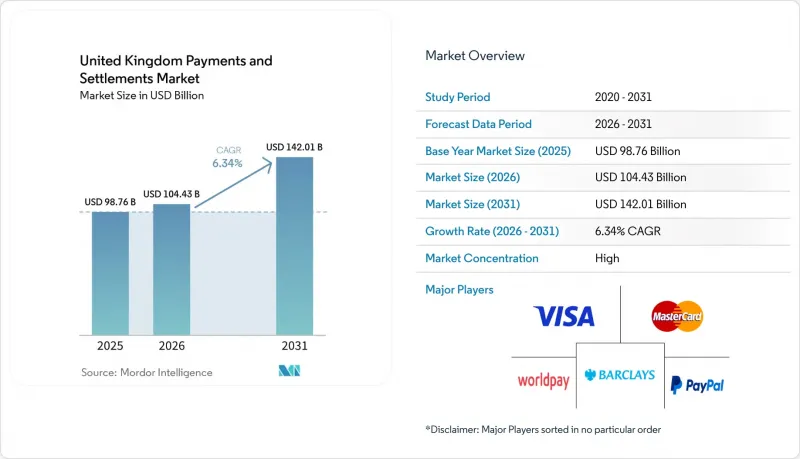
根據 Mordor Intelligence 預測,英國支付和清算市場規模預計將在 2025 年達到 987.6 億美元,2026 年達到 1,044.3 億美元,到 2031 年達到 1,420.1 億美元,2026 年至 2031 年的複合年成長率為 6.34%。
本報告按支付方式(卡片付款(金融卡、信用卡、預付)、其他)、支付類型(國內、跨境)、交易類型(企業對企業支付、其他)、終端用戶行業(零售/電子商務、其他)、支付網路基礎設施(卡網路支付、其他)以及地區(英格蘭、蘇格蘭、威爾斯、北愛爾蘭)進行細分。市場規模以美元計價。
英國支付和清算市場的趨勢和洞察
快速支付和帳戶對帳戶 (A2A) 支付的廣泛採用正在取代批量處理的商業支付網路。
英國支付和清算市場正受益於企業擴大使用即時支付方式進行日常轉帳。預計到2024年,快速支付(Faster Payments)將佔英國企業間支付的50%,首次超過Bacs直接貸記(Bacs Direct Credit)。這種轉變要求清算銀行全天候管理流動性,而不是像以往那樣以每日結算週期為中心。在英國電子商務生態系統中,帳戶間(A2A)支付的普及率與更廣泛的歐洲市場相比仍然較低。這表明,隨著消費者和商家擴大採用能夠降低交易成本、加快支付速度並增強支付安全性的直接銀行解決方案,A2A支付具有巨大的成長潛力。對商家而言,試用這些服務的理由顯而易見,因為它們既能幫助他們減少對卡片付款費的依賴,又能保持即時驗證功能。
英國的開放銀行和車輛回收計畫(VRP)實施進入商業化階段。
2025年,開放銀行結算交易量達3.51億筆,年增57%。綜合可變時間結算的交易量成長了98%,截至2025年12月,用戶連線數達到1,650萬。支付發起服務(PIS)的API呼叫量成長了53%,是帳戶資訊服務(AIS)呼叫量成長率的兩倍多。英國支付資訊署(UKPI)的商業可變回收計畫(VRP)於2026年6月2日運作,面向一般電子商務的「第二階段」計畫於2026年底推出。 VRP佔開放銀行交易量的16%,顯示時間結算在英國結算和清算市場中的重要性日益凸顯。英國金融行為監理局(FCA)計畫在2026年底前討論一項長期開放銀行框架,而監理合規準備工作是市場參與企業產業計畫的核心議題。
應用程式詐騙賠償責任正在重塑支付公司的成本模式。
強制性的已通過核准推送支付(APP)詐騙保護框架從根本上重構了英國支付生態系統的詐騙風險管理,明確了付款方和收款方支付服務供應商在符合條件的詐騙損失方面的責任分類。該法規強化了支付業者的財務課責,並要求其採取更強力的詐欺防制策略、擴大風險儲備,以及建立更完善的營運管理系統,以保障盈利。由於與購買相關的詐欺仍然是APP詐欺中最常見的形式,支付服務供應商正增加對即時詐欺偵測、商家檢驗和增強預付款認證的投入,以減少支付授權前的非法貿易。
細分市場分析
到2025年,卡片付款將佔英國支付結算市場佔有率的40.78%。 2024年英國共發生488億筆支付交易,其中簽帳金融卡支付261億筆,佔所有支付交易的53%。簽帳金融卡在日常消費中繼續扮演核心角色,廣泛應用於零售、旅遊和定期消費等各種場景。數位錢包是第二大支付方式,2024年英國成年人中註冊行動錢包的比例將達到57%,高於2023年的42%。先買後付(BNPL)和嵌入式信用的使用率在2024年將達到25%,高於2023年的14%。先買後付的監管將於2026年7月15日生效,屆時數百萬用戶將需要獲得授權、支付能力評估和金融申訴專員服務。隨著開放銀行推動帳戶間轉帳和即時支付的普及,傳統銀行轉帳的交易佔有率正在下降。這些變化表明,支付服務提供者需要支援多種消費者支付方式,而不是依賴單一的支付方法。
預計從2026年到2031年,數位資產、穩定幣和代幣化支付的複合年成長率將達到15.89%。 2026年6月,英國金融行為監理局(FCA)發布了英國持牌穩定幣發行機構的最終規則,該規則將於2027年10月生效。英格蘭銀行和FCA也共同製定了針對系統性穩定幣發行機構的聯合方案。這些框架將為機構發行機構在開發以英鎊計價的穩定幣產品時提供更清晰的界線。受監管的以英鎊計價的穩定幣有望提供可程式設計的高價值支付和嵌入式合規資訊。由於這些產品必須同時滿足監管和營運要求,英國支付和清算市場將繼續需要嚴格的監管。與此類監管相關的成本預計將用於支持對發行機構、託管機構和支付基礎設施的投資。雖然卡片付款仍然很重要,但其主導地位正受到直接帳戶轉帳和專為數位資產設計的支付網路的挑戰。
至2025年,國內支付將佔按支付類型分類的總交易量的78.34%。 2024年,CHAPS系統將處理87.5兆英鎊(111兆美元)的交易額,佔英國所有英鎊計價支付的88%。 Bacs直接扣款將繼續支援每年49億筆定期扣款指令。這些國內資金流動為英國支付和清算市場提供了穩定的基礎,因為家庭和企業都依賴它們進行日常收款和匯款。正是如此龐大的規模使得英國清算系統的變革影響深遠,其範圍遠超過消費者支付。國內支付服務提供者必須在可靠性、即時驗證、資料要求和詐欺防範之間取得平衡。雖然大規模企業和金融交易仍然集中在高價值系統上,但日常支付擴大透過即時支付系統進行處理。
預計到2031年,跨境支付將以8.56%的複合年成長率成長。儘管傳統銀行仍處理大部分高價值代理交易,但Wise在2026會計年度處理了超過2,400億美元的跨境交易。 2026年1月,英鎊成為歐元區以外SWIFT跨境流動交易量第三大的貨幣。超過70家全球金融機構已同意在2026年全面實施SWIFT的微支付架構。 2025年9月,英國線上消費佔銀行卡總使用量的50.5%,推動了無卡(CNP)跨境支付量的成長。儘管英國支付和清算市場正受益於這些趨勢,但透明的定價和可追溯的支付狀態對於服務提供者獲取消費者和中小企業的支付流量至關重要。跨境服務還需要滿足日益成長的對處理速度、驗證和合規資料的期望。
其他好處
- Excel格式的市場預測(ME)表
- 3個月的分析師支持
目錄
第1章:引言
- 研究假設和市場定義
- 調查範圍
第2章:調查方法
第3章執行摘要
第4章 市場狀況
- 市場概覽
- 市場促進因素
- 從現金和支票過渡到電子支付
- 更快的付款方式和帳戶間結算(A2A結算)的普及
- 英國引入開放銀行和浮動利率定期結算
- 非接觸式支付、行動錢包和嵌入式結帳系統的擴展
- 英國支付基礎設施現代化及ISO 20022標準的實施
- 商家對低成本直接銀行支付的需求
- 市場限制因素
- 已通過核准推播付款(APP)詐騙和賠償風險
- 英國二級金融機構傳統核心銀行體系的局限性
- 英國信用卡支付系統費用不斷上漲,以及商家轉換其他支付服務商造成的摩擦。
- 英國在開放銀行與新型支付技術的監理轉型過程零散
- 價值和供應鏈分析
- 監理情勢
- 技術展望
- 波特五力分析
第5章 市場規模與成長預測
- 透過支付方式
- 卡片付款(金融卡、信用卡、預付)
- 數位錢包和行動支付
- 帳戶間結算和即時結算
- 傳統銀行轉賬
- 後付費(先買後付)和嵌入式信用
- 數位資產、穩定幣、代幣化支付
- 其他付款方式
- 按付款方式
- 國內的
- 跨境
- 按交易類型
- 企業對企業 (B2B) 支付
- 消費者對企業 (C2B) 支付
- 企業對消費者 (B2C) 支付
- 個人對個人 (C2C) 付款
- 按最終用戶行業分類
- 零售與電子商務
- 銀行和金融服務
- 衛生保健
- 飯店、旅遊和旅遊業
- 政府/公共部門
- 教育
- 交通運輸與出行
- 製造和工業服務
- 專業服務/商業服務
- 其他行業
- 透過支付網路基礎設施
- 卡網路支付
- 自動清算系統 (ACH) 支付
- 即時全額結算
- 高速/即時支付系統
- 代理銀行和基於SWIFT的結算
- 支付系統的互聯
- 代幣化和分散式帳本支付
- 按地區
- 英格蘭
- 蘇格蘭
- 威爾斯
- 北愛爾蘭
第6章 競爭情勢
- 市場集中度
- 策略趨勢
- 市佔率分析
- 公司簡介
- Visa Inc.
- Mastercard Incorporated
- Worldpay Group Limited
- PayPal Holdings, Inc.
- Barclays PLC
- Adyen NV
- Stripe, Inc.
- Juspay Technologies
- Checkout.com Group Ltd.
- HSBC Holdings plc
- Lloyds Banking Group plc
- NatWest Group plc
- Wise plc
- Revolut Ltd.
- GoCardless Ltd.
- SumUp Limited
- Block, Inc.(Square)
- Fiserv, Inc.
- ACI Worldwide, Inc.
- Trustly Group AB
- Klarna Bank AB
第7章 市場機會與未來展望
According to Mordor Intelligence, the United Kingdom payments and settlements market size is projected to be USD 98.76 billion in 2025, USD 104.43 billion in 2026, and reach USD 142.01 billion by 2031, growing at a CAGR of 6.34% from 2026 to 2031.
This report is Segmented by Mode of Payment (Card Payments (Debit, Credit, Prepaid), and More), Payment Type (Domestic, Cross-Border), Transaction Type (Business-To-Business Payments, and More), End-User Industry (Retail and E-Commerce, and More), Settlement Rail and Infrastructure (Card-Network Settlement, and More), and Geography (England, Scotland, Wales, Northern Ireland). Value (USD).
United Kingdom Payments and Settlements Market Trends and Insights
Faster Payments and A2A Adoption Displace Batch-Based Business Payment Rails
The United Kingdom payments and settlements market is benefiting as businesses use real-time payments for a larger share of routine transfers. Faster Payments accounted for 50% of the United Kingdom business payments in 2024, surpassing Bacs Direct Credit for the first time . This shift requires settlement banks to manage liquidity throughout the day and night rather than around end-of-day cycles. Account-to-account payments remain underpenetrated in the United Kingdom e-commerce ecosystem compared with broader European markets, highlighting significant growth headroom as consumers and merchants increasingly adopt direct bank payment solutions that offer lower transaction costs, faster settlement, and enhanced payment security. Merchants have a clear reason to test these services because they can reduce reliance on card processing fees while retaining access to immediate confirmation.
United Kingdom Open Banking and VRP Rollout Enter Their Commercial Phase
Open banking payments reached 351 million in 2025, up 57% from the prior year. Sweeping variable recurring payment volumes grew 98%, while user connections reached 16.5 million by December 2025. Payment Initiation Service API calls increased 53%, more than twice the pace reported for Account Information Service calls . The UKPI commercial VRP scheme went live on June 2, 2026, and Wave 2 for general e-commerce is targeted for the end of 2026. VRPs accounted for 16% of open banking transactions, indicating that the use of recurring payments is becoming a meaningful part of the United Kingdom's payments and settlements market. The FCA plans to consult on the longer-term open banking framework before the end of 2026, making regulatory readiness central to scheme participants' operating plans.
APP Fraud Reimbursement Liability Restructures Payment Firm, Cost Models
The mandatory authorized push payment (APP) fraud reimbursement framework has fundamentally reshaped fraud risk management across the United Kingdom payments ecosystem by introducing shared liability between sending and receiving payment service providers for eligible fraud losses. The regulation increases financial accountability for payment providers, requiring stronger fraud prevention strategies, enhanced risk provisioning, and more robust operational controls to protect profitability. As purchase fraud remains the most common form of APP fraud, payment service providers are increasingly investing in real-time fraud detection, merchant verification, and enhanced pre-payment authentication to reduce fraudulent transactions before payment authorization.
Other drivers and restraints analyzed in the detailed report include:
- Bank of England RT2 and ISO 20022 Adoption Position CHAPS for Cross-Border Interoperability
- Contactless and Mobile Wallet Expansion Accelerates Across Demographic Groups
- Legacy Core-Banking Architecture Limits Real-Time Participation at Tier-2 Institutions
For complete list of drivers and restraints, kindly check the Table Of Contents.
Segment Analysis
Card payments held 40.78% of the United Kingdom payments and settlements market share in 2025. Debit cards accounted for 26.1 billion of the 48.8 billion payments made in the United Kingdom in 2024, equal to 53% of all payments. The segment remains central to daily spending because it is accepted across retail, travel, and recurring purchases. Digital Wallets were the second-largest mode, with 57% of the United Kingdom adults registered for mobile wallets in 2024, up from 42% in 2023. BNPL and Embedded Credit reached 25% adoption among adults in 2024, up from 14% in 2023. Regulation of deferred payment credit began on July 15, 2026, requiring authorization, affordability assessments, and access to the Financial Ombudsman Service for millions of users. Account-to-account and instant payments continue to scale through open banking, while traditional bank transfers are losing share of volume. These shifts show why payment acceptance providers need to support multiple consumer payment options rather than rely on a single instrument.
Digital assets, Stablecoins, and Tokenized Payments are forecast to grow at a 15.89% CAGR from 2026 to 2031. The FCA published final rules for the United Kingdom-authorized stablecoin issuers in June 2026, which will apply from October 2027. The Bank of England and FCA also set out a joint approach for systemic stablecoin issuers. These frameworks give institutional issuers clearer boundaries for developing sterling stablecoin products. A regulated sterling stablecoin could offer programable high-value settlement and embedded compliance information. The United Kingdom payments and settlements market will still need strong controls because these products must meet both regulatory and operational requirements. The cost of those controls is likely to support investment in issuer, custody, and settlement infrastructure. Card payments will remain important, but their lead is being tested by rails designed for direct account transfer and digital assets.
Domestic payments held 78.34% of payment-type volume in 2025. CHAPS processed GBP 87.5 trillion (USD 111 trillion) in 2024, representing 88% of the United Kingdom's sterling payment value. Bacs Direct Debit continued to support 4.9 billion recurring instructions each year. These domestic flows provide a stable base for the United Kingdom's payments and settlements market, as households and businesses rely on them for regular collections and transfers. Their scale also explains why changes to the United Kingdom clearing systems have broad effects beyond consumer checkout. Domestic providers must balance reliability, immediate confirmation, data requirements, and fraud prevention. Large corporate and financial transactions remain concentrated in high-value systems, while routine payments increasingly move through real-time rails.
Cross-Border payments are forecast to grow at an 8.56% CAGR through 2031. Incumbent banks continue to process most high-value correspondent transactions, while Wise processed more than USD 240 billion in cross-border transactions during the financial year 2026. The pound became the third-most-active currency in non-eurozone SWIFT cross-border flows in January 2026. SWIFT's retail payments framework has commitments from more than 70 global financial institutions for live implementation in 2026. Online spending accounted for 50.5% of total United Kingdom card spending in September 2025, increasing the relevant volume of card-not-present cross-border payments. The United Kingdom payments and settlements market benefits from this activity, but providers need transparent pricing and traceable payment status to compete for consumer and small-business flows. Cross-border services will also face rising expectations for speed, confirmation, and compliance data.
Complete Report Scope:
- By Mode of Payment
- Card Payments (Debit, Credit, Prepaid)
- Digital Wallets & Mobile Money
- Account-to-Account & Instant Payments
- Traditional Bank Transfers
- Buy Now, Pay Later & Embedded Credit
- Digital Assets, Stablecoins & Tokenised Payments
- Other Payments
- By Payment Type
- Domestic
- Cross-Border
- By Transaction Type
- Business-to-Business Payments
- Consumer-to-Business Payments
- Business-to-Consumer Payments
- Consumer-to-Consumer Payments
- By End-User Industry
- Retail and E-Commerce
- Banking and Financial Services
- Healthcare
- Hospitality, Travel, and Tourism
- Government and Public Sector
- Education
- Transportation and Mobility
- Manufacturing and Industrial Services
- Professional Services and Business Services
- Other Industries
- By Settlement Rail and Infrastructure
- Card-Network Settlement
- Automated Clearing House Settlement
- Real-Time Gross Settlement
- Fast / Instant Payment Systems
- Correspondent Banking and SWIFT-Based Settlement
- Payment-System Interlinking
- Tokenized and Distributed-Ledger Settlement
- By Geography
- England
- Scotland
- Wales
- Northern Ireland
List of Companies Covered in this Report:
- Visa Inc.
- Mastercard Incorporated
- Worldpay Group Limited
- PayPal Holdings, Inc.
- Barclays PLC
- Adyen N.V.
- Stripe, Inc.
- Juspay Technologies
- Checkout.com Group Ltd.
- HSBC Holdings plc
- Lloyds Banking Group plc
- NatWest Group plc
- Wise plc
- Revolut Ltd.
- GoCardless Ltd.
- SumUp Limited
- Block, Inc. (Square)
- Fiserv, Inc.
- ACI Worldwide, Inc.
- Trustly Group AB
- Klarna Bank AB
Additional Benefits:
- The market estimate (ME) sheet in Excel format
- 3 months of analyst support
TABLE OF CONTENTS
1 INTRODUCTION
- 1.1 Study Assumptions and Market Definition
- 1.2 Scope of the Study
2 RESEARCH METHODOLOGY
3 EXECUTIVE SUMMARY
4 MARKET LANDSCAPE
- 4.1 Market Overview
- 4.2 Market Drivers
- 4.2.1 Migration From Cash and Cheques to Electronic Payments
- 4.2.2 Faster Payments and Account-to-Account Adoption
- 4.2.3 United Kingdom Open Banking and Variable Recurring Payments Rollout
- 4.2.4 Contactless, Mobile Wallet, and Embedded Checkout Expansion
- 4.2.5 United Kingdom Settlement Infrastructure Modernization and ISO 20022 Adoption
- 4.2.6 Merchant Demand for Lower-Cost Direct Bank Payments
- 4.3 Market Restraints
- 4.3.1 Authorized Push Payment Fraud and Reimbursement Exposure
- 4.3.2 Legacy Core-Banking Constraints at United Kingdom Tier-2 Institutions
- 4.3.3 United Kingdom Card Scheme Fee Inflation and Merchant Switching Friction
- 4.3.4 Fragmented United Kingdom Regulatory Transition for Open Banking and New Payment Technologies
- 4.4 Value and Supply-Chain Analysis
- 4.5 Regulatory Landscape
- 4.6 Technological Outlook
- 4.7 Porter's Five Forces Analysis
- 4.7.1 Competitive Rivalry Analysis
- 4.7.2 Threat of New Entrants Analysis
- 4.7.3 Bargaining Power of Suppliers Analysis
- 4.7.4 Bargaining Power of Merchants and Buyers Analysis
- 4.7.5 Threat of Substitutes Analysis
5 MARKET SIZE AND GROWTH FORECASTS
- 5.1 By Mode of Payment
- 5.1.1 Card Payments (Debit, Credit, Prepaid)
- 5.1.2 Digital Wallets & Mobile Money
- 5.1.3 Account-to-Account & Instant Payments
- 5.1.4 Traditional Bank Transfers
- 5.1.5 Buy Now, Pay Later & Embedded Credit
- 5.1.6 Digital Assets, Stablecoins & Tokenised Payments
- 5.1.7 Other Payments
- 5.2 By Payment Type
- 5.2.1 Domestic
- 5.2.2 Cross-Border
- 5.3 By Transaction Type
- 5.3.1 Business-to-Business Payments
- 5.3.2 Consumer-to-Business Payments
- 5.3.3 Business-to-Consumer Payments
- 5.3.4 Consumer-to-Consumer Payments
- 5.4 By End-User Industry
- 5.4.1 Retail and E-Commerce
- 5.4.2 Banking and Financial Services
- 5.4.3 Healthcare
- 5.4.4 Hospitality, Travel, and Tourism
- 5.4.5 Government and Public Sector
- 5.4.6 Education
- 5.4.7 Transportation and Mobility
- 5.4.8 Manufacturing and Industrial Services
- 5.4.9 Professional Services and Business Services
- 5.4.10 Other Industries
- 5.5 By Settlement Rail and Infrastructure
- 5.5.1 Card-Network Settlement
- 5.5.2 Automated Clearing House Settlement
- 5.5.3 Real-Time Gross Settlement
- 5.5.4 Fast / Instant Payment Systems
- 5.5.5 Correspondent Banking and SWIFT-Based Settlement
- 5.5.6 Payment-System Interlinking
- 5.5.7 Tokenized and Distributed-Ledger Settlement
- 5.6 By Geography
- 5.6.1 England
- 5.6.2 Scotland
- 5.6.3 Wales
- 5.6.4 Northern Ireland
6 COMPETITIVE LANDSCAPE
- 6.1 Market Concentration
- 6.2 Strategic Moves
- 6.3 Market Share Analysis
- 6.4 Company Profiles (includes Global Level Overview, Market Level Overview, Core Segments, Financials as available, Strategic Information, Market Rank/Share, Products and Services, Recent Developments)
- 6.4.1 Visa Inc.
- 6.4.2 Mastercard Incorporated
- 6.4.3 Worldpay Group Limited
- 6.4.4 PayPal Holdings, Inc.
- 6.4.5 Barclays PLC
- 6.4.6 Adyen N.V.
- 6.4.7 Stripe, Inc.
- 6.4.8 Juspay Technologies
- 6.4.9 Checkout.com Group Ltd.
- 6.4.10 HSBC Holdings plc
- 6.4.11 Lloyds Banking Group plc
- 6.4.12 NatWest Group plc
- 6.4.13 Wise plc
- 6.4.14 Revolut Ltd.
- 6.4.15 GoCardless Ltd.
- 6.4.16 SumUp Limited
- 6.4.17 Block, Inc. (Square)
- 6.4.18 Fiserv, Inc.
- 6.4.19 ACI Worldwide, Inc.
- 6.4.20 Trustly Group AB
- 6.4.21 Klarna Bank AB
7 MARKET OPPORTUNITIES AND FUTURE OUTLOOK
- 7.1 White-Space and Unmet-Need Assessment

 歐洲清算所和結算機構:市場佔有率分析、行業趨勢和統計數據以及成長預測(2026-2031 年)清算所和結算機構:市場佔有率分析、行業趨勢和統計數據、成長預測(2026-2031 年)支付與結算:市場佔有率分析、產業趨勢與統計、成長預測(2026-2031)
 2026年全球清算結算市場報告即時支付:市場佔有率分析、產業趨勢與統計、成長預測(2026-2031)
 支付監控市場規模、佔有率和成長分析:按組件、部署模式、應用、最終用戶和地區分類-2026-2033年產業預測
 全球支付監控市場
 清算結算系統市場預測至2034年:按交易後功能、支援的資產類別、基礎設施類型、部署方式和最終用戶分類的全球分析2026年全球補丁編配平台市場報告
 即時支付市場分析及至2035年預測:依類型、產品、服務、技術、組件、應用、最終用戶、部署模式及類型分類