


 |
市場調查報告書
商品編碼
2119344
技術偵察即服務:市場佔有率分析、行業趨勢和統計數據、成長預測(2026-2031 年)Technology Scouting-as-a-Service - Market Share Analysis, Industry Trends & Statistics, Growth Forecasts (2026 - 2031) |
||||||

※ 本網頁內容可能與最新版本有所差異。詳細情況請與我們聯繫。
據 Mordor Intelligence 稱,技術偵察即服務 (TSaaS) 市場在 2025 年的價值為 14.5 億美元,預計到 2031 年將從 2026 年的 16.7 億美元成長到 33.9 億美元,在預測期(2026-2031 年)成長到 33.9 億美元,在預測期為 1521%。
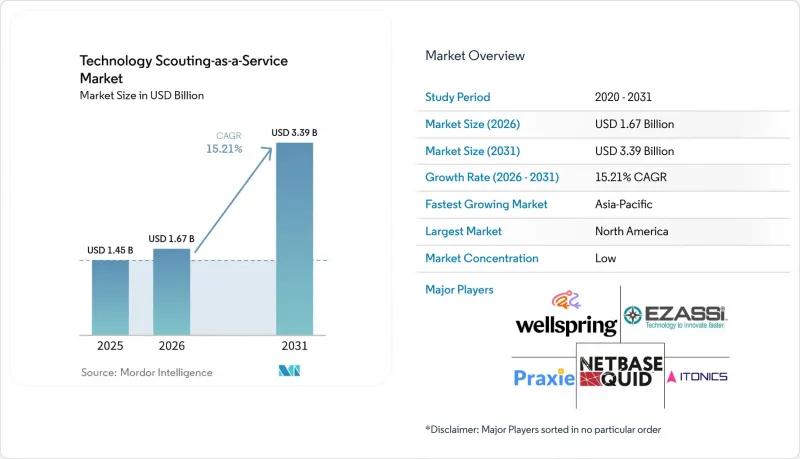
本報告按交付模式(軟體訂閱、託管式市場研究服務和混合軟體服務)、最終用戶(例如企業研發和工程部門)、企業規模(大型企業和中小企業)、技術和架構(例如 4G 和 LTE)以及地區進行細分。市場預測以美元計價。
全球技術偵察即服務市場趨勢與洞察
企業壓力迫使企業縮短創新週期
當產品和研發負責人需要更快地取得外部資訊以輔助投資決策時,「技術偵察即服務」市場便能從中受益。更短的研發週期減少了團隊單獨研究專利、文獻和新創企業的時間。這種服務模式為創新領導者提供了一種系統化的方法,即使在進行重大策略調整時也能持續收集外部資訊。這有助於及早識別能夠補充內部研發專案的技術,並幫助團隊在投入資源進行長期研發專案之前比較外部選項。因此,訂閱和持續的研究請求可以成為持續創新工作的一部分,而不是一次性專案。
利用人工智慧輔助發現專利、出版品和新創公司。
人工智慧正在改變服務供應商搜尋大量且分散的技術資訊來源的方式。 2026年6月,PatSnap擴展了其「Hiro」平台,新增了互動式搜尋功能,可搜尋涵蓋174個互動式的超過2.08億項專利、2.15億份非專利文件以及16億個法律資料點。如此龐大的規模顯著縮短了建構初始技術格局所需的時間。因此,在技術偵察即服務(TaaS)市場中,能夠針對特定商業性挑戰系統化搜尋結果的系統正變得越來越有價值。僅僅具備搜尋搜尋是不夠的,因為重複的實體和不完整的記錄會降低輸出結果的可靠性。只有擁有強大的資料匹配和審核流程的服務供應商,才能使人工智慧驅動的研究對企業團隊更有價值。
保密性和資料主權要求
高度敏感的客戶問詢可能會限制透過雲端交付的技術偵察服務的使用。專有技術差距搜尋可能會暴露公司的產品優先順序、合作夥伴意圖和研發方向。 IBM 在 2026 年 6 月發布的報告顯示,68% 的受訪高階主管認為跨司法管轄區的資料居住要求是一項重大的營運挑戰。因此,技術偵察即服務 (TSaaS) 市場需要為在多個司法管轄區營運的客戶提供明確的資料管理架構。客戶可控的加密、地理資料儲存和透明的存取規則可以緩解採購方面的擔憂。如果供應商無法解釋如何處理敏感搜尋及其相關交付物,則可能會面臨企業銷售週期延長的問題。
細分市場分析
截至2025年,軟體訂閱模式佔據了「技術偵察即服務」市場佔有率的42.14%。這種模式符合現有的技術預算,並為採購團隊提供了可預測的年度授權模式。此外,這種模式允許研究、智慧財產權和創新負責人在遇到問題時直接搜尋資訊。這項優勢體現了持續存取專有資料、搜尋工具和監控功能的價值。 「技術偵察即服務」市場在這種交付模式下的規模主要得益於那些將技術偵察作為一項持續內部職能的組織。然而,使用者仍然需要大量的內部專業知識來設定明確的搜尋標準並評估結果。這限制了完全自助式模式對小規模的創新團隊的吸引力。
預計從2026年到2031年,託管式探勘服務將以16.42%的複合年成長率成長,成為該細分市場中成長最快的服務。這是因為該服務滿足了買家的需求,他們需要的是能夠直接影響決策的成果,而不是僅僅訪問研究入口網站。這些客戶可以利用外部分析師進行技術格局分析、合作夥伴篩檢和針對性檢驗。當組織既需要平台存取權又需要明確定義的研究要素時,混合軟體和服務仍然可行。如果採購法規明確規定了服務範圍,政府和國防部門的使用者可能更傾向於這種形式。由於自動化搜尋可以處理大部分初始發現工作,交付模式正在轉向更注重分析師支援的模式。同時提供自助服務和託管服務的供應商可以滿足內部能力各異的買家的需求。
至2025年,企業研發和工程部門將佔據技術偵察即服務(TSaaS)市場38.42%的佔有率。這些團隊利用外部資訊來了解與其發展重點相關的專利、研究活動和技術選項。與內部智慧財產權和產品團隊的長期合作,能夠使這項服務融入日常研究流程。這不僅有助於持續使用,一旦整合到工作流程中,更換供應商也變得困難。企業創新和策略團隊也利用偵察結果來支援產品組合規劃和機會選擇。採購和供應鏈部門也正在成為新的用戶,他們需要在韌性計畫中提高對潛在供應商和材料的可見度。技術偵察即服務市場為這些部門提供了一個通用的技術選擇平台。
預計到2031年,企業創投和併購團隊的複合年成長率將達到17.36%。這些團隊需要快速獲取有關早期公司、領先技術資訊和競爭對手交易趨勢的訊號。忽略目標或智慧財產權風險會直接影響收購和合作決策。因此,這些團隊非常重視能夠將新創公司監測與專利和技術分析相結合的工具。將探勘工作融入交易流程將有助於達成更高價值的合約。政府和國防機構仍然是特殊的使用者群體,因為機密資訊和採購要求可能會限制標準平台的使用。大學和研究機構也是基本客群的一部分,但它們的預算和服務需求與企業用戶不同。
區域分析
至2025年,北美將佔全球技術偵察即服務(TaaS)市場收入的38.14%。美國擁有大量的企業研發部門、企業創投項目和技術密集產業。這些用戶越來越需要系統化的方法來識別外部技術選項。生命科學和資訊通訊技術(ICT)是重要的需求來源,因為這兩個產業都管理著大量的研究數據和智慧財產權。加拿大透過創新專案和跨境研發合作做出貢獻。墨西哥則透過製造業技術升級帶來潛在需求。北美在技術偵察即服務市場中的佔有率反映了其完善的企業預算和成熟的創新流程。
歐洲是全球第二大區域市場,這主要得益於德國、英國和法國的企業研發計畫。這些國家的買家尤其重視資料管治、智慧財產權審查和跨境授權問題。這推動了對能夠記錄調查方法並保護客戶搜尋活動的供應商的需求。在義大利、西班牙和其他歐洲國家,開放式創新正在不斷擴展,而且不僅限於大型跨國公司。預計到2031年,亞太地區的複合年成長率將達到21.42%,是所有地區中最高的。一項2026年的研究分析了山東省戰略性新興產業的專利轉移數據,重點關注了中國的跨境技術採購活動。日本的智慧財產權實踐以及印度和韓國技術生態系統的發展也在推動該地區的需求。
澳洲在資源和潔淨科技領域的活動正在拓展技術偵察即服務 (TSaaS) 市場的區域機會。南美洲仍處於起步階段,但巴西的開放式創新計畫和阿根廷的研究機構正在推動需求的逐步成長。在中東,來自阿拉伯聯合大公國、沙烏地阿拉伯和卡達的主權財富基金和產業多元化計畫的投資需求也在不斷成長。在這些計劃中,技術轉移被納入更廣泛的經濟發展規劃。雖然目前來自非洲的收入規模小規模,但南非、埃及和奈及利亞的企業和公共部門的需求正在擴大。在全部區域,服務提供者需要根據當地的數據、語言和採購需求調整其調查範圍和服務模式。
其他好處:
- Excel格式的市場預測(ME)表
- 3個月的分析師支持
目錄
第1章:引言
- 研究假設和市場定義
- 調查範圍
第2章:調查方法
第3章執行摘要
第4章 市場狀況
- 市場概覽
- 市場促進因素
- 企業面臨縮短創新週期的壓力
- 利用人工智慧技術在專利、學術論文和新創公司中進行資訊發現。
- 擴大外部研發與開放式創新活動
- 在「內部開發還是外部採購」以及合作關係的決策中,需要降低風險。
- 擴大跨產業技術轉移
- 對持續監測微弱訊號和了解競爭趨勢的需求日益成長
- 市場限制因素
- 關於保密性和資料主權的要求
- 檢驗技術準備就緒性和商業性適用性的困難
- 分散式資料權限和不一致的實體解析
- 從球探挖掘到付費夥伴關係的轉換週期很長。
- 宏觀經濟因素對市場的影響
- 產業價值鏈分析
- 科技趨勢
- 監理情勢
- 波特五力分析
第5章 市場規模與成長預測
- 按型號提供
- 軟體訂閱
- 管理童軍服務
- 混合軟體和服務
- 最終用戶
- 企業研發和工程
- 企業創新與策略
- 企業創投和併購;
- 採購和供應鏈組織
- 政府和國防機構
- 大學和研究機構
- 按公司規模
- 大公司
- 小型企業
- 透過技術和架構
- 4G 和 LTE
- 5G 非獨立組網
- 5G獨立組網
- 其他技術
- 按地區
- 北美洲
- 美國
- 加拿大
- 墨西哥
- 南美洲
- 巴西
- 阿根廷
- 智利
- 其他南美國家
- 歐洲
- 德國
- 英國
- 法國
- 義大利
- 西班牙
- 其他歐洲國家
- 亞太地區
- 中國
- 日本
- 印度
- 韓國
- 澳洲
- 其他亞太國家
- 中東
- 阿拉伯聯合大公國
- 沙烏地阿拉伯
- 卡達
- 其他中東國家
- 非洲
- 南非
- 埃及
- 奈及利亞
- 其他非洲國家
- 北美洲
第6章 競爭情勢
- 市場集中度
- 策略趨勢
- 市佔率分析
- 公司簡介
- Wellspring International, Inc.
- Ezassi, Inc.
- Praxie, Inc.
- ITONICS GmbH
- NetBase Quid, Inc.
- Questel SAS
- Qmarkets Ltd.
- Clarivate Plc
- IP.com, LLC
- The Lens
- Research Solutions, Inc.
- PatSnap Pte. Ltd.
- Findest BV
- NineSigma, Inc.
- yet2.com, Inc.
- Wazoku Limited
- Inpart Limited
- PreScouter, Inc.
- GreyB Services Private Limited
- TechScout, Inc.
- Novable SRL
- Linknovate GmbH
- Traction Technology, Inc.
- HYPE Innovation GmbH
第7章 市場機會與未來展望
According to Mordor Intelligence, the technology scouting-as-a-Service market size was valued at USD 1.45 billion in 2025 and estimated to grow from USD 1.67 billion in 2026 to reach USD 3.39 billion by 2031, at a CAGR of 15.21% during the forecast period (2026-2031).
This report is Segmented by Delivery Model (Software Subscription, Managed Scouting Service, and Hybrid Software and Services), End User (Corporate R&D and Engineering, and More), Enterprise Size (Large Enterprises, and Small and Medium-Sized Enterprises), Technology and Architecture (4G and LTE, and More), and Geography. The Market Forecasts are Provided in Terms of Value (USD).
Global Technology Scouting-as-a-Service Market Trends and Insights
Enterprise Pressure to Shorten Innovation Cycles
The Technology Scouting-as-a-Service Market benefits when product and R&D leaders need faster external evidence for investment decisions. Shorter development schedules leave less time for teams to conduct separate patent, literature, and startup searches. The service model gives innovation leaders a structured way to keep external scanning active between major strategy reviews. This can support earlier identification of technologies that may complement an internal development program. It can also help teams compare external options before committing resources to a lengthy build program. As a result, subscriptions and repeat research assignments can become part of ongoing innovation operations rather than a one-time project.
AI-Assisted Discovery Across Patents, Publications, and Startups
AI is changing how providers search large and disconnected sources of technology evidence. In June 2026, PatSnap expanded Hiro to include conversational search across more than 208 million patents, 215 million non-patent literature records, and 1.6 billion legal data points from 174 jurisdictions. This scale can reduce the time required to create an initial technology landscape. The Technology Scouting-as-a-Service Market, therefore, places increasing value on systems that can organize results for a specific commercial question. Search capability alone is not enough, as duplicate entities and incomplete records can undermine the reliability of the outputs. Providers with stronger data matching and review processes can make AI-supported research more useful for enterprise teams.
Confidentiality and Data-Sovereignty Requirements
Confidential client questions can limit the use of cloud-delivered technology scouting services. A proprietary search for technical gaps can reveal a company's product priorities, partnership interests, and research direction. IBM reported in June 2026 that 68% of surveyed senior executives saw cross-jurisdictional data residency requirements as a material operational challenge. The Technology Scouting-as-a-Service Market must therefore provide clear data controls for clients operating across multiple jurisdictions. Customer-controlled encryption, regional data storage, and transparent access rules can reduce procurement concerns. Providers that cannot explain how sensitive searches and associated outputs are handled may face longer enterprise sales cycles.
Other drivers and restraints analyzed in the detailed report include:
- Rising External R&D and Open Innovation Activity
- Need to De-Risk Build-Versus-Buy and Partnership Decisions
- Difficulty Validating Technical Readiness and Commercial Fit
For complete list of drivers and restraints, kindly check the Table Of Contents.
Segment Analysis
Software subscription held 42.14% of the Technology Scouting-as-a-Service Market share in 2025. It fits within established technology budgets and provides procurement teams with a predictable annual licensing model. The format also allows research, IP, and innovation staff to search for information directly when a question arises. Its lead reflects the value of continuing access to proprietary data, search tools, and monitoring functions. The Technology Scouting-as-a-Service Market size for this delivery model is supported by organizations that use scouting as an ongoing internal capability. However, users still need enough internal expertise to create clear searches and assess the results. This limits the appeal of a fully self-service offer for smaller innovation teams.
Managed scouting service is forecast to expand at a 16.42% CAGR from 2026 to 2031, the fastest rate within this segmentation. It meets the needs of buyers who need decision-ready output rather than access to a research portal. These clients can use external analysts for technology landscaping, partner screening, and targeted validation. Hybrid software and services remain relevant where an organization wants platform access alongside a defined research component. Government and defense users may favor this arrangement when procurement rules require a clear scope of services. The delivery mix is moving toward analyst-supported work as automated search handles more of the initial discovery task. Providers that keep both self-service and managed options can serve buyers with different internal capabilities.
Corporate R&D and engineering held 38.42% of the Technology Scouting-as-a-Service Market share in 2025. These teams use external intelligence to understand patents, research activity, and technological alternatives related to their development priorities. Long-standing links with internal IP and product teams can make the service part of a regular research process. This supports recurring use and makes switching providers more difficult when workflows are embedded. Corporate innovation and strategy teams also use scouting outputs to support portfolio planning and opportunity selection. Procurement and supply chain organizations are emerging users because resilience programs require greater visibility into potential suppliers and materials. The Technology Scouting-as-a-Service Market gives these groups a common evidence base for technology choices.
Corporate venture capital and M&A teams are forecast to grow at a 17.36% CAGR through 2031. They need rapid access to early-stage company signals, prior-art information, and competitive deal activity. A missed target or an unrecognized intellectual property risk can directly affect an acquisition or partnership decision. These teams, therefore, place value on tools that combine startup monitoring with patent and technology analysis. Their demand can support higher-value contracts when scouting is integrated into transaction workflows. Government and defense organizations remain a specialized user group because classification and procurement requirements can restrict the use of standard platforms. Universities and research institutions offer an additional customer base, although their budgets and service requirements differ from those of corporate users.
Complete Report Scope:
- By Delivery Model
- Software Subscription
- Managed Scouting Service
- Hybrid Software and Services
- By End User
- Corporate R&D and Engineering
- Corporate Innovation and Strategy
- Corporate Venture Capital and M&A
- Procurement and Supply-Chain Organizations
- Government and Defense Organizations
- Universities and Research Institutions
- By Enterprise Size
- Large Enterprises
- Small and Medium-Sized Enterprises
- By Technology and Architecture
- 4G and LTE
- 5G Non-Standalone
- 5G Standalone
- Others Technologies
- By Geography
- North America
- United States
- Canada
- Mexico
- South America
- Brazil
- Argentina
- Chile
- Rest of South America
- Europe
- Germany
- United Kingdom
- France
- Italy
- Spain
- Rest of Europe
- Asia-Pacific
- China
- Japan
- India
- South Korea
- Australia
- Rest of Asia-Pacific
- Middle East
- United Arab Emirates
- Saudi Arabia
- Qatar
- Rest of Middle East
- Africa
- South Africa
- Egypt
- Nigeria
- Rest of Africa
- North America
Geography Analysis
North America accounted for 38.14% of the global Technology Scouting-as-a-Service Market revenue in 2025. The United States has a large base of corporate R&D functions, corporate venture programs, and technology-intensive industries. These users increasingly need a structured way to identify external technology options. Life sciences and information and communications technology are important sources of demand because both sectors manage large volumes of research and intellectual property. Canada contributes through innovation programs and cross-border R&D links. Mexico adds potential demand through manufacturing technology upgrades. North America's Technology Scouting-as-a-Service Market share reflects established enterprise budgets and mature innovation processes.
Europe is the second-largest regional market, supported by corporate R&D programs in Germany, the United Kingdom, and France. Buyers in these countries place particular emphasis on data governance, intellectual property review, and cross-border licensing questions. This supports demand for providers that can document research methods and protect client search activity. Italy, Spain, and other European countries are expanding their use of open innovation beyond the largest multinationals. Asia-Pacific is forecast to grow at a 21.42% CAGR through 2031, the fastest regional rate. China's cross-border technology sourcing activity is documented in a 2026 study of patent transfer data from Shandong Province's strategic emerging industries. Japan's intellectual property practices and the development of technology ecosystems in India and South Korea add to regional demand.
Australia's resource and clean technology activity broadens the regional opportunity for the Technology Scouting-as-a-Service Market. South America remains at an earlier stage, with Brazil's open-innovation programs and Argentina's research institutions supporting gradual growth in demand. The Middle East is also seeing growing demand for investment from sovereign wealth funds and industrial diversification programs in the United Arab Emirates, Saudi Arabia, and Qatar. These programs place technology transfer within wider economic development plans. Africa currently contributes modest revenue, but South Africa, Egypt, and Nigeria offer developing sources of enterprise and public-sector demand. Across these regions, providers need to adapt their research coverage and service model to local data, language, and procurement needs.
- Wellspring International, Inc.
- Ezassi, Inc.
- Praxie, Inc.
- ITONICS GmbH
- NetBase Quid, Inc.
- Questel SAS
- Qmarkets Ltd.
- Clarivate Plc
- IP.com, LLC
- The Lens
- Research Solutions, Inc.
- PatSnap Pte. Ltd.
- Findest B.V.
- NineSigma, Inc.
- yet2.com, Inc.
- Wazoku Limited
- Inpart Limited
- PreScouter, Inc.
- GreyB Services Private Limited
- TechScout, Inc.
- Novable SRL
- Linknovate GmbH
- Traction Technology, Inc.
- HYPE Innovation GmbH
Additional Benefits:
- The market estimate (ME) sheet in Excel format
- 3 months of analyst support
TABLE OF CONTENTS
1 INTRODUCTION
- 1.1 Study Assumptions and Market Definition
- 1.2 Scope of the Study
2 RESEARCH METHODOLOGY
3 EXECUTIVE SUMMARY
4 MARKET LANDSCAPE
- 4.1 Market Overview
- 4.2 Market Drivers
- 4.2.1 Enterprise Pressure to Shorten Innovation Cycles
- 4.2.2 AI-Assisted Discovery Across Patents, Publications, and Startups
- 4.2.3 Rising External R&D and Open Innovation Activity
- 4.2.4 Need to De-Risk Build-versus-Buy and Partnership Decisions
- 4.2.5 Expansion of Cross-Industry Technology Transfer
- 4.2.6 Demand for Continuous Weak-Signal and Competitive Monitoring
- 4.3 Market Restraints
- 4.3.1 Confidentiality and Data-Sovereignty Requirements
- 4.3.2 Difficulty Validating Technical Readiness and Commercial Fit
- 4.3.3 Fragmented Data Rights and Inconsistent Entity Resolution
- 4.3.4 Long Conversion Cycles from Scouting to Paid Partnerships
- 4.4 Impact of Macroeconomic Factors on the Market
- 4.5 Industry Value-Chain Analysis
- 4.6 Technology Outlook
- 4.7 Regulatory Landscape
- 4.8 Porter's Five Forces Analysis
- 4.8.1 Threat of New Entrants
- 4.8.2 Bargaining Power of Suppliers
- 4.8.3 Bargaining Power of Buyers
- 4.8.4 Threat of Substitutes
- 4.8.5 Intensity of Competitive Rivalry
5 MARKET SIZE AND GROWTH FORECASTS (VALUE)
- 5.1 By Delivery Model
- 5.1.1 Software Subscription
- 5.1.2 Managed Scouting Service
- 5.1.3 Hybrid Software and Services
- 5.2 By End User
- 5.2.1 Corporate R&D and Engineering
- 5.2.2 Corporate Innovation and Strategy
- 5.2.3 Corporate Venture Capital and M&A
- 5.2.4 Procurement and Supply-Chain Organizations
- 5.2.5 Government and Defense Organizations
- 5.2.6 Universities and Research Institutions
- 5.3 By Enterprise Size
- 5.3.1 Large Enterprises
- 5.3.2 Small and Medium-Sized Enterprises
- 5.4 By Technology and Architecture
- 5.4.1 4G and LTE
- 5.4.2 5G Non-Standalone
- 5.4.3 5G Standalone
- 5.4.4 Others Technologies
- 5.5 By Geography
- 5.5.1 North America
- 5.5.1.1 United States
- 5.5.1.2 Canada
- 5.5.1.3 Mexico
- 5.5.2 South America
- 5.5.2.1 Brazil
- 5.5.2.2 Argentina
- 5.5.2.3 Chile
- 5.5.2.4 Rest of South America
- 5.5.3 Europe
- 5.5.3.1 Germany
- 5.5.3.2 United Kingdom
- 5.5.3.3 France
- 5.5.3.4 Italy
- 5.5.3.5 Spain
- 5.5.3.6 Rest of Europe
- 5.5.4 Asia-Pacific
- 5.5.4.1 China
- 5.5.4.2 Japan
- 5.5.4.3 India
- 5.5.4.4 South Korea
- 5.5.4.5 Australia
- 5.5.4.6 Rest of Asia-Pacific
- 5.5.5 Middle East
- 5.5.5.1 United Arab Emirates
- 5.5.5.2 Saudi Arabia
- 5.5.5.3 Qatar
- 5.5.5.4 Rest of Middle East
- 5.5.6 Africa
- 5.5.6.1 South Africa
- 5.5.6.2 Egypt
- 5.5.6.3 Nigeria
- 5.5.6.4 Rest of Africa
- 5.5.1 North America
6 COMPETITIVE LANDSCAPE
- 6.1 Market Concentration
- 6.2 Strategic Moves
- 6.3 Market Share Analysis
- 6.4 Company Profiles (includes Global Level Overview, Market Level Overview, Core Segments, Financials as available, Strategic Information, Market Rank/Share, Products and Services, Recent Developments)
- 6.4.1 Wellspring International, Inc.
- 6.4.2 Ezassi, Inc.
- 6.4.3 Praxie, Inc.
- 6.4.4 ITONICS GmbH
- 6.4.5 NetBase Quid, Inc.
- 6.4.6 Questel SAS
- 6.4.7 Qmarkets Ltd.
- 6.4.8 Clarivate Plc
- 6.4.9 IP.com, LLC
- 6.4.10 The Lens
- 6.4.11 Research Solutions, Inc.
- 6.4.12 PatSnap Pte. Ltd.
- 6.4.13 Findest B.V.
- 6.4.14 NineSigma, Inc.
- 6.4.15 yet2.com, Inc.
- 6.4.16 Wazoku Limited
- 6.4.17 Inpart Limited
- 6.4.18 PreScouter, Inc.
- 6.4.19 GreyB Services Private Limited
- 6.4.20 TechScout, Inc.
- 6.4.21 Novable SRL
- 6.4.22 Linknovate GmbH
- 6.4.23 Traction Technology, Inc.
- 6.4.24 HYPE Innovation GmbH
7 MARKET OPPORTUNITIES AND FUTURE OUTLOOK
- 7.1 White-Space and Unmet-Need Assessment

 數位城市人工智慧解決方案市場:全球市場預測,2026-2032年
 全球循環經濟貨幣化管理市場預測至2034年:依收入模式、收入活動、價值流、貨幣化管道、最終用戶和地區分類
 Web3行銷服務:市場佔有率分析、產業趨勢與統計、成長預測(2026-2031年)
 勝負分析服務市場規模、佔有率和成長分析:按服務類型、交付方式、應用、最終用戶和地區分類-2026-2033年產業預測人工智慧驅動的農場管理軟體市場預測至2034年:按部署類型、軟體模組、人工智慧技術、應用、最終用戶和地區分類的全球分析勞動力評估平台市場預測至2034年-按組件、部署模式、評估類型、企業規模、應用、最終用戶和地區分類的全球分析循環收益管理市場:預測至 2034 年 - 按收益模式、管理功能、平台類型、部署模式、最終用戶和地區分類的全球分析人工智慧專業服務市場:全球市場預測,2026-2032年預測性案源計分軟體:市場佔有率分析、產業趨勢和統計數據、成長預測(2026-2031 年)意向資料軟體:市場佔有率分析、產業趨勢與統計、成長預測(2026-2031)