


 |
市場調查報告書
商品編碼
2117592
預測性案源計分軟體:市場佔有率分析、產業趨勢和統計數據、成長預測(2026-2031 年)Predictive Lead Scoring Software - Market Share Analysis, Industry Trends & Statistics, Growth Forecasts (2026 - 2031) |
||||||

※ 本網頁內容可能與最新版本有所差異。詳細情況請與我們聯繫。
根據 Mordor Intelligence 預測,預測性案源計分軟體的市場規模預計將從 2025 年的 20.7 億美元和 2026 年的 24.6 億美元成長到 2031 年的 62.8 億美元,2026 年至 2031 年的複合年成長率為 20.62%。
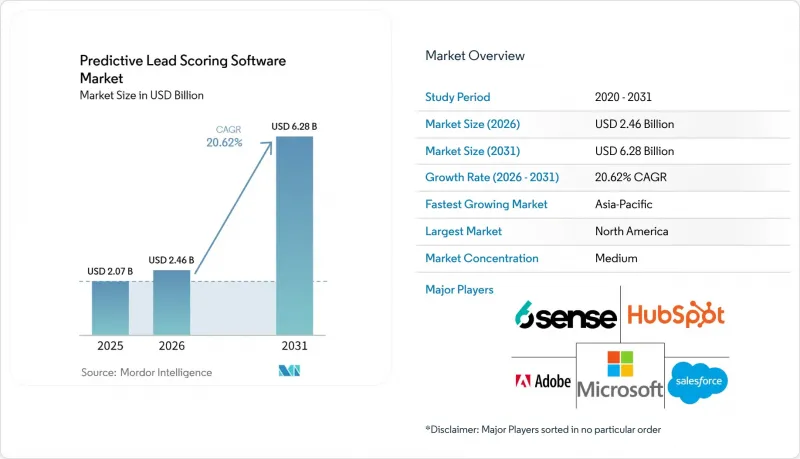
本報告按組件(軟體和服務)、部署類型(雲端、混合、本地部署)、企業規模(大型企業和中小企業)、應用程式(線索合格和優先排序等)、最終用戶(醫療保健和生命科學、零售和電子商務等)以及地區進行細分。市場預測以美元(USD)為單位。
全球預測性案源計分軟體市場趨勢及洞察
越來越需要優先考慮銷售通路。
預測性案源計分軟體市場正受惠於B2B銷售團隊管理銷售通路規模方式的顯著轉變。銷售團隊目前處理的線索、客戶訊號和通路活動數量遠遠超過單一銷售負責人能夠有效監控的範圍。 Salesforce報告稱,實施Agentforce for Revenue後,報價創建時間縮短了75%,每筆交易的點擊次數減少了87%,這充分展現了自動化如何解放銷售團隊的時間。這正引領著預測性案源計分軟體市場的轉變,優先排序正從單純的工作流程偏好轉變為營運要求。一旦團隊開始依賴基於模型的排名,就很難再回到人工審核線索的方式,因為這種方式耗時費力、結果不一致,而且極易錯失商機。
擴展基於人工智慧的收入管理工作流程
預測性案源計分軟體市場的發展也得益於人工智慧在更廣泛的營收營運工作流程中的日益普及。 HG Insights 收購 MadKudu 進一步強化了這一趨勢,並推出了一個“營收成長代理生態系統”,該系統將預測性案源計分和客戶評分與來自 Salesforce、Gong、Marketo、Salesloft、Outreach 和 Snowflake 的資料整合在一起。在這種環境下,評分不再是銷售開發代表 (SDR) 團隊單獨使用的工具,而是路由、排序、客戶審核和銷售通路管理不可或缺的一部分。 Salesforce 還報告稱,Agentforce 在 2026 會計年度的年度經常性收入 (ARR) 達到 8 億美元,成交量達 29,000 筆,這表明以代理為主導的執行模式正在達到商業性規模。隨著營收團隊擴大採用整合式人工智慧工作流程,預計預測性案源計分軟體市場的合約規模將擴大,轉型成本也將上升。
分散的B2B技術堆疊中資料品質差異
數據品質仍然是預測性案源計分軟體市場中最明顯的營運瓶頸。 Validity 在 2025 年 CRM 資料管理報告中指出,儘管各組織普遍意識到準確性問題,但只有 32% 的組織表示正在積極解決這些問題。這表明許多公司仍然低估了低品質數據對模型輸出的影響。由於聯絡人記錄、帳戶識別碼和活動欄位在眾多相互關聯的系統中傳輸,因此在資料到達評分引擎之前,錯誤可能會累積。這會導致排名不穩定、銷售負責人信心下降以及預測性案源計分軟體市場投資回報率降低。對於那些試圖將 CRM、行銷自動化、客戶成功和第三方意圖資料整合到單一模型中,但缺乏統一欄位管治的組織而言,這個問題尤其嚴重。
細分市場分析
預計到2025年,軟體收入將佔總收入的72.41%,這凸顯了買家對整合到CRM和行銷自動化環境中的評分工具的強烈偏好。預測性案源計分軟體市場的這一細分領域正受到供應商的推動,他們將評分功能整合到大規模的平台中,從而減少了採購摩擦並降低了初始部署成本。 Salesforce、HubSpot和Microsoft Dynamics 365透過將預測功能整合到更廣泛的工作流程系統中,而不是作為獨立產品銷售評分功能,鞏固了這一趨勢。因此,在預測性案源計分軟體市場中,將基本評分功能定位為進階功能變得越來越困難。
預計到2031年,服務業將以23.84%的複合年成長率成長,其中軟體產業目前是規模最大且成長最快的組成部分。買家越來越需要模型配置、管治、資料映射、重新訓練和變更管理方面的幫助,即使在初始部署之後,這種需求仍然存在。 Clari和Salesloft在2025年12月合併後宣布,將把研發投入增加一倍,並專注於新的人工智慧工作流程自動化服務。這印證了服務深度在客戶維繫日益重要的觀點。因此,預測性案源計分軟體市場正呈現出兩極化的趨勢:一方面是廣泛可用的嵌入式軟體,另一方面是與校準和業務改進相關的高價值服務營運。
到2025年,基於雲端的採用將佔收入的68.19%,這反映了現代評分系統的技術需求。即時模型效能依賴與CRM、行為事件流和增強API的即時同步,而這些在雲端環境中比在孤立的本機系統中更容易實現。這也是預測性案源計分軟體市場與雲端CRM平台的廣泛應用緊密相關的原因之一。雲端模式也吸引了那些尋求更快更新、更容易擴展和更輕的內部IT負擔的買家。
受企業對柔軟性和敏感資料更嚴格控制的需求驅動,混合部署預計到2031年將以22.63%的複合年成長率成長。受嚴格監管的產業和跨國公司通常依賴雲端服務進行訊號擷取和模型交付,同時又需要私有基礎設施來支援其部分工作流程。隨著隱私、資料居住和管治問題與日常營運的連結日益緊密,這種組合在預測性案源計分軟體市場中變得越來越普遍。本地部署在政府、國防和某些工業領域仍然重要,但擴大不再作為完全獨立的架構使用,而是僅限於特定的評分功能。
區域分析
到2025年,北美將佔全球銷售額的36.71%,在預測性案源計分軟體市場佔據最大佔有率。該地區受益於CRM的高滲透率、B2B軟體公司的高度集中以及客戶獲取成本本已較低的銷售環境。與較不成熟的軟體市場相比,這些條件使得北美更容易證明線索優先排序的合理性,並能更快地實施解決方案。歐洲仍然是第二大市場,這主要得益於德國、英國和法國的企業需求。在歐洲預測性案源計分軟體市場,可解釋性、稽核追蹤和資料處理控制越來越受到關注,買家傾向於將這些功能視為採購必需項,而非可選升級。
歐盟人工智慧法案為區域發展趨勢增添了新的維度。通用人工智慧的相關規定將於2025年8月生效,而針對更廣泛、高風險系統的條款則延至2026年實施。這迫使預測性案源計分軟體市場的供應商在服務歐洲客戶時,更加重視透明度、文件和模型管治。預計到2031年,亞太地區的複合年成長率將達到25.92%,成為預測案源計分軟體市場成長最快的區域市場。印度和東南亞正在崛起為主要的成長引擎,而日本和韓國則繼續擴大其現有的企業規模。
銷售團隊在2026年7月發布的報告顯示,印度81%的行銷人員將在工作流程中使用人工智慧,顯示該地區已經超越了最初的實驗階段。在日本,隨著在地化進程的推進,以及當地企業越來越習慣在面向客戶的工作流程中使用人工智慧,人工智慧的應用也取得了進展。南美洲仍處於發展初期,但隨著金融服務和數位商務公司對其銷售系統進行現代化改造,巴西和阿根廷的需求正在成長。中東和非洲市場規模仍然較小,但阿拉伯聯合大公國和沙烏地阿拉伯的成長尤為活躍,國家層面的數位化專案正在推動人工智慧軟體的普及應用。
其他好處:
- Excel格式的市場預測(ME)表
- 3個月的分析師支持
目錄
第1章:引言
- 研究假設和市場定義
- 調查範圍
第2章:調查方法
第3章執行摘要
第4章 市場狀況
- 市場概覽
- 市場促進因素
- 越來越需要優先考慮銷售通路。
- 擴展人工智慧驅動的收入管理工作流程
- 對即時意圖和行為訊號的需求日益成長
- 基於雲端的客戶關係管理 (CRM) 和行銷自動化套件的廣泛應用。
- 數位獲客管道轉換壓力增大,客戶獲取成本(CAC)也隨之升高。
- 監管機構強調基於模型的銷售決策的可審計性
- 市場限制因素
- 分散的B2B技術堆疊中資料品質差異
- 由於買方流程快速變化,模型存在差異。
- 銷售和行銷流程設計方面缺乏內部成熟度
- 與傳統 CRM 和 ERP 環境整合的複雜性
- 宏觀經濟因素對市場的影響
- 產業價值鏈分析
- 科技趨勢
- 監理情勢
- 波特五力分析
第5章 市場規模與成長預測
- 按組件
- 軟體
- 服務
- 不同的發展
- 基於雲端的
- 混合
- 現場
- 按公司規模
- 大公司
- 小型企業
- 透過使用
- 選擇潛在客戶並確定其優先級
- 銷售機會管理
- 最佳化行銷宣傳活動
- 客戶獲取和轉換率最佳化
- 以帳戶為基礎的行銷(ABM)
- 按最終用戶行業分類
- IT/通訊
- BFSI
- 醫療保健和生命科學
- 零售與電子商務
- 工業製造
- 教育和研究機構
- 媒體與娛樂
- 政府/行政部門
- 能源公用事業
- 其他終端用戶產業
- 按地區
- 北美洲
- 美國
- 加拿大
- 墨西哥
- 南美洲
- 巴西
- 阿根廷
- 其他南美國家
- 歐洲
- 德國
- 英國
- 法國
- 俄羅斯
- 西班牙
- 其他歐洲國家
- 亞太地區
- 中國
- 日本
- 印度
- 韓國
- 東南亞
- 其他亞太國家
- 中東和非洲
- 中東
- 沙烏地阿拉伯
- 阿拉伯聯合大公國
- 其他中東國家
- 非洲
- 南非
- 奈及利亞
- 其他非洲國家
- 中東
- 北美洲
第6章 競爭情勢
- 市場集中度
- 策略趨勢
- 市佔率分析
- 公司簡介
- 6sense, Inc.
- HubSpot, Inc.
- Salesforce, Inc.
- Adobe Inc.
- Zoho Corporation Pvt. Ltd.
- Microsoft Corporation
- Oracle Corporation
- Freshworks Inc.
- Pipedrive, Inc.
- LeadSquared Inc.
- Demandbase, Inc.
- Clari Inc.
- Apollo.io, Inc.
- ActiveCampaign, LLC
- SugarCRM Inc.
- Qualified.com
- MadKudu, Inc.
- Outreach Corporation
- ZoomInfo, Inc
第7章 市場機會與未來展望
According to Mordor Intelligence, the predictive lead scoring software market size is projected to expand from USD 2.07 billion in 2025 and USD 2.46 billion in 2026 to USD 6.28 billion by 2031, registering a CAGR of 20.62% between 2026 and 2031.
This report is Segmented by Component (Software, and Services), Deployment (Cloud-Based, Hybrid, and On-Premises), Enterprise Size (Large Enterprises, and Small and Medium Enterprises), Application (Lead Qualification and Prioritization, and More), End User (Healthcare and Life Sciences, Retail and E-Commerce, and More), and Geography. The Market Forecasts are Provided in Terms of Value (USD).
Global Predictive Lead Scoring Software Market Trends and Insights
Rising Need for Sales Pipeline Prioritization
The predictive lead-scoring software market is benefiting from a clear shift in how B2B sales teams manage pipeline volume. Sales teams now handle more leads, more account signals, and more channel activity than individual reps can review effectively. Salesforce reported that its own use of Agentforce for Revenue reduced quoting time by 75% and cut clicks per transaction by 87%, which shows how automation can return selling time to revenue teams. This makes prioritization less of a workflow preference and more of an operating requirement inside the predictive lead scoring software market. Once teams begin relying on model-guided ranking, it becomes harder to return to manual lead triage because that process is slower, less consistent, and more exposed to missed opportunities.
Expansion of AI-Based Revenue Operations Workflows
The predictive lead scoring software market is also being lifted by the spread of AI across broader revenue operations workflows. HG Insights strengthened this direction when it acquired MadKudu and launched a revenue growth agentic ecosystem that connected predictive lead and account scoring with data from Salesforce, Gong, Marketo, Salesloft, Outreach, and Snowflake. In this setting, scoring is no longer a stand-alone tool used only by SDR teams, because it becomes part of routing, sequencing, account review, and pipeline management. Salesforce also reported that Agentforce ARR reached USD 800 million in fiscal year 2026, with 29,000 deals closed, which shows the commercial scale of this shift toward agent-based execution. As more revenue teams adopt connected AI workflows, the predictive lead scoring software market is likely to see larger deal sizes and higher switching costs.
Data Quality Gaps Across Fragmented B2B Tech Stack
Data quality remains the clearest operational limitation in the predictive lead-scoring software market. Validity stated in its 2025 CRM data management report that organizations widely recognize accuracy problems, but only 32% said they actively struggle with them, which suggests many firms are still underestimating how weak data affects model output. When contact records, account identifiers, and activity fields move across many connected systems, errors can compound before data reaches the scoring engine. That creates unstable rankings, weak rep confidence, and lower returns from implementation inside the predictive lead scoring software market. The issue is especially serious for organizations trying to combine CRM, marketing automation, customer success, and third-party intent data into one model without consistent field governance.
Other drivers and restraints analyzed in the detailed report include:
- Growing Demand for Real-Time Intent and Behavior Signals
- Wider Adoption of Cloud CRM and Marketing Automation Suites
- Model Drift from Rapidly Changing Buyer Journeys
For complete list of drivers and restraints, kindly check the Table Of Contents.
Segment Analysis
Software accounted for 72.41% of revenue in 2025, underscoring buyers' strong preference for embedded scoring tools within CRM and marketing automation environments. This part of the predictive lead scoring software market has been shaped by vendors that embed scoring within larger platforms, reducing procurement friction and lowering the cost of first adoption. Salesforce, HubSpot, and Microsoft Dynamics 365 all helped normalize this pattern by making predictive functions available within broader workflow systems rather than selling scoring as a stand-alone purchase. As a result, basic scoring has become harder to defend as a premium feature in the predictive lead scoring software market.
Services are projected to grow at a 23.84% CAGR through 2031, making it the faster-growing component, even though software remains larger today. Buyers increasingly need help with model setup, governance, data mapping, retraining, and change management, and that need continues after initial deployment. Clari and Salesloft said after their December 2025 merger that they doubled R&D investment and committed to new AI workflow automation services, which supports the view that service depth is becoming more important in customer retention. The predictive lead scoring software market is therefore splitting between widely available embedded software and higher-value service work tied to calibration and operational improvement.
Cloud-based deployment accounted for 68.19% of revenue in 2025, reflecting the technical needs of modern scoring systems. Real-time model performance depends on live CRM synchronization, behavioral event feeds, and enrichment APIs, and these are much easier to support in cloud environments than in isolated local systems. This is one reason the predictive lead scoring software market has remained closely linked to the broader adoption of cloud CRM platforms. The cloud model also suits buyers who want faster updates, easier scaling, and lower internal IT burden.
Hybrid deployment is projected to grow at a 22.63% CAGR through 2031, driven by enterprises that need both flexibility and tighter control over sensitive data. Regulated sectors and multinational firms often need private infrastructure for parts of the workflow, while still relying on cloud services for signal ingestion and model serving. That combination is becoming more common in the predictive lead scoring software market as privacy, residency, and governance concerns move closer to daily operations. On-premises deployment still matters in government, defense, and some industrial settings, but it is increasingly used for selected scoring functions rather than as a full independent architecture.
Complete Report Scope:
- By Component
- Software
- Services
- By Deployment
- Cloud-Based
- Hybrid
- On-Premises
- By Enterprise Size
- Large Enterprises
- Small and Medium Enterprises
- By Application
- Lead Qualification and Prioritization
- Sales Opportunity Management
- Marketing Campaign Optimization
- Customer Acquisition and Conversion Optimization
- Account-Based Marketing (ABM)
- By End User Industry
- IT and Telecommunication
- BFSI
- Healthcare and Life Sciences
- Retail and E-Commerce
- Industrial Manufacturing
- Education and Research Institutions
- Media and Entertainment
- Government and Administration
- Energy and Utilities
- Other End User Industries
- By Geography
- North America
- United States
- Canada
- Mexico
- South America
- Brazil
- Argentina
- Rest of South America
- Europe
- Germany
- United Kingdom
- France
- Russia
- Spain
- Rest of Europe
- Asia-Pacific
- China
- Japan
- India
- South Korea
- Southeast Asia
- Rest of Asia-Pacific
- Middle East and Africa
- Middle East
- Saudi Arabia
- United Arab Emirates
- Rest of Middle East
- Africa
- South Africa
- Nigeria
- Rest of Africa
- Middle East
- North America
Geography Analysis
North America accounted for 36.71% of global revenue in 2025, making it the largest market share holder in the predictive lead scoring software market. The region benefits from deep CRM penetration, a high concentration of B2B software companies, and selling environments where customer acquisition costs are already under pressure. Those conditions make lead prioritization easier to justify and faster to operationalize than in less mature software markets. Europe remained the second-largest region, supported by enterprise demand in Germany, the United Kingdom, and France. The predictive lead scoring software market in Europe also reflects a stronger focus on explainability, audit trails, and data-handling controls, as buyers often treat these features as procurement requirements rather than optional upgrades.
The EU AI Act added another layer to that regional pattern as its general-purpose AI obligations became applicable in August 2025 and broader high-risk system provisions rolled into 2026 enforcement. This is pushing vendors in the predictive lead-scoring software market to place greater emphasis on transparency, documentation, and model governance when serving European customers. Asia-Pacific is projected to grow at a 25.92% CAGR through 2031, making it the fastest-growing regional segment in the predictive lead scoring software market. India and Southeast Asia are emerging as the main growth engines, while Japan and South Korea continue to build on established enterprise bases.
Salesforce reported in July 2026 that 81% of marketers in India had adopted AI in their workflows, which shows that the region is already moving beyond early experimentation. Japan is also progressing as localization improves and local enterprises become more comfortable using AI within customer-facing workflows. South America is still in earlier stages of development, but Brazil and Argentina are seeing demand as financial services and digital commerce firms update their sales systems. The Middle East and Africa remain a smaller opportunity set, with the strongest activity concentrated in the UAE and Saudi Arabia, where national digitalization programs are supporting wider AI software adoption.
- 6sense, Inc.
- HubSpot, Inc.
- Salesforce, Inc.
- Adobe Inc.
- Zoho Corporation Pvt. Ltd.
- Microsoft Corporation
- Oracle Corporation
- Freshworks Inc.
- Pipedrive, Inc.
- LeadSquared Inc.
- Demandbase, Inc.
- Clari Inc.
- Apollo.io, Inc.
- ActiveCampaign, LLC
- SugarCRM Inc.
- Qualified.com
- MadKudu, Inc.
- Outreach Corporation
- ZoomInfo, Inc
Additional Benefits:
- The market estimate (ME) sheet in Excel format
- 3 months of analyst support
TABLE OF CONTENTS
1 INTRODUCTION
- 1.1 Study Assumptions and Market Definition
- 1.2 Scope of the Study
2 RESEARCH METHODOLOGY
3 EXECUTIVE SUMMARY
4 MARKET LANDSCAPE
- 4.1 Market Overview
- 4.2 Market Drivers
- 4.2.1 Rising Need for Sales Pipeline Prioritization
- 4.2.2 Expansion of AI-Based Revenue Operations Workflows
- 4.2.3 Growing Demand for Real-Time Intent And Behavior Signals
- 4.2.4 Wider Adoption of Cloud CRM and Marketing Automation Suites
- 4.2.5 Higher Conversion Pressure in High-CAC Digital Acquisition Channels
- 4.2.6 Regulatory Preference for Auditability in Model-Based Sales Decisions
- 4.3 Market Restraints
- 4.3.1 Data Quality Gaps Across Fragmented B2B Tech Stacks
- 4.3.2 Model Drift From Rapidly Changing Buyer Journeys
- 4.3.3 Limited Internal Maturity in Sales And Marketing Process Design
- 4.3.4 Integration Complexity with Legacy CRM And ERP Environments
- 4.4 Impact of Macroeconomic Factors on the Market
- 4.5 Industry Value-Chain Analysis
- 4.6 Technology Outlook
- 4.7 Regulatory Landscape
- 4.8 Porter's Five Forces Analysis
- 4.8.1 Threat of New Entrants
- 4.8.2 Bargaining Power of Suppliers
- 4.8.3 Bargaining Power of Buyers
- 4.8.4 Threat of Substitutes
- 4.8.5 Intensity of Competitive Rivalry
5 MARKET SIZE AND GROWTH FORECASTS (VALUE)
- 5.1 By Component
- 5.1.1 Software
- 5.1.2 Services
- 5.2 By Deployment
- 5.2.1 Cloud-Based
- 5.2.2 Hybrid
- 5.2.3 On-Premises
- 5.3 By Enterprise Size
- 5.3.1 Large Enterprises
- 5.3.2 Small and Medium Enterprises
- 5.4 By Application
- 5.4.1 Lead Qualification and Prioritization
- 5.4.2 Sales Opportunity Management
- 5.4.3 Marketing Campaign Optimization
- 5.4.4 Customer Acquisition and Conversion Optimization
- 5.4.5 Account-Based Marketing (ABM)
- 5.5 By End User Industry
- 5.5.1 IT and Telecommunication
- 5.5.2 BFSI
- 5.5.3 Healthcare and Life Sciences
- 5.5.4 Retail and E-Commerce
- 5.5.5 Industrial Manufacturing
- 5.5.6 Education and Research Institutions
- 5.5.7 Media and Entertainment
- 5.5.8 Government and Administration
- 5.5.9 Energy and Utilities
- 5.5.10 Other End User Industries
- 5.6 By Geography
- 5.6.1 North America
- 5.6.1.1 United States
- 5.6.1.2 Canada
- 5.6.1.3 Mexico
- 5.6.2 South America
- 5.6.2.1 Brazil
- 5.6.2.2 Argentina
- 5.6.2.3 Rest of South America
- 5.6.3 Europe
- 5.6.3.1 Germany
- 5.6.3.2 United Kingdom
- 5.6.3.3 France
- 5.6.3.4 Russia
- 5.6.3.5 Spain
- 5.6.3.6 Rest of Europe
- 5.6.4 Asia-Pacific
- 5.6.4.1 China
- 5.6.4.2 Japan
- 5.6.4.3 India
- 5.6.4.4 South Korea
- 5.6.4.5 Southeast Asia
- 5.6.4.6 Rest of Asia-Pacific
- 5.6.5 Middle East and Africa
- 5.6.5.1 Middle East
- 5.6.5.1.1 Saudi Arabia
- 5.6.5.1.2 United Arab Emirates
- 5.6.5.1.3 Rest of Middle East
- 5.6.5.2 Africa
- 5.6.5.2.1 South Africa
- 5.6.5.2.2 Nigeria
- 5.6.5.2.3 Rest of Africa
- 5.6.5.1 Middle East
- 5.6.1 North America
6 COMPETITIVE LANDSCAPE
- 6.1 Market Concentration
- 6.2 Strategic Moves
- 6.3 Market Share Analysis
- 6.4 Company Profiles (includes Global Level Overview, Market Level Overview, Core Segments, Financials as available, Strategic Information, Market Rank/Share, Products and Services, Recent Developments)
- 6.4.1 6sense, Inc.
- 6.4.2 HubSpot, Inc.
- 6.4.3 Salesforce, Inc.
- 6.4.4 Adobe Inc.
- 6.4.5 Zoho Corporation Pvt. Ltd.
- 6.4.6 Microsoft Corporation
- 6.4.7 Oracle Corporation
- 6.4.8 Freshworks Inc.
- 6.4.9 Pipedrive, Inc.
- 6.4.10 LeadSquared Inc.
- 6.4.11 Demandbase, Inc.
- 6.4.12 Clari Inc.
- 6.4.13 Apollo.io, Inc.
- 6.4.14 ActiveCampaign, LLC
- 6.4.15 SugarCRM Inc.
- 6.4.16 Qualified.com
- 6.4.17 MadKudu, Inc.
- 6.4.18 Outreach Corporation
- 6.4.19 ZoomInfo, Inc
7 MARKET OPPORTUNITIES AND FUTURE OUTLOOK
- 7.1 White-Space and Unmet-Need Assessment

 數位城市人工智慧解決方案市場:全球市場預測,2026-2032年
 全球循環經濟貨幣化管理市場預測至2034年:依收入模式、收入活動、價值流、貨幣化管道、最終用戶和地區分類
 技術偵察即服務:市場佔有率分析、行業趨勢和統計數據、成長預測(2026-2031 年)Web3行銷服務:市場佔有率分析、產業趨勢與統計、成長預測(2026-2031年)
 勝負分析服務市場規模、佔有率和成長分析:按服務類型、交付方式、應用、最終用戶和地區分類-2026-2033年產業預測人工智慧驅動的農場管理軟體市場預測至2034年:按部署類型、軟體模組、人工智慧技術、應用、最終用戶和地區分類的全球分析勞動力評估平台市場預測至2034年-按組件、部署模式、評估類型、企業規模、應用、最終用戶和地區分類的全球分析循環收益管理市場:預測至 2034 年 - 按收益模式、管理功能、平台類型、部署模式、最終用戶和地區分類的全球分析人工智慧專業服務市場:全球市場預測,2026-2032年意向資料軟體:市場佔有率分析、產業趨勢與統計、成長預測(2026-2031)