


 |
市場調查報告書
商品編碼
2119208
Web3行銷服務:市場佔有率分析、產業趨勢與統計、成長預測(2026-2031年)Web3 Marketing Services - Market Share Analysis, Industry Trends & Statistics, Growth Forecasts (2026 - 2031) |
||||||

※ 本網頁內容可能與最新版本有所差異。詳細情況請與我們聯繫。
據 Mordor Intelligence 稱,2025 年 Web3 行銷服務市值為 20.7 億美元,預計到 2031 年將從 2026 年的 24.5 億美元成長至 56.2 億美元,預測期(2026-2031 年)的複合年成長率為 18.06%。
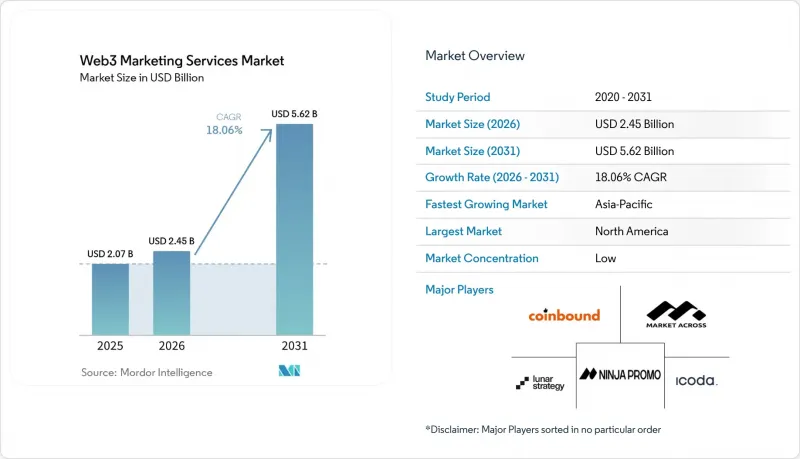
本報告按服務類型(社群建立與管理、憑證式的宣傳活動和獎勵計畫、基於NFT的互動與忠誠度、Web3廣告與效果行銷等)、最終用戶(Web3基礎設施供應商、去中心化金融(DeFi)平台、NFT和遊戲專案等)以及地區進行細分。市場預測以美元(USD)計價。
全球Web3行銷服務市場趨勢與洞察
增加加密貨幣原生品牌的預算撥款
協議金庫和去中心化自治組織 (DAO) 正在從臨時性的推廣支出轉向正式的行銷預算,這使得 Web3 行銷服務市場的代理機構在簽訂長期合作協議和製定跨週期計劃時有了更清晰的理由。 Aave 的管治記錄顯示,其在 2025 年撥出 75 萬美元用於活動和贊助,而 Arbitrum 的管治則考慮在同一時期撥出 150 萬美元用於活動和品牌推廣。這兩個例子都表明,行銷資源應融入管治流程,而不是將推廣活動視為臨時啟動成本。由於代幣擁有者可以審查資金的提案用途,代理機構必須解釋每項宣傳活動如何支持協議的實質目標。錢包獲取成本、總鎖定價值 (TVL) 的變化以及推薦轉換率都是可以提交社區審查的指標範例。能夠將這些指標與清晰的鏈上結果聯繫起來的代理機構,比那些僅提供創新作品或標準互動數據的代理機構更有說服力。
基於錢包的受眾群成長
基於錢包的定向投放正成為Web3行銷服務市場中至關重要的用戶獲取工具,因為它允許宣傳活動觸及已驗證鏈上活動的用戶,而非根據瀏覽器行為推斷的受眾。 Addressable報告稱,其數據涵蓋七個區塊鏈上超過2,300萬已驗證錢包持有者,以及450多個鏈上指標。 2026年6月,該公司報告稱,全球排名前三的加密貨幣交易所透過錢包定向投放宣傳活動獲得了超過3200次高品質的應用程式安裝。這一結果表明,當目標受眾已經在使用加密貨幣產品時,「每次檢驗錢包連接的成本」可能比「每次點擊成本」(CPC)更有意義。透過將錢包識別碼與社交媒體個人資料進行匹配,廣告代理商無需依賴基於cookie的追蹤,即可在主流管道上重新定位活躍的加密貨幣用戶。此外,廣告代理商還可以根據用戶與協議的互動、代幣擁有情形和管治活動來定義受眾,而傳統數位廣告代理商難以複製這種能力。
平台和廣告網路政策的變化
平台廣告規則的變更可能會擾亂正在進行的加密貨幣宣傳活動,並給廣告代理商帶來迫在眉睫的營運風險。 Google、Meta 和 TikTok 都至少在 2024 年至 2026 年年中期間修改過一次關於加密貨幣和數位資產廣告的政策,這要求代理商重新審查帳戶狀態、受眾清單和創新核准情況。美國聯邦貿易委員會 (FTC) 的「推薦指南」規定了社群媒體推薦(包括使用人工智慧產生內容的推薦)的揭露要求。因此,代理商必須同時應對平台規則和揭露義務,而客戶通常更傾向於按效果付費。這不僅增加了難以透過定價彌補的工作量,還會使宣傳活動成效預測變得更加困難。此外,廣告支出可能會轉向加密貨幣原生廣告網路和社群分發,這可能會減少依賴單一主流平台的代理商的機會。
細分市場分析
2025年,「社區營造與管理」將佔Web3行銷服務市場佔有率的31.26%。對於協議和代幣項目而言,活躍參與者數量、管治參與率以及Discord互動度是衡量代幣流動性和協議採納率的重要指標。因此,社群活動不再只是溝通工具,而是品牌策略的關鍵要素。基於NFT的互動和忠誠度服務,以及憑證式的宣傳活動和獎勵計劃,構成了服務組合的核心。這些服務既是推廣工具,也是產品功能。例如,NFT忠誠度憑證既可以宣傳品牌,又能為用戶提供檢驗的鏈上資產。 Web3廣告和成效行銷通常被那些在產品開發早期階段優先考慮可衡量錢包獲取量的協議所採用。公共關係、內容創作和搜尋引擎最佳化仍然是所有類型客戶的補充服務。
預計從2026年到2031年,影響者和創作者行銷將以22.34%的複合年成長率成長。由於主流廣告管道可能無法以相同的精準度觸及加密貨幣原生用戶,因此協議通常會利用創作者資源。 Coin Bureau於2025年收購了KOLLAB的策略股份,這反映了其將加密媒體發現與創作者宣傳活動執行相結合的意圖。 KOLLAB與超過250位精選創作者建立了合作關係,覆蓋全球近5,000萬加密貨幣用戶。創作者專案也正轉向基於績效的契約,並包含資訊揭露要求。隨著付費推廣標準對客戶和監管機構日益清晰,這種模式可能會取代固定費用合約。在Web3行銷服務產業,能夠利用國際KOL網路並滿足品牌安全和合約要求的代理商備受青睞。對於尋求可衡量結果並希望接觸值得信賴的加密社群的客戶而言,這些能力至關重要。
區域分析
2025年,北美佔據了Web3行銷服務市場36.72%的佔有率。該地區受益於集中的加密資本市場、資金籌措的協議以及完善的鏈上歸因基礎設施。美國仍然是該地區最大的國內市場。創投對區塊鏈的投入、個人投資者持有的加密資產以及在X和YouTube等平台上龐大的KOL網路,整體支撐了社群、廣告和分析服務的需求。在加拿大,需求主要來自與金融科技緊密相連的區塊鏈生態系統,其中以合規為導向的成長策略至關重要。在墨西哥,針對西班牙語使用者的社區營造服務迎來了新的機會。這些因素共同促成了北美在Web3行銷服務市場的主導地位。
預計亞太地區2026年至2031年的複合年成長率將達到21.56%。韓國是個人投資者進行加密貨幣交易的活躍市場,擁有眾多以韓元計價、並已在金融資訊局(FIU)註冊的交易所,例如Upbit和Bithumb,這些交易所匯集了來自個人投資者的流動性。如果受眾品質得到確認,利用韓語KOL(關鍵意見領袖)和在Kakao頻道上宣傳活動可以獲得更高的價格。在日本,金融廳建立了一套完善的監管體系,合規的加密貨幣廣告是一項專門的業務。新加坡根據《金融服務與市場法》推出的數位代幣服務供應商(DTSP)計畫已於2025年6月30日生效。該計劃對向海外客戶提供服務的新加坡公司提出了要求,並強化了新加坡作為區域中心的地位,合規性將影響代理商的市場地位。
歐洲市場雖然已經成熟,但歐盟加密資產市場監管條例 (MiCA) 的合規要求正在重組。該框架明確區分了擁有符合加密資產服務供應商要求的宣傳活動基礎設施的代理機構和不具備此類基礎設施的代理機構。德國和法國一直在支持歐洲大陸的需求,而英國在金融行為監管局 (FCA) 的監管下維持著自身的金融推廣框架。這為在歐洲市場運營的代理商創造了雙重合規環境。在南美洲,巴西正透過智慧型手機普及、Pix Payments 支援的點對點加密貨幣交易以及不斷擴展的去中心化金融 (DeFi) 活動創造新的商機。中東和非洲仍處於起步階段,但杜拜和阿布達比正在吸引協議總部入駐,對英語和阿拉伯語的關鍵意見領袖 (KOL) 和公共關係服務的需求日益成長。南非仍然是撒哈拉以南非洲新興生態系統的核心,在 Web3 行銷服務市場,當地語言和合規知識至關重要。
其他好處:
- Excel格式的市場預測(ME)表
- 3個月的分析師支持
目錄
第1章:引言
- 研究假設和市場定義
- 調查範圍
第2章:調查方法
第3章執行摘要
第4章 市場狀況
- 市場概覽
- 市場促進因素
- 增加加密貨幣原生品牌的預算撥款
- 基於錢包的受眾群成長
- 擴展鏈上歸因與分析
- 透過代幣實現社區獲利
- 透過元宇宙和虛擬活動重塑品牌形象
- 市場對以合規性為首要任務的Web3成長專家需求旺盛
- 市場限制因素
- 平台和廣告網路政策的變化
- 錢包間和鏈下交易過程中的歸因差距
- 由於代幣和 NFT 需求放緩,導致預算削減。
- 關於加密貨幣推廣相關法規的考量
- 宏觀經濟因素對市場的影響
- 產業價值鏈分析
- 監理情勢
- 技術展望
- 波特五力分析
第5章 市場規模與成長預測
- 按服務類型
- 社區營造與管理
- 憑證式的宣傳活動和獎勵計劃
- 利用NFT提升客戶參與與忠誠度
- Web3廣告與成效行銷
- 影響者和創作者行銷
- 其他服務類型
- 最終用戶
- Web3 基礎設施供應商
- 去中心化金融(DeFi)平台
- NFT 和遊戲項目
- 傳統企業與消費品牌
- 其他最終用戶
- 按地區
- 北美洲
- 美國
- 加拿大
- 墨西哥
- 南美洲
- 巴西
- 阿根廷
- 智利
- 其他南美國家
- 歐洲
- 德國
- 英國
- 法國
- 義大利
- 西班牙
- 其他歐洲國家
- 亞太地區
- 中國
- 日本
- 印度
- 韓國
- 澳洲
- 其他亞太國家
- 中東和非洲
- 阿拉伯聯合大公國
- 沙烏地阿拉伯
- 南非
- 其他中東和非洲國家
- 北美洲
第6章 競爭情勢
- 市場集中度
- 策略趨勢
- 市佔率分析
- 公司簡介
- Coinbound, LLC
- Lunar Strategy BV
- Blockchain Marketing Ninja
- MarketAcross Ltd.
- ReBlonde Ltd.
- Coinpresso
- NinjaPromo Ltd.
- ICODA
- Solus Agency
- Coinband
- Blockwiz
- CryptoVirally
- CryptoPR
- FINPR
- Buzz Dealer
- GuerrillaBuzz
- Flexe.io
- Hype Partners Ltd.
- Omni Agency
- Crynet
- Proleo.io
第7章 市場機會與未來展望
According to Mordor Intelligence, the web3 marketing services market size was valued at USD 2.07 billion in 2025 and is estimated to grow from USD 2.45 billion in 2026 to reach USD 5.62 billion by 2031, at a CAGR of 18.06% during the forecast period (2026-2031).
This report is Segmented by Service Type (Community Building and Management, Token-Based Campaigns and Incentives Programs, NFT-Based Engagement and Loyalty, Web3 Advertising and Performance Marketing, and More), by End User (Web3 Infrastructure Providers, Decentralized Finance Platforms, NFT and Gaming Projects, and More), and Geography. The Market Forecasts are Provided in Terms of Value (USD).
Global Web3 Marketing Services Market Trends and Insights
Rising Crypto-Native Brand Budget Allocation
Protocol treasuries and decentralized autonomous organizations have moved from irregular promotion spending toward formal marketing budgets, which gives agencies a clearer basis for retainer work and multi-period planning in the Web3 marketing services market. Aave governance records included a USD 750,000 allocation for events and sponsorships in 2025, while Arbitrum governance considered a USD 1.5 million events and brand activation allocation for the same cycle. Both examples place marketing resources within a public governance process instead of treating promotion as a last-minute launch expense. Token holders can review the proposed use of funds, so agencies must explain how each campaign supports practical protocol objectives. Wallet acquisition costs, changes in total value locked, and referral conversions are examples of measures that can be presented for community review. An agency that can connect these measures to clear on-chain outcomes has a stronger basis for selection than one that provides only creative work or standard engagement totals.
Growth of Wallet-Based Audience Targeting
Wallet-based targeting allows campaigns to reach users with verified on-chain activity instead of audiences inferred from browser behavior, making it an important acquisition tool in the Web3 marketing services market. Addressable reported that its data covered more than 23 million matched wallet owners across 7 blockchains and more than 450 on-chain metrics. In June 2026, it reported that a top-3 global crypto exchange generated more than 3,200 quality application installs through a wallet-targeted campaign. The reported result shows why the cost per verified wallet connection can be more meaningful than the cost per click when the intended audience already uses crypto products. Wallet identifiers can be matched to social media profiles, allowing agencies to retarget crypto-active audiences on mainstream channels without relying on cookie-based tracking. Agencies can also define audiences by protocol interactions, token holdings, or governance activity, giving them a capability that general digital agencies may not readily reproduce.
Platform and Ad Network Policy Volatility
Changes to platform advertising rules can disrupt live crypto campaigns and pose immediate operational risk for agencies. Google, Meta, and TikTok each changed policies for crypto and digital asset advertising at least once between 2024 and mid-2026, requiring agencies to revisit account conditions, audience lists, and creative approvals. The Federal Trade Commission's Endorsement Guides set disclosure expectations for social media endorsements, including endorsements that use AI-generated content. Agencies must therefore manage platform rules and disclosure obligations simultaneously, often for clients who prefer performance-based fees. This adds work that may be difficult to recover through pricing and can make campaign delivery less predictable. It can also shift spending toward crypto-native ad networks and community distribution, reducing the opportunity for agencies dependent on a single mainstream platform.
Other drivers and restraints analyzed in the detailed report include:
- Expansion of On-Chain Attribution and Analytics
- Token-Gated Community Monetization
- Attribution Gaps Across Wallet and Off-Chain Journeys
For complete list of drivers and restraints, kindly check the Table Of Contents.
Segment Analysis
Community Building and Management accounted for 31.26% of the Web3 marketing services market share in 2025. For protocols and token projects, active participants, governance turnout, and Discord engagement can indicate token liquidity and protocol adoption. This makes community activity a primary part of brand strategy rather than a supporting communication function. NFT-Based Engagement and Loyalty services, along with Token-Based Campaigns and Incentives Programs, occupied the middle of the service mix. These offerings can serve as promotional tools and product features simultaneously. An NFT loyalty credential, for example, can promote a brand while giving the recipient a verifiable on-chain asset. Web3 Advertising and Performance Marketing is generally used by protocols that prioritize measurable wallet acquisition during earlier product stages. Public relations, content production, and search engine optimization remain supporting services across client types.
Influencer and Creator Marketing is projected to expand at a CAGR of 22.34% from 2026 to 2031. Protocols often use creators because mainstream advertising channels may not reach crypto-native audiences with the same level of relevance. Coin Bureau acquired a strategic stake in KOLLAB in 2025, reflecting its interest in combining crypto media discovery with creator campaign execution. The KOLLAB reported more than 250 curated creator relationships and a reach of nearly 50 million crypto users globally. Creator programs are also shifting toward performance-linked agreements that include disclosure requirements. This can replace flat-fee arrangements when paid promotion standards become more visible to clients and regulators. The Web3 marketing services industry favors agencies that can activate international KOL networks while meeting brand-safety and contracting expectations. These capabilities matter most where clients seek measurable results and access to trusted crypto communities.
Complete Report Scope:
- By Service Type
- Community Building and Management
- Token-Based Campaigns and Incentives Programs
- NFT-Based Engagement and Loyalty
- Web3 Advertising and Performance Marketing
- Influencer and Creator Marketing
- Other Service Types
- By End User
- Web3 Infrastructure Providers
- Decentralized Finance Platforms
- NFT and Gaming Projects
- Traditional Enterprises and Consumer Brands
- Other End Users
- By Geography
- North America
- United States
- Canada
- Mexico
- South America
- Brazil
- Argentina
- Chile
- Rest of South America
- Europe
- Germany
- United Kingdom
- France
- Italy
- Spain
- Rest of Europe
- Asia-Pacific
- China
- Japan
- India
- South Korea
- Australia
- Rest of Asia-Pacific
- Middle East and Africa
- United Arab Emirates
- Saudi Arabia
- South Africa
- Rest of Middle East and Africa
- North America
Geography Analysis
North America accounted for 36.72% of the Web3 marketing services market share in 2025. The region benefits from concentrated crypto capital markets, funded protocols, and established on-chain attribution infrastructure. The United States remained the largest national market in the region. Blockchain venture investment, retail crypto ownership, and extensive KOL networks on X and YouTube supported demand across community, advertising, and analytics services. Canada added demand from a fintech-adjacent blockchain ecosystem where compliance-focused growth work is relevant. Mexico created a separate opportunity for community-building services designed for Spanish-language audiences. Together, these factors helped North America retain a leading position in the Web3 marketing services market.
Asia-Pacific is projected to expand at a CAGR of 21.56% from 2026 to 2031. South Korea is a high-intensity retail crypto setting, where Financial Intelligence Unit-registered won-denominated exchanges, including Upbit and Bithumb, concentrate retail liquidity. Korean-language KOL work and Kakao channel campaigns can carry higher prices when audience quality is verified. Japan has structured oversight under the Financial Services Agency, which makes compliant crypto advertising a specialized activity. Singapore's Digital Token Service Provider regime under the Financial Services and Markets Act took effect on June 30, 2025. The regime addressed requirements for Singapore-incorporated firms serving overseas clients and reinforced the city-state's role as a regional hub where compliance affects agency positioning.
Europe is mature but has been reshaped by compliance requirements under the European Union's Markets in Crypto-Assets Regulation. The framework separated agencies with crypto-asset service provider-ready campaign infrastructure from those without. Germany and France supported continental demand, while the United Kingdom retained a separate Financial Conduct Authority financial promotions framework. This creates a dual-compliance environment for agencies operating across European markets. In South America, Brazil has created a developing opportunity through smartphone use, retail crypto activity supported by Pix payments, and increasing decentralized finance activity. The Middle East and Africa remained at an earlier stage, although Dubai and Abu Dhabi attracted protocol headquarters and demand for English- and Arabic-language KOL and public relations services. South Africa remained an anchor for the developing sub-Saharan ecosystem, making regional language and compliance knowledge important for the Web3 marketing services market.
- Coinbound, LLC
- Lunar Strategy B.V.
- Blockchain Marketing Ninja
- MarketAcross Ltd.
- ReBlonde Ltd.
- Coinpresso
- NinjaPromo Ltd.
- ICODA
- Solus Agency
- Coinband
- Blockwiz
- CryptoVirally
- CryptoPR
- FINPR
- Buzz Dealer
- GuerrillaBuzz
- Flexe.io
- Hype Partners Ltd.
- Omni Agency
- Crynet
- Proleo.io
Additional Benefits:
- The market estimate (ME) sheet in Excel format
- 3 months of analyst support
TABLE OF CONTENTS
1 INTRODUCTION
- 1.1 Study Assumptions and Market Definition
- 1.2 Scope of the Study
2 RESEARCH METHODOLOGY
3 EXECUTIVE SUMMARY
4 MARKET LANDSCAPE
- 4.1 Market Overview
- 4.2 Market Drivers
- 4.2.1 Rising Crypto Native Brand Budget Allocation
- 4.2.2 Growth of Wallet Based Audience Targeting
- 4.2.3 Expansion of On-Chain Attribution and Analytics
- 4.2.4 Token-Gated Community Monetization
- 4.2.5 Metaverse and Virtual Event Brand Activation
- 4.2.6 Compliance First Web3 Growth Specialist Demand
- 4.3 Market Restraints
- 4.3.1 Platform and Ad Network Policy Volatility
- 4.3.2 Attribution Gaps Across Wallet and Off-Chain Journeys
- 4.3.3 Budget Pullback After Token and NFT Demand Cooling
- 4.3.4 Regulatory Sensitivity Around Crypto Promotions
- 4.4 Impact of Macroeconomic Factors on the Market
- 4.5 Industry Value Chain Analysis
- 4.6 Regulatory Landscape
- 4.7 Technological Outlook
- 4.8 Porter's Five Forces Analysis
- 4.8.1 Threat of New Entrants
- 4.8.2 Bargaining Power of Suppliers
- 4.8.3 Bargaining Power of Buyers
- 4.8.4 Threat of Substitutes
- 4.8.5 Intensity of Competitive Rivalry
5 MARKET SIZE AND GROWTH FORECASTS (VALUE)
- 5.1 By Service Type
- 5.1.1 Community Building and Management
- 5.1.2 Token-Based Campaigns and Incentives Programs
- 5.1.3 NFT-Based Engagement and Loyalty
- 5.1.4 Web3 Advertising and Performance Marketing
- 5.1.5 Influencer and Creator Marketing
- 5.1.6 Other Service Types
- 5.2 By End User
- 5.2.1 Web3 Infrastructure Providers
- 5.2.2 Decentralized Finance Platforms
- 5.2.3 NFT and Gaming Projects
- 5.2.4 Traditional Enterprises and Consumer Brands
- 5.2.5 Other End Users
- 5.3 By Geography
- 5.3.1 North America
- 5.3.1.1 United States
- 5.3.1.2 Canada
- 5.3.1.3 Mexico
- 5.3.2 South America
- 5.3.2.1 Brazil
- 5.3.2.2 Argentina
- 5.3.2.3 Chile
- 5.3.2.4 Rest of South America
- 5.3.3 Europe
- 5.3.3.1 Germany
- 5.3.3.2 United Kingdom
- 5.3.3.3 France
- 5.3.3.4 Italy
- 5.3.3.5 Spain
- 5.3.3.6 Rest of Europe
- 5.3.4 Asia-Pacific
- 5.3.4.1 China
- 5.3.4.2 Japan
- 5.3.4.3 India
- 5.3.4.4 South Korea
- 5.3.4.5 Australia
- 5.3.4.6 Rest of Asia-Pacific
- 5.3.5 Middle East and Africa
- 5.3.5.1 United Arab Emirates
- 5.3.5.2 Saudi Arabia
- 5.3.5.3 South Africa
- 5.3.5.4 Rest of Middle East and Africa
- 5.3.1 North America
6 COMPETITIVE LANDSCAPE
- 6.1 Market Concentration
- 6.2 Strategic Moves
- 6.3 Market Share Analysis
- 6.4 Company Profiles (includes Global Level Overview, Market Level Overview, Core Segments, Financials as available, Strategic Information, Market Rank/Share, Products and Services, Recent Developments)
- 6.4.1 Coinbound, LLC
- 6.4.2 Lunar Strategy B.V.
- 6.4.3 Blockchain Marketing Ninja
- 6.4.4 MarketAcross Ltd.
- 6.4.5 ReBlonde Ltd.
- 6.4.6 Coinpresso
- 6.4.7 NinjaPromo Ltd.
- 6.4.8 ICODA
- 6.4.9 Solus Agency
- 6.4.10 Coinband
- 6.4.11 Blockwiz
- 6.4.12 CryptoVirally
- 6.4.13 CryptoPR
- 6.4.14 FINPR
- 6.4.15 Buzz Dealer
- 6.4.16 GuerrillaBuzz
- 6.4.17 Flexe.io
- 6.4.18 Hype Partners Ltd.
- 6.4.19 Omni Agency
- 6.4.20 Crynet
- 6.4.21 Proleo.io
7 MARKET OPPORTUNITIES AND FUTURE OUTLOOK
- 7.1 White-Space and Unmet-Need Assessment

 數位城市人工智慧解決方案市場:全球市場預測,2026-2032年
 全球循環經濟貨幣化管理市場預測至2034年:依收入模式、收入活動、價值流、貨幣化管道、最終用戶和地區分類
 技術偵察即服務:市場佔有率分析、行業趨勢和統計數據、成長預測(2026-2031 年)
 勝負分析服務市場規模、佔有率和成長分析:按服務類型、交付方式、應用、最終用戶和地區分類-2026-2033年產業預測人工智慧驅動的農場管理軟體市場預測至2034年:按部署類型、軟體模組、人工智慧技術、應用、最終用戶和地區分類的全球分析勞動力評估平台市場預測至2034年-按組件、部署模式、評估類型、企業規模、應用、最終用戶和地區分類的全球分析循環收益管理市場:預測至 2034 年 - 按收益模式、管理功能、平台類型、部署模式、最終用戶和地區分類的全球分析人工智慧專業服務市場:全球市場預測,2026-2032年預測性案源計分軟體:市場佔有率分析、產業趨勢和統計數據、成長預測(2026-2031 年)意向資料軟體:市場佔有率分析、產業趨勢與統計、成長預測(2026-2031)