


 |
市場調查報告書
商品編碼
2117525
意向資料軟體:市場佔有率分析、產業趨勢與統計、成長預測(2026-2031)Intent Data Software - Market Share Analysis, Industry Trends & Statistics, Growth Forecasts (2026 - 2031) |
||||||

※ 本網頁內容可能與最新版本有所差異。詳細情況請與我們聯繫。
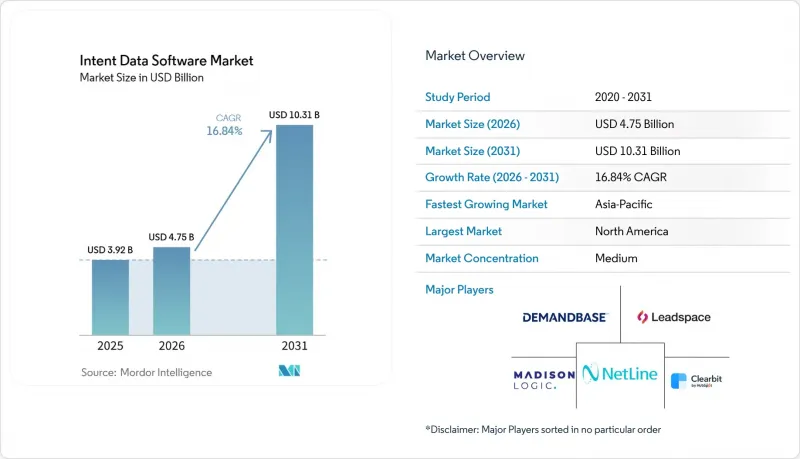
據 Mordor Intelligence 稱,意向數據軟體市場預計將從 2025 年的 39.2 億美元成長到 2026 年的 47.5 億美元,到 2031 年達到 103.1 億美元,預計 2026 年至 2031 年的複合年成長率為 16.84%。
本報告按元件(軟體和服務)、部署模式(雲端和本地部署)、應用(線索情報和商機識別等)、組織規模(大型企業和中小企業)、最終用戶產業(資訊科技和電信等)以及地區進行細分。市場預測以價值(美元)表示。
全球意圖數據軟體市場趨勢與洞察
擴大人工智慧驅動的買家訊號評分技術的應用。
基於人工智慧的訊號評分已從一項便利功能發展成為意向數據軟體市場的核心需求。如今,買家期望平台能夠處理大量的行為數據,並將其轉化為清晰的購買階段分類,從而幫助銷售團隊快速採取行動。領先的供應商不再僅僅根據客戶是否被標記為「活躍」來評估其價值,因為買家希望了解評分變化的原因以及導致這種變化的具體行動。這進一步提升了「可解釋性」在公司評估中的重要性,尤其是在多個團隊需要信任相同客戶優先模型的情況下。根據 6sense 的數據,在 2025 年第二季至 2026 年第一季期間,被列為「6sense 合格客戶」的客戶,其機會價值比未被列為優先客戶的客戶高出 29%,交易規模高出 33%。因此,意向數據軟體市場正在向那些能夠將評分準確性與可衡量的商業性成果相結合,同時保持用戶易於理解的邏輯的平台轉型。
拓展我們的以客戶為基礎的行銷(ABM)計劃
帳戶行銷 (ABM) 專案的擴展正在改變意向數據軟體市場的購買、部署和衡量方式。買家越來越傾向於選擇一個統一的環境,將帳戶訊號、受眾激活、推廣計劃和宣傳活動協調整合在一起,無需繁瑣的手動操作。這使得支出從孤立的意向資料來源轉向能夠支援更廣泛的產生收入流程(涵蓋行銷和銷售團隊)的平台。同時,這也改變了企業內部採用意向資料的理由,因為當意向資料支持整合的帳戶規劃而非單一的、狹隘的線索篩選任務時,其合理性更容易得到認可。在此背景下,意向數據軟體市場受益,因為買家將帳戶行銷視為一種營運模式,而不是一次性的宣傳活動方法。這一趨勢將推動大規模的合約規模和更深入的平台採用,同時也加大了供應商將啟動功能直接整合到核心工作流程中的壓力。
意圖訊號雜訊和誤報風險
在意向數據軟體市場,誤報仍然是最明顯的風險之一。如果平台在沒有充分理由的情況下將某個帳戶識別為“活躍”,銷售團隊可能會浪費時間在與實際買家利益不符的行銷策略上。問題不僅在於效率低;反覆的低品質行銷策略甚至會在正式採購談判開始前就損害客戶對公司的信任。在企業級市場,這個問題特別關鍵,因為每個客戶都價值連城,而且採購團隊通常涉及眾多相關人員。因此,在意向資料軟體市場,那些能夠在早期試點階段和客戶導入週期內,利用買家本身的客戶名單來驗證其訊號品質的供應商備受青睞。買家不太可能選擇走捷徑,想當然地認為所有訊號源都同樣可靠,因此對價值驗證的標準也更高。
細分市場分析
到2025年,軟體收入將佔總收入的68.15%,成為意向數據軟體市場中最大的組成部分。這一市場格局反映了資料流正從基礎資料饋送向軟體環境的轉變,後者將訊號收集、帳戶評分、啟動和衡量整合到一個統一的營運層中。買家越來越傾向於單一平台,因為它可以減少行銷、銷售和營收營運團隊在處理相同帳戶訊號時產生的工作流程摩擦。隨著客戶為更廣泛的執行系統付費,而非僅僅為狹義的意向文件或孤立的主題資料來源付費,平均合約價值也在不斷成長。隨著供應商將意向智慧整合到需要即時訊號存取的CRM工具、行銷自動化系統和AI代理的工作流程中,軟體層正變得越來越重要。
預計到2031年,服務市場將以19.77%的複合年成長率成長,成為意向數據軟體市場中成長最快的細分領域。這項成長主要由已購買平台但仍需實施、評分設計、宣傳活動啟動和工作流程調整等方面所支持的機構所推動。許多購買公司部署工具的速度超過了建立有效利用意向工具所需的內部營運模式的速度,從而產生了對支援服務的持續需求。當公司從試點用例過渡到跨多個團隊、地區和系統的全公司範圍部署時,這一點尤其明顯。事實上,初始部署能否充分發揮商業性價值,或最終未能充分利用,往往取決於所提供的服務。
預計到2025年,基於雲端的採用將佔營收的71.33%,並在2031年之前以19.04%的複合年成長率成長。這意味著雲端是意向數據軟體市場中規模最大且成長最快的採用模式。這一趨勢反映出,買家仍有空間從傳統的混合和本地部署環境遷移到雲端。雲端採用符合該類別的技術需求,因為即時訊號處理、人工智慧評分和工作流程編配都依賴快速、始終可用的資料交換。它也符合採購行為,因為買家更傾向於頻繁更新和降低基礎設施管理負擔,而不是維護本地系統。
儘管本地部署的市場佔有率較小,但在意圖數據軟體市場中仍佔據重要地位。在法規環境中,由於資料儲存位置、安全審查或內部政策等原因,完全遷移到公共雲端較為困難,本地部署的作用尤為顯著。金融機構、政府技術採購者以及部分醫療機構仍然優先考慮對敏感資料的儲存位置和方式進行控制。這些採購者通常選擇私有雲端或混合模式,以支援意圖主導的工作流程,同時維持更嚴格的管治。這為能夠提供更多託管部署選項的供應商創造了一個永續且高價值的細分市場。
區域分析
2025年,北美地區佔了37.41%的銷售額,成為意向數據軟體市場最大的佔有率。這一37.41%的市場佔有率之所以領先,主要得益於該地區最成熟的基於客戶的行銷環境、較高的SaaS採用率以及密集的B2B技術供應商群體。美國作為核心市場的地位依然穩固,因為CRM、行銷自動化和收入管理工具已深度融入企業銷售流程。鑑於客戶流程最佳化和平台整合正在重塑商業格局,ZoomInfo已將2026年全年銷售額預測上調至11.8億美元至12億美元。因此,儘管北美意向資料軟體市場仍然是最發達的地區,但其成長軌跡越來越依賴平台更新、工作流程深化和實際貢獻,而不僅僅是最初的採用。
預計到2031年,亞太地區將以18.30%的複合年成長率成長,成為意向數據軟體市場成長最快的區域市場。該地區不僅落後於北美,而且正在積極擁抱行動優先銷售、多語言支援以及技術主導市場中快速變化的商業週期。隨著企業實現銷售和行銷流程的數位化,並尋求更有效的客戶優先排序工具,印度、韓國、中國和東南亞已成為關鍵的需求中心。此外,在日本和韓國,語言準確性和本地合規要求的重要性尤其突出,這可能會對過度依賴英語模式的全球供應商構成障礙。澳洲和紐西蘭的採購模式較為成熟,仍要求買家更加重視資料外洩防範和資料處理規範。
在德國、英國和法國的支持下,歐洲仍佔據著意向資料軟體市場的重要佔有率。儘管該地區受益於成熟的企業軟體採購流程和卓有成效的客戶導向行銷 (ABM) 專案實施經驗,但由於買家對資料處理和自動評分實踐的謹慎態度,評估過程往往相對緩慢。英國的需求依然強勁且獨特,而歐洲大陸則為在地化客製化的替代解決方案提供了發展空間,這些解決方案在本地適應性方面可以與美國平台相媲美。 Expandi Limited 於 2026 年 3 月收購了 Kompass,從而建立了大規模、更獨立的歐洲 B2B 數據、媒體和人工智慧驅動的行銷平台,該平台將企業圖形智慧與基於媒體的行為訊號和購買意向數據相結合。南美、中東和非洲仍然是小規模的區域市場,但隨著企業數位化、政府主導的技術投資以及該地區 B2B 軟體採用率的不斷提高,這些地區的市場規模正在不斷擴大,目標基本客群也在持續成長。
其他好處:
- Excel格式的市場預測(ME)表
- 3個月的分析師支持
目錄
第1章:引言
- 研究假設和市場定義
- 調查範圍
第2章:調查方法
第3章執行摘要
第4章 市場狀況
- 市場概覽
- 市場促進因素
- 擴大人工智慧驅動的買家訊號評分的應用
- 擴展以客戶為基礎的行銷計劃
- 即時銷售和行銷協作的必要性
- 加深對所有數字觸點上第一方意圖的理解
- 複雜採購委員會對垂直整合的意圖模型的需求。
- 面向績效收入平台的供應商整合
- 市場限制因素
- 人為訊號雜訊和誤報的風險
- 隱私、同意和資料管治限制
- CRM、MAP 和 CDP 技術堆疊整合的複雜性。
- 長期、多方參與的採購週期難以融入。
- 產業價值鏈分析
- 監理情勢
- 技術展望
- 宏觀經濟因素對市場的影響
- 波特五力分析
第5章 市場規模與成長預測
- 按組件
- 軟體
- 服務
- 部署模式
- 雲
- 現場
- 透過使用
- 領先情報和機會識別
- 以帳戶為基礎的行銷(ABM)
- 銷售和收入情報
- 客戶經驗與個人化
- 風險、合規和詐欺偵測情報
- 按組織規模
- 大公司
- 小型企業
- 按最終用戶行業分類
- IT/通訊
- 銀行、金融服務和保險(BFSI)
- 零售與電子商務
- 媒體與娛樂
- 醫療保健和生命科學
- 工業製造
- 其他終端用戶產業
- 按地區
- 北美洲
- 美國
- 加拿大
- 墨西哥
- 南美洲
- 巴西
- 阿根廷
- 其他南美國家
- 歐洲
- 德國
- 英國
- 法國
- 義大利
- 西班牙
- 俄羅斯
- 其他歐洲國家
- 亞太地區
- 中國
- 日本
- 印度
- 韓國
- 澳洲和紐西蘭
- 其他亞太國家
- 中東
- 沙烏地阿拉伯
- 阿拉伯聯合大公國
- 土耳其
- 其他中東國家
- 非洲
- 南非
- 奈及利亞
- 其他非洲國家
- 北美洲
第6章 競爭情勢
- 市場集中度
- 策略趨勢
- 市佔率分析
- 公司簡介
- 6sense, Inc.
- Bombora, Inc.
- Demandbase, Inc.
- ZoomInfo Technologies Inc.
- TechTarget, Inc.
- G2.com, Inc.
- Madison Logic, Inc.
- Leadspace, Inc.
- DemandScience, LLC
- RollWorks, a NextRoll company
- NetLine Corporation
- Dealfront Group GmbH
- Cognism Limited
- Clearbit, Inc.
- Terminus Software, Inc.
- Aberdeen, Inc.
- Slintel, Inc.
- DemandJump, Inc.
- EverString, Inc.
- LeadSift Inc.
第7章 市場機會與未來展望
According to Mordor Intelligence, the intent data software market size is expected to increase from USD 3.92 billion in 2025 to USD 4.75 billion in 2026 and reach USD 10.31 billion by 2031, growing at a CAGR of 16.84% over 2026-2031.
This report is Segmented by Component (Software, and Services), Deployment Mode (Cloud, and On-Premises), Application (Lead Intelligence and Opportunity Identification, and More), Organization Size (Large Enterprises, and Small and Medium Enterprises), End User Industry (Information Technology and Telecommunications, and More), and Geography. The Market Forecasts are Provided in Terms of Value (USD).
Global Intent Data Software Market Trends and Insights
Rising Adoption of AI-Driven Buyer Signal Scoring
AI-based signal scoring has moved from a useful feature to a core requirement in the intent data software market. Buyers now expect platforms to process large volumes of behavioral activity and translate them into clear buying-stage classifications that sales teams can act on quickly. The strongest vendors are no longer judged only on whether they can flag an account as active, because buyers also want to understand why the score changed and which behaviors drove the shift. This is making explainability more important in enterprise evaluations, especially when multiple teams need to trust the same account prioritization model. 6sense stated that accounts prioritized as 6sense Qualified Accounts delivered 29% higher opportunity values and 33% larger deal sizes than non-qualified accounts across the Q2 2025 to Q1 2026 period. The intent data software market is therefore moving toward platforms that can connect scoring accuracy with measurable commercial outcomes while still keeping the logic understandable to users.
Expansion of Account-Based Marketing Programs
The expansion of account-based marketing programs is changing how the intent data software market is bought, deployed, and measured. Buyers increasingly want one environment where account signals, audience activation, outreach planning, and campaign coordination can work together without heavy manual handoffs. This shifts spending away from isolated intent feeds and toward platforms that can support a broader revenue motion across marketing and sales teams. It also changes the internal buying case, because intent data is easier to justify when it supports coordinated account planning rather than a single, narrow lead qualification task. In this setting, the intent data software market benefits when buyers treat account-based marketing as an operating model rather than a single-campaign approach. That pattern supports larger contracts, deeper platform usage, and more pressure on vendors to integrate activation features directly into the core workflow.
Intent Signal Noise and False Positive Risk
False positives remain one of the clearest risks in the intent data software market. When a platform identifies an account as active without sufficient evidence, sales teams can waste time on outreach that does not align with real buyer interest. The problem is not only inefficiency; repeated low-quality outreach can weaken account trust before a serious buying conversation begins. This matters even more in enterprise segments, where each account is high-value, and buying groups often involve many stakeholders. The intent data software market, therefore, rewards vendors that can prove signal quality against a buyer's own account list during early pilots and onboarding cycles. Buyers are becoming less willing to assume that all signal sources are equally reliable, and that is raising the standard for proof of value.
Other drivers and restraints analyzed in the detailed report include:
- Need For Real-Time Sales and Marketing Orchestration
- Growth of First-Party Intent Capture across Digital Touchpoints
- Privacy, Consent, and Data Governance Constraints
For complete list of drivers and restraints, kindly check the Table Of Contents.
Segment Analysis
Software accounted for 68.15% of revenue in 2025, making it the largest component of the intent data software market. That position reflects the shift from basic data feeds to integrated software environments that combine signal collection, account scoring, activation, and measurement into a single operating layer. Buyers increasingly prefer a single platform because it reduces workflow friction among marketing, sales, and revenue operations teams that all act on the same account signals. This also increases the average contract value, since customers are paying for a broader execution system rather than a narrow intent file or an isolated topic feed. The software layer has become more central as vendors connect intent intelligence to CRM tools, marketing automation systems, and AI agent workflows that need live signal access.
Services are projected to expand at a 19.77% CAGR through 2031, making them the fastest-growing component of the intent data software market. Growth is being supported by organizations that have bought a platform but still need help with implementation, scoring design, campaign activation, and workflow alignment. Many buyers can purchase intent tools faster than they can build the internal operating model needed to use them well, which creates steady demand for support services. This is especially evident when companies move from a pilot use case to an enterprise rollout spanning multiple teams, geographies, and systems. In practice, services often determine whether an initial deployment reaches full commercial value or remains underused.
Cloud-based deployment accounted for 71.33% of revenue in 2025 and is projected to grow at a 19.04% CAGR through 2031. This means cloud is both the largest and the fastest-growing deployment model in the intent data software market. The pattern reflects a category that still has room for migration as buyers move away from older hybrid and on-premises setups. Cloud deployment fits the technical needs of the category because real-time signal processing, AI-assisted scoring, and workflow orchestration depend on fast, always-available data exchange. It also fits procurement behavior, since buyers want frequent updates and lower infrastructure management burdens rather than local system maintenance.
On-premises deployment remains relevant in the intent data software market even though its share is smaller. Its role is strongest in regulated environments where data residency, security reviews, or internal policies make full public cloud adoption difficult. Financial institutions, government-adjacent technology buyers, and some healthcare organizations still value private control over where sensitive data sits and how it moves. These buyers often turn to private cloud or hybrid models that preserve stricter governance while still allowing intent-driven workflows. That keeps a durable, high-value niche in place for vendors that can support more controlled deployment options.
Complete Report Scope:
- By Component
- Software
- Services
- By Deployment Mode
- Cloud
- On-Premises
- By Application
- Lead Intelligence and Opportunity Identification
- Account-Based Marketing (ABM)
- Sales and Revenue Intelligence
- Customer Experience and Personalization
- Risk, Compliance and Fraud Intelligence
- By Organization Size
- Large Enterprises
- Small and Medium Enterprises
- By End User Industry
- Information Technology and Telecommunications
- Banking, Financial Services, and Insurance (BFSI)
- Retail and E-commerce
- Media and Entertainment
- Healthcare and Life Sciences
- Industrial Manufacturing
- Other End User Industries
- By Geography
- North America
- United States
- Canada
- Mexico
- South America
- Brazil
- Argentina
- Rest of South America
- Europe
- Germany
- United Kingdom
- France
- Italy
- Spain
- Russia
- Rest of Europe
- Asia-Pacific
- China
- Japan
- India
- South Korea
- Australia and New Zealand
- Rest of Asia-Pacific
- Middle East
- Saudi Arabia
- United Arab Emirates
- Turkey
- Rest of Middle East
- Africa
- South Africa
- Nigeria
- Rest of Africa
- North America
Geography Analysis
North America accounted for 37.41% of revenue in 2025, giving the region the largest share of the intent data software market. This 37.41% position represented the leading share of the intent data software market because the region has the most mature account-based marketing environment, high SaaS adoption, and a dense base of B2B technology vendors. The United States remains the anchor market because CRM, marketing automation, and revenue operations tools are deeply embedded across enterprise selling motions. ZoomInfo revised its full-year 2026 revenue guidance to USD 1.18-1.20 billion, reflecting a commercial environment shaped by customer rationalization and platform consolidation. The North American intent data software market, therefore, remains the most developed region, but its growth path is increasingly tied to platform replacement, workflow depth, and proof of contribution rather than simple first-time adoption.
Asia-Pacific is projected to expand at a 18.30% CAGR through 2031, making it the fastest-growing regional segment in the intent data software market. The region is not only following North America with a time lag, but also adopting mobile-first selling, multilingual engagement, and fast-moving commercial cycles in technology-led markets. India, South Korea, China, and Southeast Asia are key demand centers as enterprises digitize their sales and marketing processes and seek better account-prioritization tools. Japan and South Korea also highlight the importance of language precision and local compliance expectations, which can create gaps for global vendors that rely too heavily on English-language models. Australia and New Zealand are closer to mature Western buying patterns, but buyer expectations still include greater attention to breach response and data-handling discipline.
Europe remains a substantial part of the intent data software market, supported by Germany, the United Kingdom, and France. The region benefits from established enterprise software buying processes and a meaningful installed base of account-based marketing programs, but evaluations can move more slowly because buyers are cautious about data handling and automated scoring practices. The United Kingdom continues to show solid independent demand, while continental Europe creates room for regional alternatives that can compete with United States-based platforms on local fit. Expandi Limited acquired Kompass in March 2026 to create a larger independent European B2B data, media, and AI-powered marketing platform that combines firmographic intelligence with media-based behavioral signals and purchase intent data. South America, the Middle East, and Africa remain smaller regional markets, but they are becoming more visible as enterprise digitization, sovereign technology investment, and regional B2B software adoption continue to widen the addressable base.
- 6sense, Inc.
- Bombora, Inc.
- Demandbase, Inc.
- ZoomInfo Technologies Inc.
- TechTarget, Inc.
- G2.com, Inc.
- Madison Logic, Inc.
- Leadspace, Inc.
- DemandScience, LLC
- RollWorks, a NextRoll company
- NetLine Corporation
- Dealfront Group GmbH
- Cognism Limited
- Clearbit, Inc.
- Terminus Software, Inc.
- Aberdeen, Inc.
- Slintel, Inc.
- DemandJump, Inc.
- EverString, Inc.
- LeadSift Inc.
Additional Benefits:
- The market estimate (ME) sheet in Excel format
- 3 months of analyst support
TABLE OF CONTENTS
1 INTRODUCTION
- 1.1 Study Assumptions and Market Definition
- 1.2 Scope of the Study
2 RESEARCH METHODOLOGY
3 EXECUTIVE SUMMARY
4 MARKET LANDSCAPE
- 4.1 Market Overview
- 4.2 Market Drivers
- 4.2.1 Rising Adoption of AI-Driven Buyer Signal Scoring
- 4.2.2 Expansion of Account-Based Marketing Programs
- 4.2.3 Need for Real-Time Sales and Marketing Orchestration
- 4.2.4 Growth of First-Party Intent Capture Across Digital Touchpoints
- 4.2.5 Demand for Verticalized Intent Models in Complex Buying Committees
- 4.2.6 Vendor Consolidation Toward Outcome-Based Revenue Platforms
- 4.3 Market Restraints
- 4.3.1 Intent Signal Noise and False Positive Risk
- 4.3.2 Privacy, Consent, and Data Governance Constraints
- 4.3.3 Integration Complexity Across CRM, MAP, and CDP Stacks
- 4.3.4 Attribution Difficulty in Long and Multi-Stakeholder Buying Cycles
- 4.4 Industry Value Chain Analysis
- 4.5 Regulatory Landscape
- 4.6 Technological Outlook
- 4.7 Impact of Macroeconomic Factors on the Market
- 4.8 Porter's Five Forces Analysis
- 4.8.1 Threat of New Entrants
- 4.8.2 Bargaining Power of Suppliers
- 4.8.3 Bargaining Power of Buyers
- 4.8.4 Threat of Substitutes
- 4.8.5 Competitive Rivalry
5 MARKET SIZE AND GROWTH FORECASTS (VALUE)
- 5.1 By Component
- 5.1.1 Software
- 5.1.2 Services
- 5.2 By Deployment Mode
- 5.2.1 Cloud
- 5.2.2 On-Premises
- 5.3 By Application
- 5.3.1 Lead Intelligence and Opportunity Identification
- 5.3.2 Account-Based Marketing (ABM)
- 5.3.3 Sales and Revenue Intelligence
- 5.3.4 Customer Experience and Personalization
- 5.3.5 Risk, Compliance and Fraud Intelligence
- 5.4 By Organization Size
- 5.4.1 Large Enterprises
- 5.4.2 Small and Medium Enterprises
- 5.5 By End User Industry
- 5.5.1 Information Technology and Telecommunications
- 5.5.2 Banking, Financial Services, and Insurance (BFSI)
- 5.5.3 Retail and E-commerce
- 5.5.4 Media and Entertainment
- 5.5.5 Healthcare and Life Sciences
- 5.5.6 Industrial Manufacturing
- 5.5.7 Other End User Industries
- 5.6 By Geography
- 5.6.1 North America
- 5.6.1.1 United States
- 5.6.1.2 Canada
- 5.6.1.3 Mexico
- 5.6.2 South America
- 5.6.2.1 Brazil
- 5.6.2.2 Argentina
- 5.6.2.3 Rest of South America
- 5.6.3 Europe
- 5.6.3.1 Germany
- 5.6.3.2 United Kingdom
- 5.6.3.3 France
- 5.6.3.4 Italy
- 5.6.3.5 Spain
- 5.6.3.6 Russia
- 5.6.3.7 Rest of Europe
- 5.6.4 Asia-Pacific
- 5.6.4.1 China
- 5.6.4.2 Japan
- 5.6.4.3 India
- 5.6.4.4 South Korea
- 5.6.4.5 Australia and New Zealand
- 5.6.4.6 Rest of Asia-Pacific
- 5.6.5 Middle East
- 5.6.5.1 Saudi Arabia
- 5.6.5.2 United Arab Emirates
- 5.6.5.3 Turkey
- 5.6.5.4 Rest of Middle East
- 5.6.6 Africa
- 5.6.6.1 South Africa
- 5.6.6.2 Nigeria
- 5.6.6.3 Rest of Africa
- 5.6.1 North America
6 COMPETITIVE LANDSCAPE
- 6.1 Market Concentration
- 6.2 Strategic Moves
- 6.3 Market Share Analysis
- 6.4 Company Profiles (includes Global Level Overview, Market Level Overview, Core Segments, Financials as available, Strategic Information, Market Rank/Share, Products and Services, Recent Developments)
- 6.4.1 6sense, Inc.
- 6.4.2 Bombora, Inc.
- 6.4.3 Demandbase, Inc.
- 6.4.4 ZoomInfo Technologies Inc.
- 6.4.5 TechTarget, Inc.
- 6.4.6 G2.com, Inc.
- 6.4.7 Madison Logic, Inc.
- 6.4.8 Leadspace, Inc.
- 6.4.9 DemandScience, LLC
- 6.4.10 RollWorks, a NextRoll company
- 6.4.11 NetLine Corporation
- 6.4.12 Dealfront Group GmbH
- 6.4.13 Cognism Limited
- 6.4.14 Clearbit, Inc.
- 6.4.15 Terminus Software, Inc.
- 6.4.16 Aberdeen, Inc.
- 6.4.17 Slintel, Inc.
- 6.4.18 DemandJump, Inc.
- 6.4.19 EverString, Inc.
- 6.4.20 LeadSift Inc.
7 MARKET OPPORTUNITIES AND FUTURE OUTLOOK
- 7.1 White-space and Unmet-Need Assessment

 數位城市人工智慧解決方案市場:全球市場預測,2026-2032年
 全球循環經濟貨幣化管理市場預測至2034年:依收入模式、收入活動、價值流、貨幣化管道、最終用戶和地區分類
 技術偵察即服務:市場佔有率分析、行業趨勢和統計數據、成長預測(2026-2031 年)Web3行銷服務:市場佔有率分析、產業趨勢與統計、成長預測(2026-2031年)
 勝負分析服務市場規模、佔有率和成長分析:按服務類型、交付方式、應用、最終用戶和地區分類-2026-2033年產業預測人工智慧驅動的農場管理軟體市場預測至2034年:按部署類型、軟體模組、人工智慧技術、應用、最終用戶和地區分類的全球分析勞動力評估平台市場預測至2034年-按組件、部署模式、評估類型、企業規模、應用、最終用戶和地區分類的全球分析循環收益管理市場:預測至 2034 年 - 按收益模式、管理功能、平台類型、部署模式、最終用戶和地區分類的全球分析人工智慧專業服務市場:全球市場預測,2026-2032年預測性案源計分軟體:市場佔有率分析、產業趨勢和統計數據、成長預測(2026-2031 年)