

 |
市場調查報告書
商品編碼
2119192
美國自主農業曳引機:市場佔有率分析、行業趨勢和統計數據以及成長預測(2026-2031 年)United States Autonomous Agricultural Tractors - Market Share Analysis, Industry Trends & Statistics, Growth Forecasts (2026 - 2031) |
||||||

※ 本網頁內容可能與最新版本有所差異。詳細情況請與我們聯繫。
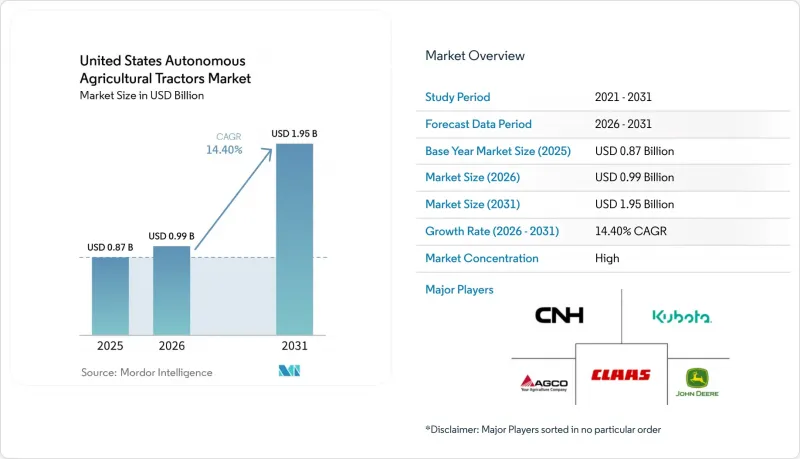
根據 Mordor Intelligence 預測,美國自主農業曳引機市場規模預計將在 2025 年達到 8.7 億美元,2026 年成長至 9.9 億美元,到 2031 年將擴大至 19.5 億美元,在預測期(2026-2031 年)內複合年成長率為 14.4%。
本報告按馬力(30馬力以下、31-100馬力、100馬力以上)、自動化程度(半自動、全自動)、驅動系統(柴油、混合動力、其他)、應用領域(犁地、播種、收割、其他)、組件(GPS/GNSS、其他)以及農場規模(小規模、中型、大型)對市場進行細分分析。市場預測以美元計價。
美國自動駕駛農業曳引機市場趨勢與洞察
熟練農業機械操作人員長期短缺
美國農業機械操作員培訓不足是推動自動駕駛農用曳引機市場發展的直接因素。根據美國農業部(USDA)統計,H-2A簽證的核准數量從2005會計年度的4.8萬份增加到2024會計年度的38.5萬份。然而,這種成長並未解決季節性人手不足,因為並非所有獲準的職位最終都能獲得簽證。農場需要能夠操作大型機械並了解精準播種、導航系統和農田狀況的操作員。這些技能比一般農業勞動力更為專業,因此農場很難迅速補充經驗豐富的曳引機操作員。引入自動駕駛系統可以讓經驗豐富的員工從持續操作轉向監督和異常處理任務,從而解決營運和人力短缺的問題。當農場需要在短時間內完成多項田間作業時,這種需求尤其突出。
在有限的天氣條件下自主工作
在玉米帶,播種和犁地的最佳時間不到10天,之後土壤條件就會惡化。一台能夠在夜間持續作業的曳引機可以幫助農民更有效地利用這段有限的時間。其優點不僅在於減少勞動時間,還在於確保田間作業的及時性。在2025年國際消費電子展(CES)上,約翰迪爾公司發表了9RX,這是一款配備16個攝影機感測系統的自動駕駛曳引機,與原始平台相比,田間作業速度提升了40%。該系統專為需要長時間穩定作業的田間作業而設計。自動駕駛農業機械能夠根據同一套程序,晝夜執行地頭轉彎和耕作深度調整,從而減少白天和夜間田間作業的差異。在美國,由於播種和犁地的延誤限制了作物管理的選擇,自動駕駛農業曳引機市場從中受益匪淺。中西部和大平原地區平坦廣闊的田野為這種應用場景提供了理想的運作條件。
農場層面的前期投入成本高,且投資報酬率存在不確定性。
自動駕駛套件需要一筆初始投資,許多農場難以負擔這筆費用。 2026年2月,普渡大學農業中心報價,改裝約翰迪爾8R和9R曳引機需要4萬至4.5萬美元,外加每年1萬美元的訂閱費,且不限耕地面積。該中心2026年的分析模擬了中西部地區玉米和大豆各佔50%的輪作模式。研究發現,在基準假設下,這將導致每公頃虧損63美元。研究還表明,只有當小時工資超過44美元時,自動駕駛農機才能超越傳統農機。根據美國農業部的報告,2025年4月農場工人的平均時薪為18.58美元。這種差距意味著,僅靠降低人事費用不足以證明購買自動駕駛農機的合理性。美國自動駕駛農用曳引機市場預計將首先在那些旺季勞動力不足的農場中擴張。對於小規模農場而言,可能需要採用基於服務的收費系統或降低設備價格,才能使其真正普及應用。
細分市場分析
到2025年,31-100馬力區間的曳引機將占美國自動駕駛農用曳引機市場46%的銷售量。此區間適用於一般行栽作物作業,並且與中西部地區農場目前使用的許多曳引機相容。與售後系統的兼容性進一步推動了市場需求,因為買家可以升級現有設備而不是更換新設備。該馬力範圍的曳引機也適用於需要自動駕駛進行日常犁地和農田維護作業的農場。該區間最大的市場佔有率反映了其龐大的部署量和這些曳引機的效用。在2025年國際消費電子展(CES)上,約翰迪爾公司發布了配備16個攝影機感知系統的9RX自動駕駛曳引機,這表明製造商正在將自動駕駛功能擴展到各個級別的曳引機。由於作物類型和農場面積的不同,作業需求也各不相同,因此美國自動駕駛農用曳引機市場涵蓋了多個馬力範圍。
預計到2031年,100匹馬力以上的曳引機市場將以23.4%的複合年成長率成長。大規模商業農場使用這類機器進行重型犁地和廣大農田的作業。高馬力設備的價值在於,一名操作員可以同時操控多台機器。此外,即使在天氣條件有限的短時間內,這些機器也能覆蓋更廣闊的農田,使得較高的購買成本對於擁有大型曳引機的農場來說更具可負擔性。 30馬力及以下的曳引機市場規模仍然較小,但其緊湊的尺寸使其適用於大型機器難以作業的區域,在特種作物和溫室種植中發揮重要作用。美國自動農業曳引機市場仍涵蓋高容量田間作業平台和小型專用機器,其中高馬力曳引機與大規模農場的運作特別密切相關。
到2025年,半自動系統將占美國自動農用曳引機市場58%的銷售量。這些系統需要人工監控,無論是在現場還是遠端監控。這種運作模式符合當前的安全措施和各州的要求,使生產者能夠在不選擇完全自動駕駛的情況下熟悉自動駕駛技術。此細分市場佔多數佔有率,反映了現有技術與實際農場風險管理之間的平衡。半自動系統可以處理重複性任務,並在情況改變時允許人工進行判斷。這種方法適用於犁地、糧食運輸和其他計畫內的田間作業。目前,監控系統是美國自動農用曳引機市場商業化應用的主要切入點。
預計到2031年,全自動系統將以22.5%的複合年成長率成長。這一成長將取決於不斷累積的現場經驗、軟體的改進以及人工干預需求的減少。隨著每次商業部署,製造商可以獲得更多關於障礙物偵測、定位和機器行為的數據,這將擴展可執行的任務範圍,同時最大限度地減少直接監督。當農場在旺季無法可靠地保障操作人員時,這一領域尤其重要,與半自動系統相比,它為大規模機械群提供了更具擴充性的工作模式。監管和責任框架預計將影響無人操作的普及速度。預計在可預見的未來,美國自動農業曳引機市場仍將以人工監督型系統為主導。全自動設備由於滿足了對可擴展機械管理的長期需求,因此展現出更高的成長率。
其他好處
- Excel格式的市場預測(ME)表
- 三個月的分析師支持
目錄
第1章:引言
- 研究假設和市場定義
- 調查範圍
第2章:調查方法
第3章執行摘要
第4章 市場狀況
- 市場概覽
- 市場促進因素
- 熟練農業機械操作人員長期短缺
- 在有限的天氣條件下自主工作
- 精確放置和最佳化投入材料
- 為現有曳引機加裝自動駕駛系統,以延長其使用壽命
- 大規模農作物農場多台機器的監控
- 特種作物的安全性和勞動力經濟性
- 市場限制因素
- 農場層面的前期投入成本高,且投資報酬率存在不確定性。
- 州級運營商的機上要求和法律責任尚不清楚。
- 實際現場條件下的介入負擔
- 農業機械與農業軟體之間的互通性有限。
- 監理情勢
- 技術展望
- 波特五力分析
第5章 市場規模與成長預測
- 惠普
- 30馬力或以下
- 31~100HP
- 100馬力或以上
- 按自動化級別
- 半自動
- 完全自主
- 透過驅動系統
- 柴油引擎
- 混合
- 電池供電
- 透過使用
- 犁地
- 播種
- 收成
- 果園和葡萄園工作
- 按組件
- GPS/GNSS
- 感測器和視覺系統
- LiDAR模組
- 控制和導航軟體
- 按農場規模
- 小規模(不足100公頃)
- 中型(100-500公頃)
- 大型(超過500公頃)
第6章 競爭情勢
- 市場集中度
- 策略趨勢
- 市佔率分析
- 公司簡介
- Deere & Company
- CNH Industrial NV
- AGCO Corporation
- Kubota Corporation
- Monarch Tractor
- YANMAR HOLDINGS CO., LTD.
- CLAAS KGaA mbH
- Mahindra & Mahindra Ltd.
- SDF SpA
- TYM Corporation
- ISEKI & CO., LTD.
- Ztractor Inc.
- Sabanto
- Kinze Manufacturing
- TYM Corporation
第7章 市場機會與未來展望
According to Mordor Intelligence, the United States autonomous agricultural tractors market was valued at USD 0.87 billion in 2025 and is estimated to grow from USD 0.99 billion in 2026 to USD 1.95 billion by 2031, at a CAGR of 14.4% during the forecast period (2026-2031).
This report is Segmented by Horsepower (Up To 30 HP, 31 To 100 HP, and Above 100 HP), by Automation Level (Fully Automated and Semi-Automated), by Drive Type (Diesel, Hybrid, and More), by Application (Tillage, Sowing, Harvesting, and More), by Component (GPSand GNSS, and More), and by Farm Size (Small, Medium, and Large). The Market Forecasts are Provided in Terms of Value (USD).
United States Autonomous Agricultural Tractors Market Trends and Insights
Persistent Shortage of Skilled Farm Equipment Operators
The shortage of trained equipment operators is a direct driver for the United States autonomous agricultural tractors market. According to the United States Department of Agriculture (USDA), H-2A certifications rose from 48,000 in fiscal year 2005 to 385,000 in fiscal year 2024. This expansion did not eliminate seasonal coverage gaps, as not every certified position resulted in a visa issuance. Farms require operators who can handle large equipment and understand precision planting, guidance systems, and field conditions. These capabilities are more specialized than general farm labor, making it difficult for farms to quickly replace experienced tractor operators. Autonomous systems enable experienced employees to shift from continuous driving to supervision and exception handling, addressing both operational and numerical workforce gaps. This need is most pronounced when farms must complete multiple field tasks within a short period.
Autonomous Work during Narrow Weather Windows
Planting and tillage windows in the Corn Belt can last fewer than 10 days before soil conditions become unsuitable. A tractor that can continue working through the night allows farms to make better use of this limited time. The benefit comes from timely fieldwork, not only from reduced labor hours. John Deere presented its autonomous 9RX at CES 2025, featuring a 16-camera perception system and a 40% increase in field speed compared with the first-generation platform[. The system was designed for field tasks where consistent operation is critical over long work periods. Autonomous equipment can perform headland turns and adjust implement depth using the same programmed approach during both day and night operations, reducing variability between daytime and overnight field passes. The United States autonomous agricultural tractor market benefits when delayed planting or tillage would otherwise reduce crop management options. Flat, large fields in the Midwest and Great Plains offer the most suitable operating conditions for this use case.
High Upfront Cost and Uncertain Farm-Level Payback
Autonomy kits require an upfront investment that many farms find difficult to justify. In February 2026, Purdue University's center for agriculture cited retrofit costs of USD 40,000 to USD 45,000 for John Deere 8R and 9R tractors, plus annual subscription fees of USD 10,000 for unlimited-acre tillage. Its 2026 analysis modeled a 50/50 corn-soybean rotation in the Midwest. The study found a USD 63 per-hectare deficit under baseline assumptions. It also found that autonomous equipment did not outperform conventional equipment until wages exceeded USD 44 per hour. The USDA reported an average field worker wage of USD 18.58 per hour in April 2025 . This gap means that labor savings alone are not enough to support the purchase decision. The United States autonomous agricultural tractors market to expand first among farms that cannot obtain labor at critical times. Smaller farms may need a service-based payment model or lower kit prices before adoption becomes practical.
Other drivers and restraints analyzed in the detailed report include:
- Precision Placement and Input-Use Optimization
- Retrofit Autonomy for Existing Tractors
- State-Level Operator-Presence and Liability Uncertainty
For complete list of drivers and restraints, kindly check the Table Of Contents.
Segment Analysis
The 31 to 100 HP segment accounted for 46% of the United States autonomous agricultural tractors market revenue in 2025. This segment supports common row-crop tasks and is compatible with many tractors already in use on Midwestern farms. Demand is further supported by compatibility with retrofit systems, which allows buyers to upgrade existing equipment rather than replace it. The horsepower range also suits farms requiring autonomy for recurring tillage and field-preparation work. The segment's leading share reflects the size of the installed base and the practical utility of these tractors. At CES 2025, Deere & Company introduced the autonomous 9RX tractor, featuring a 16-camera perception system, demonstrating that manufacturers are extending autonomous capabilities across different tractor classes. The United States autonomous agricultural tractors market spans multiple horsepower ranges, as operating requirements vary by crop type and farm acreage.
The above 100 HP segment is forecast to grow at a 23.4% CAGR through 2031. Large commercial farms use these machines for heavy tillage and broad-acre fieldwork. Multi-machine supervision improves the value of high-horsepower equipment, as a single operator can oversee several units simultaneously. These machines can also cover more acreage during narrow weather windows, making their higher purchase cost more manageable on farms with substantial acreage. The less than 30 HP segment remains smaller in value but plays a role in specialty crops and controlled environments, as their compact dimensions suit areas where larger equipment cannot operate easily. The United States autonomous agricultural tractors market continues to include both high-capacity field platforms and smaller specialty machines, with the high-horsepower segment more closely tied to fleet-scale operations.
Semi-autonomous systems accounted for 58% of the United States autonomous agricultural tractors market revenue in 2025. These systems require human supervision, either on-site or remotely. This operating model aligns with current safety practices and state-level requirements, and allows growers to become familiar with autonomous technology without committing to fully unattended operation. The segment's majority share reflects the balance between available technology and practical farm risk management. Semi-autonomous systems can handle repeatable tasks while allowing human judgment when conditions change. This approach applies to tillage, grain cart work, and other planned field operations. Supervised systems currently serve as the primary commercial entry point in the United States autonomous agricultural tractors market.
Fully autonomous systems are forecast to grow at a 22.5% CAGR through 2031. Their growth depends on accumulated field experience, software improvements, and reduced intervention requirements. Each commercial deployment provides manufacturers with additional data on obstacle detection, positioning, and machine behavior, which helps expand the range of tasks that can be performed with less direct oversight. This segment is particularly relevant where farms cannot reliably hire operators during critical periods, and it offers a more scalable labor model for large fleets compared to semi-autonomous setups. Regulations and liability frameworks will influence how quickly unattended operation becomes common. The United States autonomous agricultural tractors market will remain weighted toward supervised models in the near term. Fully autonomous equipment carries a higher growth rate because it addresses the longer-term need for scalable fleet management.
Complete Report Scope:
- By Horsepower
- Up to 30 HP
- 31 to 100 HP
- Above 100 HP
- By Automation Level
- Semi-Autonomous
- Fully Autonomous
- By Drive Type
- Diesel
- Hybrid
- Battery-Electric
- By Application
- Tillage
- Sowing
- Harvesting
- Orchard and Vineyard Operations
- By Component
- GPS and GNSS
- Sensors and Vision Systems
- LiDAR and Radar Modules
- Control and Navigation Software
- By Farm Size
- Small (Less than 100 ha)
- Medium (100 to 500 ha)
- Large (More than 500 ha)
List of Companies Covered in this Report:
- Deere & Company
- CNH Industrial N.V.
- AGCO Corporation
- Kubota Corporation
- Monarch Tractor
- YANMAR HOLDINGS CO., LTD.
- CLAAS KGaA mbH
- Mahindra & Mahindra Ltd.
- SDF S.p.A.
- TYM Corporation
- ISEKI & CO., LTD.
- Ztractor Inc.
- Sabanto
- Kinze Manufacturing
- TYM Corporation
Additional Benefits:
- The market estimate (ME) sheet in Excel format
- 3 months of analyst support
TABLE OF CONTENTS
1 Introduction
- 1.1 Study Assumptions and Market Definition
- 1.2 Scope of the Study
2 Research Methodology
3 Executive Summary
4 Market Landscape
- 4.1 Market Overview
- 4.2 Market Drivers
- 4.2.1 Persistent shortage of skilled farm equipment operators
- 4.2.2 Autonomous operation across narrow weather windows
- 4.2.3 Precision placement and input-use optimization
- 4.2.4 Retrofit autonomy extending existing tractor life
- 4.2.5 Multi-machine supervision in large-scale row-crop farms
- 4.2.6 Specialty-crop safety and labor economics
- 4.3 Market Restraints
- 4.3.1 High upfront cost and uncertain farm-level payback
- 4.3.2 State-level operator-presence and liability uncertainty
- 4.3.3 Intervention burden in real-world field conditions
- 4.3.4 Limited interoperability across implements and farm software
- 4.4 Regulatory Landscape
- 4.5 Technological Outlook
- 4.6 Porter's Five Forces Analysis
- 4.6.1 Bargaining Power of Suppliers
- 4.6.2 Bargaining Power of Buyers
- 4.6.3 Threat of New Entrants
- 4.6.4 Threat of Substitutes
- 4.6.5 Intensity of Competitive Rivalry
5 Market Size And Growth Forecasts (Value)
- 5.1 By Horsepower
- 5.1.1 Up to 30 HP
- 5.1.2 31 to 100 HP
- 5.1.3 Above 100 HP
- 5.2 By Automation Level
- 5.2.1 Semi-Autonomous
- 5.2.2 Fully Autonomous
- 5.3 By Drive Type
- 5.3.1 Diesel
- 5.3.2 Hybrid
- 5.3.3 Battery-Electric
- 5.4 By Application
- 5.4.1 Tillage
- 5.4.2 Sowing
- 5.4.3 Harvesting
- 5.4.4 Orchard and Vineyard Operations
- 5.5 By Component
- 5.5.1 GPS and GNSS
- 5.5.2 Sensors and Vision Systems
- 5.5.3 LiDAR and Radar Modules
- 5.5.4 Control and Navigation Software
- 5.6 By Farm Size
- 5.6.1 Small (Less than 100 ha)
- 5.6.2 Medium (100 to 500 ha)
- 5.6.3 Large (More than 500 ha)
6 Competitive Landscape
- 6.1 Market Concentration
- 6.2 Strategic Moves
- 6.3 Market Share Analysis
- 6.4 Company Profiles (includes Global Level Overview, Market Level Overview, Core Segments, Financials as available, Strategic Information, Market Rank/Share, Products and Services, and Recent Developments)
- 6.4.1 Deere & Company
- 6.4.2 CNH Industrial N.V.
- 6.4.3 AGCO Corporation
- 6.4.4 Kubota Corporation
- 6.4.5 Monarch Tractor
- 6.4.6 YANMAR HOLDINGS CO., LTD.
- 6.4.7 CLAAS KGaA mbH
- 6.4.8 Mahindra & Mahindra Ltd.
- 6.4.9 SDF S.p.A.
- 6.4.10 TYM Corporation
- 6.4.11 ISEKI & CO., LTD.
- 6.4.12 Ztractor Inc.
- 6.4.13 Sabanto
- 6.4.14 Kinze Manufacturing
- 6.4.15 TYM Corporation
7 Market Opportunities And Future Outlook

 英國自動農業曳引機:市場佔有率分析、行業趨勢和統計數據以及成長預測(2026-2031 年)中國自主農業曳引機市場:市佔率分析、產業趨勢與統計及成長預測(2026-2031年)
 2026年全球自動駕駛曳引機市場報告
 自動駕駛曳引機市場:按產品、移動性、推進類型、導航技術、應用和最終用戶分類-2026-2032年全球市場預測自主和半自動自主曳引機市場:按產品、曳引機類型、組件、自主程度、功率輸出、推進類型、應用和最終用戶分類-全球預測,2026-2032年
 自動駕駛曳引機市場規模、佔有率和成長分析:按自動駕駛等級、組件、功率輸出、驅動系統、應用、技術和地區分類-2026-2033年產業預測自動駕駛曳引機:市佔率分析、產業趨勢與統計、成長預測(2026-2031)
 自動曳引機市場規模、佔有率、趨勢和預測:按組件、產量、作物類型、應用和地區分類,2026-2034年
 2026-2034年全球自動駕駛曳引機市場規模、佔有率、趨勢和成長分析報告2026年全球自動播種機市場報告