

 |
市場調查報告書
商品編碼
2119103
中國自主農業曳引機市場:市佔率分析、產業趨勢與統計及成長預測(2026-2031年)China Autonomous Agricultural Tractor - Market Share Analysis, Industry Trends & Statistics, Growth Forecasts (2026 - 2031) |
||||||

※ 本網頁內容可能與最新版本有所差異。詳細情況請與我們聯繫。
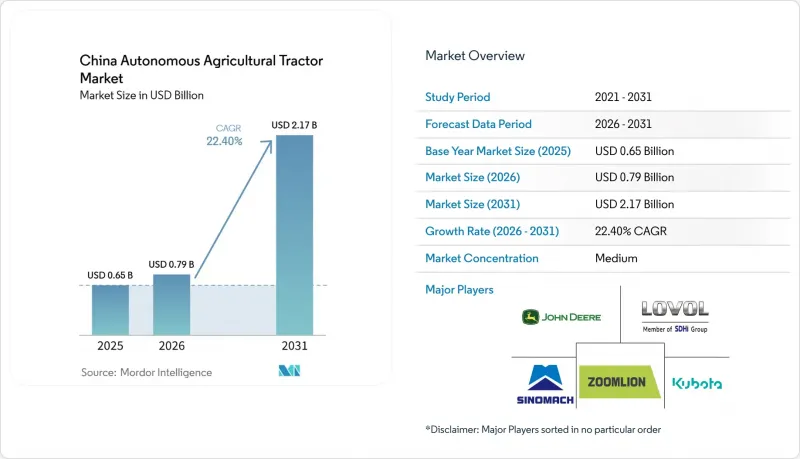
根據 Mordor Intelligence 預測,中國自動駕駛農業曳引機市場規模預計在 2025 年達到 6.5 億美元,2026 年擴大到 7.9 億美元,到 2031 年達到 21.7 億美元。
預測期(2026-2031 年)的複合年成長率預計為 22.4%。
本報告按馬力(30馬力以下、31-100馬力、100馬力以上)、自動化程度(全自動和半自動)、驅動系統(柴油、混合動力、純電動)、應用領域(犁地、播種等)、組件(GPS/GNSS、雷射雷達和雷達模組等)以及農場規模(小規模、中型、大型)進行細分。市場預測以美元計價。
中國自動駕駛農用曳引機市場趨勢與洞察
政府主導的智慧農業和北斗的引入
中國自動駕駛農機市場與該國的智慧農業政策和北斗導航技術的引進密切相關。政府對北斗導航設備的支持,以及相關農業機械自動駕駛系統標準的製定,為設備採購商提供了更清晰的採購、認證和補貼資格架構。這些政策也更傾向於基於國內導航基礎設施設計的系統,而非專為海外衛星導航平台開發的產品。農業農村部和工業和資訊化部正在持續制定智慧農業裝備現代化的補貼政策和優先事項。
農村地區農業勞動力短缺和人事費用上升
中國的自動農用曳引機市場正在應對犁地和秋收季節勞動力短缺的挑戰。人事費用的上升和季節性勞動力短缺促使農民更願意採用省力技術。在農業推廣服務支援技術應用的地區,這一趨勢尤其明顯。因此,合作社管理者在評估自動農用機械時,不僅要考慮年度人事費用,還要考慮其在旺季緩解人手不足風險的能力。這增強了那些允許操作員在保持田間作業穩定的同時兼顧多項任務的曳引機的價值提案。這種優勢在大型農場中最為顯著,因為這些農場的機械運轉率高,初始投資也更划算。
小規模農戶面臨的前期投入成本高,投資報酬不均衡的問題
配備齊全的自動駕駛曳引機需要大量的初始投資,包括感測器、控制單元、導航軟體和通訊硬體。雖然政府補貼計畫降低了符合資格的智慧農機設備的購買成本,但小規模農戶僅靠每年的使用成本仍難以收回剩餘投資。此外,為大規模面積農田設計的系統並不適用於不規則形狀的地塊,而且由於移動和設置需要時間,會降低工作效率。合作所有權和「機器即服務 (MaaS)」模式可以降低進入門檻,但並不能消除所有與田間作業相關的挑戰。因此,與大型農場部署曳引機車隊相比,小規模農戶採用自動駕駛曳引機的速度預計會更慢。
細分市場分析
到2025年,31-100馬力等級的曳引機將佔據中國自動駕駛農用曳引機市場38.9%的佔有率。此功率範圍適用於水稻、小麥和玉米的種植,並與國有農場和成熟合作社的田地規模相符。此等級現有底盤設計可與北斗RTK改裝系統結合,使農場操作人員無需更換整車即可增加自主導航功能。 30馬力以下的曳引機適用於小規模田地和果園,但儘管改裝套件日益普及,農田的分散化仍然限制了其應用。
預計2026年至2031年間,功率超過100馬力的曳引機市場將以23.4%的複合年成長率成長。這項需求主要由黑龍江、內蒙古和新疆等地的大型糧食農場所推動,這些地區廣闊的田地使得每日作業面積得以增加。 2025年9月,中聯重科發表了DX7004,這是一款專為大面積作業設計的1200馬力混合動力曳引機。據該公司稱,該機型日耕面積可達480公頃,為合作社採購商提供了一種將曳引機性能與大規模農場相匹配的方案。採購需求中功率轉向高功率級別,反映了一體化農場在中國自主農業曳引機市場中日益重要的地位。
至2025年,半自動系統將佔中國自動農用曳引機市場67.6%的佔有率。這些系統減少了人工操控,但仍需要操作員進行監控和現場決策。與全自動配置相比,這種方式所需的校準和培訓更少,更適合正在逐步實施自動化的合作社。
預計從2026年到2031年,全自動駕駛系統將以22.5%的複合年成長率成長。買家不僅越來越關注曳引機的初始自動駕駛水平,也越來越關注其技術架構是否能夠適應未來的升級。開放式整合系統可能會在曳引機的整個運作期間引入其他功能,這會影響生命週期成本的計算。國家自動駕駛系統標準為設備認證提供了通用框架,並支撐了政府獎勵計劃的合格。這種法規環境正在推動系統從駕駛輔助系統逐步轉向更高級的自動駕駛配置。目前,半自動系統仍然佔據主導地位,這與熟練技術人員和操作人員供應有限的情況相吻合。
其他好處:
- Excel格式的市場預測(ME)表
- 3個月的分析師支持
目錄
第1章:引言
- 研究假設和市場定義
- 調查範圍
第2章:調查方法
第3章執行摘要
第4章 市場狀況
- 市場概覽
- 市場促進因素
- 政府主導的智慧農業和北斗系統的發展
- 農業部門人手不足和農村地區人事費用上升
- 精密農業和投入最佳化的要求
- 擴大大型農業和農業服務合作社
- 透過維修和共享模式實現小規模地塊的自主性
- 針對中國市場進行自主農業機械的在地化開發。
- 市場限制因素
- 小規模農戶面臨的挑戰是前期投入成本高、投資報酬率不穩定。
- 農地碎片化和農場管理中規模經濟的限制。
- 資料管治、網路安全和跨境技術限制
- 本地自主系統的服務、協調和維護能力有限。
- 監理情勢
- 技術展望
- 波特五力分析
第5章 市場規模與成長預測
- 按馬力
- 30馬力或以下
- 31~100 HP
- 100馬力或以上
- 按自動化級別
- 半自動
- 完全自主
- 透過驅動系統
- 柴油引擎
- 混合
- 電池式電動車
- 透過使用
- 犁地
- 播種
- 收成
- 果園和葡萄園的經營
- 按組件
- GPS/GNSS
- 感測器和視覺系統
- 相機和視覺系統
- LiDAR和雷達模組
- 控制和導航軟體
- 按農場規模
- 小規模農場(少於100公頃)
- 中型農場(100-500公頃)
- 大型農場(超過500公頃)
第6章 競爭情勢
- 市場集中度
- 策略趨勢
- 市佔率分析
- 公司簡介
- YTO Group Corporation(China National Machinery Industry Corporation)
- Lovol Heavy Industry Co., Ltd.
- Zoomlion Heavy Industry Science and Technology Co., Ltd.
- Deere and Company
- CNH Industrial NV
- AGCO Corporation
- Kubota Corporation
- Yanmar Holdings Co., Ltd.
- TYM Corporation
- ISEKI & Co., Ltd.
- Shandong Wuzheng Group Co., Ltd.
- Jiangsu Yueda Intelligent Agricultural Equipment Co., Ltd.(Jiangsu Yueda Group Co., Ltd.)
- Changzhou Dongfeng Agricultural Machinery Group Co., Ltd.
- XAG Co., Ltd.
第7章 市場機會與未來展望
According to Mordor Intelligence, the China autonomous agricultural tractor market was valued at USD 0.65 billion in 2025 and is estimated to grow from USD 0.79 billion in 2026 and reach USD 2.17 billion by 2031, at a CAGR of 22.4% during the forecast period (2026-2031).
This report is Segmented by Horsepower (Up To 30 HP, 31-100 HP and Above 100 HP), by Automation Level (Fully Autonomous and Semi-Autonomous), by Drive Type (Diesel, Hybrid, and Battery-Electric), by Application (Tillage, Sowing, and More), by Component (GPS/GNSS, Lidar and Radar Modules, and More), and by Farm Size (Small, Medium, and Large). The Market Forecasts are Provided in Terms of Value (USD).
China Autonomous Agricultural Tractor Market Trends and Insights
Government-Led Smart Agriculture and BeiDou Deployment
The China autonomous agricultural tractor market is closely linked to the country's smart agriculture agenda and the adoption of BeiDou navigation technology. Government support for BeiDou-enabled autonomous equipment, together with standards governing automatic driving systems for agricultural machinery, provides equipment buyers with a clearer framework for procurement, certification, and subsidy eligibility. These policies also favor systems designed around domestic navigation infrastructure over products developed solely for foreign satellite-navigation platforms. The Ministry of Agriculture and Rural Affairs (MARA) and the Ministry of Industry and Information Technology (MIIT) continue to shape subsidy policies and priorities for intelligent agricultural equipment modernization.
Agricultural Labor Shortages and Rising Rural Labor Costs
The China autonomous agricultural tractor market addresses the challenge of securing workers during spring plowing and autumn harvest seasons. Rising labor costs and seasonal labor shortages are increasing farmers' willingness to adopt labor-saving technologies, particularly where agricultural extension services support technology adoption. Cooperative managers can therefore evaluate autonomous equipment based on its ability to reduce peak-season staffing risks, rather than annual wage costs alone. This strengthens the value proposition for tractors that can maintain consistent field operations while enabling operators to oversee multiple tasks. The benefits are most pronounced on larger farms, where higher equipment utilization can justify the initial investment.
High Upfront Cost and Uneven Return on Investment for Smallholders
A fully equipped autonomous tractor requires a substantial upfront investment, including sensors, control units, navigation software, and connectivity hardware. Although government subsidy programs help reduce acquisition costs for qualifying intelligent machinery, the remaining investment can still be difficult for small operators to recover through annual use. Large-field systems are also less suited to irregular plots, where travel and setup time reduce operational efficiency. Cooperative ownership and machinery as a service models can lower the entry barrier, but they do not eliminate all field-access challenges. As a result, adoption among smallholders is anticipated to progress more gradually than fleet deployment on larger farms.
Other drivers and restraints analyzed in the detailed report include:
- Precision Farming and Input Optimization Requirements
- Expansion of Large-Scale Farming and Agricultural Service Cooperatives
- Fragmented Farm Parcels and Limited Operating Economies of Scale
For complete list of drivers and restraints, kindly check the Table Of Contents.
Segment Analysis
The 31-100 HP class held 38.9% of the China autonomous agricultural tractor market share in 2025. This range is suited to rice, wheat, and corn operations and the field sizes found at state farms and established cooperatives. Existing chassis designs in this class can be paired with BeiDou RTK retrofit systems, giving farm operators a way to add automated guidance without replacing entire tractor fleets. Machines up to 30 HP serve small fields and orchards, but parcel fragmentation continues to limit their adoption even as retrofit packages become more widely available.
The above 100 HP segment is forecast to expand at a 23.4% CAGR between 2026 and 2031. Demand is supported by large grain farms in Heilongjiang, Inner Mongolia, and Xinjiang, where wide fields allow machines to cover more land per day. In September 2025, Zoomlion introduced the DX7004, a 1,200 HP hybrid tractor designed for large-area operations. The company stated that the model could cover 480 hectares per day, offering cooperative buyers a way to align tractor capacity with larger farm units. The shift from mid-range to higher-power procurement reflects the growing role of consolidated farms in the China autonomous agricultural tractor market.
Semi-autonomous systems held 67.6% of the China autonomous agricultural tractor market share in 2025. These systems reduce manual steering demands while retaining an operator for monitoring and field decisions. This arrangement requires less calibration and training than a fully autonomous configuration, making it suitable for cooperatives that are adding automation in stages.
Fully autonomous systems are forecast to expand at a 22.5% CAGR between 2026 and 2031. Buyers increasingly consider whether a tractor's technical architecture can support future upgrades, rather than evaluating only its initial autonomy level. Open-integration systems can alter lifetime cost calculations, as additional capabilities may be added throughout the tractor's operating life. National standards for autonomous driving systems provide a common framework for equipment certification and support eligibility for government incentive programs. This regulatory environment encourages a gradual transition from driver-assisted systems to more autonomous configurations. The near-term lead held by semi-autonomous systems is consistent with the limited availability of trained technicians and operators.
Complete Report Scope:
- By Horsepower
- Up to 30 HP
- 31-100 HP
- Above 100 HP
- By Automation Level
- Semi-Autonomous
- Fully Autonomous
- By Drive Type
- Diesel
- Hybrid
- Battery-Electric
- By Application
- Tillage
- Sowing
- Harvesting
- Orchard and Vineyard Operations
- By Component
- GPS/GNSS
- Sensors and Vision Systems
- Camera and Vision Systems
- LiDAR and Radar Modules
- Control and Navigation Software
- By Farm Size
- Small Farms (Less100 Hectares)
- Medium Farms (100-500 Hectares)
- Large Farms (More than 500 Hectares)
List of Companies Covered in this Report:
- YTO Group Corporation (China National Machinery Industry Corporation)
- Lovol Heavy Industry Co., Ltd.
- Zoomlion Heavy Industry Science and Technology Co., Ltd.
- Deere and Company
- CNH Industrial N.V.
- AGCO Corporation
- Kubota Corporation
- Yanmar Holdings Co., Ltd.
- TYM Corporation
- ISEKI & Co., Ltd.
- Shandong Wuzheng Group Co., Ltd.
- Jiangsu Yueda Intelligent Agricultural Equipment Co., Ltd. (Jiangsu Yueda Group Co., Ltd.)
- Changzhou Dongfeng Agricultural Machinery Group Co., Ltd.
- XAG Co., Ltd.
Additional Benefits:
- The market estimate (ME) sheet in Excel format
- 3 months of analyst support
TABLE OF CONTENTS
1 INTRODUCTION
- 1.1 Study Assumptions and Market Definition
- 1.2 Scope of the Study
2 RESEARCH METHODOLOGY
3 EXECUTIVE SUMMARY
4 MARKET LANDSCAPE
- 4.1 Market Overview
- 4.2 Market Drivers
- 4.2.1 Government-led smart agriculture and BeiDou deployment
- 4.2.2 Agricultural labor shortages and rising rural labor costs
- 4.2.3 Precision farming and input optimization requirements
- 4.2.4 Expansion of large-scale farming and agricultural service cooperatives
- 4.2.5 Small-plot autonomy enabled by retrofit and shared-use models
- 4.2.6 China-specific localization of autonomous agricultural machinery
- 4.3 Market Restraints
- 4.3.1 High upfront cost and uneven return on investment for smallholders
- 4.3.2 Fragmented farm parcels and limited operating economies of scale
- 4.3.3 Data governance, cybersecurity, and cross-border technology constraints
- 4.3.4 Limited local service, calibration, and autonomous-system maintenance capacity
- 4.4 Regulatory Landscape
- 4.5 Technological Outlook
- 4.6 Porter's Five Forces Analysis
- 4.6.1 Bargaining Power of Suppliers
- 4.6.2 Bargaining Power of Buyers
- 4.6.3 Threat of New Entrants
- 4.6.4 Threat of Substitutes
- 4.6.5 Intensity of Competitive Rivalry
5 MARKET SIZE AND GROWTH FORECASTS (VALUE)
- 5.1 By Horsepower
- 5.1.1 Up to 30 HP
- 5.1.2 31-100 HP
- 5.1.3 Above 100 HP
- 5.2 By Automation Level
- 5.2.1 Semi-Autonomous
- 5.2.2 Fully Autonomous
- 5.3 By Drive Type
- 5.3.1 Diesel
- 5.3.2 Hybrid
- 5.3.3 Battery-Electric
- 5.4 By Application
- 5.4.1 Tillage
- 5.4.2 Sowing
- 5.4.3 Harvesting
- 5.4.4 Orchard and Vineyard Operations
- 5.5 By Component
- 5.5.1 GPS/GNSS
- 5.5.2 Sensors and Vision Systems
- 5.5.3 Camera and Vision Systems
- 5.5.4 LiDAR and Radar Modules
- 5.5.5 Control and Navigation Software
- 5.6 By Farm Size
- 5.6.1 Small Farms (Less100 Hectares)
- 5.6.2 Medium Farms (100-500 Hectares)
- 5.6.3 Large Farms (More than 500 Hectares)
6 COMPETITIVE LANDSCAPE
- 6.1 Market Concentration
- 6.2 Strategic Moves
- 6.3 Market Share Analysis
- 6.4 Company Profiles (Includes Global Level Overview, Market Level Overview, Core Segments, Financials as Available, Strategic Information, Market Rank/Share, Products and Services, Recent Developments)
- 6.4.1 YTO Group Corporation (China National Machinery Industry Corporation)
- 6.4.2 Lovol Heavy Industry Co., Ltd.
- 6.4.3 Zoomlion Heavy Industry Science and Technology Co., Ltd.
- 6.4.4 Deere and Company
- 6.4.5 CNH Industrial N.V.
- 6.4.6 AGCO Corporation
- 6.4.7 Kubota Corporation
- 6.4.8 Yanmar Holdings Co., Ltd.
- 6.4.9 TYM Corporation
- 6.4.10 ISEKI & Co., Ltd.
- 6.4.11 Shandong Wuzheng Group Co., Ltd.
- 6.4.12 Jiangsu Yueda Intelligent Agricultural Equipment Co., Ltd. (Jiangsu Yueda Group Co., Ltd.)
- 6.4.13 Changzhou Dongfeng Agricultural Machinery Group Co., Ltd.
- 6.4.14 XAG Co., Ltd.
7 MARKET OPPORTUNITIES AND FUTURE OUTLOOK

 美國自主農業曳引機:市場佔有率分析、行業趨勢和統計數據以及成長預測(2026-2031 年)英國自動農業曳引機:市場佔有率分析、行業趨勢和統計數據以及成長預測(2026-2031 年)
 2026年全球自動駕駛曳引機市場報告
 自動駕駛曳引機市場:按產品、移動性、推進類型、導航技術、應用和最終用戶分類-2026-2032年全球市場預測自主和半自動自主曳引機市場:按產品、曳引機類型、組件、自主程度、功率輸出、推進類型、應用和最終用戶分類-全球預測,2026-2032年
 自動駕駛曳引機市場規模、佔有率和成長分析:按自動駕駛等級、組件、功率輸出、驅動系統、應用、技術和地區分類-2026-2033年產業預測自動駕駛曳引機:市佔率分析、產業趨勢與統計、成長預測(2026-2031)
 自動曳引機市場規模、佔有率、趨勢和預測:按組件、產量、作物類型、應用和地區分類,2026-2034年
 2026-2034年全球自動駕駛曳引機市場規模、佔有率、趨勢和成長分析報告2026年全球自動播種機市場報告