

 |
市場調查報告書
商品編碼
2119163
英國自動農業曳引機:市場佔有率分析、行業趨勢和統計數據以及成長預測(2026-2031 年)United Kingdom Autonomous Agricultural Tractors - Market Share Analysis, Industry Trends & Statistics, Growth Forecasts (2026 - 2031) |
||||||

※ 本網頁內容可能與最新版本有所差異。詳細情況請與我們聯繫。
據 Mordor Intelligence 稱,2025 年英國自動農業曳引機市場價值 3,800 萬美元,預計到 2031 年將達到 7,730 萬美元,而 2026 年為 4,800 萬美元,預測期(2026-2031 年)的複合年成長率為 12.5%。
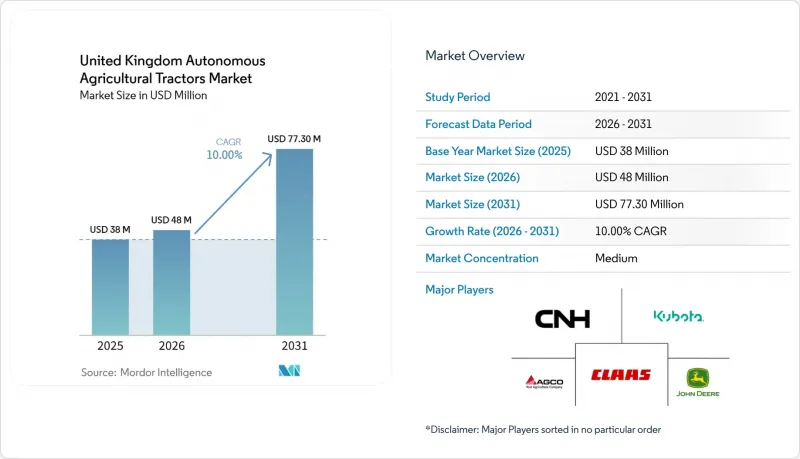
本報告根據馬力(30馬力以下、31-100馬力、100馬力以上)、自動化程度(全自動、半自動)、驅動系統(柴油、混合動力、其他)、應用領域(犁地、播種、收割、其他)、組件(GPS/GNSS、其他)以及農場規模(小規模、中型、大型)對市場進行細分分析。市場預測以美元計價。
英國自動駕駛農業曳引機市場趨勢與洞察
農業勞動力短缺和熟練操作人員短缺
英國的自動駕駛農用曳引機市場正受益於結構性而非暫時性的勞動力結構轉變。脫歐後的移民政策預計到2024年,每年從歐盟到英國的季節性工人數將比2020年以前減少4萬至7萬人。這一缺口正在改變園藝和作物種植業的田間作業經濟格局。這種壓力不僅限於一般的田間作業,隨著老一代工人退出勞動市場,尋找熟練的曳引機操作員和主管的替代者也變得越來越困難。這一點至關重要,因為早期的自動駕駛農用機械在犁地和播種等重複性作業中表現最佳。歷史上,農場一直依賴熟練的操作員來長期保持作業的精準度。隨著勞動力的減少,英國的自動駕駛農用曳引機市場對那些希望在保持品質的同時減少對日益萎縮的勞動力的依賴的農場來說,正變得越來越有吸引力。這也是為什麼在廣大的農業地區,中功率高功率曳引機仍然吸引大部分商業性興趣的原因之一。
精密農業和互聯導航系統的引入
在英國主要耕作區精密農業應用日益普及的推動下,英國自動駕駛農用曳引機市場正在蓬勃發展。根據英國農業和園藝發展委員會 (AHDB) 預測,到 2025 年,英國超過 65% 的大型農場將使用配備原廠安裝或改裝的 RTK-GNSS 導航系統的曳引機。這意味著現有曳引機車隊中的相當一部分已經具備實現更高水平自動駕駛所需的核心定位基礎設施。這項現有基礎設施降低了應用門檻,使得自動駕駛的實現不再需要每次都更換整台機器,而是只需升級軟體、感測器和控制系統即可。約翰迪爾公司一直致力於透過其「互聯機器與營運生態系統」推動這一分階段的推廣,該生態系統支援基於現有精密農業工作流程的路線規劃和現場作業。隨著配備導航功能的曳引機不斷加入車隊,自動駕駛升級的基礎設施也將隨之擴展,而目前對精密農業的投資將直接促進英國自動駕駛農用曳引機市場在未來幾年的成長。
高昂的實施成本限制了除大型企業以外的其他公司採用這種做法。
高昂的初始成本仍然是英國自動駕駛農用曳引機市場最明顯的障礙之一。對於小規模農場而言,高馬力、全自動設備的高昂價格難以負擔,因為他們每年的機器使用量有限,而且投資回收期往往超過典型的更換週期。根據英國環境、食品和農村事務部 (DEFRA) 2024 年的數據,面積小於 100 公頃的農場佔英國農地總面積的面積,這意味著大多數農場在初期階段並不適合採用高價自動化技術。雖然改造方案降低了採用門檻,但商業案例仍取決於運轉率、田地佈局以及能否獲得專業技術支援。因此,目前最先進的採用者是大型農場和承包商,他們可以利用其廣闊的土地和運作的設備運行時間,在更大的面積部署這項技術。在租賃、承包和農場間共用等所有權模式變得更加普遍之前,成本問題很可能仍將阻礙英國自動駕駛農用曳引機市場的普及。
細分市場分析
到2025年,31-100馬力細分市場將佔英國自動農用曳引機市場38.9%的佔有率,成為銷售量最大的馬力細分市場。這一市場地位反映了英格蘭低地農業區眾多農場依賴多功能中功率曳引機進行犁地、播種和噴灑作業,並種植大田作物和收穫作物的現狀。該細分市場的優勢還在於設備成本、作業靈活性以及是否適合自動或半自動操作之間實現了合理的平衡。對於英國大部分自動農用曳引機市場而言,對於那些希望實現自動化但又不想立即購買最大功率曳引機的農場來說,該馬力細分市場仍然是最現實的切入點。
預計到2031年,馬力超過100匹的細分市場將以11.5%的複合年成長率成長,顯示該細分市場具有更強的成長潛力。這一成長與大規模糧食和根莖類作物種植密切相關,在這些種植作業中,高牽引力作業、長距離田間行駛和夜間作業提高了自動化設備的投資回報率。 AGCO公司推出的Fendt 1000 Vario Gen4系列進一步強化了這一趨勢,該系列產品標配了用於犁地和糧食運輸的自動駕駛選項,並將於2026年開始交付。同時,低馬力細分市場仍主要局限於有限的利基應用,在英國自動農用曳引機市場中遠遠落後於主流田間設備類別。隨著商業應用的擴展,預計馬力成長最顯著的細分市場將是那些能夠在更大農田上長時間運作的大型機械。
到2025年,半自動系統將佔據英國自動農用曳引機市場67.6%的佔有率,成為自動化程度最高的系統。這一市場格局反映了當前的保險、安全和監管趨勢,這些趨勢傾向於那些能夠讓操作員始終處於作業循環之內或附近的系統。半自動機器透過路徑執行、田邊管理以及與農具的協調作業來創造價值,同時又符合公認的作業規範。因此,在2025年和2026年,受監管的自動操作將成為英國自動農用曳引機市場中最具商業性可行性的類別。
目前產量較小的全自主系統預計到2031年將以13.0%的複合年成長率成長。約翰迪爾和久保田等主要製造商產品推出支撐了這個成長前景。這些公司已將用於大田作物和特種作物的自動化平台商業化。這表明,即使在監管環境尚不完善的情況下,產品準備工作也在穩步推進。隨著安全檢驗的不斷完善和法律法規的日益清晰,預計英國的自主農業曳引機市場將從人工運作轉向無人田間作業。這項轉變預計將首先應用於地理圍籬內的重複性作業,然後擴展到更廣泛的應用領域。
其他好處
- Excel格式的市場預測(ME)表
- 3個月的分析師支持
目錄
第1章:引言
- 研究假設和市場定義
- 調查範圍
第2章:調查方法
第3章執行摘要
第4章 市場狀況
- 市場概覽
- 市場促進因素
- 農業勞動力短缺和熟練操作人員短缺
- 精密農業和互聯導航系統的引入
- 政府資助加快推廣自動駕駛曳引機。
- 透過 24 小時現場操作和監控多台機器,提高了生產效率。
- 改裝自動駕駛套件和具備自動駕駛功能的曳引機平台
- 果園和葡萄園特種作物的機械化
- 市場限制因素
- 高昂的實施成本限制了除大型企業以外的其他公司採用這種做法。
- 由於法規含糊不清,導致全自動系統的引入延遲。
- 連接性和定位精度差會導致運行可靠性降低。
- 缺乏處理和運營混合車隊的準備
- 監理情勢
- 技術展望
- 波特五力分析
第5章 市場規模與成長預測
- 惠普
- 30馬力或以下
- 31~100HP
- 超過100馬力
- 按自動化級別
- 半自動
- 完全自主
- 透過驅動系統
- 柴油引擎
- 混合
- 電池和電力
- 透過使用
- 犁地
- 播種
- 收成
- 果園和葡萄園工作
- 按組件
- GPS/GNSS
- 感測器和視覺系統
- LiDAR模組
- 控制和導航軟體
- 按農場規模
- 小規模(不足100公頃)
- 中型(100-500公頃)
- 大型(超過500公頃)
第6章 競爭情勢
- 市場集中度
- 策略趨勢
- 市佔率分析
- 公司簡介
- Deere and Company
- CNH Industrial NV
- AGCO Corporation
- Kubota Corporation
- CLAAS KGaA mbH
- YANMAR HOLDINGS CO., LTD.
- Monarch Tractor
- Mahindra and Mahindra
- TYM Corporation
- SDF Group
- ZETOR TRACTORS as(HTC Corporation)
- Sonalika
- Kioti(Daedong)
- New Holland Agriculture
- JCB
第7章 市場機會與未來展望
According to Mordor Intelligence, the United Kingdom autonomous agricultural tractors market size was valued at USD 38 million in 2025 and estimated to grow from USD 48 million in 2026 to reach USD 77.3 million by 2031, at a CAGR of 12.5% during the forecast period (2026-2031).
This report is Segmented by Horsepower (Up To 30 HP, 31 To 100 HP, and Above 100 HP), by Automation Level (Fully Automated and Semi-Automated), by Drive Type (Diesel, Hybrid, and More), by Application (Tillage, Sowing, Harvesting, and More), by Component (GPS and GNSS, and More), and by Farm Size (Small, Medium, and Large). The Market Forecasts are Provided in Terms of Value (USD).
United Kingdom Autonomous Agricultural Tractors Market Trends and Insights
Farm Labor Shortages and Skilled Operator Scarcity
The United Kingdom autonomous agricultural tractors market is benefiting from a labor shift that has become structural rather than temporary. Post-Brexit migration changes reduced the annual inflow of seasonal European Union farm workers into the United Kingdom by an estimated 40,000 to 70,000 in 2024 compared with pre-2020 levels, and that gap has altered the economics of field operations across horticulture and arable farming. The pressure is not limited to general field labor, as experienced tractor operators and supervisors are also becoming harder to replace as older workers leave the workforce. This is relevant because early autonomy performs best in repetitive activities such as tillage and drilling, where farms previously relied on skilled operators to maintain accuracy over long hours. As that labor pool shrinks, the United Kingdom autonomous agricultural tractors market becomes more attractive to farms seeking to reduce dependence on scarce operators while maintaining work quality. This is one reason the mid-range and high-horsepower classes continue to draw most of the commercial attention in large arable regions.
Precision Agriculture and Connected Guidance Stack Adoption
Growth in the United Kingdom autonomous agricultural tractors market is supported by the increasing adoption of precision agriculture across major arable holdings. According to Agriculture and Horticulture Development Board (AHDB), more than 65% of large arable farms in the country in 2025 already use tractors equipped with factory-fitted or retrofit RTK-GNSS steering systems. This means a significant share of the existing fleet already has the core positioning infrastructure required for higher levels of autonomy. This installed base reduces adoption barriers, as autonomy can be introduced through software, sensor, and control upgrades rather than full machine replacement in every case. John Deere has pursued this staged approach through its connected machine and operations ecosystem, which supports path planning and field execution based on existing precision workflows. As more guidance-ready tractors enter the fleet, they expand the addressable base for autonomous upgrades, making current precision agriculture investments a direct contributor to growth in the United Kingdom autonomous agricultural tractors market over the next several years.
High Acquisition Cost Limits Reach Beyond Large Enterprises
High upfront cost remains one of the clearest barriers to the United Kingdom autonomous agricultural tractors market. The premium attached to fully autonomous packages in the higher horsepower range is difficult for smaller farms to justify when annual machine use is limited and payback periods extend beyond normal replacement cycles. In 2024, Department for Environment, Food and Rural Affairs (DEFRA) data show that farms below 100 ha account for a large share of total holdings, which means much of the farm base does not naturally fit the early economics of premium automation. Although retrofit options reduce the entry point, the business case still depends on utilization, field layout, and access to skilled support. As a result, adoption remains strongest among large farms and contractors, which can spread the technology across more acres and operating hours. Until ownership models such as leasing, contracting, and cross-farm sharing become more common, cost will continue to slow adoption in the United Kingdom autonomous agricultural tractors market.
Other drivers and restraints analyzed in the detailed report include:
- Government Funding Accelerates Autonomous Tractor Adoption
- Productivity Gains from 24-Hour Field Operations and Multi-Machine Supervision
- Regulatory Ambiguity Delays Fully Unattended Deployment
For complete list of drivers and restraints, kindly check the Table Of Contents.
Segment Analysis
The 31-to-100 HP segment held 38.9% of the United Kingdom autonomous agricultural tractors market in 2025, making it the largest horsepower band by revenue. This position reflects the prevalence of mixed arable and combinable-crop farms that rely on versatile mid-range tractors for cultivation, sowing, and spraying throughout English lowland agriculture. The segment also benefits from a practical balance between equipment cost, field versatility, and suitability for guided or semi-autonomous operation. Across much of the United Kingdom's autonomous agricultural tractor market, this range remains the most realistic entry point for farms seeking automation without immediately transitioning to the largest machines.
The above-100 HP segment is forecast to grow at a 11.5% CAGR through 2031, indicating where stronger expansion is anticipated. This growth is tied to large cereal and root crop operations, where high-draft work, long field runs, and overnight operations generate a stronger return on investment in autonomy. AGCO Corporation reinforced this direction with the launch of the Fendt 1000 Vario Gen4 series, which includes factory-integrated autonomy options for tillage and grain cart operations, with deliveries beginning in 2026. The smallest horsepower tier remains limited to narrower specialty uses, keeping it well behind the mainstream field equipment classes in the United Kingdom autonomous agricultural tractors market. As commercial adoption broadens, horsepower growth is estimated to remain strongest where large machines can operate for longer hours across more acres.
Semi-autonomous systems held 67.6% of the United Kingdom autonomous agricultural tractors market share in 2025, making them the dominant automation level. This position reflects current insurance, safety, and regulatory conditions, which favor systems that keep an operator in or near the working loop. Semi-autonomous machines deliver value through path execution, headland management, and implement coordination while remaining within accepted operating practices. As a result, supervised autonomy has become the most commercially viable category in the United Kingdom autonomous agricultural tractors market for 2025 and 2026.
Fully autonomous systems are projected to grow at a 13.0% CAGR through 2031, despite currently lower volumes. This growth outlook is supported by product launches from large manufacturers, including John Deere and Kubota Corporation, that are already commercializing higher-autonomy platforms for field and specialty-crop use. This indicates that product readiness is advancing even as regulation remains incomplete. As safety validation improves and legal clarity increases, a larger share of the United Kingdom autonomous agricultural tractors market is estimated to shift from supervised execution to unattended field operation. This transition will likely begin with repetitive tasks in geofenced field conditions before extending to more variable applications.
Complete Report Scope:
- By Horsepower
- Up to 30 HP
- 31 to 100 HP
- Above 100 HP
- By Automation Level
- Semi-Autonomous
- Fully Autonomous
- By Drive Type
- Diesel
- Hybrid
- Battery-Electric
- By Application
- Tillage
- Sowing
- Harvesting
- Orchard and Vineyard Operations
- By Component
- GPS and GNSS
- Sensors and Vision Systems
- LiDAR and Radar Modules
- Control and Navigation Software
- By Farm Size
- Small (Less than 100 ha)
- Medium (100 to 500 ha)
- Large (More than 500 ha)
List of Companies Covered in this Report:
- Deere and Company
- CNH Industrial N.V.
- AGCO Corporation
- Kubota Corporation
- CLAAS KGaA mbH
- YANMAR HOLDINGS CO., LTD.
- Monarch Tractor
- Mahindra and Mahindra
- TYM Corporation
- SDF Group
- ZETOR TRACTORS a.s. (HTC Corporation)
- Sonalika
- Kioti (Daedong)
- New Holland Agriculture
- JCB
Additional Benefits:
- The market estimate (ME) sheet in Excel format
- 3 months of analyst support
TABLE OF CONTENTS
1 Introduction
- 1.1 Study Assumptions and Market Definition
- 1.2 Scope of the Study
2 Research Methodology
3 Executive Summary
4 Market Landscape
- 4.1 Market Overview
- 4.2 Market Drivers
- 4.2.1 Farm labor shortages and skilled operator scarcity
- 4.2.2 Precision agriculture and connected guidance stack adoption
- 4.2.3 Government funding accelerates autonomous tractor adoption
- 4.2.4 Productivity gains from 24-hour field operations and multi-machine supervision
- 4.2.5 Retrofit autonomy kits and autonomy-ready tractor platforms
- 4.2.6 Specialty-crop mechanization in orchards and vineyards
- 4.3 Market Restraints
- 4.3.1 High acquisition cost limits reach beyond large enterprises
- 4.3.2 Regulatory ambiguity delays fully unattended deployment
- 4.3.3 Connectivity and positioning weaknesses reduce operating confidence
- 4.3.4 Mixed-fleet compatibility and service readiness still need work
- 4.4 Regulatory Landscape
- 4.5 Technological Outlook
- 4.6 Porter's Five Forces Analysis
- 4.6.1 Bargaining Power of Suppliers
- 4.6.2 Bargaining Power of Buyers
- 4.6.3 Threat of New Entrants
- 4.6.4 Threat of Substitutes
- 4.6.5 Intensity of Competitive Rivalry
5 Market Size and Growth Forecasts (Value)
- 5.1 By Horsepower
- 5.1.1 Up to 30 HP
- 5.1.2 31 to 100 HP
- 5.1.3 Above 100 HP
- 5.2 By Automation Level
- 5.2.1 Semi-Autonomous
- 5.2.2 Fully Autonomous
- 5.3 By Drive Type
- 5.3.1 Diesel
- 5.3.2 Hybrid
- 5.3.3 Battery-Electric
- 5.4 By Application
- 5.4.1 Tillage
- 5.4.2 Sowing
- 5.4.3 Harvesting
- 5.4.4 Orchard and Vineyard Operations
- 5.5 By Component
- 5.5.1 GPS and GNSS
- 5.5.2 Sensors and Vision Systems
- 5.5.3 LiDAR and Radar Modules
- 5.5.4 Control and Navigation Software
- 5.6 By Farm Size
- 5.6.1 Small (Less than 100 ha)
- 5.6.2 Medium (100 to 500 ha)
- 5.6.3 Large (More than 500 ha)
6 Competitive Landscape
- 6.1 Market Concentration
- 6.2 Strategic Moves
- 6.3 Market Share Analysis
- 6.4 Company Profiles (Includes Global Level Overview, Market Level Overview, Core Segments, Financials as Available, Strategic Information, Market Rank/Share, Products and Services, Recent Developments)
- 6.4.1 Deere and Company
- 6.4.2 CNH Industrial N.V.
- 6.4.3 AGCO Corporation
- 6.4.4 Kubota Corporation
- 6.4.5 CLAAS KGaA mbH
- 6.4.6 YANMAR HOLDINGS CO., LTD.
- 6.4.7 Monarch Tractor
- 6.4.8 Mahindra and Mahindra
- 6.4.9 TYM Corporation
- 6.4.10 SDF Group
- 6.4.11 ZETOR TRACTORS a.s. (HTC Corporation)
- 6.4.12 Sonalika
- 6.4.13 Kioti (Daedong)
- 6.4.14 New Holland Agriculture
- 6.4.15 JCB
7 Market Opportunities And Future Outlook

 美國自主農業曳引機:市場佔有率分析、行業趨勢和統計數據以及成長預測(2026-2031 年)中國自主農業曳引機市場:市佔率分析、產業趨勢與統計及成長預測(2026-2031年)
 2026年全球自動駕駛曳引機市場報告
 自動駕駛曳引機市場:按產品、移動性、推進類型、導航技術、應用和最終用戶分類-2026-2032年全球市場預測自主和半自動自主曳引機市場:按產品、曳引機類型、組件、自主程度、功率輸出、推進類型、應用和最終用戶分類-全球預測,2026-2032年
 自動駕駛曳引機市場規模、佔有率和成長分析:按自動駕駛等級、組件、功率輸出、驅動系統、應用、技術和地區分類-2026-2033年產業預測自動駕駛曳引機:市佔率分析、產業趨勢與統計、成長預測(2026-2031)
 自動曳引機市場規模、佔有率、趨勢和預測:按組件、產量、作物類型、應用和地區分類,2026-2034年
 2026-2034年全球自動駕駛曳引機市場規模、佔有率、趨勢和成長分析報告2026年全球自動播種機市場報告