


 |
市場調查報告書
商品編碼
2119184
亞太地區視訊點播廣告:市場佔有率分析、產業趨勢與統計及成長預測(2026-2031 年)Asia-Pacific Advertising Video-on-Demand - Market Share Analysis, Industry Trends & Statistics, Growth Forecasts (2026 - 2031) |
||||||

※ 本網頁內容可能與最新版本有所差異。詳細情況請與我們聯繫。
根據 Mordor Intelligence 預測,亞太地區廣告支援的視訊點播 (VOD) 市場規模預計將從 2025 年的 232.1 億美元成長到 2026 年的 248 億美元,然後在 2031 年達到 429.6 億美元,2026 年至 2031 年的複合年成長率為 1.1%。
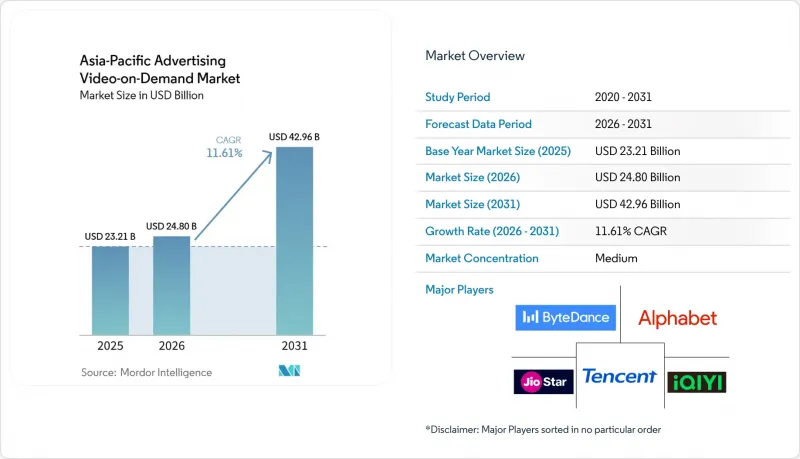
本報告按內容類型(電影、電視節目/劇集、紀錄片)、設備類型(智慧型手機/平板電腦、智慧型電視、筆記型電腦/桌上型電腦)、最終用戶(媒體/娛樂、零售/電子商務、教育、其他)、廣告形式(前置式、片中廣告、片尾廣告)和地區進行細分。市場預測以美元計價。
亞太地區視訊點播廣告市場的趨勢和洞察。
廣告支出正轉向聯網電視。
智慧電視正在重塑亞太地區的廣告支援型視訊點播 (AVOD) 市場,它將更廣泛的家庭觀看體驗與高價值的廣告位相結合。與許多行動廣告位相比,智慧電視更適合投放時長較長的創新廣告、共用觀看以及高階品牌宣傳活動。寬頻連線在家庭中的普及以及智慧電視價格的下降,正在擴大印度、澳洲、日本和韓國的智慧電視用戶群。這促使平台策略從單純追求覆蓋範圍轉向關注用戶注意力品質和每次曝光成本。然而,由於不同平台和設備製造商之間衡量方法的碎片化,這種轉變仍然受到阻礙。隨著傳統廣播預算轉向串流媒體,能夠為廣告主提供可靠的覆蓋率和頻率數據的平台,將能夠在亞太地區的廣告支援型視訊點播 (AVOD) 市場中佔據更有利的地位。
行動優先的串流服務和經濟實惠的數據流量
在亞太地區,對許多家庭而言,行動網路仍然是進入廣告支援型視訊點播 (AVOD) 市場的主要途徑。營運商透過將資料方案與影片服務捆綁銷售來支援這種模式,從而降低預付和後付費用戶的實際串流媒體成本。這些捆綁套餐也為平台提供了一條無需完全依賴直接用戶獲取即可觸及大規模用戶群的途徑。這在印度和東南亞尤其重要,因為在這些地區,低成本智慧型手機通常是人們的主要個人螢幕。此外,行動環境會產生大量的商業和觀看數據,用於在獲得用戶許可的前提下投放更相關的廣告。與營運商缺乏緊密合作關係的平台可能覆蓋範圍較窄,且難以取得用戶洞察。
充斥著廣告的廣告會讓觀眾感到疲倦和疏離。
過多的廣告或不恰當的廣告投放導致的廣告疲勞,可能會限制亞太地區廣告支援型視訊點播 (AVOD) 市場的成長。根據 Trade Desk 2025 年 7 月的報告顯示,東南亞六個市場中有 66% 的消費者會忽略單一管道上重複出現的廣告。研究也發現,印尼、菲律賓和泰國的消費者對重複廣告的敏感度尤其高。如果同一家庭在多個不共用共享頻次管理功能的平台上看到相同的宣傳活動,那麼解決這個問題就更具挑戰性。平台可以透過伺服器端廣告插入、創新輪播以及實施更合適的廣告相關性規則來應對這項挑戰。這些投入將有助於保護用戶觀看時長,並維持廣告資源,從而支持亞太地區廣告支援型視訊點播 (AVOD) 市場的發展。
細分市場分析
至2025年,電視節目和劇集內容將佔亞太地區廣告支援型視訊點播(AVOD)市場36.38%的佔有率。連續劇和真人秀節目能夠持續吸引觀眾觀看多集內容,並在每次觀看過程中創造更多廣告機會。其可重複的結構也有助於平台安排新節目的線上時間,並維持穩定的內容供應。電影依然佔據重要地位,尤其是在日本和韓國,利用院線發行片庫可以豐富內容庫,而無需投入大量成本製作原創作品。紀錄片則針對更具體的興趣領域,例如金融、健康、商業、歷史和科學。對於那些尋求比主流娛樂節目更具體內容的廣告主而言,這類受眾群極具價值。
預計到2031年,紀錄片將以12.18%的複合年成長率成長,成為所列內容類型中成長最快的。這個細分市場受益於那些為了獲取清晰資訊而選擇觀看節目的觀眾,他們可能更容易接受相關的廣告。微劇也正在改變亞太地區廣告支援型視訊點播市場中其他內容類別的地位。愛奇藝在2026年7月報告稱,其微劇庫已超過5萬部。同時,中國原創動畫的觀看時長年增了98%。短劇集符合行動裝置的觀看習慣,無需長時間觀看即可創造頻繁的廣告機會。新聞、體育賽事集錦和檔案節目等FAST內容將成為廣播公司管理可用節目庫版權的新管道。
預計到2025年,智慧型手機和平板電腦將佔亞太地區廣告支援型視訊點播市場規模的38.81%。這反映了行動裝置的高普及率,以及低成本安卓設備在印度和東南亞作為主要螢幕的普遍使用。包含串流媒體服務的行動套餐簡化了消費者開始觀看影片的步驟。這類設備為平台帶來了廣泛的使用者覆蓋率和頻繁的日常接點。它也為短影片節目、垂直螢幕影片和電商廣告提供了理想的環境。筆記型電腦和桌上型電腦仍然發揮著重要作用,尤其是在日本、韓國和澳大利亞,它們主要用於商用、教育和觀看長篇內容。
預計到2031年,智慧電視的複合年成長率將達到11.91%。智慧電視的普及正在改變亞太地區廣告支援型視訊點播市場的收入結構,因為大螢幕上的廣告位價格通常高於標準的行動廣告位。智慧電視尤其適用於品牌廣告、實況活動和長篇節目,因為觀眾通常會與他人一起觀看。在智慧電視上觀看內容並不能取代行動設備,因為行動裝置在覆蓋範圍和日常使用方面仍然非常重要。相反,這兩種裝置滿足的是不同的需求:行動裝置支援大規模傳播,而智慧電視則支援高階廣告位。一個能夠在兩種螢幕上提供一致的廣告格式、衡量標準和內容體驗的平台,可以更好地應對這種差異。
其他好處:
- Excel格式的市場預測(ME)表
- 3個月的分析師支持
目錄
第1章:引言
- 研究假設和市場定義
- 調查範圍
第2章:調查方法
第3章執行摘要
第4章 市場狀況
- 市場概覽
- 市場促進因素
- 廣告支出轉移至聯網電視和成長
- 行動優先的串流服務和價格實惠的資料通訊
- 多語言內容的在地化和提供
- FAST 和廣播公司庫的貨幣化
- 商業訊號主導和購物功能的連網電視
- 利用微劇和人工智慧進行內容在地化
- 市場限制因素
- 過度的廣告會導致觀眾疲勞和疏離。
- 以隱私為中心的定向投放的局限性
- 跨平台測量和無效流量流出
- 權利碎片化和地區審查造成的摩擦。
- 產業價值鏈分析
- 監理情勢
- 技術展望
- 波特五力分析
第5章 市場規模與成長預測
- 按內容類型
- 電影和影像作品
- 電視節目和劇集內容
- 記錄
- 其他內容類型
- 依設備類型
- 智慧型手機和平板電腦
- 智慧電視
- 筆記型電腦和桌上型電腦
- 其他設備類型
- 最終用戶
- 媒體與娛樂
- 零售與電子商務
- 銀行業、金融服務業及保險業
- 教育
- 資訊科技/通訊
- 衛生保健
- 其他終端用戶產業
- 廣告格式
- 前置式
- 中段滾動
- 後記
- 按地區
- 中國
- 印度
- 日本
- 韓國
- 澳洲
- 印尼
- 其他亞太國家
第6章 競爭情勢
- 市場集中度
- 策略趨勢
- 市佔率分析
- 公司簡介
- Alphabet Inc.
- Tencent Holdings Limited
- JioStar India Private Limited
- ByteDance Ltd.
- iQIYI, Inc.
- Amazon.com, Inc.
- Netflix, Inc.
- The Walt Disney Company
- Sony Corporation
- PCCW Limited
- PT Surya Citra Media Tbk
- NAVER Corporation
- Kakao Corp.
- LG Electronics Inc.
- Samsung Electronics Co., Ltd.
- Rakuten Group, Inc.
- Roku, Inc.
- Paramount Skydance Corporation
- Fox Corporation
- Warner Bros. Discovery, Inc.
- Comcast Corporation
- Zee Entertainment Enterprises Limited
- TV Asahi Corporation
- CyberAgent, Inc.
第7章 市場機會與未來展望
According to Mordor Intelligence, the Asia-Pacific advertising video-on-demand market size is expected to grow from USD 23.21 billion in 2025 to USD 24.80 billion in 2026 and is forecast to reach USD 42.96 billion by 2031 at 11.61% CAGR over 2026-2031.
This report is Segmented by Content Type (Movies and Films, TV Shows and Episodic Content, and Documentaries), Device Type (Smartphones and Tablets, Smart TVs, and Laptops and Desktops), End-User (Media and Entertainment, Retail and E-Commerce, Education, and More), Ad Format (Pre-Roll, Mid-Roll, and Post-Roll), and Geography. The Market Forecasts are Provided in Terms of Value (USD).
Asia-Pacific Advertising Video-on-Demand Market Trends and Insights
Rising Connected TV Ad Spend Migration
Connected television is reshaping the Asia-Pacific advertising video-on-demand market because it combines wider household viewing with higher-value ad placements. Smart TVs provide a more suitable setting for longer creative formats, shared viewing, and premium brand campaigns than many mobile placements. Growing home broadband access and lower smart TV prices are expanding the available connected television audience across India, Australia, Japan, and South Korea. This supports a shift in platform strategy from reach alone toward the quality of attention and the price achieved for each impression. The move is still limited by fragmented measurement across platforms and device makers. A platform that gives advertisers a dependable view of reach and frequency can strengthen its role in the Asia-Pacific advertising video-on-demand (AVOD) market as linear budgets move to streaming.
Mobile-First Streaming and Affordable Data
Mobile access remains the main entry point to the Asia-Pacific advertising video-on-demand market for many households. Telecom operators support this model by bundling data plans with video services, which lowers the practical cost of streaming for prepaid and postpaid customers. These bundles also give platforms a route to large subscriber bases without relying only on direct consumer acquisition. India and Southeast Asia are especially important because low-cost smartphones are often the primary personal screen. The mobile environment also creates large volumes of commerce and viewing signals that can support more relevant advertising when consent is available. Platforms without strong telecom relationships may face weaker distribution and less access to audience intelligence.
Ad-Load Fatigue and Viewer Churn
Ad-load fatigue can limit growth in the Asia-Pacific advertising video-on-demand market when repeated or poorly timed commercials interrupt viewing. The Trade Desk reported in July 2025 that 66% of consumers across 6 Southeast Asian markets tuned out repetitive ads shown on a single channel. Indonesia, the Philippines, and Thailand showed particularly high sensitivity to repeated exposure in that research. The problem is harder to manage when the same household sees a campaign across several services that do not share frequency controls. Platforms can respond through server-side ad insertion, creative rotation, and better relevance rules. Those investments can protect viewing sessions and help preserve the advertising inventory that supports the Asia-Pacific advertising video-on-demand (AVOD) market.
Other drivers and restraints analyzed in the detailed report include:
- Localized and Multilingual Content Supply
- FAST and Broadcaster Library Monetization
- Privacy-Led Targeting Constraints
For complete list of drivers and restraints, kindly check the Table Of Contents.
Segment Analysis
TV shows and episodic content held 36.38% of the Asia-Pacific advertising video-on-demand market in 2025. Serialized drama and reality formats can keep viewers engaged across several episodes and create more advertising opportunities within each session. Their repeatable structure also helps platforms schedule new releases and maintain a predictable content pipeline. Movies and films remain important, particularly in Japan and South Korea, where theatrical catalogs can add library depth without the cost of a fully original slate. Documentary viewing serves more defined interests, including finance, health, business, history, and science. This audience profile can be useful for advertisers seeking more specific contexts than broad entertainment provides.
Documentaries are projected to expand at a 12.18% CAGR through 2031, the highest rate among the listed content formats. The segment can benefit from viewers who select programs for clear informational purposes and may be more receptive to relevant advertising. Micro-dramas are also changing the role of other content categories in the Asia-Pacific advertising video-on-demand market. iQIYI reported in July 2026 that its micro-drama library had surpassed 50,000 titles, while original Chinese animation viewing duration rose 98% year over year. Short episodes fit mobile viewing habits and can support frequent ad opportunities without requiring long viewing sessions. FAST content, including news, sports highlights, and catalog programming, adds another source of programmatic inventory where broadcasters control usable library rights.
Smartphones and tablets accounted for 38.81% of the Asia-Pacific advertising video-on-demand market size in 2025. This position reflects widespread mobile ownership and the role of low-cost Android devices as primary screens in India and Southeast Asia. Mobile plans that include streaming access reduce the steps required for consumers to begin viewing. The device category gives platforms high reach and frequent daily touchpoints. It also provides a practical environment for short-form programming, vertical video, and commerce-linked advertising. Laptops and desktops remain relevant for professional, educational, and longer-form viewing, especially in Japan, South Korea, and Australia.
Smart TVs are projected to expand at an 11.91% CAGR through 2031. The shift toward connected television changes the revenue profile of the Asia-Pacific advertising video-on-demand market because big-screen placements can command stronger prices than standard mobile inventory. Connected television is particularly useful for brand advertising, live events, and long-form programming where viewers are more likely to watch with others. Smart TV viewing does not replace mobile use, since mobile remains important for reach and everyday access. Instead, the devices serve different needs, with mobile supporting scale and smart TVs supporting premium inventory. Platforms that offer consistent ad formats, measurement, and content experiences across both screens can better manage this split.
Complete Report Scope:
- By Content Type
- Movies and Films
- TV Shows and Episodic Content
- Documentaries
- Other Content Types
- By Device Type
- Smartphones and Tablets
- Smart TVs
- Laptops and Desktops
- Other Device Types
- By End-User
- Media and Entertainment
- Retail and E-Commerce
- Banking, Financial Services and Insurance
- Education
- Information Technology and Telecommunications
- Healthcare
- Other End-User Industries
- By Ad Format
- Pre-Roll
- Mid-Roll
- Post-Roll
- By Geography
- China
- India
- Japan
- South Korea
- Australia
- Indonesia
- Rest of Asia-Pacific
List of Companies Covered in this Report:
- Alphabet Inc.
- Tencent Holdings Limited
- JioStar India Private Limited
- ByteDance Ltd.
- iQIYI, Inc.
- Amazon.com, Inc.
- Netflix, Inc.
- The Walt Disney Company
- Sony Corporation
- PCCW Limited
- PT Surya Citra Media Tbk
- NAVER Corporation
- Kakao Corp.
- LG Electronics Inc.
- Samsung Electronics Co., Ltd.
- Rakuten Group, Inc.
- Roku, Inc.
- Paramount Skydance Corporation
- Fox Corporation
- Warner Bros. Discovery, Inc.
- Comcast Corporation
- Zee Entertainment Enterprises Limited
- TV Asahi Corporation
- CyberAgent, Inc.
Additional Benefits:
- The market estimate (ME) sheet in Excel format
- 3 months of analyst support
TABLE OF CONTENTS
1 INTRODUCTION
- 1.1 Study Assumptions and Market Definition
- 1.2 Scope of the Study
2 RESEARCH METHODOLOGY
3 EXECUTIVE SUMMARY
4 MARKET LANDSCAPE
- 4.1 Market Overview
- 4.2 Market Drivers
- 4.2.1 Rising Connected TV Ad Spend Migration
- 4.2.2 Mobile-First Streaming and Affordable Data
- 4.2.3 Localized and Multilingual Content Supply
- 4.2.4 FAST and Broadcaster Library Monetization
- 4.2.5 Commerce Signal-Led and Shoppable CTV
- 4.2.6 Micro-Drama and AI-Enabled Content Localization
- 4.3 Market Restraints
- 4.3.1 Ad-Load Fatigue and Viewer Churn
- 4.3.2 Privacy-Led Targeting Constraints
- 4.3.3 Cross-Platform Measurement and Invalid Traffic Leakage
- 4.3.4 Rights Fragmentation and Local Censorship Friction
- 4.4 Industry Value Chain Analysis
- 4.5 Regulatory Landscape
- 4.6 Technological Outlook
- 4.7 Porter's Five Forces Analysis
- 4.7.1 Bargaining Power of Suppliers Analysis
- 4.7.2 Bargaining Power of Buyers Analysis
- 4.7.3 Threat of New Entrants Analysis
- 4.7.4 Threat of Substitutes Analysis
- 4.7.5 Competitive Rivalry Analysis
5 MARKET SIZE AND GROWTH FORECASTS (VALUE)
- 5.1 By Content Type
- 5.1.1 Movies and Films
- 5.1.2 TV Shows and Episodic Content
- 5.1.3 Documentaries
- 5.1.4 Other Content Types
- 5.2 By Device Type
- 5.2.1 Smartphones and Tablets
- 5.2.2 Smart TVs
- 5.2.3 Laptops and Desktops
- 5.2.4 Other Device Types
- 5.3 By End-User
- 5.3.1 Media and Entertainment
- 5.3.2 Retail and E-Commerce
- 5.3.3 Banking, Financial Services and Insurance
- 5.3.4 Education
- 5.3.5 Information Technology and Telecommunications
- 5.3.6 Healthcare
- 5.3.7 Other End-User Industries
- 5.4 By Ad Format
- 5.4.1 Pre-Roll
- 5.4.2 Mid-Roll
- 5.4.3 Post-Roll
- 5.5 By Geography
- 5.5.1 China
- 5.5.2 India
- 5.5.3 Japan
- 5.5.4 South Korea
- 5.5.5 Australia
- 5.5.6 Indonesia
- 5.5.7 Rest of Asia-Pacific
6 COMPETITIVE LANDSCAPE
- 6.1 Market Concentration
- 6.2 Strategic Moves
- 6.3 Market Share Analysis
- 6.4 Company Profiles (includes Global Level Overview, Market Level Overview, Core Segments, Financials as available, Strategic Information, Market Rank/Share, Products and Services, Recent Developments)
- 6.4.1 Alphabet Inc.
- 6.4.2 Tencent Holdings Limited
- 6.4.3 JioStar India Private Limited
- 6.4.4 ByteDance Ltd.
- 6.4.5 iQIYI, Inc.
- 6.4.6 Amazon.com, Inc.
- 6.4.7 Netflix, Inc.
- 6.4.8 The Walt Disney Company
- 6.4.9 Sony Corporation
- 6.4.10 PCCW Limited
- 6.4.11 PT Surya Citra Media Tbk
- 6.4.12 NAVER Corporation
- 6.4.13 Kakao Corp.
- 6.4.14 LG Electronics Inc.
- 6.4.15 Samsung Electronics Co., Ltd.
- 6.4.16 Rakuten Group, Inc.
- 6.4.17 Roku, Inc.
- 6.4.18 Paramount Skydance Corporation
- 6.4.19 Fox Corporation
- 6.4.20 Warner Bros. Discovery, Inc.
- 6.4.21 Comcast Corporation
- 6.4.22 Zee Entertainment Enterprises Limited
- 6.4.23 TV Asahi Corporation
- 6.4.24 CyberAgent, Inc.
7 MARKET OPPORTUNITIES AND FUTURE OUTLOOK
- 7.1 White-Space and Unmet-Need Assessment

 2026年全球履歷最佳化服務市場報告
 3D廣告看板市場:按顯示類型、格式、顯示技術、項目類型、應用程式和地區分類
 無 Cookie 廣告服務:市場佔有率分析、行業趨勢和統計數據以及成長預測(2026-2031 年)音訊廣告服務:市場佔有率分析、產業趨勢與統計、成長預測(2026-2031)廣告服務:市場佔有率分析、產業趨勢與統計、成長預測(2026-2031)點擊收費廣告服務:市場佔有率分析、行業趨勢和統計數據以及成長預測(2026-2031 年)
 線上分類廣告平台市場規模、佔有率和成長分析:按類型、投放類別、收入模式、平台、最終用戶和地區分類-2026-2033年產業預測互動式OTT廣告:市佔率分析、產業趨勢與統計、成長預測(2026-2031年)
 數位廣告平台市場:2026-2032年全球市場預測(依平台類型、設備類型、定價模式、資料來源、部署模式、組織規模、客戶群及最終用戶產業分類)
 基於位置的搜尋和廣告市場規模:按類型、應用程式、地區和預測分類。