


 |
市場調查報告書
商品編碼
2119057
音訊廣告服務:市場佔有率分析、產業趨勢與統計、成長預測(2026-2031)Audio Advertising Services - Market Share Analysis, Industry Trends & Statistics, Growth Forecasts (2026 - 2031) |
||||||

※ 本網頁內容可能與最新版本有所差異。詳細情況請與我們聯繫。
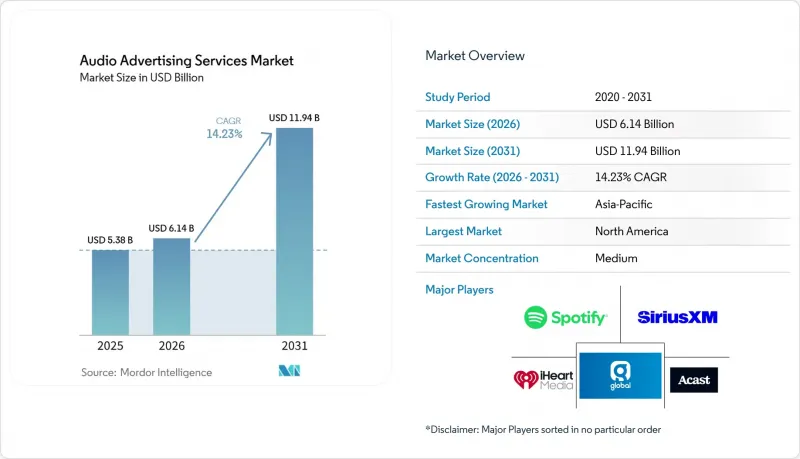
據 Mordor Intelligence 稱,2025 年音訊廣告服務市場價值為 53.8 億美元,預計到 2031 年將從 2026 年的 61.4 億美元成長至 119.4 億美元,預測期(2026-2031 年)複合年成長率為 14.23%。
本報告按服務類型(例如,音訊媒體購買和分發、創新製作服務)、購買模式(例如,直接銷售/投放訂單、程序化購買)、管道(例如,串流內音訊廣告)、最終用戶行業(例如,媒體和娛樂、汽車、技術和軟體)以及地區進行細分。市場預測以美元計價。
全球音訊廣告服務市場趨勢及洞察
播客收聽量和聽眾參與度均有所提高。
播客收聽量已達歷史新高,美國12歲以上民眾的月播客收聽時間持續成長。與前一年相比,每週收聽時長也有所增加。過去十年間,每周播客總收聽時長顯著成長。 55歲及以上美國人的月度線上音訊收聽時長也大幅成長。受眾群體的擴大正吸引更多高收入聽眾進入音訊廣告服務市場。 35至54歲的成年人也擁有較長的月度播客收聽時長,構成了一個龐大的受眾群體。
程序化音訊採購和動態廣告插入的成長
在行銷人員和媒體代理商尋求更有效率、數據驅動的購買模式的推動下,程式化數位音訊廣告支出持續成長。隨著廣告主優先考慮提高定向精準度、即時最佳化和增強宣傳活動衡量,音訊廣告購買的自動化預計將在長期內穩步發展。音訊領域的自動化程度仍低於程式化展示廣告,這意味著隨著品牌對音訊廣告庫存自動化交易的接受度越來越高,預算調整的空間也相當可觀。亞馬遜DSP已將Spotify Ad Exchange的播客庫存與SiriusXM Media和iHeartMedia頻道整合,增強了用戶獲取領先發行商優質音訊內容的管道。這使得買家能夠透過單一介面運行大規模的程式化音訊宣傳活動,從而在整個數位音訊領域實現更有效率的規劃、執行和效果管理。
無廣告訂閱和廣告攔截器限制了它們能夠觸及的廣告資源。
許多主流數位音訊平台都採用訂閱模式,這可能會縮小其依賴廣告收入維持的用戶群。 Spotify 報告稱,其在美國用戶中的用戶佔有率在 2025 年保持穩定,並預測用戶將進一步成長。 SiriusXM 也報告稱,儘管其播客網路不斷擴張,但其核心衛星廣播訂閱用戶在過去幾年中持續下降。 IAB Australia 的一項研究顯示,衡量標準方面的障礙仍然是 2026 年音訊廣告買家面臨的最大挑戰。儘管如此,超過一半的買家計劃在 2026 年增加對串流音樂廣告的投資。隨著付費平台將更多用戶引導至付費計劃,廣告主可能會面臨廣告位短缺、CPM 上漲以及效果主導型規模擴張受限等問題。
細分市場分析
預計到2031年,受眾分析和定向服務將以14.91%的複合年成長率成長,成為成長最快的服務類別。 2025年,音訊媒體採購和分發將佔據音頻廣告服務市場41.80%的佔有率。這一地位反映了其作為直接插頁訂單和程序化採購交易基礎的重要地位。受眾分析的加速成長反映了廣告策略從基於覆蓋率和頻次的規劃轉向基於聽眾層面的建模。隨著其他數位管道中基於cookie的訊號逐漸減少,廣告商正在尋求數據工具。經過身分驗證和登入的聽眾資料可以成為宣傳活動規劃中一種保護隱私的替代方案。
創新製作服務持續為出版商和品牌提供宣傳活動開發支援。隨著平台推行基於效果的報告,衡量和歸因服務也日益受到關注。 2025年10月,Triton Digital發布了AdBuilder AI,這是一款支援60多種語言的音訊創新產生工具。該工具解決了錄音室製作和配音員短缺帶來的量化限制,並有望進一步擴大音訊廣告服務在非英語市場宣傳活動中的應用。
至2025年,直接銷售和插頁訂單將佔音訊廣告服務市場佔有率的72.83%。這種模式在主持人贊助中仍然扮演著核心角色,這類贊助依賴品牌和主持人之間協商達成的贊助協議。程序化採購預計到2031年將以15.08%的複合年成長率成長。在整個預測期內,程序化採購預計將保持強勁成長。其成長將與可透過自動化系統買賣的動態廣告插頁庫存的擴張同步進行。近年來,行銷人員和媒體代理商在音訊領域採用程式化廣告的趨勢顯著增強。
預計這兩種模式將繼續在不同類型的廣告資源中佔據重要地位。串流內廣告資源可以透過大規模自動化競標高效交易。而託管音訊贊助則仍然是一種透過直接交易銷售的高階廣告形式。這類廣告形式因其個人化推薦和可靠的投放而備受青睞。那些只專注於程式化廣告效率的廣告主,在音訊廣告服務市場中可能較少有機會接觸到可靠的託管音訊廣告位。
區域分析
到2025年,北美將佔據音頻廣告服務市場39.00%的佔有率。美國擁有大規模的播客收入基礎、成熟的程序化基礎設施以及豐富的專業代理商和技術供應商人才儲備。 2025年,美國播客廣告收入將達28.62億美元。 iHeartMedia於2026年6月18日推出了「AudioGraph」服務,將身分導向和效果衡量功能引入廣播電台廣告位。該服務在美國每月覆蓋超過2.78億聽眾,並利用了來自Triton Digital和TransUnion的數據。
南美市場仍處於發展初期,但巴西、阿根廷和墨西哥正在推動該地區聽眾群體的成長。由於各地衡量體系和數位廣告成熟度的差異,南美廣告支出總額僅佔全球總額的一小部分。歐洲市場以英國、德國和法國為中心,GDPR正在重塑這些國家的認同和歸因實踐。澳洲的數位音訊和播客廣告支出近期有所成長。大多數澳洲廣告商計劃在不久的將來增加對原創播客的投資。
預計到2031年,亞太地區將以14.88%的複合年成長率成長,成為音訊廣告服務市場成長最快的地區。這一成長反映了以智慧型手機為中心的收聽方式的廣泛普及、本地化內容創作的興起以及程序化基礎設施的不斷發展。在印度,本地語言播客正在為當地廣告主創造更精準的受眾群體。日本、韓國和澳洲的區域市場較為成熟,而中國則正透過本土平台不斷擴大市場規模。主持人朗讀的廣告支持直接銷售購買模式,因為廣告商重視熟悉的聲音所帶來的可信度。
其他好處:
- Excel格式的市場預測(ME)表
- 3個月的分析師支持
目錄
第1章:引言
- 研究假設和市場定義
- 調查範圍
第2章:調查方法
第3章執行摘要
第4章 市場狀況
- 市場概覽
- 市場促進因素
- 播客收聽量和聽眾興趣均增加。
- 程序化音訊採購和動態廣告插入的成長
- 行動裝置、聯網汽車和智慧音箱中音訊應用的擴展
- 轉型為對品牌更安全、廣告過度較少的媒體環境。
- 以隱私為中心的識別框架提高了音訊領域的定位精度。
- 影片串流媒體和播客的同步播放擴大了衡量可用庫存和衡量指標的接觸點。
- 市場限制因素
- 無廣告訂閱和廣告攔截功能會限制您能看到的廣告位數量。
- 隱私法規和訊號遺失會降低歸因的準確性。
- YouTube 和短影片正在吸收品牌預算的成長。
- 跨聲道音訊測量的碎片化阻礙了預算擴展。
- 產業價值鏈分析
- 監理情勢
- 技術展望
- 宏觀經濟因素對市場的影響
- 波特五力分析
第5章 市場規模與成長預測
- 按服務類型
- 音訊媒體的取得與分發
- 創新製作服務
- 衡量和歸因服務
- 受眾分析與定向服務
- 透過採購模型
- 直接銷售和插頁訂單
- 程式化採購
- 通道特異性
- 音訊串流內廣告
- 主持人朗讀的廣告和播音員朗讀的廣告
- 品牌內容與贊助環節
- 其他頻道
- 按最終用戶行業分類
- 零售與電子商務
- 金融服務
- 媒體與娛樂
- 科技與軟體
- 醫療和藥品
- 車
- 旅遊與飯店
- 食品/飲料
- 地區
- 北美洲
- 美國
- 加拿大
- 墨西哥
- 南美洲
- 巴西
- 阿根廷
- 其他南美國家
- 歐洲
- 英國
- 德國
- 法國
- 西班牙
- 義大利
- 俄羅斯
- 其他歐洲國家
- 亞太地區
- 中國
- 日本
- 印度
- 韓國
- 澳洲
- 印尼
- 其他亞太國家
- 中東
- 沙烏地阿拉伯
- 阿拉伯聯合大公國
- 土耳其
- 其他中東國家
- 非洲
- 南非
- 奈及利亞
- 埃及
- 其他非洲國家
- 北美洲
第6章 競爭情勢
- 市場集中度
- 策略趨勢
- 市佔率分析
- 公司簡介
- Global Media Group Services Limited
- SXM Media(SiriusXM Holdings, Inc.)
- Spotify AB(Spotify Advertising)
- Acast AB
- iHeartMedia, Inc.
- Ad Results Media LLC
- Triton Digital Canada Inc.
- Oxford Road LLC
- AdsWizz Inc.
- Audacy, Inc.
- Veritone, Inc.
- Liberated Syndication Inc.(Libsyn Ads)
- PodcastOne, Inc.
- AudioGO
- Podscribe Inc.
- Comscore, Inc.
- Integral Ad Science, Inc.
- Magellan AI Inc.
- Stingray Group Inc.
第7章 市場機會與未來展望
According to Mordor Intelligence, the audio advertising services market size was valued at USD 5.38 billion in 2025 and estimated to grow from USD 6.14 billion in 2026 to reach USD 11.94 billion by 2031, at a CAGR of 14.23% during the forecast period (2026-2031).
This report is Segmented by Service Type (Audio Media Buying and Distribution, Creative Production Services, and More), Buying Model (Direct Sales and Insertion Orders, and Programmatic Buying), Channel (In-Stream Audio Ads, and More), End-User Industry (Media and Entertainment, Automotive, Technology and Software and More), and Geography. The Market Forecasts are Provided in Terms of Value (USD).
Global Audio Advertising Services Market Trends and Insights
Rising Podcast Listenership and Higher Audience Attention
Podcast listening reached new highs, with monthly podcast consumption continuing to expand among people aged 12 and older in the United States. Weekly consumption also increased compared with the previous year. Total weekly podcast consumption time grew significantly over the past decade. Monthly online audio listening among Americans aged 55 and older also rose notably. This audience expansion brings more high-purchasing-power listeners into the audio advertising services market. Adults aged 35-54 also provide a large audience base, with strong monthly podcast consumption.
Growth of Programmatic Audio Buying and Dynamic Ad Insertion
Programmatic digital audio advertising spending continued to grow, supported by rising adoption among marketers and media agencies seeking more efficient, data-driven buying models. Automation in audio buying is expected to increase steadily over the long term as advertisers prioritize improved targeting, real-time optimization, and better campaign measurement. Audio remains less automated than programmatic display, which leaves considerable room for further budget movement as brands become more comfortable with automated audio inventory transactions. Amazon DSP integrated Spotify Ad Exchange podcast inventory with SiriusXM Media and iHeartMedia channels, strengthening access to premium audio supply across major publishers. This gives buyers a single interface for scaled programmatic audio campaigns and supports more streamlined planning, activation, and performance management across digital audio environments.
Ad-Free Subscriptions and Ad Blocking Limit Reachable Inventory
Many large digital audio platforms were designed around subscriptions, which can reduce the available ad-supported listener base. Spotify reported continued growth in its subscriber share among United States listeners in 2025 and projected further subscriber growth. SiriusXM also reported multiyear declines in its core satellite subscriber base, even as it expanded its podcast network. IAB Australia found that measurement barriers remained the leading concern for audio buyers in 2026. More than half of buyers nevertheless planned to increase streaming music advertising investment in 2026. As premium platforms move more users to paid tiers, advertisers may face scarcer inventory, higher CPMs, and limits on performance-led scaling.
Other drivers and restraints analyzed in the detailed report include:
- Expansion of Audio Consumption on Mobile, Connected Cars, and Smart Speakers
- Shift Toward Brand-Safe and Low-Clutter Media Environments
- Privacy Rules and Signal Loss Weaken Attribution Precision
For complete list of drivers and restraints, kindly check the Table Of Contents.
Segment Analysis
Audience Analytics and Targeting Services is projected to expand at a 14.91% CAGR through 2031, making it the fastest-growing service type. Audio Media Buying and Distribution held 41.80% of the audio advertising services market share in 2025. Its position reflects its role as the transactional layer for direct insertion orders and programmatic buying. The faster growth of audience analytics reflects a shift from reach-and-frequency planning toward listener-level modeling. Advertisers are seeking data tools as cookie-based signals decline in other digital channels. Authenticated and logged-in listener data can provide an identity-safe alternative for campaign planning.
Creative Production Services continued to support campaign development across publishers and brands. Measurement and Attribution Services also gained attention as platforms pursued outcome-based reporting. Triton Digital launched AdBuilder AI in October 2025, an audio creative generation tool that supports more than 60 languages. The tool addresses the volume limitations of studio production and voice talent. It may support wider use of audio advertising services in market campaigns outside English-speaking markets.
Direct Sales and Insertion Orders held 72.83% of the audio advertising services market share in 2025. This model remains central to host-read sponsorships, which depend on negotiated endorsements between brands and hosts. Programmatic Buying is projected to expand at a 15.08% CAGR through 2031. Programmatic Buying is expected to expand strongly through the forecast period. Its growth follows the expansion of dynamic ad insertion inventory that can be bought and sold through automated systems. Programmatic audio adoption has increased significantly among marketers and media agencies in recent years.
The two models are likely to remain important for different inventory types. In-stream inventory can be traded efficiently through automated auctions at scale. Host-read sponsorships remain premium formats sold through direct deals. These formats are valued for their personal endorsement and trusted delivery. Advertisers that focus only on programmatic efficiency may have less exposure to high-trust host-read placements in the audio advertising services market.
Complete Report Scope:
- By Service Type
- Audio Media Buying and Distribution
- Creative Production Services
- Measurement and Attribution Services
- Audience Analytics and Targeting Services
- By Buying Model
- Direct Sales and Insertion Orders
- Programmatic Buying
- By Channel
- In-Stream Audio Ads
- Host-Read and Announcer-Read Ads
- Branded Content and Sponsored Segments
- Other Channels
- By End-User Industry
- Retail and E-commerce
- Financial Services
- Media and Entertainment
- Technology and Software
- Healthcare and Pharmaceuticals
- Automotive
- Travel and Hospitality
- Food and Beverages
- Geography
- North America
- United States
- Canada
- Mexico
- South America
- Brazil
- Argentina
- Rest of South America
- Europe
- United Kingdom
- Germany
- France
- Spain
- Italy
- Russia
- Rest of Europe
- Asia-Pacific
- China
- Japan
- India
- South Korea
- Australia
- Indonesia
- Rest of Asia-Pacific
- Middle East
- Saudi Arabia
- United Arab Emirates
- Turkey
- Rest of Middle East
- Africa
- South Africa
- Nigeria
- Egypt
- Rest of Africa
- North America
Geography Analysis
North America held 39.00% of the audio advertising services market share in 2025. The United States combines a large podcast revenue base with mature programmatic infrastructure and a deep pool of specialist agencies and technology vendors. Podcast advertising revenue in the United States reached USD 2.862 billion in 2025. iHeartMedia launched AudioGraph on June 18, 2026, bringing identity targeting and outcome measurement to broadcast radio inventory. The service reaches more than 278 million monthly United States listeners and uses Triton Digital and TransUnion data.
South America remains an early-stage opportunity, with Brazil, Argentina, and Mexico supporting regional listener growth. Absolute spending remains a small share of the global total because measurement systems and digital advertising maturity vary across the region. Europe is centered on the United Kingdom, Germany, and France, while GDPR shapes identity and attribution practices. Digital audio and podcast advertising expenditure in Australia increased in the recent period. A majority of Australian buyers planned to increase original podcast advertising spending in the near term.
Asia-Pacific is projected to expand at a 14.88% CAGR through 2031, making it the fastest-growing geographic area in the audio advertising services market. Growth reflects smartphone-led listening, localized content creation, and developing programmatic infrastructure. Regional-language podcasts in India are creating more targeted audiences for local advertisers. Japan, South Korea, and Australia represent more mature regional markets, while China adds scale through domestic platforms. Host-read advertisements support direct-sales buying models because advertisers value the trust associated with familiar voices.
- Global Media Group Services Limited
- SXM Media (SiriusXM Holdings, Inc.)
- Spotify AB (Spotify Advertising)
- Acast AB
- iHeartMedia, Inc.
- Ad Results Media LLC
- Triton Digital Canada Inc.
- Oxford Road LLC
- AdsWizz Inc.
- Audacy, Inc.
- Veritone, Inc.
- Liberated Syndication Inc. (Libsyn Ads)
- PodcastOne, Inc.
- AudioGO
- Podscribe Inc.
- Comscore, Inc.
- Integral Ad Science, Inc.
- Magellan AI Inc.
- Stingray Group Inc.
Additional Benefits:
- The market estimate (ME) sheet in Excel format
- 3 months of analyst support
TABLE OF CONTENTS
1 INTRODUCTION
- 1.1 Study Assumptions and Market Definition
- 1.2 Scope of the Study
2 RESEARCH METHODOLOGY
3 EXECUTIVE SUMMARY
4 MARKET LANDSCAPE
- 4.1 Market Overview
- 4.2 Market Drivers
- 4.2.1 Rising Podcast Listenership and Higher Audience Attention
- 4.2.2 Growth of Programmatic Audio Buying and Dynamic Ad Insertion
- 4.2.3 Expansion of Audio Consumption on Mobile, Connected Cars, and Smart Speakers
- 4.2.4 Shift Toward Brand-Safe and Low-Clutter Media Environments
- 4.2.5 Privacy-Forward Identity Frameworks Improve Addressability in Audio
- 4.2.6 Video Simulcast Podcasts Expand Sellable Inventory and Measurement Touchpoints
- 4.3 Market Restraints
- 4.3.1 Ad-Free Subscriptions and Ad Blocking Limit Reachable Inventory
- 4.3.2 Privacy Rules and Signal Loss Weaken Attribution Precision
- 4.3.3 YouTube and Short-Form Video Absorb Incremental Brand Budgets
- 4.3.4 Cross-Channel Audio Measurement Fragmentation Slows Budget Scaling
- 4.4 Industry Value-Chain Analysis
- 4.5 Regulatory Landscape
- 4.6 Technological Outlook
- 4.7 Impact of Macroeconomic Factors on the Market
- 4.8 Porter's Five Forces Analysis
- 4.8.1 Threat of New Entrants
- 4.8.2 Bargaining Power of Buyers
- 4.8.3 Bargaining Power of Suppliers
- 4.8.4 Threat of Substitutes
- 4.8.5 Competitive Rivalry
5 MARKET SIZE AND GROWTH FORECASTS (VALUE)
- 5.1 By Service Type
- 5.1.1 Audio Media Buying and Distribution
- 5.1.2 Creative Production Services
- 5.1.3 Measurement and Attribution Services
- 5.1.4 Audience Analytics and Targeting Services
- 5.2 By Buying Model
- 5.2.1 Direct Sales and Insertion Orders
- 5.2.2 Programmatic Buying
- 5.3 By Channel
- 5.3.1 In-Stream Audio Ads
- 5.3.2 Host-Read and Announcer-Read Ads
- 5.3.3 Branded Content and Sponsored Segments
- 5.3.4 Other Channels
- 5.4 By End-User Industry
- 5.4.1 Retail and E-commerce
- 5.4.2 Financial Services
- 5.4.3 Media and Entertainment
- 5.4.4 Technology and Software
- 5.4.5 Healthcare and Pharmaceuticals
- 5.4.6 Automotive
- 5.4.7 Travel and Hospitality
- 5.4.8 Food and Beverages
- 5.5 Geography
- 5.5.1 North America
- 5.5.1.1 United States
- 5.5.1.2 Canada
- 5.5.1.3 Mexico
- 5.5.2 South America
- 5.5.2.1 Brazil
- 5.5.2.2 Argentina
- 5.5.2.3 Rest of South America
- 5.5.3 Europe
- 5.5.3.1 United Kingdom
- 5.5.3.2 Germany
- 5.5.3.3 France
- 5.5.3.4 Spain
- 5.5.3.5 Italy
- 5.5.3.6 Russia
- 5.5.3.7 Rest of Europe
- 5.5.4 Asia-Pacific
- 5.5.4.1 China
- 5.5.4.2 Japan
- 5.5.4.3 India
- 5.5.4.4 South Korea
- 5.5.4.5 Australia
- 5.5.4.6 Indonesia
- 5.5.4.7 Rest of Asia-Pacific
- 5.5.5 Middle East
- 5.5.5.1 Saudi Arabia
- 5.5.5.2 United Arab Emirates
- 5.5.5.3 Turkey
- 5.5.5.4 Rest of Middle East
- 5.5.6 Africa
- 5.5.6.1 South Africa
- 5.5.6.2 Nigeria
- 5.5.6.3 Egypt
- 5.5.6.4 Rest of Africa
- 5.5.1 North America
6 COMPETITIVE LANDSCAPE
- 6.1 Market Concentration
- 6.2 Strategic Moves
- 6.3 Market Share Analysis
- 6.4 Company Profiles (includes Global Level Overview, Market Level Overview, Core Segments, Financials as available, Strategic Information, Market Rank/Share, Products and Services, Recent Developments)
- 6.4.1 Global Media Group Services Limited
- 6.4.2 SXM Media (SiriusXM Holdings, Inc.)
- 6.4.3 Spotify AB (Spotify Advertising)
- 6.4.4 Acast AB
- 6.4.5 iHeartMedia, Inc.
- 6.4.6 Ad Results Media LLC
- 6.4.7 Triton Digital Canada Inc.
- 6.4.8 Oxford Road LLC
- 6.4.9 AdsWizz Inc.
- 6.4.10 Audacy, Inc.
- 6.4.11 Veritone, Inc.
- 6.4.12 Liberated Syndication Inc. (Libsyn Ads)
- 6.4.13 PodcastOne, Inc.
- 6.4.14 AudioGO
- 6.4.15 Podscribe Inc.
- 6.4.16 Comscore, Inc.
- 6.4.17 Integral Ad Science, Inc.
- 6.4.18 Magellan AI Inc.
- 6.4.19 Stingray Group Inc.
7 MARKET OPPORTUNITIES AND FUTURE OUTLOOK
- 7.1 White-Space and Unmet-Need Assessment

 2026年全球履歷最佳化服務市場報告
 3D廣告看板市場:按顯示類型、格式、顯示技術、項目類型、應用程式和地區分類
 亞太地區視訊點播廣告:市場佔有率分析、產業趨勢與統計及成長預測(2026-2031 年)無 Cookie 廣告服務:市場佔有率分析、行業趨勢和統計數據以及成長預測(2026-2031 年)廣告服務:市場佔有率分析、產業趨勢與統計、成長預測(2026-2031)點擊收費廣告服務:市場佔有率分析、行業趨勢和統計數據以及成長預測(2026-2031 年)
 線上分類廣告平台市場規模、佔有率和成長分析:按類型、投放類別、收入模式、平台、最終用戶和地區分類-2026-2033年產業預測互動式OTT廣告:市佔率分析、產業趨勢與統計、成長預測(2026-2031年)
 數位廣告平台市場:2026-2032年全球市場預測(依平台類型、設備類型、定價模式、資料來源、部署模式、組織規模、客戶群及最終用戶產業分類)
 基於位置的搜尋和廣告市場規模:按類型、應用程式、地區和預測分類。