


 |
市場調查報告書
商品編碼
2119123
無 Cookie 廣告服務:市場佔有率分析、行業趨勢和統計數據以及成長預測(2026-2031 年)Cookie-less Advertising Services - Market Share Analysis, Industry Trends & Statistics, Growth Forecasts (2026 - 2031) |
||||||

※ 本網頁內容可能與最新版本有所差異。詳細情況請與我們聯繫。
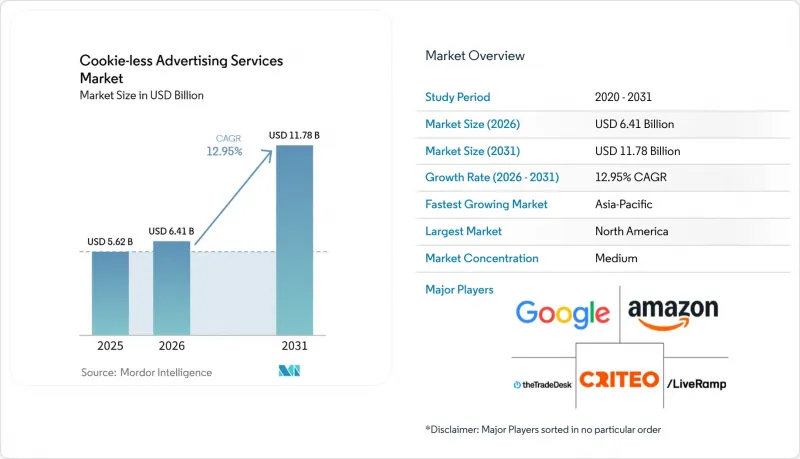
根據 Mordor Intelligence 預測,無 cookie 廣告服務的市場規模預計將從 2025 年的 56.2 億美元和 2026 年的 64.1 億美元成長到 2031 年的 117.8 億美元,2026 年至 2031 年的年複合成長率(CAGR)。
本報告按服務類型(情境定向服務、第一方數據利用服務、數據潔淨室服務等)、終端用戶行業(零售和電子商務、媒體和娛樂、醫療保健和生命科學、旅遊和酒店、汽車、電信和技術等)以及地區進行細分。市場預測以價值(美元)表示。
全球無 Cookie 廣告服務市場趨勢及洞察
第三方訊號的缺失將加速廣告基礎設施的結構重組。
無 Cookie 廣告服務市場正在應對主流瀏覽器和行動環境中第三方識別碼的減少。 Safari 和 Firefox 多年來一直默認阻止第三方 Cookie,而 Chrome 則採用了用戶可選的方式,這使得廣告商難以預測傳統識別碼的存取權限。此外,蘋果的「應用追蹤透明度」框架限制了跨應用程式追蹤,迫使行動廣告商尋找其他方法來收集和利用用戶同意的訊號。這些變化正促使廣告支出轉向第一方資料管道、伺服器端事件收集、身分替代方案、情境服務和衡量工具。早期建立這些能力的品牌可以繼續利用其客戶和活動數據,從宣傳活動規劃到報告生成。同時,那些延遲轉型的品牌則面臨著對其資料收集、同意流程和使用流程進行大規模的重新設計。
這種影響遠不止於媒體採購,因為宣傳活動報告依賴曝光量、互動量和轉換事件之間的一致性關聯。基於 Cookie 的衡量方式是為瀏覽器環境設計的,在這種環境下,第三方可以觀察到更多消費者的購買歷程。但當標識符不可用、受到限制或因瀏覽器和應用程式策略而分離時,這種方法的可靠性就會降低。因此,無 Cookie 廣告服務產業正在推動更廣泛的營運轉型,整合標籤管理、客戶關係管理 (CRM) 系統、使用者授權獲取工具和廣告平台。對於跨多個管道(包括網路、行動、零售媒體和聯網電視)營運的廣告主而言,這種需求尤其明顯。此外,即使技術上可以使用 Cookie,根據《電子隱私指令》和國家隱私法,使用者授權義務仍然適用,這使得 Cookie管治成為營運模式的組成部分,而非一項獨立的法律任務。
注重隱私的上下文導向廣告能帶來可衡量的效果,與行為導向廣告的效果相當。
情境導向廣告正發揮越來越重要的作用,因為它利用廣告周圍的內容,而不是依賴用戶的瀏覽歷史。在無 Cookie 廣告服務市場中,語意系統(用於評估語言、圖像、影片和內容主題)的使用日益增多,而不再局限於簡單的關鍵字匹配。預計到 2025 年,美國數位廣告收入將達到 2,946 億美元,其中電商媒體將貢獻 634 億美元。這反映出第一方購買數據和情境訊號在數位媒體活動中的重要性日益凸顯。無 Cookie 廣告服務市場也向聯網電視領域擴展,在該領域,內容可以按節目、劇集或場景進行評估。這使得廣告主能夠選擇合適的內容設置,並減少訊息與觀看環境之間的不匹配。對於發布商而言,這也提供了一種無需傳輸受眾層級資料即可描述優質廣告資源的新方法。
這一轉變意義重大,因為它允許在不處理個人資料的情況下使用情境訊號,類似於行為定向。這降低了用戶同意率波動的影響,並使宣傳活動投放對已認證受眾的依賴程度降低。無 Cookie 廣告服務市場也受惠於供應端標準,這些標準有助於在程序化交易中傳遞情境細分訊息。 2024 年 12 月,IAB 技術實驗室將“賣家定義受眾”更名為“精選受眾”,為發布商提供了一個框架,用於在競標流程中呈現標準化受眾和情境訊號。發布者可以使用這些訊號來打包內容,而買家無需獲取原始用戶資料即可應用品牌適用性要求。雖然這種模式並不能完全消除衡量的必要性,但在行為訊號不完整或不可用時,它提供了一個切實可行的替代方案。
分散的隱私法規為整個市場帶來了複雜的合規成本。
隱私法規構成阻礙,因為全球廣告系統必須在各個司法管轄區的不同規則下運作。無 Cookie 廣告服務市場必須解決使用者同意取得、資料使用管理、合約要求以及涵蓋廣泛工作流程的可審計性等問題。 2025 年,法國國家資訊與自由委員會 (CNIL) 因谷歌在廣告中使用 Cookie 時未獲得用戶同意而對其處以 3.25 億歐元的罰款。此案例表明,即使廣告商逐漸放棄第三方 Cookie,同意機制的設計和使用者選擇仍然是至關重要的問題。雖然 GDPR 採用的是選擇加入機制,但美國可能會引入選擇退出權和其他要求。服務多個市場的平台可能需要並行實施技術控制,從而增加管理宣傳活動和資料流的成本。
對於獨立出版商和小規模技術供應商而言,這項挑戰更為嚴峻,因為用戶同意管治需要付出成本,而降低交易量並不能輕易降低這部分成本。 IAB 的《多州隱私權協議》第五修正案將於 2026 年 6 月生效,它為美國數位廣告領域的隱私義務提供了一個通用的通用框架。雖然該框架可以減少商業合約的差異性,但其實施仍需要法律審查以及平台與合作夥伴之間的技術整合。因此,無 Cookie 廣告服務業必須能夠在日常宣傳活動營運中有效利用合規功能。擁有成熟的工程、政策和實施資源的提供者比資源較少但必須滿足相同要求的小規模公司更具優勢。即使對獨立解決方案的需求依然旺盛,這也可能鞏固大規模平台的地位。
細分市場分析
至2025年,第一方資料利用服務將佔無Cookie廣告服務市場33.71%的佔有率,成為最大的服務類別。此細分市場包括基於使用者許可的資料收集、資料增強、客戶關係管理(CRM)使用者匯入、伺服器端事件管道、轉換介面和受眾利用。這些功能如今已成為宣傳活動營運的核心,因為廣告主需要在規劃、投放和報告的各個階段使用可靠的訊號。根據IAB和普華永道(PwC)的報告,2025年美國電商媒體市場將成長18.0%,這將推動零售數據環境下對第一方啟動服務的需求。情境定向服務、身分替代服務以及衡量和歸因自適應服務也將受益於類似的訊號流失壓力,儘管身分和歸因工具在覆蓋範圍和整合方面存在局限性。
預計從2026年到2031年,數據無塵室服務將以13.74%的複合年成長率成長,成為無cookie廣告服務市場中成長最快的服務類型。據IAB稱,由於企業需要零售商、出版商、品牌和平台之間進行隱私保護的協作,因此計劃在2025年對無塵室的投資比2024年增加29%。美國聯邦貿易委員會(FTC)指出,無塵室本身並未具備隱私保護功能,管治、產出控制和監控是實施的關鍵要素。 2026年5月,陽獅集團以21.67億美元收購LiveRamp的協議凸顯了市場對獨立且基於雲端的數據整合替代方案日益成長的興趣。該領域的發展將取決於能夠提供可操作的互通性、清晰的管治以及適合無cookie廣告服務行業更廣泛廣告主群體的成本的供應商。
區域分析
預計到2025年,北美將佔據無cookie廣告服務市場51.28%的佔有率,這主要得益於程式化基礎設施、零售媒體網路、客戶資料平台以及無塵室部署的集中佈局。美國是該地區的需求中心,這得益於其大規模位廣告基礎設施以及對零售媒體、聯網電視和注重隱私的資料基礎設施的大力投資。預計到2025年,美國數位廣告收入將達到2,946億美元,其中電商媒體收入將達到634億美元。這些類別越來越依賴第一方資料、情境資料和基於使用者許可的資料訊號。在加拿大,需求主要來自出版商和廣告商對隱私權保護資料實踐的重視。同時,墨西哥正隨著電子商務的成長而發展第一方資料能力。潔淨室部署的實際成本也是該地區的一個考量因素,這可能會使一些獨立買家在尖端協作環境中落後。雖然 IAB 的多州隱私協議為國內平台製定了通用的合約標準,但其實施仍需要每個合作夥伴公司進行營運方面的變更。
歐洲是全球第二大區域集團,其法規環境由GDPR和各國隱私監管機構共同塑造。隨著數據使用管理融入數位廣告運營,該地區對符合用戶同意標準的身份識別、情境定向和效果衡量基礎設施的需求日益成長。 IAB Europe的透明度和用戶同意框架2.3版將於2026年3月1日起強制要求發布商和用戶同意管理平台使用,該框架確立了程序化廣告活動的最新合規標準。德國、英國和法國在無塵室和精選受眾公司中引領著該框架的採用,而荷蘭仍然是程序化廣告基礎設施的關鍵樞紐。英國脫歐後繼續沿用其自身的隱私框架,對注重隱私的定向選項的需求依然強勁。西班牙和義大利也正在採用這些功能,這得益於電子商務活動的擴張以及用戶同意對Cookie保留要求的持續重視。歐洲的廣告供應商必須平衡成熟的市場需求、詳細的合規要求以及各地不同的採用需求。
預計2026年至2031年間,中東地區的複合年成長率將達到13.81%,成為各地區中無Cookie廣告服務市場成長最快的地區。沙烏地阿拉伯和阿拉伯聯合大公國電子商務的蓬勃發展,以及數位廣告的日益普及,推動了對能夠在新的管治框架下運作的定向和衡量工具的需求。亞太地區也是一個重要的成長區域。龐大的行動優先用戶群體以及各國不同的數據法規,促使市場對在地化的身份和數據使用方案的需求不斷成長。中國的資料本地化要求以及東協市場的隱私法規,推動了尊重各國資料主權條件的服務的發展。日本和澳洲在採用基於國際標準的無Cookie技術方面一直走在前列,領先許多其他區域市場。南美洲和非洲的市場規模雖然較小,但巴西和南非的需求也日益成長。在這些國家,對隱私合規性的投入正促使品牌建構第一方資料基礎架構。在這些地區,無 cookie 廣告服務市場為能夠根據當地的同意慣例、發布商生態系統和廣告商資源調整服務的提供者提供了長期機會。
其他好處:
- Excel格式的市場預測(ME)表
- 3個月的分析師支持
目錄
第1章:引言
- 研究假設和市場定義
- 調查範圍
第2章:調查方法
第3章執行摘要
第4章 市場狀況
- 市場概覽
- 宏觀經濟因素對市場的影響
- 市場促進因素
- 瀏覽器和行動 ID 中第三方訊號的遺失
- 增加對注重隱私的定向廣告的投入
- 利用第一方數據並拓展零售媒體合作夥伴關係
- 擴展人工智慧驅動的語意分析、影片分析和連網電視上下文分析。
- 潔淨室互通性的標準化
- 供應商的精選內容和賣家定義的目標受眾
- 市場限制因素
- 隱私法規碎片化以及同意管理的成本
- 已驗證身份的規模和匹配率的局限性
- 瀏覽器儲存限制和 cookie 分區會降低持久性。
- 出版商收入來源壓縮:隱私保護測試環境的趨勢
- 產業價值鏈分析
- 監理情勢
- 技術展望
- 波特五力分析
第5章 市場規模與成長預測
- 按服務類型
- 情境定向服務
- 第一方數據利用服務
- 數據無塵室服務
- 替代身分服務
- 測量和歸因適應服務
- 按最終用戶行業分類
- 零售與電子商務
- 媒體與娛樂
- 銀行業、金融服務業及保險業
- 醫療保健和生命科學
- 旅遊與飯店
- 車
- 通訊與科技
- 其他終端用戶產業
- 按地區
- 北美洲
- 美國
- 加拿大
- 墨西哥
- 南美洲
- 巴西
- 阿根廷
- 智利
- 其他南美國家
- 歐洲
- 德國
- 英國
- 法國
- 義大利
- 西班牙
- 荷蘭
- 俄羅斯
- 其他歐洲國家
- 亞太地區
- 中國
- 日本
- 印度
- 韓國
- 澳洲
- 新加坡
- 印尼
- 其他亞太國家
- 中東
- 沙烏地阿拉伯
- 阿拉伯聯合大公國
- 土耳其
- 其他中東國家
- 非洲
- 南非
- 奈及利亞
- 肯亞
- 其他非洲國家
- 北美洲
第6章 競爭情勢
- 市場集中度
- 策略趨勢
- 市佔率分析
- 公司簡介
- Google LLC
- Amazon.com, Inc.
- The Trade Desk, Inc.
- LiveRamp Holdings, Inc.
- Criteo SA
- Adobe Inc.
- PubMatic, Inc.
- Integral Ad Science Holding Corp.
- Lotame Solutions, Inc.
- Quantcast Corporation
- Snowflake Inc.
- Acxiom LLC
- InfoSum Ltd.
- InMobi Pte. Ltd.
- Microsoft Corporation
- Oracle Corporation
- Nexxen International Ltd.
- Permutive, Inc.
- ID5 Technology Limited
- OpenX Software Ltd.
第7章 市場機會與未來展望
According to Mordor Intelligence, the cookie-less advertising services market size is projected to expand from USD 5.62 billion in 2025 and USD 6.41 billion in 2026 to USD 11.78 billion by 2031, registering a CAGR of 12.95% between 2026 to 2031.
This report is Segmented by Service Type (Contextual Targeting Services, First-Party Data Activation Services, Data Clean Room Services, and More), End-User Industry (Retail and E-Commerce, Media and Entertainment, Healthcare and Life Sciences, Travel and Hospitality, Automotive, Telecom and Technology, and More), and Geography. The Market Forecasts are Provided in Terms of Value (USD).
Global Cookie-less Advertising Services Market Trends and Insights
Third-Party Signal Loss Drives Structural Reallocation of Advertising Infrastructure
The cookie-less advertising services market is responding to the erosion of third-party identifiers across major browsers and mobile environments. Safari and Firefox have blocked third-party cookies by default for years, while Chrome uses a user-choice approach that leaves advertisers with less predictable access to traditional identifiers. Apple's App Tracking Transparency framework has also limited cross-app tracking, so mobile advertisers need other ways to collect and activate consented signals. These changes shift spending toward first-party data pipelines, server-side event collection, identity alternatives, contextual services, and measurement tools. Brands that established these capabilities earlier can continue using their own customer and event data across campaign planning and reporting. Brands that delayed the transition face a more extensive redesign of their data collection, consent flows, and activation processes.
The effect extends beyond media buying because campaign reporting depends on stable links between exposure, engagement, and conversion events. Cookie-based measurement was designed for a browser environment where a third party could observe more of the consumer journey. That approach is less reliable when identifiers are unavailable, restricted, or separated by browser and app policies. The cookie-less advertising services industry therefore supports a broader operational change that connects tag management, customer relationship management systems, consent tools, and advertising platforms. The need is especially clear for advertisers that operate across web, mobile, retail media, and connected TV channels. Consent obligations under the ePrivacy Directive and state privacy laws also remain relevant even when a cookie is technically available, which makes governance part of the operating model rather than a separate legal task.
Privacy-Safe Contextual Targeting Gains Measurable Performance Parity With Behavioral Advertising
Contextual targeting is taking on a larger role because it can use the content surrounding an advertisement instead of relying on an individual's browsing history. The cookie-less advertising services market increasingly uses semantic systems that assess language, images, video, and content themes rather than simple keyword matching. U.S. digital advertising revenue reached USD 294.6 billion in 2025, and commerce media generated USD 63.4 billion, reflecting the expanding importance of first-party purchase and contextual signals in digital media activity. The cookie-less advertising services market is also moving into connected TV, where content can be assessed at the program, episode, or scene level. This allows buyers to select suitable content settings and reduce mismatches between a message and the viewing environment. It gives publishers another way to describe premium inventory without transferring audience-level data.
The change is important because contextual signals can be used without processing personal data in the same manner as behavioral targeting. That can reduce exposure to changes in consent rates and make campaign delivery less dependent on authenticated audiences. The cookie-less advertising services market is also benefiting from supply-side standards that make contextual segments easier to communicate in programmatic transactions. IAB Tech Lab renamed Seller-Defined Audiences as Curated Audiences in December 2024, providing publishers with a framework to expose standardized audience and contextual signals in the bid stream. Publishers can use those signals to package content, while buyers can apply brand suitability requirements without receiving raw user data. This model does not eliminate the need for measurement, but it creates a workable alternative when behavioral signals are incomplete or unavailable.
Fragmented Privacy Regulations Impose Compounding Compliance Costs Across Markets
Privacy regulation is a restraint because global advertising systems must operate under rules that differ by jurisdiction. The cookie-less advertising services market must support consent collection, data use controls, contractual requirements, and auditability across a wide range of workflows. In 2025, France's CNIL imposed a EUR 325 million fine on Google for advertising cookie consent failures. The case shows that consent design and user choice remain material issues even when advertisers are moving away from third-party cookies. GDPR uses an opt-in approach, while U.S. state rules can use opt-out rights and other requirements. Platforms serving several markets may need parallel technical controls, which increases the cost of managing campaigns and data flows.
The challenge is more significant for independent publishers and smaller technology providers because consent governance introduces costs that do not decline easily with lower transaction volume. The IAB's Fifth Amended Multi-State Privacy Agreement became effective in June 2026 and provides a common U.S. contracting framework for digital advertising privacy obligations. The framework can reduce variation in commercial agreements, but deployment still requires legal review and technical integration across platforms and partners. The cookie-less advertising services industry must therefore make compliance functions usable within daily campaign operations. Providers with established engineering, policy, and implementation resources have an advantage over smaller firms that must absorb the same requirements with fewer resources. This can strengthen the position of scaled platforms even where demand for independent solutions remains high.
Other drivers and restraints analyzed in the detailed report include:
- First-Party Data Activation and Retail Media Partnerships Reconfigure the Programmatic Value Chain
- AI-Led Semantic, Video, and CTV Contextual Analysis Creates a New Buying Category
- Limited Match Rates for Authenticated Identity Constrain Open-Web Addressability
For complete list of drivers and restraints, kindly check the Table Of Contents.
Segment Analysis
First-Party Data Activation Services held a 33.71% share of the cookie-less advertising services market size in 2025, making them the largest service category. The segment covers consented data collection, enrichment, customer relationship management onboarding, server-side event pipelines, conversion interfaces, and audience activation. These capabilities are now central to campaign operations because advertisers need dependable signals that can be used across planning, delivery, and reporting. IAB and PwC reported that U.S. commerce media expanded 18.0% in 2025, reinforcing demand for first-party activation in retail data environments. Contextual Targeting Services, Identity Alternative Services, and Measurement and Attribution Adaptation Services benefit from the same signal-loss pressure, though identity and attribution tools face reach and integration limits.
Data Clean Room Services are projected to expand at a 13.74% CAGR from 2026 to 2031, the highest rate among service types in the cookie-less ad services market. IAB stated that companies planned to invest 29% more in clean rooms in 2025 than in 2024 because they need privacy-safe collaboration across retailer, publisher, brand, and platform data. The Federal Trade Commission stated that clean rooms are not inherently privacy-preserving, making governance, output controls, and monitoring important parts of an implementation. Publicis Groupe's May 2026 agreement to acquire LiveRamp for USD 2.167 billion increased attention on independent and cloud-based alternatives for data collaboration. The segment will depend on providers that can deliver practical interoperability, clear governance, and costs suited to a wider group of advertisers in the cookie-less advertising services industry.
Complete Report Scope:
- By Service Type
- Contextual Targeting Services
- First-Party Data Activation Services
- Data Clean Room Services
- Identity Alternative Services
- Measurement and Attribution Adaptation Services
- By End-user Industry
- Retail and E-commerce
- Media and Entertainment
- Banking, Financial Services, and Insurance
- Healthcare and Life Sciences
- Travel and Hospitality
- Automotive
- Telecom and Technology
- Other End-user Industries
- By Geography
- North America
- United States
- Canada
- Mexico
- South America
- Brazil
- Argentina
- Chile
- Rest of South America
- Europe
- Germany
- United Kingdom
- France
- Italy
- Spain
- Netherlands
- Russia
- Rest of Europe
- Asia-Pacific
- China
- Japan
- India
- South Korea
- Australia
- Singapore
- Indonesia
- Rest of Asia-Pacific
- Middle East
- Saudi Arabia
- United Arab Emirates
- Turkey
- Rest of Middle East
- Africa
- South Africa
- Nigeria
- Kenya
- Rest of Africa
- North America
Geography Analysis
North America held 51.28% of the cookie-less advertising services market size in 2025, supported by a concentration of programmatic infrastructure, retail media networks, customer data platforms, and clean room deployments. The United States is central to regional demand because it has a large digital advertising base and active investment in retail media, connected TV, and privacy-oriented data infrastructure. U.S. digital advertising revenue reached USD 294.6 billion in 2025, while commerce media generated USD 63.4 billion. These categories rely increasingly on first-party purchase, contextual, and consented data signals. Canada contributes demand through publisher and advertiser adoption of privacy-aware data practices, while Mexico is building first-party data capabilities alongside e-commerce development. The region is also affected by the practical cost of clean room implementation, which can keep some independent buyers outside the most advanced collaboration environments. The IAB's multi-state privacy agreement gives national platforms a common contracting baseline, though implementation still requires operational changes across partners.
Europe is the second-largest regional block and operates under a regulatory environment shaped by GDPR and national privacy oversight. The region has a strong need for consent-compatible identity, contextual targeting, and measurement infrastructure because data use controls are embedded in digital advertising operations. IAB Europe's Transparency and Consent Framework version 2.3 became mandatory for publishers and consent management platforms on March 1, 2026, creating an updated compliance baseline for programmatic activity. Germany, the United Kingdom, and France lead enterprise adoption of clean rooms and curated audiences, while the Netherlands remains an important programmatic infrastructure hub. The United Kingdom continues to operate its own privacy framework after leaving the European Union, which sustains demand for privacy-safe targeting options. Spain and Italy are adopting these capabilities as e-commerce activity expands and consent requirements remain relevant for cookie storage. European providers must balance mature demand with detailed compliance expectations and fragmented local implementation needs.
The Middle East is projected to expand at a 13.81% CAGR from 2026 to 2031, the highest regional rate in the cookie-less advertising services market. E-commerce growth in Saudi Arabia and the United Arab Emirates, together with broader digital advertising adoption, supports demand for targeting and measurement tools that can operate under emerging governance frameworks. Asia-Pacific is also a major growth area because large mobile-first audiences and different national data rules increase the need for locally suitable identity and data activation options. China's data localization requirements and privacy rules across Association of Southeast Asian Nations markets encourage services that can respect national data sovereignty conditions. Japan and Australia have adopted international standards-based cookie-less technologies earlier than many regional markets. South America and Africa have lower absolute volumes but show demand in Brazil and South Africa, where privacy compliance investments encourage brands to build first-party data infrastructure. The cookie-less advertising services market offers longer-term opportunities in these regions for providers that can adapt their services to local consent practices, publisher ecosystems, and advertiser resources.
- Google LLC
- Amazon.com, Inc.
- The Trade Desk, Inc.
- LiveRamp Holdings, Inc.
- Criteo S.A.
- Adobe Inc.
- PubMatic, Inc.
- Integral Ad Science Holding Corp.
- Lotame Solutions, Inc.
- Quantcast Corporation
- Snowflake Inc.
- Acxiom LLC
- InfoSum Ltd.
- InMobi Pte. Ltd.
- Microsoft Corporation
- Oracle Corporation
- Nexxen International Ltd.
- Permutive, Inc.
- ID5 Technology Limited
- OpenX Software Ltd.
Additional Benefits:
- The market estimate (ME) sheet in Excel format
- 3 months of analyst support
TABLE OF CONTENTS
1 INTRODUCTION
- 1.1 Study Assumptions and Market Definition
- 1.2 Scope of the Study
2 RESEARCH METHODOLOGY
3 EXECUTIVE SUMMARY
4 MARKET LANDSCAPE
- 4.1 Market Overview
- 4.2 Impact of Macroeconomic Factors on the Market
- 4.3 Market Drivers
- 4.3.1 Third-Party Signal Loss Across Browsers and Mobile IDs
- 4.3.2 Rising Spend on Privacy-Safe Contextual Targeting
- 4.3.3 Growth of First-Party Data Activation and Retail Media Partnerships
- 4.3.4 Expansion of AI-Led Semantic, Video, and CTV Contextual Analysis
- 4.3.5 Standardization of Clean Room Interoperability
- 4.3.6 Supply-Side Curation and Seller-Defined Audiences
- 4.4 Market Restraints
- 4.4.1 Fragmented Privacy Regulations and Consent Governance Costs
- 4.4.2 Limited Scale and Match Rates for Authenticated Identity
- 4.4.3 Browser Storage Caps and Cookie Partitioning Weaken Persistence
- 4.4.4 Publisher Yield Compression in Privacy-Safe Testing Environments
- 4.5 Industry Value Chain Analysis
- 4.6 Regulatory Landscape
- 4.7 Technological Outlook
- 4.8 Porter's Five Forces Analysis
- 4.8.1 Bargaining Power of Buyers
- 4.8.2 Bargaining Power of Suppliers
- 4.8.3 Threat of New Entrants
- 4.8.4 Threat of Substitutes
- 4.8.5 Competitive Rivalry
5 MARKET SIZE AND GROWTH FORECASTS (VALUE)
- 5.1 By Service Type
- 5.1.1 Contextual Targeting Services
- 5.1.2 First-Party Data Activation Services
- 5.1.3 Data Clean Room Services
- 5.1.4 Identity Alternative Services
- 5.1.5 Measurement and Attribution Adaptation Services
- 5.2 By End-user Industry
- 5.2.1 Retail and E-commerce
- 5.2.2 Media and Entertainment
- 5.2.3 Banking, Financial Services, and Insurance
- 5.2.4 Healthcare and Life Sciences
- 5.2.5 Travel and Hospitality
- 5.2.6 Automotive
- 5.2.7 Telecom and Technology
- 5.2.8 Other End-user Industries
- 5.3 By Geography
- 5.3.1 North America
- 5.3.1.1 United States
- 5.3.1.2 Canada
- 5.3.1.3 Mexico
- 5.3.2 South America
- 5.3.2.1 Brazil
- 5.3.2.2 Argentina
- 5.3.2.3 Chile
- 5.3.2.4 Rest of South America
- 5.3.3 Europe
- 5.3.3.1 Germany
- 5.3.3.2 United Kingdom
- 5.3.3.3 France
- 5.3.3.4 Italy
- 5.3.3.5 Spain
- 5.3.3.6 Netherlands
- 5.3.3.7 Russia
- 5.3.3.8 Rest of Europe
- 5.3.4 Asia-Pacific
- 5.3.4.1 China
- 5.3.4.2 Japan
- 5.3.4.3 India
- 5.3.4.4 South Korea
- 5.3.4.5 Australia
- 5.3.4.6 Singapore
- 5.3.4.7 Indonesia
- 5.3.4.8 Rest of Asia-Pacific
- 5.3.5 Middle East
- 5.3.5.1 Saudi Arabia
- 5.3.5.2 United Arab Emirates
- 5.3.5.3 Turkey
- 5.3.5.4 Rest of Middle East
- 5.3.6 Africa
- 5.3.6.1 South Africa
- 5.3.6.2 Nigeria
- 5.3.6.3 Kenya
- 5.3.6.4 Rest of Africa
- 5.3.1 North America
6 COMPETITIVE LANDSCAPE
- 6.1 Market Concentration
- 6.2 Strategic Moves
- 6.3 Market Share Analysis
- 6.4 Company Profiles (includes Global Level Overview, Market Level Overview, Core Segments, Financials as available, Strategic Information, Market Rank/Share, Products and Services, Recent Developments)
- 6.4.1 Google LLC
- 6.4.2 Amazon.com, Inc.
- 6.4.3 The Trade Desk, Inc.
- 6.4.4 LiveRamp Holdings, Inc.
- 6.4.5 Criteo S.A.
- 6.4.6 Adobe Inc.
- 6.4.7 PubMatic, Inc.
- 6.4.8 Integral Ad Science Holding Corp.
- 6.4.9 Lotame Solutions, Inc.
- 6.4.10 Quantcast Corporation
- 6.4.11 Snowflake Inc.
- 6.4.12 Acxiom LLC
- 6.4.13 InfoSum Ltd.
- 6.4.14 InMobi Pte. Ltd.
- 6.4.15 Microsoft Corporation
- 6.4.16 Oracle Corporation
- 6.4.17 Nexxen International Ltd.
- 6.4.18 Permutive, Inc.
- 6.4.19 ID5 Technology Limited
- 6.4.20 OpenX Software Ltd.
7 MARKET OPPORTUNITIES AND FUTURE OUTLOOK
- 7.1 White-Space and Unmet-Need Assessment

 2026年全球履歷最佳化服務市場報告
 3D廣告看板市場:按顯示類型、格式、顯示技術、項目類型、應用程式和地區分類
 亞太地區視訊點播廣告:市場佔有率分析、產業趨勢與統計及成長預測(2026-2031 年)音訊廣告服務:市場佔有率分析、產業趨勢與統計、成長預測(2026-2031)廣告服務:市場佔有率分析、產業趨勢與統計、成長預測(2026-2031)點擊收費廣告服務:市場佔有率分析、行業趨勢和統計數據以及成長預測(2026-2031 年)
 線上分類廣告平台市場規模、佔有率和成長分析:按類型、投放類別、收入模式、平台、最終用戶和地區分類-2026-2033年產業預測互動式OTT廣告:市佔率分析、產業趨勢與統計、成長預測(2026-2031年)
 數位廣告平台市場:2026-2032年全球市場預測(依平台類型、設備類型、定價模式、資料來源、部署模式、組織規模、客戶群及最終用戶產業分類)
 基於位置的搜尋和廣告市場規模:按類型、應用程式、地區和預測分類。