


 |
市場調查報告書
商品編碼
2119004
行銷歸因服務:市場佔有率分析、產業趨勢與統計資料、成長預測(2026-2031 年)Marketing Attribution Services - Market Share Analysis, Industry Trends & Statistics, Growth Forecasts (2026 - 2031) |
||||||

※ 本網頁內容可能與最新版本有所差異。詳細情況請與我們聯繫。
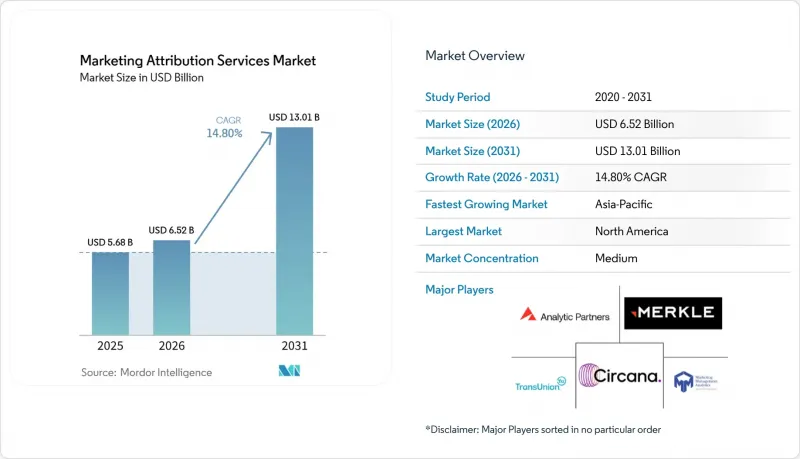
據 Mordor Intelligence 稱,2025 年行銷歸因服務市值為 56.8 億美元,預計到 2031 年將達到 130.1 億美元,而 2026 年為 65.2 億美元,預測期(2026-2031 年)的複合年成長率為 14.80%。
本報告按歸因模型(例如,多點觸控模型)、部署模式(例如,雲端、本地部署)、組織規模(例如,大型企業、中小企業)、最終用戶行業(例如,零售和電子商務、銀行、金融服務和保險 (BFSI)、媒體和娛樂、旅遊和酒店、消費品)以及地區進行細分。市場預測以美元 (USD) 為單位。
全球行銷歸因服務市場趨勢與洞察
企業對整合式 MMM、MTA 和增量框架的需求日益成長。
企業採購負責人利用行銷組合模型 (MMM) 進行預算規劃,利用多點觸控歸因進行通路管理,並利用增量測試來檢驗支出是否產生預期效果。行銷歸因服務市場的發展動力源自於將這三種方法整合到一個統一的營運流程中的需求。同行評審的關於 AIMx 框架的研究表明,與分散的衡量方法相比,整合這些方法可以提高決策的一致性和預算分配的穩定性。這使得一致的預算提案比多個各自獨立的模型輸出更有用,尤其是在媒體和財務團隊必須在整個宣傳活動週期中使用相同的規劃假設的情況下。益普索 MMA 和 Ekimetrics 在 Forrester Wave:行銷衡量與最佳化服務(2026 年第一季)報告中均被評為“領導者”,這兩家公司都強調技術驅動的規劃和決策流程。因此,行銷歸因服務市場將重視那些能夠縮短從衡量到預算編制時間的供應商。
全通路和零售媒體衡量方法的日益普及。
預計到2026年,美國零售媒體廣告支出將達到693.3億美元,將增加跨零售商平台和其他媒體管道進行效果衡量的需求。零售媒體購買者表示,銷售成長和投資報酬率(ROI)的證明是關鍵要求,跨零售商和線上/線下管道的可比衡量標準也至關重要。由於零售商專屬報告無法提供品牌整體活動的統一觀點,行銷歸因服務市場正在蓬勃發展以填補這一空白。能夠在多個無塵室環境中運作的供應商可以為品牌提供通用標準,用於宣傳活動包括透過不同零售商平台、發布商網站以及自身客戶管道進行的宣傳活動。閉合迴路衡量也有助於零售媒體網路展示廣告曝光是否促成了購買。因此,行銷歸因服務市場將在媒體採購決策和與零售商的合作決策中發揮更重要的作用。
由於隱私法規和瀏覽器限制導致訊號遺失
隱私控制和瀏覽器限制正在減少可用於確定性歸因模型的識別碼數量。蘋果的「應用程式追蹤透明度」和瀏覽器隱私功能改變了可用於衡量行動和網路活動的數據。此外,使用者同意要求可能會導致部分客戶旅程被排除在可觀察記錄之外。行銷歸因服務市場必須解決訊號遺失的問題,因為錯過早期互動可能導致對最終點擊管道的估計過高。服務提供者需要更多的調整、測試和聚合技術來獲得可操作的洞察。同時,客戶必須理解,模型結果可能比直接觀察到的互動具有更大的不確定性。這會增加實施所需的工作量,並延長買家實現新服務價值所需的時間。
細分市場分析
至2025年,多點觸控歸因將佔據行銷歸因服務市場48.24%的佔有率。這一佔有率反映了2023年之前簽署的企業合約以及通路最佳化中對用戶旅程級數據的持續需求。當客戶互動能夠跨觸點關聯時,模型仍然有效。然而,隱私法規可能會限制此類關聯,並增加基於模型的估計值的使用。當服務提供者因瀏覽器、作業系統和使用者許可設定等原因無法觀察到同一用戶在整個旅程中的行為時,這種情況尤其突出。對於通路較少、衡量資源有限的小規模組織而言,單觸點歸因仍然有效。
預計到2031年,演算法歸因和機率歸因將以16.02%的複合年成長率成長。由於這些模型無需持久標識符即可運行,並且即使在隱私限制下也能利用更廣泛的數據模式,因此使用這些模型的行銷歸因服務市場規模正在擴大。 AIMx的研究表明,整合人工智慧輔助的方法比獨立的方法能夠提供更穩定的規劃和預測。益普索MMA發布了其敏捷歸因平台2.0版本,該版本具有自動最佳化和持續調整功能。同時,Ekimetrics推出了Eki.Decisions,該平台整合了行銷組合建模、情境模擬和管治。此外,Meridian和Robyn等開放原始碼框架在擴展機率方法應用範圍的同時,仍需要對結果定義、資料輸入選擇和模型品質檢查進行控制。
到2025年,雲端部署將佔總收入的58.42%。憑藉訂閱式定價和靈活的運算能力,雲端系統非常適合模型訓練和平台整合。這種部署模式在中型D2C(直接面對消費者)和電子商務品牌中很常見,這些企業需要降低部署成本、快速取得模型容量,並與現有的廣告和商務系統整合。在金融服務和醫療保健行業,由於需要對敏感資料進行更嚴格的控制,本地部署系統仍然非常重要。此外,由於每位買家的合規要求各不相同,行銷歸因服務市場也持續採用這種部署模式。
預計到 2031 年,混合部署將以 15.93% 的複合年成長率成長。混合部署依賴於將分析計算與原始資料儲存分開的架構。這使得企業能夠在利用可擴展運算的同時,將敏感資訊儲存在受控位置。 2026 年 6 月,Accenture宋(Accenture Song)在 Amazon Bedrock 和 AWS Clean Rooms 上發布了「行銷投資導航器」(Marketing Investment Navigator),展示了以隱私為中心的雲端控制平台方法。能夠在客戶雲端環境中運行分析的供應商可以滿足高度監管行業的需求。在這些產業中,資訊管治、稽核要求和本地資料處理規則都會影響供應商的選擇和衡量專案的範圍,這可能會減少企業回歸完全本地部署設計的需求。
區域分析
2025年,北美佔據了行銷歸因服務市場41.36%的佔有率。該地區擁有眾多數位廣告商、完善的無塵室基礎設施以及許多專業服務提供者。 2026年,美國零售媒體廣告支出達到693.3億美元,增加了在封閉平台環境下衡量的需求。 Transunion和Google於2026年5月宣布合併,合併後Transunion將成為YouTube廣告唯一的多點觸控歸因提供者。美國和加拿大的隱私權保護要求也推動了對減少對第三方識別碼依賴的衡量方案的需求,獎勵大型廣告商採用可在多種監管和平台環境下使用的方法。
就收入而言,歐洲是行銷歸因服務市場第二大貢獻者。與 GDPR 相關的資料保護要求推動了人們對聚合方法(例如針對地域覆蓋範圍廣的宣傳活動進行行銷組合建模)的興趣。 Analytic Partners 於 2025 年 1 月收購了 Analytics,從而擴大了在德國、瑞士和波蘭的業務。隨著品牌適應隱私要求和數位廣告實踐日趨成熟,德國和英國在採用此類方法方面處於領先。預計隨著企業從代理商管理的衡量模式轉向混合或內部模式,法國、義大利、西班牙和其他歐洲國家也將成長。南美洲,尤其是巴西和智利,仍處於起步階段,數位廣告投資的成長速度超過了本地衡量基礎設施的建設速度,這為能夠提供可操作服務的雲端服務提供者創造了機會,而無需像大型顧問公司那樣進行大規模的本地部署。
預計到2031年,亞太地區將以16.32%的複合年成長率成長。該地區行銷歸因服務市場規模的成長主要得益於中國、印度、日本、韓國和東南亞等地電子商務的蓬勃發展,以及行動優先的購物模式的普及。中國的《個人資料保護法》和印度的《數位個人資料保護法》正在推動本土品牌和跨國品牌採用以隱私為先的衡量方法。在以沙烏地阿拉伯和阿拉伯聯合大公國為首的中東地區,數位商務的擴張和媒體投資的增加正在推動市場需求的成長。非洲市場仍處於起步階段,但南非和奈及利亞的應用相對活躍,其應用規模預計將取決於數位商務的成長、媒體投資的增加、資料基礎設施的完善以及在地化隱私保護措施的發展。
其他好處:
- Excel格式的市場預測(ME)表
- 3個月的分析師支持
目錄
第1章:引言
- 研究假設和市場定義
- 調查範圍
第2章:調查方法
第3章執行摘要
第4章 市場狀況
- 市場概覽
- 市場促進因素
- 全通路和零售媒體衡量方法的日益普及。
- 企業對 MMM、MTA 和增量式 TI 框架的整合需求日益成長。
- 擴大第一方資料範圍和強制性無塵室測量
- 對即時投資報酬率課責和預算重新分配的需求日益成長。
- 越來越需要衡量內部製作內容、採購內容和經營團隊主導內容的影響。
- 在用戶旅程和暗漏斗中,對人工智慧驅動的歸因分析的需求日益成長。
- 市場限制因素
- 由於隱私法規和瀏覽器限制導致訊號遺失
- 進階資料整合和模型校準的複雜性。
- 隱私保護型歸因 API 中的測量雜訊和誤差
- 零點擊路徑和受人工智慧影響但無法追蹤的路徑的比例正在增加。
- 產業價值鏈分析
- 監理情勢
- 技術展望
- 波特五力分析
第5章 市場規模與成長預測
- 按歸因模型
- 單次觸摸歸因
- 多點觸控歸因
- 演算法和機率歸因
- 部署模式
- 雲
- 現場
- 混合
- 按組織規模
- 大公司
- 小型企業
- 按最終用戶行業分類
- 零售與電子商務
- BFSI
- 資訊科技/通訊
- 媒體與娛樂
- 醫療保健和生命科學
- 旅遊與飯店
- 消費品
- 其他終端用戶產業
- 按地區
- 北美洲
- 美國
- 加拿大
- 墨西哥
- 南美洲
- 巴西
- 阿根廷
- 智利
- 其他南美國家
- 歐洲
- 德國
- 英國
- 法國
- 義大利
- 西班牙
- 其他歐洲國家
- 亞太地區
- 中國
- 日本
- 印度
- 韓國
- 澳洲
- 其他亞太國家
- 中東
- 沙烏地阿拉伯
- 阿拉伯聯合大公國
- 卡達
- 其他中東國家
- 非洲
- 南非
- 埃及
- 奈及利亞
- 其他非洲國家
- 北美洲
第6章 競爭情勢
- 市場集中度
- 策略趨勢
- 市佔率分析
- 公司簡介
- Analytic Partners, LP
- Merkle Inc.
- TransUnion LLC
- Ipsos MMA
- Circana, Inc.
- Gain Theory
- Kantar Group
- Ekimetrics
- Acxiom
- C5i
- LatentView Analytics
- Marketbridge LLC
- OptiMine Software, Inc.
- DAC Group
- LifeSight
- Rockerbox, Inc.
- North Beam, Inc.
- LeadsRx, Inc
- Precis Digital Company Group
- BitBang Srl
第7章 市場機會與未來展望
According to Mordor Intelligence, the marketing attribution services market size was valued at USD 5.68 billion in 2025 and estimated to grow from USD 6.52 billion in 2026 to reach USD 13.01 billion by 2031, at a CAGR of 14.80% during the forecast period (2026-2031).
This report is Segmented by Attribution Model (Multi-Touch, and More), Deployment Mode (Cloud, On-Premises, and More), Organization Size (Large Enterprises, and Small and Medium-Sized Enterprises), End-User Industry (Retail and E-Commerce, BFSI, Media and Entertainment, Travel and Hospitality, Consumer Goods, and More), and Geography. The Market Forecasts are Provided in Terms of Value (USD).
Global Marketing Attribution Services Market Trends and Insights
Rising Enterprise Demand for Unified MMM, MTA, and Incrementality Frameworks
Enterprise buyers are using marketing mix modeling for budget planning, multi-touch attribution for channel management, and incrementality testing to test whether spend caused a result. The marketing attribution services market is supported by this need to bring the three methods into one operating process. A peer-reviewed study of the AIMx framework found that integrating these methods can improve decision consistency and budget allocation stability compared with fragmented measurement approaches. This makes a reconciled budget recommendation more useful than several disconnected model outputs, especially when media teams and finance teams must use the same planning assumptions across a campaign cycle. Ipsos MMA and Ekimetrics received Leader recognition in the Forrester Wave for Marketing Measurement and Optimization Services, Q1 2026, and both have emphasized technology-supported planning and decision processes. The marketing attribution services market therefore rewards providers that can shorten the time from measurement to a budget decision.
Growing Adoption of Omnichannel and Retail Media Measurement
U.S. retail media advertising spending reached USD 69.33 billion in 2026, increasing the need for measurement across retailer platforms and other media channels. Retail media buyers reported that proof of sales lift and return on investment were leading requirements, while comparable cross-retailer measurement and online-to-offline measurement were also important. The marketing attribution services market gains from this gap because retailer-specific reporting does not provide a consistent view of a brand's total activity. Providers that work across multiple clean room environments can give brands a common basis for comparing campaigns, including campaigns that run through separate retailer platforms, publisher properties, and owned customer channels. Closed-loop measurement also helps retail media networks show whether advertising exposure led to purchases. This places the marketing attribution services market closer to both media buying decisions and retailer partnership decisions.
Signal Loss from Privacy Rules and Browser Restrictions
Privacy controls and browser restrictions reduce the identifiers available to deterministic attribution models. Apple's App Tracking Transparency and browser privacy features have changed the data available for measurement across mobile and web activity. Consent requirements can also leave parts of a customer journey outside the observable record. The marketing attribution services market must address this loss of signal because missing early interactions can place too much credit on final-click channels. Providers need more calibration work, testing, and aggregated methods to produce usable findings, while clients must understand that a modeled result may carry more uncertainty than a directly observed interaction. This raises implementation effort and can lengthen the time before buyers see value from a new service.
Other drivers and restraints analyzed in the detailed report include:
- Expanding First-Party Data and Clean Room Measurement Mandates
- Increasing Need for Real-Time ROI Accountability and Budget Reallocation
- High Data Integration and Model Calibration Complexity
For complete list of drivers and restraints, kindly check the Table Of Contents.
Segment Analysis
Multi-Touch Attribution held 48.24% of the marketing attribution services market share in 2025. Its position reflects enterprise contracts established before 2023 and continued demand for journey-level data in channel optimization. The model remains useful where customer interactions can be linked across touchpoints. Privacy restrictions, however, can limit that linkage and increase the use of modeled estimates, particularly when browsers, operating systems, and consent choices prevent a provider from observing the same user across a complete journey. Single-Touch Attribution remains relevant for smaller organizations with fewer channels and limited measurement resources.
Algorithmic and Probabilistic Attribution is projected to expand at a 16.02% CAGR through 2031. The marketing attribution services market size for this model is rising because it can operate without persistent identifiers and can use broader data patterns under privacy constraints. The AIMx study found that integrated, AI-supported approaches can offer more stable planning and forecasting than isolated methods. Ipsos MMA released Version 2.0 of its Agile Attribution Platform with automated optimization and continuous recalibration, while Ekimetrics introduced Eki.Decisions to connect marketing mix modeling, scenario simulation, and governance, and open-source frameworks such as Meridian and Robyn are expanding access to probabilistic methods while preserving the need to define outcomes, select data inputs, and check model quality.
Cloud deployment held 58.42% of revenue in 2025. Subscription pricing and elastic computing capacity make cloud systems suitable for model training and platform integration. This mode is common among mid-sized direct-to-consumer and e-commerce brands that need a lower entry cost, fast access to model capacity, and connections to the advertising and commerce systems they already use. On-premises systems remain relevant in financial services and healthcare, where organizations seek greater control over sensitive data. The marketing attribution services market retains this deployment choice because compliance needs differ widely by buyer.
Hybrid deployment is forecast to grow at a 15.93% CAGR through 2031. Hybrid deployment is supported by architectures that separate analytical computing from raw data storage. This lets organizations use scalable computing while keeping sensitive information in a controlled location. Accenture Song launched Marketing Investment Navigator on Amazon Bedrock and AWS Clean Rooms in June 2026, demonstrating a platform approach built around privacy-oriented cloud controls. Vendors that can run analytics in a client's cloud environment can address requirements in regulated sectors, where information governance, audit needs, and local data handling rules affect both supplier selection and the scope of a measurement project, potentially reducing the need to return to a fully on-premises design.
Complete Report Scope:
- By Attribution Model
- Single-Touch Attribution
- Multi-Touch Attribution
- Algorithmic and Probabilistic Attribution
- By Deployment Mode
- Cloud
- On-Premises
- Hybrid
- By Organization Size
- Large Enterprises
- Small and Medium-Sized Enterprises
- By End-User Industry
- Retail and E-commerce
- BFSI
- IT and Telecommunications
- Media and Entertainment
- Healthcare and Life Sciences
- Travel and Hospitality
- Consumer Goods
- Other End-User Industries
- By Geography
- North America
- United States
- Canada
- Mexico
- South America
- Brazil
- Argentina
- Chile
- Rest of South America
- Europe
- Germany
- United Kingdom
- France
- Italy
- Spain
- Rest of Europe
- Asia-Pacific
- China
- Japan
- India
- South Korea
- Australia
- Rest of Asia-Pacific
- Middle East
- Saudi Arabia
- United Arab Emirates
- Qatar
- Rest of Middle East
- Africa
- South Africa
- Egypt
- Nigeria
- Rest of Africa
- North America
Geography Analysis
North America held 41.36% of the marketing attribution services market share in 2025. The region has a large base of digital advertisers, established clean room infrastructure, and many specialist providers. U.S. retail media advertising spending reached USD 69.33 billion in 2026, raising the need for measurement in walled garden environments. TransUnion and Google announced an integration in May 2026 that made TransUnion the sole multi-touch attribution provider for YouTube advertising. Privacy requirements in the United States and Canada also support demand for measurement designs that reduce reliance on third-party identifiers, and this gives large advertisers an incentive to adopt methods that can be used across several legal and platform environments.
Europe is the second-largest revenue contributor to the marketing attribution services market. GDPR-related data protection requirements have increased interest in aggregated methods such as marketing mix modeling for campaigns with meaningful regional reach. Analytic Partners acquired Analyx in January 2025, expanding its position in Germany, Switzerland, and Poland. Germany and the United Kingdom lead adoption as brands adapt to privacy requirements and more mature digital advertising activity. France, Italy, Spain, and the rest of Europe offer room for growth as organizations shift from agency-managed measurement toward hybrid and internal models. South America, particularly Brazil and Chile, remains earlier-stage, with digital advertising investment growing faster than local measurement infrastructure, creating an opening for cloud-based providers that can offer usable services without the extensive local delivery footprint required by large consultancies.
Asia-Pacific is projected to expand at a 16.32% CAGR through 2031. The marketing attribution services market size in the region is supported by e-commerce growth and mobile-first buyer journeys across China, India, Japan, South Korea, and Southeast Asia. China's Personal Information Protection Law and India's Digital Personal Data Protection Act are encouraging privacy-first measurement practices among local and multinational brands. The Middle East, led by Saudi Arabia and the UAE, is building demand alongside digital commerce and media investment. Africa remains at an earlier stage, with South Africa and Nigeria among the more active adoption markets, while the scale of adoption will depend on the growth of digital commerce, media investment, data infrastructure, and locally appropriate privacy practices.
- Analytic Partners, LP
- Merkle Inc.
- TransUnion LLC
- Ipsos MMA
- Circana, Inc.
- Gain Theory
- Kantar Group
- Ekimetrics
- Acxiom
- C5i
- LatentView Analytics
- Marketbridge LLC
- OptiMine Software, Inc.
- DAC Group
- LifeSight
- Rockerbox, Inc.
- North Beam, Inc.
- LeadsRx, Inc
- Precis Digital Company Group
- BitBang S.r.l.
Additional Benefits:
- The market estimate (ME) sheet in Excel format
- 3 months of analyst support
TABLE OF CONTENTS
1 INTRODUCTION
- 1.1 Study Assumptions and Market Definition
- 1.2 Scope of the Study
2 RESEARCH METHODOLOGY
3 EXECUTIVE SUMMARY
4 MARKET LANDSCAPE
- 4.1 Market Overview
- 4.2 Market Drivers
- 4.2.1 Growing Adoption of Omnichannel and Retail Media Measurement
- 4.2.2 Rising Enterprise Demand for Unified MMM, MTA, and Incrementality Frameworks
- 4.2.3 Expanding First-Party Data and Clean Room Measurement Mandates
- 4.2.4 Increasing Need for Real-Time ROI Accountability and Budget Reallocation
- 4.2.5 Rising Need to Measure Owned, Earned, and Executive-Led Content Influence
- 4.2.6 Growing Demand for Attribution Across AI-Assisted and Dark-Funnel Journeys
- 4.3 Market Restraints
- 4.3.1 Signal Loss From Privacy Rules and Browser Restrictions
- 4.3.2 High Data Integration and Model Calibration Complexity
- 4.3.3 Measurement Noise and Error in Privacy-Preserving Attribution APIs
- 4.3.4 Growing Share of Zero-Click and Unobservable AI-Influenced Journeys
- 4.4 Industry Value Chain Analysis
- 4.5 Regulatory Landscape
- 4.6 Technological Outlook
- 4.7 Porter's Five Forces Analysis
- 4.7.1 Bargaining Power of Buyers
- 4.7.2 Bargaining Power of Suppliers
- 4.7.3 Threat of New Entrants
- 4.7.4 Threat of Substitutes
- 4.7.5 Competitive Rivalry
5 MARKET SIZE AND GROWTH FORECASTS (VALUE)
- 5.1 By Attribution Model
- 5.1.1 Single-Touch Attribution
- 5.1.2 Multi-Touch Attribution
- 5.1.3 Algorithmic and Probabilistic Attribution
- 5.2 By Deployment Mode
- 5.2.1 Cloud
- 5.2.2 On-Premises
- 5.2.3 Hybrid
- 5.3 By Organization Size
- 5.3.1 Large Enterprises
- 5.3.2 Small and Medium-Sized Enterprises
- 5.4 By End-User Industry
- 5.4.1 Retail and E-commerce
- 5.4.2 BFSI
- 5.4.3 IT and Telecommunications
- 5.4.4 Media and Entertainment
- 5.4.5 Healthcare and Life Sciences
- 5.4.6 Travel and Hospitality
- 5.4.7 Consumer Goods
- 5.4.8 Other End-User Industries
- 5.5 By Geography
- 5.5.1 North America
- 5.5.1.1 United States
- 5.5.1.2 Canada
- 5.5.1.3 Mexico
- 5.5.2 South America
- 5.5.2.1 Brazil
- 5.5.2.2 Argentina
- 5.5.2.3 Chile
- 5.5.2.4 Rest of South America
- 5.5.3 Europe
- 5.5.3.1 Germany
- 5.5.3.2 United Kingdom
- 5.5.3.3 France
- 5.5.3.4 Italy
- 5.5.3.5 Spain
- 5.5.3.6 Rest of Europe
- 5.5.4 Asia-Pacific
- 5.5.4.1 China
- 5.5.4.2 Japan
- 5.5.4.3 India
- 5.5.4.4 South Korea
- 5.5.4.5 Australia
- 5.5.4.6 Rest of Asia-Pacific
- 5.5.5 Middle East
- 5.5.5.1 Saudi Arabia
- 5.5.5.2 United Arab Emirates
- 5.5.5.3 Qatar
- 5.5.5.4 Rest of Middle East
- 5.5.6 Africa
- 5.5.6.1 South Africa
- 5.5.6.2 Egypt
- 5.5.6.3 Nigeria
- 5.5.6.4 Rest of Africa
- 5.5.1 North America
6 COMPETITIVE LANDSCAPE
- 6.1 Market Concentration
- 6.2 Strategic Moves
- 6.3 Market Share Analysis
- 6.4 Company Profiles (includes Global Level Overview, Market Level Overview, Core Segments, Financials as available, Strategic Information, Market Rank/Share, Products and Services, Recent Developments)
- 6.4.1 Analytic Partners, LP
- 6.4.2 Merkle Inc.
- 6.4.3 TransUnion LLC
- 6.4.4 Ipsos MMA
- 6.4.5 Circana, Inc.
- 6.4.6 Gain Theory
- 6.4.7 Kantar Group
- 6.4.8 Ekimetrics
- 6.4.9 Acxiom
- 6.4.10 C5i
- 6.4.11 LatentView Analytics
- 6.4.12 Marketbridge LLC
- 6.4.13 OptiMine Software, Inc.
- 6.4.14 DAC Group
- 6.4.15 LifeSight
- 6.4.16 Rockerbox, Inc.
- 6.4.17 North Beam, Inc.
- 6.4.18 LeadsRx, Inc
- 6.4.19 Precis Digital Company Group
- 6.4.20 BitBang S.r.l.
7 MARKET OPPORTUNITIES AND FUTURE OUTLOOK
- 7.1 White-Space and Unmet-Need Assessment

 多點觸控觸控歸因:市場佔有率分析、產業趨勢與統計、成長預測(2026-2031 年)
 行銷歸因軟體市場:按歸因模型、產業、部署類型和組織規模分類 - 2026-2032 年全球預測
 全球多點觸控觸控歸因市場
 多點觸控歸因市場規模、佔有率和成長分析(按模型類型、組件、部署方法、組織規模、最終用戶產業和地區):產業預測(2025-2032)
 行銷歸因軟體市場規模、佔有率、趨勢分析報告:按類型、部署、公司規模、最終用途、地區、細分預測,2025-2030 年
 行銷歸因軟體市場 - 全球產業規模、佔有率、趨勢、機會和預測,按組件、歸因類型、組織規模、部署類型、地區和競爭細分,2019-2029F