


 |
市場調查報告書
商品編碼
2118977
貿易行銷服務:市場佔有率分析、產業趨勢與統計、成長預測(2026-2031)Trade Marketing Services - Market Share Analysis, Industry Trends & Statistics, Growth Forecasts (2026 - 2031) |
||||||

※ 本網頁內容可能與最新版本有所差異。詳細情況請與我們聯繫。
據 Mordor Intelligence 稱,2025 年貿易行銷服務市值為 48.2 億美元,預計到 2031 年將達到 101.8 億美元,高於 2026 年的 53.3 億美元,在預測期(2026-2031 年)內的複合年成長率為 13.82%。
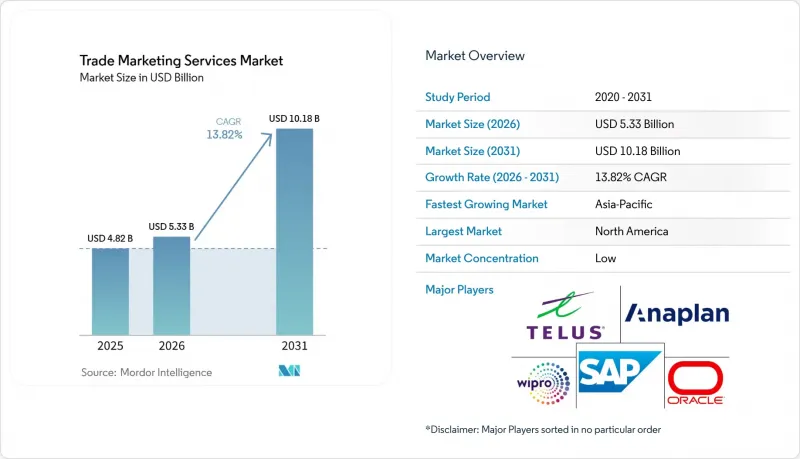
本報告按組件(解決方案、服務)、部署模式(雲端部署、其他)、組織規模(大型企業、中小企業)、應用程式(促銷規劃和日程管理、其他)、最終用戶行業(零售和電子商務、媒體和娛樂、其他)以及地區進行細分。市場預測以美元計價。
全球貿易行銷服務市場的趨勢與洞察
提高貿易行銷支出投資報酬率的壓力越來越大
傳統上,消費品公司會將銷售額的15%到25%用於貿易行銷活動,但其中相當一部分支出並未帶來可觀的回報。貿易行銷服務市場透過將促銷記錄、發票檢驗和收款流程整合到一個統一的營運模式中,有效應對了這項挑戰。據Genpact公司稱,企業會漏掉高達20%的可避免扣款,並且超過30%的無效發票未得到解決,導致員工耗費大量時間處理發票,並掩蓋了促銷活動的真實財務績效。 Genpact的扣款催收服務旨在自動收集、檢驗和解決發票信息,每筆案件可減少1.5%的財務損失,並每年額外追回高達15%的款項。這使企業無需手動審核日常的證據收集和核實工作。自動化的、可審計的解決方案流程使促銷經理能夠從財務層面詳細了解發票、客戶帳戶和宣傳活動週期內的計劃支出和實際支出。如果促銷活動的效果未達到預期,這種更高的透明度可能會改變財務團隊核准、追蹤和審查促銷預算的方式。
全通路零售與數位商務的擴張
目前,對許多製造商而言,傳統零售、現代通路、電子商務、快消和D2C(直接面對消費者)通路相互關聯。這使得貿易行銷服務市場在需要促銷策劃、庫存訊號、數位化啟動和可靠業務資料交換的合作產業計畫中扮演越來越重要的角色。根據IAB Europe預測,到2024年,歐洲零售業的數位廣告支出將成長16%,達到1,189億歐元(以2024年平均外匯計算,約1,284億美元)。這表明,整合零售商數據、廣告活動和產品促銷的管道在商業性的重要性日益凸顯。報告顯示,忠誠度計畫和數據驅動型廣告形式擁有最強勁的成長前景。隨著將促銷策劃、貨架可見性和零售媒體表現聯繫起來的需求不斷成長,買家對平台功能、報告細節和零售商協作的期望也越來越高。隨著零售商關係越來越依賴數據,支援這些協作的供應商將在商業規劃和客戶管理中發揮更核心的作用。
傳統ERP和資料整合的複雜性
大型消費品製造商通常使用專為財務合併和供應鏈執行而非詳細的促銷管理而設計的ERP系統。每個系統都有其獨特的資料結構、時間安排、負責人和異常處理流程,因此,整合POS資訊、促銷條件、扣款記錄和出貨確認可能需要數月才能完成。此外,貿易行銷服務市場必須遵守美國通用會計準則ASC 606和國際財務報告準則(IFRS) 15的報告要求。這些要求使得在公司跨多個市場進行報告並需要解釋商業活動如何影響已確認收入時,準確累計貿易應付帳款、可變對價和結算至關重要。 XTEL提供經認證的連接器,可將促銷應付帳款寫入SAP返利協議,並透過SAP工作流程管理處理異常狀況。雖然原生整合可以減少人工對賬,但它並不能消除複雜全球部署所需的持續IT投資,尤其是在需要使新流程與現有控制和報告義務保持一致的情況下。
細分市場分析
到2025年,該解決方案佔據了貿易行銷服務市場58.62%的佔有率。這主要歸功於買家優先考慮用於促銷計劃、價格最佳化、零售執行和貿易分析的整合軟體。這些平台擴大採用生成式人工智慧技術,用於促銷報告、情境規劃和與零售商的溝通,從而減少了客戶團隊重複性的準備工作,同時又能維持正式的核准和審核流程。這些產品的廣泛功能使其區別於專注於促銷週期特定階段的傳統本地部署工具。傳統工具僅用於制定促銷方案,而無法整合最終結算結果、零售商發票、現場證據或活動後針對初始商業目標的帳戶級績效評估,這可能導致不同團隊使用相同商業活動的不完整記錄。該軟體還支援跨零售帳戶維護通用記錄,從而在銷售、財務和客戶關係團隊需要在相同促銷條件下運作時,改進核准和結算管理。其卓越的業績記錄為貿易行銷服務市場奠定了堅實的基礎。這是因為客戶可以隨著時間的推移逐步擴展其功能,從基本的規劃和分析到現場執行和扣款管理,而無需替換其繼續保存財務數據和企業客戶記錄的核心系統。
預計2026年至2031年,服務市場將以15.16%的複合年成長率成長,成長率高於解決方案市場。製造商在購買平台後,通常需要實施、數據統一、促銷建模和績效報告方面的幫助,尤其是在零售商的文件和內部系統中存在不相容的記錄時。 2026年6月,Genpact推出了基於代理的扣款催收服務,為先前通常由企業內部處理的工作流程增加了託管選項。 2026年4月,Wipro與Oram集團簽署了為期八年的協議。該協定價值超過10億美元,其中承諾投入8億美元,涵蓋包括客戶參與和貿易營運在內的轉型任務。此類舉措模糊了軟體授權和基於結果的營運支援之間的界限,可能會給扣款管理和分析領域的單一供應商帶來壓力。
在2025年的貿易行銷服務市場中,雲端採用率達到52.56%。買家優先考慮降低基礎設施需求、快速部署以及與託管服務模式的兼容性,這使得企業無需自行建置所有功能即可利用專家營運支援。雲端原生產品能夠持續更新模型,並在促銷期間POS資料量激增時擴展。這使得團隊能夠利用最新信息,而無需依賴定期資料提取,並將來自計劃、財務、銷售和客戶帳戶的用戶整合到單一工作流程中,而無需本地軟體維護。此外,區域設置有助於跨國用戶在遵守歐盟資料居住要求的同時,將當地法規應用於零售商和消費者資訊。這些優勢確保了雲端仍然是主要的採用方式。
混合部署預計將在2026年至2031年間以17.18%的複合年成長率成長。許多跨國公司仍然將財務記錄、敏感的零售合約條款以及與ERP系統關聯的權責發生製資料保存在本地環境中,因為內部管治、審計要求以及對舊有系統的投資仍然至關重要。同時,規劃和分析工作負載正在遷移到雲端,使團隊能夠利用共用工具、頻繁更新和可擴展的運算資源。由此產生的架構將雲端的管治與對受管記錄的治理相結合,使團隊能夠在利用現代規劃應用程式的同時,維護有關敏感財務和客戶資訊的既定策略。 XTEL的SAP S/4HANA整合解決方案支援這樣一種模型:基於雲端的規劃層透過自動化工作流程將資料寫入ERP的結算引擎,這反映了貿易行銷服務市場中大型企業的實際遷移路徑。
區域分析
到2025年,北美將佔據貿易行銷服務市場36.41%的佔有率。該地區聚集了許多大型消費品公司,它們在貿易分析領域的投資已進入後期階段,與零售商建立了牢固的關係,並擁有充足的資金籌措能力,用於持續推進商業規劃和衡量系統的現代化。與沃爾瑪、克羅格和亞馬遜的合資產業計畫正在將貿易支出與品牌媒體支出整合起來,這要求品牌和零售商將促銷資金、媒體活動和商業性成果視為一個整體來考慮。這推動了對支援貿易促銷管理和零售媒體最佳化的工具的需求。互動廣告協會(IAB)和媒體評級委員會正在製定店內數位庫存的衡量框架,加拿大也受益於類似的零售結構。同時,隨著現代貿易的擴張,墨西哥也湧現許多早期商業機會。
預計亞太地區2026年至2031年的複合年成長率將達到15.24%,在所有地區中增速最高。印度日常消費品(FMCG)銷售額在2025年上半年加速成長至13.7%,凸顯了製造商管理包括傳統零售、現代貿易、電商和本地分銷管道在內的多元化分銷管道的必要性。在中國,社群電商和直播帶貨正在推動市場發展,電子商務在中國和韓國的快速消費品銷售額中佔比高達40%,因此協調一致的促銷計劃至關重要。東南亞的快速商業模式要求即時庫存管理和執行指令,這進一步提升了即時工具在該地區貿易行銷服務市場的重要性。
到2025年,歐洲將佔較大佔有率,其中德國、英國和法國是國內市場最成熟的國家。 2024年,歐洲數位廣告市場成長16%,達到1,189億歐元,以2024年平均外匯計算,約1,284億美元。 2026年3月,零售媒體聯盟將在德國成立,致力於在3萬家EDEKA門市建構統一的、可預訂的店內零售媒體生態系統。雖然《一般資料保護規則》(GDPR)正在規範消費者分析和零售商的資料處理政策,但基於雲端的解決方案在南美洲,尤其是在巴西和阿根廷,正得到早期應用,不過也面臨基礎設施差異和外匯波動等挑戰。中東和非洲仍處於應用初期,但阿拉伯聯合大公國和沙烏地阿拉伯的零售現代化項目正在推動對商品行銷分析和數位化活化的需求。
其他好處:
- Excel格式的市場預測(ME)表
- 3個月的分析師支持
目錄
第1章:引言
- 研究假設和市場定義
- 調查範圍
第2章:調查方法
第3章執行摘要
第4章 市場狀況
- 市場概覽
- 市場促進因素
- 提高貿易支出投資報酬率的壓力越來越大
- 全通路零售的擴張和數位商務的復興。
- 雲端運算和人工智慧驅動的交易平台正在加速普及。
- 零售營運進度進行即時視覺化的需求日益成長。
- 零售媒體與促銷預算的整合
- 稅收抵扣退款和促銷合規認證的自動化
- 市場限制因素
- 傳統ERP和資料整合的複雜性
- 資料完整性差和組織準備不足
- 零售商數據環境碎片化和“圍牆花園”式測量
- 自動扣款審計與績效核實負擔
- 宏觀經濟因素對市場的影響
- 產業價值鏈分析
- 科技趨勢
- 監理情勢
- 波特五力分析
第5章 市場規模與成長預測
- 按組件
- 解決方案
- 服務
- 部署模式
- 雲
- 現場
- 混合
- 按組織規模
- 大公司
- 小型企業
- 透過使用
- 促銷計劃和日程管理
- 最佳化定價和促銷
- 零售實務和商品行銷
- 貿易分析與決策支持
- 管道宣傳活動自動化與資金管理
- 按最終用戶行業分類
- 零售與電子商務
- 媒體與娛樂
- 醫療保健和生命科學
- 旅遊與飯店
- 消費品
- 其他終端用戶產業(銀行、金融服務與保險、教育、汽車、IT/電信等)
- 按地區
- 北美洲
- 美國
- 加拿大
- 墨西哥
- 南美洲
- 巴西
- 阿根廷
- 智利
- 其他南美國家
- 歐洲
- 德國
- 英國
- 法國
- 義大利
- 西班牙
- 其他歐洲國家
- 亞太地區
- 中國
- 日本
- 印度
- 韓國
- 澳洲
- 其他亞太國家
- 中東
- 阿拉伯聯合大公國
- 沙烏地阿拉伯
- 卡達
- 其他中東國家
- 非洲
- 南非
- 埃及
- 奈及利亞
- 其他非洲國家
- 北美洲
第6章 競爭情勢
- 市場集中度
- 策略趨勢
- 市佔率分析
- 公司簡介
- SAP SE
- Oracle Corporation
- Salesforce, Inc.
- Aforza Ltd
- Anaplan, Inc.
- UpClear SAS
- Repsly, Inc.
- StayinFront, Inc.
- Pepperi Ltd.
- Wiser Solutions, Inc.
- Asseco Business Solutions SA
- ParallelDots, Inc.
- Impartner Software, Inc.
- ZINFI Technologies, Inc.
- Mindmatrix Inc.
- Visualfabriq BV
- TELUS Communications Inc.
- o9 Solutions, Inc.
- Circana, LLC
- Wipro Limited
第7章 市場機會與未來展望
According to Mordor Intelligence, the trade marketing services market size was valued at USD 4.82 billion in 2025 and is estimated to grow from USD 5.33 billion in 2026 to reach USD 10.18 billion by 2031, at a CAGR of 13.82% during the forecast period (2026-2031).
This report is Segmented by Component (Solutions, and Services), Deployment Mode (Cloud, and More), Organization Size (Large Enterprises, and Small and Medium Enterprises), Application (Promotion Planning and Calendar Management, and More), End User Industry (Retail and E-Commerce, Media and Entertainment, and More), and Geography. The Market Forecasts are Provided in Terms of Value (USD).
Global Trade Marketing Services Market Trends and Insights
Increasing Pressure to Improve Trade Spend ROI
Consumer goods companies have historically devoted 15% to 25% of revenue to trade marketing activities, yet a material share of spending has lacked verified returns. The Trade Marketing Services Market addresses that issue by bringing together promotion records, claim validation, and recovery workflows into a single operating model. Genpact stated that companies can miss up to 20% of preventable deductions and leave more than 30% of invalid claims unresolved, resulting in claims that consume staff time and obscure the true financial results of promotions. Its deductions recovery offering was designed to automatically gather, validate, and resolve claims, with the potential to reduce financial leakage by 1.5% per engagement and achieve up to 15% additional annual recoveries, shifting routine evidence collection and checking away from manual review. Automated, auditable resolution provides trade leaders with a finance-grade view of planned and realized spending across claims, customer accounts, and campaign periods. That visibility can change how finance teams approve, track, and challenge trade budgets when promotional performance falls short of original expectations.
Expansion of Omnichannel Retail and Digital Commerce Activation
General trade, modern trade, e-commerce, quick commerce, and direct-to-consumer sales now operate as connected channels for many manufacturers. This makes the Trade Marketing Services Market more relevant to joint business plans that require promotional plans, inventory signals, digital activation, and reliable operational data exchange. Digital advertising in European retail contexts grew 16% in 2024 to EUR 118.9 billion, equivalent to USD 128.4 billion at the 2024 average exchange rate, according to IAB Europe, demonstrating the growing commercial importance of channels that combine retailer data, advertising activity, and product promotion. Loyalty and data-driven formats showed the strongest growth outlook in that report. The need to link promotional planning with shelf visibility and retail media performance is raising buyer expectations for platform capabilities, reporting detail, and retailer collaboration. Providers that support those connections can become more central to commercial planning and account management as the retailer relationship becomes more data-dependent.
Legacy ERP and Data Integration Complexity
Large consumer goods manufacturers often use ERP systems built for financial consolidation and supply chain execution rather than detailed promotion management. Connecting point-of-sale information, promotion terms, deduction records, and shipment confirmations can add months to a platform implementation, as each system has its own data structure, timing, owner, and exception-resolution process. The Trade Marketing Services Market must also accommodate reporting needs under US GAAP ASC 606 and IFRS 15. Those requirements make it essential to accurately account for trade accruals, variable consideration, and settlements when companies report across markets and must explain how commercial activity affects recognized revenue. XTEL provides certified connectors that write promotion accruals into SAP rebate agreements and route exceptions through SAP Workflow Management. Native integration can reduce manual reconciliation, but it does not eliminate the ongoing IT investment required for complex global deployments, particularly when new processes must be aligned with existing controls and reporting obligations.
Other drivers and restraints analyzed in the detailed report include:
- Accelerating Adoption of Cloud and AI-Enabled Trade Platforms
- Rising Need for Real-Time Retail Execution Visibility
- Low Data Harmonization and Organizational Readiness
For complete list of drivers and restraints, kindly check the Table Of Contents.
Segment Analysis
Solutions held 58.62% of the Trade Marketing Services Market share in 2025, as buyers prioritized integrated software for promotion planning, price optimization, retail execution, and trade analytics. These platforms increasingly include generative AI for promotional reporting, scenario planning, and retailer communication, reducing repetitive preparation work for account teams while retaining formal approval and audit processes. The broader function of these products distinguishes them from older on-premises tools that focused on a narrow stage of the promotion cycle, such as planning an offer without connecting the eventual settlement result, retailer claim, field evidence, or later account-level assessment of performance against original commercial objectives, which can leave separate teams using incomplete records of the same commercial event. Software also supports common records across retail accounts, which can improve control over approvals and settlements when sales, finance, and customer teams need to work from the same promotion terms. Its installed base provides a stable foundation for the Trade Marketing Services Market as customers add capabilities over time, from basic planning through analytics, field execution, and deduction management, without necessarily replacing the core systems that continue to hold financial data and enterprise customer records.
Services are projected to expand at a 15.16% CAGR from 2026 to 2031, faster than solutions. Manufacturers often need help with implementation, data harmonization, promotional modeling, and performance reporting after a platform purchase, particularly when retailer files and internal systems do not use comparable records. Genpact launched an agentic deductions recovery service in June 2026, adding a managed route to a workflow that has often been handled internally. Wipro signed an 8-year Olam Group contract in April 2026 valued at more than USD 1 billion, with committed spending of USD 800 million, for transformation work that included customer engagement and trade operations. Such engagements blur the line between software licenses and outcome-linked operational support and may place pressure on standalone vendors in deduction management and analytics.
Cloud deployment accounted for 52.56% of the Trade Marketing Services Market in 2025. Buyers favored lower infrastructure requirements, faster onboarding, and compatibility with managed-service models, which can help companies access specialized operational support without building every capability internally. Cloud-native products can issue model updates continuously and scale during promotion periods that generate high volumes of point-of-sale data, allowing teams to work with current information rather than periodic extracts and to bring planning, finance, sales, and customer account users into a single workflow without local software maintenance. Regional configurations can also support EU data-residency requirements while helping multinational users apply local controls to retailer and shopper information. These advantages explain why the cloud remained the leading deployment approach.
Hybrid deployment is projected to expand at a 17.18% CAGR from 2026 to 2031. Many multinationals retain financial records, sensitive retailer terms, and ERP-linked accrual data in on-premises environments because internal governance, audit requirements, and legacy investments remain important. At the same time, they are moving planning and analytics workloads to the cloud, where teams can access shared tools, frequent updates, and scalable computing resources. The resulting architecture combines cloud scaling with governance over controlled records, letting teams use modern planning applications while maintaining established policies for sensitive financial and customer information. XTEL's SAP S/4HANA integration supports a model in which cloud planning layers write into ERP settlement engines through automated workflows, reflecting the practical transition path for large organizations in the Trade Marketing Services Market.
Complete Report Scope:
- By Component
- Solutions
- Services
- By Deployment Mode
- Cloud
- On-premises
- Hybrid
- By Organization Size
- Large Enterprises
- Small and Medium Enterprises
- By Application
- Promotion Planning and Calendar Management
- Price and Promotion Optimization
- Retail Execution and Merchandising
- Trade Analytics and Decision Support
- Channel Campaign Automation and Fund Management
- By End User Industry
- Retail and E-commerce
- Media and Entertainment
- Healthcare and Life Sciences
- Travel and Hospitality
- Consumer Goods
- Other End User Industries (BFSI, Education, Automotive, and IT and Telecom amongst Others)
- By Geography
- North America
- United States
- Canada
- Mexico
- South America
- Brazil
- Argentina
- Chile
- Rest of South America
- Europe
- Germany
- United Kingdom
- France
- Italy
- Spain
- Rest of Europe
- Asia-Pacific
- China
- Japan
- India
- South Korea
- Australia
- Rest of Asia-Pacific
- Middle East
- United Arab Emirates
- Saudi Arabia
- Qatar
- Rest of Middle East
- Africa
- South Africa
- Egypt
- Nigeria
- Rest of Africa
- North America
Geography Analysis
North America held 36.41% of the Trade Marketing Services Market share in 2025. The region has a concentration of large consumer goods companies that are in later stages of trade analytics investment, with established retail relationships and a greater ability to finance ongoing modernization of commercial planning and measurement systems. Joint business plans with Walmart, Kroger, and Amazon increasingly combine trade and brand media spending, requiring the brand and retailer to consider promotional funding, media activity, and commercial outcomes together. This raises demand for tools that support both trade promotion management and retail media optimization. The IAB and Media Rating Council are working on measurement frameworks for in-store digital inventory, while Canada benefits from similar retail structures and Mexico offers an earlier-stage opportunity as modern trade expands.
Asia-Pacific is projected to expand at a 15.24% CAGR from 2026 to 2031, the highest regional rate. India's FMCG value growth accelerated to 13.7% in the first half of 2025, underscoring the need for manufacturers to manage a wide mix of general trade, modern trade, digital commerce, and local distribution channels. China is shaped by social commerce and livestream selling, while e-commerce accounted for 40% of FMCG sales in China and South Korea, underscoring the need for coordinated promotional planning. Southeast Asian quick commerce requires immediate inventory and execution signals, making real-time tools increasingly relevant to the Trade Marketing Services Market across the region.
Europe represented a significant share in 2025, with Germany, the United Kingdom, and France among the most mature national markets. The European digital advertising market grew 16% in 2024 to EUR 118.9 billion, equivalent to USD 128.4 billion at the 2024 average exchange rate. The Retail Media Alliance launched in Germany in March 2026 to create a centrally bookable in-store retail media ecosystem across 30,000 EDEKA stores. GDPR shapes the handling of shopper analytics and retailer data, while South America has seen early cloud-based adoption in Brazil and Argentina, but faces infrastructure gaps and currency volatility. The Middle East and Africa remained at an earlier adoption stage, with the UAE and Saudi Arabia's retail modernization programs driving demand for merchandising analytics and digital activation.
- SAP SE
- Oracle Corporation
- Salesforce, Inc.
- Aforza Ltd
- Anaplan, Inc.
- UpClear SAS
- Repsly, Inc.
- StayinFront, Inc.
- Pepperi Ltd.
- Wiser Solutions, Inc.
- Asseco Business Solutions S.A.
- ParallelDots, Inc.
- Impartner Software, Inc.
- ZINFI Technologies, Inc.
- Mindmatrix Inc.
- Visualfabriq B.V.
- TELUS Communications Inc.
- o9 Solutions, Inc.
- Circana, LLC
- Wipro Limited
Additional Benefits:
- The market estimate (ME) sheet in Excel format
- 3 months of analyst support
TABLE OF CONTENTS
1 INTRODUCTION
- 1.1 Study Assumptions and Market Definition
- 1.2 Scope of the Study
2 RESEARCH METHODOLOGY
3 EXECUTIVE SUMMARY
4 MARKET LANDSCAPE
- 4.1 Market Overview
- 4.2 Market Drivers
- 4.2.1 Increasing Pressure to Improve Trade Spend ROI
- 4.2.2 Expansion of Omnichannel Retail and Digital Commerce Activation
- 4.2.3 Accelerating Adoption of Cloud and AI-Enabled Trade Platforms
- 4.2.4 Rising Need for Real-Time Retail Execution Visibility
- 4.2.5 Retail Media and Trade Budget Convergence
- 4.2.6 Automation of Deduction Recovery and Promotion Compliance Proof
- 4.3 Market Restraints
- 4.3.1 Legacy ERP and Data Integration Complexity
- 4.3.2 Low Data Harmonization and Organizational Readiness
- 4.3.3 Fragmented Retailer Data Environments and Walled-Garden Measurement
- 4.3.4 Automated Deduction Audits and Proof-of-Performance Burden
- 4.4 Impact of Macroeconomic Factors on the Market
- 4.5 Industry Value-Chain Analysis
- 4.6 Technology Outlook
- 4.7 Regulatory Landscape
- 4.8 Porter's Five Forces Analysis
- 4.8.1 Threat of New Entrants
- 4.8.2 Bargaining Power of Suppliers
- 4.8.3 Bargaining Power of Buyers
- 4.8.4 Threat of Substitutes
- 4.8.5 Intensity of Competitive Rivalry
5 MARKET SIZE AND GROWTH FORECASTS (VALUE)
- 5.1 By Component
- 5.1.1 Solutions
- 5.1.2 Services
- 5.2 By Deployment Mode
- 5.2.1 Cloud
- 5.2.2 On-premises
- 5.2.3 Hybrid
- 5.3 By Organization Size
- 5.3.1 Large Enterprises
- 5.3.2 Small and Medium Enterprises
- 5.4 By Application
- 5.4.1 Promotion Planning and Calendar Management
- 5.4.2 Price and Promotion Optimization
- 5.4.3 Retail Execution and Merchandising
- 5.4.4 Trade Analytics and Decision Support
- 5.4.5 Channel Campaign Automation and Fund Management
- 5.5 By End User Industry
- 5.5.1 Retail and E-commerce
- 5.5.2 Media and Entertainment
- 5.5.3 Healthcare and Life Sciences
- 5.5.4 Travel and Hospitality
- 5.5.5 Consumer Goods
- 5.5.6 Other End User Industries (BFSI, Education, Automotive, and IT and Telecom amongst Others)
- 5.6 By Geography
- 5.6.1 North America
- 5.6.1.1 United States
- 5.6.1.2 Canada
- 5.6.1.3 Mexico
- 5.6.2 South America
- 5.6.2.1 Brazil
- 5.6.2.2 Argentina
- 5.6.2.3 Chile
- 5.6.2.4 Rest of South America
- 5.6.3 Europe
- 5.6.3.1 Germany
- 5.6.3.2 United Kingdom
- 5.6.3.3 France
- 5.6.3.4 Italy
- 5.6.3.5 Spain
- 5.6.3.6 Rest of Europe
- 5.6.4 Asia-Pacific
- 5.6.4.1 China
- 5.6.4.2 Japan
- 5.6.4.3 India
- 5.6.4.4 South Korea
- 5.6.4.5 Australia
- 5.6.4.6 Rest of Asia-Pacific
- 5.6.5 Middle East
- 5.6.5.1 United Arab Emirates
- 5.6.5.2 Saudi Arabia
- 5.6.5.3 Qatar
- 5.6.5.4 Rest of Middle East
- 5.6.6 Africa
- 5.6.6.1 South Africa
- 5.6.6.2 Egypt
- 5.6.6.3 Nigeria
- 5.6.6.4 Rest of Africa
- 5.6.1 North America
6 COMPETITIVE LANDSCAPE
- 6.1 Market Concentration
- 6.2 Strategic Moves
- 6.3 Market Share Analysis
- 6.4 Company Profiles (includes Global Level Overview, Market Level Overview, Core Segments, Financials as available, Strategic Information, Market Rank/Share, Products and Services, Recent Developments)
- 6.4.1 SAP SE
- 6.4.2 Oracle Corporation
- 6.4.3 Salesforce, Inc.
- 6.4.4 Aforza Ltd
- 6.4.5 Anaplan, Inc.
- 6.4.6 UpClear SAS
- 6.4.7 Repsly, Inc.
- 6.4.8 StayinFront, Inc.
- 6.4.9 Pepperi Ltd.
- 6.4.10 Wiser Solutions, Inc.
- 6.4.11 Asseco Business Solutions S.A.
- 6.4.12 ParallelDots, Inc.
- 6.4.13 Impartner Software, Inc.
- 6.4.14 ZINFI Technologies, Inc.
- 6.4.15 Mindmatrix Inc.
- 6.4.16 Visualfabriq B.V.
- 6.4.17 TELUS Communications Inc.
- 6.4.18 o9 Solutions, Inc.
- 6.4.19 Circana, LLC
- 6.4.20 Wipro Limited
7 MARKET OPPORTUNITIES AND FUTURE OUTLOOK
- 7.1 White-Space and Unmet-Need Assessment

 數位行銷服務市場:按服務類型、公司規模、最終用戶和地區分類
 落地頁最佳化服務:市場佔有率分析、產業趨勢與統計、成長預測(2026-2031)需求創造服務:市場佔有率分析、產業趨勢與統計、成長預測(2026-2031 年)醫療保健行銷服務:市場佔有率分析、行業趨勢和統計數據、成長預測(2026-2031 年)身臨其境型行銷服務:市場佔有率分析、產業趨勢與統計、成長預測(2026-2031)
 需求產生軟體市場:2026-2032年全球市場預測(依產品類型、定價模式、產業、部署模式及組織規模分類)數位行銷:市場佔有率分析、產業趨勢與統計、成長預測(2026-2031)數位公關服務:市場佔有率分析、產業趨勢與統計、成長預測(2026-2031)
 電子郵件送達率工具市場規模、佔有率和成長分析:按解決方案類型、部署方式、組織規模、最終用戶產業和地區分類-2026-2033 年產業預測
 2026-2030年全球交付和行銷電子郵件市場