


 |
市場調查報告書
商品編碼
2119312
需求創造服務:市場佔有率分析、產業趨勢與統計、成長預測(2026-2031 年)Demand Generation Services - Market Share Analysis, Industry Trends & Statistics, Growth Forecasts (2026 - 2031) |
||||||

※ 本網頁內容可能與最新版本有所差異。詳細情況請與我們聯繫。
根據 Mordor Intelligence 預測,需求產生服務市場規模預計將在 2025 年達到 88.9 億美元,2026 年達到 95.4 億美元,到 2031 年達到 135.1 億美元,2026 年至 2031 年的複合年成長率為 7.21%。
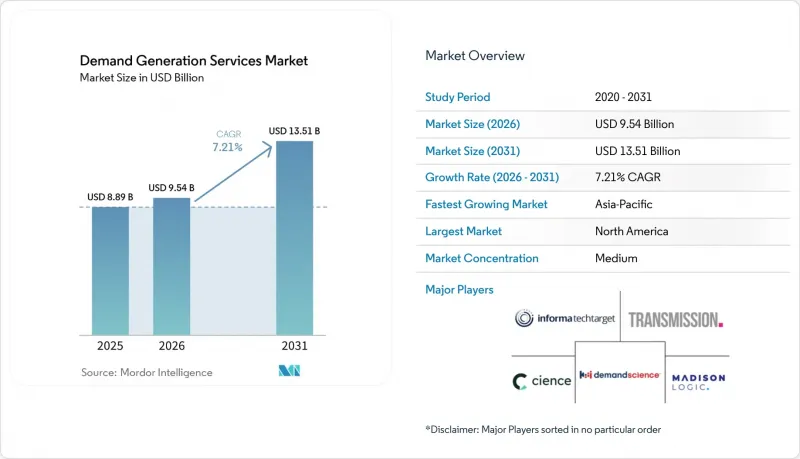
本報告按服務類型(內容行銷、搜尋引擎最佳化和搜尋引擎行銷、社群媒體行銷、電子郵件行銷和行銷自動化、付費廣告和效果行銷等)、組織規模(大型企業和中小企業)、最終用戶產業(零售和電子商務、銀行、金融服務和保險等)以及地區進行細分。市場預測以美元計價。
全球需求生成服務市場趨勢與洞察
推出人工智慧驅動的個人化和預測性案源計分。
人工智慧驅動的個人化正成為需求生成服務供應商的核心產品。 2026年,案源計分工具將結合行為、企業形象、技術特徵和購買意願訊號,辨識出購買可能性高的客戶。這將使團隊能夠將推廣放在那些在關鍵商業性採購期內表現出積極購買行為的客戶身上。許多企業仍需要基礎內容產生以外的實施支持,這正推動著需求產生服務市場的發展。根據Pedowitz Group的一份報告,到2025年,28%的B2B企業將全面利用人工智慧,而不僅限於基礎內容產生。將評分與CRM操作結合的服務提供者可以更好地展現行銷活動、銷售跟進、銷售管道進度和商業性成果之間的關聯性。
從MQL追蹤轉向對銷售管道和收入的課責
行銷合格線索 (MQL) 作為衡量需求產生績效的關鍵指標,效用正在下降。客戶越來越要求提供證據,證明宣傳活動能夠創造商機、影響交易進程並提升轉換收入。根據 Pedowitz Group 的一項調查,到 2025 年,74% 的 B2B 企業將把銷售管道或收入作為關鍵指標,但只有 18% 的企業能夠達到收入行銷成熟度。這一差距為能夠建立全通路歸因和報告,並與銷售團隊進行有效協作的服務提供者帶來了商機。需求生成服務市場正在轉向以衡量線索品質、銷售管道貢獻、交易進度和續約價值為指標的合約。隨著客戶將預算重新分配到可衡量的商業性成果上,那些僅報告註冊量或表單填寫量的代理商將面臨更大的挑戰。
資料隱私、同意和無 Cookie 定向限制
隱私法規和 Cookie 限制正在縮小跨境定向可用的資料範圍。服務提供者必須調整宣傳活動,以符合 GDPR、CCPA 和亞太隱私框架下的同意要求。這使得客戶團隊在受眾群體建立、宣傳活動衡量、多點觸控歸因以及商業性價值驗證等方面面臨更多挑戰。由於客戶期望無論身處何地都能獲得符合隱私規定的執行,需求產生服務市場面臨更高的營運要求。儘管對第一方數據和基於同意的數據的投資不斷增加,但基於上下文的方法僅能部分支援專業的 B2B 定向。這種情況增加了合規成本,使那些擁有完善的資料管治流程、區域實施經驗和正式隱私管理實務的公司更具優勢。
細分市場分析
到2025年,內容行銷將佔據需求產生服務市場佔有率的23.67%。這一地位反映了其在教育買家以及為人工智慧驅動的搜尋和報價體驗提供素材方面所發揮的作用。根據內容行銷協會(CMI)預測,到2026年,內容行銷將佔B2B行銷總預算的26%。服務提供者正在調整其內容創作方式,以提昇在傳統搜尋引擎和搜尋引擎生成式搜尋中的可見度。隨著自然搜尋發現帶來長期回報,搜尋引擎最佳化(SEO)和搜尋引擎行銷(SEM)繼續支持穩定的流量。社群媒體行銷,尤其是LinkedIn上的活動,能夠推動針對特定帳號的精準投放,並提升與買家的互動。隨著客戶關係管理(CRM)觸發的序列化訊息取代了廣泛的外發訊息,電子郵件行銷和行銷自動化仍然至關重要。這些工具使團隊能夠更及時地回應互動訊號。在需求產生服務市場,對能夠滿足教育、發現、開發和銷售對話等需求的內容的需求日益成長。這種廣泛的應用使得內容行銷計劃成為許多整合交付計劃的核心。
預計到2031年,付費廣告和成效行銷將以7.68%的複合年成長率成長。這一成長反映了客戶對具有清晰歸因和商業性課責的服務模式的需求。基於效果的收費可以將服務費用與高品質的交易和銷售目標掛鉤。這使得服務供應商承擔了更多的執行風險,在財務審查日益嚴格的時期,這無疑是一個極具吸引力的選擇。隨著更多相關人員加入採購團隊,基於帳戶的展示廣告和內容傳送也變得越來越重要。這些管道增加了目標帳戶中可啟動的聯絡人數量。因此,在需求產生服務產業,可衡量的宣傳活動執行和跨付費管道的整合報告變得更加重要。服務提供者還需要在宣傳活動規模、精準的受眾選擇和課責的銷售追蹤之間取得平衡。在需求產生服務市場,能夠證明付費措施如何支援特定客戶和商機的服務提供者將更受青睞。這需要一種能夠整合媒體規劃、受眾管理和效果報告的服務模式。
區域分析
2025年,北美地區佔全球營收的34.68%。該地區擁有企業技術公司、基於帳戶的行銷(ABM)平台和專業代理商高度密集的優勢。 2026年4月,Demandbase發布了Demandbase AI,該平台包含工作流程整合和對話式測量功能。 2026年6月,ZoomInfo正式發布了其GTM.AI平台,該平台將檢驗的商業數據與人工智慧代理商連接起來。 Informa TechTarget也圍繞著「統一需求」重組其業務,該需求整合了品牌、內容、線索和意圖資料。
預計2026年至2031年,亞太地區將以7.89%的複合年成長率成長。印度是該地區成長的核心驅動力,因為企業負責人正在加大對數位化和人工智慧相關能力的投資。印度品牌股權基金會的一份報告顯示,印度的B2B電子商務產業預計將在不久的將來顯著擴張。中國企業軟體的日益普及以及東南亞數位廣告活動的活性化也推動了需求成長。印度、日本、韓國和中國的隱私法規提升了該地區資料管治專業知識的價值。
在歐洲,由於GDPR提倡隱私優先和第一方資料策略,因此一種獨特的商業環境正在形成。根據bvik的趨勢晴雨表調查,大多數受訪者認為短期內最佳化生成式人工智慧至關重要,許多受訪者將人工智慧驅動的個人化列為優先事項。報告指出人工智慧可節省成本的受訪者比例相對較低,顯示人工智慧的採用率仍有差異。在英國和法國,成熟的基於帳戶的行銷生態系統得以維持,而在西班牙和義大利,面向中型企業的服務基礎設施正在發展中。在南美、中東和非洲,由於數位化進程的推進和企業軟體使用量的增加,預計長期需求將持續成長。
其他好處:
- Excel格式的市場預測(ME)表
- 3個月的分析師支持
目錄
第1章:引言
- 研究假設和市場定義
- 調查範圍
第2章:調查方法
第3章執行摘要
第4章 市場狀況
- 市場概覽
- 市場促進因素
- 推出人工智慧驅動的個人化和預測性案源計分。
- 從 MQL 追蹤過渡到銷售管道和收入責任制。
- 增加對以客戶為基礎的行銷和採購集團協調的投入。
- 對全通路自動化和CRM整合執行的需求日益成長。
- 生成式引擎最佳化與人工智慧搜尋發現服務
- 暗漏斗情報和微事件啟動策略
- 市場限制因素
- 資料隱私、同意和無 Cookie 定向限制
- 獲客成本上升及付費媒體飽和
- CRM原生AI正在縮小獨立服務的差異化差距。
- 人工智慧內容供應過剩和消費者信任度下降
- 宏觀經濟因素對市場的影響
- 產業價值鏈分析
- 監理情勢
- 技術展望
- 波特五力分析
第5章 市場規模與成長預測
- 按服務類型
- 內容行銷
- 搜尋引擎最佳化 (SEO) 和搜尋引擎行銷 (SEM)
- 社群媒體行銷
- 電子郵件行銷和行銷自動化
- 付費廣告和成效行銷
- 其他服務類型
- 按組織規模
- 大公司
- 小型企業
- 按最終用戶行業分類
- 零售與電子商務
- 媒體與娛樂
- BFSI
- 資訊科技/通訊
- 旅遊與飯店
- 衛生保健
- 其他終端用戶產業
- 按地區
- 北美洲
- 美國
- 加拿大
- 墨西哥
- 南美洲
- 巴西
- 阿根廷
- 智利
- 其他南美國家
- 歐洲
- 德國
- 英國
- 法國
- 義大利
- 西班牙
- 其他歐洲國家
- 亞太地區
- 中國
- 日本
- 印度
- 韓國
- 澳洲
- 其他亞太國家
- 中東
- 阿拉伯聯合大公國
- 沙烏地阿拉伯
- 卡達
- 其他中東國家
- 非洲
- 南非
- 埃及
- 奈及利亞
- 其他非洲國家
- 北美洲
第6章 競爭情勢
- 市場集中度
- 策略趨勢
- 市佔率分析
- 公司簡介
- Informa TechTarget, Inc.
- Demand Science Group Inc.
- Madison Logic, Inc.
- CIENCE Technologies, Inc.
- Transmission Agency Ltd.
- The Marketing Practice
- Walker Sands Communications, LLC
- memoryBlue, LLC
- Ironpaper, Inc.
- Demandbase, Inc.
- 6sense Insights, Inc.
- ZoomInfo Technologies LLC
- Cognism Limited
- Belkins Inc.
- Martal Group Inc.
- Callbox Inc.
- Directive Consulting LLC
- Gripped Ltd.
第7章 市場機會與未來展望
According to Mordor Intelligence, the demand generation services market size is projected to be USD 8.89 billion in 2025, USD 9.54 billion in 2026, and reach USD 13.51 billion by 2031, growing at a CAGR of 7.21% from 2026 to 2031.
This report is Segmented by Service Type (Content Marketing, SEO and SEM, Social Media Marketing, Email Marketing and Marketing Automation, Paid Advertising and Performance Marketing, and More), Organization Size (Large Enterprises, and Small and Medium Enterprises), End-User Industry (Retail and E-Commerce, BFSI, and More), and Geography. The Market Forecasts are Provided in Terms of Value (USD).
Global Demand Generation Services Market Trends and Insights
AI-Powered Personalization and Predictive Lead Scoring Adoption
AI-powered personalization is becoming a core delivery capability for demand generation service providers. In 2026, lead-scoring tools combine behavioral, firmographic, technographic, and intent signals to identify accounts with greater purchase potential. This allows teams to focus outreach on accounts that show active buying behavior during commercially relevant purchase windows. The demand generation services market benefits from the fact that many organizations still need implementation support beyond basic content generation. The Pedowitz Group reported that 28% of B2B organizations were AI-fluent beyond basic content generation in 2025. Providers that connect scoring to CRM actions can demonstrate a closer link between marketing activity, sales follow-up, pipeline progress, and commercial outcomes.
Shift From MQL Tracking to Pipeline and Revenue Accountability
Marketing-qualified leads are becoming less useful as the primary measure of demand-generation performance. Clients increasingly want evidence that campaigns create opportunities, influence deal movement, and support closed revenue. The Pedowitz Group found that 74% of B2B organizations used pipeline or revenue as their main metric in 2025, although only 18% had reached revenue marketing maturity. This gap creates work for providers that can build full-funnel attribution, reporting, and practical coordination with sales teams. The demand generation services market is moving toward agreements that measure qualified opportunities, pipeline contribution, deal movement, and renewal value. Agencies that report only registrations or form fills are more exposed when clients reallocate budgets toward measurable commercial results.
Data Privacy, Consent, and Cookie-Less Targeting Limits
Privacy rules and cookie restrictions are narrowing the data available for cross-border targeting. Providers must adapt campaigns to comply with consent requirements under the GDPR, the CCPA, and Asia-Pacific privacy frameworks. This complicates audience building, campaign measurement, multi-touch attribution, and proof of commercial value across client teams. The demand generation services market faces higher operating requirements as clients expect privacy-compliant execution across regions. More investment is moving toward first-party and consent-based data, while contextual approaches provide only partial support for specialized B2B targeting. These conditions increase compliance costs and favor firms with established data governance processes, regional delivery experience, and formal privacy management practices.
Other drivers and restraints analyzed in the detailed report include:
- Rising Account-Based Marketing and Buying Group Orchestration Spend
- Growing Need for Omnichannel Automation and CRM-Connected Execution
- Rising Cost Per Lead and Paid Media Saturation
For complete list of drivers and restraints, kindly check the Table Of Contents.
Segment Analysis
Content marketing held 23.67% of the demand generation services market share in 2025. Its position reflects its role in educating buyers and supplying material for AI-powered search and citation experiences. Content Marketing Institute reported that content marketing received 26% of total B2B marketing budgets in 2026. Providers are adapting content production to support both conventional search and visibility in generative engines. SEO and SEM continue to support sustained volume, as organic discovery can deliver long-term returns. Social media marketing, especially LinkedIn activity, supports account-targeted distribution and buyer engagement. Email marketing and marketing automation remain important when CRM-triggered sequences replace broad outbound messages. These tools help teams respond to engagement signals with more timely communication. The demand generation services market increasingly requires content that can serve education, discovery, nurture, and sales conversations. This broad use makes content programs central to many integrated delivery plans.
Paid advertising and performance marketing are projected to expand at a 7.68% CAGR through 2031. This growth reflects client demand for service models with clear attribution and commercial accountability. Performance-linked billing can align service fees with qualified meetings or pipeline targets. This shifts more execution risk to the service provider, which is attractive during periods of stricter financial review. Account-based display and content syndication are also gaining relevance as buying groups include more stakeholders. These channels increase the number of contacts that can be activated within a target account. The demand generation services industry is therefore placing more emphasis on measurable campaign delivery across paid channels and integrated reporting. Providers also need to balance campaign scale with precise audience selection and accountable sales follow-up. The demand generation services market favors operators that can show how paid activity supports named accounts and revenue opportunities. This requires media planning, audience management, and performance reporting to operate as one service.
Complete Report Scope:
- By Service Type
- Content Marketing
- SEO and SEM
- Social Media Marketing
- Email Marketing and Marketing Automation
- Paid Advertising and Performance Marketing
- Other Service Types
- By Organization Size
- Large Enterprises
- Small and Medium Enterprises
- By End-User Industry
- Retail and E-commerce
- Media and Entertainment
- BFSI
- IT and Telecom
- Travel and Hospitality
- Healthcare
- Other End-User Industries
- By Geography
- North America
- United States
- Canada
- Mexico
- South America
- Brazil
- Argentina
- Chile
- Rest of South America
- Europe
- Germany
- United Kingdom
- France
- Italy
- Spain
- Rest of Europe
- Asia-Pacific
- China
- Japan
- India
- South Korea
- Australia
- Rest of Asia-Pacific
- Middle East
- United Arab Emirates
- Saudi Arabia
- Qatar
- Rest of Middle East
- Africa
- South Africa
- Egypt
- Nigeria
- Rest of Africa
- North America
Geography Analysis
North America held 34.68% of global revenue in 2025. The region benefits from a dense base of enterprise technology firms, account-based marketing platforms, and specialist agencies. Demandbase introduced Demandbase AI in April 2026, including workflow integration and conversational measurement features. ZoomInfo made its GTM.AI platform generally available in June 2026 to connect verified commercial data with AI agents. Informa TechTarget is also repositioning its business around unified demand, combining brand, content, leads, and intent data.
Asia-Pacific is projected to grow at a 7.89% CAGR from 2026 to 2031. India is a central source of regional momentum as enterprise buyers increase investment in digital and AI-related capabilities. The India Brand Equity Foundation reported that India's B2B e-commerce sector is projected to expand significantly in the near term. China's expanding enterprise software deployment and growing digital advertising activity in Southeast Asia also support demand. Privacy rules across India, Japan, South Korea, and China increase the value of regional data governance expertise.
Europe has a distinct operating environment because GDPR encourages privacy-first and first-party data strategies. The bvik Trendbarometer found that most respondents considered generative engine optimization essential in the near term, while many prioritized AI-driven personalization. A smaller share reported cost savings from AI, which indicates that adoption is still uneven. The United Kingdom and France retain established account-based marketing ecosystems, while Spain and Italy are developing mid-market service capacity. South America, the Middle East, and Africa offer longer-term demand as digital adoption and enterprise software use increase.
- Informa TechTarget, Inc.
- Demand Science Group Inc.
- Madison Logic, Inc.
- CIENCE Technologies, Inc.
- Transmission Agency Ltd.
- The Marketing Practice
- Walker Sands Communications, LLC
- memoryBlue, LLC
- Ironpaper, Inc.
- Demandbase, Inc.
- 6sense Insights, Inc.
- ZoomInfo Technologies LLC
- Cognism Limited
- Belkins Inc.
- Martal Group Inc.
- Callbox Inc.
- Directive Consulting LLC
- Gripped Ltd.
Additional Benefits:
- The market estimate (ME) sheet in Excel format
- 3 months of analyst support
TABLE OF CONTENTS
1 INTRODUCTION
- 1.1 Study Assumptions and Market Definition
- 1.2 Scope of the Study
2 RESEARCH METHODOLOGY
3 EXECUTIVE SUMMARY
4 MARKET LANDSCAPE
- 4.1 Market Overview
- 4.2 Market Drivers
- 4.2.1 AI-Powered Personalization and Predictive Lead Scoring Adoption
- 4.2.2 Shift From MQL Tracking to Pipeline and Revenue Accountability
- 4.2.3 Rising Account-Based Marketing and Buying Group Orchestration Spend
- 4.2.4 Growing Need for Omnichannel Automation and CRM-Connected Execution
- 4.2.5 Generative Engine Optimization and AI Search Discovery Services
- 4.2.6 Dark-Funnel Intelligence and Micro-Event Activation Strategies
- 4.3 Market Restraints
- 4.3.1 Data Privacy, Consent, and Cookie-Less Targeting Limits
- 4.3.2 Rising Cost Per Lead and Paid Media Saturation
- 4.3.3 CRM-Native AI Compressing Standalone Service Differentiation
- 4.3.4 AI Content Glut and Buyer Trust Erosion
- 4.4 Impact of Macroeconomic Factors on the Market
- 4.5 Industry Value Chain Analysis
- 4.6 Regulatory Landscape
- 4.7 Technological Outlook
- 4.8 Porter's Five Forces Analysis
- 4.8.1 Bargaining Power of Buyers
- 4.8.2 Bargaining Power of Suppliers
- 4.8.3 Threat of New Entrants
- 4.8.4 Threat of Substitutes
- 4.8.5 Intensity of Competitive Rivalry
5 MARKET SIZE AND GROWTH FORECASTS (VALUE)
- 5.1 By Service Type
- 5.1.1 Content Marketing
- 5.1.2 SEO and SEM
- 5.1.3 Social Media Marketing
- 5.1.4 Email Marketing and Marketing Automation
- 5.1.5 Paid Advertising and Performance Marketing
- 5.1.6 Other Service Types
- 5.2 By Organization Size
- 5.2.1 Large Enterprises
- 5.2.2 Small and Medium Enterprises
- 5.3 By End-User Industry
- 5.3.1 Retail and E-commerce
- 5.3.2 Media and Entertainment
- 5.3.3 BFSI
- 5.3.4 IT and Telecom
- 5.3.5 Travel and Hospitality
- 5.3.6 Healthcare
- 5.3.7 Other End-User Industries
- 5.4 By Geography
- 5.4.1 North America
- 5.4.1.1 United States
- 5.4.1.2 Canada
- 5.4.1.3 Mexico
- 5.4.2 South America
- 5.4.2.1 Brazil
- 5.4.2.2 Argentina
- 5.4.2.3 Chile
- 5.4.2.4 Rest of South America
- 5.4.3 Europe
- 5.4.3.1 Germany
- 5.4.3.2 United Kingdom
- 5.4.3.3 France
- 5.4.3.4 Italy
- 5.4.3.5 Spain
- 5.4.3.6 Rest of Europe
- 5.4.4 Asia-Pacific
- 5.4.4.1 China
- 5.4.4.2 Japan
- 5.4.4.3 India
- 5.4.4.4 South Korea
- 5.4.4.5 Australia
- 5.4.4.6 Rest of Asia-Pacific
- 5.4.5 Middle East
- 5.4.5.1 United Arab Emirates
- 5.4.5.2 Saudi Arabia
- 5.4.5.3 Qatar
- 5.4.5.4 Rest of Middle East
- 5.4.6 Africa
- 5.4.6.1 South Africa
- 5.4.6.2 Egypt
- 5.4.6.3 Nigeria
- 5.4.6.4 Rest of Africa
- 5.4.1 North America
6 COMPETITIVE LANDSCAPE
- 6.1 Market Concentration
- 6.2 Strategic Moves
- 6.3 Market Share Analysis
- 6.4 Company Profiles (includes Global Level Overview, Market Level Overview, Core Segments, Financials as available, Strategic Information, Market Rank/Share, Products and Services, Recent Developments)
- 6.4.1 Informa TechTarget, Inc.
- 6.4.2 Demand Science Group Inc.
- 6.4.3 Madison Logic, Inc.
- 6.4.4 CIENCE Technologies, Inc.
- 6.4.5 Transmission Agency Ltd.
- 6.4.6 The Marketing Practice
- 6.4.7 Walker Sands Communications, LLC
- 6.4.8 memoryBlue, LLC
- 6.4.9 Ironpaper, Inc.
- 6.4.10 Demandbase, Inc.
- 6.4.11 6sense Insights, Inc.
- 6.4.12 ZoomInfo Technologies LLC
- 6.4.13 Cognism Limited
- 6.4.14 Belkins Inc.
- 6.4.15 Martal Group Inc.
- 6.4.16 Callbox Inc.
- 6.4.17 Directive Consulting LLC
- 6.4.18 Gripped Ltd.
7 MARKET OPPORTUNITIES AND FUTURE OUTLOOK
- 7.1 White-Space and Unmet-Need Assessment

 數位行銷服務市場:按服務類型、公司規模、最終用戶和地區分類
 落地頁最佳化服務:市場佔有率分析、產業趨勢與統計、成長預測(2026-2031)醫療保健行銷服務:市場佔有率分析、行業趨勢和統計數據、成長預測(2026-2031 年)身臨其境型行銷服務:市場佔有率分析、產業趨勢與統計、成長預測(2026-2031)貿易行銷服務:市場佔有率分析、產業趨勢與統計、成長預測(2026-2031)
 需求產生軟體市場:2026-2032年全球市場預測(依產品類型、定價模式、產業、部署模式及組織規模分類)數位行銷:市場佔有率分析、產業趨勢與統計、成長預測(2026-2031)數位公關服務:市場佔有率分析、產業趨勢與統計、成長預測(2026-2031)
 電子郵件送達率工具市場規模、佔有率和成長分析:按解決方案類型、部署方式、組織規模、最終用戶產業和地區分類-2026-2033 年產業預測
 2026-2030年全球交付和行銷電子郵件市場