


 |
市場調查報告書
商品編碼
2098516
數位公關服務:市場佔有率分析、產業趨勢與統計、成長預測(2026-2031)Digital PR Services - Market Share Analysis, Industry Trends & Statistics, Growth Forecasts (2026 - 2031) |
||||||

※ 本網頁內容可能與最新版本有所差異。詳細情況請與我們聯繫。
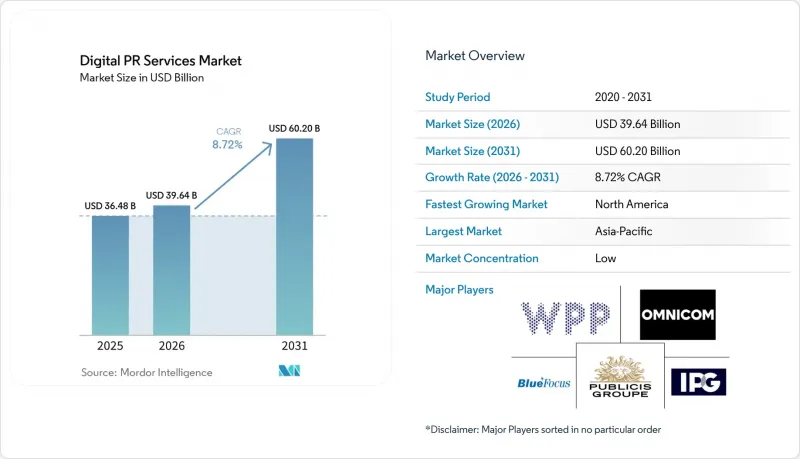
根據 Mordor Intelligence 預測,數位公關服務市場規模預計將在 2025 年達到 364.8 億美元,2026 年達到 396.4 億美元,2031 年達到 602 億美元,2026 年至 2031 年的複合年成長率為 8.72%。
本報告按服務類型(包括媒體互動和線上新聞報告、搜尋主導公關和權威性建設等)、客戶公司規模(大型企業、中小企業)、終端用戶行業(零售和電子商務、IT和電信、銀行、金融服務和保險等)以及地區進行細分。市場預測以美元計價。
全球數位公關服務市場趨勢與洞察
對線上聲譽管理的需求日益成長
線上聲譽管理已從一項可有可無的支出轉變為整個數位公關服務市場的核心營運必需品。美國聯邦貿易委員會 (FTC) 2024 年的《反虛假評論規則》將評論真實性列為合規要求,凸顯了在各個數位管道進行經核實的檢驗、記錄和補救流程的必要性。這項轉變意義重大,因為負面評論如今不僅影響品牌信譽,還會影響品牌在電商和搜尋平台上的曝光度。因此,數位公關服務市場對持續監控、快速回應流程以及清晰、可審查的審計追蹤的需求日益成長。對於以數位優先的品牌而言,這種壓力尤其顯著,因為突發的聲譽問題可能會同時影響流量、轉換率和品牌曝光。隨著品牌互動轉向社群電商和平台主導的購買流程,數位公關服務市場將繼續受益於日益增加的、需要持續監控的聲譽敏感觸點。
將公關預算轉移到數位和社交管道
預算分配持續向數位化管道轉移,推動了數位公關服務市場的發展。根據“IPRN 2026年公關業務調查”,67%的公關公司高管預計2026年業務將實現成長,而28%的受訪者表示,人工智慧整合和客戶預算壓力是他們最大的擔憂。這一趨勢表明,客戶並非在所有媒體管道上都削減預算,而是優先考慮並維持能夠同時提升品牌知名度、互動度和聲譽的數位傳播活動。 WPP Media將於2025年推出,這反映了向人工智慧驅動的整合媒體營運的更廣泛轉變,與主要客戶目前對傳播和績效職能協同運作的期望高度契合。在數位公關服務市場,這一趨勢進一步迫使公關公司超越傳統的提案數量,提供更強大的內容營運、更有效率的工作流程和更精準的目標定位。此外,隨著越來越多的預算流向相同的數位管道,郵件收件匣中的競爭也日益激烈,這提升了公關公司關係和編輯相關性的價值。
媒體宣傳、社群媒體和搜尋結果的投資報酬率衡量指標分散。
對於數位公關服務市場而言,效果衡量仍然是一個結構性挑戰,因為媒體曝光、社群媒體表現和搜尋影響力等數據仍然分散在不同的報告系統中。這使得代理商和客戶難以將媒體報告與銷售管道、轉換率或客戶維繫等指標關聯起來,從而滿足財務團隊對「完整」的定義。此外,人工智慧產生的回饋創造了一個新的視覺領域,而大多數報告系統尚未能充分衡量這些領域,這為數位公關服務市場帶來了新的複雜性。陽獅集團透過在2025年和2026年對關鍵平台進行大規模投資,加強了對預測性衡量和數據整合的關注,顯示了各大集團對此問題的重視程度。然而,數位公關服務市場仍然缺乏一個通用標準,將聲譽、媒體曝光、互動和人工智慧驅動的影響力轉化為一個廣為接受的單一投資報酬率模型。在這一差距彌合之前,即使媒體曝光策略能夠提供更強的長期價值,一些客戶仍會繼續偏愛那些能夠清晰體現最終點擊歸因的管道。
細分市場分析
到2025年,媒體推廣和線上報道將佔數位公關服務市場的23.19%,成為最大的服務細分領域。這一市場地位反映了在權威報導上發表文章的價值仍然存在,尤其是在品牌需要第三方檢驗而非自我宣傳的情況下。預計從2026年到2031年,衡量、分析和情感智慧的複合年成長率將達到13.28%,成為數位公關服務市場中成長最快的細分領域。這表明,行業關注點正在從單純地報告結果轉向展示宣傳活動、管道和相關人員群體的影響力。因此,數位公關服務產業正在從簡單地匯總媒體曝光轉向將聲譽管理活動與需求訊號、人工智慧視覺化和即時敘事追蹤相結合。搜尋主導的數位公關和權威性建設也受益於這一轉變,因為客戶正在尋找能夠解釋報導不僅發表在何處,而且在搜尋和人工智慧環境下為何如此重要的代理商。
在數位公關服務市場,以影響者和內容創作者主導主導的公關宣傳活動正日益與思想領袖和經營團隊定位相融合。這種整合至關重要,因為品牌擴大利用值得信賴的個人以及企業管道,在網路討論和贏得媒體方面樹立權威。美國聯邦貿易委員會 (FTC) 修訂後的建議規則為這項工作增加了一層合規要求,提升了那些能夠兼顧流程規範和創新執行的代理商的價值。雖然社群媒體公關和互動規模化仍然是重要的營運環節,但平台差異如今決定了代理商如何分配資源和衡量結果。事實上,數位公關服務市場更重視那些能夠將推廣、內容創作者專案、危機應變和資料分析整合到單一服務架構中的公司,而不是將這些服務分割出售。
區域分析
到2025年,北美將佔據數位公關服務市場38.32%的佔有率,成為最大的區域市場。該地區受益於強大的代理商基礎設施、成熟的企業需求以及比大多數其他市場更快的地理資訊系統(GEO)相關服務商業化進程。根據IPRN的研究,到2026年,15%的代理機構將已從GEO服務中獲得收入,而41%的代理機構仍將累積洞察或開展試點計畫。這證實了北美在人工智慧視覺化服務商業化方面的領先地位。美國仍然是這一轉變的核心,它將大型企業龐大的公關預算與先進的分析、軟體和平台合作夥伴關係生態系統相結合。加拿大和墨西哥則增添了各自獨特的優勢,例如加拿大的雙語溝通需求和墨西哥不斷擴展的戰略樞紐活動。
歐洲在數位公關服務市場中仍然佔據著舉足輕重的地位,這得益於代理商深厚的專業知識、跨境品牌活動以及對數位合規性的壓力所驅動的持續需求。該地區的法規環境更加重視透明度、管治和平台責任,從而提升了專注於聲譽、資訊揭露和資料處理的公關工作的諮詢價值。這一趨勢有利於那些能夠將傳播執行與法律知識和完善的流程管理相結合的代理機構。此外,歐洲之所以重要,還在於其擁有遍及多個主要經濟區的成熟需求,而非僅依賴單一國家。
預計亞太地區在2026年至2031年間將以9.81%的複合年成長率成長,成為數位公關服務市場成長最快的地區。這一成長主要得益於行動優先的商務模式、平台多樣性以及在高度多元化的媒體系統中對多語言聲譽管理的需求。在日本,《2025年公關公司報告》將網紅行銷和影片製作列為公關公司需求成長最快的兩大類別,顯示數位形式正迅速成為傳播規劃的核心。中國、印度和韓國也是重要的市場,因為這些市場需要深入了解當地平台,而不是單純地應用西方的公關方法。這進一步凸顯了深入在地化執行的重要性,因為區域分散反而成為需求的來源,而非障礙。
其他好處:
- Excel格式的市場預測(ME)表
- 3個月的分析師支持
目錄
第1章:引言
- 研究假設和市場定義
- 調查範圍
第2章:調查方法
第3章執行摘要
第4章 市場狀況
- 市場概覽
- 宏觀經濟因素對市場的影響
- 市場促進因素
- 對線上聲譽管理的需求日益成長
- 將公關預算轉移到數位和社交管道
- 受網紅和內容創作者主導,媒體宣傳支出增加
- 需要可衡量的公關分析和歸因
- 公關預算將包括在人工智慧搜尋引擎上的曝光。
- Reddit 和社群主導的發現機制正在為媒體宣傳策劃帶來新的形式。
- 市場限制因素
- 自然搜尋結果、社群媒體搜尋結果和搜尋結果中投資報酬率衡量標準的分散性。
- 資料隱私和影響者資訊揭露方面的合規負擔
- 谷歌關於濫用網站聲譽的規則正在削弱傳統的「反向連結優先」策略的有效性。
- 人工智慧產生的虛假資訊和深度造假的威脅正在推高檢驗成本。
- 產業價值鏈分析
- 監理情勢
- 技術展望
- 波特五力分析
第5章 市場規模與成長預測
- 按服務類型
- 積極利用媒體宣傳和網路報道
- 搜尋主導的數位公關和權威建設
- 思想領導內容與經營團隊定位
- 以影響者和內容創作者主導主導的公關宣傳活動
- 線上聲譽管理和品牌監測
- 危機溝通與聲譽復原
- 拓展社群媒體公關與互動
- 測量、分析和情感智慧
- 按客戶公司規模分類
- 大公司
- 小型企業
- 按最終用戶行業分類
- 零售與電子商務
- 資訊科技/通訊
- BFSI
- 醫療保健和生命科學
- 媒體與娛樂
- 旅遊與飯店
- 製造業和工業部門
- 其他終端用戶產業
- 按地區
- 北美洲
- 美國
- 加拿大
- 墨西哥
- 南美洲
- 巴西
- 阿根廷
- 智利
- 其他南美國家
- 歐洲
- 德國
- 英國
- 法國
- 義大利
- 西班牙
- 其他歐洲國家
- 亞太地區
- 中國
- 日本
- 印度
- 韓國
- 澳洲
- 其他亞太國家
- 中東
- 阿拉伯聯合大公國
- 沙烏地阿拉伯
- 卡達
- 其他中東國家
- 非洲
- 南非
- 埃及
- 奈及利亞
- 其他非洲國家
- 北美洲
第6章 競爭情勢
- 市場集中度
- 策略趨勢
- 市佔率分析
- 公司簡介
- Omnicom Group Inc.
- WPP plc
- Publicis Groupe SA
- The Interpublic Group of Companies, Inc.
- BlueFocus Intelligent Communications Group Co., Ltd.
- DJE Holdings, LLC
- APCO Worldwide LLC
- FINN Partners, Inc.
- Ruder Finn, Inc.
- TEAM LEWIS Ltd.
- Real Chemistry, Inc.
- Brunswick Group LLP
- FTI Consulting, Inc.
- WE Communications, LLC
- Hotwire Global Communications Ltd.
- MikeWorldWide, Inc.
- 5W Public Relations, LLC
- G&S Business Communications, Inc.
- Brafton, LLC
- The Hoffman Agency, Inc.
第7章 市場機會與未來展望
According to Mordor Intelligence, the digital PR services market size is projected to be USD 36.48 billion in 2025, USD 39.64 billion in 2026, and reach USD 60.20 billion by 2031, growing at a CAGR of 8.72% from 2026 to 2031.
This report is Segmented by Service Type (Earned Media Outreach and Online Press Coverage, Search-Led Digital PR and Authority Building, and More), Client Organization Size (Large Enterprises, and Small and Medium Enterprises), End-User Industry (Retail and E-Commerce, IT and Telecommunications, BFSI, and More), and Geography. The Market Forecasts are Provided in Terms of Value (USD).
Global Digital PR Services Market Trends and Insights
Rising Demand for Online Reputation Management
Online reputation management has moved from a discretionary line item to a core operating need across the digital PR services market. The FTC's 2024 anti-fake-review rule made review authenticity a compliance issue, underscoring the need for verified monitoring, documentation, and remediation processes across digital channels. That change matters because negative review events now affect not only brand trust but also discoverability on commerce and search platforms. The digital PR services market is therefore seeing stronger demand for always-on monitoring, faster response workflows, and cleaner audit trails that can withstand scrutiny. This pressure is even higher for digital-first brands, where a sudden reputational issue can simultaneously affect traffic, conversions, and visibility. As more brand interaction shifts to social commerce and platform-led buying journeys, the digital PR services market continues to benefit from the expansion of reputation-sensitive surfaces that require constant oversight.
Shift of PR Budgets to Digital and Social Channels
Budget allocation has continued to shift toward digital channels, supporting the digital PR services market. In the IPRN PR Business Survey 2026, 67% of PR agency principals expected business growth in 2026, while AI integration and client budget pressure were cited together as the leading concern by 28% of respondents. That pattern shows that clients are not pulling back evenly across media channels, but are instead protecting digital communications work that can support visibility, engagement, and reputation at once. The launch of WPP Media in 2025 also reflected this broader shift toward AI-powered, integrated media execution, which closely aligns with how large clients now expect communications and performance functions to work together. In the digital PR services market, this creates greater pressure on agencies to deliver stronger content operations, faster workflow speeds, and more precise targeting, rather than relying on legacy pitch volume. It also raises the value of agency relationships and editorial relevance, because inbox competition rises as more budgets move into the same digital channels.
ROI Measurement Fragmentation Across Earned, Social, and Search Outcomes
Measurement remains a structural challenge for the digital PR services market because earned outcomes, social performance, and search effects still sit in separate reporting systems. This makes it harder for agencies and clients to connect editorial placement with pipeline, conversion, or retention in a way that finance teams consider complete. The digital PR services market is also dealing with a new layer of complexity, as AI-generated answers create another visibility surface that most reporting stacks do not yet measure well. Publicis reinforced its focus on predictive measurement and connected data through major platform investments in 2025 and 2026, demonstrating how seriously large groups are taking this problem. Even so, the digital PR services market still lacks a universal standard that converts reputation, coverage, engagement, and AI presence into one accepted ROI model. Until that gap narrows, some clients will continue to favor channels with cleaner last-click attribution, even when earned strategies offer stronger long-term value.
Other drivers and restraints analyzed in the detailed report include:
- Growing Influencer and Creator-Led Earned Media Spend
- AI Search and Answer Engine Visibility Becoming a PR Budget Line
- Data Privacy and Influencer Disclosure Compliance Burden
For complete list of drivers and restraints, kindly check the Table Of Contents.
Segment Analysis
Earned Media Outreach and Online Press Coverage accounted for 23.19% of the digital PR services market in 2025, making it the largest service block. That position reflects the continued value of credible editorial placement, especially when brands need third-party validation rather than self-published claims. Measurement, Analytics, and Sentiment Intelligence is projected to grow at a 13.28% CAGR from 2026 to 2031, making it the fastest-growing service area in the digital PR services market. This shows a shift away from output-only reporting and toward proof of impact across campaigns, channels, and stakeholder groups. The digital PR services industry is therefore moving from counting placements to linking reputation work with demand signals, AI visibility, and real-time narrative tracking. Search-led digital PR and authority building are benefiting from the same change, because clients want agencies that can explain not only where a story landed but also why it mattered in search and AI environments.
Influencer and Creator-Led PR Campaigns are becoming increasingly integrated with thought leadership and executive positioning in the digital PR services market. That convergence matters because brands increasingly use trusted individuals, not only corporate channels, to carry authority into online discussions and earned media formats. The FTC's updated endorsement rules add a stronger compliance layer to this work, increasing the value of agencies that can manage process discipline alongside creative execution. Social Media PR and Engagement Amplification remains an important operating layer, but platform differences now shape how agencies allocate effort and measure outcomes. In practice, the digital public relations (PR) services market rewards firms that can integrate outreach, creator programs, crisis readiness, and analytics into a single service architecture rather than selling them as isolated tasks.
Complete Report Scope:
- By Service Type
- Earned Media Outreach and Online Press Coverage
- Search-Led Digital PR and Authority Building
- Thought Leadership Content and Executive Positioning
- Influencer and Creator-Led PR Campaigns
- Online Reputation Management and Brand Monitoring
- Crisis Communication and Reputation Repair
- Social Media PR and Engagement Amplification
- Measurement, Analytics, and Sentiment Intelligence
- By Client Organization Size
- Large Enterprises
- Small and Medium Enterprises
- By End-User Industry
- Retail and E-commerce
- IT and Telecommunications
- BFSI
- Healthcare and Life Sciences
- Media and Entertainment
- Travel and Hospitality
- Manufacturing and Industrials
- Other End-User Industries
- By Geography
- North America
- United States
- Canada
- Mexico
- South America
- Brazil
- Argentina
- Chile
- Rest of South America
- Europe
- Germany
- United Kingdom
- France
- Italy
- Spain
- Rest of Europe
- Asia-Pacific
- China
- Japan
- India
- South Korea
- Australia
- Rest of Asia-Pacific
- Middle East
- United Arab Emirates
- Saudi Arabia
- Qatar
- Rest of Middle East
- Africa
- South Africa
- Egypt
- Nigeria
- Rest of Africa
- North America
Geography Analysis
North America held 38.32% of the digital PR services market share in 2025, making it the largest regional bloc. The region benefits from dense agency infrastructure, mature enterprise demand, and faster commercialization of GEO-related services than most other markets. The IPRN survey showed that 15% of agencies were already generating revenue from GEO in 2026, while 41% were still building knowledge and testing, which supports North America's lead in monetizing AI visibility services. The United States remains the center of that shift because it combines large enterprise communications budgets with an advanced ecosystem of analytics, software, and platform partnerships. Canada and Mexico add different strengths to the regional mix, with bilingual communications requirements in Canada and expanding strategic hub activity in Mexico.
Europe remains a large and important part of the digital public relations (PR) services market because agency depth, cross-border brand activity, and digital compliance pressures support sustained demand. The region's regulatory environment places greater emphasis on transparency, governance, and platform responsibility, thereby enhancing the advisory value of PR work focused on reputation, disclosures, and data handling. This tends to favor agencies that can combine communications execution with legal awareness and documented process controls. Europe also matters because it offers mature demand across multiple major economies, rather than relying on a single national center.
Asia-Pacific is projected to grow at a 9.81% CAGR from 2026 to 2031, which makes it the fastest-growing region in the digital PR services market. The region's growth is supported by mobile-first commerce, platform diversity, and the need for multilingual reputation management across very different media systems. In Japan, influencer-driven communications and video production ranked as the top 2 demand-growth categories among PR firms in the PR Companies Report 2025, which shows how quickly digital formats have moved into core communications planning. China, India, and South Korea are also important because each market requires local platform fluency rather than a simple adaptation of Western PR playbooks. That increases the value of local execution depth and makes regional fragmentation a source of demand rather than a barrier.
- Omnicom Group Inc.
- WPP plc
- Publicis Groupe S.A.
- The Interpublic Group of Companies, Inc.
- BlueFocus Intelligent Communications Group Co., Ltd.
- DJE Holdings, LLC
- APCO Worldwide LLC
- FINN Partners, Inc.
- Ruder Finn, Inc.
- TEAM LEWIS Ltd.
- Real Chemistry, Inc.
- Brunswick Group LLP
- FTI Consulting, Inc.
- WE Communications, LLC
- Hotwire Global Communications Ltd.
- MikeWorldWide, Inc.
- 5W Public Relations, LLC
- G&S Business Communications, Inc.
- Brafton, LLC
- The Hoffman Agency, Inc.
Additional Benefits:
- The market estimate (ME) sheet in Excel format
- 3 months of analyst support
TABLE OF CONTENTS
1 INTRODUCTION
- 1.1 Study Assumptions and Market Definition
- 1.2 Scope of the Study
2 RESEARCH METHODOLOGY
3 EXECUTIVE SUMMARY
4 MARKET LANDSCAPE
- 4.1 Market Overview
- 4.2 Impact of Macroeconomic Factors on the Market
- 4.3 Market Drivers
- 4.3.1 Rising Demand for Online Reputation Management
- 4.3.2 Shift of PR Budgets to Digital and Social Channels
- 4.3.3 Growing Influencer and Creator-Led Earned Media Spend
- 4.3.4 Need for Measurable PR Analytics and Attribution
- 4.3.5 AI Search and Answer Engine Visibility Becoming a PR Budget Line
- 4.3.6 Reddit and Community-Led Discovery Reshaping Earned Media Planning
- 4.4 Market Restraints
- 4.4.1 ROI Measurement Fragmentation Across Earned, Social, and Search Outcomes
- 4.4.2 Data Privacy and Influencer Disclosure Compliance Burden
- 4.4.3 Google Site Reputation Abuse Rules Weakening Legacy Backlink-First Tactics
- 4.4.4 AI-Generated Misinformation and Deepfake Crises Raising Verification Costs
- 4.5 Industry Value Chain Analysis
- 4.6 Regulatory Landscape
- 4.7 Technological Outlook
- 4.8 Porter's Five Forces Analysis
- 4.8.1 Threat of New Entrants
- 4.8.2 Bargaining Power of Buyers
- 4.8.3 Bargaining Power of Suppliers
- 4.8.4 Threat of Substitutes
- 4.8.5 Intensity of Competitive Rivalry
5 MARKET SIZE AND GROWTH FORECASTS (VALUE)
- 5.1 By Service Type
- 5.1.1 Earned Media Outreach and Online Press Coverage
- 5.1.2 Search-Led Digital PR and Authority Building
- 5.1.3 Thought Leadership Content and Executive Positioning
- 5.1.4 Influencer and Creator-Led PR Campaigns
- 5.1.5 Online Reputation Management and Brand Monitoring
- 5.1.6 Crisis Communication and Reputation Repair
- 5.1.7 Social Media PR and Engagement Amplification
- 5.1.8 Measurement, Analytics, and Sentiment Intelligence
- 5.2 By Client Organization Size
- 5.2.1 Large Enterprises
- 5.2.2 Small and Medium Enterprises
- 5.3 By End-User Industry
- 5.3.1 Retail and E-commerce
- 5.3.2 IT and Telecommunications
- 5.3.3 BFSI
- 5.3.4 Healthcare and Life Sciences
- 5.3.5 Media and Entertainment
- 5.3.6 Travel and Hospitality
- 5.3.7 Manufacturing and Industrials
- 5.3.8 Other End-User Industries
- 5.4 By Geography
- 5.4.1 North America
- 5.4.1.1 United States
- 5.4.1.2 Canada
- 5.4.1.3 Mexico
- 5.4.2 South America
- 5.4.2.1 Brazil
- 5.4.2.2 Argentina
- 5.4.2.3 Chile
- 5.4.2.4 Rest of South America
- 5.4.3 Europe
- 5.4.3.1 Germany
- 5.4.3.2 United Kingdom
- 5.4.3.3 France
- 5.4.3.4 Italy
- 5.4.3.5 Spain
- 5.4.3.6 Rest of Europe
- 5.4.4 Asia-Pacific
- 5.4.4.1 China
- 5.4.4.2 Japan
- 5.4.4.3 India
- 5.4.4.4 South Korea
- 5.4.4.5 Australia
- 5.4.4.6 Rest of Asia-Pacific
- 5.4.5 Middle East
- 5.4.5.1 United Arab Emirates
- 5.4.5.2 Saudi Arabia
- 5.4.5.3 Qatar
- 5.4.5.4 Rest of Middle East
- 5.4.6 Africa
- 5.4.6.1 South Africa
- 5.4.6.2 Egypt
- 5.4.6.3 Nigeria
- 5.4.6.4 Rest of Africa
- 5.4.1 North America
6 COMPETITIVE LANDSCAPE
- 6.1 Market Concentration
- 6.2 Strategic Moves
- 6.3 Market Share Analysis
- 6.4 Company Profiles (includes Global Level Overview, Market Level Overview, Core Segments, Financials as available, Strategic Information, Market Rank/Share, Products and Services, Recent Developments)
- 6.4.1 Omnicom Group Inc.
- 6.4.2 WPP plc
- 6.4.3 Publicis Groupe S.A.
- 6.4.4 The Interpublic Group of Companies, Inc.
- 6.4.5 BlueFocus Intelligent Communications Group Co., Ltd.
- 6.4.6 DJE Holdings, LLC
- 6.4.7 APCO Worldwide LLC
- 6.4.8 FINN Partners, Inc.
- 6.4.9 Ruder Finn, Inc.
- 6.4.10 TEAM LEWIS Ltd.
- 6.4.11 Real Chemistry, Inc.
- 6.4.12 Brunswick Group LLP
- 6.4.13 FTI Consulting, Inc.
- 6.4.14 WE Communications, LLC
- 6.4.15 Hotwire Global Communications Ltd.
- 6.4.16 MikeWorldWide, Inc.
- 6.4.17 5W Public Relations, LLC
- 6.4.18 G&S Business Communications, Inc.
- 6.4.19 Brafton, LLC
- 6.4.20 The Hoffman Agency, Inc.
7 MARKET OPPORTUNITIES AND FUTURE OUTLOOK
- 7.1 White-Space and Unmet-Need Assessment

 數位行銷服務市場:按服務類型、公司規模、最終用戶和地區分類
 落地頁最佳化服務:市場佔有率分析、產業趨勢與統計、成長預測(2026-2031)需求創造服務:市場佔有率分析、產業趨勢與統計、成長預測(2026-2031 年)醫療保健行銷服務:市場佔有率分析、行業趨勢和統計數據、成長預測(2026-2031 年)身臨其境型行銷服務:市場佔有率分析、產業趨勢與統計、成長預測(2026-2031)貿易行銷服務:市場佔有率分析、產業趨勢與統計、成長預測(2026-2031)
 需求產生軟體市場:2026-2032年全球市場預測(依產品類型、定價模式、產業、部署模式及組織規模分類)數位行銷:市場佔有率分析、產業趨勢與統計、成長預測(2026-2031)
 電子郵件送達率工具市場規模、佔有率和成長分析:按解決方案類型、部署方式、組織規模、最終用戶產業和地區分類-2026-2033 年產業預測
 2026-2030年全球交付和行銷電子郵件市場