


 |
市場調查報告書
商品編碼
2119210
醫療保健行銷服務:市場佔有率分析、行業趨勢和統計數據、成長預測(2026-2031 年)Healthcare Marketing Services - Market Share Analysis, Industry Trends & Statistics, Growth Forecasts (2026 - 2031) |
||||||

※ 本網頁內容可能與最新版本有所差異。詳細情況請與我們聯繫。
根據 Mordor Intelligence 預測,醫療保健行銷服務市場規模將從 2025 年的 537.3 億美元成長到 2026 年的 568.2 億美元,到 2031 年將達到 798.1 億美元,2026 年至 2031 年的年複合成長率(CAGR)。
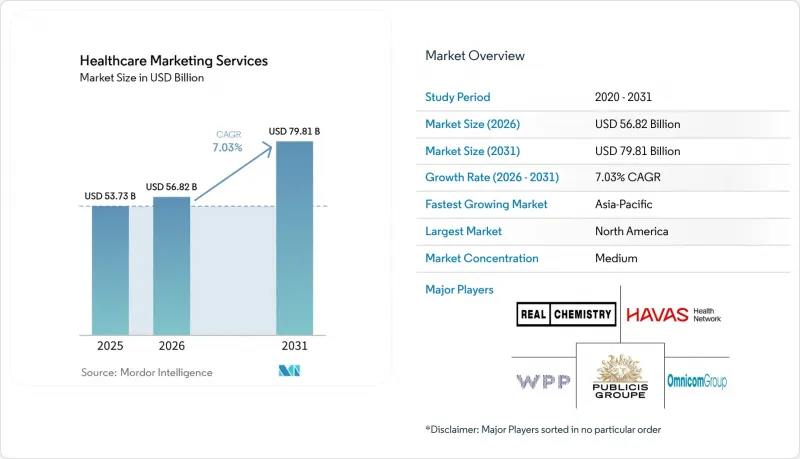
本報告按服務類型(數位行銷服務、品牌策略和創新服務、聲譽管理、公共關係和宣傳服務等)、最終用戶(醫療服務提供者和醫療系統、製藥和生物技術公司、醫療設備和診斷設備公司等)以及地區進行細分。市場預測以美元計價。
醫療保健行銷服務市場的趨勢和洞察
患者主導、自主獲取資訊的方式在搜尋、社群媒體和人工智慧領域日益普及。
醫療保健行銷服務市場正在積極應對越來越多的患者在臨床介入之前就開始的就醫歷程。根據凱撒家庭基金會 (KFF) 的報告,到 2026 年,29% 的美國成年人每月將使用人工智慧聊天機器人獲取健康建議,高於 2024 年年中的 17%。 KFF 也指出,搜尋引擎、社群媒體和人工智慧工具正在影響人們獲取健康資訊和建議的方式。皮尤研究中心的一項研究發現,用戶更重視人工智慧聊天機器人提供的健康資訊的“便利性”,而不是其“準確性”。這種差距凸顯了清晰的醫療服務提供者資訊、臨床資格以及在傳統臨床環境之外也能理解的最新解答的重要性。醫療機構需要加強其數位化服務,引導患者從初步檢查到適當的治療方案,同時避免誇大醫療效果。
「數位化入口網站」與線上預訂的加大投入
醫療機構正在投資建造患者就診系統,將外部溝通與預約完成連接起來。 2026年6月,Assort Health 籌集了1.2億美元,用於在整個患者諮詢流程中部署人工智慧代理。該公司表示,其平台部署後,預約量增加了5%,人員配置能力提高了115%。當預約流程簡單又快速時,醫療機構不僅可以根據網站流量,還可以根據實際預約量來評估宣傳活動的有效性。這種轉變正在拓展代理商的工作範圍,使其從宣傳推廣擴展到病患就診流程設計、客服中心協調和預約轉換率衡量。隨著醫院和醫療系統不斷改善患者就診管道,預計醫療行銷服務市場將持續成長。
關於追蹤像素和同意權的隱私訴訟
隱私執法部門正在限制曾經用於日常宣傳活動效果評估的追蹤工具的使用。美國衛生與公眾服務部指出,受監管的企業在使用線上追蹤技術時必須保護個人識別健康資訊。 2026年7月,聯邦貿易委員會以及猶他州和加州對Hims & Hers公司提起訴訟,指控其透過廣告像素共用敏感健康資訊。該訴訟表明,資料收集和廣告行為會帶來法律、財務和聲譽風險。行銷團隊需要替換或重新設計那些無法滿足隱私要求的衡量方法。在醫療保健行銷服務市場,那些能夠利用經用戶同意的數據、注重隱私的分析方法和適當的合約控制,同時又能維持有效衡量的公司備受青睞。
細分市場分析
到2025年,數位行銷服務將佔醫療保健行銷服務市場佔有率的37.20%,成為最大的服務類別。該細分市場包括搜尋行銷、程序化患者導向、付費社交媒體活動以及製藥公司和醫療保健提供者使用的其他數位管道。其規模反映了透過可觀察和調整效果的管道觸達患者和醫療保健專業人員 (HCP) 的需求。數位行銷活動仍然依賴可靠的內容、精準的定向以及符合法規的宣傳活動資訊收集。預計從2026年到2031年,分析、洞察和合規服務將以7.83%的複合年成長率成長,成為成長最快的服務類型。
在醫療保健行銷服務市場中,分析、洞察和合規服務的市場規模成長,主要源自於對衡量方法的重新思考,因為基於像素的歸因分析正面臨限制。各機構需要切實可行的方法,將媒體活動與病患諮詢、預約、醫護人員互動以及其他可接受的結果連結起來。這包括伺服器端分析、安全資料處理、知情同意記錄以及專為醫療保健客戶設計的報告。品牌策略和創新服務仍然至關重要,因為品牌訊息需要在所有場景下都有效,包括人工智慧產生的回應、傳統媒體和臨床環境。聲譽管理、公共關係和宣傳服務也變得越來越重要,因為醫療服務提供者資訊、病患回饋和臨床信譽會影響數位搜尋結果。
區域分析
2025年,北美佔據了醫療保健行銷服務市場46.80%的佔有率。該地區擁有蓬勃發展的藥品推廣市場、完善的醫療保健廣告基礎設施,並且率先採用了醫療保健專用人工智慧工具。此外,美國的監管執法力度已將保護隱私的資料管理實務作為選擇代理商的關鍵標準。美國聯邦貿易委員會(FTC)於2026年7月對Hims & Hers採取的行動凸顯了加強對廣告系統中敏感健康資訊使用情況持續監控的必要性。能夠滿足隱私、FDA法規和醫療數據要求的代理商比一般的數位行銷公司具有顯著優勢。
預計亞太地區在2026年至2031年間將以7.91%的複合年成長率成長,成為所有地區中成長最快的地區。這一成長反映了製藥業的擴張、對數位醫療的投資、行動優先的醫療保健使用習慣以及對病人參與工具日益成長的需求。印度的數位醫療計畫已為擴大醫療保健數位化進程建立了關鍵的基礎設施。中國的醫療平台正在支援人工智慧驅動的慢性病管理以及與製藥公司進行新型互動。在日本和韓國,需要採用特定市場的資料保護方法,這增加了國際公司的複雜性。因此,亞太地區醫療保健行銷服務市場的規模既受到商業性擴張的影響,也受到各地區數據法規差異的影響。
在歐洲,歐洲健康資料空間框架已經推出。該框架計劃於2025年生效,旨在為歐盟範圍內的健康數據存取和使用建立通用的方法。 2026年,法國修訂了其國家數位健康政策,以符合歐洲健康資料空間的要求以及人工智慧倫理中關於健康資料使用的相關規定。在南美洲,一個數位健康生態系統正在興起,其中巴西在該地區的健康科技活動中佔據了相當大的佔有率。中東和非洲的需求則主要受到沙烏地阿拉伯和阿拉伯聯合大公國私人醫院之間競爭以及製藥公司在非洲主要城市擴張的推動。
其他好處
- Excel格式的市場預測(ME)表
- 3個月的分析師支持
目錄
第1章:引言
- 研究假設和市場定義
- 調查範圍
第2章:調查方法
第3章執行摘要
第4章 市場狀況
- 市場概覽
- 市場促進因素
- 患者主導、自主獲取資訊的方式在搜尋、社群媒體和人工智慧領域日益普及。
- 增加對「數位化入口」和線上預訂系統的投資
- 全通路整合和個人化專案的擴展
- 透過口碑加強聲譽管理和患者選擇。
- 在生成引擎最佳化和人工智慧目錄可見性方面的支出
- 在某些受監管市場放鬆對遠端醫療廣告的管制
- 市場限制因素
- 關於追蹤像素和同意權的隱私訴訟
- 資料碎片化以及醫療、法律和監管方面的審查週期延遲。
- 由於零點擊搜尋的出現,傳統搜尋引擎最佳化(SEO)的經濟效益下降
- 平台身份驗證和內容策略變更
- 宏觀經濟因素對市場的影響
- 產業價值鏈分析
- 監理情勢
- 技術展望
- 波特五力分析
第5章 市場規模與成長預測
- 按服務類型
- 數位行銷服務
- 品牌策略與創新服務
- 聲譽管理、公共關係和宣傳服務
- 分析、洞察和合規服務
- 最終用戶
- 醫療保健提供者和醫療保健系統
- 製藥和生物技術公司
- 醫療設備及診斷設備公司
- 健康保險支付方/健康保險計劃
- 按地區
- 北美洲
- 美國
- 加拿大
- 墨西哥
- 南美洲
- 巴西
- 阿根廷
- 智利
- 其他南美國家
- 歐洲
- 德國
- 英國
- 法國
- 義大利
- 西班牙
- 荷蘭
- 俄羅斯
- 其他歐洲國家
- 亞太地區
- 中國
- 日本
- 印度
- 澳洲
- 韓國
- 新加坡
- 其他亞太國家
- 中東
- 沙烏地阿拉伯
- 阿拉伯聯合大公國
- 土耳其
- 以色列
- 其他中東國家
- 非洲
- 南非
- 埃及
- 奈及利亞
- 肯亞
- 其他非洲國家
- 北美洲
第6章 競爭情勢
- 市場集中度
- 策略趨勢
- 市佔率分析
- 公司簡介
- Omnicom Group Inc.
- Publicis Groupe SA
- WPP plc
- Havas Health & You
- Indegene Limited
- Real Chemistry, Inc.
- IQVIA Inc.
- Accenture plc
- Klick Inc.
- Avalere Health Topco Limited
- OPEN Health Communications LLP
- Merkle Inc.
- Syneos Health, Inc.
- Cognizant Technology Solutions Corporation
- EVERSANA, LLC
- GCI Health, LLC
- Experian plc
- PatientPoint, LLC
- CMI Media Group
第7章 市場機會與未來展望
According to Mordor Intelligence, the healthcare marketing services market size is projected to expand from USD 53.73 billion in 2025 to USD 56.82 billion in 2026, and to USD 79.81 billion by 2031, registering a CAGR of 7.03% between 2026 and 2031.
This report is Segmented by Service Type (Digital Marketing Services, Brand Strategy and Creative Services, Reputation, Public Relations, and Advocacy Services, and More), End-User (Healthcare Providers and Health Systems, Pharmaceutical and Biotechnology Companies, Medical Device and Diagnostics Companies, and More), and Geography. The Market Forecasts are Provided in Terms of Value (USD).
Insights and Trends of Healthcare Marketing Services
Rise of Patient Self-Navigation Across Search, Social, and AI
The healthcare marketing services market is responding to a patient journey that increasingly starts before a clinical interaction. KFF reported that 29% of US adults used AI chatbots monthly for health advice in 2026, compared with 17% in mid-2024. KFF also found that search engines, social media, and AI tools influence how people seek health information and advice. Pew Research Center found that users viewed health information from AI chatbots as convenient more often than accurate. This gap places greater weight on clear provider information, clinical credentials, and current answers that can be understood outside a traditional clinical setting. Healthcare organizations need their digital presence to guide patients from early research to appropriate care options without overstating medical claims.
Expansion of Digital Front Door and Online Scheduling Investment
Healthcare providers are investing in patient access systems that connect public-facing communications with appointment completion. Assort Health raised USD 120 million in June 2026 to expand AI-agent deployment across the patient journey. The company stated that its platform supported a 5% increase in appointment volume and a 115% increase in labor capacity for deployments. When scheduling is simple and responsive, provider campaigns can be evaluated by booked appointments rather than web traffic alone. This change broadens agency assignments from awareness work to journey design, contact-center coordination, and appointment conversion measurement. The healthcare marketing services market sees recurring demand as hospitals and health systems continue to improve patient access pathways.
Privacy Litigation Around Tracking Pixels and Consent
Privacy enforcement limits the use of tracking tools that once supported routine campaign measurement. The US Department of Health and Human Services has stated that regulated entities must protect individually identifiable health information when using online tracking technologies. In July 2026, the Federal Trade Commission and the states of Utah and California sued Hims and Hers over alleged sharing of sensitive health information through advertising pixels. The complaint shows how data collection and advertising practices can create legal, financial, and reputational exposure. Marketing teams must replace or redesign measurement practices that cannot meet privacy requirements. The healthcare marketing services market rewards firms that can use consented data, privacy-safe analytics, and appropriate contractual controls while retaining useful measurement.
Other drivers and restraints analyzed in the detailed report include:
- Growth of Omnichannel Commercialization and Personalization Programs
- Intensifying Reputation Management and Review-Driven Patient Choice
- Fragmented Data and Slow Medical, Legal, and Regulatory Review Cycles
For complete list of drivers and restraints, kindly check the Table Of Contents.
Segment Analysis
Digital Marketing Services held 37.20% of the healthcare marketing services market share in 2025, making it the largest service category. The segment includes search marketing, programmatic patient targeting, paid social activity, and other digital channels used by pharmaceutical companies and providers. Its scale reflects the need to reach patients and HCPs across channels where performance can be observed and adjusted. Digital work still depends on reliable content, appropriate targeting, and compliant collection of campaign information. Analytics, Insights, and Compliance Services is projected to expand at a 7.83% CAGR from 2026 to 2031, the fastest pace among service types.
The healthcare marketing services market size for analytics, insights, and compliance work is driven by the need to rebuild measurement when pixel-based attribution is limited. Organizations need practical ways to connect media activity with patient inquiries, appointments, HCP engagement, and other permitted outcomes. This includes server-side analytics, secure data handling, consent records, and reporting designed for healthcare clients. Brand Strategy and Creative Services remain important because brand information must work across AI-generated answers, traditional media, and point-of-care settings. Reputation, Public Relations, and Advocacy Services are also becoming more relevant as provider information, patient feedback, and clinical credibility influence digital discovery.
Complete Report Scope:
- By Service Type
- Digital Marketing Services
- Brand Strategy and Creative Services
- Reputation, Public Relations, and Advocacy Services
- Analytics, Insights, and Compliance Services
- By End-User
- Healthcare Providers and Health Systems
- Pharmaceutical and Biotechnology Companies
- Medical Device and Diagnostics Companies
- Health Insurance Payers and Health Plans
- By Geography
- North America
- United States
- Canada
- Mexico
- South America
- Brazil
- Argentina
- Chile
- Rest of South America
- Europe
- Germany
- United Kingdom
- France
- Italy
- Spain
- Netherlands
- Russia
- Rest of Europe
- Asia-Pacific
- China
- Japan
- India
- Australia
- South Korea
- Singapore
- Rest of Asia-Pacific
- Middle East
- Saudi Arabia
- United Arab Emirates
- Turkey
- Israel
- Rest of Middle East
- Africa
- South Africa
- Egypt
- Nigeria
- Kenya
- Rest of Africa
- North America
Geography Analysis
North America accounted for 46.80% of the healthcare marketing services market share in 2025. The region has substantial pharmaceutical promotion, an established healthcare advertising infrastructure, and early adoption of healthcare-focused AI tools. US enforcement activity has also made privacy-safe data practices central to agency selection. The Federal Trade Commission's July 2026 action against Hims and Hers highlighted ongoing scrutiny of the use of sensitive health information in advertising systems. Agencies that can meet privacy, FDA-awareness, and healthcare data requirements have an advantage over general digital marketing firms.
Asia-Pacific is projected to expand at a 7.91% CAGR from 2026 to 2031, the fastest regional rate. Growth reflects pharmaceutical expansion, digital health investment, mobile-first care behavior, and increasing demand for patient engagement tools. India's digital health programs have created important infrastructure for broader healthcare digitization. China's healthcare platforms are supporting AI-enabled chronic disease management and new forms of pharmaceutical engagement. Japan and South Korea require market-specific data protection approaches, which adds complexity for international agencies. The healthcare marketing services market size in Asia-Pacific is therefore shaped by both commercial expansion and differing local data rules.
Europe is implementing the European Health Data Space framework, which entered into force in 2025 and sets a common approach to health data access and use across the European Union. France updated its national digital health doctrine in 2026 to reflect the European Health Data Space requirements and AI ethics for the use of health data. South America has an emerging digital health ecosystem, with Brazil providing a large share of the region's health technology activity. Demand in the Middle East and Africa is driven by competition among private hospitals in Saudi Arabia and the United Arab Emirates, as well as pharmaceutical expansion in major African cities.
- Omnicom Group Inc.
- Publicis Groupe S.A.
- WPP plc
- Havas Health & You
- Indegene Limited
- Real Chemistry, Inc.
- IQVIA Inc.
- Accenture plc
- Klick Inc.
- Avalere Health Topco Limited
- OPEN Health Communications LLP
- Merkle Inc.
- Syneos Health, Inc.
- Cognizant Technology Solutions Corporation
- EVERSANA, LLC
- GCI Health, LLC
- Experian plc
- PatientPoint, LLC
- CMI Media Group
Additional Benefits:
- The market estimate (ME) sheet in Excel format
- 3 months of analyst support
TABLE OF CONTENTS
1 INTRODUCTION
- 1.1 Study Assumptions and Market Definition
- 1.2 Scope of the Study
2 RESEARCH METHODOLOGY
3 EXECUTIVE SUMMARY
4 MARKET LANDSCAPE
- 4.1 Market Overview
- 4.2 Market Drivers
- 4.2.1 Rise of Patient Self-Navigation Across Search, Social, and AI
- 4.2.2 Expansion of Digital Front Door and Online Scheduling Investment
- 4.2.3 Growth of Omnichannel Commercialization and Personalization Programs
- 4.2.4 Intensifying Reputation Management and Review-driven Patient Choice
- 4.2.5 Generative Engine Optimization and AI Directory Visibility Spend
- 4.2.6 Telemedicine Advertising Liberalization in Select Regulated Markets
- 4.3 Market Restraints
- 4.3.1 Privacy Litigation Around Tracking Pixels and Consent
- 4.3.2 Fragmented Data and Slow Medical, Legal, and Regulatory Review Cycles
- 4.3.3 Zero-click Search Erodes Traditional SEO Economics
- 4.3.4 Platform Certification and Content-policy Volatility
- 4.4 Impact of Macroeconomic Factors on the Market
- 4.5 Industry Value Chain Analysis
- 4.6 Regulatory Landscape
- 4.7 Technological Outlook
- 4.8 Porter's Five Forces Analysis
- 4.8.1 Bargaining Power of Buyers
- 4.8.2 Bargaining Power of Suppliers
- 4.8.3 Threat of New Entrants
- 4.8.4 Threat of Substitutes
- 4.8.5 Intensity of Competitive Rivalry
5 MARKET SIZE AND GROWTH FORECASTS (VALUE)
- 5.1 By Service Type
- 5.1.1 Digital Marketing Services
- 5.1.2 Brand Strategy and Creative Services
- 5.1.3 Reputation, Public Relations, and Advocacy Services
- 5.1.4 Analytics, Insights, and Compliance Services
- 5.2 By End-User
- 5.2.1 Healthcare Providers and Health Systems
- 5.2.2 Pharmaceutical and Biotechnology Companies
- 5.2.3 Medical Device and Diagnostics Companies
- 5.2.4 Health Insurance Payers and Health Plans
- 5.3 By Geography
- 5.3.1 North America
- 5.3.1.1 United States
- 5.3.1.2 Canada
- 5.3.1.3 Mexico
- 5.3.2 South America
- 5.3.2.1 Brazil
- 5.3.2.2 Argentina
- 5.3.2.3 Chile
- 5.3.2.4 Rest of South America
- 5.3.3 Europe
- 5.3.3.1 Germany
- 5.3.3.2 United Kingdom
- 5.3.3.3 France
- 5.3.3.4 Italy
- 5.3.3.5 Spain
- 5.3.3.6 Netherlands
- 5.3.3.7 Russia
- 5.3.3.8 Rest of Europe
- 5.3.4 Asia-Pacific
- 5.3.4.1 China
- 5.3.4.2 Japan
- 5.3.4.3 India
- 5.3.4.4 Australia
- 5.3.4.5 South Korea
- 5.3.4.6 Singapore
- 5.3.4.7 Rest of Asia-Pacific
- 5.3.5 Middle East
- 5.3.5.1 Saudi Arabia
- 5.3.5.2 United Arab Emirates
- 5.3.5.3 Turkey
- 5.3.5.4 Israel
- 5.3.5.5 Rest of Middle East
- 5.3.6 Africa
- 5.3.6.1 South Africa
- 5.3.6.2 Egypt
- 5.3.6.3 Nigeria
- 5.3.6.4 Kenya
- 5.3.6.5 Rest of Africa
- 5.3.1 North America
6 COMPETITIVE LANDSCAPE
- 6.1 Market Concentration
- 6.2 Strategic Moves
- 6.3 Market Share Analysis
- 6.4 Company Profiles (includes Global Level Overview, Market Level Overview, Core Segments, Financials as available, Strategic Information, Market Rank/Share, Products and Services, Recent Developments)
- 6.4.1 Omnicom Group Inc.
- 6.4.2 Publicis Groupe S.A.
- 6.4.3 WPP plc
- 6.4.4 Havas Health & You
- 6.4.5 Indegene Limited
- 6.4.6 Real Chemistry, Inc.
- 6.4.7 IQVIA Inc.
- 6.4.8 Accenture plc
- 6.4.9 Klick Inc.
- 6.4.10 Avalere Health Topco Limited
- 6.4.11 OPEN Health Communications LLP
- 6.4.12 Merkle Inc.
- 6.4.13 Syneos Health, Inc.
- 6.4.14 Cognizant Technology Solutions Corporation
- 6.4.15 EVERSANA, LLC
- 6.4.16 GCI Health, LLC
- 6.4.17 Experian plc
- 6.4.18 PatientPoint, LLC
- 6.4.19 CMI Media Group
7 MARKET OPPORTUNITIES AND FUTURE OUTLOOK
- 7.1 White-Space and Unmet-Need Assessment

 數位行銷服務市場:按服務類型、公司規模、最終用戶和地區分類
 落地頁最佳化服務:市場佔有率分析、產業趨勢與統計、成長預測(2026-2031)需求創造服務:市場佔有率分析、產業趨勢與統計、成長預測(2026-2031 年)身臨其境型行銷服務:市場佔有率分析、產業趨勢與統計、成長預測(2026-2031)貿易行銷服務:市場佔有率分析、產業趨勢與統計、成長預測(2026-2031)
 需求產生軟體市場:2026-2032年全球市場預測(依產品類型、定價模式、產業、部署模式及組織規模分類)數位行銷:市場佔有率分析、產業趨勢與統計、成長預測(2026-2031)數位公關服務:市場佔有率分析、產業趨勢與統計、成長預測(2026-2031)
 電子郵件送達率工具市場規模、佔有率和成長分析:按解決方案類型、部署方式、組織規模、最終用戶產業和地區分類-2026-2033 年產業預測
 2026-2030年全球交付和行銷電子郵件市場