


 |
市場調查報告書
商品編碼
2118201
混合量子與經典計算軟體:市場佔有率分析、產業趨勢與統計及成長預測(2026-2031)Hybrid Quantum-Classical Computing Software - Market Share Analysis, Industry Trends & Statistics, Growth Forecasts (2026 - 2031) |
||||||

※ 本網頁內容可能與最新版本有所差異。詳細情況請與我們聯繫。
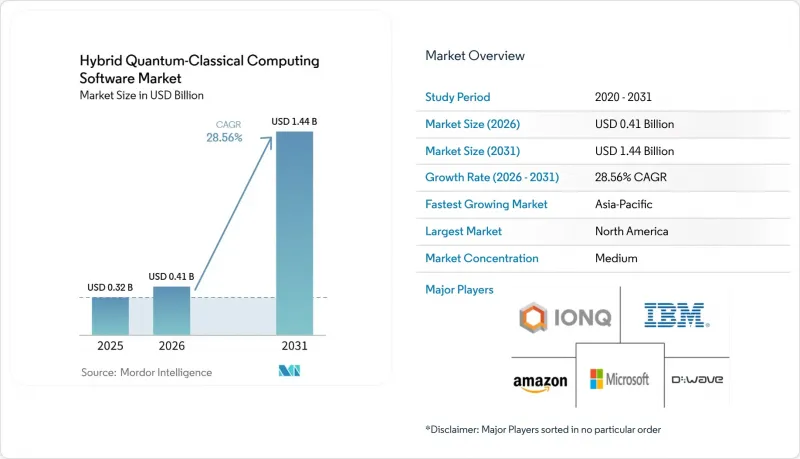
據 Mordor Intelligence 稱,混合量子-經典計算軟體的市場規模預計將從 2025 年的 3.2 億美元成長到 2026 年的 4.1 億美元,到 2031 年達到 14.4 億美元,預計 2026 年至 2031 年的複合年成長率為 28.56%。
本報告按組件(軟體和服務)、部署模式(雲端和本地部署)、技術(超導性量子位元、離子阱等)、應用(最佳化、模擬和建模等)、終端用戶產業(銀行、金融服務和保險、醫療保健和生命科學等)以及地區進行細分。市場預測以美元計價。
全球混合量子與經典運算軟體市場趨勢及洞察
企業對獨立於硬體的混合工作流程編配。
隨著企業在建立量子工作流程時將可移植性放在首位,編配已成為混合量子-經典運算軟體市場的關鍵採購標準。買家越來越需要能夠在超導性、離子阱和退火等環境下運行的應用程式,而無需大幅重寫相關的業務邏輯。這一趨勢降低了緊密耦合軟體堆疊的重要性,並提升了位於硬體之上的編譯器、調度器和工作流程層的價值。 2026年6月,IBM宣布已有超過340家機構加入其量子網路,並承諾藍圖超過100億美元用於開發更廣泛應用所需的軟體和生態系統層。這意義重大,因為如果編配與硬體無關,持續的軟體收入將減少對特定處理器發佈時間的依賴。這也意味著,在混合量子-經典運算軟體市場中,那些能夠促進現有企業環境中可移植性和工作流程連續性的供應商將備受青睞。
擴展對量子開發環境的雲端存取
雲端存取縮短了混合量子-經典運算軟體市場從研究到企業試點活動的路徑。企業不再需要投資低溫硬體、專業維運團隊或專用內部基礎設施來測試工作流程。 IBM 表示,其量子雲端服務已從最初的 5 個量子位元擴展到超過 100 個量子位元的系統,其中包括 120 個量子位元的「夜鷹」(Nighthawk)處理器。 AWS 也於 2026 年 6 月加強了與 QuEra 的合作,向 Amazon Braket 推出了「Megaquop」規模的裝置藍圖,目標是在 2028 年前實現數百個邏輯量子位元的百萬次量子運算。隨著雲端存取的擴展,不僅終端用戶的需求正在成長,希望將量子呼叫整合到傳統企業應用程式中的系統整合商和軟體供應商的需求也在成長。這一趨勢將支撐混合量子-經典運算軟體市場的發展,因為軟體的普及可能在企業能夠直接擁有硬體之前就已實現。
對於大多數工作負載而言,營運優勢有限。
混合量子-經典計算軟體市場最大的限制因素仍然是,能夠持續展現出優於最佳化經典方法的實際優勢的工作負載範圍狹窄。儘管許多先導計畫展現了技術潛力,但這並不一定能轉化為業務部門在多個預算週期內都能認可的採購交易。問題不僅在於效能,還在於效果歸因,因為混合工作流程通常嚴重依賴經典系統來處理計算負載。這使得買家在評估價值時難以識別量子軟體層的直接貢獻。這種信任差距延緩了從試點協議到常規許可或管理服務合約的過渡。這也意味著,在容錯系統能夠支撐更廣泛的可靠優勢之前,混合量子-經典運算軟體市場必須保持數年的商業性興趣。
細分市場分析
到2025年,軟體收入將佔總收入的76.82%,在混合量子-經典計算軟體市場佔據最大佔有率。在當前週期中,企業客戶仍然優先投資於開發框架、編譯器、工作流程和編配平台,而非完全外包執行的模式。這一趨勢反映出市場正處於一個階段,許多買家正在加深對內部量子技術的理解,並檢驗量子工作流程如何融入更廣泛的數位化和分析程序中。 IBM的Qiskit生態系統被全球約70%的量子開發人員使用,這顯示在硬體標準化普及之前,軟體能力可以成為一項持久的優勢。事實上,擁有強大軟體社群的供應商能夠更輕鬆地擴展培訓、工具和工作流程庫,尤其是在早期先導計畫方面。
混合量子與經典運算軟體市場的服務板塊預計到2031年將以30.54%的複合年成長率成長,其中服務板塊預計將成為成長最快的板塊。這一轉變反映了一個簡單的商業性現實:儘管許多公司能夠贊助量子相關項目,但它們仍然缺乏內部專業知識來處理這些項目。因此,託管交付、整合支援、工作流程最佳化和應用程式設計在合約結構和供應商收入模式中變得越來越重要。混合量子與經典計算軟體產業開始重視那些能夠標準化這些服務並將其整合到可重複交付模式中的供應商,而不是僅僅依賴客製化的諮詢式合約。這項轉變意義重大,因為持續的託管支援可以加速軟體的普及,即使對於初次使用者而言,軟體的自助操作仍然具有挑戰性。隨著時間的推移,與最初的普及階段相比,混合量子與經典運算軟體市場可能會在平台收入和服務主導的執行之間取得更平衡的局面。
到 2025 年,雲端服務將佔總收入的 72.14%,使其在混合計量收費和經典運算軟體市場(按部署模式分類)佔據領先市場佔有率。隨著硬體品質、運轉率和長期架構選項在不同供應商之間不斷發展,企業更傾向於按需付費的存取模式。雲端平台透過將存取、開發工具、工作流程控制和錯誤緩解功能整合到單一的商業路徑中,減少了內部摩擦。過去十年,IBM 一直致力於擴展雲端存取系統,而 AWS 則透過 Amazon Braket 和擴展後的 QuEra藍圖圖不斷深化託管量子存取。這種架構有助於快速啟動先導計畫,並為買家提供了一種在各種後端類型之間進行實驗的方法,而無需受限於單一的所有權模式。
此外,雲端是成長最快的採用管道,預計在2026年至2031年間,混合量子和經典運算軟體市場中雲端的複合年成長率將達到29.82%。雲端的商業性優勢不僅限於存取;它還支援混合架構,從而能夠在更廣泛的企業環境中整合高效能運算 (HPC)、人工智慧 (AI) 工具和量子例程。雖然目前本地部署通路規模相對小規模,但預計在預測期後半段,隨著主權、國防和嚴格的資料處理法規優先於成本效益,本地部署的重要性將日益凸顯。即使對本地解決方案的需求增加,混合量子和經典運算軟體市場預計仍將以雲端主導,因為雲端仍然是實現實驗、擴展和多後端可移植性的最便捷途徑。
區域分析
2025年,北美地區佔銷售額的42.88%,佔據混合量子-經典計算軟體市場最大的區域佔有率。美國憑藉其集中的量子雲端基礎設施、企業早期採用者以及軟體開發人才,推動了這項需求的成長。 IBM於2026年6月公佈的藍圖包括擴建其位於奧爾巴尼奈米技術園區的製造地,並在芝加哥和阿馬拉瓦蒂推出新系統,這將進一步加強該地區的供應鏈基礎,並提升生態系統的認知度。加拿大憑藉光電系統推動了這一趨勢,而南美洲仍處於商業應用的早期階段,更傾向於依賴雲端實驗而非本地硬體。
2025年,歐洲保持了其競爭優勢,仍然是混合量子-經典計算軟體市場政策支持下商業發展最活躍的地區之一。英國、德國和法國繼續引領區域活動,這得益於深度科技供應商、試驗計畫和公共支援機制的共同作用。德國仍存在顯著的普及差距,Bitkom發布的2026年報告顯示,69%的公司將尋求先導計畫的資金支持,67%的公司希望簡化雲端平台的存取。這一趨勢表明,在該地區,各領域的認知度提升速度超過了實際營運準備速度。此外,在歐洲,買家在評估供應商和部署模式時,仍優先考慮開放的生態系統、可移植性和主權性等因素。
預計到2031年,亞太地區將以31.92%的複合年成長率成長,並有望成為混合量子-經典計算軟體市場所有地區中成長最快的地區。日本是該地區的主要驅動力,理研運作著IBM量子系統二號,並推動將量子處理器與高效能運算基礎設施連接的以量子為中心的超級運算研究。 2026年6月,富士通和第一生命集團開始利用富士通的1024節點量子模擬器叢集和量子硬體,進行資產配置最佳化的聯合研究。中國和韓國也透過國家級量子計劃,持續提升其國內軟體能力。中東地區在初期應用階段仍落後於領先地區,但透過夥伴關係主導的開發以及對在地化數位基礎設施日益成長的興趣,已取得進展。非洲地區仍處於起步階段,但其雲端接入門檻較低,這意味著隨著該地區數位計畫的成熟,其未來的參與度可能會逐步擴大。
其他好處:
- Excel格式的市場預測(ME)表
- 3個月的分析師支持
目錄
第1章:引言
- 研究假設和市場定義
- 調查範圍
第2章:調查方法
第3章執行摘要
第4章 市場狀況
- 市場概覽
- 市場促進因素
- 企業對獨立於硬體的混合工作流程編配。
- 擴展對量子開發環境的雲端存取
- 量子糾錯與糾錯工具鏈的發展
- 量子軟體在最佳化和模擬工作負載的應用日益廣泛
- 能夠處理量子運算的人員短缺正在加速託管軟體的普及。
- 量子中間表示和編譯器標準化的新需求
- 市場限制因素
- 對於大多數工作負載而言,其在生產環境中的優勢有限。
- 後端工具鏈互通性的碎片化
- 傳統高效能運算和企業IT架構中高整合度工作的負擔
- 由於投資回報率不確定以及供應商鎖定風險,導致採購延誤。
- 產業價值鏈分析
- 宏觀經濟因素對市場的影響
- 技術展望
- 監理情勢
- 波特五力分析
第5章 市場規模與成長預測
- 按組件
- 軟體
- 服務
- 部署模式
- 雲
- 現場
- 透過技術
- 超導性比特
- 被捕獲的離子
- 量子退火
- 其他技術
- 透過使用
- 最佳化
- 模擬與建模
- 密碼技術與安全
- 數據分析和財務建模
- 其他用途
- 按最終用戶行業分類
- BFSI
- 醫療保健和生命科學
- 零售與電子商務
- 資訊科技/通訊
- 媒體與娛樂
- 工業製造
- 能源公用事業
- 政府和公共行政
- 其他終端用戶產業
- 按地區
- 北美洲
- 美國
- 加拿大
- 墨西哥
- 南美洲
- 巴西
- 阿根廷
- 其他南美國家
- 歐洲
- 德國
- 英國
- 法國
- 西班牙
- 義大利
- 俄羅斯
- 其他歐洲國家
- 亞太地區
- 中國
- 印度
- 日本
- 韓國
- 澳洲和紐西蘭
- 其他亞太國家
- 中東
- 沙烏地阿拉伯
- 阿拉伯聯合大公國
- 土耳其
- 其他中東國家
- 非洲
- 南非
- 奈及利亞
- 埃及
- 其他非洲國家
- 北美洲
第6章 競爭情勢
- 市場集中度
- 策略趨勢
- 市佔率分析
- 公司簡介
- IBM Corporation
- IonQ, Inc.
- Microsoft Corporation
- Amazon.com, Inc.
- D-Wave Quantum Inc.
- Rigetti Computing, Inc.
- Alphabet Inc.
- Quantinuum Ltd.
- Xanadu Quantum Technologies Inc.
- Pasqal SAS
- QC Ware Corp.
- Riverlane Limited
- Classiq Technologies Ltd.
- Kipu Quantum
- Quantum Machines Ltd.
- QBraid
- QuEra Computing Inc.
- Infleqtion Inc.
- Algorithmiq Oy
- Phasecraft Ltd.
第7章 市場機會與未來展望
According to Mordor Intelligence, the hybrid quantum-classical computing software market size is expected to increase from USD 0.32 billion in 2025 to USD 0.41 billion in 2026 and reach USD 1.44 billion by 2031, growing at a CAGR of 28.56% over 2026-2031.
This report is Segmented by Component (Software, and Services), Deployment Mode (Cloud, and On-Premises), Technology (Superconducting Qubits, Trapped Ions, and More), Application (Optimization, Simulation and Modeling, and More), End-User Industry (BFSI, Healthcare and Life Sciences, and More), and Geography. The Market Forecasts are Provided in Terms of Value (USD).
Global Hybrid Quantum-Classical Computing Software Market Trends and Insights
Rising Enterprise Demand for Hardware-Agnostic Hybrid Workflow Orchestration
Enterprises are organizing quantum work around portability, and that has made orchestration a central buying criterion in the hybrid quantum-classical computing software market. Buyers increasingly want applications that can run across superconducting, trapped-ion, and annealing environments without major rewrites to the surrounding business logic. This preference weakens tightly coupled software stacks and raises the value of compilers, schedulers, and workflow layers that sit above the hardware. IBM stated in June 2026 that its quantum network included more than 340 organizations and tied its more than USD 10 billion roadmap commitment to the software and ecosystem layers needed for broader adoption. That matters because recurring software revenue becomes less dependent on the release timing of specific processors when orchestration is hardware-agnostic. It also means the hybrid quantum-classical computing software market is rewarding vendors that make portability and workflow continuity easier inside existing enterprise environments.
Expanding Cloud Access to Quantum Development Environments
Cloud access has shortened the path from research interest to enterprise pilot activity in the hybrid quantum-classical computing software market. Companies no longer need to fund cryogenic hardware, specialist operating teams, or dedicated in-house infrastructure before they can test a workflow. IBM noted that its quantum cloud offering has expanded from a 5-qubit starting point to systems with more than 100 qubits, including the 120-qubit Nighthawk processor. AWS also deepened its collaboration with QuEra in June 2026 to bring a Megaquop-scale device roadmap to Amazon Braket, with the goal of one million quantum operations across hundreds of logical qubits by 2028. Wider cloud access is broadening demand not only among end users, but also among system integrators and software vendors that want to embed quantum calls inside classical enterprise applications. That pattern supports the hybrid quantum-classical computing software market because software adoption can grow before direct enterprise ownership of hardware becomes practical.
Limited Production-Grade Advantage Across Most Workloads
The largest restraint in the hybrid quantum-classical computing software market is still the narrow range of workloads that can prove a consistent production-grade advantage over optimized classical methods. Many pilots show technical promise, but that does not always translate into a procurement case that a business unit can defend over several budget cycles. The issue is not only performance, but also attribution, because hybrid workflows often rely on classical systems for most of the computational burden. That makes it harder for buyers to isolate the direct contribution of the quantum software layer when they assess value. This credibility gap slows the movement from pilot contracts to recurring licenses and managed service commitments. It also means the hybrid quantum-classical computing software market must sustain commercial interest for several years before fault-tolerant systems can support broader claims of dependable advantage.
Other drivers and restraints analyzed in the detailed report include:
- Growth Of Quantum Error Mitigation and Error Correction Toolchains
- Increasing Use of Quantum Software in Optimization and Simulation Workloads
- Fragmented Toolchain Interoperability Across Backends
For complete list of drivers and restraints, kindly check the Table Of Contents.
Segment Analysis
Software accounted for 76.82% of revenue in 2025, which gave it the largest share of the hybrid quantum-classical computing software market. In the current cycle, enterprise customers are still investing first in development frameworks, compilers, workflow layers, and orchestration platforms rather than fully outsourced execution models. That preference reflects a market stage where many buyers are building internal familiarity and testing how quantum workflows fit within broader digital and analytics programs. IBM's Qiskit ecosystem has been used by around 70% of quantum developers globally, which shows how software familiarity can become a durable advantage before broad hardware standardization takes shape. In practice, the vendors with strong software communities have had an easier time expanding training, tooling, and workflow libraries around early pilots.
The hybrid quantum-classical computing software market size for services is projected to expand at a 30.54% CAGR through 2031, making services the fastest-growing component segment. This shift reflects a simple commercial reality, because many enterprises can sponsor quantum work but cannot yet staff it with specialized in-house teams. Managed delivery, integration support, workflow tuning, and application design are therefore becoming more important to contract structure and vendor revenue mix. The hybrid quantum-classical computing software industry is starting to reward vendors that can standardize these services into repeatable delivery models rather than relying only on custom consulting-style engagements. That change matters because recurring managed support can lift adoption even when direct software self-service remains difficult for first-time buyers. Over time, the hybrid quantum-classical computing software market is likely to show a broader mix between platform revenue and service-led execution than it did in the earliest adoption phase.
Cloud delivery captured 72.14% of revenue in 2025, giving it the leading position in the hybrid quantum-classical computing software market share by deployment mode. Enterprises have favored pay-as-you-go access because hardware quality, uptime, and long-term architecture choices are still evolving across vendors. Cloud platforms also reduce internal friction by combining access, development tools, workflow controls, and error mitigation functions within one commercial path. IBM highlighted the scaling of cloud-accessible systems over the last decade, while AWS continued to deepen managed quantum access through Amazon Braket and its expanded QuEra roadmap. This structure supports faster pilot initiation and gives buyers a way to experiment across backend types without committing to a single ownership model.
Cloud is also the faster-growing deployment path, with a 29.82% CAGR projected for 2026-2031 in the hybrid quantum-classical computing software market. The commercial advantage of cloud is not limited to access alone, because it also supports hybrid architectures where HPC, AI tools, and quantum routines can be coordinated within broader enterprise environments. On-premises deployment remains a smaller channel today, but it is expected to gain relevance later in the forecast period where sovereignty, defense, and strict data handling rules outweigh cost efficiency. Even as on-premises demand grows, the hybrid quantum-classical computing software market is likely to remain cloud-led because cloud is still the easiest route to experimentation, scaling, and multi-backend portability.
Complete Report Scope:
- By Component
- Software
- Services
- By Deployment Mode
- Cloud
- On-Premises
- By Technology
- Superconducting Qubits
- Trapped Ions
- Quantum Annealing
- Other Technologies
- By Application
- Optimization
- Simulation and Modeling
- Cryptography and Security
- Data Analytics and Financial Modeling
- Other Applications
- By End-User Industry
- BFSI
- Healthcare and Life Sciences
- Retail and E-Commerce
- IT and Telecom
- Media and Entertainment
- Industrial Manufacturing
- Energy and Utilities
- Government and Public Administration
- Other End-User Industries
- By Geography
- North America
- United States
- Canada
- Mexico
- South America
- Brazil
- Argentina
- Rest of South America
- Europe
- Germany
- United Kingdom
- France
- Spain
- Italy
- Russia
- Rest of Europe
- Asia-Pacific
- China
- India
- Japan
- South Korea
- Australia and New Zealand
- Rest of Asia-Pacific
- Middle East
- Saudi Arabia
- United Arab Emirates
- Turkey
- Rest of Middle East
- Africa
- South Africa
- Nigeria
- Egypt
- Rest of Africa
- North America
Geography Analysis
North America accounted for 42.88% of 2025 revenue, which gave it the largest hybrid quantum-classical computing software market share by region. The United States drove most of that demand through its concentration of quantum cloud infrastructure, enterprise early adopters, and software development talent. IBM's June 2026 roadmap commitment included manufacturing expansion at the Albany NanoTech Complex and new system deployments in Chicago and Amaravati, which reinforced the region's supply-side depth and ecosystem visibility. Canada added to this profile through its photonic ecosystem, while South America remained earlier in commercial adoption and relied more on cloud-based experimentation than on local hardware ownership.
Europe held a competitive position in 2025 and remained one of the most active regions for policy-backed commercial development in the hybrid quantum-classical computing software market. The United Kingdom, Germany, and France continued to shape regional activity through a mix of deep-tech vendors, pilot programs, and public support mechanisms. Germany still showed a meaningful implementation gap, with Bitkom reporting in 2026 that 69% of firms sought financial support for pilot projects and 67% wanted simplified cloud platform access. This pattern suggests that awareness has moved faster than operational readiness across large parts of the region. Europe also continued to place weight on open ecosystems, portability, and sovereignty considerations when buyers evaluated vendors and deployment models.
Asia-Pacific is projected to expand at a 31.92% CAGR through 2031, giving it the fastest regional growth profile in the hybrid quantum-classical computing software market. Japan has been a major regional anchor, with RIKEN operating IBM Quantum System Two and advancing quantum-centric supercomputing work that links quantum processors with HPC infrastructure. June 2026, Fujitsu and Daiichi Life Group launched joint research on asset allocation optimization using Fujitsu's 1,024-node quantum simulator cluster and quantum hardware. China and South Korea also continued to build domestic software capability through national quantum programs. The Middle East remained earlier in adoption but moved forward through partnership-led development and a stronger interest in locally controlled digital infrastructure. Africa was still nascent, yet lower barriers to cloud access can gradually widen future participation as regional digital programs mature.
- IBM Corporation
- IonQ, Inc.
- Microsoft Corporation
- Amazon.com, Inc.
- D-Wave Quantum Inc.
- Rigetti Computing, Inc.
- Alphabet Inc.
- Quantinuum Ltd.
- Xanadu Quantum Technologies Inc.
- Pasqal SAS
- QC Ware Corp.
- Riverlane Limited
- Classiq Technologies Ltd.
- Kipu Quantum
- Quantum Machines Ltd.
- QBraid
- QuEra Computing Inc.
- Infleqtion Inc.
- Algorithmiq Oy
- Phasecraft Ltd.
Additional Benefits:
- The market estimate (ME) sheet in Excel format
- 3 months of analyst support
TABLE OF CONTENTS
1 INTRODUCTION
- 1.1 Study Assumptions and Market Definition
- 1.2 Scope of the Study
2 RESEARCH METHODOLOGY
3 EXECUTIVE SUMMARY
4 MARKET LANDSCAPE
- 4.1 Market Overview
- 4.2 Market Drivers
- 4.2.1 Rising Enterprise Demand for Hardware-Agnostic Hybrid Workflow Orchestration
- 4.2.2 Expanding Cloud Access to Quantum Development Environments
- 4.2.3 Growth of Quantum Error Mitigation and Error Correction Toolchains
- 4.2.4 Increasing Use of Quantum Software in Optimization and Simulation Workloads
- 4.2.5 Quantum-Ready Talent Shortage Accelerating Managed Software Adoption
- 4.2.6 Emerging Need for Quantum Intermediate Representation and Compiler Standardization
- 4.3 Market Restraints
- 4.3.1 Limited Production-Grade Advantage Across Most Workloads
- 4.3.2 Fragmented Toolchain Interoperability Across Backends
- 4.3.3 High Integration Burden With Classical HPC and Enterprise IT Stacks
- 4.3.4 Procurement Delays Driven by Unclear ROI and Vendor Lock-In Risk
- 4.4 Industry Value Chain Analysis
- 4.5 Impact of Macroeconomic Factors on the Market
- 4.6 Technological Outlook
- 4.7 Regulatory Landscape
- 4.8 Porter's Five Forces Analysis
- 4.8.1 Bargaining Power of Suppliers
- 4.8.2 Bargaining Power of Buyers
- 4.8.3 Threat of New Entrants
- 4.8.4 Threat of Substitutes
- 4.8.5 Intensity of Competitive Rivalry
5 MARKET SIZE AND GROWTH FORECASTS (VALUE)
- 5.1 By Component
- 5.1.1 Software
- 5.1.2 Services
- 5.2 By Deployment Mode
- 5.2.1 Cloud
- 5.2.2 On-Premises
- 5.3 By Technology
- 5.3.1 Superconducting Qubits
- 5.3.2 Trapped Ions
- 5.3.3 Quantum Annealing
- 5.3.4 Other Technologies
- 5.4 By Application
- 5.4.1 Optimization
- 5.4.2 Simulation and Modeling
- 5.4.3 Cryptography and Security
- 5.4.4 Data Analytics and Financial Modeling
- 5.4.5 Other Applications
- 5.5 By End-User Industry
- 5.5.1 BFSI
- 5.5.2 Healthcare and Life Sciences
- 5.5.3 Retail and E-Commerce
- 5.5.4 IT and Telecom
- 5.5.5 Media and Entertainment
- 5.5.6 Industrial Manufacturing
- 5.5.7 Energy and Utilities
- 5.5.8 Government and Public Administration
- 5.5.9 Other End-User Industries
- 5.6 By Geography
- 5.6.1 North America
- 5.6.1.1 United States
- 5.6.1.2 Canada
- 5.6.1.3 Mexico
- 5.6.2 South America
- 5.6.2.1 Brazil
- 5.6.2.2 Argentina
- 5.6.2.3 Rest of South America
- 5.6.3 Europe
- 5.6.3.1 Germany
- 5.6.3.2 United Kingdom
- 5.6.3.3 France
- 5.6.3.4 Spain
- 5.6.3.5 Italy
- 5.6.3.6 Russia
- 5.6.3.7 Rest of Europe
- 5.6.4 Asia-Pacific
- 5.6.4.1 China
- 5.6.4.2 India
- 5.6.4.3 Japan
- 5.6.4.4 South Korea
- 5.6.4.5 Australia and New Zealand
- 5.6.4.6 Rest of Asia-Pacific
- 5.6.5 Middle East
- 5.6.5.1 Saudi Arabia
- 5.6.5.2 United Arab Emirates
- 5.6.5.3 Turkey
- 5.6.5.4 Rest of Middle East
- 5.6.6 Africa
- 5.6.6.1 South Africa
- 5.6.6.2 Nigeria
- 5.6.6.3 Egypt
- 5.6.6.4 Rest of Africa
- 5.6.1 North America
6 COMPETITIVE LANDSCAPE
- 6.1 Market Concentration
- 6.2 Strategic Moves
- 6.3 Market Share Analysis
- 6.4 Company Profiles (includes Global Level Overview, Market Level Overview, Core Segments, Financials as available, Strategic Information, Market Rank/Share, Products and Services, Recent Developments)
- 6.4.1 IBM Corporation
- 6.4.2 IonQ, Inc.
- 6.4.3 Microsoft Corporation
- 6.4.4 Amazon.com, Inc.
- 6.4.5 D-Wave Quantum Inc.
- 6.4.6 Rigetti Computing, Inc.
- 6.4.7 Alphabet Inc.
- 6.4.8 Quantinuum Ltd.
- 6.4.9 Xanadu Quantum Technologies Inc.
- 6.4.10 Pasqal SAS
- 6.4.11 QC Ware Corp.
- 6.4.12 Riverlane Limited
- 6.4.13 Classiq Technologies Ltd.
- 6.4.14 Kipu Quantum
- 6.4.15 Quantum Machines Ltd.
- 6.4.16 QBraid
- 6.4.17 QuEra Computing Inc.
- 6.4.18 Infleqtion Inc.
- 6.4.19 Algorithmiq Oy
- 6.4.20 Phasecraft Ltd.
7 MARKET OPPORTUNITIES AND FUTURE OUTLOOK
- 7.1 White Space and Unmet Need Assessment

 2026年全球高效能運算平台(人工智慧應用)市場報告
 全球資料中心運算與人工智慧市場(2027-2040 年)
 資料處理單元市場報告:趨勢、預測與競爭分析(至2035年)
 高效能運算市場機會、成長要素、產業趨勢分析及2026-2035年預測。
 高效能運算:市場佔有率分析、產業趨勢與統計及成長預測(2026-2031 年)
 高效能運算市場:按組件、技術、資料類型、最終用戶、部署模式和組織規模分類-2026-2032年全球市場預測加速計算:市場佔有率分析、行業趨勢和統計數據、成長預測(2026-2031 年)異質計算:市場佔有率分析、產業趨勢與統計、成長預測(2026-2031)雲端運算高效能運算(HPC):市場佔有率分析、產業趨勢與統計及成長預測(2026-2031 年)高效能運算 (HPC) 市場規模、佔有率、成長率和全球產業分析:按類型、應用和地區分類的洞察,2026-2034 年預測