


 |
市場調查報告書
商品編碼
2098499
加速計算:市場佔有率分析、行業趨勢和統計數據、成長預測(2026-2031 年)Accelerated Computing - Market Share Analysis, Industry Trends & Statistics, Growth Forecasts (2026 - 2031) |
||||||

※ 本網頁內容可能與最新版本有所差異。詳細情況請與我們聯繫。
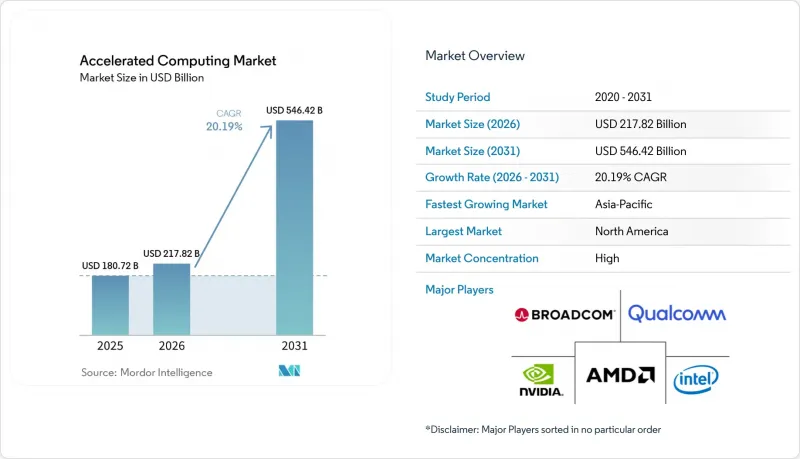
根據 Mordor Intelligence 預測,加速運算市場規模將從 2025 年的 1,807.2 億美元成長到 2026 年的 2,178.2 億美元,然後在 2031 年達到 5,464.2 億美元,2026 年至 2031 年的複合年成長率為 20.19%。
本報告按處理器類型(圖形處理器 (GPU)、專用積體電路 (ASIC) 等)、部署方式(本地部署和資料中心、邊緣和嵌入式等)、功能(訓練和推理)、最終用戶(超大規模雲端服務供應商、企業和託管資料中心等)以及地區進行細分。市場預測以美元 (USD) 為單位。
全球加速運算市場趨勢及洞察
訓練大規模語言模型的需求日益成長
在整個加速運算市場中,訓練最先進的模型如今已成為資本配置的核心。根據 Epoch AI 的數據,自 2020 年以來,訓練最先進的語言模型所需的運算能力每年成長五倍,同期電力需求也每年翻倍。到 2026 年中,已知規模最大的訓練運行將消耗 5 × 10²⁶ FLOPs 的運算能力,相當於 GPT-4 運算能力的 24 倍。這一趨勢意義重大,因為即使在建立基礎模型之後,諸如微調、剪枝和強化學習等後續訓練步驟也會不斷延長運算週期,這意味著硬體需求的成長不再僅取決於預訓練的規模。 NVIDIA 的 Blackwell 平台在 2026 年 6 月就印證了這項轉變。根據 MLPerf Training v6.0 測試結果,DeepSeek-V3 671B 在 8192 個 CoreWeave GB300 NVL72 GPU 上僅用 2.02 分鐘就完成了訓練。因此,在高速運算市場,能夠同時提供晶片級高效能和機架級可擴充性的廠商仍然備受青睞。
邊緣推理工作負載的快速成長
隨著推理工作負載擴展到無法依賴遠端雲端容量執行任何任務的設備和系統,加速運算市場正在不斷擴張。這種轉變使得延遲、本地反應速度和能源效率變得更加關鍵,從而提升了ASIC、FPGA和專用推理引擎在汽車、工業和醫療領域的重要性。向基於代理的AI的轉變又增添了一層複雜性,因為將預填和解碼階段分離,使得不同的處理器能夠處理同一工作流程的不同部分。 2025年12月,NVIDIA透過與Groq達成一項價值200億美元的授權協議,展示了這個發展方向。 Groq在水冷式Rubin系列LPX機架中部署了NVIDIA的LPU資料流引擎,以實現低延遲推理。此外,AWS在2026年6月正式推出搭載NVIDIA RTX PRO 4500 Blackwell Server Edition GPU的EC2 G7實例,進一步加速了推理週期,其AI推理性能比上一代產品提升高達4.6倍。隨著這些技術的普及,預計加速運算市場的支出將分散到更廣泛的硬體配置上,而不是像以前那樣幾乎將所有價值都集中在集中式訓練叢集上。
集中生產5奈米以下製程的產能
加速運算市場持續面臨挑戰,尤其是在尖端製程節點的供應基礎有限方面。魏先生在2026年6月表示,對尖端節點的需求比現有產能高出25%至30%,而且至少在2027年之前預計不會有所改善。這種限制不僅限於邏輯晶片的生產;用於連接加速器晶片和HBM的先進封裝能力也依然緊張。換句話說,一些晶片設計商仍然面臨著真正的障礙,因為即使完成了產品設計,如果無法獲得晶圓代工廠和封裝的配額,他們也無法擴大出貨量。因此,即使終端用戶需求強勁,加速運算市場的採購也可能被延遲。這也減緩了小規模加速器供應商將設計訂單轉化為可觀收入的速度,導致供應持續集中在已獲得製造管道的大型公司手中。
細分市場分析
到2025年,GPU將佔據加速運算市場55.34%的佔有率。這反映了NVIDIA CUDA生態系統的深度及其與AI框架、企業級堆疊和雲端服務的廣泛整合。這一佔有率並非僅源自於晶片效能;採購團隊也重視軟體的成熟度、開發人員的熟悉程度以及現有GPU工作流程的低成本切換。事實上,對於那些尋求即時獲得高吞吐量AI訓練和通用推理能力的組織而言,GPU仍然是首選。當買家無法快速為客製化晶片設計定義穩定的工作負載設定檔時,GPU仍然具有優勢。因此,儘管其他技術不斷進步,加速運算市場的處理器層仍以GPU為核心。
預計到2031年,客製化ASIC將以21.32%的複合年成長率成長,成為加速運算市場中成長最快的處理器細分市場。這一成長動能主要由超大規模資料中心業者資料中心圍繞內部工作負載設計的計畫所推動,這些工作負載的特點是高運轉率和更嚴格的軟體控制。谷歌的TPU藍圖和微軟的Maia 200部署都證明了這種模式的吸引力,因為這兩個計劃都優先考慮每瓦和每美元的性能,而不是與第三方產品的廣泛兼容性。 FPGA在低延遲和可重構的應用場景中仍然發揮著重要作用,儘管規模較小。同時,CPU和NPU在邊緣推理領域日益受到重視,因為在邊緣推理領域,成本和效率比最大吞吐量更為重要。 GPU仍然是加速運算產業廣泛部署的首選。然而,在工作負載規模大、可重複且經濟穩定的領域,客製化晶片的角色正在穩步擴大。
到2025年,本地部署和資料中心部署將佔加速運算市場51.48%的佔有率,證實了高密度集中式基礎設施仍然是最大的收入來源。這種情況與超大規模資料中心業者和大型企業密切相關,他們需要叢集系統來進行最先進的模型訓練、大規模批量推理和安全的內部部署。高機架密度、電源供給能力、冷卻方案和軟體編配等因素都有利於那些能夠管理自身基礎設施或利用專業託管模式的買家。因此,本地部署和資料中心環境構成了目前加速運算市場的整體收入基礎。這也解釋了為什麼供應商仍然將大規模系統的整合和打包放在其產品線的頂端。
預計到2031年,邊緣和嵌入式環境的部署將以21.51%的複合年成長率成長,成為加速運算市場中成長最快的部署模式。這一成長主要由自動駕駛汽車、工業機器人和互聯醫療系統等應用推動,這些應用需要確定性的本地處理,而不是依賴與雲端的往返通訊。在許多終端場景中,低延遲和能源效率比尖峰時段浮點效能更為重要,因此這些部署正在改變硬體選擇標準。雖然雲端對於無法承擔私有叢集部署成本的企業用戶仍然至關重要,但如果能夠長期維持高利用率,自主部署的經濟效益將更具吸引力。隨著推理工作負載擴展到更多實際應用場景,預計加速運算市場將呈現更均衡的集中式容量和分散式運算環境配置。
區域分析
到2025年,北美將佔據加速計算市場41.26%的佔有率,成為最大的貢獻地區。該地區受益於超大規模資料中心業者資本的最高集中度、成熟的人工智慧軟體生態系統以及最廣泛的企業人工智慧用戶群。它仍然是平台領導者的關鍵樞紐,影響整個加速運算市場的採購標準、基準預期和商業部署模式。美國透過建設大規模資料中心引領這一地位,而加拿大則透過安大略省和魁北克省擴大了容量。墨西哥也透過近岸供應鏈轉移提升了其重要性。出口合規性將繼續是該地區商業環境的一部分,因為美國工業與安全局(BIS)將於2026年1月實施的框架將影響美國供應商的海外銷售機制和客戶身份驗證。
預計到2031年,亞太地區將以21.65%的複合年成長率成長,成為加速運算市場成長最快的區域。這一成長得益於政府主導的人工智慧運算項目,這些項目正從政策聲明轉向資金支持的基礎設施建設項目。日本已透過經濟產業省承諾投入130億美元,用於支持半導體和工業人工智慧計畫。隨著該地區人工智慧基礎設施的擴展,微軟也宣布將在2026年至2029年間在日本投資103億美元。 2026年5月,韓國金融服務委員會批准了57億美元的國家人工智慧基礎設施建設預算,其中包括一個擁有15,000個GPU的國家人工智慧運算中心,以及一個由Naver Cloud、三星SDS和Ellis Group主導的營運團隊。中國仍然是主要的需求中心,但出口限制進一步鞏固了國內加速器供應商的地位,導致其在不同的供應鏈下發展。
歐洲和其他地區構成了加速運算市場的其餘部分,其中德國、英國和法國主導。歐洲的需求主要來自汽車計算(用於高級駕駛輔助系統 (ADAS) 和自動駕駛)、製造地的工業自動化以及英國金融服務業的應用案例。南美、中東和非洲以及亞太地區的一些小國是新興市場,由於各國推行數位化計畫和對資料中心的投資,這些地區對人工智慧基礎設施的需求正在成長。在這些地區,加速計算市場的發展預計不僅會受到超大規模資料中心業者中心集中化的影響,還會受到公共部門計劃、國內資料保留要求以及企業選擇性採用等因素的共同推動。
其他好處:
- Excel格式的市場預測(ME)表
- 3個月的分析師支持
目錄
第1章:引言
- 研究假設和市場定義
- 調查範圍
第2章:調查方法
第3章執行摘要
第4章 市場狀況
- 市場概覽
- 市場促進因素
- 增加大規模語言模型的訓練量
- 邊緣推理工作負載的快速成長
- 超大規模資料中心業者採用客製化矽
- 擴大節能型加速器架構的應用
- 先進的冷卻技術和最佳化的機架密度
- 矽光電與光連接模組的整合
- 市場限制因素
- 生產能力集中度低於 5 Nm
- 液冷集群整體擁有成本高
- 先進加速器出口限制的不確定性
- HBM 和先進包裝瓶頸
- 產業價值鏈分析
- 監理情勢
- 技術展望
- 宏觀經濟因素對市場的影響
- 波特五力分析
第5章 市場規模與成長預測
- 依處理器類型
- 圖形處理器(GPU)
- 專用積體電路(ASIC)
- 現場可程式閘陣列(FPGA)
- 中央處理器(CPU)和神經處理器(NPU)
- 不同的發展
- 本地部署和資料中心
- 基於雲端的
- 邊緣和嵌入式
- 按功能
- 訓練
- 推理
- 最終用戶
- 超大規模雲端服務供應商
- 企業和託管資料中心
- 汽車製造商和一級供應商
- 醫療保健和生命科學
- 金融服務
- 通訊和5G基礎設施
- 政府、國防和研究機構
- 製造和工業自動化
- 按地區
- 北美洲
- 美國
- 加拿大
- 墨西哥
- 歐洲
- 德國
- 英國
- 法國
- 義大利
- 其他歐洲國家
- 亞太地區
- 中國
- 日本
- 韓國
- 印度
- 東南亞
- 其他亞太國家
- 南美洲
- 中東和非洲
- 北美洲
第6章 競爭情勢
- 市場集中度
- 策略趨勢
- 供應商定位分析
- 公司簡介
- NVIDIA Corporation
- Advanced Micro Devices, Inc.
- Intel Corporation
- Qualcomm Incorporated
- Broadcom Inc.
- Marvell Technology, Inc.
- Cerebras Systems, Inc.
- Groq, Inc.
- Tenstorrent Inc.
- Graphcore Limited
- SambaNova Systems, Inc.
- Rebellions Inc.
- Hailo Technologies Ltd.
第7章 市場機會與未來展望
According to Mordor Intelligence, the accelerated computing market size is expected to grow from USD 180.72 billion in 2025 to USD 217.82 billion in 2026 and is forecast to reach USD 546.42 billion by 2031 at 20.19% CAGR over 2026-2031.
This report is Segmented by Processor Type (Graphics Processing Unit (GPU), Application-Specific Integrated Circuit, and More), Deployment (On-Premises and Data Center, Edge and Embedded, and More), Function (Training, and Inference), End User (Hyperscale Cloud Service Providers, Enterprise and Colocation Data Centers, and More), and Geography. The Market Forecasts are Provided in Terms of Value (USD).
Global Accelerated Computing Market Trends and Insights
Rising Large Language Model Training Intensity
Frontier model training now sits at the center of capital allocation across the accelerated computing market. Epoch AI data showed that training compute for frontier language models grew 5x per year since 2020, and power requirements doubled annually over the same period. The largest known training run by mid-2026 consumed 5X1026 FLOPs, which was 24 times the compute used for GPT-4. That pattern matters because hardware demand no longer rises only with pre-training volume, as post-training steps such as fine-tuning, pruning, and reinforcement learning continue to extend the compute cycle after the base model is built. NVIDIA's Blackwell platform reinforced this shift in June 2026, when MLPerf Training v6.0 results showed DeepSeek-V3 671B trained in 2.02 minutes on 8,192 GB300 NVL72 GPUs at CoreWeave. The accelerated computing market, therefore, continues to favor vendors that can deliver scale at the rack level, not just higher performance at the chip level.
Rapid Expansion of Edge Inference Workloads
The accelerated computing market is expanding as inference workloads are spreading across devices and systems that cannot rely on distant cloud capacity for every task. That change gives greater weight to latency, local responsiveness, and power efficiency, thereby improving the position of ASICs, FPGAs, and specialized inference engines in automotive, industrial, and medical settings. The move toward agentic AI adds another layer, because separating prefill and decode stages creates room for different processors to handle different parts of the same workflow. NVIDIA validated that direction in December 2025 through a USD 20 billion licensing agreement with Groq, bringing LPU dataflow engines into liquid-cooled Rubin-generation LPX racks for low-latency inference. AWS also accelerated the inference cycle in June 2026 by making EC2 G7 instances generally available with NVIDIA RTX PRO 4500 Blackwell Server Edition GPUs, delivering up to 4.6x higher AI inference performance than the earlier generation. As these deployments scale, the accelerated computing market is likely to spread spending across a broader hardware mix instead of concentrating nearly all value in centralized training clusters.
Sub-5 Nm Capacity Concentration
The accelerated computing market remains exposed to a narrow supply base at the most advanced process nodes. In June 2026, Wei said demand for advanced nodes exceeded available capacity by 25-30%, and relief was not expected until at least 2027. The constraint is not limited to logic production, because advanced packaging capacity for linking accelerator dies with HBM has also remained under pressure. That means some chip designers still face a practical barrier even after completing product design, because they cannot scale shipments without foundry and packaging allocation. The result is that procurement in the accelerated computing market can be delayed even when end demand remains strong. This also slows the pace at which smaller accelerator vendors can convert design wins into meaningful revenue, keeping supply concentrated among players with secured manufacturing access.
Other drivers and restraints analyzed in the detailed report include:
- Hyperscaler Custom Silicon Adoption
- Growing Adoption of Energy-Efficient Accelerator Architectures
- Export-Control Uncertainty for Advanced Accelerators
For complete list of drivers and restraints, kindly check the Table Of Contents.
Segment Analysis
GPUs held a 55.34% share of the accelerated computing market in 2025, reflecting the depth of NVIDIA's CUDA ecosystem and its broad integration into AI frameworks, enterprise stacks, and cloud services. That share was not based solely on chip performance, because procurement teams also value software maturity, developer familiarity, and the lower switching costs that come with existing GPU workflows. In practice, GPUs remain the default choice for organizations seeking immediate access to high-throughput AI training and general-purpose inference. They also continue to benefit when buyers cannot commit early enough to a stable workload profile for custom chip design. This keeps the processor layer of the accelerated computing market centered on GPUs even as alternatives improve.
Custom ASICs are projected to grow at a 21.32% CAGR through 2031, making them the fastest-growing processor segment in the accelerated computing market. Their momentum comes mainly from hyperscaler programs that are designed around internal workloads with high utilization and tighter software control. Google's TPU roadmap and Microsoft's Maia 200 deployment show why the model is attractive, as both programs prioritize performance per watt and per dollar rather than broad third-party compatibility. FPGAs continue to hold a smaller but useful role in low-latency and reconfigurable use cases, while CPUs and NPUs are gaining relevance in edge inference where cost and efficiency matter more than maximum throughput. The accelerated computing industry still favors GPUs for broad deployment, but the accelerated computing market is steadily making more room for custom silicon where workloads are large, repeatable, and economically stable.
On-premises and data center deployments accounted for 51.48% of the accelerated computing market in 2025, underscoring that dense, centralized infrastructure still has the largest revenue base. This position is tied to hyperscalers and large enterprises that need clustered systems for frontier model training, large-batch inference, and secure internal deployments. High rack density, power delivery, cooling readiness, and software orchestration all favor buyers who can control their own infrastructure or work through specialized colocation models. That makes on-premises and data center environments the anchor for current revenue across the accelerated computing market. It also explains why suppliers still prioritize large-system integration and packaging scale at the top end of the product stack.
Edge and embedded deployment is forecast to grow at a 21.51% CAGR through 2031, which makes it the fastest-growing deployment model in the accelerated computing market. Growth comes from autonomous vehicles, industrial robots, and connected medical systems that require deterministic local processing rather than round-trip cloud reliance. These deployments are changing hardware selection because low latency and power efficiency matter more than peak floating-point output in many endpoint scenarios. Cloud remains important for enterprise buyers that cannot fund private clusters, but ownership economics become more attractive when utilization stays high for long periods. As inference workloads spread across more real-world environments, the accelerated computing market is likely to see a more balanced mix between centralized capacity and distributed compute footprints.
Complete Report Scope:
- By Processor Type
- Graphics Processing Unit (GPU)
- Application-Specific Integrated Circuit (ASIC)
- Field-Programmable Gate Array (FPGA)
- Central Processing Unit (CPU) and Neural Processing Unit (NPU)
- By Deployment
- On-Premises and Data Center
- Cloud-Based
- Edge and Embedded
- By Function
- Training
- Inference
- By End User
- Hyperscale Cloud Service Providers
- Enterprise and Colocation Data Centers
- Automotive OEMs and Tier-1 Suppliers
- Healthcare and Life Sciences
- Financial Services
- Telecom and 5G Infrastructure
- Government, Defense, and Research
- Manufacturing and Industrial Automation
- By Geography
- North America
- United States
- Canada
- Mexico
- Europe
- Germany
- United Kingdom
- France
- Italy
- Rest of Europe
- Asia-Pacific
- China
- Japan
- South Korea
- India
- Southeast Asia
- Rest of Asia-Pacific
- South America
- Middle East and Africa
- North America
Geography Analysis
North America accounted for 41.26% of the accelerated computing market share in 2025, making it the largest regional contributor. The region benefits from the deepest concentration of hyperscaler capital, mature AI software ecosystems, and the broadest installed base of enterprise AI users. It also remains the main operating base for platform leaders that influence procurement standards, benchmark expectations, and commercial deployment models across the accelerated computing market. The United States leads this position through large-scale data center buildouts, while Canada adds capacity through Ontario and Quebec, and Mexico is gaining relevance from nearshore supply-chain shifts. Export compliance remains part of the regional operating picture because the January 2026 BIS framework affects how U.S.-based suppliers structure overseas sales and customer certifications.
Asia-Pacific is projected to grow at a 21.65% CAGR through 2031, which makes it the fastest-growing regional block in the accelerated computing market. Growth is being supported by sovereign AI compute programs that are moving from policy statements into funded infrastructure projects. Japan committed USD 13 billion through METI to semiconductor and industrial AI programs, and Microsoft said it would invest JPY 1.6 trillion (USD 10.3 billion) in Japan between 2026 and 2029 as regional AI infrastructure expands. South Korea's Financial Services Commission approved USD 5.7 billion for national AI infrastructure in May 2026, including a national AI compute center with 15,000 GPUs and an operator group led by Naver Cloud, Samsung SDS, and Ellis Group. China remains a large demand center but is developing under a different supply framework, as export restrictions continue to push domestic accelerator vendors into a stronger position.
Europe and the remaining regions account for the balance of the accelerated computing market, led by Germany, the United Kingdom, and France. European demand is being supported by automotive compute for ADAS and autonomous driving, industrial automation in manufacturing centers, and financial services use cases in the United Kingdom. South America, the Middle East and Africa, and smaller Asia-Pacific countries represent emerging pockets where national digital programs and data center investment are increasing demand for AI infrastructure. In these regions, the accelerated computing market is likely to develop through a mix of public-sector programs, sovereign data requirements, and selective enterprise adoption rather than through hyperscaler concentration alone.
- NVIDIA Corporation
- Advanced Micro Devices, Inc.
- Intel Corporation
- Qualcomm Incorporated
- Broadcom Inc.
- Marvell Technology, Inc.
- Cerebras Systems, Inc.
- Groq, Inc.
- Tenstorrent Inc.
- Graphcore Limited
- SambaNova Systems, Inc.
- Rebellions Inc.
- Hailo Technologies Ltd.
Additional Benefits:
- The market estimate (ME) sheet in Excel format
- 3 months of analyst support
TABLE OF CONTENTS
1 INTRODUCTION
- 1.1 Study Assumptions and Market Definition
- 1.2 Scope of the Study
2 RESEARCH METHODOLOGY
3 EXECUTIVE SUMMARY
4 MARKET LANDSCAPE
- 4.1 Market Overview
- 4.2 Market Drivers
- 4.2.1 Rising Large Language Model Training Intensity
- 4.2.2 Rapid Expansion of Edge Inference Workloads
- 4.2.3 Hyperscaler Custom Silicon Adoption
- 4.2.4 Growing Adoption of Energy-Efficient Accelerator Architectures
- 4.2.5 Advanced Cooling and Rack Density Optimization
- 4.2.6 Silicon Photonics and Optical Interconnect Integration
- 4.3 Market Restraints
- 4.3.1 Sub-5 Nm Capacity Concentration
- 4.3.2 High Total Cost of Ownership for Liquid-Cooled Clusters
- 4.3.3 Export-Control Uncertainty for Advanced Accelerators
- 4.3.4 HBM and Advanced Packaging Bottlenecks
- 4.4 Industry Value Chain Analysis
- 4.5 Regulatory Landscape
- 4.6 Technological Outlook
- 4.7 Impact of Macroeconomic Factors on the Market
- 4.8 Porter's Five Forces Analysis
- 4.8.1 Threat of New Entrants
- 4.8.2 Bargaining Power of Suppliers
- 4.8.3 Bargaining Power of Buyers
- 4.8.4 Threat of Substitutes
- 4.8.5 Competitive Rivalry
5 MARKET SIZE AND GROWTH FORECASTS (VALUE)
- 5.1 By Processor Type
- 5.1.1 Graphics Processing Unit (GPU)
- 5.1.2 Application-Specific Integrated Circuit (ASIC)
- 5.1.3 Field-Programmable Gate Array (FPGA)
- 5.1.4 Central Processing Unit (CPU) and Neural Processing Unit (NPU)
- 5.2 By Deployment
- 5.2.1 On-Premises and Data Center
- 5.2.2 Cloud-Based
- 5.2.3 Edge and Embedded
- 5.3 By Function
- 5.3.1 Training
- 5.3.2 Inference
- 5.4 By End User
- 5.4.1 Hyperscale Cloud Service Providers
- 5.4.2 Enterprise and Colocation Data Centers
- 5.4.3 Automotive OEMs and Tier-1 Suppliers
- 5.4.4 Healthcare and Life Sciences
- 5.4.5 Financial Services
- 5.4.6 Telecom and 5G Infrastructure
- 5.4.7 Government, Defense, and Research
- 5.4.8 Manufacturing and Industrial Automation
- 5.5 By Geography
- 5.5.1 North America
- 5.5.1.1 United States
- 5.5.1.2 Canada
- 5.5.1.3 Mexico
- 5.5.2 Europe
- 5.5.2.1 Germany
- 5.5.2.2 United Kingdom
- 5.5.2.3 France
- 5.5.2.4 Italy
- 5.5.2.5 Rest of Europe
- 5.5.3 Asia-Pacific
- 5.5.3.1 China
- 5.5.3.2 Japan
- 5.5.3.3 South Korea
- 5.5.3.4 India
- 5.5.3.5 Southeast Asia
- 5.5.3.6 Rest of Asia-Pacific
- 5.5.4 South America
- 5.5.5 Middle East and Africa
- 5.5.1 North America
6 COMPETITIVE LANDSCAPE
- 6.1 Market Concentration
- 6.2 Strategic Moves
- 6.3 Vendor Positioning Analysis
- 6.4 Company Profiles (includes Global Level Overview, Market Level Overview, Core Segments, Financials as available, Strategic Information, Market Rank/Share, Products and Services, Recent Developments)
- 6.4.1 NVIDIA Corporation
- 6.4.2 Advanced Micro Devices, Inc.
- 6.4.3 Intel Corporation
- 6.4.4 Qualcomm Incorporated
- 6.4.5 Broadcom Inc.
- 6.4.6 Marvell Technology, Inc.
- 6.4.7 Cerebras Systems, Inc.
- 6.4.8 Groq, Inc.
- 6.4.9 Tenstorrent Inc.
- 6.4.10 Graphcore Limited
- 6.4.11 SambaNova Systems, Inc.
- 6.4.12 Rebellions Inc.
- 6.4.13 Hailo Technologies Ltd.
7 MARKET OPPORTUNITIES AND FUTURE OUTLOOK
- 7.1 White-Space and Unmet-Need Assessment

 2026年全球高效能運算平台(人工智慧應用)市場報告
 全球資料中心運算與人工智慧市場(2027-2040 年)
 資料處理單元市場報告:趨勢、預測與競爭分析(至2035年)
 高效能運算市場機會、成長要素、產業趨勢分析及2026-2035年預測。
 混合量子與經典計算軟體:市場佔有率分析、產業趨勢與統計及成長預測(2026-2031)高效能運算:市場佔有率分析、產業趨勢與統計及成長預測(2026-2031 年)
 高效能運算市場:按組件、技術、資料類型、最終用戶、部署模式和組織規模分類-2026-2032年全球市場預測異質計算:市場佔有率分析、產業趨勢與統計、成長預測(2026-2031)雲端運算高效能運算(HPC):市場佔有率分析、產業趨勢與統計及成長預測(2026-2031 年)高效能運算 (HPC) 市場規模、佔有率、成長率和全球產業分析:按類型、應用和地區分類的洞察,2026-2034 年預測