


 |
市場調查報告書
商品編碼
2098500
異質計算:市場佔有率分析、產業趨勢與統計、成長預測(2026-2031)Heterogeneous Computing - Market Share Analysis, Industry Trends & Statistics, Growth Forecasts (2026 - 2031) |
||||||

※ 本網頁內容可能與最新版本有所差異。詳細情況請與我們聯繫。
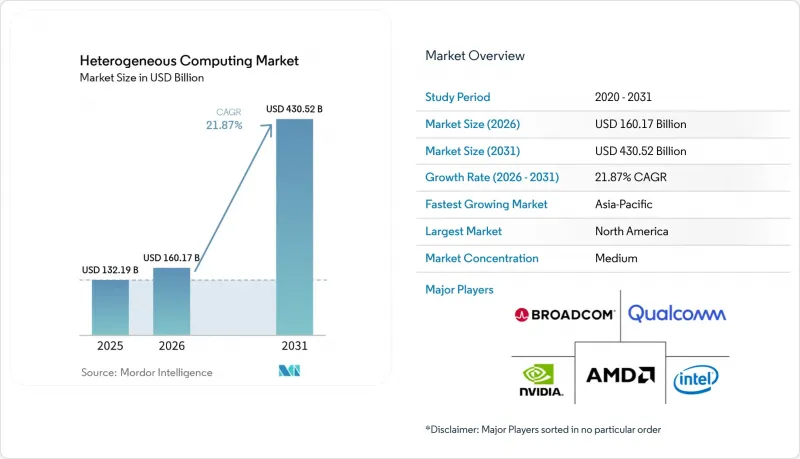
根據 Mordor Intelligence 預測,異質運算市場預計將從 2025 年的 1,321.9 億美元成長到 2026 年的 1,601.7 億美元,到 2031 年達到 4,305.2 億美元,2026 年至 2031 年的複合年成長率預計為 21.87%。
本報告按元件(硬體、軟體、服務)、部署模式(本地部署、雲端、混合部署)、處理器類型(CPU、GPU、FPGA、ASIC 等)、應用程式(人工智慧/機器學習、資料中心/雲端運算等)、最終用戶(政府/公共部門等)和地區進行細分。市場預測以美元計價。
全球異質運算市場趨勢及洞察
生成式人工智慧和大規模語言模式的工作量增加
生成式人工智慧工作負載是異質運算市場短期內最大的驅動力,促使買家將高密度訓練加速器與針對高容量推理處理最佳化的硬體結合。大規模語言模型不僅在模型訓練期間產生需求,而且在部署後很長一段時間內,還會帶來持續的服務負載,從而增加令牌處理、記憶體存取和延遲方面的要求。這使得單處理器策略的實用性降低,因為單一架構很少能在整個人工智慧工作流程中實現效能、利用率和能源效率的最佳平衡。 Google 2026 年 4 月發布的 TPU 8t 和 TPU 8i 清晰地展現了這種差異:一種設計針對大規模訓練進行了最佳化,另一種則針對並行推理和降低網路延遲進行了最佳化。因此,異構運算市場不僅取決於晶片的純粹處理速度,還取決於能夠整合不同加速器配置的平台。能夠協調晶片、互連、記憶體和軟體以滿足這些需求的供應商,離企業持續採用的目標更近了一步。
人工智慧訓練和推理中對平行處理的需求日益成長。
對平行處理日益成長的需求正將異質運算市場的作用從超大規模人工智慧擴展到模擬、研究、金融和工業計算等領域。由於沒有單一的設備類別能夠有效率地處理所有階段,這些工作負載越來越依賴CPU、GPU和專用加速器之間的協同處理。亞馬遜將於2026年發布的Graviton 5,憑藉其4晶片架構、420 GB/s的晶片間頻寬以及增強的機器學習推理性能,表明即使是CPU等級的產品也正在重新設計以適應並行人工智慧處理的特性。軟體領域也出現了類似的趨勢,AMD在MLPerf Inference 6.0上提交的首個3 GPU異質運算方案,突顯了跨不同處理器資源的編配如何直接提升效能。學術研究也支持這一方向,發表在《科學報告》(Scientific Reports)上的一項研究表明,混合雲邊緣系統中基於學習的調度可以透過動態調整工作負載以適應可用硬體來提高服務品質。因此,異構運算市場正在朝向系統級最佳化轉變,其價值不在於單一晶片的規格,而在於處理器如何協同運作。
異質系統設計與檢驗中的高資本密集度
由於多處理器系統所需的檢驗工作量遠遠超過單架構部署,其高資本密集度仍是異質運算市場發展的主要阻礙。從晶片設計和基板開發到互連調優、記憶體整合、軟體相容性測試和系統認證,每個階段都存在成本壓力。這種負擔對中型企業和新興市場營運商尤其沉重,因為它們無法承擔將工程成本分攤到龐大且穩定的運算量上。因此,市場主要集中在擁有清晰工作負載可見度和雄厚財務基礎的超大規模資料中心業者、大型企業和公共機構手中。先進的封裝要求進一步增加了成本和執行風險,從而縮小了能夠支援大規模生產部署的供應商數量。
細分市場分析
2025 年異質運算市場中,硬體佔比高達 58.41%,凸顯了當前支出嚴重偏向加速器、伺服器、記憶體和配套基礎架構。短期內,最大的收入來源仍然與 GPU 密集型資料中心的擴張相關,買家在關注軟體全面標準化之前,仍優先考慮獲取運算能力。這種支出模式也體現在時間節點上,大規模硬體部署達到商業規模的速度超過了編配和調度軟體在更廣泛的企業環境中實現商業化的速度。因此,儘管長期差異化趨勢將轉向技術堆疊的頂端,但到 2026 年,異質運算市場仍將以硬體佔據最大感知價值佔有率為特徵。
儘管GPU、FPGA、ASIC和CPU的部署量均有所成長,但GPU仍然是絕對收入貢獻最大的產品,因為它們在訓練和許多推理任務中繼續發揮核心作用。 AMD以科學和人工智慧工作負載發布的「Instinct MI430X」(配備432GB HBM4顯存和19.6TB/s頻寬)表明,硬體供應商正努力同時拓展其在研究和商業人工智慧領域的作用。預計2026年至2031年軟體的複合年成長率將達到23.16%,這意味著它將成為成長最快的領域,並表明編配框架、調度器、抽象層和記憶體管理工具的價值日益成長。隨著許多客戶仍然需要整合支援來運行混合環境並最大限度地減少部署錯誤,服務的重要性也在不斷提升。在異質運算產業,這種構成比表明,雖然硬體仍然是支出的切入點,但軟體和服務正在成為實現持續收入和提高客戶維繫的主要途徑。
預計到2025年,異質運算市場中本地部署解決方案將佔50.48%,這表明儘管雲端運算領域投入龐大,但本地基礎設施仍然是最大的部署基礎。這反映了企業級GPU叢集、大學系統和國家實驗室環境的部署歷史,這些環境已經累積了多年的資本投入。此外,由於即時推理工作負載通常需要比遠端雲端區域能夠持續提供的更低延遲,因此本地部署也受益於實際的限制。資料管理要求進一步推動了本地部署,尤其是在金融、醫療保健和政府等行業,這些行業對模型權重、訓練資料和敏感輸出結果有著更嚴格的處理規則。
預計到2031年,雲端運算將以22.78%的複合年成長率成長,成為異質運算市場中成長最快的應用模式。這項成長主要得益於超大規模資料中心業者資料中心對GPU和ASIC結合環境的投資,這些環境使客戶無需前期資本投入即可使用專用處理器。混合部署的趨勢遠超於此,企業不再使用單一環境處理所有任務,而是根據延遲、合規性和成本要求,在本地和雲端資源之間分配工作負載。龐大的本地部署基礎與快速成長的雲端業務並存,顯示異質運算市場並非單向遷移。相反,工作負載的部署變得更加靈活,這持續推動整個異質運算產業對部署柔軟性的需求。
區域分析
2025年,北美佔據異質運算市場40.83%的佔有率,其主導地位得益於該地區高度集中的超大規模資料中心、先進的人工智慧開發商以及國防相關運算項目。美國憑藉其政策立場及商業基礎設施,持續支持人工智慧叢集及相關半導體生產能力的快速部署,並持續保持此地位的核心地位。 2025年1月發布的《推進美國在人工智慧基礎設施領域領導地位的行政命令》表明,聯邦政策已開始協調大規模計算擴展的建設速度、供應穩定性和授權方向。 2026年4月,加拿大推出了人工智慧主權運算基礎設施計劃,旨在支援全部區域公司擁有的高效能人工智慧最佳化系統,進一步鞏固了區域格局。這種私營部門和公共部門的共同支持,使北美在異質運算市場的部署能力和短期採購動能方面保持了優勢。
預計到2031年,亞太地區將以22.36%的複合年成長率成長,成為異構運算市場成長最快的地區。這一成長主要得益於政府的計算支援計劃、國內對半導體研發日益成長的興趣,以及其在記憶體、封裝和更廣泛的半導體供應鏈中的核心地位。這一點意義重大,因為許多支援異質系統的核心技術,例如先進封裝和高頻寬記憶體,都集中在亞太地區的生產網路中。這種集中性加速了本地買家對這些技術的採用,同時該地區的成長也與全球對加速器、伺服器及相關組件的需求密切相關。因此,亞太地區可望進一步鞏固其在異質運算市場中的地位,成為未來系統擴展的需求中心和關鍵供應鏈。
歐洲在異構運算市場中仍扮演著重要角色,公共政策和產業現代化正推動人工智慧基礎設施在各個領域得到更廣泛的應用。英國於2026年6月發布的「人工智慧硬體計畫」尤其引人注目,該計畫將運算能力投資、對國內半導體企業的支援以及技術技能發展相結合。儘管南美、中東和非洲在2026年仍處於起步階段,但隨著各國政府和機構評估自身的運算能力和本地人工智慧基礎設施需求,市場趨勢仍在不斷改善。這些地區在資本密集度、電力系統和工程人才獲取方面面臨更高的挑戰,這意味著人工智慧的普及速度可能慢於北美和亞太地區。然而,隨著公共工程、通訊基礎設施現代化和企業人工智慧應用之間的協調性加強,這些地區仍有進一步發展的空間。
其他好處:
- Excel格式的市場預測(ME)表
- 3個月的分析師支持
目錄
第1章:引言
- 研究假設和市場定義
- 調查範圍
第2章:調查方法
第3章執行摘要
第4章 市場狀況
- 市場概覽
- 市場促進因素
- 生成式人工智慧和大規模語言模式的工作量增加
- 人工智慧訓練和推理中對平行處理的需求日益成長。
- 主權人工智慧和國家運算基礎設施的擴展
- 過渡到以能源效率和每瓦性能為優先的架構
- 擴展多模態和即時分析工作負載
- 面向低延遲運算的邊緣到雲端編配
- 市場限制因素
- 異質系統的設計和檢驗需要高額的資本投入。
- 並行程式設計和硬體/軟體協同設計方面人員短缺。
- 高密度運算環境中的熱能和電源供應限制
- 供應鏈對先進節點、HBM 和封裝能力的依賴
- 產業價值鏈分析
- 監理情勢
- 技術展望
- 宏觀經濟因素對市場的影響
- 波特五力分析
第5章 市場規模與成長預測
- 按組件
- 硬體
- 軟體
- 服務
- 部署模式
- 現場
- 雲
- 混合
- 依處理器類型
- 中央處理器(CPU)
- 圖形處理器(GPU)
- 現場可程式閘陣列(FPGA)
- 專用積體電路(ASIC)
- 其他處理器類型
- 透過使用
- 人工智慧和機器學習
- 資料中心和雲端運算
- 科學模擬與建模
- 邊緣運算
- 汽車和自動駕駛系統
- 其他用途
- 最終用戶
- 公司
- 政府/公共部門
- 研究機構和學術機構
- 通訊業者和網路營運商
- 其他最終用戶
- 按地區
- 北美洲
- 美國
- 加拿大
- 墨西哥
- 歐洲
- 德國
- 英國
- 法國
- 義大利
- 其他歐洲國家
- 亞太地區
- 中國
- 日本
- 韓國
- 印度
- 東南亞
- 其他亞太國家
- 南美洲
- 中東和非洲
- 北美洲
第6章 競爭情勢
- 市場集中度
- 策略趨勢
- Vendor Positioning Analysis
- 公司簡介
- NVIDIA Corporation
- Advanced Micro Devices, Inc.
- Intel Corporation
- Qualcomm Incorporated
- Broadcom Inc.
- Marvell Technology, Inc.
- MediaTek Inc.
- Arm Holdings plc
- Samsung Electronics Co., Ltd.
- Huawei Technologies Co., Ltd.
- Graphcore Limited
- Cerebras Systems, Inc.
- Groq, Inc.
- Tenstorrent Inc.
- SiFive, Inc.
- Cambricon Technologies Corporation Limited
- Biren Technology(Shanghai)Co., Ltd.
- Ampere Computing LLC
- SambaNova Systems, Inc.
- Untether AI Corp.
第7章 市場機會與未來展望
According to Mordor Intelligence, the heterogeneous computing market size is expected to increase from USD 132.19 billion in 2025 to USD 160.17 billion in 2026 and reach USD 430.52 billion by 2031, growing at a CAGR of 21.87% over 2026-2031.
This report is Segmented by Component (Hardware, Software, and Services), Deployment Mode (On-Premises, Cloud, and Hybrid), Processor Type (CPU, GPU, FPGA, ASIC, and More), Application (Artificial Intelligence and Machine Learning, Data Center and Cloud Computing, and More), End User (Government and Public Sector, and More), and Geography. The Market Forecasts are Provided in Terms of Value (USD).
Global Heterogeneous Computing Market Trends and Insights
Rising Generative AI and Large Language Model Workloads
Generative AI workloads are the strongest near-term force driving the heterogeneous computing market, pushing buyers to combine dense training accelerators with hardware optimized for high-volume inference. Large language models do not create demand solely through model training; they also impose a lasting serving burden that increases token throughput, memory access, and latency requirements long after deployment begins. That is making single-processor strategies less practical, since one architecture rarely delivers the best mix of performance, utilization, and power efficiency across the full AI workflow. Google's TPU 8t and TPU 8i launch in April 2026 clearly showed this split, with one design tuned for large-scale training and the other for concurrent inference and lower network latency. The heterogeneous computing market is therefore being shaped by platforms that can integrate different accelerator profiles rather than by raw chip speed alone. Vendors that can align silicon, interconnect, memory, and software around those needs are moving closer to repeat enterprise adoption.
Growing Need for Parallel Processing in AI Training and Inference
The growing need for parallel processing is widening the role of the heterogeneous computing market beyond hyperscale AI and into simulation, research, finance, and industrial computing. These workloads increasingly depend on coordinated processing across CPUs, GPUs, and specialized accelerators because no single device class handles every stage efficiently. Amazon's Graviton5 design, introduced in 2026 with a 4-chiplet structure, 420 GB/s inter-chiplet bandwidth, and stronger machine learning inference performance, showed that even CPU-class products are now being redesigned around parallel AI behavior. The same pattern is visible in software, where AMD's first 3-GPU heterogeneous submission in MLPerf Inference 6.0 highlighted how orchestration across different processor resources can become a direct performance lever. Academic work also supports this direction, with research published in Scientific Reports showing that learning-based scheduling on hybrid cloud-edge systems improves service quality by dynamically matching workloads to available hardware. As a result, the heterogeneous computing market is moving toward system-level optimization, where the value lies in how processors work together rather than in isolated chip specifications.
High Capital Intensity for Heterogeneous System Design and Validation
High capital intensity remains a major brake on the heterogeneous computing market because multi-processor systems require far more validation work than single-architecture deployments. Cost pressure appears at every stage, including silicon design, board development, interconnect tuning, memory integration, software compatibility testing, and system qualification. That burden is hardest on mid-sized enterprises and emerging-market operators that cannot spread engineering costs across very large, stable compute volumes. The result is a market where adoption can cluster among hyperscalers, large enterprises, and public institutions that have clearer workload visibility and stronger balance sheets. Advanced packaging requirements add another layer of cost and execution risk, narrowing the number of suppliers able to support production-scale deployment.
Other drivers and restraints analyzed in the detailed report include:
- Expansion of Sovereign AI and National Compute Infrastructure
- Shift Toward Energy-Efficient and Performance-Per-Watt Architectures
- Scarcity of Parallel Programming and Hardware-Software Co-Design Talent
For complete list of drivers and restraints, kindly check the Table Of Contents.
Segment Analysis
Hardware accounted for 58.41% of the heterogeneous computing market in 2025, underscoring how strongly current spending still leans toward accelerator purchases, servers, memory, and supporting infrastructure. The largest near-term revenue pool remained tied to GPU-dense data center expansion, where buyers continued to prioritize access to computing capacity before focusing on full software standardization. That spending pattern also reflected timing, since large hardware rollouts reached commercial scale faster than orchestration and scheduling software could be monetized across broad enterprise environments. The heterogeneous computing market, therefore, entered 2026 with hardware still carrying the largest share of recognized value, even though long-term differentiation is moving higher in the stack.
GPU, FPGA, ASIC, and CPU products all expanded their installed base, but GPUs drove the largest absolute revenue contribution because they remained central to both training and many inference tasks. AMD's Instinct MI430X, presented for scientific and AI workloads with 432 GB of HBM4 memory and 19.6 TB/s bandwidth, illustrated how hardware suppliers are trying to widen their role across research and commercial AI at the same time. Software is projected to grow at a 23.16% CAGR from 2026 to 2031, which makes it the fastest-growing component and points to increasing value in orchestration frameworks, schedulers, abstraction layers, and memory management tools. Services continue to matter because many customers still need integration support to operate mixed environments with fewer deployment errors. Within the heterogeneous computing industry, this mix suggests that hardware is still the entry point for spending, while software and services are becoming the main path to recurring revenue and tighter customer retention.
On-premises accounted for 50.48% of the heterogeneous computing market in 2025, underscoring that local infrastructure remained the largest deployment base despite heavy cloud investment. That position reflected the installed footprint of enterprise GPU clusters, university systems, and national laboratory environments that had already absorbed several years of capital spending. The segment also benefited from practical constraints, since real-time inference workloads often require lower latency than distant cloud regions can consistently deliver. Data control requirements added further support for local deployment, especially in finance, healthcare, and government settings, where model weights, training data, and sensitive outputs are subject to stricter handling rules.
Cloud is projected to grow at a 22.78% CAGR through 2031, making it the fastest-growing deployment mode in the heterogeneous computing market. This growth is being driven by hyperscaler investment in mixed GPU and ASIC environments that allow customers to access specialized processors without upfront capital commitments. Hybrid deployment is expanding beyond that trend, as enterprises route workloads between local and cloud resources based on latency, compliance, and cost conditions rather than using one environment for every task. The coexistence of a leading on-premises base and a faster-growing cloud segment suggests that the heterogeneous computing market is not following a one-way migration path. Instead, workload placement is becoming more selective, which sustains demand for deployment flexibility across the broader heterogeneous computing industry.
Complete Report Scope:
- By Component
- Hardware
- Software
- Services
- By Deployment Mode
- On-Premises
- Cloud
- Hybrid
- By Processor Type
- Central Processing Unit (CPU)
- Graphics Processing Unit (GPU)
- Field-Programmable Gate Array (FPGA)
- Application-Specific Integrated Circuit (ASIC)
- Other Processor Types
- By Application
- Artificial Intelligence and Machine Learning
- Data Center and Cloud Computing
- Scientific Simulation and Modeling
- Edge Computing
- Automotive and Autonomous Systems
- Other Applications
- By End User
- Enterprises
- Government and Public Sector
- Research Institutes and Academia
- Telecommunications and Network Operators
- Other End Users
- By Geography
- North America
- United States
- Canada
- Mexico
- Europe
- Germany
- United Kingdom
- France
- Italy
- Rest of Europe
- Asia-Pacific
- China
- Japan
- South Korea
- India
- Southeast Asia
- Rest of Asia-Pacific
- South America
- Middle East and Africa
- North America
Geography Analysis
North America held 40.83% of the heterogeneous computing market in 2025, and that lead rested on its deep concentration of hyperscale data centers, advanced AI developers, and defense-linked computing programs. The United States remained the core of this position because its policy stance and commercial infrastructure continued to support the fast deployment of AI clusters and related semiconductor capacity. The January 2025 executive order on advancing U.S. leadership in AI infrastructure showed that federal policy was already aligning build-out speed, supply security, and permitting direction around large-scale compute expansion. Canada strengthened the regional picture in April 2026 by launching its AI Sovereign Compute Infrastructure Program to support Canadian-owned AI-optimized high-performance systems. In the heterogeneous computing market, that combination of private scale and public support kept North America ahead on both installed capacity and near-term procurement momentum.
Asia-Pacific is projected to grow at a 22.36% CAGR through 2031, making it the fastest-growing region in the heterogeneous computing market. The region's growth is being supported by government compute programs, rising domestic chip ambitions, and its central role in memory, packaging, and broader semiconductor supply chains. This matters because many of the core enabling technologies for heterogeneous systems, including advanced packaging and high-bandwidth memory, are concentrated in Asia-Pacific production networks. That concentration can speed deployment for local buyers while also tying regional growth to global demand for accelerators, servers, and supporting components. The heterogeneous computing market is therefore likely to see Asia-Pacific strengthen both as a demand center and as a supply-side backbone for future system scaling.
Europe remained an important part of the heterogeneous computing market because public policy and industrial modernization are pushing AI infrastructure into more sectors. The United Kingdom's June 2026 AI Hardware Plan stood out because it paired compute capacity spending with support for domestic chip firms and technical skills development. South America and Middle East and Africa were earlier-stage regions in 2026, but the market direction there was still improving as governments and institutions evaluated sovereign compute capacity and local AI infrastructure needs. These regions face higher barriers around capital intensity, power systems, and engineering availability, which means adoption may move in steps rather than at the same pace seen in North America or Asia-Pacific. Even so, the heterogeneous computing market has room to deepen in these regions when public programs, telecom modernization, and enterprise AI deployment become more coordinated.
- NVIDIA Corporation
- Advanced Micro Devices, Inc.
- Intel Corporation
- Qualcomm Incorporated
- Broadcom Inc.
- Marvell Technology, Inc.
- MediaTek Inc.
- Arm Holdings plc
- Samsung Electronics Co., Ltd.
- Huawei Technologies Co., Ltd.
- Graphcore Limited
- Cerebras Systems, Inc.
- Groq, Inc.
- Tenstorrent Inc.
- SiFive, Inc.
- Cambricon Technologies Corporation Limited
- Biren Technology (Shanghai) Co., Ltd.
- Ampere Computing LLC
- SambaNova Systems, Inc.
- Untether AI Corp.
Additional Benefits:
- The market estimate (ME) sheet in Excel format
- 3 months of analyst support
TABLE OF CONTENTS
1 INTRODUCTION
- 1.1 Study Assumptions and Market Definition
- 1.2 Scope of the Study
2 RESEARCH METHODOLOGY
3 EXECUTIVE SUMMARY
4 MARKET LANDSCAPE
- 4.1 Market Overview
- 4.2 Market Drivers
- 4.2.1 Rising Generative AI and Large Language Model Workloads
- 4.2.2 Growing Need for Parallel Processing in AI Training and Inference
- 4.2.3 Expansion of Sovereign AI and National Compute Infrastructure
- 4.2.4 Shift Toward Energy-Efficient and Performance-per-Watt Architectures
- 4.2.5 Growth of Multimodal and Real-Time Analytics Workloads
- 4.2.6 Edge-to-Cloud Orchestration for Low-Latency Compute
- 4.3 Market Restraints
- 4.3.1 High Capital Intensity for Heterogeneous System Design and Validation
- 4.3.2 Scarcity of Parallel Programming and Hardware-Software Co-Design Talent
- 4.3.3 Thermal and Power Delivery Constraints in Dense Compute Environments
- 4.3.4 Supply Chain Dependence on Advanced Nodes, HBM, and Packaging Capacity
- 4.4 Industry Value Chain Analysis
- 4.5 Regulatory Landscape
- 4.6 Technological Outlook
- 4.7 Impact of Macroeconomic Factors on the Market
- 4.8 Porter's Five Forces Analysis
- 4.8.1 Threat of New Entrants
- 4.8.2 Bargaining Power of Suppliers
- 4.8.3 Bargaining Power of Buyers
- 4.8.4 Threat of Substitutes
- 4.8.5 Competitive Rivalry
5 MARKET SIZE AND GROWTH FORECASTS (VALUE)
- 5.1 By Component
- 5.1.1 Hardware
- 5.1.2 Software
- 5.1.3 Services
- 5.2 By Deployment Mode
- 5.2.1 On-Premises
- 5.2.2 Cloud
- 5.2.3 Hybrid
- 5.3 By Processor Type
- 5.3.1 Central Processing Unit (CPU)
- 5.3.2 Graphics Processing Unit (GPU)
- 5.3.3 Field-Programmable Gate Array (FPGA)
- 5.3.4 Application-Specific Integrated Circuit (ASIC)
- 5.3.5 Other Processor Types
- 5.4 By Application
- 5.4.1 Artificial Intelligence and Machine Learning
- 5.4.2 Data Center and Cloud Computing
- 5.4.3 Scientific Simulation and Modeling
- 5.4.4 Edge Computing
- 5.4.5 Automotive and Autonomous Systems
- 5.4.6 Other Applications
- 5.5 By End User
- 5.5.1 Enterprises
- 5.5.2 Government and Public Sector
- 5.5.3 Research Institutes and Academia
- 5.5.4 Telecommunications and Network Operators
- 5.5.5 Other End Users
- 5.6 By Geography
- 5.6.1 North America
- 5.6.1.1 United States
- 5.6.1.2 Canada
- 5.6.1.3 Mexico
- 5.6.2 Europe
- 5.6.2.1 Germany
- 5.6.2.2 United Kingdom
- 5.6.2.3 France
- 5.6.2.4 Italy
- 5.6.2.5 Rest of Europe
- 5.6.3 Asia-Pacific
- 5.6.3.1 China
- 5.6.3.2 Japan
- 5.6.3.3 South Korea
- 5.6.3.4 India
- 5.6.3.5 Southeast Asia
- 5.6.3.6 Rest of Asia-Pacific
- 5.6.4 South America
- 5.6.5 Middle East and Africa
- 5.6.1 North America
6 COMPETITIVE LANDSCAPE
- 6.1 Market Concentration
- 6.2 Strategic Moves
- 6.3 Vendor Positioning Analysis
- 6.4 Company Profiles (includes Global Level Overview, Market Level Overview, Core Segments, Financials as available, Strategic Information, Market Rank/Share, Products and Services, Recent Developments)
- 6.4.1 NVIDIA Corporation
- 6.4.2 Advanced Micro Devices, Inc.
- 6.4.3 Intel Corporation
- 6.4.4 Qualcomm Incorporated
- 6.4.5 Broadcom Inc.
- 6.4.6 Marvell Technology, Inc.
- 6.4.7 MediaTek Inc.
- 6.4.8 Arm Holdings plc
- 6.4.9 Samsung Electronics Co., Ltd.
- 6.4.10 Huawei Technologies Co., Ltd.
- 6.4.11 Graphcore Limited
- 6.4.12 Cerebras Systems, Inc.
- 6.4.13 Groq, Inc.
- 6.4.14 Tenstorrent Inc.
- 6.4.15 SiFive, Inc.
- 6.4.16 Cambricon Technologies Corporation Limited
- 6.4.17 Biren Technology (Shanghai) Co., Ltd.
- 6.4.18 Ampere Computing LLC
- 6.4.19 SambaNova Systems, Inc.
- 6.4.20 Untether AI Corp.
7 MARKET OPPORTUNITIES AND FUTURE OUTLOOK
- 7.1 White-Space and Unmet-Need Assessment

 2026年全球高效能運算平台(人工智慧應用)市場報告
 全球資料中心運算與人工智慧市場(2027-2040 年)
 資料處理單元市場報告:趨勢、預測與競爭分析(至2035年)
 高效能運算市場機會、成長要素、產業趨勢分析及2026-2035年預測。
 混合量子與經典計算軟體:市場佔有率分析、產業趨勢與統計及成長預測(2026-2031)高效能運算:市場佔有率分析、產業趨勢與統計及成長預測(2026-2031 年)
 高效能運算市場:按組件、技術、資料類型、最終用戶、部署模式和組織規模分類-2026-2032年全球市場預測加速計算:市場佔有率分析、行業趨勢和統計數據、成長預測(2026-2031 年)雲端運算高效能運算(HPC):市場佔有率分析、產業趨勢與統計及成長預測(2026-2031 年)高效能運算 (HPC) 市場規模、佔有率、成長率和全球產業分析:按類型、應用和地區分類的洞察,2026-2034 年預測