


 |
市場調查報告書
商品編碼
2118195
螯合微量元素肥料:市場佔有率分析、產業趨勢與統計、成長預測(2026-2031)Chelated Micronutrient Fertilizers - Market Share Analysis, Industry Trends & Statistics, Growth Forecasts (2026 - 2031) |
||||||

※ 本網頁內容可能與最新版本有所差異。詳細情況請與我們聯繫。
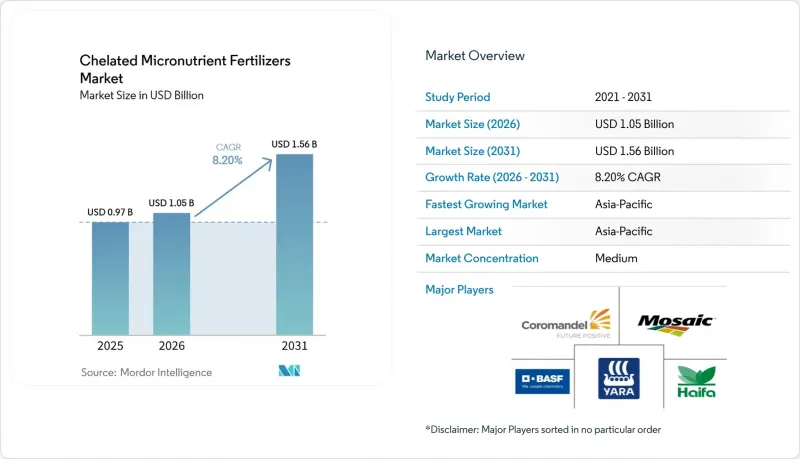
根據 Mordor Intelligence 預測,螯合微量元素肥料的市場規模預計將從 2025 年的 9.7 億美元和 2026 年的 10.5 億美元成長到 2031 年的 15.6 億美元,2026 年至 2031 年的年複合成長率(CAGR)為 8.20%。
本報告按微量元素類型(鋅、鐵、錳等)、形態(乾粉、液體)、螯合劑(EDTA、EDDHA等)、作物類型(水果、蔬菜等)、施用方法(施肥/灌溉、葉面噴布等)和地區(北美、歐洲等)進行分類。市場預測以價值(美元)和數量(公噸)表示。
螯合微量元素肥料的全球市場趨勢與洞察
集約化農業耕作地區土壤中微量元素消耗的進程。
螯合微量元素肥料市場需求旺盛,主要受作物輪作系統的影響,因為該系統消耗蘊藏量微量元素的速度遠超過其補充速度。 2024年發表於《土壤科學前沿》(Frontiers in Soil Science)的一項研究發現,在印度28個邦採集的土壤樣本中,38%存在鋅缺乏,凸顯了大規模商業農業基地面臨的這一農業化學品挑戰的嚴重性。在灌溉量大的地區,鋅缺乏商業性的影響更為顯著,因為這些地區的生產者既有經濟獎勵,也有農業化學品能力過渡到高品質的養分改良方案。 2024年發表於《土壤科學與植物營養雜誌》(Journal of Soil Science and Plant Nutrition)的一項研究表明,鋅產品會因劣化、淋溶和遷移等原因,導致土壤中植物可利用的鋅含量下降,這證實了即使重複使用,穩定的螯合鋅供應也能保持高效。隨著生產者在這些土壤條件下獲得更可靠的作物反應,從低成本鹽類肥料轉向螯合微量元素肥料的趨勢將難以逆轉,從而維持了對螯合微量元素肥料的需求。
精密農業正在推動處方型微量營養素的使用量增加。
可變施肥系統、遙感探測和土壤測繪技術的普及,使微量元素管理更加精準,減少了被動應對,市場從中受益匪淺。 2026年發表於《應用水科學研究》的一篇文章說明了精準施肥系統如何將感測器、控制器和注入裝置相結合,在合適的時間和地點為每種作物提供最佳養分——這是廣譜噴灑無法實現的。隨著農民和服務供應商越來越需要穩定性好、吸收特性明確且與精密儀器相容的產品,採購行為正在改變。BASF公司於2025年10月在日本推出“xarvio HEALTHY FIELDS for RiTA”,進一步發展了這個理念。該服務將人工智慧(AI)驅動的土壤改良服務和養分處方支援與水稻產量保證模式相結合。隨著這些數據主導計畫的日益普及,螯合微量元素肥料市場正受益於從通用配方轉向針對特定養分處方策略的客製化配方。
與傳統微量元素肥料相比,成本較高
螯合微量元素肥料市場最大的結構性限制仍是價格。這是因為螯合產品通常比同等硫酸鹽類產品更貴。這種價格差異可能是傳統產品的1.5到2.5倍,這對預算有限的小規模農戶和作物種植者來說構成了障礙。雖然降低施用量可以在一定程度上抵消這種差異,但僅靠節省的成本往往不足以改變主糧作物種植者的行為,因為在這些作物中,即時成本仍然是主要的決策因素。這種影響在穀物和其他商品作物中最為顯著,因為良好的農藥效果並不一定能轉化為顯著的短期經濟效益。因此,螯合微量元素肥料市場仍集中在園藝、出口農業、人工環境以及其他對維持品質和產量穩定性有更高商業性價值的農業系統。
細分市場分析
鋅仍是最大的營養元素類別,在2025年佔螯合微量元素肥料市場的26.2%。這一地位反映了鋅缺乏症的廣泛地域性,以及穀物、蔬菜和園藝系統整體需要可靠的鋅缺乏症糾正措施。 2024年發表在MDPI期刊《植物》(Plants)上的一篇綜述指出,鋅是熱帶土壤中最缺乏的微量元素,報告顯示全部區域鋅含量不足的問題,並強調了鋅在熱帶農業中的商業性重要性。鐵也是一個重要的組成部分,因為它對於糾正鈣質土壤中鐵的有效性迅速下降導致的黃化病至關重要。錳、銅和鉬在螯合微量元素肥料市場中也扮演著重要角色,因為它們與特定的酶功能、固氮作用以及作物特定的營養規劃密切相關。
預計硼將成為微量營養素類別中成長最快的元素,到2031年將以9.1%的複合年成長率成長。這一成長與水果、蔬菜和油籽種植面積的增加密切相關,因為硼缺乏會直接影響這些作物的開花、結果、種子形成和品質。其商業性邏輯顯而易見:這些作物種植系統的生產者通常更願意為營養管理方案付費,以避免明顯的、不可逆轉的產量損失。至於鐵,預計它將繼續在技術難度較高的土壤中發揮關鍵作用,因為即使更簡單的配方效果有所下降,基於EDDHA的補充方法仍然表現優異。因此,營養素的整體組成在滿足大規模缺乏糾正需求和支持小規模但生長迅速、高價值作物生產的特殊用途之間取得了平衡。
在螯合微量元素肥料市場,乾粉製劑佔最大佔有率,預計到2025年將達到58.4%。乾粉產品之所以能保持其主導地位,是因為它們易於儲存,可透過傳統通路便捷運輸,並且適用於仍依賴標準處理系統的大型農場的種植方案。此外,它們也滿足了那些傾向於大規模採購慣例糧食作物、追求更長保存期限和熟悉施用方法的生產者的需求。這些實際優勢解釋了為什麼即使施用方法不斷發展,乾粉產品在銷售量方面仍然保持核心地位。
預計液態肥料將實現最快成長,到2031年將以8.8%的複合年成長率成長。這項轉變與肥料灌溉、保護性栽培、水耕以及其他需要精確溶解和穩定營養輸送的系統密切相關。液態肥料也非常適合商業園藝中日益普及的低劑量、高頻率施肥方案。此外,新型可生物分解螯合劑非常適合液態肥料的開發,因為這類肥料能夠輕鬆兼顧營養輸送、易於操作和系統相容性等優點。因此,液態肥料並非迅速取代乾粉肥料,而是一個漸進的過程:液態肥料在技術先進的作物栽培系統中佔據市場佔有率不斷擴大,而乾粉肥料在傳統施肥模式中仍然佔據主導地位。
區域分析
預計到2025年,亞太地區將佔據螯合微量元素肥料市場25.3%的佔有率,並將維持所有地區中最高的成長率,到2031年複合年成長率將達到8.9%。這種雙重主導地位反映了中國和印度的作物生產規模,以及該地區集約化耕作土壤中普遍存在的微量元素缺乏問題。 2024年發表在《土壤科學前沿》(Frontiers in Soil Science)上的一項印度研究發現,在從28個邦採集的土壤樣本中,38%的樣本存在鋅缺乏,這凸顯了該地區最大的農業系統之一亟需進行更有針對性的改進。此外,隨著滴灌、葉面噴布和作物專項諮詢計畫在商業農業中的普及,水溶性產品在該地區的應用也日益廣泛。BASF公司於 2025 年 10 月在日本推出面向 RiTA 的“xarvio HEALTHY FIELDS”,這表明數位農業和微量營養素處方箋可以整合到服務主導的模式中,這對螯合微量營養素肥料市場的未來發展方向至關重要。
歐洲長期以來在螯合微量元素肥料市場佔有重要地位。這是因為該地區的生產商面臨更嚴格的食品品質要求,擁有更完善的農業化學品支持體系,並且能夠更廣泛地使用精準施肥技術。西班牙、義大利、德國和法國仍然是該市場的核心參與者。這是因為地中海地區的園藝和多年生作物生產系統需要在密集生產條件下確保微量元素的可靠供應。此外,歐洲的法規環境也更為嚴格,尤其是對於必須符合歐盟肥料法規和永續性要求的產品系列。因此,與許多其他地區相比,可生物分解的螯合劑在歐洲的重要性日益凸顯。由此可見,歐洲不僅影響當地的需求,也影響服務多個市場的供應商的全球配方策略。
北美和南美都是長期成長的關鍵地區,但兩者對螯合微量元素肥料的需求結構卻有所不同。在北美,精密農業發展更為成熟,施肥灌溉、變數施肥系統以及精細化的土壤管理推動了螯合微量元素肥料在特種作物和先進行種植作物種植中的應用。而南美洲則深受熱帶和亞熱帶地區農業現實的影響,尤其是在巴西,鋅和硼的缺乏仍然是大規模種植系統中面臨的重大挑戰。中東和非洲雖然銷售量相對小規模,但卻是具有重要戰略意義的地區,因為溫室種植、出口導向園藝以及嚴格的用水管理正在推動清潔高效微量元素肥料的供應。在全部區域,隨著生產者將灌溉管理、商業作物集約化種植以及對更穩定養分吸收的迫切需求相結合,螯合微量元素肥料的市場正在不斷擴大。
其他好處:
- Excel格式的市場預測(ME)表
- 3個月的分析師支持
目錄
第1章:引言
- 研究假設和市場定義
- 調查範圍
- 調查方法
第2章:本報告的內容
第3章:執行摘要和主要發現
第4章:主要產業趨勢
- 主要農作物種植面積
- 田間作物
- 園藝作物
- 草坪和觀賞植物
- 平均施肥量
- 主要營養素
- 田間作物
- 園藝作物
- 草坪和觀賞植物
- 主要營養素
- 法律規範
- 價值鍊和通路分析
- 市場促進因素
- 集約化農業耕作地區土壤中微量元素消耗的進程。
- 精密農業正在推動處方型微量營養素的使用量增加。
- 保護高價值作物產量的需求推動了對含螯合劑產品的需求。
- 水溶性螯合劑可增強與施肥和灌溉的相容性。
- 對永續性的壓力正在加速採用低劑量營養最佳化方案。
- 與傳統微量營養素鹽相比,其優異的生物利用度是推動這項轉變的關鍵因素。
- 市場限制因素
- 與傳統微量營養素投入相比,成本更高。
- 由於不相容的罐混劑,農民有誤用的風險
- 性能會因土壤酸鹼度和水硬度條件而異。
- 監管機構對螯合劑的持久性和環境行為的審查。
第5章 市場規模與成長預測
- 依微量營養素類型
- 鋅
- 鐵
- 錳
- 硼
- 銅
- 鉬
- 其他類型的微量營養素
- 按形式
- 乾燥
- 液體
- 螯合劑
- EDTA
- EDDHA
- DTPA
- IDHA
- 其他螯合劑
- 按作物類型
- 水果和蔬菜
- 穀類和穀類食品
- 油籽/豆類
- 其他作物類型
- 透過使用
- 葉片表面
- 土壤
- 灌溉
- 種子處理
- 按地區
- 北美洲
- 美國
- 加拿大
- 其他北美國家
- 南美洲
- 巴西
- 阿根廷
- 其他南美國家
- 歐洲
- 德國
- 法國
- 英國
- 義大利
- 西班牙
- 俄羅斯
- 其他歐洲國家
- 亞太地區
- 中國
- 印度
- 日本
- 韓國
- 澳洲
- 其他亞太國家
- 中東
- 沙烏地阿拉伯
- 阿拉伯聯合大公國
- 土耳其
- 其他中東國家
- 非洲
- 南非
- 埃及
- 奈及利亞
- 其他非洲國家
- 北美洲
第6章 競爭情勢
- 市場集中度
- 策略趨勢
- 市佔率分析
- 公司簡介
- BASF SE
- The Mosaic Company
- Haifa Group
- Yara International ASA
- Coromandel International Limited
- Nouryon Chemicals Holding BV
- Valagro SpA
- ADOB Sp. z oo Sp.j.
- ATP Nutrition, LLC
- BMS Micro-Nutrients BV
- Van Iperen International BV
- Wilbur-Ellis Company LLC
- ICL Group Ltd.
- The Andersons, Inc.
- Nufarm Limited
第7章 化肥產業執行長面臨的關鍵策略挑戰
According to Mordor Intelligence, the chelated micronutrient fertilizers market size is projected to expand from USD 0.97 billion in 2025 and USD 1.05 billion in 2026 to USD 1.56 billion by 2031, registering a CAGR of 8.20% between 2026 and 2031.
This report is Segmented by Micronutrient Type (Zinc, Iron, Manganese, and More), by Form (Dry and Liquid), by Chelating Agent (EDTA, EDDHA, and More), by Crop Type (Fruits and Vegetables, and More), by Application Mode (Fertigation, Foliar, and More), and by Geography (North America, Europe, and More). The Market Forecasts are Provided in Terms of Value (USD) and Volume (Metric Tons).
Global Chelated Micronutrient Fertilizers Market Trends and Insights
Rising Micronutrient Depletion in Intensively Farmed Soils
The chelated micronutrient fertilizers market is seeing strong support from continuous cropping systems that are depleting micronutrient reserves faster than they are replenished. A 2024 study in Frontiers in Soil Science reported that zinc deficiency in India was documented in 38% of soil samples collected across 28 states, confirming the scale of the agronomic problem in a large commercial farming base . The commercial effect is stronger in productive irrigation belts, where growers have both the economic incentive and the agronomic capability to shift toward premium nutrient correction programs. Research published in the Journal of Soil Science and Plant Nutrition in 2024 showed that zinc products can lose plant-available fractions in soil through aging, leaching, and migration, supporting the performance case for stable chelated delivery under repeated use. Once growers see more reliable crop response under these soil conditions, the chelated micronutrient fertilizers market tends to retain that demand because the move away from low-cost salts becomes harder to reverse.
Precision Agriculture is Increasing Prescription-Based Micronutrient Use
The market is benefiting from the spread of variable-rate systems, remote sensing, and soil mapping, which make micronutrient management more targeted and less reactive. Research in Applied Water Science in 2026 described how precision fertigation systems combine sensors, controllers, and injection units to deliver crop-specific nutrients with timing and placement that broadcast methods cannot match. This changes procurement behavior because growers and service providers increasingly want products with consistent stability, known uptake behavior, and compatibility with precision equipment. BASF SE expanded this logic in October 2025 when it launched xarvio HEALTHY FIELDS for RiTA in Japan, combining artificial intelligence-based soil improvement services and nutrient prescription support with a yield guarantee model for rice farmers. As these data-led programs become more common, the chelated micronutrient fertilizers market gains from the shift away from generic blends and toward defined formulations that fit prescription nutrition strategies.
Higher Cost Versus Conventional Micronutrient Inputs
Pricing remains the most significant structural constraint in the chelated micronutrient fertilizers market, as chelated products typically cost more than comparable sulfate-based alternatives. This premium can range from 1.5 to 2.5 times the cost of conventional options, creating a barrier for smallholder farming systems and crops with limited input budgets. Lower application rates help offset that difference, but the saving is often not enough to change grower behavior in staple crop programs where immediate cost still drives decisions. The effect is strongest in cereals and other commodity crops, where a favorable agronomic response does not always translate into a convincing short-term economic return. That keeps the chelated micronutrient fertilizers market more concentrated in horticulture, export agriculture, controlled environments, and other farm systems where quality protection and yield stability carry higher commercial value.
Other drivers and restraints analyzed in the detailed report include:
- Yield Protection in High-Value Crops is Supporting Chelated Formulations
- Water-Soluble Chelates are Expanding Fertigation Compatibility
- Regulatory Scrutiny Around Chelating Agent Persistence and Environmental Fate
For complete list of drivers and restraints, kindly check the Table Of Contents.
Segment Analysis
Zinc remained the largest nutrient category, accounting for 26.2% of the chelated micronutrient fertilizers market in 2025. This position reflects the broad geographic spread of zinc deficiency and the practical need for dependable correction across grain, vegetable, and horticultural systems. A 2024 review in Plants from MDPI noted that zinc is the most deficient micronutrient in tropical soils and reported weak zinc status across Brazil's Cerrado region, underscoring its commercial relevance in tropical agriculture. Iron is one of the major segments because it remains essential for correcting chlorosis in calcareous soils, where iron availability breaks down quickly. Manganese, copper, and molybdenum also retained a role in the chelated micronutrient fertilizers market because their use is tied to specific enzyme functions, nitrogen fixation support, and crop-specific nutrition plans.
Boron is projected to register the fastest growth among micronutrient categories, expanding at a 9.1% CAGR through 2031. That growth is tied to rising acreage for fruit, vegetables, and oilseeds, where boron deficiency can directly affect flowering, fruit set, seed development, and quality. The commercial logic is straightforward: growers in these crop systems are usually more willing to pay for nutrient programs that prevent visible, irreversible production losses. Iron is likely to remain important in technically difficult soils because EDDHA-based delivery continues to offer strong performance, even as simpler formulations lose effectiveness. The broader nutrient mix, therefore, remains balanced between large-volume deficiency correction and smaller, but faster-growing, specialty uses that support higher-value crop production.
Dry formulations accounted for the largest share of the chelated micronutrient fertilizers market, representing 58.4% in 2025. Dry products kept this lead because they are easier to store, easier to move through conventional distribution channels, and better suited to broad-acre programs that still depend on standard handling systems. They also align well with bulk procurement practices for grain crops and with growers who prefer longer shelf life and familiar application formats. These practical advantages help explain why dry products remain the base volume category even as application methods continue to evolve.
Liquid formulations are projected to register the fastest growth, expanding at a CAGR of 8.8% through 2031. This shift is closely linked to the wider use of fertigation, protected cultivation, hydroponics, and other systems that require accurate dissolution and stable nutrient delivery. Liquid products are also better aligned with low-dose, high-frequency feeding schedules that commercial horticulture increasingly prefers. Newer biodegradable chelates also fit naturally into liquid product development because these formats make it easier to combine nutrient delivery with handling convenience and system compatibility. The result is a gradual form transition, not a sudden replacement, with liquids gaining share in technically advanced crop systems while dry products continue to dominate older application models.
Complete Report Scope:
- By Micronutrient Type
- Zinc
- Iron
- Manganese
- Boron
- Copper
- Molybdenum
- Other Micronutrient Types
- By Form
- Dry
- Liquid
- By Chelating Agent
- EDTA
- EDDHA
- DTPA
- IDHA
- Other Chelating Agents
- By Crop Type
- Fruits and Vegetables
- Cereals and Grains
- Oilseeds and Pulses
- Other Crop Types
- By Application
- Foliar
- Soil
- Fertigation
- Seed Treatment
- By Geography
- North America
- United States
- Canada
- Rest of North America
- South America
- Brazil
- Argentina
- Rest of South America
- Europe
- Germany
- France
- United Kingdom
- Italy
- Spain
- Russia
- Rest of Europe
- Asia-Pacific
- China
- India
- Japan
- South Korea
- Australia
- Rest of Asia-Pacific
- Middle East
- Saudi Arabia
- United Arab Emirates
- Turkey
- Rest of Middle East
- Africa
- South Africa
- Egypt
- Nigeria
- Rest of Africa
- North America
Geography Analysis
Asia-Pacific accounted for 25.3% of the chelated micronutrient fertilizers market share in 2025 and is also projected to post the fastest regional CAGR of 8.9% through 2031. This dual lead reflects the scale of crop production in China and India and the depth of unresolved micronutrient deficiency across intensively farmed soils in the region. The 2024 Frontiers in Soil Science study on India confirmed zinc deficiency in 38% of sampled soils from 28 states, underscoring the need for more targeted correction in one of the region's largest agricultural systems. The region is also seeing stronger adoption of water-soluble products as drip irrigation, foliar feeding, and crop-specific advisory programs become more common in commercial farming. BASF SE's October 2025 launch of xarvio HEALTHY FIELDS for RiTA in Japan showed how digital agronomy and micronutrient prescription can be bundled into service-led models, which is important for the future direction of the chelated micronutrient fertilizers market.
Europe held a significant position in the chelated micronutrient fertilizers market because growers there operate with tighter food quality requirements, stronger agronomic support systems, and broader access to precision application technology. Spain, Italy, Germany, and France remain central because Mediterranean horticulture and permanent crop systems need reliable micronutrient performance under intensive production conditions. The regulatory setting is also more demanding, especially for product portfolios that must align with European Union fertilizer rules and sustainability expectations. That is why biodegradable chelates are becoming more relevant in Europe than in many other regions. The region, therefore, influences not only local demand but also global formulation strategies for suppliers serving multiple markets.
North America and South America showed different demand structures within the chelated micronutrient fertilizers market, even though both regions are important to long-term growth. North America reflects greater maturity in precision farming, where fertigation, variable-rate systems, and detailed soil management support adoption in specialty crops and advanced row-crop operations. South America is more strongly tied to the agronomic realities of tropical and subtropical production, especially in Brazil, where zinc and boron deficiencies remain important in large-scale cropping systems. The Middle East and Africa remain smaller in volume, but they are strategically relevant because greenhouse production, export horticulture, and water-use discipline favor clean and efficient micronutrient delivery. Across these regions, the chelated micronutrient fertilizers market is strengthening as growers combine irrigation control, commercial crop intensity, and a clear need for more stable nutrient uptake.
- BASF SE
- The Mosaic Company
- Haifa Group
- Yara International ASA
- Coromandel International Limited
- Nouryon Chemicals Holding B.V.
- Valagro S.p.A.
- ADOB Sp. z o.o. Sp.j.
- ATP Nutrition, LLC
- BMS Micro-Nutrients B.V.
- Van Iperen International B.V.
- Wilbur-Ellis Company LLC
- ICL Group Ltd.
- The Andersons, Inc.
- Nufarm Limited
Additional Benefits:
- The market estimate (ME) sheet in Excel format
- 3 months of analyst support
TABLE OF CONTENTS
1 INTRODUCTION
- 1.1 Study Assumptions and Market Definition
- 1.2 Scope of the Study
- 1.3 Research Methodology
2 REPORT OFFERS
3 EXECUTIVE SUMMARY AND KEY FINDINGS
4 KEY INDUSTRY TRENDS
- 4.1 Acreage of Major Crop Types
- 4.1.1 Field Crops
- 4.1.2 Horticultural Crops
- 4.1.3 Turf and Ornamental
- 4.2 Average Nutrient Application Rates
- 4.2.1 Primary Nutrients
- 4.2.1.1 Field Crops
- 4.2.1.2 Horticultural Crops
- 4.2.1.3 Turf and Ornamental
- 4.2.1 Primary Nutrients
- 4.3 Regulatory Framework
- 4.4 Value Chain and Distribution Channel Analysis
- 4.5 Market Drivers
- 4.5.1 Rising micronutrient depletion in intensively farmed soils
- 4.5.2 Precision agriculture is increasing prescription-based micronutrient use
- 4.5.3 Yield protection in high-value crops is supporting chelated formulations
- 4.5.4 Water-soluble chelates are expanding fertigation compatibility
- 4.5.5 Sustainability pressure is accelerating low-dose nutrient efficiency adoption
- 4.5.6 Bioavailability advantage over conventional micronutrient salts is driving conversion
- 4.6 Market Restraints
- 4.6.1 Higher cost versus conventional micronutrient inputs
- 4.6.2 Farmer misapplication risk from incompatible tank mixes
- 4.6.3 Variable performance across soil pH and water hardness conditions
- 4.6.4 Regulatory scrutiny around chelating agent persistence and environmental fate
5 MARKET SIZE AND GROWTH FORECASTS (VALUE AND VOLUME)
- 5.1 By Micronutrient Type
- 5.1.1 Zinc
- 5.1.2 Iron
- 5.1.3 Manganese
- 5.1.4 Boron
- 5.1.5 Copper
- 5.1.6 Molybdenum
- 5.1.7 Other Micronutrient Types
- 5.2 By Form
- 5.2.1 Dry
- 5.2.2 Liquid
- 5.3 By Chelating Agent
- 5.3.1 EDTA
- 5.3.2 EDDHA
- 5.3.3 DTPA
- 5.3.4 IDHA
- 5.3.5 Other Chelating Agents
- 5.4 By Crop Type
- 5.4.1 Fruits and Vegetables
- 5.4.2 Cereals and Grains
- 5.4.3 Oilseeds and Pulses
- 5.4.4 Other Crop Types
- 5.5 By Application
- 5.5.1 Foliar
- 5.5.2 Soil
- 5.5.3 Fertigation
- 5.5.4 Seed Treatment
- 5.6 By Geography
- 5.6.1 North America
- 5.6.1.1 United States
- 5.6.1.2 Canada
- 5.6.1.3 Rest of North America
- 5.6.2 South America
- 5.6.2.1 Brazil
- 5.6.2.2 Argentina
- 5.6.2.3 Rest of South America
- 5.6.3 Europe
- 5.6.3.1 Germany
- 5.6.3.2 France
- 5.6.3.3 United Kingdom
- 5.6.3.4 Italy
- 5.6.3.5 Spain
- 5.6.3.6 Russia
- 5.6.3.7 Rest of Europe
- 5.6.4 Asia-Pacific
- 5.6.4.1 China
- 5.6.4.2 India
- 5.6.4.3 Japan
- 5.6.4.4 South Korea
- 5.6.4.5 Australia
- 5.6.4.6 Rest of Asia-Pacific
- 5.6.5 Middle East
- 5.6.5.1 Saudi Arabia
- 5.6.5.2 United Arab Emirates
- 5.6.5.3 Turkey
- 5.6.5.4 Rest of Middle East
- 5.6.6 Africa
- 5.6.6.1 South Africa
- 5.6.6.2 Egypt
- 5.6.6.3 Nigeria
- 5.6.6.4 Rest of Africa
- 5.6.1 North America
6 COMPETITIVE LANDSCAPE
- 6.1 Market Concentration
- 6.2 Strategic Moves
- 6.3 Market Share Analysis
- 6.4 Company Profiles (Includes Global Level Overview, Market Level Overview, Core Business Segments, Financials, Key Information, Market Rank, Market Share, Products and Services, and Analysis of Recent Developments)
- 6.4.1 BASF SE
- 6.4.2 The Mosaic Company
- 6.4.3 Haifa Group
- 6.4.4 Yara International ASA
- 6.4.5 Coromandel International Limited
- 6.4.6 Nouryon Chemicals Holding B.V.
- 6.4.7 Valagro S.p.A.
- 6.4.8 ADOB Sp. z o.o. Sp.j.
- 6.4.9 ATP Nutrition, LLC
- 6.4.10 BMS Micro-Nutrients B.V.
- 6.4.11 Van Iperen International B.V.
- 6.4.12 Wilbur-Ellis Company LLC
- 6.4.13 ICL Group Ltd.
- 6.4.14 The Andersons, Inc.
- 6.4.15 Nufarm Limited


