


 |
市場調查報告書
商品編碼
2118046
行銷雲:市場佔有率分析、產業趨勢與統計資料、成長預測(2026-2031 年)Marketing Cloud - Market Share Analysis, Industry Trends & Statistics, Growth Forecasts (2026 - 2031) |
||||||

※ 本網頁內容可能與最新版本有所差異。詳細情況請與我們聯繫。
根據 Mordor Intelligence 預測,行銷雲端市場規模預計將在 2025 年達到 463.4 億美元,在 2026 年達到 510.9 億美元,並在 2026 年至 2031 年以 13.71% 的複合年成長率成長,到 2031 億美元達到 971.1 億美元。
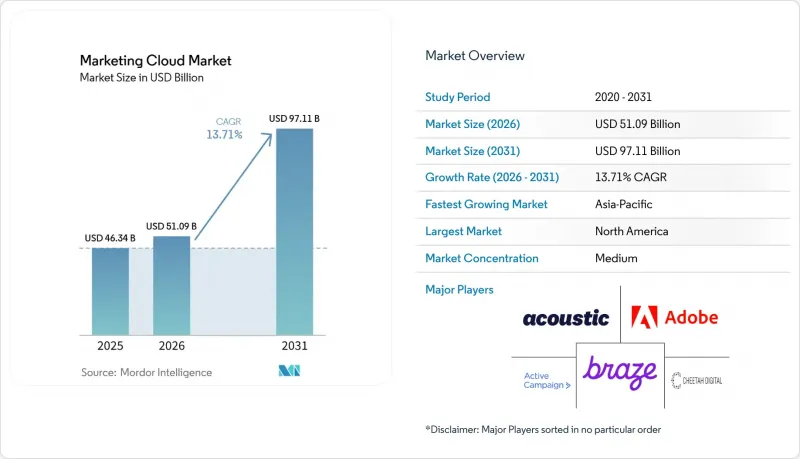
本報告按組件(平台和服務)、部署類型(公共雲端、混合雲端、私有雲端)、組織規模(大型企業和中小企業)、行銷職能(廣告和品牌推廣等)、終端用戶產業(銀行、金融服務和保險、IT和電信等)以及地區進行細分。市場預測以價值(美元)表示。
全球行銷雲端市場趨勢與洞察
人工智慧驅動的宣傳活動編配和內容生成
生成式人工智慧正從試點階段走向企業整個行銷體系的日常應用。 Salesforce 於 2026 年 6 月發布了銷售團隊 Marketing,這是一個人工智慧代理可以識別潛在客戶、創建全通路內容並最佳化宣傳活動以實現收入目標的平台。據銷售團隊稱,早期採用者 Rawlings 在實施該平台後,宣傳活動創建時間縮短了 75%,這表明自動化開始對執行速度產生顯著影響。這種轉變也將改變團隊分配任務的方式,使編配和重複性生產工作擺脫手動工作流程的束縛。在整個行銷雲端市場,率先採用這些功能的供應商很可能比行動遲緩的競爭對手擁有更強大的數據和工作流程優勢。此外,歐盟人工智慧法規要求平台提供者添加管理功能,以確保歐洲客戶在自動化決策過程中享有透明度。
在整個客戶旅程中,對即時個人化的需求日益成長。
即時個人化不再只是差異化優勢,而是正在成為客戶的基本期望。 Salesforce銷售團隊,在 2025 年假期季節,人工智慧驅動的個人化建議和對話式代理商將推動全球零售訂單的 20%,創造 2,620 億美元的收入。 Salesforce 也報告稱,86% 的銷售團隊人員表示人工智慧改變了客戶參與,78% 的行銷人員表示,所需的個人化內容量已經超過了人工團隊的產出能力。 Clavio 報告稱,到 2026 年初,其平台每天將處理超過 80 億個客戶檔案,涉及 34 億次客戶互動,這表明大規模個人化所需的基礎設施深度。事實上,支出正在轉向統一的客戶檔案,將行為資料、交易資料和使用者授權資料整合到一個統一的營運層。行銷雲市場正受益於此轉變。這是因為,能夠無縫整合這些資料流的平台可以幫助客戶在各個管道上做出更快、更相關的決策。
CRM、CDP、電商和資料湖之間的整合非常複雜。
整合複雜性仍然是行銷雲端市場廣泛採用的最大阻礙因素。如今,企業系統堆疊通常整合了來自不同供應商的 CRM 系統、客戶資料平台 (CDP)、商務平台和資料湖,每增加一層,身分匹配、工作流程設計和資料遷移所需的工作量就會增加。當企業採用人工智慧工具時,這個問題會更加突出,因為這些系統需要比許多傳統堆疊所能提供的更清晰、更快速的資料連接。因此,團隊需要花費更多時間維護連接器,從而減少了他們能夠投入宣傳活動、分析和改進客戶計劃的時間。供應商正試圖透過原生整合和收購來減輕這種負擔,例如銷售團隊於 2026 年 6 月與 Contentful 達成的協議。然而,這種限制因素仍然是一個巨大的挑戰,因為異質環境可能會在每次添加新功能時引入相容性問題。
細分市場分析
截至2025年,平台將佔據行銷雲市場81.46%的佔有率,而服務板塊預計到2031年將以15.68%的複合年成長率成長。這一差距表明,該領域在價值創造和客戶管理方面仍然高度依賴核心軟體平台。這也表明部署基礎正在日趨成熟,因為已獲得平台許可的購買者在部署、最佳化和託管支援方面的支出不斷增加。在行銷雲端產業,隨著企業在不給內部團隊造成過重負擔的情況下,努力實現人工智慧代理、生命週期自動化和整合資料管道的營運化,對服務的需求正在不斷成長。
對於尋求高級功能但又不想建立大規模內部營運架構的中型企業買家而言,託管服務尤其重要。專業服務也依然至關重要,因為企業部署通常需要在實現預期結果之前進行工作流程重新設計、資料準備和管治設定。 Adobe 公佈的 2025 會計年度營收為 237.7 億美元,其中創新和行銷專業人士的訂閱收入較去年同期成長 11%。這反映出大規模軟體生態系統能夠多大程度上滿足相關服務的需求。在行銷雲端產業,這意味著雖然平台發揮著重要的經濟作用,但隨著部署變得越來越複雜,服務在執行負擔方面也承擔著越來越重要的角色。
預計到2025年,公共雲端採用率將佔總收入的68.92%,並將以14.91%的複合年成長率持續成長至2031年。這種雙重主導地位表明,雲端不再只是新採用方案的推薦模式,而是已成為行銷雲端市場的營運標準。買家青睞雲,因為它能夠提供快速更新、便捷的API存取以及針對資料密集型個人化用例的卓越可擴展性。這一趨勢也削弱了無法跟上人工智慧發布週期和即時處理需求的傳統本地部署架構的吸引力。
在資料處理管理和內部管治仍然影響採購決策的法規環境中,私有雲端繼續發揮至關重要的作用。對於那些希望在過渡期間將敏感記錄保留在傳統環境中,同時實現宣傳活動和分析層現代化的企業而言,混合模式仍然可行。 Salesforce 計劃收購 Contentful,這正在推動向「雲端優先」和「可組合」營運模式的更廣泛轉變,從而更緊密地將內容和編配聯繫起來。在整個行銷雲端市場,關鍵的轉折點不再是企業是否採用雲端,而是它們如何在不影響安全性、合規性或現有營運的情況下,快速將關鍵工作流程遷移到雲端。
區域分析
2025年,北美地區佔全球銷售額的40.27%,並持續維持其在整體行銷雲端市場的領先地位。 Salesforce報告稱,2025會計年度其行銷和商務雲端銷售額達52.81億美元,反映了該地區企業平台支出的規模。該地區受益於供應商集中度高、數位基礎設施成熟以及企業預算足以支援高度整合的部署。銷售團隊仍然是主要的需求中心,其中德國、英國和法國是該地區的主要市場。歐盟人工智慧法規要求對客戶的自動化系統進行更嚴格的管治和提高透明度,因此,客戶更傾向於選擇能夠將人工智慧功能與更清晰的合規管理相結合的平台。
預計到2031年,亞太地區的複合年成長率將達到18.92%,成為行銷雲市場成長最快的區域市場。這一成長率反映了幾個關鍵市場目前相對較低的雲端採用率,以及中小企業加速向雲端採用的趨勢。根據Klaviyo的數據顯示,2026年第一季,美洲以外地區的銷售額成長了39%,除英國以外的歐洲、中東和非洲地區(EMEA)的銷售額年增了51%。這顯示全球對現代客戶參與平台的需求十分廣泛。雖然中國仍然是規模最大的區域市場,但印度和東南亞的採用勢頭更為強勁,尤其是在中小企業中。在澳大利亞,銀行業和保險業正在大力投資即時個人化和管治功能,這些功能被視為具有更高的策略價值。
儘管南美洲在行銷雲市場中所佔佔有率仍然相對較小,但隨著該地區數位行銷能力的提升,其重要性日益凸顯。巴西仍然是該地區的主要需求中心,擁有最大的企業用戶群和最活躍的技術支出。在中東和非洲,市場呈現兩極化的趨勢:海灣國家積極投資於數位化多元化,而撒哈拉以南非洲市場的應用仍處於起步階段。對於那些希望在北美和歐洲等成熟市場之外拓展業務的供應商而言,這些地區提供了巨大的發展空間。
其他好處:
- Excel格式的市場預測(ME)表
- 3個月的分析師支持
目錄
第1章:引言
- 研究假設和市場定義
- 調查範圍
第2章:調查方法
第3章執行摘要
第4章 市場狀況
- 市場概覽
- 市場促進因素
- 在整個客戶旅程中,對即時個人化的需求日益成長。
- 人工智慧驅動的宣傳活動調整和內容生成
- 第三方 Cookie 的減少以及由此導致的第一方資料使用方式的轉變
- 一個可組合的行銷技術棧,用於取代單一的整體式套件。
- B2B和B2C領域與收入相關的生命週期自動化成長
- 擴展的隱私保護身份驗證和同意管理
- 市場限制因素
- CRM、CDP、電商和資料湖之間的整合非常複雜。
- 企業資料隱私、資料儲存位置和同意合規負擔
- 封閉式行銷套件帶來的供應商鎖定風險
- 行銷分析、自動化和人工智慧營運方面的技能差距
- 產業價值鏈分析
- 監理情勢
- 技術展望
- 波特五力分析
- 價格分析
- 宏觀經濟因素對市場的影響
第5章 市場規模與成長預測
- 按組件
- 平台
- 服務
- 託管服務
- 專業服務
- 部署模式
- 公共雲端
- 混合雲端
- 私有雲端
- 按組織規模
- 大公司
- 小型企業
- 透過行銷職能
- 廣告和品牌推廣
- 客戶資料管理
- 宣傳活動管理
- 內容管理
- 電子郵件行銷
- 社群媒體行銷
- 分析與報告
- 按最終用戶行業分類
- BFSI
- 資訊科技/通訊
- 醫療保健和生命科學
- 零售與電子商務
- 媒體與娛樂
- 旅遊與飯店
- 製造業
- 教育
- 其他終端用戶產業
- 按地區
- 北美洲
- 美國
- 加拿大
- 墨西哥
- 南美洲
- 巴西
- 阿根廷
- 其他南美國家
- 歐洲
- 德國
- 英國
- 法國
- 義大利
- 西班牙
- 俄羅斯
- 其他歐洲國家
- 亞太地區
- 中國
- 印度
- 日本
- 韓國
- 澳洲
- 其他亞太國家
- 中東和非洲
- 中東
- 土耳其
- 沙烏地阿拉伯
- 阿拉伯聯合大公國
- 其他中東國家
- 非洲
- 南非
- 其他非洲國家
- 中東
- 北美洲
第6章 競爭情勢
- 市場集中度
- 策略趨勢
- 市佔率分析
- 公司簡介
- Adobe Inc.
- ActiveCampaign, LLC
- Acoustic, LP
- Braze, Inc.
- Cheetah Digital, LLC
- CleverTap Private Limited
- Emarsys eMarketing Systems AG
- HubSpot, Inc.
- Iterable, Inc.
- Klaviyo, Inc.
- Leanplum, Inc.
- MoEngage, Inc.
- Oracle Corporation
- Pega Systems Inc.
- Redpoint Global Inc.
- Salesforce, Inc.
- SAP SE
- SAS Institute Inc.
- Segment.io, Inc.
- Sprinklr, Inc.
- Tealium, Inc.
- Teradata Corporation
- Treasure Data, Inc.
- WebEngage Technologies Pvt. Ltd.
- Zeta Global Holdings Corp.
第7章 市場機會與未來展望
According to Mordor Intelligence, the marketing cloud market size stood at USD 46.34 billion in 2025 and USD 51.09 billion in 2026 and is forecast to reach USD 97.11 billion by 2031, at a CAGR of 13.71% from 2026 to 2031.
This report is Segmented by Component (Platforms, and Services), Deployment Mode (Public Cloud, Hybrid Cloud, and Private Cloud) Organization Size (Large Enterprises, and Small and Medium-Sized Enterprises), Marketing Function (Advertising and Branding, and More), End User Industry (BFSI, IT and Telecom, and More), and Geography. The Market Forecasts are Provided in Terms of Value (USD).
Global Marketing Cloud Market Trends and Insights
Ai-Driven Campaign Orchestration and Content Generation
Generative AI has moved from pilot activity into daily use across enterprise marketing stacks. Salesforce launched Agentforce Marketing in June 2026, and the platform allows AI agents to identify prospects, create omnichannel content, and optimize campaigns against revenue goals. Salesforce said early adopter Rawlings reported 75% faster campaign creation after implementation, which shows that automation is now affecting execution speed in measurable ways. This shift also changes how teams allocate work, because orchestration and repetitive production tasks can move away from manual workflows. Across the Marketing Cloud Market, vendors that deploy these capabilities earlier are likely to build stronger data and workflow advantages over slower rivals. The EU AI Act is also pushing platform providers to add transparency controls to automated customer-facing decisions in Europe.
Rising Need for Real-Time Personalization Across Customer Journeys
Real-time personalization now functions less as a differentiator and more as a basic customer expectation. Salesforce said AI-powered personalized recommendations and conversational agents drove 20% of all global retail orders during the 2025 holiday season, generating USD 262 billion in revenue. Salesforce also reported that 86% of marketers said AI has changed customer engagement, while 78% said the required volume of personalized content is beyond what human teams can produce alone. Klaviyo said its platform processed 3.4 billion daily customer interactions across more than 8 billion customer profiles in early 2026, which shows the infrastructure depth now needed for personalization at scale. The practical effect is that spending is moving toward unified customer profiles that bring together behavioral, transactional, and consent data into a single operating layer. The Marketing Cloud Market benefits from this shift because platforms that connect those data flows cleanly can support faster and more relevant customer decisions across channels.
Integration Complexity Across Crm, Cdp, Commerce, and Data Lakes
Integration complexity remains the most material restraint on wider deployment across the Marketing Cloud Market. Enterprise stacks now commonly combine CRM systems, CDPs, commerce platforms, and data lakes from different vendors, and each added layer increases the effort needed for identity matching, workflow design, and data movement. The problem becomes more visible when companies adopt AI tools, because those systems need cleaner and faster data connections than many legacy stacks can provide. Teams then spend more time maintaining connectors and less time improving campaigns, analysis, and customer programs. Vendors are trying to reduce this burden through native integration and acquisition activity, including Salesforce's June 2026 agreement for Contentful. Even so, the restraint remains significant because each new capability can create a new compatibility gap in heterogeneous environments.
Other drivers and restraints analyzed in the detailed report include:
- First-Party Data Activation as Third-Party Cookies Fade
- Composable Marketing Stacks Replacing Monolithic Suites
- Enterprise Data Privacy, Residency, and Consent Compliance Burden
For complete list of drivers and restraints, kindly check the Table Of Contents.
Segment Analysis
Platforms held 81.46% of the Marketing Cloud Market share in 2025, while services are projected to grow at a 15.68% CAGR through 2031. That gap shows how strongly the category still depends on core software platforms for value capture and account control. It also shows that the installed base is maturing, because buyers who already licensed platforms are now spending more on implementation, optimization, and managed support. Within the marketing cloud industry, service demand is rising as enterprises try to operationalize AI agents, lifecycle automation, and connected data pipelines without overextending internal teams.
Managed services are particularly relevant for mid-market buyers who want sophisticated capability without building a large internal operating layer. Professional services also remain important because enterprise deployments often require workflow redesign, data preparation, and governance setup before expected gains appear. Adobe reported FY2025 revenue of USD 23.77 billion, with Creative and Marketing Professional subscriptions growing 11% year over year, which reflects the scale at which large software ecosystems can support attached services demand. In the marketing cloud industry, this leaves platforms as the economic anchor while services carry a growing share of the execution burden as deployments become more complex.
Public cloud deployment accounted for 68.92% of revenue in 2025 and is projected to record a 14.91% CAGR through 2031. That dual lead shows that cloud is no longer just the preferred model for new deployments, but the operating standard for the Marketing Cloud Market. Buyers favor it because it supports faster updates, easier API access, and better elasticity for data-heavy personalization use cases. The same pattern also reduces the appeal of older on-premise architectures that struggle to keep pace with AI release cycles and real-time processing needs.
Private cloud retains a role in regulated environments where control over data handling and internal governance still shapes buying criteria. Hybrid models also remain relevant for enterprises that want to modernize campaign and analytics layers while keeping sensitive records in legacy environments during transition. Salesforce's planned acquisition of Contentful reinforces the broader move toward cloud-first and composable operating models that connect content and orchestration more tightly. Across the Marketing Cloud Market, the main divide is no longer whether organizations will use cloud, but how fast they can move critical workflows there without disrupting security, compliance, or existing operations.
Complete Report Scope:
- By Component
- Platforms
- Services
- Managed Services
- Professional Services
- By Deployment Mode
- Public Cloud
- Hybrid Cloud
- Private Cloud
- By Organization Size
- Large Enterprises
- Small and Medium-Sized Enterprises
- By Marketing Function
- Advertising and Branding
- Customer Data Management
- Campaign Management
- Content Management
- Email Marketing
- Social Media Marketing
- Analytics and Reporting
- By End User Industry
- BFSI
- IT and Telecom
- Healthcare and Life Sciences
- Retail and E-Commerce
- Media and Entertainment
- Travel and Hospitality
- Manufacturing
- Education
- Rest of End User Industries
- By Geography
- North America
- United States
- Canada
- Mexico
- South America
- Brazil
- Argentina
- Rest of South America
- Europe
- Germany
- United Kingdom
- France
- Italy
- Spain
- Russia
- Rest of Europe
- Asia-Pacific
- China
- India
- Japan
- South Korea
- Australia
- Rest of Asia-Pacific
- Middle East and Africa
- Middle East
- Turkey
- Saudi Arabia
- United Arab Emirates
- Rest of Middle East
- Africa
- South Africa
- Rest of Africa
- Middle East
- North America
Geography Analysis
North America held 40.27% of revenue in 2025, which kept it in the leading position across the Marketing Cloud Market. Salesforce reported FY2025 Marketing and Commerce cloud revenue of USD 5.281 billion, which reflects the depth of enterprise platform spending tied to this region. The region benefits from a dense vendor base, mature digital infrastructure, and enterprise budgets that can support integration-heavy deployments. Europe remains a major demand center, with Germany, the United Kingdom, and France anchoring a large share of regional activity. The EU AI Act is pushing more governance and transparency into customer-facing automated systems, which supports platforms that can combine AI capability with clearer compliance controls.
Asia-Pacific is projected to record an 18.92% CAGR through 2031, making it the fastest-growing regional segment in the Marketing Cloud Market. The growth rate reflects lower current penetration in several large markets and a faster shift toward cloud adoption among SMEs. Klaviyo reported that revenue outside the Americas grew 39% in Q1 2026, with EMEA excluding the United Kingdom up 51% year over year, which points to broader international demand expansion around modern customer engagement platforms. China remains the largest regional market by volume, while India and Southeast Asia present stronger velocity in adoption, especially among smaller businesses. Australia also supports premium budgets in banking and insurance where real-time personalization and governance capabilities carry higher strategic value.
South America remains a smaller part of the Marketing Cloud Market, but it is still gaining importance as digital marketing capability broadens in the region. Brazil remains the main regional demand center because it combines the largest business base with the strongest technology spending profile. The Middle East and Africa shows a split pattern, with Gulf countries investing more actively in digital diversification while sub-Saharan markets remain earlier in adoption. Together, these regions provide expansion room for vendors seeking growth beyond the more established North American and European base.
- Adobe Inc.
- ActiveCampaign, LLC
- Acoustic, L.P.
- Braze, Inc.
- Cheetah Digital, LLC
- CleverTap Private Limited
- Emarsys eMarketing Systems AG
- HubSpot, Inc.
- Iterable, Inc.
- Klaviyo, Inc.
- Leanplum, Inc.
- MoEngage, Inc.
- Oracle Corporation
- Pega Systems Inc.
- Redpoint Global Inc.
- Salesforce, Inc.
- SAP SE
- SAS Institute Inc.
- Segment.io, Inc.
- Sprinklr, Inc.
- Tealium, Inc.
- Teradata Corporation
- Treasure Data, Inc.
- WebEngage Technologies Pvt. Ltd.
- Zeta Global Holdings Corp.
Additional Benefits:
- The market estimate (ME) sheet in Excel format
- 3 months of analyst support
TABLE OF CONTENTS
1 INTRODUCTION
- 1.1 Study Assumptions and Market Definition
- 1.2 Scope of the Study
2 RESEARCH METHODOLOGY
3 EXECUTIVE SUMMARY
4 MARKET LANDSCAPE
- 4.1 Market Overview
- 4.2 Market Drivers
- 4.2.1 Rising Need for Real-Time Personalization Across Customer Journeys
- 4.2.2 AI-Driven Campaign Orchestration and Content Generation
- 4.2.3 First-Party Data Activation as Third-Party Cookies Fade
- 4.2.4 Composable Marketing Stacks Replacing Monolithic Suites
- 4.2.5 Growth of Revenue-Tied Lifecycle Automation in B2B and B2C
- 4.2.6 Expansion of Privacy-Safe Identity Resolution and Consent Management
- 4.3 Market Restraints
- 4.3.1 Integration Complexity Across CRM, CDP, Commerce, and Data Lakes
- 4.3.2 Enterprise Data Privacy, Residency, and Consent Compliance Burden
- 4.3.3 Vendor Lock-In Risks From Closed Marketing Suites
- 4.3.4 Skills Gap in Marketing Analytics, Automation, and AI Operations
- 4.4 Industry Value-Chain Analysis
- 4.5 Regulatory Landscape
- 4.6 Technological Outlook
- 4.7 Porter's Five Forces Analysis
- 4.7.1 Bargaining Power of Buyers
- 4.7.2 Bargaining Power of Suppliers
- 4.7.3 Threat of New Entrants
- 4.7.4 Threat of Substitutes
- 4.7.5 Intensity of Competitive Rivalry
- 4.8 Pricing Analysis
- 4.9 Impact of Macroeconomic Factors on the Market
5 MARKET SIZE AND GROWTH FORECASTS (VALUE)
- 5.1 By Component
- 5.1.1 Platforms
- 5.1.2 Services
- 5.1.2.1 Managed Services
- 5.1.2.2 Professional Services
- 5.2 By Deployment Mode
- 5.2.1 Public Cloud
- 5.2.2 Hybrid Cloud
- 5.2.3 Private Cloud
- 5.3 By Organization Size
- 5.3.1 Large Enterprises
- 5.3.2 Small and Medium-Sized Enterprises
- 5.4 By Marketing Function
- 5.4.1 Advertising and Branding
- 5.4.2 Customer Data Management
- 5.4.3 Campaign Management
- 5.4.4 Content Management
- 5.4.5 Email Marketing
- 5.4.6 Social Media Marketing
- 5.4.7 Analytics and Reporting
- 5.5 By End User Industry
- 5.5.1 BFSI
- 5.5.2 IT and Telecom
- 5.5.3 Healthcare and Life Sciences
- 5.5.4 Retail and E-Commerce
- 5.5.5 Media and Entertainment
- 5.5.6 Travel and Hospitality
- 5.5.7 Manufacturing
- 5.5.8 Education
- 5.5.9 Rest of End User Industries
- 5.6 By Geography
- 5.6.1 North America
- 5.6.1.1 United States
- 5.6.1.2 Canada
- 5.6.1.3 Mexico
- 5.6.2 South America
- 5.6.2.1 Brazil
- 5.6.2.2 Argentina
- 5.6.2.3 Rest of South America
- 5.6.3 Europe
- 5.6.3.1 Germany
- 5.6.3.2 United Kingdom
- 5.6.3.3 France
- 5.6.3.4 Italy
- 5.6.3.5 Spain
- 5.6.3.6 Russia
- 5.6.3.7 Rest of Europe
- 5.6.4 Asia-Pacific
- 5.6.4.1 China
- 5.6.4.2 India
- 5.6.4.3 Japan
- 5.6.4.4 South Korea
- 5.6.4.5 Australia
- 5.6.4.6 Rest of Asia-Pacific
- 5.6.5 Middle East and Africa
- 5.6.5.1 Middle East
- 5.6.5.1.1 Turkey
- 5.6.5.1.2 Saudi Arabia
- 5.6.5.1.3 United Arab Emirates
- 5.6.5.1.4 Rest of Middle East
- 5.6.5.2 Africa
- 5.6.5.2.1 South Africa
- 5.6.5.2.2 Rest of Africa
- 5.6.5.1 Middle East
- 5.6.1 North America
6 COMPETITIVE LANDSCAPE
- 6.1 Market Concentration
- 6.2 Strategic Moves
- 6.3 Market Share Analysis
- 6.4 Company Profiles (includes Global Level Overview, Market Level Overview, Core Segments, Financials as available, Strategic Information, Market Rank/Share, Products and Services, Recent Developments)
- 6.4.1 Adobe Inc.
- 6.4.2 ActiveCampaign, LLC
- 6.4.3 Acoustic, L.P.
- 6.4.4 Braze, Inc.
- 6.4.5 Cheetah Digital, LLC
- 6.4.6 CleverTap Private Limited
- 6.4.7 Emarsys eMarketing Systems AG
- 6.4.8 HubSpot, Inc.
- 6.4.9 Iterable, Inc.
- 6.4.10 Klaviyo, Inc.
- 6.4.11 Leanplum, Inc.
- 6.4.12 MoEngage, Inc.
- 6.4.13 Oracle Corporation
- 6.4.14 Pega Systems Inc.
- 6.4.15 Redpoint Global Inc.
- 6.4.16 Salesforce, Inc.
- 6.4.17 SAP SE
- 6.4.18 SAS Institute Inc.
- 6.4.19 Segment.io, Inc.
- 6.4.20 Sprinklr, Inc.
- 6.4.21 Tealium, Inc.
- 6.4.22 Teradata Corporation
- 6.4.23 Treasure Data, Inc.
- 6.4.24 WebEngage Technologies Pvt. Ltd.
- 6.4.25 Zeta Global Holdings Corp.
7 MARKET OPPORTUNITIES AND FUTURE OUTLOOK
- 7.1 White-Space and Unmet-Need Assessment

 全球公共雲端應用服務市場規模、佔有率、趨勢和成長分析報告(2026-2034)
 Cubanetis 市場預測 2034 – 按元件、部署模式、組織規模、叢集管理類型、應用、最終使用者和地區分類的全球分析
 雲端應用安全市場:按組件、雲端服務模型、應用資產類型、最終用戶產業和企業規模分類-2026-2032年全球市場預測
 南美洲綠色IT軟體:市場佔有率分析、產業趨勢與統計及成長預測(2026-2031年)德國綠色IT軟體:市場佔有率分析、產業趨勢與統計及成長預測(2026-2031年)無紙化企業和數位化流程永續性軟體:市場佔有率分析、產業趨勢和統計數據以及成長預測(2026-2031 年)Kubernetes:市場佔有率分析、產業趨勢與統計、成長預測(2026-2031)
 容器和 Kubernetes 安全市場報告:按組件、產品、組織規模、行業垂直領域和地區分類(2026-2034 年)
 Kubernetes市場規模、佔有率和成長分析(按組件、產品、組織規模、垂直產業和地區分類)-2026-2033年產業預測
 雲端應用安全市場規模、佔有率和成長分析(按類型、組件、組織規模、部署類型、垂直產業和地區分類)-2026-2033年產業預測