


 |
市場調查報告書
商品編碼
2117469
摩托車:市場佔有率分析、產業趨勢與統計、成長預測(2025-2030)Motorcycle - Market Share Analysis, Industry Trends & Statistics, Growth Forecasts (2025 - 2030) |
||||||

※ 本網頁內容可能與最新版本有所差異。詳細情況請與我們聯繫。
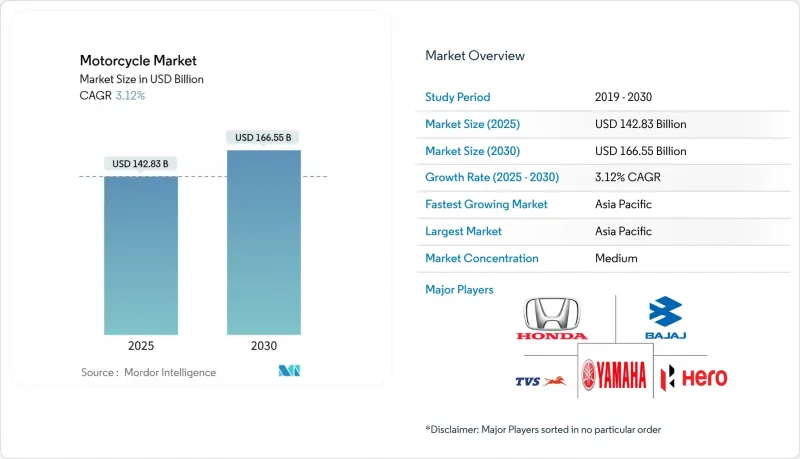
根據 Mordor Intelligence 預測,全球摩托車市場規模預計在 2025 年達到 1,428.3 億美元,到 2030 年達到 1,665.5 億美元,在此期間的複合年成長率為 3.12%。
本報告按摩托車類型(標準型、巡航型、運動型、探險型、旅行型、越野型)、引擎排氣量(200cc以下、200-400cc、400-800cc、800cc以上)、驅動方式(內燃機、電動)、用途(個人、商用南美洲)和地區(北美、北美、歐洲、亞洲、中東和亞洲)細分。市場預測以價值(美元)和銷售(輛)為單位呈現。
全球摩托車市場趨勢與洞察
南亞和東南亞都市區中產階級的快速壯大
在東南亞,都市區中產階級的壯大正在加速摩托車的普及。泰國的目標是到2030年將溫室氣體排放量減少20-25%,並強制規定其汽車產量的30%必須是零排放汽車。這種人口結構的變化正在創造一種獨特的市場動態:傳統的出行方式與環保意識相互交織,從而推動了對傳統摩托車和電動摩托車的需求。印尼是繼中國和印度之後的世界第三大摩托車市場。 2024年,印尼的摩托車銷量達到640萬輛。該地區的基礎設施建設未能跟上車輛普及的步伐,這為能夠提供價格合理、可靠且符合新環保標準的交通工具的製造商創造了巨大的商機。
政府對電動車的支持措施正在加速電動機車的普及。
透過直接購車補貼和基礎設施投資,政策框架正日益推動電動摩托車的普及。在印度尼西亞,一項擴大了資格標準的700萬印尼幣補貼計畫於2024年8月實施,旨在加速電動摩托車市場滲透。在歐洲市場,遵守歐盟5+排放氣體標準是強制性的,這造成了成本壓力,也無意中加速了電動化的普及,因為製造商需要在合規投資和電動化研發項目之間取得平衡。這種策略影響不僅限於短期銷售。政府實際上是在津貼過渡性基礎設施,而這些基礎設施將決定長期的市場主導。泰國透過Oyika進行的電池更換試驗計畫表明,政策支持如何促進在人口稠密的城市環境中建立傳統充電基礎設施無法實現的生態系統。
最後一公里零工經濟配送車輛的成長
隨著電器平台和外送服務業務的擴張,商用摩托車的使用量激增。印尼的商業用戶平均每天行駛150-200公里,而個人用戶則為15-70公里。這種高使用密度造就了獨特的市場動態。儘管初始投資較高,但就總擁有成本(TCO)而言,電動車具有顯著優勢,尤其是在電池更換基礎設施完善、週轉迅速的情況下,從而最大限度地提高盈利。馬來西亞郵政的車隊擴張表明,機構投資者正在推動大規模普及,加速基礎設施建設,並透過規模經濟降低單位成本。商用摩托車市場11.26%的複合年成長率反映了這種根本性轉變:摩托車正從個人交通工具轉變為重要的商業工具,這要求摩托車市場在性能、可靠性和服務方面做出相應的調整。
細分市場分析
雖然標準摩托車佔據了42.73%的市場佔有率,但探險摩托車細分市場預計將在2024年以10.12%的複合年成長率實現最高成長,這反映出消費者對多功能平台的偏好,這類平台能夠滿足從都市區通勤到休閒旅行等多種用途。該細分市場的擴張與人口結構趨勢相符,富裕的千禧世代和X世代騎士正在尋找能夠透過高性能和高階定位來證明其高價位合理性的多功能車輛。巡航摩托車也受益於哈雷戴維森的策略性重新定位,該公司推出了包括Street Glide Ultra和Pan America ST在內的2025款升級車型,目標客戶既包括傳統愛好者,也包括年輕一代。
運動型摩托車在主要市場面臨高額保險費和監管限制等不利因素,而旅行型摩托車則受到老年消費者日益成長的需求推動,他們更注重舒適性而非性能。越野摩托車的需求保持穩定,這得益於休閒娛樂和農村市場的實用性。然而,由於續航里程的限制以及偏遠地區充電基礎設施的不足,電動車型仍處於發展階段。市場向探險和旅行型摩托車的轉變顯示市場日趨成熟,差異化因素越來越依賴生活方式定位,而非單純的交通工具實用性。
2024年,200cc以下排氣量摩托車市佔率維持在50.86%,而200-400cc排氣量區間(以電動車型為主)正經歷快速成長,年複合成長率高達12.38%。這是因為製造商將電動動力傳動系統引入傳統上用於都市區通勤的排氣量區間。這種策略定位體現了電動摩托車的扭力特性,使其能夠在滿足監管要求和消費者對都市區出行期望的同時,提供與更大排氣量內燃機(ICE)相媲美的性能。 400-800cc排氣量區間成長較為溫和,製造商需要在性能和燃油效率之間尋求平衡。另一方面,800cc以上排氣量區間的目標市場是小眾愛好者群體,對銷售的影響有限。
電動機車製造商正日益將目光投向200-400cc排氣量區間,該區間的電池技術能夠為典型使用模式提供可接受的續航里程和充電特性。 Hero MotoCorp推出的電動踏板車「VIDA Z」以及TVS Motors的互聯功能表明,傳統製造商正在將電動車型整合到現有產品系列中,而不是創建獨立的電動品牌。這種排氣量分類的轉變預示著,隨著電氣化進程的加速,未來的市場結構將更加重視性能特徵,而非傳統的排氣量分類。
區域分析
預計亞太地區在2024年將維持71.68%的市場佔有率,並在2025年至2030年間繼續以8.09%的複合年成長率成長。這主要得益於印度和菲律賓摩托車產量的激增(東協地區成長率最高),這兩個國家在2024年的銷售成長率達到7%,達到168萬輛。該地區的領先地位反映了都市化趨勢、不斷壯大的中產階級以及基礎設施建設的進步,這些因素都促使人們在擁擠的城市環境中選擇二輪車而非四輪車。東南亞地區透過與PowerPod和Mamotor等夥伴關係共同發展電池更換基礎設施,為該地區帶來了傳統市場難以複製的競爭優勢,並有望隨著電氣化進程的加速,進一步鞏固亞太地區的主導地位。
北美和歐洲市場呈現成熟市場的特徵,儘管成長率較為溫和,但同時也推動高階市場擴張和技術創新,進而影響全球產品開發趨勢。歐洲市場面臨歐5+排放氣體法規的監管壓力,加速了電氣化轉型,同時也為傳統製造商帶來了合規成本。哈雷戴維森透過推出2025年車型和拓展經銷商網路,在這些市場進行了戰略調整,這表明高階製造商如何在保持品牌定位的同時,適應不斷變化的人口結構和監管要求。亞太地區以銷售成長為主,而歐美市場則以銷售額,這種區域差異給那些旨在實現全球規模擴張的製造商和那些致力於高階定位的製造商帶來了不同的戰略挑戰。
拉丁美洲正崛起為成長機會之地。受配送服務和都市區出行需求的推動,墨西哥摩托車市場預計到2029年將比目前水準成長三倍,達到每年600萬輛。該地區的成長潛力反映了經濟發展、都市化趨勢以及基礎設施的限制,這些因素使得兩輪解決方案比傳統汽車更具優勢。秘魯2025年第一季12.4%的成長率展現了該地區的成長勢頭,而巴西2024年上半年踏板車市場30.02%的成長則凸顯了特定品類的市場機會。中東和非洲是新興市場,經濟發展和基礎設施需求催生了對經濟可靠交通途徑的需求,但市場成長仍受到經濟波動和基礎設施限制的限制。
其他好處:
- Excel格式的市場預測(ME)表
- 3個月的分析師支持
目錄
第1章:引言
- 研究假設和市場定義
- 調查範圍
第2章:調查方法
第3章執行摘要
第4章 市場狀況
- 市場概覽
- 市場促進因素
- 南亞和東南亞都市區中產階級的快速壯大
- 政府對電動車的支持措施正在加速電動機車的普及。
- ADAS與互聯技術(物聯網/車載資訊服務)的整合
- 各OEM廠商的售後服務訂閱收入模式
- 零工經濟配送車輛在最後一公里配送中增加
- 新興市場的低成本電池更換網路
- 市場限制因素
- 歐洲逐步淘汰ICE的做法正在增加合規成本。
- 鋰離子電池原物料價格波動
- 微型出行替代方案正在蠶食對 0-200cc 等級車輛的需求。
- 第一代電動機車的轉售價值有限。
- 價值供應鏈分析
- 監理情勢
- 技術展望
- 波特五力模型
第5章 市場規模與成長預測
- 按摩托車類型
- 標準
- 巡洋艦
- 運動的
- 冒險
- 巡迴
- 越野
- 按引擎排氣量
- 200毫升或以下
- 200~400 cc
- 400~800 cc
- 800 cc 或以上
- 依推進類型
- 內燃機(ICE)
- 電的
- 透過使用
- 個人的
- 商業
- 按地區
- 北美洲
- 美國
- 加拿大
- 其他北美國家
- 南美洲
- 巴西
- 阿根廷
- 其他南美國家
- 歐洲
- 英國
- 德國
- 西班牙
- 義大利
- 法國
- 俄羅斯
- 其他歐洲國家
- 亞太地區
- 印度
- 中國
- 日本
- 韓國
- 其他亞太國家
- 中東和非洲
- 阿拉伯聯合大公國
- 沙烏地阿拉伯
- 土耳其
- 埃及
- 南非
- 其他中東和非洲國家
- 北美洲
第6章 競爭情勢
- 市場集中度
- 策略趨勢
- 市佔率分析
- 公司簡介
- Honda Motor Co., Ltd.
- Yamaha Motor Co., Ltd.
- Hero MotoCorp Ltd.
- Bajaj Auto Ltd.
- TVS Motor Company
- Harley-Davidson, Inc.
- BMW AG
- KTM AG
- Suzuki Motor Corporation
- Kawasaki Heavy Industries, Ltd.
- Ducati Motor Holding SpA
- Piaggio and C. SpA
- Triumph Motorcycles Ltd.
- Royal Enfield(Eicher Motors)
- CFMoto
- Husqvarna Motorcycles
- Zero Motorcycles, Inc.
- Energica Motor Company
- NIU Technologies
- Yadea Technology Group
- Benelli
- Mahindra(Classic Legends)
第7章 市場機會與未來展望
According to Mordor Intelligence, the global motorcycle market size stands at USD 142.83 billion in 2025 and is forecast to touch USD 166.55 billion by 2030, reflecting a 3.12% CAGR over the period.
This report is Segmented by Motorcycle Type (Standard, Cruiser, Sports, Adventure, Touring, Off-Road), Engine Capacity (Up To 200cc, 200-400cc, 400-800cc, Above 800cc), Propulsion Type (ICE, Electric), Application (Personal, Commercial), and Geography (North America, South America, Europe, Asia-Pacific, Middle East and Africa). The Market Forecasts are Provided in Terms of Value (USD) and Volume (Units).
Global Motorcycle Market Trends and Insights
Rapid Urban Middle-Class Expansion in South and Southeast Asia
Southeast Asia's motorcycle adoption accelerates as urban middle-class populations expand, with Thailand targeting a 20-25% greenhouse gas reduction by 2030 while mandating that zero-emission vehicles comprise 30% of automotive production. This demographic shift creates a unique market dynamic where traditional mobility patterns intersect with environmental consciousness, driving demand for conventional and electric two-wheelers. Indonesia is the th ird-largest motorcycle market globally, following China and India. In 2024, motorcycle sales in Indonesia were recorded at 6.4 million units. The region's infrastructure development lags behind vehicle adoption, creating opportunities for manufacturers who can deliver affordable, reliable transportation solutions that navigate congested urban environments while meeting emerging environmental standards.
Government EV Incentives Accelerating E-Motorcycle Uptake
Policy frameworks increasingly favor electric motorcycle adoption through direct purchase subsidies and infrastructure investments, with Indonesia implementing a Rp 7 million subsidy program that expanded eligibility criteria in August 2024 to accelerate motorcycle market penetration. European markets face mandatory Euro 5+ emissions compliance, creating cost pressures that inadvertently accelerate electric adoption as manufacturers balance compliance investments against electric development programs. The strategic implication extends beyond immediate sales impact-governments are essentially subsidizing the transition infrastructure that will determine long-term market leadership. Thailand's battery-swapping pilot programs through Oyika demonstrate how policy support enables ecosystem development that traditional charging infrastructure cannot match in dense urban environments.
Growth of Last-Mile Gig-Economy Delivery Fleets
Commercial motorcycle adoption surges as e-commerce platforms and food delivery services scale operations, with business users in Indonesia typically covering 150-200 kilometers daily compared to private users' 15-70 kilometer range. This usage intensity creates distinct market dynamics where total cost of ownership calculations favor electric alternatives despite higher upfront costs, particularly when battery-swapping infrastructure enables rapid turnaround times that maximize earning potential. Pos Malaysia's fleet expansion demonstrates how institutional buyers drive volume adoption that accelerates infrastructure development and reduces per-unit costs through economies of scale. The commercial segment's growth at 11.26% CAGR reflects this fundamental shift where motorcycles transition from personal transportation to essential business tools that require different performance, reliability, and service characteristics in the motorcycle market.
Other drivers and restraints analyzed in the detailed report include:
- Integration of ADAS and Connected Tech (IoT/Telematics)
- After-Sales Subscription Revenue Models by OEMs
- ICE Phase-Out Regulations in Europe Raising Compliance Costs
- Raw-Material Price Volatility for Li-ion Batteries
For complete list of drivers and restraints, kindly check the Table Of Contents.
Segment Analysis
Standard motorcycles command a 42.73% share, while the Adventure segment has the fastest growth at 10.12% CAGR in 2024, reflecting consumer preferences for versatile platforms that accommodate urban commuting and recreational touring applications. This segment expansion aligns with demographic trends where affluent millennials and Gen X riders seek multipurpose vehicles that justify higher price points through enhanced capability and premium positioning. Cruiser motorcycles benefit from Harley-Davidson's strategic repositioning, with the company launching updated 2025 models, including the Street Glide Ultra and Pan America ST, that target both traditional enthusiasts and younger demographics.
Sports motorcycles face headwinds from insurance costs and regulatory restrictions in key markets, while touring variants capture growth from aging demographics who prioritize comfort over performance. Off-road motorcycles experience steady demand driven by recreational usage and utility applications in rural markets. However, electric variants remain nascent due to range limitations and charging infrastructure constraints in remote areas. The segmentation shift toward adventure and touring categories signals broader market maturation where differentiation increasingly depends on lifestyle positioning rather than pure transportation utility.
The up to 200cc segment maintains 50.86% market share in 2024, yet the electric-dominant 200-400cc category accelerates at 12.38% CAGR as manufacturers position electric powertrains in displacement categories traditionally serving urban commuting applications. This strategic positioning reflects electric motorcycles' torque characteristics that deliver performance comparable to larger displacement ICE engines while meeting regulatory requirements and consumer expectations for urban mobility. The 400-800cc segment experiences moderate growth as manufacturers balance performance demands with fuel efficiency requirements, while the above 800cc categories serve niche enthusiast markets with limited volume impact.
Electric motorcycle manufacturers increasingly target the 200-400cc equivalent performance range where battery technology delivers acceptable range and charging characteristics for typical usage patterns. Hero MotoCorp's VIDA Z electric scooter launch and TVS Motor's connected features demonstrate how traditional manufacturers integrate electric alternatives within existing product portfolios rather than creating separate electric brands. The capacity segmentation evolution suggests future market structure will increasingly reflect performance characteristics rather than traditional displacement categories as electric adoption accelerates.
Complete Report Scope:
- By Motorcycle Type
- Standard
- Cruiser
- Sports
- Adventure
- Touring
- Off-road
- By Engine Capacity
- Up to 200 cc
- 200 to 400 cc
- 400 to 800 cc
- Above 800 cc
- By Propulsion Type
- Internal Combustion Engine (ICE)
- Electric
- By Application
- Personal
- Commercial
- By Geography
- North America
- United States
- Canada
- Rest of North America
- South America
- Brazil
- Argentina
- Rest of South America
- Europe
- United Kingdom
- Germany
- Spain
- Italy
- France
- Russia
- Rest of Europe
- Asia-Pacific
- India
- China
- Japan
- South Korea
- Rest of Asia-Pacific
- Middle East and Africa
- United Arab Emirates
- Saudi Arabia
- Turkey
- Egypt
- South Africa
- Rest of Middle-East and Africa
- North America
Geography Analysis
Asia-Pacific maintains 71.68% market share in 2024 while sustaining 8.09% CAGR through 2025-2030, driven by India's motorcycle production surge and the Philippines' 7% sales growth in 2024 to 1.68 million units-the highest growth rate in ASEAN. The region's dominance reflects urbanization trends, expanding middle-class populations, and infrastructure development favoring two-wheeler adoption over four alternatives in congested urban environments. Battery-swapping infrastructure development through partnerships like PowerPod-Mamotor in Southeast Asia creates competitive advantages that traditional markets cannot easily replicate, potentially extending Asia-Pacific's leadership position as electrification accelerates.
North America and Europe exhibit mature market characteristics with moderate growth rates yet drive premium segment expansion and technological innovation that influences global product development trends. European markets face regulatory pressures from Euro 5+ emissions standards that accelerate electric adoption while creating compliance costs for traditional manufacturers. Harley-Davidson's strategic repositioning in these markets, with 2025 model launches and expanded dealer networks, illustrates how premium manufacturers adapt to changing demographics and regulatory requirements while maintaining brand positioning. The regional contrast between Asia-Pacific's volume growth and Western markets' value growth creates different strategic imperatives for manufacturers seeking global scale versus premium positioning.
Latin America emerges as a growth opportunity with Mexico's motorcycle market projected to reach 6 million annual sales by 2029, tripling from current levels as delivery services and urban mobility needs drive adoption. The region's growth potential reflects economic development, urbanization trends, and infrastructure constraints that favor two-wheeler solutions over traditional automotive alternatives. Peru's 12.4% Q1 2025 growth demonstrates the region's momentum while Brazil's scooter segment expansion at 30.02% in H1 2024 illustrates category-specific opportunities. Middle East and Africa represent emerging opportunities where economic development and infrastructure needs create demand for affordable, reliable transportation solutions, though market development remains constrained by economic volatility and infrastructure limitations.
- Honda Motor Co., Ltd.
- Yamaha Motor Co., Ltd.
- Hero MotoCorp Ltd.
- Bajaj Auto Ltd.
- TVS Motor Company
- Harley-Davidson, Inc.
- BMW AG
- KTM AG
- Suzuki Motor Corporation
- Kawasaki Heavy Industries, Ltd.
- Ducati Motor Holding S.p.A.
- Piaggio and C. SpA
- Triumph Motorcycles Ltd.
- Royal Enfield (Eicher Motors)
- CFMoto
- Husqvarna Motorcycles
- Zero Motorcycles, Inc.
- Energica Motor Company
- NIU Technologies
- Yadea Technology Group
- Benelli
- Mahindra (Classic Legends)
Additional Benefits:
- The market estimate (ME) sheet in Excel format
- 3 months of analyst support
TABLE OF CONTENTS
1 Introduction
- 1.1 Study Assumptions and Market Definition
- 1.2 Scope of the Study
2 Research Methodology
3 Executive Summary
4 Market Landscape
- 4.1 Market Overview
- 4.2 Market Drivers
- 4.2.1 Rapid urban middle-class expansion in South and Southeast Asia
- 4.2.2 Government EV incentives accelerating e-motorcycle uptake
- 4.2.3 Integration of ADAS and connected tech (IoT/telematics)
- 4.2.4 After-sales subscription revenue models by OEMs
- 4.2.5 Growth of last-mile gig-economy delivery fleets
- 4.2.6 Low-cost battery-swap networks in emerging markets
- 4.3 Market Restraints
- 4.3.1 ICE phase-out regulations in Europe raising compliance costs
- 4.3.2 Raw-material price volatility for Li-ion batteries
- 4.3.3 Micro-mobility alternatives cannibalising 0 to 200 cc demand
- 4.3.4 Limited resale value of first-gen e-motorcycles
- 4.4 Value/Supply-Chain Analysis
- 4.5 Regulatory Landscape
- 4.6 Technological Outlook
- 4.7 Porter's Five Forces
- 4.7.1 Bargaining Power of Suppliers
- 4.7.2 Bargaining Power of Buyers
- 4.7.3 Threat of New Entrants
- 4.7.4 Threat of Substitutes
- 4.7.5 Competitive Rivalry
5 Market Size and Growth Forecasts (Value (USD) and Volume (Units))
- 5.1 By Motorcycle Type
- 5.1.1 Standard
- 5.1.2 Cruiser
- 5.1.3 Sports
- 5.1.4 Adventure
- 5.1.5 Touring
- 5.1.6 Off-road
- 5.2 By Engine Capacity
- 5.2.1 Up to 200 cc
- 5.2.2 200 to 400 cc
- 5.2.3 400 to 800 cc
- 5.2.4 Above 800 cc
- 5.3 By Propulsion Type
- 5.3.1 Internal Combustion Engine (ICE)
- 5.3.2 Electric
- 5.4 By Application
- 5.4.1 Personal
- 5.4.2 Commercial
- 5.5 By Geography
- 5.5.1 North America
- 5.5.1.1 United States
- 5.5.1.2 Canada
- 5.5.1.3 Rest of North America
- 5.5.2 South America
- 5.5.2.1 Brazil
- 5.5.2.2 Argentina
- 5.5.2.3 Rest of South America
- 5.5.3 Europe
- 5.5.3.1 United Kingdom
- 5.5.3.2 Germany
- 5.5.3.3 Spain
- 5.5.3.4 Italy
- 5.5.3.5 France
- 5.5.3.6 Russia
- 5.5.3.7 Rest of Europe
- 5.5.4 Asia-Pacific
- 5.5.4.1 India
- 5.5.4.2 China
- 5.5.4.3 Japan
- 5.5.4.4 South Korea
- 5.5.4.5 Rest of Asia-Pacific
- 5.5.5 Middle East and Africa
- 5.5.5.1 United Arab Emirates
- 5.5.5.2 Saudi Arabia
- 5.5.5.3 Turkey
- 5.5.5.4 Egypt
- 5.5.5.5 South Africa
- 5.5.5.6 Rest of Middle-East and Africa
- 5.5.1 North America
6 Competitive Landscape
- 6.1 Market Concentration
- 6.2 Strategic Moves
- 6.3 Market Share Analysis
- 6.4 Company Profiles (Includes Global level Overview, Market level overview, Core Segments, Financials as available, Strategic Information, Market Rank/Share for key companies, Products and Services, and Recent Developments)
- 6.4.1 Honda Motor Co., Ltd.
- 6.4.2 Yamaha Motor Co., Ltd.
- 6.4.3 Hero MotoCorp Ltd.
- 6.4.4 Bajaj Auto Ltd.
- 6.4.5 TVS Motor Company
- 6.4.6 Harley-Davidson, Inc.
- 6.4.7 BMW AG
- 6.4.8 KTM AG
- 6.4.9 Suzuki Motor Corporation
- 6.4.10 Kawasaki Heavy Industries, Ltd.
- 6.4.11 Ducati Motor Holding S.p.A.
- 6.4.12 Piaggio and C. SpA
- 6.4.13 Triumph Motorcycles Ltd.
- 6.4.14 Royal Enfield (Eicher Motors)
- 6.4.15 CFMoto
- 6.4.16 Husqvarna Motorcycles
- 6.4.17 Zero Motorcycles, Inc.
- 6.4.18 Energica Motor Company
- 6.4.19 NIU Technologies
- 6.4.20 Yadea Technology Group
- 6.4.21 Benelli
- 6.4.22 Mahindra (Classic Legends)
7 Market Opportunities and Future Outlook
- 7.1 White-space and Unmet-Need Assessment

 傳統摩托車和踏板車市場規模、佔有率和成長分析:按產品類型、引擎排氣量、驅動技術、最終用途、價格範圍、銷售管道和地區分類-2026-2033年產業預測
 摩托車資訊娛樂系統市場:依連接方式、顯示類型、車輛類型和使用者介面分類-2026-2032年全球市場預測
 摩托車市場分析及預測(至2035年):類型、技術、應用、最終用戶、車輛類別、引擎類型及用途
 2026年全球摩托車市場報告
 摩托車市場-全球產業規模、佔有率、趨勢、機會、預測:按類型、動力系統、地區和競爭格局分析(2021-2031年)
 摩托車及踏板車市場機會、成長要素、產業趨勢分析及2026-2035年預測
 虛擬實境摩托車模擬器市場預測——按類型、應用、最終用戶和地區分類的全球分析——2034年
 摩托車市場規模、佔有率和成長分析:按車型、類型、傳動系統、引擎類型、排氣量、銷售管道和地區分類-2026-2033年產業預測摩托車市場機會、成長要素、產業趨勢分析及2026-2035年預測。
 摩托車資訊娛樂系統市場:按類型、應用、銷售管道和地區分類(2026-2034 年)