

 |
市場調查報告書
商品編碼
2117368
歐洲汽車鋼板沖壓市場:市場佔有率分析、產業趨勢與統計、成長預測(2026-2031)Europe Automotive Steel Stamping - Market Share Analysis, Industry Trends & Statistics, Growth Forecasts (2026 - 2031) |
||||||

※ 本網頁內容可能與最新版本有所差異。詳細情況請與我們聯繫。
據 Mordor Intelligence 稱,2025 年歐洲汽車鈑金沖壓市場價值為 22.5 億美元,2026 年預計為 23.4 億美元,預計到 2031 年將達到 28.5 億美元。
預計從 2026 年到 2031 年,其複合年成長率將達到 4.02%。
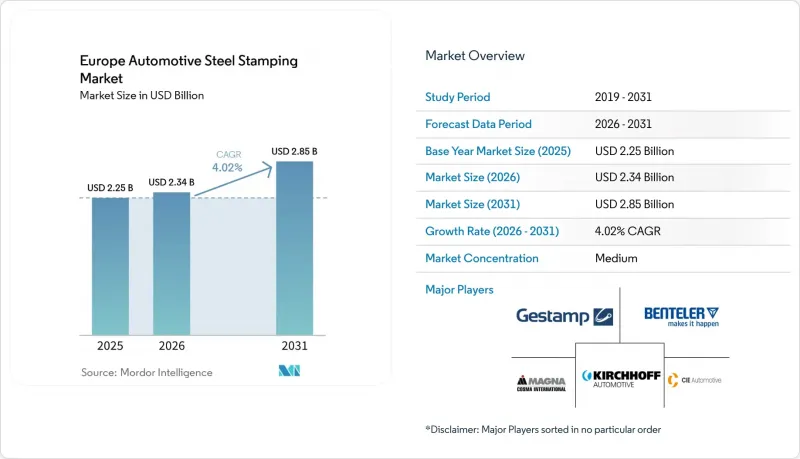
本報告按技術(沖裁、壓花等)、製程(輥壓成型、熱沖壓等)、車輛類型(乘用車、輕型商用車等)、驅動系統(內燃機車輛和電動車)以及國家(德國、法國等)進行分類。市場預測以美元計價。
歐洲汽車鋼板沖壓成型市場的趨勢與洞察
電動車結構件需求激增
先進技術目前正應用於電動車的電池盒機殼和碰撞管理結構。這些結構採用封閉回路型伺服壓力控制,並使用雷射焊接的客製化坯料。這些坯料巧妙地將高強度熱壓硬化鋼外殼與韌性芯材熔合在一起。值得注意的是,Gestamp公司強調,用於電池式電動車的熱沖壓門環對其銷售額貢獻顯著,這與其策略定位相符。同時,Valmet Automotive公司在波蘭取得了長足進步,擴建了其位於扎里(Zary)的工廠,將電池盒組件直接放置在電芯生產線旁。 POSCO公司位於布熱格(Brzeg)的牽引電機疊片工廠與電動車供應鏈中心緊密結合,進一步體現了產業的這種轉變,象徵著沖壓成型能力的東移。然而,需要注意的是,缺乏熱成型能力和關鍵的ISO 26262認證的供應商未來可能會失去市場佔有率。
歐盟二氧化碳排放法規迫使汽車製造商減輕車身重量。
隨著車輛平均二氧化碳排放量法規的訂定,車輛總重的每一公斤都成為汽車製造商需要考慮的經濟因素。薩爾茨吉特公司的「Robusal 800」技術使大眾汽車能夠在保持碰撞安全性能的前提下顯著降低車門面板的重量。塔塔鋼鐵公司的「WarP-AHSS」計畫正在試驗一種溫壓成型技術,旨在將鍍鋅高抗張強度鋼投入大規模生產,同時避免氫脆現象。雖然更薄的金屬板材可以降低材料成本,但也會增加模具磨損。應對這項挑戰需要投資於自適應壓合力系統,這將導致每次伺服壓力機改造都產生顯著的額外成本。
歐盟工廠面臨高資本投資和能源成本。
建立一條熱沖壓生產線成本高昂,而且德國的工業用電價格遠高於波蘭。儘管投入了大量資金,但由於運轉率下降,Gestamp在西歐的銷售額大幅下滑。此外,進口碳排放邊境調節措施(CBAM)下的額外收費進一步加劇了原物料價格的上漲。而且,在高能耗的熱沖壓製程中,電價上漲會導致加工成本相應增加。
細分市場分析
預計2025年,落料製程將佔歐洲汽車鈑金沖壓市場銷售額的36.85%,複合年成長率達4.45%。這主要得益於客製化坯料如今採用雷射焊接工藝,將高強度鋼(AHSS)和鋁材組合成一個預成型件。雷射落料等技術進步能夠確保高品質的邊緣並最大限度地減少廢料,正在歐洲汽車鈑金沖壓市場中發揮重要作用。同時,主要用於成型複雜形狀的壓印工藝雖然市場佔有率不大,但由於其能夠實現高精度公差,因此在諸如安全氣囊安裝座等應用中備受青睞,因此在高價值產品中需求旺盛。
最新的伺服壓力機透過將落料、拉伸和修邊整合到一次沖程中,徹底革新了這個製程。這項創新不僅縮小了工廠面積,還提高了整體設備效率 (OEE)。 BILSTEIN 的雷射落料技術因其無需機械模具(即使是複雜形狀)而備受關注。然而,與這項技術相關的資本支出 (CAPEX) 對小規模工廠而言仍然是一個挑戰。液壓成形和溫成形技術由於週期時間長,目前仍僅限於特定應用領域,但 Benteler 的「CliMore」管材有望成為高階電動車 (EV) 副車架的通用技術。
熱沖壓製程的複合年成長率 (CAGR) 為 5.34%,超過所有其他製程。這主要歸功於其抗張強度顯著提高,超過 1500 MPa,以滿足原始設備製造商 (OEM) 的碰撞安全要求以及電池盒 60 kJ/kg 的能量吸收目標。歐洲汽車鈑金沖壓市佔率主要集中在擁有局部冷卻和感應回火相關智慧財產權的供應商手中,其中 Gestamp 和 Kirchhoff 是該領域的主導者。
預計2025年,輥壓成型將維持33.26%的市場佔有率,繼續主導市場,歐洲汽車鈑金沖壓市場整體亦是如此。冷壓成型仍然是車門面板和引擎蓋的主要製造程序,但隨著內燃機汽車產量趨於穩定,其產量預計將逐漸下降。超塑性成型受限於20分鐘的生產週期,不適用於大規模生產,其市佔率仍低於1%。
其他好處:
- Excel格式的市場預測(ME)表
- 3個月的分析師支持
目錄
第1章:引言
- 研究假設和市場定義
- 調查範圍
第2章:調查方法
第3章執行摘要
第4章 市場狀況
- 市場概覽
- 市場促進因素
- 電動車結構件的需求正在激增。
- 歐盟二氧化碳排放標準迫使汽車製造商減輕車身重量。
- 使用高抗張強度鋼可以減少板材厚度。
- 歐盟乘用車生產的復甦
- 伺服壓力機與雷射落料技術創新介紹
- 由原始設備製造商 (OEM) 和一級製造商 (Tier 1 manufacturer) 組成的合資企業,用於內部沖壓加工。
- 市場限制因素
- 歐盟工廠的高資本投資與能源成本
- 扁鋼價格波動
- 西歐技術純熟勞工短缺
- 與鋁和複合材料的競爭
- 價值供應鏈分析
- 監理情勢
- 技術展望
- 波特五力模型
第5章 市場規模與成長預測
- 透過技術
- 空白
- 壓紋飾面
- 鑄幣
- 法蘭加工
- 彎曲過程
- 其他技術
- 透過流程
- 輥壓成型
- 熱壓印
- 鈑金成型
- 金屬加工
- 其他流程
- 按車輛類型
- 搭乘用車
- 輕型商用車
- 大型商用車輛
- 透過推進力
- 內燃機(ICE)
- 電動車(純電動車+插電式混合動力車)
- 國家
- 德國
- 法國
- 英國
- 義大利
- 西班牙
- 波蘭
- 瑞典
- 捷克共和國
- 其他歐洲國家
第6章 競爭情勢
- 市場集中度
- 策略趨勢
- 市佔率分析
- 公司簡介
- Gestamp Automocion SA
- Benteler International AG
- Magna International Inc.(Cosma)
- Kirchhoff Automotive GmbH
- CIE Automotive SA
- ThyssenKrupp AG
- voestalpine AG
- Tower International, Inc.(Autokiniton)
- Martinrea International Inc.
- Dura Automotive Systems(Shiloh Industries)
- GEDIA Automotive Group
- Press-Kogyo Co., Ltd.
- JBM Group(Valenciennes)
- Lingyun Industrial(Europe)
- Fischer Reinforced Metal Components
- ArcelorMittal Tailored Blanks
- Salzgitter Mannesmann Stamping
第7章 市場機會與未來展望
According to Mordor Intelligence, the european automotive steel stamping market size was valued at USD 2.25 billion in 2025, is estimated at USD 2.34 billion in 2026, and is projected to reach USD 2.85 billion by 2031, growing at a CAGR of 4.02% from 2026 to 2031.
This report is Segmented by Technology (Blanking, Embossing, and More), Process (Roll Forming, Hot Stamping, and More), Vehicle Type (Passenger Cars, Light Commercial Vehicles, and More), Propulsion (Internal-Combustion Engine and Electric Vehicles), and Country (Germany, France, and More). The Market Forecasts are Provided in Terms of Value (USD).
Europe Automotive Steel Stamping Market Trends and Insights
Surging EV-Specific Structural Part Demand
Battery-box enclosures and crash-management structures for electric vehicles now rely on advanced technologies. These structures utilize closed-loop servo-press control and feature laser-welded tailored blanks. These blanks skillfully merge high-strength press-hardened steel perimeters with ductile cores. In a notable move, Gestamp highlighted that hot-stamped door rings for battery-electric vehicles contribute significantly to its turnover, aligning with its strategic taxonomy. Meanwhile, Valmet Automotive is making strides in Poland, expanding its zary site to position the battery-box sub-assembly right next to cell production. Further emphasizing the industry's shift, POSCO's traction-motor lamination plant in Brzeg showcases the eastward migration of stamping capacity, aligning closely with EV supply-chain nodes. However, a word of caution: suppliers without hot-forming capabilities or the crucial ISO 26262 certification may lose market share in the future.
EU CO2-Emission Norms Pressuring OEM Lightweighting
Fleet-average CO2 limits translate every kilogram of curb weight into a financial consideration for OEMs. Salzgitter's Robusal 800 enabled Volkswagen to significantly reduce the mass of a door inner while maintaining crash ratings . Tata Steel's WarP-AHSS program is piloting warm-stamping techniques to bring zinc-coated high-strength steels into series production while avoiding hydrogen embrittlement. While thinner gauges can lower material costs, they also increase die wear. This challenge requires investments in adaptive binder-force systems, resulting in substantial additional expenses for each servo-press retrofit.
High Capex and Energy Costs in EU Plants
Installing a hot-stamping line is costly, while industrial electricity prices in Germany remain considerably higher than in Poland. Despite substantial investments in capital expenditures, Gestamp experienced a notable decline in revenue from Western Europe, primarily due to underutilization. CBAM surcharges on incoming tonnes further intensify feedstock inflation. Additionally, for energy-intensive hot stamping, increases in electricity prices result in a proportional increase in conversion costs.
Other drivers and restraints analyzed in the detailed report include:
- Uptake of Ultra-High-Strength Steels Enabling Thinner Gauges
- Recovery of EU Passenger-Car Production
- Volatility in Flat-Steel Prices
For complete list of drivers and restraints, kindly check the Table Of Contents.
Segment Analysis
Blanking accounted for 36.85% of Europe's automotive steel stamping market revenue in 2025, expanding at a 4.45% CAGR, as tailored blanks marry AHSS and aluminum into single laser-welded preforms. In Europe, the automotive steel stamping market is reaping the benefits of advancements such as laser blanking, which ensure high-quality edges and minimize scrap. While coining, primarily used for intricate features, captures a modest share, it commands a premium due to its ability to achieve precise tolerances, a feature highly valued in airbag-mount bosses.
Modern servo presses are revolutionizing the process by integrating blanking, drawing, and trimming into a single stroke. This innovation not only reduces factories' physical footprint but also enhances Overall Equipment Effectiveness (OEE). BILSTEIN's laser blanking technology is making waves by eliminating the need for mechanical dies, even for intricate shapes. However, the capital expenditure (capex) associated with this technology poses a challenge for smaller workshops. While hydroforming and warm forming techniques remain specialized due to their longer cycle times, Benteler's CliMore tubes suggest a promising crossover for premium electric vehicle (EV) subframes.
Hot stamping's 5.34% CAGR surpasses that of every other process, as OEM crash requirements and battery-box energy-absorption targets of 60 kJ/kg elevate tensile strengths above 1,500 MPa. Europe's automotive steel stamping market share tilts toward suppliers with IP around partial-cooling or induction tempering, a space dominated by Gestamp and Kirchhoff.
Roll forming continues to dominate the market with 33.26% share in 2025, mirroring the overall European automotive steel stamping market. Cold stamping remains the workhorse for door outers and hoods, but faces tapering volumes as ICE output plateaus. Superplastic forming lingers below 1% share, constrained by 20-minute cycles unsuitable for mass production.
Complete Report Scope:
- By Technology
- Blanking
- Embossing
- Coining
- Flanging
- Bending
- Other Technologies
- By Process
- Roll Forming
- Hot Stamping
- Sheet-Metal Forming
- Metal Fabrication
- Other Processes
- By Vehicle Type
- Passenger Cars
- Light Commercial Vehicles
- Heavy Commercial Vehicles
- By Propulsion
- Internal-Combustion Engine (ICE)
- Electric Vehicles (BEV + PHEV)
- By Country
- Germany
- France
- United Kingdom
- Italy
- Spain
- Poland
- Sweden
- Czech Republic
- Rest of Europe
List of Companies Covered in this Report:
- Gestamp Automocion S.A.
- Benteler International AG
- Magna International Inc. (Cosma)
- Kirchhoff Automotive GmbH
- CIE Automotive S.A.
- ThyssenKrupp AG
- voestalpine AG
- Tower International, Inc. (Autokiniton)
- Martinrea International Inc.
- Dura Automotive Systems (Shiloh Industries)
- GEDIA Automotive Group
- Press-Kogyo Co., Ltd.
- JBM Group (Valenciennes)
- Lingyun Industrial (Europe)
- Fischer Reinforced Metal Components
- ArcelorMittal Tailored Blanks
- Salzgitter Mannesmann Stamping
Additional Benefits:
- The market estimate (ME) sheet in Excel format
- 3 months of analyst support
TABLE OF CONTENTS
1 Introduction
- 1.1 Study Assumptions and Market Definition
- 1.2 Scope of the Study
2 Research Methodology
3 Executive Summary
4 Market Landscape
- 4.1 Market Overview
- 4.2 Market Drivers
- 4.2.1 Surging EV-Specific Structural Part Demand
- 4.2.2 EU CO2-Emission Norms Pressuring OEM Lightweighting
- 4.2.3 Uptake of Ultra-High-Strength Steels Enabling Thinner Gauges
- 4.2.4 Recovery of EU Passenger-Car Production
- 4.2.5 Servo-Press and Laser-Blanking Innovations Adoption
- 4.2.6 OEM-Tier-1 Joint Ventures for In-House Stamping
- 4.3 Market Restraints
- 4.3.1 High CAPEX and Energy Costs in EU Plants
- 4.3.2 Volatility in Flat-Steel Prices
- 4.3.3 Skilled-Labor Shortages in Western Europe
- 4.3.4 Competition from Aluminum and Composites
- 4.4 Value/Supply-Chain Analysis
- 4.5 Regulatory Landscape
- 4.6 Technological Outlook
- 4.7 Porter's Five Forces
- 4.7.1 Threat of New Entrants
- 4.7.2 Bargaining Power of Buyers
- 4.7.3 Bargaining Power of Suppliers
- 4.7.4 Threat of Substitutes
- 4.7.5 Competitive Rivalry
5 Market Size and Growth Forecasts (Value (USD))
- 5.1 By Technology
- 5.1.1 Blanking
- 5.1.2 Embossing
- 5.1.3 Coining
- 5.1.4 Flanging
- 5.1.5 Bending
- 5.1.6 Other Technologies
- 5.2 By Process
- 5.2.1 Roll Forming
- 5.2.2 Hot Stamping
- 5.2.3 Sheet-Metal Forming
- 5.2.4 Metal Fabrication
- 5.2.5 Other Processes
- 5.3 By Vehicle Type
- 5.3.1 Passenger Cars
- 5.3.2 Light Commercial Vehicles
- 5.3.3 Heavy Commercial Vehicles
- 5.4 By Propulsion
- 5.4.1 Internal-Combustion Engine (ICE)
- 5.4.2 Electric Vehicles (BEV + PHEV)
- 5.5 By Country
- 5.5.1 Germany
- 5.5.2 France
- 5.5.3 United Kingdom
- 5.5.4 Italy
- 5.5.5 Spain
- 5.5.6 Poland
- 5.5.7 Sweden
- 5.5.8 Czech Republic
- 5.5.9 Rest of Europe
6 Competitive Landscape
- 6.1 Market Concentration
- 6.2 Strategic Moves
- 6.3 Market Share Analysis
- 6.4 Company Profiles (Includes Global Level Overview, Market Level Overview, Core Segments, Financials as Available, Strategic Information, Market Rank/Share for Key Companies, Products and Services, SWOT Analysis, and Recent Developments)
- 6.4.1 Gestamp Automocion S.A.
- 6.4.2 Benteler International AG
- 6.4.3 Magna International Inc. (Cosma)
- 6.4.4 Kirchhoff Automotive GmbH
- 6.4.5 CIE Automotive S.A.
- 6.4.6 ThyssenKrupp AG
- 6.4.7 voestalpine AG
- 6.4.8 Tower International, Inc. (Autokiniton)
- 6.4.9 Martinrea International Inc.
- 6.4.10 Dura Automotive Systems (Shiloh Industries)
- 6.4.11 GEDIA Automotive Group
- 6.4.12 Press-Kogyo Co., Ltd.
- 6.4.13 JBM Group (Valenciennes)
- 6.4.14 Lingyun Industrial (Europe)
- 6.4.15 Fischer Reinforced Metal Components
- 6.4.16 ArcelorMittal Tailored Blanks
- 6.4.17 Salzgitter Mannesmann Stamping
7 Market Opportunities and Future Outlook
- 7.1 White-Space and Unmet-Need Assessment

 汽車鋼材沖壓市場機會、成長促進因素、產業趨勢分析及2026-2035年預測。
 汽車沖壓成型市場規模、佔有率和成長分析:按零件類型、金屬類型、製程類型、車輛類型和地區分類-2026-2033年產業預測
 汽車沖壓加工市場:預測(至2034年)-按製程、沖壓加工類型、材料、車輛類型、應用和地區分類的全球分析
 汽車金屬衝壓市場-全球產業規模、佔有率、趨勢、機會、預測:依車輛類型、技術、製程、地區和競爭格局分類,2021-2031年
 汽車沖壓件市場:依材質類型、技術、應用和最終用途產業分類-2026-2032年全球預測汽車底盤沖壓件市場按製程類型、材料類型、車輛類型、應用和最終用戶分類,全球預測,2026-2032年
 汽車金屬衝壓:市場佔有率分析、產業趨勢與統計、成長預測(2026-2031)汽車座椅靠背沖壓件市場:按材質、製造流程、車輛類型、應用和最終用戶分類 - 全球預測 2026-2032汽車沖壓機自動化市場機會、成長促進因素、產業趨勢分析及預測(2025-2034年)
 汽車金屬沖壓加工市場評估:車輛類型·技術·流程·各地區的機會及預測 (2018-2032年)