


 |
市場調查報告書
商品編碼
1937432
汽車金屬衝壓:市場佔有率分析、產業趨勢與統計、成長預測(2026-2031)Automotive Metal Stamping - Market Share Analysis, Industry Trends & Statistics, Growth Forecasts (2026 - 2031) |
||||||

※ 本網頁內容可能與最新版本有所差異。詳細情況請與我們聯繫。
2025年汽車金屬衝壓市場價值為1,081.3億美元,預計到2031年將達到1,453.2億美元,而2026年為1,135.9億美元。
預計在預測期(2026-2031 年)內,複合年成長率將達到 5.05%。
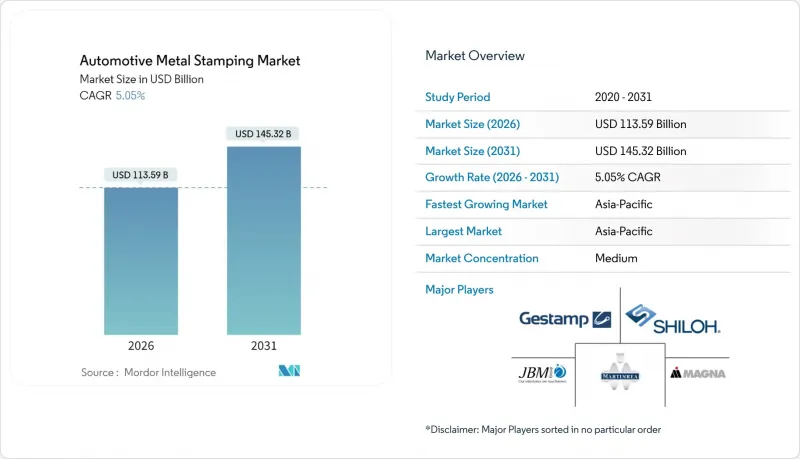
在車輛電氣化程度不斷提高、輕量化法規日益嚴格以及全球汽車產量穩步復甦的推動下,汽車金屬衝壓市場在乘用車和商用車領域依然保持強勁勢頭。沖壓件是所有現代汽車車身結構、電池機殼和底盤模組的基礎,因此,隨著汽車製造商並行開發內燃機、混合動力和純電動車架構,這項技術至關重要。儘管材料向鋁和先進高抗張強度鋼 (AHSS) 的過渡仍在繼續,但鋼材具有成本優勢和供應鏈熟悉度,這使得沖壓製造商能夠在生產恢復後迅速擴大生產規模。同時,熱沖壓和伺服壓力機的應用使供應商能夠在不犧牲尺寸精度的前提下,實現更薄的板材和更高的強度。隨著汽車製造商要求數位雙胞胎交貨和可追溯性以支援空中下載 ( 在線連續) 車輛軟體更新,整合數位孿生、線上視覺系統和封閉回路型控制系統正從測試線走向主流生產線。
全球汽車金屬衝壓市場趨勢與洞察
汽車生產加速復甦(2025年及以後)
隨著全球汽車組裝量恢復到疫情前的峰值水平,沖壓機製造商正在運作暫停中的壓平機並加快模俱生產。現代鋼鐵計劃在路易斯安那州新建的工廠將於2029年投產,每年供應數百萬噸汽車用鋼,並透過其電弧煉鋼製程將碳排放強度降低五分之三。此次擴建將使區域生產線能夠擴大電動車(EV)的產能。產能擴張表明,汽車金屬衝壓市場正在調整資本支出,以配合整車製造商(OEM)的新車型發布。供應商現在可以在同一台伺服沖壓機上靈活生產高抗張強度鋼(AHSS)、傳統鋼材和鋁坯,隨著平台多樣化,訂單成長速度加快。這種柔軟性將縮短新車型的前置作業時間是在整車製造商需要為軟體定義汽車生產小批量、高頻次的試生產批次時。
減輕車身重量以提高燃油效率並延長電動車續航里程
車輛減重每公斤都能提升車輛的整體燃油經濟性,並延長電動車的續航里程。為此,沖壓製造商目前正在試用一系列高抗張強度鋼(AHSS),其抗張強度超過 1.2 GPa,同時保持良好的冷成形性能。安賽樂米塔爾和基爾霍夫汽車公司已展示了 Fortiform 系列鋼材,其彎曲性能優於雙相鋼,無需額外的拉延加工即可實現更薄的壁厚。採用這些鋼材製造的更薄的蓋子、封蓋和加強支架,持續為汽車金屬衝壓市場提供更輕、更強的零件。這項轉變要求工廠購買大噸位伺服壓力機和雷射切割機,以便對毛坯進行客製化焊接,從而在同一面板中組合不同厚度的部件。隨著鋁材應用的不斷成長,一級供應商需要平衡其用於熱處理 6xxx 系列合金的爐線,同時兼顧 AHSS 板材的酸洗和鍍鋅工序。
鋼鐵和鋁價格波動
原物料價格波動會吞噬原本就微薄的利潤,金屬成本佔沖壓成本的五分之三以上。鋁坯關稅的提高(美國提案暗示將大幅提高關稅稅率)將對所有坯料供應商產生連鎖反應,迫使一級供應商重新談判年度定價條款。大型企業透過在商品交易所進行避險或與鋼廠簽訂多年期合約鎖定採購量來降低波動風險。汽車金屬衝壓市場的小型製造商則面臨營運資金緊張的困境,促使他們透過聯合採購池和聯盟來增強自身的議價能力。
細分市場分析
到2025年,落料工序將佔總收入的26.64%,這鞏固了其在下游成型前將板材切割成近淨成形坯料的核心地位。這一佔有率反映了汽車金屬衝壓市場規模持續依賴高速機械壓力機進行平面模壓成型。連續卷材生產線和在線連續表面檢測確保了外板所需的尺寸精度。壓花工序雖然規模較小,但其複合年成長率將達到5.11%,成為成長最快的工序,因為設計工作室需要無需二次裝飾工序即可實現的紋理效果。
為了降低噪音、振動和不平順性 (NVH),原始設備製造商 (OEM) 對阻尼肋和加強輪胎邊緣的需求不斷成長,推動了壓花生產線的訂單。高噸位壓力機和可程式設計滑塊運動裝置能夠在不減薄基材的情況下製造出深圖案,從而滿足碰撞安全標準。隨著結構件變得越來越薄,壓花製程可以提高局部剛度並減少厚度。因此,對伺服驅動壓力機的投資使供應商能夠在落料、壓印和輕壓花之間自由切換,從而在保持芯材落料產量的同時擴展其服務範圍。這種方法使汽車金屬衝壓市場保持多元化和韌性。
到2025年,鈑金成形將佔總收入的42.62%,這表明傳統級進模仍然是汽車金屬衝壓市場(尤其是大批量生產內裝板和子組件)的基礎。自動捲料送料器和快速晶粒模車最大限度地提高了設備正常運作,使供應商能夠適應縮短的車型週期。熱沖壓的收入成長將相對滯後,但其複合年成長率將達到5.17%,這主要得益於電動車防撞梁應用對馬氏體強度要求較高(約1.5 GPa)的驅動。
新型多區淬火控制爐有助於防止氫脆,而機器人真空轉移技術則可減少氧化皮的堆積。一級供應商正在提供結合傳統沖壓機和熱壓機的平台組合,以滿足尋求最佳化供應商結構的原始設備製造商 (OEM) 採購部門的需求。級進模和傳送模系統對於支架和加強筋板的製造仍然至關重要。然而,伺服沖壓機的改造正在突破高強度鋼 (AHSS) 的成形極限,這表明技術正在逐步轉型,從而支持汽車金屬衝壓市場的發展。
區域分析
預計到2025年,亞太地區將佔全球收入的37.89%,並在2031年之前保持5.13%的強勁複合年成長率,這主要得益於中國汽車裝配線的重啟以及印度政策支持的本地化生產。在上海、廣州、浦那和清奈等地的叢集中,伺服沖壓機正在安裝到位,用於生產國產電動車所需的高抗張強度鋼車頂橫樑和熱成型側梁。政府對新能源汽車的激勵措施幫助模具廠維持了本世紀末的訂單訂單,從而鞏固了其在亞太地區汽車金屬衝壓市場的地位。
北美透過投資智慧工廠以及韓國和日本鋼鐵巨頭的近岸外包策略,保持其技術優勢。現代鋼鐵位於路易斯安那州的工廠向南部組裝走廊供應卷材,縮短了物流距離,並減少了沖壓件的碳排放。美國和墨西哥的一級供應商正在部署基於雲端的製造執行系統(MES)平台,以將沖壓機運轉率與原始設備製造商(OEM)的生產計畫同步,從而避免罰款、獲得獎金,並提升汽車金屬衝壓市場的服務水平。
儘管人事費用高昂,歐洲仍保持創新優勢。蒂森克虜伯材料加工歐洲公司位於斯圖加特的工廠維修計劃,將物聯網感測器與人工智慧驅動的製程控制系統結合,以減少廢棄物並改善預測性維護。歐盟基於車輛排放氣體法規的輕量化指令,正在推動多材料連接技術的研發,並增強供應商的專業能力。雖然南美洲和中東及非洲地區的市場佔有率仍然不足,但CKD組裝廠的擴張,特別是待開發區沖壓機(用於皮卡和緊湊型SUV)的引入,正在為未來的成長鋪平道路。
其他福利:
- Excel格式的市場預測(ME)表
- 分析師支持(3個月)
目錄
第1章 引言
- 研究假設和市場定義
- 調查範圍
第2章調查方法
第3章執行摘要
第4章 市場情勢
- 市場概覽
- 市場促進因素
- 汽車生產復甦的擴大
- 促進減重(以提高燃油效率和電動車續航里程)
- 電動車熱沖壓電池機殼成長
- 中印汽車供應鏈快速復甦
- OEM巨型沖壓體結構
- 利用閉合迴路數位雙胞胎實現零缺陷沖壓
- 市場限制
- 鋼鐵和鋁價格波動
- 熟練的模具和工具製造人員短缺
- 伺服和液壓壓平機需要昂貴的資本投資
- 區域金屬供應中斷
- 價值/價值鏈分析
- 監管環境
- 技術展望
- 波特五力模型
- 新進入者的威脅
- 買方的議價能力
- 供應商的議價能力
- 替代品的威脅
- 競爭對手之間的競爭
第5章 市場規模及成長預測(價值(美元))
- 透過技術
- 空白
- 壓花
- 鑄幣
- 翻邊
- 彎曲
- 深畫
- 其他
- 透過流程
- 輥壓成型
- 熱壓印
- 鈑金加工
- 漸進式印刷加工
- 轉印壓機械加工
- 金屬加工
- 其他
- 按車輛類型
- 搭乘用車
- 輕型商用車
- 中型和重型商用車輛
- 材料
- 鋼材
- 鋁
- 其他
- 透過使用
- 車身面板
- 傳動和結構部件
- 排氣系統部件
- 底盤和懸吊部件
- 其他
- 按地區
- 北美洲
- 美國
- 加拿大
- 北美其他地區
- 南美洲
- 巴西
- 阿根廷
- 其他南美洲國家
- 歐洲
- 德國
- 英國
- 法國
- 義大利
- 西班牙
- 俄羅斯
- 其他歐洲地區
- 亞太地區
- 中國
- 日本
- 印度
- 韓國
- 亞太其他地區
- 中東和非洲
- 阿拉伯聯合大公國
- 沙烏地阿拉伯
- 土耳其
- 埃及
- 南非
- 其他中東和非洲地區
- 北美洲
第6章 競爭情勢
- 市場集中度
- 策略趨勢
- 市佔率分析
- 公司簡介
- Magna International
- Gestamp Automocion
- Shiloh Industries
- Martinrea International
- JBM Group
- Aisin Seiki
- G-TEKT
- Tower International
- D&H Industries
- PDQ Tool & Stamping
- Alcoa
- American Industrial Company
- Manor Tool & Manufacturing
- Tempco Manufacturing
- Wisconsin Metal Parts
- Lindy Manufacturing
第7章 市場機會與未來展望
The Automotive Metal Stamping Market was valued at USD 108.13 billion in 2025 and estimated to grow from USD 113.59 billion in 2026 to reach USD 145.32 billion by 2031, at a CAGR of 5.05% during the forecast period (2026-2031).
Rising vehicle electrification, lightweighting mandates, and a steady rebound in global automobile output keep the automotive metal stamping market resilient across passenger and commercial vehicle programs. Stamped parts underpin every modern body structure, battery enclosure, and chassis module, making the technology indispensable as OEMs juggle internal-combustion, hybrid, and battery-electric architectures. Material migration toward aluminum and advanced high-strength steel (AHSS) continues, but steel dominates in cost and supply-chain familiarity, allowing stampers to scale volumes quickly whenever production rebounds. Simultaneously, hot-stamping and servo-press upgrades let suppliers achieve thinner gauges and higher strengths without sacrificing dimensional integrity. Integrated digital twins, inline vision systems, and closed-loop controls are moving from pilot lines to mainstream operations as automakers demand zero-defect delivery and traceability to support over-the-air vehicle software updates.
Global Automotive Metal Stamping Market Trends and Insights
Increasing Automobile Production Rebound (Post-2025)
Global vehicle assemblies are climbing pre-pandemic peaks, prompting stampers to reopen idled presses and accelerate tool builds. Hyundai Steel's planned Louisiana complex will deliver numerous automotive steel annually from 2029, cutting carbon intensity by three-fifths via electric-arc routes and positioning regional lines for higher electric-vehicle (EV) output . Capacity expansions illustrate how the automotive metal stamping market aligns capital spending with renewed OEM model launches. Suppliers can juggle AHSS, conventional grades, and aluminum blanks on the same servo press and win incremental orders as platforms diversify. Their flexibility shortens new-model lead times when OEMs request pilot lots for software-defined vehicles in smaller, more frequent batches.
Lightweighting Push for Better Fuel Economy & EV Range
Each kilogram removed from a vehicle lifts fleet fuel economy targets and lengthens EV range, so stampers now trial AHSS families that exceed 1.2 GPa while remaining cold-formable. ArcelorMittal and KIRCHHOFF Automotive validated Fortiform grades that surpass dual-phase steel bending metrics, enabling thinner gauges without extra draw-bead complexity . Down-gauged lids, closures, and reinforcement brackets created through such grades keep the automotive metal stamping market on course to supply lighter yet stronger parts. The transition forces shops to buy higher-tonnage servo presses and tailor-welded-blank lasers that marry dissimilar thicknesses inside one panel. Aluminum uptake runs parallel, so tier-ones must balance furnace lines for heat-treatable 6xxx alloys alongside pickling and galvanizing for AHSS sheets.
Volatile Steel & Aluminum Prices
Raw material swings can erase thin margins because metal outlays exceed three-fifths of stamping cost. Tariff hikes on aluminum billet-US proposals indicate rates climbing exponentially-would ripple across blank suppliers and push tier-ones to renegotiate annual price clauses. Larger players hedge on commodity exchanges or lock multi-year offtake with mills, cushioning volatility. Smaller shops within the automotive metal stamping market face working-capital strain, prompting joint-procurement pools or consortia to gain leverage.
Other drivers and restraints analyzed in the detailed report include:
- Rapid Recovery of Chinese & Indian Auto Supply Chains
- OEM Adoption of Mega-Stamp Body Structures
- Shortage of Skilled Tool-and-Die Makers
For complete list of drivers and restraints, kindly check the Table Of Contents.
Segment Analysis
Blanking captured 26.64% of 2025 revenue, underscoring its integral role in cutting sheet stock to net-shape blanks before downstream forming. This share illustrates how the automotive metal stamping market size still relies on high-speed mechanical presses for flat-pattern preparation. Continuous coil lines with inline surface inspection uphold the dimensional accuracy needed for outer panels. Embossing, although smaller, is registering the fastest 5.11% CAGR as design studios request textures that remove secondary decorative steps.
OEM requests for NVH damping ribs and stiffening beads lift embossing line orders. High-tonnage presses with programmable slide motions create deep patterns without thinning the base metal, meeting crashworthiness standards. As structures evolve toward fewer parts, embossing raises local stiffness, allowing gauge reduction. Consequently, capital outlays in servo-driven presses ensure suppliers can toggle among blanking, coining, and light embossing, expanding service menus while retaining core blanking volumes. This approach keeps the automotive metal stamping market diversified but resilient.
Sheet-metal forming contributed 42.62% of 2025 turnover, proving that traditional progressive dies still anchor the automotive metal stamping market share for high-volume inner panels and sub-assemblies. Automated coil feeds and quick-die-change carts maximize uptime, letting suppliers meet compressed model cycles. Hot-stamping trails in revenue but shows the strongest 5.17% CAGR, driven by EV crash-rail applications that require martensitic strengths near 1.5 GPa.
New furnaces with multi-zone quench control help prevent hydrogen embrittlement, and robotic vacuum transfer limits scale build-up. Tier-ones offering conventional and hot-stamping win platform bundles from OEM purchasing teams looking to rationalize supplier counts. Progressive-die and transfer-die systems remain essential for brackets and reinforcement plates. Still, servo-press retrofits lift, forming limits on AHSS sheets and illustrating the incremental technology migration sustaining the automotive metal stamping market.
The Automotive Metal Stamping Market Report is Segmented by Technology (Blanking, Embossing, and More), Process (Roll Forming, Hot Stamping, and More), Vehicle Type (Passenger Cars, Light Commercial Vehicles, and More), Material (Steel and More), Application (Body Panels, Transmission & Structural Components, and More), and Geography. The Market Forecasts are Provided in Terms of Value (USD).
Geography Analysis
Asia-Pacific commanded 37.89% of global revenue in 2025 and is growing at a robust CAGR of 5.13% through 2031, aided by China's restart of assembly lines and India's policy-backed localization drives. Clusters around Shanghai, Guangzhou, Pune, and Chennai attract servo-press installations, enabling output of AHSS roof rails and hot-stamped side-sills for domestic EV models. Government incentives for new-energy vehicles ensure sustained tool-shop backlogs through the decade-end, bolstering the region's automotive metal stamping market presence.
North America maintains technology leadership through investments in smart-factory upgrades and near-shoring by Korean and Japanese steel majors. Hyundai Steel's Louisiana plant will supply coil stock for southern assembly corridors, shortening logistics and lowering embodied carbon in stamped parts. U.S. and Mexican tier-ones adopt cloud-MES platforms to synchronize press uptime with OEM production sequencing, capturing penalty-avoidance bonuses while elevating service levels within the automotive metal stamping market.
Europe sustains an innovation edge despite high labor costs. Projects like thyssenkrupp Materials Processing Europe's Stuttgart upgrade link IoT sensors to AI-driven process control, slashing scrap and raising predictive maintenance accuracy. Lightweighting directives under EU fleet targets channel R&D toward multi-material joining, reinforcing supplier know-how. South America, the Middle East, and Africa remain smaller contributors. Still, rising CKD assembly hubs usher in greenfield presses, particularly for pickup trucks and compact SUVs, setting the stage for future gains.
- Magna International
- Gestamp Automocion
- Shiloh Industries
- Martinrea International
- JBM Group
- Aisin Seiki
- G-TEKT
- Tower International
- D&H Industries
- PDQ Tool & Stamping
- Alcoa
- American Industrial Company
- Manor Tool & Manufacturing
- Tempco Manufacturing
- Wisconsin Metal Parts
- Lindy Manufacturing
Additional Benefits:
- The market estimate (ME) sheet in Excel format
- 3 months of analyst support
TABLE OF CONTENTS
1 Introduction
- 1.1 Study Assumptions & Market Definition
- 1.2 Scope of the Study
2 Research Methodology
3 Executive Summary
4 Market Landscape
- 4.1 Market Overview
- 4.2 Market Drivers
- 4.2.1 Increasing Automobile Production Rebound
- 4.2.2 Lightweighting Push For Better Fuel Economy & EV Range
- 4.2.3 Growth Of Hot-Stamped Battery Enclosures In EVs
- 4.2.4 Rapid Recovery Of Chinese & Indian Auto Supply Chains
- 4.2.5 OEM Adoption Of Mega-Stamp Body Structures
- 4.2.6 Closed-Loop Digital Twins Enabling Zero-Defect Stamping
- 4.3 Market Restraints
- 4.3.1 Volatile Steel & Aluminum Prices
- 4.3.2 Shortage Of Skilled Tool-And-Die Makers
- 4.3.3 High Cap-Ex For Servo & Hydraulic Presses
- 4.3.4 Regional Metal Supply Disruptions
- 4.4 Value/Supply-Chain Analysis
- 4.5 Regulatory Landscape
- 4.6 Technological Outlook
- 4.7 Porter's Five Forces
- 4.7.1 Threat of New Entrants
- 4.7.2 Bargaining Power of Buyers
- 4.7.3 Bargaining Power of Suppliers
- 4.7.4 Threat of Substitutes
- 4.7.5 Competitive Rivalry
5 Market Size & Growth Forecasts (Value (USD))
- 5.1 By Technology
- 5.1.1 Blanking
- 5.1.2 Embossing
- 5.1.3 Coining
- 5.1.4 Flanging
- 5.1.5 Bending
- 5.1.6 Deep Drawing
- 5.1.7 Others
- 5.2 By Process
- 5.2.1 Roll Forming
- 5.2.2 Hot Stamping
- 5.2.3 Sheet-Metal Forming
- 5.2.4 Progressive-Die Stamping
- 5.2.5 Transfer-Die Stamping
- 5.2.6 Metal Fabrication
- 5.2.7 Others
- 5.3 By Vehicle Type
- 5.3.1 Passenger Cars
- 5.3.2 Light Commercial Vehicles
- 5.3.3 Medium and Heavy Commercial Vehicles
- 5.4 By Material
- 5.4.1 Steel
- 5.4.2 Aluminum
- 5.4.3 Others
- 5.5 By Application
- 5.5.1 Body Panels
- 5.5.2 Transmission and Structural Components
- 5.5.3 Exhaust Components
- 5.5.4 Chassis and Suspension Parts
- 5.5.5 Others
- 5.6 By Geography
- 5.6.1 North America
- 5.6.1.1 United States
- 5.6.1.2 Canada
- 5.6.1.3 Rest of North America
- 5.6.2 South America
- 5.6.2.1 Brazil
- 5.6.2.2 Argentina
- 5.6.2.3 Rest of South America
- 5.6.3 Europe
- 5.6.3.1 Germany
- 5.6.3.2 United Kingdom
- 5.6.3.3 France
- 5.6.3.4 Italy
- 5.6.3.5 Spain
- 5.6.3.6 Russia
- 5.6.3.7 Rest of Europe
- 5.6.4 Asia-Pacific
- 5.6.4.1 China
- 5.6.4.2 Japan
- 5.6.4.3 India
- 5.6.4.4 South Korea
- 5.6.4.5 Rest of Asia-Pacific
- 5.6.5 Middle-East and Africa
- 5.6.5.1 United Arab Emirates
- 5.6.5.2 Saudi Arabia
- 5.6.5.3 Turkey
- 5.6.5.4 Egypt
- 5.6.5.5 South Africa
- 5.6.5.6 Rest of Middle-East and Africa
- 5.6.1 North America
6 Competitive Landscape
- 6.1 Market Concentration
- 6.2 Strategic Moves
- 6.3 Market Share Analysis
- 6.4 Company Profiles (includes Global Level Overview, Market Level Overview, Core Segments, Financials as Available, Strategic Information, Market Rank/Share for Key Companies, Products and Services, SWOT Analysis, and Recent Developments)
- 6.4.1 Magna International
- 6.4.2 Gestamp Automocion
- 6.4.3 Shiloh Industries
- 6.4.4 Martinrea International
- 6.4.5 JBM Group
- 6.4.6 Aisin Seiki
- 6.4.7 G-TEKT
- 6.4.8 Tower International
- 6.4.9 D&H Industries
- 6.4.10 PDQ Tool & Stamping
- 6.4.11 Alcoa
- 6.4.12 American Industrial Company
- 6.4.13 Manor Tool & Manufacturing
- 6.4.14 Tempco Manufacturing
- 6.4.15 Wisconsin Metal Parts
- 6.4.16 Lindy Manufacturing
7 Market Opportunities & Future Outlook
- 7.1 White-space & Unmet-Need Assessment

 歐洲汽車鋼板沖壓市場:市場佔有率分析、產業趨勢與統計、成長預測(2026-2031)
 汽車鋼材沖壓市場機會、成長促進因素、產業趨勢分析及2026-2035年預測。
 汽車沖壓成型市場規模、佔有率和成長分析:按零件類型、金屬類型、製程類型、車輛類型和地區分類-2026-2033年產業預測
 汽車沖壓加工市場:預測(至2034年)-按製程、沖壓加工類型、材料、車輛類型、應用和地區分類的全球分析
 汽車金屬衝壓市場-全球產業規模、佔有率、趨勢、機會、預測:依車輛類型、技術、製程、地區和競爭格局分類,2021-2031年
 汽車沖壓件市場:依材質類型、技術、應用和最終用途產業分類-2026-2032年全球預測汽車底盤沖壓件市場按製程類型、材料類型、車輛類型、應用和最終用戶分類,全球預測,2026-2032年汽車座椅靠背沖壓件市場:按材質、製造流程、車輛類型、應用和最終用戶分類 - 全球預測 2026-2032汽車沖壓機自動化市場機會、成長促進因素、產業趨勢分析及預測(2025-2034年)
 汽車金屬沖壓加工市場評估:車輛類型·技術·流程·各地區的機會及預測 (2018-2032年)