


 |
市場調查報告書
商品編碼
2109156
汽車鋼材沖壓市場機會、成長促進因素、產業趨勢分析及2026-2035年預測。Automotive Steel Stamping Market Opportunity, Growth Drivers, Industry Trend Analysis, and Forecast 2026 - 2035 |
||||||

全球汽車鋼材沖壓市場預計到 2025 年將達到 905 億美元,年複合成長率為 5.3%,預計到 2035 年將達到 1,498 億美元。
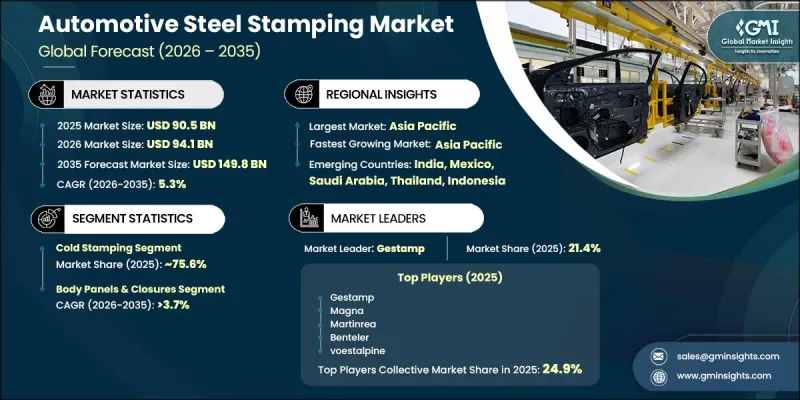
該市場透過支持耐用、高精度且經濟高效的汽車零件的大規模生產,持續為汽車製造業做出貢獻。電動和混合動力汽車研發投入的增加,以及對車輛效率和減排排放氣體的日益嚴格,正在改變對先進鋼材沖壓解決方案的需求。汽車製造商正擴大採用改進的沖壓技術來生產輕量化、高強度的結構部件,以支援不斷發展的車輛設計。鋼材沖壓是一種特殊的成型工藝,可將金屬板材加工成成品汽車零件,從而實現跨多個汽車平臺的高效生產。這項技術對於傳統汽車製造和新興車輛架構都至關重要,為供應商開發創新解決方案創造了機會。更高等級鋼材的廣泛應用、最佳化的材料設計以及改進的製造程序,正在進一步提高生產效率和零件性能。
| 市場範圍 | |
|---|---|
| 開始年份 | 2025 |
| 預測期 | 2026-2035 |
| 起始金額 | 905億美元 |
| 預測金額 | 1498億美元 |
| 複合年成長率 | 5.3% |
預計到2025年,冷沖壓製程將佔據75.6%的市場佔有率,並在2035年之前以3.7%的複合年成長率成長。該工藝憑藉其成本效益高、生產效率高以及適用於汽車零件批量生產等優勢,保持著主導地位。冷沖壓製程能夠穩定生產金屬零件,同時降低製造成本並保持營運效率,因此被汽車製造商廣泛採用。
預計到2025年,車身面板和車門鎖件市場佔有率將達到29%,並在2026年至2035年間以3.7%的複合年成長率成長。該細分市場涵蓋了對尺寸精度、結構性能、輕量化設計和表面光潔度要求極高的關鍵車輛外部零件。先進的沖壓成型技術使製造商能夠以更高的精度、重複性和製造一致性生產這些零件,從而滿足汽車行業日益成長的需求。
預計到2025年,中國汽車鋼材沖壓市場將佔據全球54.2%的佔有率,市場規模將達到230億美元。中國憑藉其龐大的汽車製造地、完善的供應鏈網路以及強大的汽車製造商、鋼鐵製造商和零件供應商網路,保持主導地位。汽車產量的成長和電動車(EV)製造的擴張,對先進的鋼材沖壓技術產生了巨大的需求。高抗張強度鋼的引進、先進的沖壓製程以及自動化生產系統的運用,提高了製造效率,並協助國內汽車輕量化策略的實施。
目錄
第1章:調查方法
第2章執行摘要
第3章 行業洞察
- 產業生態系分析
- 供應商情況
- 利潤率分析
- 成本結構
- 每個階段增加的價值
- 影響價值鏈的因素
- 中斷
- 影響產業的因素
- 成長促進因素
- 對輕型車輛和節能車輛的需求日益成長
- 擴大先進高抗張強度鋼(AHSS)和熱沖壓技術的應用。
- 電動車 (EV) 產量和電池結構部件的擴張
- 嚴格的汽車安全法規推動了對高強度沖壓件的需求。
- 產業潛在風險與挑戰
- 鋼鐵和原物料價格波動
- 先進的沖壓加工設備和自動化需要大量的資金投入。
- 市場機遇
- 電動汽車電池機殼和結構件的需求不斷成長
- 擴大工業4.0、自動化和智慧製造技術的應用。
- 擴大多材料車輛結構及精密金屬成型技術的應用。
- 本地化汽車生產和區域供應鏈的擴張
- 成長促進因素
- 成長潛力分析
- 技術與創新展望
- 最新科技趨勢
- 高抗張強度鋼(AHSS)的壓制
- 熱沖壓與壓固化技術
- 伺服壓力機和自動壓力生產線
- 新興技術
- 人工智慧驅動的品質檢測和預測過程控制
- 利用數位孿生科技的智慧印刷處理
- 用於電動車結構的整合式多材料成型
- 最新科技趨勢
- 價格分析
- 對過去價格趨勢的分析
- 依球員類型分類的定價策略(高級球員、超值球員、成本加成球員)
- 監管指南
- 北美洲
- 美國國家公路交通安全管理局(NHTSA)
- 加拿大汽車安全標準
- 歐洲
- 聯合國歐洲經濟委員會車輛安全法規,歐盟報廢車輛(ELV)
- 英國整車類型認證(WVTA)
- 亞太地區
- 中國:中國第六階段排放氣體標準
- 印度:汽車產業標準(AIS)
- 日本國土交通省
- 拉丁美洲
- 國家運輸委員會(CONTRAN)汽車安全法規
- 墨西哥官方標準(NOM)
- 中東和非洲
- 阿拉伯聯合大公國計量與標準化局(ESMA)
- 沙烏地阿拉伯標準、計量和品質組織(SASO)
- 國家強制性規範監理局(NRCS)
- 北美洲
- 波特的分析
- PESTLE分析
- 專利趨勢
- 永續性和環境方面
- 永續計劃
- 減少廢棄物策略
- 再生鋼材和循環製造
- 生產中的能源效率
- 具有環保意識的舉措
- 考慮碳足跡
- 人工智慧和生成式人工智慧對市場的影響
- 利用人工智慧改造現有經營模式
- 按細分市場分類的生成式人工智慧用例和部署藍圖
- 風險、限制和監管考量
- 預測假設和情境分析
- 基本案例:驅動複合年成長率的關鍵宏觀經濟與產業變量
- 樂觀情境:宏觀經濟與產業的順風
- 悲觀情景:宏觀經濟放緩或產業逆風
第4章 競爭情勢
- 介紹
- 企業市佔率分析
- 主要市場公司的競爭分析
- 競爭定位矩陣
- 主要進展
- 併購
- 夥伴關係和聯盟
- 新產品發布
- 業務拓展計劃及資金籌措
- 按公司規模進行基準測試
- 排名分類標準與遴選標準
- 按收入、地區和創新能力分類的層級定位矩陣。
第5章 市場估價與預測:依沖壓製程分類,2022-2035年
- 熱壓印
- 冷壓印
第6章 市場估計與預測:依組件分類,2022-2035年
- 車身面板和鎖扣
- 白車身結構
- 底盤部件
- 動力傳動系統
- 安全/加固
- 電池和電動車結構
第7章 市場估價與預測:依車輛類型分類,2022-2035年
- 搭乘用車
- 轎車
- 掀背車
- SUV/跨界車
- 商用車輛
- 輕型商用車(LCV)
- 中型商用車(MCV)
- 重型商用車(HCV)
第8章 市場估算與預測:依最終用戶分類,2022-2035年
- OEM
- 一級供應商
- 售後市場
第9章 市場估計與預測:依地區分類,2022-2035年
- 北美洲
- 美國
- 加拿大
- 歐洲
- 英國
- 德國
- 法國
- 義大利
- 西班牙
- 比利時
- 荷蘭
- 瑞典
- 俄羅斯
- 亞太地區
- 中國
- 印度
- 日本
- 澳洲
- 新加坡
- 韓國
- 越南
- 印尼
- 泰國
- 拉丁美洲
- 巴西
- 墨西哥
- 阿根廷
- 中東和非洲
- 南非
- 沙烏地阿拉伯
- UAE
第10章:公司簡介
- 世界公司
- Gestamp
- Magna
- AUTOKINITON
- Martinrea
- Benteler
- KIRCHHOFF
- voestalpine
- General Motors
- Ford Motor
- Volkswagen
- 當地公司
- Futaba Industrial
- Topre
- Yorozu
- Unipres
- AAPICO Hitech
- Sungwoo Hitech
- Hwashin
- Tata AutoComp
- Coskunoz Metal
- HUAYU Automotive
The Global Automotive Steel Stamping Market was valued at USD 90.5 billion in 2025 and is estimated to grow at a CAGR of 5.3% to reach USD 149.8 billion by 2035.
The market continues to help in automotive manufacturing by supporting the large-scale production of durable, accurate, and cost-efficient vehicle components. Growing investments in electric and hybrid vehicle development, combined with increasing regulatory focus on vehicle efficiency and emission reduction, are reshaping demand for advanced steel stamping solutions. Automotive manufacturers are increasingly adopting improved stamping technologies to produce lightweight yet strong structural components that support evolving vehicle designs. Steel stamping involves transforming sheet metal into finished automotive parts through specialized forming processes that enable efficient production across multiple vehicle platforms. Technology remains essential for both traditional automotive manufacturing and emerging vehicle architectures, creating opportunities for suppliers to develop innovative solutions. Increasing adoption of advanced steel grades, optimized material designs, and improved manufacturing techniques is further enhancing production efficiency and component performance.
| Market Scope | |
|---|---|
| Start Year | 2025 |
| Forecast Year | 2026-2035 |
| Start Value | $90.5 Billion |
| Forecast Value | $149.8 Billion |
| CAGR | 5.3% |
The cold stamping segment accounted for a 75.6% share in 2025 and is expected to grow at a CAGR of 3.7% through 2035. The segment maintains its leading position due to its cost-effectiveness, high production efficiency, and suitability for large-volume automotive manufacturing. Cold stamping continues to be widely adopted by vehicle manufacturers because it enables consistent production of metal components while maintaining operational efficiency and reducing manufacturing expenses.
The body panels and closures segment held a 29% share in 2025 and is projected to grow at a CAGR of 3.7% from 2026 to 2035. This segment includes key exterior vehicle components that require precise dimensions, strong structural performance, lightweight characteristics, and high-quality surface finishes. Advanced stamping techniques allow manufacturers to produce these components with improved accuracy, repeatability, and manufacturing consistency, supporting growing demand across the automotive industry.
China Automotive Steel Stamping Market accounted for a 54.2% share, generating USD 23 billion in 2025. The country maintains its leading position due to its extensive automotive manufacturing base, established supply chain network, and strong presence of vehicle manufacturers, steel producers, and component suppliers. Increasing vehicle production and rising electric vehicle manufacturing are creating significant demand for advanced steel stamping technologies. The adoption of high-strength steel materials, advanced stamping methods, and automated production systems is improving manufacturing efficiency while supporting vehicle lightweighting initiatives across the country.
Major companies operating in the global automotive steel stamping market include Gestamp, Magna, Martinrea, Benteler, Kirchhoff, Autokiniton, voestalpine, Shiloh Industries, AISIN, and Tower International. Companies operating in the automotive steel stamping market are focusing on technological innovation, production expansion, and strategic collaborations to strengthen their market position. Leading manufacturers are investing in advanced stamping equipment, automation technologies, and improved material processing capabilities to enhance efficiency and meet changing automotive requirements. Businesses are also developing lightweight and high-strength component solutions to support the growing demand for electric vehicles and fuel-efficient transportation. Strategic partnerships with automotive manufacturers help companies secure long-term supply agreements and expand their market presence. In addition, organizations are strengthening global manufacturing networks, improving operational capabilities, and investing in research and development to enhance product quality, reduce production costs, and maintain competitiveness in the evolving automotive supply chain.
Table of Contents
Chapter 1 Methodology
- 1.1 Research approach
- 1.2 Quality Commitments
- 1.2.1 GMI AI policy & data integrity commitment
- 1.2.1.1 Source consistency protocol
- 1.2.1 GMI AI policy & data integrity commitment
- 1.3 Research Trail & Confidence Scoring
- 1.3.1 Research Trail Components
- 1.3.2 Scoring Components
- 1.4 Data Collection
- 1.4.1 Partial list of primary sources
- 1.5 Data mining sources
- 1.5.1 Paid sources
- 1.5.1.1 Sources, by region
- 1.5.1 Paid sources
- 1.6 Base estimates and calculations
- 1.6.1 Base year calculation
- 1.7 Forecast
- 1.7.1 Quantified market impact analysis
- 1.7.1.1 Mathematical impact of growth parameters on forecast
- 1.7.1 Quantified market impact analysis
- 1.8 Research transparency addendum
- 1.8.1 Source attribution framework
- 1.8.2 Quality assurance metrics
- 1.8.3 Our commitment to trust
Chapter 2 Executive Summary
- 2.1 Industry 360° synopsis, 2022 – 2035
- 2.2 Key market trends
- 2.2.1 Regional
- 2.2.2 Stamping Process
- 2.2.3 Component
- 2.2.4 Vehicle
- 2.2.5 End User
- 2.3 TAM Analysis, 2026-2035
- 2.4 CXO perspectives: Strategic imperatives
Chapter 3 Industry Insights
- 3.1 Industry ecosystem analysis
- 3.1.1 Supplier landscape
- 3.1.2 Profit margin analysis
- 3.1.3 Cost structure
- 3.1.4 Value addition at each stage
- 3.1.5 Factor affecting the value chain
- 3.1.6 Disruptions
- 3.2 Industry impact forces
- 3.2.1 Growth drivers
- 3.2.1.1 Growing demand for lightweight vehicles and fuel efficiency
- 3.2.1.2 Increasing adoption of advanced high-strength steel (AHSS) and hot stamping technologies
- 3.2.1.3 Expansion of electric vehicle (EV) production and battery structural components
- 3.2.1.4 Stringent vehicle safety regulations driving demand for high-strength stamped components
- 3.2.2 Industry pitfalls and challenges
- 3.2.2.1 Volatility in steel and raw material prices
- 3.2.2.2 High capital investment required for advanced stamping equipment and automation
- 3.2.3 Market opportunities
- 3.2.3.1 Rising demand for battery enclosures and EV structural components
- 3.2.3.2 Increasing adoption of Industry 4.0, automation, and smart manufacturing technologies
- 3.2.3.3 Growing utilization of multi-material vehicle structures and precision metal forming
- 3.2.3.4 Expansion of localized automotive manufacturing and regional supply chains
- 3.2.1 Growth drivers
- 3.3 Growth potential analysis
- 3.4 Technology and Innovation landscape
- 3.4.1 Current technological trends
- 3.4.1.1 Advanced High-Strength Steel (AHSS) Stamping
- 3.4.1.2 Hot Stamping and Press Hardening Technologies
- 3.4.1.3 Servo Presses and Automated Stamping Lines
- 3.4.2 Emerging technologies
- 3.4.2.1 AI-Based Quality Inspection and Predictive Process Control
- 3.4.2.2 Digital Twin–Enabled Smart Stamping Manufacturing
- 3.4.2.3 Integrated Multi-Material Forming for EV Structures
- 3.4.1 Current technological trends
- 3.5 Pricing Analysis (Driven by Primary Research)
- 3.5.1 Historical Price Trend Analysis
- 3.5.2 Pricing Strategy by Player Type (Premium / Value / Cost-plus)
- 3.6 Regulatory guideline
- 3.6.1 North America
- 3.6.1.1 National Highway Traffic Safety Administration
- 3.6.1.2 Canada Motor Vehicle Safety Standards
- 3.6.2 Europe
- 3.6.2.1 UNECE Vehicle Safety Regulations, EU End-of-Life Vehicles (ELV)
- 3.6.2.2 UK Whole Vehicle Type Approval (WVTA)
- 3.6.3 Asia Pacific
- 3.6.3.1 China: China VI Emission Standards
- 3.6.3.2 India: Automotive Industry Standards (AIS)
- 3.6.3.3 Japan: Ministry of Land, Infrastructure
- 3.6.4 Latin America
- 3.6.4.1 National Traffic Council (CONTRAN) Vehicle Safety Regulations
- 3.6.4.2 Official Mexican Standards (NOM)
- 3.6.5 MEA
- 3.6.5.1 Emirates Authority for Standardization and Metrology (ESMA)
- 3.6.5.2 Saudi Standards, Metrology and Quality Organization (SASO)
- 3.6.5.3 National Regulator for Compulsory Specifications (NRCS)
- 3.6.1 North America
- 3.7 Porter’s analysis
- 3.8 PESTEL analysis
- 3.9 Patent Landscape (Driven by Primary Research)
- 3.10 Sustainability and environmental aspects
- 3.10.1 Sustainable practices
- 3.10.2 Waste reduction strategies
- 3.10.3 Recycled Steel & Circular Manufacturing
- 3.10.4 Energy efficiency in production
- 3.10.5 Eco-friendly Initiatives
- 3.10.6 Carbon footprint considerations
- 3.11 Impact of AI & Generative AI on the Market (Driven by Primary Research)
- 3.11.1 AI-Driven Disruption of Existing Business Models
- 3.11.2 GenAI Use Cases & Adoption Roadmap by Segment
- 3.11.3 Risks, Limitations & Regulatory Considerations
- 3.12 Forecast assumptions & scenario analysis (Driven by Primary Research)
- 3.12.1 Base Case - Key Macro & Industry Variables Driving CAGR
- 3.12.2 Optimistic Scenarios - Favourable macro and industry tailwinds
- 3.12.3 Pessimistic Scenario - Macroeconomic slowdown or industry headwinds
Chapter 4 Competitive Landscape, 2025
- 4.1 Introduction
- 4.2 Company market share analysis
- 4.2.1 North America
- 4.2.2 Europe
- 4.2.3 Asia Pacific
- 4.2.4 Latin America
- 4.2.5 MEA
- 4.3 Competitive analysis of major market players
- 4.4 Competitive positioning matrix
- 4.5 Key developments
- 4.5.1 Mergers & acquisitions
- 4.5.2 Partnerships & collaborations
- 4.5.3 New Product Launches
- 4.5.4 Expansion Plans and funding
- 4.6 Company Tier Benchmarking
- 4.6.1 Tier Classification Criteria & Qualifying Thresholds
- 4.6.2 Tier Positioning Matrix by Revenue, Geography & Innovation
Chapter 5 Market Estimates & Forecast, By Stamping Process, 2022 - 2035 ($Bn)
- 5.1 Key trends
- 5.2 Hot Stamping
- 5.3 Cold Stamping
Chapter 6 Market Estimates & Forecast, By Component, 2022 - 2035 ($Bn)
- 6.1 Key trends
- 6.2 Body Panels & Closures
- 6.3 Body-in-White Structural
- 6.4 Chassis Components
- 6.5 Powertrain
- 6.6 Safety & Reinforcement
- 6.7 Battery & EV Structural
Chapter 7 Market Estimates & Forecast, By Vehicle, 2022 - 2035 ($Bn)
- 7.1 Key trends
- 7.2 Passenger cars
- 7.2.1 Sedans
- 7.2.2 Hatchbacks
- 7.2.3 SUVs & crossovers
- 7.3 Commercial vehicles
- 7.3.1 Light commercial vehicles (LCV)
- 7.3.2 Medium commercial vehicles (MCV)
- 7.3.3 Heavy commercial vehicles (HCV)
Chapter 8 Market Estimates & Forecast, By End user, 2022 – 2035 ($Bn)
- 8.1 Key trends
- 8.2 OEMs
- 8.3 Tier 1 Suppliers
- 8.4 Aftermarket
Chapter 9 Market Estimates & Forecast, By Region, 2022 - 2035 ($Bn)
- 9.1 Key trends
- 9.2 North America
- 9.2.1 US
- 9.2.2 Canada
- 9.3 Europe
- 9.3.1 UK
- 9.3.2 Germany
- 9.3.3 France
- 9.3.4 Italy
- 9.3.5 Spain
- 9.3.6 Belgium
- 9.3.7 Netherlands
- 9.3.8 Sweden
- 9.3.9 Russia
- 9.4 Asia Pacific
- 9.4.1 China
- 9.4.2 India
- 9.4.3 Japan
- 9.4.4 Australia
- 9.4.5 Singapore
- 9.4.6 South Korea
- 9.4.7 Vietnam
- 9.4.8 Indonesia
- 9.4.9 Thailand
- 9.5 Latin America
- 9.5.1 Brazil
- 9.5.2 Mexico
- 9.5.3 Argentina
- 9.6 MEA
- 9.6.1 South Africa
- 9.6.2 Saudi Arabia
- 9.6.3 UAE
Chapter 10 Company Profiles
- 10.1 Global Players
- 10.1.1 Gestamp
- 10.1.2 Magna
- 10.1.3 AUTOKINITON
- 10.1.4 Martinrea
- 10.1.5 Benteler
- 10.1.6 KIRCHHOFF
- 10.1.7 voestalpine
- 10.1.8 General Motors
- 10.1.9 Ford Motor
- 10.1.10 Volkswagen
- 10.2 Regional Players
- 10.2.1 Futaba Industrial
- 10.2.2 Topre
- 10.2.3 Yorozu
- 10.2.4 Unipres
- 10.2.5 AAPICO Hitech
- 10.2.6 Sungwoo Hitech
- 10.2.7 Hwashin
- 10.2.8 Tata AutoComp
- 10.2.9 Coskunoz Metal
- 10.2.10 HUAYU Automotive

 歐洲汽車鋼板沖壓市場:市場佔有率分析、產業趨勢與統計、成長預測(2026-2031)
 汽車沖壓成型市場規模、佔有率和成長分析:按零件類型、金屬類型、製程類型、車輛類型和地區分類-2026-2033年產業預測
 汽車沖壓加工市場:預測(至2034年)-按製程、沖壓加工類型、材料、車輛類型、應用和地區分類的全球分析
 汽車金屬衝壓市場-全球產業規模、佔有率、趨勢、機會、預測:依車輛類型、技術、製程、地區和競爭格局分類,2021-2031年
 汽車沖壓件市場:依材質類型、技術、應用和最終用途產業分類-2026-2032年全球預測汽車底盤沖壓件市場按製程類型、材料類型、車輛類型、應用和最終用戶分類,全球預測,2026-2032年汽車金屬衝壓:市場佔有率分析、產業趨勢與統計、成長預測(2026-2031)汽車座椅靠背沖壓件市場:按材質、製造流程、車輛類型、應用和最終用戶分類 - 全球預測 2026-2032
 汽車沖壓機自動化市場機會、成長促進因素、產業趨勢分析及預測(2025-2034年)
 汽車金屬沖壓加工市場評估:車輛類型·技術·流程·各地區的機會及預測 (2018-2032年)