


 |
市場調查報告書
商品編碼
2117352
線上食品雜貨銷售:市場佔有率分析、行業趨勢和統計數據以及成長預測(2026-2031 年)Online Grocery - Market Share Analysis, Industry Trends & Statistics, Growth Forecasts (2026 - 2031) |
||||||

※ 本網頁內容可能與最新版本有所差異。詳細情況請與我們聯繫。
根據 Mordor Intelligence 預測,線上雜貨市場規模預計將從 2025 年的 9,600 億美元成長到 2026 年的 1.06 兆美元,並預計到 2031 年將達到 1.74 兆美元。
預計從 2026 年到 2031 年,其複合年成長率將達到 10.47%。
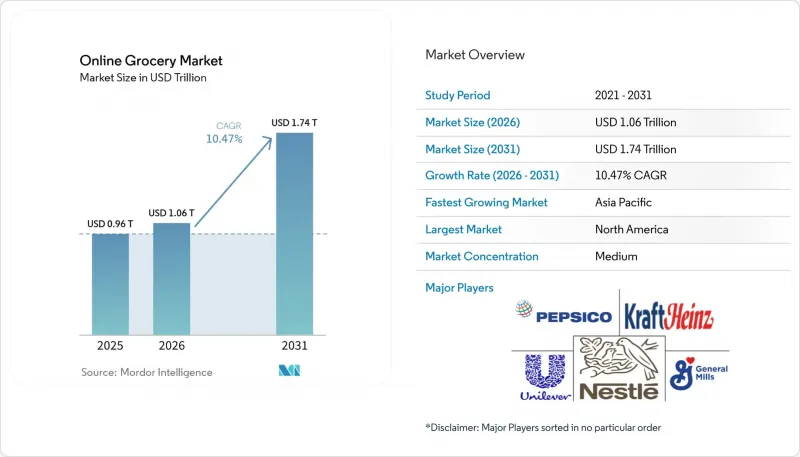
本報告按產品類別(生鮮食品和生鮮產品、廚屋主食和烹飪必需品、其他)、配送模式(即時配送、當日送達、定期配送、其他模式)、平台類型(公司網站/應用程式、聚合平台、其他)和地區(北美、歐洲、亞太、其他)進行細分。市場預測以美元計價。
全球線上食品雜貨市場趨勢及洞察
城市生活方式帶來的便利
加速的都市化和雙薪家庭的增加正在改變全球各地的食品雜貨購物習慣,推動線上食品雜貨市場的發展。在日本(92%)、阿根廷(90%)、荷蘭(89%)和美國(83%)等高度都市化的國家,城市居民擴大使用便捷的解決方案來購買日常必需品。在孟買和紐約等城市,消費者會根據自己的生活方式設定送貨時間,以避免排長隊和擁擠的商店。像BigBasket(塔塔集團旗下)和Instacart(與多家美國零售商合作)這樣的平台,透過靈活的送貨時間、保存購物清單和自動續訂等功能,正在革新購物體驗。亞馬遜(Amazon Fresh)、沃爾瑪(Great Value、Sam's Choice)和克羅格(Simple Truth)等零售巨頭則透過個人化產品推薦、人工智慧驅動的建議和微型倉配中心,不斷強化線上食品雜貨產業。同時,雀巢、聯合利華和百事可樂等日常消費品巨頭也正在利用這些平台最佳化產品可見度、實施捆綁銷售策略,並為精通數位技術的消費者開發配送系統。
透過訂閱提升客戶忠誠度
線上食品雜貨訂閱模式正在改變日常消費品(FMCG) 的銷售格局,迎合了日益重視便利性、穩定性和個人化的消費者的需求。對消費者而言,這些訂閱服務透過自動化補貨流程,簡化了牛奶、麥片和點心等日常用品的購買。這不僅最大限度地減少了麻煩,也培養了消費者對品牌的忠誠度。例如,克羅格 (Kroger) 的「Boost」和艾伯森 (Albertsons) 的「Schedule & Save」服務,讓消費者可以輕鬆註冊定期配送,配送對象包括雀巢、聯合利華和百事可樂等知名品牌,確保他們始終擁有所需的必需品,而無需糾結是否需要再次購買。除了免費送貨外,這些訂閱模式還提供額外的福利,例如專屬折扣、優先配送時段,甚至還有加油積分獎勵。這些獎勵不僅提高了消費者對平台的忠誠度,也增強了他們對訂閱服務中重點推廣品牌的忠誠度。在新興市場,「Blinkit」和「Zepto」等平台也開始利用這股趨勢獲利。在印度的都市區,越來越多的消費者正在積極使用訂閱和即時配送服務,尤其是在衝動性購買和零食、飲料等高周轉率商品方面。
高昂的運費和附加費用會影響購買價格。
在充滿挑戰的經濟環境下,價格敏感型消費者越來越擔心配送費,這阻礙了網路生鮮購物的普及。零售商面臨著如何在不斷上漲的營運成本和消費者對價格實惠的服務需求之間取得平衡的難題。例如,亞馬遜生鮮(Amazon Fresh)最近大幅提高了免運費的最低訂單金額,從35美元提高到150美元。此舉引發了許多忠實用戶的強烈不滿,他們認為這設定了不必要的門檻。在大西洋彼岸的英國,樂購(Tesco)將最低訂單金額從40歐元提高到50歐元,這項決定也凸顯了整個產業的普遍趨勢。零售商的目標不僅是提高平均訂單價值,還要提高每筆訂單的盈利。隨著消費者對配送服務的期望不斷提高,網路生鮮平檯面臨著如何在價格實惠和營運效率之間取得平衡的艱鉅挑戰。
細分市場分析
到2025年,生鮮食品易腐品將主導線上生鮮市場,佔40.92%的市佔率。這一趨勢反映出消費者對冷鏈可靠性和配送速度的信心日益增強。日常消費品(FMCG)公司,尤其是乳製品、生鮮和蛋白質類產品公司,正抓住這一機遇,進軍傳統上由實體零售主導的直接面對消費者的分銷管道。 Amul、Mother Dairy和雀巢等品牌正透過與電商平台合作拓展業務。同時,Licious和ITC Master Chef等肉類和魚貝類公司正利用「暗店」模式和冷藏物流,強調衛生、品質和便利性,以擴大其在生鮮快速消費品領域的線上影響力。
儘管生鮮食品仍佔據市場佔有率領先地位,但包裝食品和簡便食品正在迅速崛起,預計到2031年複合年成長率將達到18.85%。這種快速成長對百事可樂、ITC和億滋國際等品牌來說十分有利,因為它們的即食零食、穀物和食材自煮包經常在線上銷售。透過利用數位平台,快速消費品公司可以實施個人化促銷、捆綁銷售和自動續訂功能,從而提高購買頻率和訂單價值。在線銷售在嬰兒護理等高階領域尤其火爆。
區域分析
預計到2025年,北美將佔據線上雜貨市場35.98%的主導佔有率,鞏固其作為該行業最已開發地區的地位。這一主導地位源自於北美完善的電子商務基礎設施、廣泛的數位支付普及以及都市區龐大的市場需求。領先的日常消費品(FMCG)公司正巧妙地利用亞馬遜生鮮(Amazon Fresh)、沃爾瑪(Walmart)和克羅格(Kroger)等平台,建立強大的全通路策略,以滿足時間緊迫的消費者的需求。在都市區,便利性和速度特別重要,加工食品、個人保健產品和生活必需品的銷售正透過當日達和預約配送服務保持強勁成長。
同時,亞太地區正經歷最快的成長,預計到2031年年複合成長率(CAGR)將達到20.95%。快速的都市化、以行動裝置為中心的消費群體以及即時零售服務的興起是推動這一快速成長的主要因素。印度、印尼和越南等國家對日常消費品(FMCG)的參與度不斷提高,Blinkit、BigBasket、GrabMart、京東、阿里巴巴旗下的盒馬鮮生和拼多多等平台發揮關鍵作用。這些平台不僅促進了烹飪必需品和健康飲品的銷售,還利用演算法建議和快速復購功能,為快速消費品品牌帶來了顯著優勢。
歐洲的穩定成長得益於監管機構對永續配送和數位化透明度的支持。雀巢和達能等領導企業正與Ocado和家樂福線上等平台合作,同時遵守當地的永續性和包裝標準。在南美,隨著智慧型手機的普及和Mercado Libre等平台的興起,數位化格局正在不斷演變,這使得快速消費品品牌能夠加強飲料和乾貨的數位化分銷。在中東和非洲,都市區密度的增加和行動支付的廣泛應用正促使聯合利華和百事可樂等公司建立數位化平台,並與當地電商企業合作。
其他好處
- Excel格式的市場預測(ME)表
- 3個月的分析師支持
目錄
第1章:引言
- 研究假設和市場定義
- 調查範圍
第2章:調查方法
第3章執行摘要
第4章 市場狀況
- 市場概覽
- 市場促進因素
- 城市生活方式帶來的便利
- 透過訂閱提升客戶忠誠度
- 由於暗店的擴張,配送速度加快。
- 個人化與非接觸式科技的融合
- 行動端最佳化購物和數位支付
- 對永續和環保包裝材料的需求
- 市場限制因素
- 高昂的運費和額外費用對購買的負擔能力產生了負面影響。
- 對實體店購物有強烈的偏好
- 對新鮮度和品質的擔憂
- 履約營運的複雜性
- 供應鏈分析
- 技術展望
- 監理展望
- 波特五力模型
第5章 市場規模與成長預測
- 產品類型
- 生鮮食品/生鮮產品
- 新鮮農產品
- 乳製品
- 肉類、雞肉和魚貝類
- 麵包店
- 日常食品/烹飪必需品
- 穀類、豆類
- 食用油
- 香辛料和調味料
- 包裝食品和速食食品
- 即食食品(RTE)/即烹調食品(RTC)
- 小吃
- 肉類、雞肉和魚貝類
- 糖果甜點
- 其他包裝食品
- 飲料
- 個人保健產品
- 家用清潔劑
- 嬰兒護理產品
- 其他
- 生鮮食品/生鮮產品
- 交付模式
- 即時出貨
- 當日送達
- 定期配送
- 其他型號
- 依平台類型
- 公司網站/應用程式
- 聚合平台
- 其他
- 按地區
- 北美洲
- 美國
- 加拿大
- 墨西哥
- 其他北美國家
- 歐洲
- 德國
- 英國
- 義大利
- 法國
- 西班牙
- 荷蘭
- 波蘭
- 比利時
- 其他歐洲國家
- 亞太地區
- 中國
- 印度
- 日本
- 澳洲
- 印尼
- 韓國
- 泰國
- 新加坡
- 其他亞太國家
- 南美洲
- 巴西
- 阿根廷
- 哥倫比亞
- 其他南美國家
- 中東和非洲
- 南非
- 沙烏地阿拉伯
- 阿拉伯聯合大公國
- 土耳其
- 其他中東和非洲國家
- 北美洲
第6章 競爭情勢
- 市場集中度
- 策略趨勢
- 市佔率分析
- 公司簡介
- Nestle SA
- Unilever PLC
- The Kraft Heinz Company
- General Mills, Inc.
- PepsiCo, Inc.
- Danone SA
- Mondelez International, Inc.
- Mars, Incorporated
- The Coca-Cola Company
- The Procter & Gamble Company
- Colgate-Palmolive Company
- Reckitt Benckiser Group plc
- Grupo Bimbo, SAB de CV
- Groupe Lactalis SA
- Arla Foods amba
- Gujarat Cooperative Milk Marketing Federation(GCMMF)
- Nissin Foods Holdings Co., Ltd.
- The Campbell's Company
- Conagra Brands, Inc.
- L'Oreal SA
第7章 市場機會與未來展望
According to Mordor Intelligence, the online grocery market size is estimated to grow from USD 0.96 trillion in 2025 to USD 1.06 trillion in 2026, and is projected to reach USD 1.74 trillion by 2031, expanding at a 10.47% CAGR during 2026-2031.
This report is Segmented by Product Category (Fresh and Perishable Goods, Pantry Staples and Cooking Essentials, and More), Delivery Model (Instant Delivery, Same-Day Delivery, Scheduled Delivery, Other Models), Platform Type (Own Website/App, Aggregator Platforms, Others), and Geography (North America, Europe, Asia-Pacific, and More). The Market Forecasts are Provided in Terms of Value (USD).
Global Online Grocery Market Trends and Insights
Convenience Driven by Urban Lifestyles
Urbanization is accelerating, and with the rise of dual-income households, grocery shopping behaviors are evolving worldwide, supporting the online grocery market. In urbanized nations such as Japan (92%), Argentina (90%), the Netherlands (89%), and the U.S. (83%), city dwellers are increasingly turning to convenient solutions for their daily essentials . In cities like Mumbai and New York, consumers schedule deliveries to align with their routines, avoiding long queues and crowded aisles. Platforms like BigBasket (Tata Group) and Instacart (in collaboration with various U.S. retailers) are revolutionizing the shopping experience with features like flexible delivery windows, saved shopping lists, and auto-reordering. Retail giants ssuch as Amazon (Amazon Fresh), Walmart (Great Value, Sam's Choice), and Kroger (Simple Truth) are enhancing the online grocery industry through personalized product curation, AI-driven recommendations, and micro-fulfillment centers. Concurrently, FMCG behemoths like Nestle, Unilever, and PepsiCo are capitalizing on these platforms, optimizing product visibility, bundling strategies, and ensuring delivery readiness for the digital-savvy consumer.
Customer Loyalty Through Subscriptions
Online grocery subscription models are reshaping the landscape of FMCG sales, catering to a consumer base that increasingly values convenience, consistency, and personalization. For consumers, these subscriptions streamline routine purchases like milk, cereals, or snacks by automating the reordering process. This not only minimizes effort but also fosters habitual brand loyalty. Take Kroger's Boost and Albertsons' Schedule & Save, for instance. They enable consumers to effortlessly subscribe to regular deliveries from major brands like Nestle, Unilever, and PepsiCo, ensuring their pantries are consistently stocked without the hassle of repeated decision-making. Beyond just free delivery, these subscription models offer added perks, exclusive discounts, priority delivery slots, and even fuel rewards. Such incentives not only bolster consumer loyalty to the platform but also to the brands prominently featured in their subscriptions. In emerging markets, platforms like Blinkit and Zepto are capitalizing on this trend. Urban Indian consumers are increasingly leveraging subscription and instant delivery features, especially for impulse buys and high-turnover items like snacks and beverages.
High Delivery Fees and Surcharges Impact Affordability
As economic conditions tighten, price-sensitive consumers are increasingly wary of delivery fees, hindering the adoption of online grocery shopping. Retailers grapple with the challenge of balancing soaring operational costs against consumers' demand for budget-friendly services. Take Amazon Fresh, for example: it recently upped its free delivery threshold from USD 35 to a hefty USD 150. This move drew ire from loyal users, many of whom felt it created an unwelcome barrier. Across the pond in the United Kingdom, Tesco's decision to raise its minimum order value from EUR 40 to EUR 50 underscores a broader industry trend. Retailers are not just aiming to boost average order sizes but also to enhance the economics of each order. With rising delivery expectations, online grocery platforms face the daunting task of balancing affordability with operational efficiency.
Other drivers and restraints analyzed in the detailed report include:
- Faster Delivery Through Dark Store Expansion
- Mobile-Optimized Shopping and Digital Payments
- Preference for In-Store Shopping
For complete list of drivers and restraints, kindly check the Table Of Contents.
Segment Analysis
In 2025, fresh and perishable goods dominate the online grocery landscape, commanding a 40.92% market share. This trend underscores a growing consumer trust in the integrity of cold chains and the promptness of deliveries. FMCG players, especially in the dairy, produce, and protein sectors, are seizing this opportunity, tapping into direct-to-consumer channels that were previously the domain of offline retail. Brands such as Amul, Mother Dairy, and Nestle are broadening their horizons, forging alliances with e-grocery platforms. Meanwhile, meat and seafood entities like Licious and ITC Master Chef are making strides with dark-store models and refrigerated logistics, emphasizing hygiene, quality, and convenience to scale their online presence in the perishable FMCG segment.
While fresh goods lead in market share, packaged and convenience foods are on a rapid ascent, boasting a projected CAGR of 18.85% through 2031. This surge is advantageous for brands like PepsiCo, ITC, and Mondelez, as their ready-to-eat snacks, cereals, and meal kits enjoy frequent online basket placements. Digital platforms empower FMCG companies to roll out tailored promotions, combo deals, and auto-reorder features, amplifying both purchase frequency and order size. Premium segments, notably baby care, are witnessing a surge in online traction.
Complete Report Scope:
- By Product Category
- Fresh and Perishable Goods
- Fresh Produce
- Dairy Products
- Meat, Poultry and Seafood
- Bakery
- Pantry Staples and Cooking Essentials
- Cereals, Grains, Pulses
- Cooking Oils
- Spices and Condiments
- Packaged and Convenience Foods
- Ready-to-Eat (RTE) and Ready-to-Cook (RTC) Foods
- Snacks
- Meat, Poultry and Seafood
- Confectionery
- Other Packaged Foods
- Beverages
- Personal Care Products
- Household Cleaning Products
- Baby Care Products
- Others
- Fresh and Perishable Goods
- By Delivery Model
- Instant Delivery
- Same-Day Delivery
- Scheduled Delivery
- Other Models
- By Platform Type
- Own Website/App
- Aggregator Platforms
- Others
- By Geography
- North America
- United States
- Canada
- Mexico
- Rest of North America
- Europe
- Germany
- United Kingdom
- Italy
- France
- Spain
- Netherlands
- Poland
- Belgium
- Rest of Europe
- Asia-Pacific
- China
- India
- Japan
- Australia
- Indonesia
- South Korea
- Thailand
- Singapore
- Rest of Asia-Pacific
- South America
- Brazil
- Argentina
- Colombia
- Rest of South America
- Middle East and Africa
- South Africa
- Saudi Arabia
- United Arab Emirates
- Turkey
- Rest of Middle East and Africa
- North America
Geography Analysis
In 2025, North America commands a dominant 35.98% share of the online grocery market, underscoring its status as the industry's most developed region. This supremacy is attributed to North America's sophisticated e-commerce framework, the widespread embrace of digital payments, and a pronounced urban demand. Major FMCG players have adeptly harnessed platforms like Amazon Fresh, Walmart, and Kroger, crafting robust omnichannel strategies to cater to the needs of time-sensitive consumers. The region's urban centers, with their heightened emphasis on convenience and speed, have bolstered consistent sales of packaged foods, personal care products, and household necessities, facilitated through both same-day and scheduled delivery services.
Meanwhile, the Asia-Pacific region is witnessing the most rapid expansion, boasting a CAGR of 20.95% projected through 2031. Swift urbanization, a mobile-centric consumer base, and the rise of instant retail services fuel this surge. Countries such as India, Indonesia, and Vietnam are experiencing heightened FMCG engagement, with platforms like Blinkit, BigBasket, and GrabMart,JD.com, Alibaba's Freshippo, and Pinduoduo These platforms not only facilitate the sale of cooking essentials and health beverages but also leverage algorithmic recommendations and expedited reordering, much to the advantage of FMCG brands.
Europe's steady growth is driven by regulatory support for sustainable deliveries and digital transparency. Major players like Nestle and Danone are aligning with local sustainability and packaging standards while partnering with platforms such as Ocado and Carrefour Online. South America's digital landscape is evolving due to smartphone adoption and the dominance of platforms like Mercado Libre, enabling FMCG brands to enhance digital distribution in beverages and dry groceries. In the Middle East and Africa, rising urban density and mobile payments are helping companies like Unilever and PepsiCo establish digital platforms and collaborate with local e-retailers.
- Nestle S.A.
- Unilever PLC
- The Kraft Heinz Company
- General Mills, Inc.
- PepsiCo, Inc.
- Danone S.A.
- Mondelez International, Inc.
- Mars, Incorporated
- The Coca-Cola Company
- The Procter & Gamble Company
- Colgate-Palmolive Company
- Reckitt Benckiser Group plc
- Grupo Bimbo, S.A.B. de C.V.
- Groupe Lactalis S.A.
- Arla Foods amba
- Gujarat Cooperative Milk Marketing Federation (GCMMF)
- Nissin Foods Holdings Co., Ltd.
- The Campbell's Company
- Conagra Brands, Inc.
- L'Oreal S.A.
Additional Benefits:
- The market estimate (ME) sheet in Excel format
- 3 months of analyst support
TABLE OF CONTENTS
1 INTRODUCTION
- 1.1 Study Assumptions and Market Definition
- 1.2 Scope of the Study
2 RESEARCH METHODOLOGY
3 EXECUTIVE SUMMARY
4 MARKET LANDSCAPE
- 4.1 Market Overview
- 4.2 Market Drivers
- 4.2.1 Convenience Driven by Urban Lifestyles
- 4.2.2 Customer Loyalty Through Subscriptions
- 4.2.3 Faster Delivery Through Dark Store Expansion
- 4.2.4 Personalized and Contactless Tech Integration
- 4.2.5 Mobile-Optimized Shopping and Digital Payments
- 4.2.6 Demand for Sustainable and Eco-Friendly Packaging
- 4.3 Market Restraints
- 4.3.1 High High Delivery Fees and Surcharges Impact Affordabilitys
- 4.3.2 Persistent Preference for In-Store Shopping
- 4.3.3 Concerns Over Freshness and Quality
- 4.3.4 Operational Complexities in Fulfillment
- 4.4 Supply-Chain Analysis
- 4.5 Technological Outlook
- 4.6 Regulatory Outlook
- 4.7 Porter's Five Forces
- 4.7.1 Threat of New Entrants
- 4.7.2 Bargaining Power of Suppliers
- 4.7.3 Bargaining Power of Buyers
- 4.7.4 Threat of Substitutes
- 4.7.5 Competitive Rivalry
5 MARKET SIZE AND GROWTH FORECASTS (VALUE)
- 5.1 By Product Category
- 5.1.1 Fresh and Perishable Goods
- 5.1.1.1 Fresh Produce
- 5.1.1.2 Dairy Products
- 5.1.1.3 Meat, Poultry and Seafood
- 5.1.1.4 Bakery
- 5.1.2 Pantry Staples and Cooking Essentials
- 5.1.2.1 Cereals, Grains, Pulses
- 5.1.2.2 Cooking Oils
- 5.1.2.3 Spices and Condiments
- 5.1.3 Packaged and Convenience Foods
- 5.1.3.1 Ready-to-Eat (RTE) and Ready-to-Cook (RTC) Foods
- 5.1.3.2 Snacks
- 5.1.3.3 Meat, Poultry and Seafood
- 5.1.3.4 Confectionery
- 5.1.3.5 Other Packaged Foods
- 5.1.4 Beverages
- 5.1.5 Personal Care Products
- 5.1.6 Household Cleaning Products
- 5.1.7 Baby Care Products
- 5.1.8 Others
- 5.1.1 Fresh and Perishable Goods
- 5.2 By Delivery Model
- 5.2.1 Instant Delivery
- 5.2.2 Same-Day Delivery
- 5.2.3 Scheduled Delivery
- 5.2.4 Other Models
- 5.3 By Platform Type
- 5.3.1 Own Website/App
- 5.3.2 Aggregator Platforms
- 5.3.3 Others
- 5.4 By Geography
- 5.4.1 North America
- 5.4.1.1 United States
- 5.4.1.2 Canada
- 5.4.1.3 Mexico
- 5.4.1.4 Rest of North America
- 5.4.2 Europe
- 5.4.2.1 Germany
- 5.4.2.2 United Kingdom
- 5.4.2.3 Italy
- 5.4.2.4 France
- 5.4.2.5 Spain
- 5.4.2.6 Netherlands
- 5.4.2.7 Poland
- 5.4.2.8 Belgium
- 5.4.2.9 Rest of Europe
- 5.4.3 Asia-Pacific
- 5.4.3.1 China
- 5.4.3.2 India
- 5.4.3.3 Japan
- 5.4.3.4 Australia
- 5.4.3.5 Indonesia
- 5.4.3.6 South Korea
- 5.4.3.7 Thailand
- 5.4.3.8 Singapore
- 5.4.3.9 Rest of Asia-Pacific
- 5.4.4 South America
- 5.4.4.1 Brazil
- 5.4.4.2 Argentina
- 5.4.4.3 Colombia
- 5.4.4.4 Rest of South America
- 5.4.5 Middle East and Africa
- 5.4.5.1 South Africa
- 5.4.5.2 Saudi Arabia
- 5.4.5.3 United Arab Emirates
- 5.4.5.4 Turkey
- 5.4.5.5 Rest of Middle East and Africa
- 5.4.1 North America
6 COMPETITIVE LANDSCAPE
- 6.1 Market Concentration
- 6.2 Strategic Moves
- 6.3 Market Share Analysis
- 6.4 Company Profiles (includes Global level Overview, Market level overview, Core Segments, Financials as available, Strategic Information, Market Rank/Share for key companies, Products and Services, and Recent Developments)
- 6.4.1 Nestle S.A.
- 6.4.2 Unilever PLC
- 6.4.3 The Kraft Heinz Company
- 6.4.4 General Mills, Inc.
- 6.4.5 PepsiCo, Inc.
- 6.4.6 Danone S.A.
- 6.4.7 Mondelez International, Inc.
- 6.4.8 Mars, Incorporated
- 6.4.9 The Coca-Cola Company
- 6.4.10 The Procter & Gamble Company
- 6.4.11 Colgate-Palmolive Company
- 6.4.12 Reckitt Benckiser Group plc
- 6.4.13 Grupo Bimbo, S.A.B. de C.V.
- 6.4.14 Groupe Lactalis S.A.
- 6.4.15 Arla Foods amba
- 6.4.16 Gujarat Cooperative Milk Marketing Federation (GCMMF)
- 6.4.17 Nissin Foods Holdings Co., Ltd.
- 6.4.18 The Campbell's Company
- 6.4.19 Conagra Brands, Inc.
- 6.4.20 L'Oreal S.A.
7 MARKET OPPORTUNITIES AND FUTURE OUTLOOK

 線上雜貨市場-全球市場預測(2026-2032年)
 亞太地區線上生鮮市場:市場佔有率分析、產業趨勢與統計、成長預測(2026-2031年)
 線上食品市場:按產品類型、購買方式和地區分類
 2026年全球線上雜貨市場報告
 全球線上雜貨市場規模、佔有率、趨勢和成長分析報告(2026-2034)
 B2B線上雜貨市場-全球產業規模、佔有率、趨勢、機會及預測(產品類型、支付方式、地區及競爭格局分類,2021-2031年)線上雜貨市場-全球產業規模、佔有率、趨勢、機會和預測:按產品類型、配送類型、地區和競爭格局分類,2021-2031年
 全球線上雜貨市場:依產品、配送方式及地區劃分-市場規模、產業動態、機會分析及預測(2026-2035 年)
 日本線上雜貨市場報告:按產品類型、經營模式、平台、購買方式和地區分類(2026-2034年)
 線上雜貨市場規模、佔有率和成長分析(按產品類型、配送類型、支付方式、最終用戶和地區分類)-2026-2033年產業預測