


 |
市場調查報告書
商品編碼
2116044
歐洲無損檢測:市場佔有率分析、產業趨勢與統計及成長預測(2026-2031 年)Europe Non-Destructive Testing - Market Share Analysis, Industry Trends & Statistics, Growth Forecasts (2026 - 2031) |
||||||

※ 本網頁內容可能與最新版本有所差異。詳細情況請與我們聯繫。
根據 Mordor Intelligence 估計,2026 年歐洲無損檢測市值為 70.2 億美元,預計到 2031 年將達到 104.2 億美元,在預測期(2026-2031 年)內複合年成長率為 8.22%。
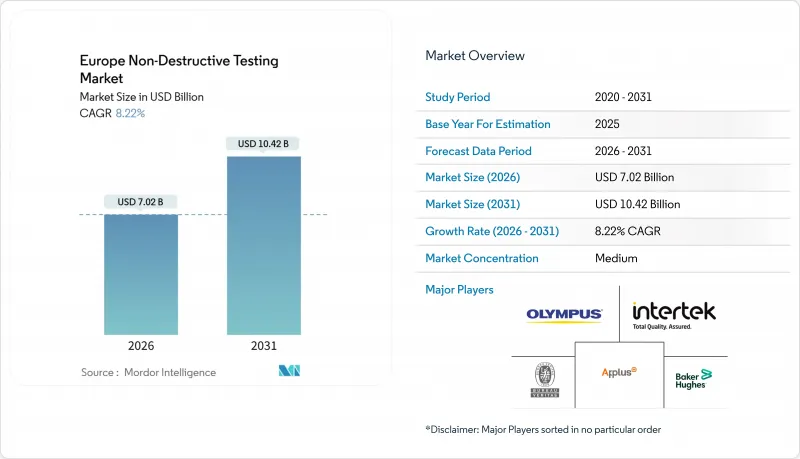
本報告按檢測方法(例如,射線照相檢測、超音波檢測、磁粉檢測)、組件類型(設備、軟體和分析平台、服務)、服務模式(例如,內部實施、外包)、最終用戶產業(例如,石油和天然氣、航太和國防、汽車和交通運輸)以及地區進行細分。市場預測以美元計價。
歐洲無損檢測市場趨勢與洞察
歐盟關於工業安全和產品責任的嚴格指令
壓力設備指令、機械法規和車輛檢驗方案的修訂擴大了強制性檢驗的範圍並提高了檢驗頻率。現規定,使用年限超過12年的商用車輛必須每年進行結構檢驗,使得德國、法國和西班牙每年新增約120萬次檢驗。產品責任法規的修訂將舉證責任轉移到製造商身上,強制要求航太和醫療設備生產線建立可審計的無損檢測記錄。儘管合規性要求日益嚴格,但歐洲無損檢測市場的需求仍然強勁,並未受到宏觀經濟放緩或傳統技術價格壓力的影響。
歐洲航太和國防領域對MRO設施的資本投資增加。
2024年至2026年間,通用電氣航空航太公司、賽峰集團及其他維修機構投資超過12.5億美元,用於擴展其超音波和電腦斷層掃描(CT)能力,從而縮短引擎大修週期,並實現對積層製造零件在同一班次內進行複檢。這股投資浪潮與空中巴士的預測相符,即到2031年,歐洲累計MRO支出將達到1,300億美元,其中無損檢測(NDT)將佔總成本的8%。目前,能夠將檢測數據整合到企業資產管理系統中的高通量設施正享受著優惠的合約條款,這正在加速軟體的普及應用,並推動歐洲無損檢測市場朝預測分析方向發展。
三級認證無損檢測 (NDT) 人員長期短缺
歐洲對三級超音波和射線照相檢測專家的需求比供應量高出15%,導致日薪高達近870美元,並延誤了複雜焊接的檢測。 ISO 9712標準規定的五年工作經驗要求加劇了這一短缺,而來自核能行業的競爭也使問題雪上加霜。儘管自動化減少了日常工作,但法律規範仍然要求人工核准,這限制了檢測能力,並促使參與企業投資建造內部培訓設施。
細分市場分析
到2025年,超音波檢測解決方案將佔據歐洲無損檢測市場30.11%的佔有率,並因其在檢測厚焊縫、複合材料和劣化管道壁的表面下缺陷方面的應用而備受青睞。大規模航太製造商目前使用128單元相位陣列探頭,僅需12分鐘即可完成渦輪盤掃描,相較於先前使用傳統脈衝回波探頭所需的45分鐘,掃描時間顯著縮短。雖然射線照相檢測對於核能相關焊接和積層製造零件仍然至關重要,但電腦斷層掃描(CT)正日益普及,以滿足EASA Part 21的體積檢測要求。兆赫成像、雷射超音波和人工智慧輔助熱成像等新興技術預計將以8.92%的複合年成長率成長,成為歐洲無損檢測市場成長最快的領域。
檢測規程擴大採用多種檢測方法相結合的方式。例如,單一風力發電機的宣傳活動可能需要結合無人機目視檢測、超音波抽檢以及渦流陣列螺栓螺紋檢測。能夠將這些資料來源的資訊整合到一個整合式儀表板中的供應商,預計將在歐洲無損檢測市場不斷成長的軟體領域佔據重要佔有率。
隨著資產所有者不斷將合規性和責任委託給經認證的服務提供者,預計到2025年,服務業將佔總收入的49.57%。光是必維集團(Bureau Veritas)一家,2024年在歐洲的無損檢測服務收入就達到了13億美元。然而,儘管歐洲整體無損檢測市場的複合年成長率為8.22%,但軟體和分析平台的複合年成長率卻高達9.14%。例如,Evident公司的OmniScan X4等儀器內建神經網路,能夠以92%的準確率對焊接缺陷進行分類,從而縮短了獲得三級認證所需的時間。由於訂閱式分析服務的毛利率徘徊在70%左右,是勞力密集服務的兩倍,因此,老牌服務巨頭正對收購利基軟體公司表現出濃厚的興趣。
Zetec和Olympus等公司推廣的軟體和租賃硬體捆綁銷售模式,使客戶無需前期投資,而供應商則能確保持續的收入。這種顛覆傳統設備銷售模式的做法,正在重塑歐洲無損檢測市場的利潤結構。
其他好處:
- Excel格式的市場預測(ME)表
- 3個月的分析師支持
目錄
第1章:引言
- 研究假設和市場定義
- 調查範圍
第2章:調查方法
第3章執行摘要
第4章 市場狀況
- 市場概覽
- 市場促進因素
- 歐盟關於工業安全和產品責任的嚴格指令
- 歐洲航太和國防領域對MRO設施的資本投資增加。
- 需要進行檢查以延長北海老舊油氣資產的使用壽命。
- 根據歐盟車輛檢驗方案,對在公共道路上行駛的商用車輛進行強制性定期檢驗。
- 積層製造 (AM) 零件認證需求的激增,催生了對新的非破壞性檢測 (NDT) 協議的需求。
- 對小型模組化核子反應爐(SMR)的投資正在推動先進的在運作中測試。
- 市場限制因素
- 三級認證無損檢測 (NDT) 人員長期短缺
- 中小型企業擁有相位陣列超音波和DR系統的成本較高。
- 歐盟標準協調的碎片化正在減緩其成果在跨境的接受程度。
- 新興的兆赫無損檢測解決方案在實際應用中的穩健性限制。
- 產業價值鏈分析
- 監理情勢
- 技術展望
- 波特五力分析
- 價格分析
第5章 市場規模與成長預測
- 透過測試方法
- 放射成像(膠片、數位、CT)
- 超音波(傳統、PAUT、TOFD)
- 磁粒子檢測法
- 液體滲透探傷測試
- 目視檢查和遠端目視檢查
- 電磁法和渦流法
- 新興技術
- 依組件類型
- 裝置
- 軟體和分析平台
- 服務
- 按服務類型
- 內部檢查
- 外包/第三方檢驗
- 租賃
- 按最終用戶行業分類
- 石油和天然氣
- 航太/國防
- 汽車和運輸業
- 發電
- 工業製造
- 建築和基礎設施
- 其他終端用戶產業
- 國家
- 英國
- 德國
- 法國
- 義大利
- 西班牙
- 其他國家
第6章 競爭情勢
- 市場集中度
- 策略趨勢
- 市佔率分析
- 公司簡介
- Baker Hughes Company
- Bureau Veritas SA
- Applus Servicios Tecnologicos SLU
- Intertek Group plc
- Olympus Corporation
- Yxlon International GmbH(Comet Group)
- Zetec Inc.
- Magnaflux Corporation
- Mistras Group, Inc.
- Eddyfi Technologies Inc.
- Waygate Technologies GmbH(Baker Hughes)
- TWI Ltd
- Sonatest Ltd
- NDT Global Services Ltd
- ROSEN Group GmbH
- Nikon Metrology NV
- VisiConsult X-ray Systems & Solutions GmbH
- NOVO DR Ltd
- Scanna MSC Ltd
- 3DX-RAY Ltd(Image Scan Holdings plc)
- Logos Imaging, LLC
- Teledyne ICM SA
- X-RIS SRL
- Institut de Soudure Groupe
- SGS Societe Generale de Surveillance SA
- TUV Nord Group
第7章 市場機會與未來展望
According to Mordor Intelligence, the Europe non-Destructive testing market size is estimated at USD 7.02 billion in 2026, and is expected to reach USD 10.42 billion by 2031, at a CAGR of 8.22% during the forecast period (2026-2031).
This report is Segmented by Testing Method (Radiography, Ultrasonic, Magnetic Particle, and More), Component Type (Equipment, Software and Analytics Platforms, and Services), Service Mode (In-House, Outsourced, and More), End-User Industry (Oil and Gas, Aerospace and Defense, Automotive and Transportation, and More), and Geography. The Market Forecasts are Provided in Terms of Value (USD).
Europe Non-Destructive Testing Market Trends and Insights
Stringent EU Directives on Industrial Safety and Product Liability
Revisions to the Pressure Equipment Directive, Machinery Regulation, and the Roadworthiness Package have widened the scope and tightened the cadence of mandatory inspections. Commercial vehicles older than 12 years now face annual structural checks, adding roughly 1.2 million inspections across Germany, France, and Spain each year. Updated product-liability rules shift the burden of proof onto manufacturers, compelling the creation of auditable, non-destructive testing records in aerospace and medical-device production lines. As compliance becomes non-negotiable, Europe Non-Destructive Testing market demand remains insulated from macro-economic slowdowns and pricing pressure on legacy techniques.
Rising Capital Expenditure in European Aerospace and Defense MRO Facilities
Between 2024 and 2026, GE Aerospace, Safran, and other maintenance organizations committed more than USD 1.25 billion to expand ultrasonic and computed-tomography capacity, shortening engine overhaul cycles and enabling same-shift re-inspection of additive-manufactured parts. The spending wave aligns with Airbus forecasts indicating USD 130 billion in cumulative European MRO outlays to 2031, with NDT accounting for 8% of total costs. High throughput facilities that integrate inspection data into enterprise asset-management systems now enjoy preferential contract terms, accelerating software adoption and pushing the Europe Non-Destructive Testing market toward predictive analytics.
Persistent Shortage of Level-III Certified NDT Personnel
Pan-European demand for Level-III ultrasonic and radiographic specialists outstrips supply by 15%, pushing day rates near USD 870 and delaying complex weld inspections. The five-year experiential requirement embedded in ISO 9712 prolongs the talent gap, while competition from the nuclear sector intensifies scarcity. Automation mitigates routine tasks, but regulatory frameworks still mandate human sign-off, constraining throughput and nudging Europe Non-Destructive Testing market participants to invest in internal academies.
Other drivers and restraints analyzed in the detailed report include:
- Ageing Oil and Gas Assets in the North Sea Demanding Life-Extension Inspections
- Mandatory Periodic Testing of On-Road Commercial Vehicles under EU Roadworthiness Package
- High Ownership Cost of Phased-Array Ultrasonic and Digital Radiography Systems for SMEs
For complete list of drivers and restraints, kindly check the Table Of Contents.
Segment Analysis
Ultrasonic solutions accounted for 30.11% of Europe Non-Destructive Testing market share in 2025, favored for detecting subsurface flaws in thick welds, composites, and aged pipeline walls. Large aerospace shops now scan turbine disks in 12 minutes using 128-element phased-array heads, down from 45 minutes with legacy pulse-echo probes. Radiography remains indispensable for nuclear welds and additive-manufactured parts, while computed tomography is gaining traction to meet EASA Part 21 volumetric mandates. Emerging techniques - terahertz imaging, laser ultrasonics, and AI-assisted thermography - are forecast at an 8.92% CAGR, making them the fastest slice of the Europe Non-Destructive Testing market.
Increasingly, inspection protocols combine modalities. A single wind-turbine tower campaign might deploy drone-based visual surveys, ultrasonic spot checks, and eddy-current arrays for bolt-thread inspections. Vendors able to integrate data from these sources into unified dashboards stand to capture the expanding software layer of the Europe Non-Destructive Testing market.
Services delivered 49.57% of 2025 revenue as asset owners continued to outsource compliance and liability to accredited providers. Bureau Veritas alone logged USD 1.3 billion in European NDT services during 2024. However, software and analytics platforms are rising at 9.14% CAGR, even as the broader Europe Non-Destructive Testing market advances at 8.22%. Instruments such as Evident's OmniScan X4 ship with embedded neural networks that classify weld flaws with 92% accuracy, reducing Level-III sign-off time. Gross margins on subscription analytics hover near 70%, double those of labor-intensive services, incentivizing incumbent service giants to acquire niche software firms.
When software is bundled with rental hardware- an approach championed by Zetec and Olympus- customers sidestep upfront capital, while vendors lock in recurring revenue. This inversion of the traditional equipment-sale model is reshaping the profit pool within the Europe Non-Destructive Testing market.
Complete Report Scope:
- By Testing Method
- Radiography (Film, Digital, CT)
- Ultrasonic (Conventional, PAUT, TOFD)
- Magnetic Particle
- Liquid Penetrant
- Visual and Remote Visual
- Electromagnetic and Eddy- Current
- Emerging Techniques
- By Component Type
- Equipment
- Software and Analytics Platforms
- Services
- By Service Mode
- In-house Inspection
- Outsourced/Third-Party Inspection
- Rental and Leasing
- By End-User Industry
- Oil and Gas
- Aerospace and Defense
- Automotive and Transportation
- Power Generation
- Industrial Manufacturing
- Construction and Infrastructure
- Other End-User Industries
- By Country
- United Kingdom
- Germany
- France
- Italy
- Spain
- Other Countries
List of Companies Covered in this Report:
- Baker Hughes Company
- Bureau Veritas SA
- Applus Servicios Tecnologicos S.L.U.
- Intertek Group plc
- Olympus Corporation
- Yxlon International GmbH (Comet Group)
- Zetec Inc.
- Magnaflux Corporation
- Mistras Group, Inc.
- Eddyfi Technologies Inc.
- Waygate Technologies GmbH (Baker Hughes)
- TWI Ltd
- Sonatest Ltd
- NDT Global Services Ltd
- ROSEN Group GmbH
- Nikon Metrology NV
- VisiConsult X-ray Systems & Solutions GmbH
- NOVO DR Ltd
- Scanna MSC Ltd
- 3DX-RAY Ltd (Image Scan Holdings plc)
- Logos Imaging, LLC
- Teledyne ICM SA
- X-RIS SRL
- Institut de Soudure Groupe
- SGS Societe Generale de Surveillance SA
- TUV Nord Group
Additional Benefits:
- The market estimate (ME) sheet in Excel format
- 3 months of analyst support
TABLE OF CONTENTS
1 INTRODUCTION
- 1.1 Study Assumptions and Market Definition
- 1.2 Scope of the Study
2 RESEARCH METHODOLOGY
3 EXECUTIVE SUMMARY
4 MARKET LANDSCAPE
- 4.1 Market Overview
- 4.2 Market Drivers
- 4.2.1 Stringent EU Directives On Industrial Safety and Product Liability
- 4.2.2 Rising Capital Expenditure In European Aerospace and Defence MRO Facilities
- 4.2.3 Ageing Oil and Gas Assets In The North Sea Demanding Life-Extension Inspections
- 4.2.4 Mandatory Periodic Testing Of On-Road Commercial Vehicles Under EU Roadworthiness Package
- 4.2.5 Surge In Additive-Manufacturing (AM) Part Qualification Requiring Novel NDT Protocols
- 4.2.6 Investments In Small Modular Nuclear Reactors (SMRs) Driving Advanced In-Service Inspection
- 4.3 Market Restraints
- 4.3.1 Persistent Shortage Of Level-III Certified NDT Personnel
- 4.3.2 High Ownership Cost Of Phased-Array Ultrasonic and DR Systems For SMEs
- 4.3.3 Fragmented EU Standards Harmonisation Delaying Cross-Border Acceptance Of Results
- 4.3.4 Limited Field-Use Robustness Of Emerging Terahertz NDT Solutions
- 4.4 Industry Value Chain Analysis
- 4.5 Regulatory Landscape
- 4.6 Technological Outlook
- 4.7 Porter's Five Forces Analysis
- 4.7.1 Bargaining Power of Suppliers
- 4.7.2 Bargaining Power of Buyers
- 4.7.3 Threat of New Entrants
- 4.7.4 Threat of Substitutes
- 4.7.5 Intensity of Competitive Rivalry
- 4.8 Pricing Analysis
5 MARKET SIZE AND GROWTH FORECASTS (VALUE)
- 5.1 By Testing Method
- 5.1.1 Radiography (Film, Digital, CT)
- 5.1.2 Ultrasonic (Conventional, PAUT, TOFD)
- 5.1.3 Magnetic Particle
- 5.1.4 Liquid Penetrant
- 5.1.5 Visual and Remote Visual
- 5.1.6 Electromagnetic and Eddy- Current
- 5.1.7 Emerging Techniques
- 5.2 By Component Type
- 5.2.1 Equipment
- 5.2.2 Software and Analytics Platforms
- 5.2.3 Services
- 5.3 By Service Mode
- 5.3.1 In-house Inspection
- 5.3.2 Outsourced/Third-Party Inspection
- 5.3.3 Rental and Leasing
- 5.4 By End-User Industry
- 5.4.1 Oil and Gas
- 5.4.2 Aerospace and Defense
- 5.4.3 Automotive and Transportation
- 5.4.4 Power Generation
- 5.4.5 Industrial Manufacturing
- 5.4.6 Construction and Infrastructure
- 5.4.7 Other End-User Industries
- 5.5 By Country
- 5.5.1 United Kingdom
- 5.5.2 Germany
- 5.5.3 France
- 5.5.4 Italy
- 5.5.5 Spain
- 5.5.6 Other Countries
6 COMPETITIVE LANDSCAPE
- 6.1 Market Concentration
- 6.2 Strategic Moves
- 6.3 Market Share Analysis
- 6.4 Company Profiles (includes Global level Overview, Market Level Overview, Core Segments, Financials as Available, Strategic Information, Market Rank/Share for Key Companies, Products and Services, and Recent Developments)
- 6.4.1 Baker Hughes Company
- 6.4.2 Bureau Veritas SA
- 6.4.3 Applus Servicios Tecnologicos S.L.U.
- 6.4.4 Intertek Group plc
- 6.4.5 Olympus Corporation
- 6.4.6 Yxlon International GmbH (Comet Group)
- 6.4.7 Zetec Inc.
- 6.4.8 Magnaflux Corporation
- 6.4.9 Mistras Group, Inc.
- 6.4.10 Eddyfi Technologies Inc.
- 6.4.11 Waygate Technologies GmbH (Baker Hughes)
- 6.4.12 TWI Ltd
- 6.4.13 Sonatest Ltd
- 6.4.14 NDT Global Services Ltd
- 6.4.15 ROSEN Group GmbH
- 6.4.16 Nikon Metrology NV
- 6.4.17 VisiConsult X-ray Systems & Solutions GmbH
- 6.4.18 NOVO DR Ltd
- 6.4.19 Scanna MSC Ltd
- 6.4.20 3DX-RAY Ltd (Image Scan Holdings plc)
- 6.4.21 Logos Imaging, LLC
- 6.4.22 Teledyne ICM SA
- 6.4.23 X-RIS SRL
- 6.4.24 Institut de Soudure Groupe
- 6.4.25 SGS Societe Generale de Surveillance SA
- 6.4.26 TUV Nord Group
7 MARKET OPPORTUNITIES AND FUTURE OUTLOOK
- 7.1 White-space and Unmet-Need Assessment

 石油和天然氣行業的無損檢測 (NDT):市場佔有率分析、行業趨勢和統計數據以及成長預測 (2026-2031)歐洲無損檢測設備:市場佔有率分析、產業趨勢與統計及成長預測(2026-2031 年)航太無損檢測:市場佔有率分析、產業趨勢與統計、成長預測(2026-2031)
 無損檢測 (NDT) 設備市場:按檢測方法、設備類型、技術、產業、國家和地區分類-全球產業分析、市場規模、市場佔有率及 2026 年至 2033 年預測
 2026年全球非破壞性檢驗設備市場報告英國無損檢測 (NDT):市場佔有率分析、產業趨勢與統計、成長預測(2025-2030 年)
 非破壞性檢測設備系統市場機會、成長要素、產業趨勢分析及2026-2035年預測
 非破壞性檢驗與檢驗市場:依技術、方法、服務、自動化程度、材料類型及產業分類-2026-2032年全球市場預測
 X光非破壞性檢測設備市場規模、佔有率和趨勢分析報告:按光源類型、設備類型、技術、檢測器類型、應用、最終用戶、地區和細分市場預測(2026-2033年)
 2026年無損檢測(NDT)產業十大成長機會