


 |
市場調查報告書
商品編碼
2113359
歐洲無損檢測設備:市場佔有率分析、產業趨勢與統計及成長預測(2026-2031 年)Europe NDT Equipment - Market Share Analysis, Industry Trends & Statistics, Growth Forecasts (2026 - 2031) |
||||||

※ 本網頁內容可能與最新版本有所差異。詳細情況請與我們聯繫。
據 Mordor Intelligence 稱,歐洲無損檢測 (NDT) 設備市場預計到 2026 年價值 64.4 億美元,高於 2025 年的 59.7 億美元,預計到 2031 年將達到 94.1 億美元。
預計從 2026 年到 2031 年,其複合年成長率將達到 7.88%。
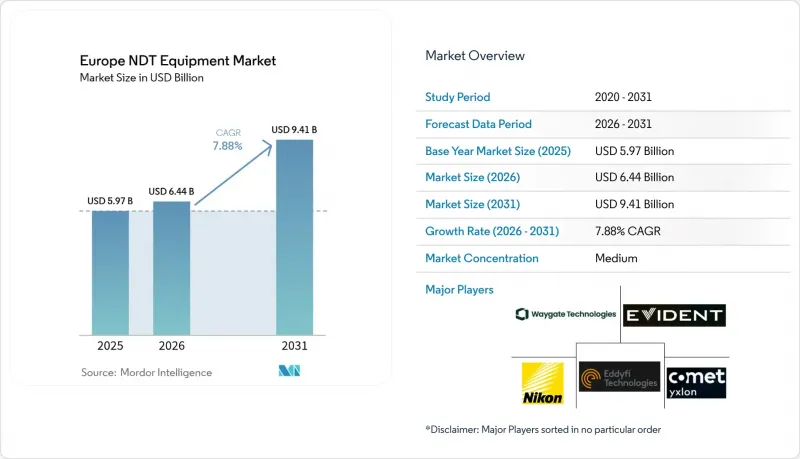
本報告按類型(設備和服務)、檢測技術(射線照相、超音波、磁粉檢測等)、終端用戶行業(石油天然氣、電力能源等)、服務類型(檢測服務、校準服務等)以及國家(英國、德國等)進行細分。市場預測以美元計價。
歐洲無損檢測 (NDT) 設備市場的趨勢與洞察
嚴格的法規強制要求遵守安全標準
在整個歐洲無損檢測 (NDT) 設備市場,營運商必須遵守歐盟壓力設備指令和 2024 年生效的修訂版國際原子能總署 (IAEA) 安全標準。德國 TÜV 等國內機構已縮短高壓容器的允許偵測間隔,以便即時採購能夠一次掃描覆蓋整個壁面的相位陣列超音波設備。統一的 ISO 9712 人員要求現在要求跨境運作必須獲得雙重認證,但東歐各國的執行情況仍然不一致,導致價格差異。這促使跨國公司將高階檢測業務集中在德國和荷蘭。保險公司越來越不願意為僅採用人工方法檢測的關鍵資產提供保險,這促使即使是對成本敏感的中小企業也轉向先進的、可追溯的解決方案。因此,合規相關支出成長速度超過了總資本支出,從而為設備和管理服務都創造了強勁的需求。
石油和天然氣行業管道健康管理的擴展
北海和波羅的海的營運商正以基於管道狀態的評估取代全年例行檢查,該評估採用線上超音波和電磁聲學工具。這些工具可在不中斷輸送的情況下繪製壁厚減薄圖。北海過渡管理局於2024年發布的一項指令將超過12,000公里的老舊鋼製管道納入兩年一次的檢查計劃,導致服務積壓激增,並催生了一系列多年期合約。德國和荷蘭的氫注入試驗計畫凸顯了更頻繁的焊接檢查對於監測脆化問題的必要性。擁有可在1,500米深海底作業並覆蓋相位陣列檢測範圍的機器人爬行器的服務供應商正在設計可按宣傳活動租賃的模組化掃描儀,這種模式受到希望降低前期成本的運營商的青睞。
熟練的無損檢測(NDT)技術人員短缺
到2028年,約有38%的ISO 9712 3級檢驗員將達到退休年齡,但目前的培訓計畫每年僅培養不到2500名2級候選人。預計到2024年,認證超音波專家的平均時薪將飆升14%,是普通製造業工資漲幅的兩倍,這將給採用固定價格框架合約的服務供應商的利潤率帶來壓力。雖然基於VR的模擬器有助於縮短學習曲線,但認證機構仍然對計入認證的虛擬培訓時長有所限制,阻礙了人才的補充。這種人才短缺也限制了歐洲無損檢測(NDT)設備市場採用複雜檢測技術(例如飛行時間繞射(TOF))的速度,而這些技術需要豐富的解讀經驗。
細分市場分析
截至2025年,設備仍將佔據主導地位,佔歐洲無損檢測(NDT)設備市場57.64%的佔有率。然而,隨著客戶從一次性資本投資轉向可變營運成本,預計到2031年,服務業的複合年成長率將達到9.1%,超過設備業的成長速度。目前,歐洲無損檢測設備市場由設備供應商主導,但該市場正轉向包含軟體更新和現場校準的捆綁式租賃方案,使現金流與專案里程碑保持一致。對於石油和天然氣巨頭而言,設備所有權模式仍然至關重要,因為頻繁的檢測需要較高的設備運轉率。然而,即使是這些大型公司,在平台生命週期中偶爾使用CT和聲波檢測時,也會選擇外包。這種趨勢在建設公司中尤其明顯,他們更傾向於按專案累計檢測,而不是在施工週期之間維護閒置的檢測器。同時,服務專家透過擴大區域檢驗實驗室、降低調動成本以及利用批量購買耗材的折扣,實現了具有競爭力的每日費率。
服務業的成長動能也得益於保險法規,這些法規要求對關鍵焊接、壓力容器和複合材料接頭進行第三方認證。必維集團(Bureau Veritas)在2024年將其服務網路擴大了17%,並推廣以舊換新優惠,鼓勵客戶淘汰老舊的輻射檢測設備,轉而簽訂服務型合約。設備製造商則透過與當地檢測實驗室成立合資企業來應對這一趨勢,在分擔資產使用風險的同時,保持市場准入。這些合作關係進一步模糊了供應商和服務供應商之間的界限,加劇了混合型競爭格局,在這種格局下,收入多元化至關重要。
2025年,超音波檢測在歐洲無損檢測(NDT)設備市場技術收入中仍佔31.96%,這主要得益於其在焊接檢測、厚度測量以及複合材料分層檢測方面的應用。然而,熱成像技術預計到2031年將以8.15%的複合年成長率成長,這反映了紅外線感測器成本的下降以及對風力渦輪機葉片和太陽能集熱器非接觸式檢測需求的成長。在離岸風力發電電場,無人機搭載的紅外線攝影機可以在不到一小時內掃描80公尺長的葉片,從而減少原本需要繩索作業的停機時間。紅外線技術還可用於太陽能發電廠的早期故障檢測,識別指示組串故障的熱點,而無需中斷發電。 X光偵測由於能夠建立永久記錄,在航太領域仍佔有一席之地,但由於許可障礙和限制區域的相關成本降低了投資報酬率(ROI),其在都市區的擴展受到限制。
電渦流檢測正在革新積層製造程序,它能夠檢測導電合金表面下的孔隙,並避免了X光檢測帶來的輻射問題。新的EN 17640標準統一了電渦流檢測的驗收標準,並簡化了飛機零件的認證流程。聲發射系統在石化產業的即時洩漏檢測領域佔據著一個雖小但成長迅速的市場。同時,儘管目視檢測勞動密集且利潤率低,但它仍然是大規模生產的主要檢測方法。磁粉檢測和液體滲透探傷檢測在汽車曲軸和鍛件的檢測中仍然發揮作用,但總合電渦流檢測檢測和熱成像技術以更快、更清潔的工作流程取而代之,它們的市場佔有率正在逐漸下降。
其他好處:
- Excel格式的市場預測(ME)表
- 3個月的分析師支持
目錄
第1章:引言
- 研究假設和市場定義
- 調查範圍
第2章:調查方法
第3章執行摘要
第4章 市場狀況
- 市場概覽
- 市場促進因素
- 嚴格的監管標準,強制要求遵守安全標準
- 擴大應用範圍,以確保石油和天然氣行業的管道完整性。
- 擴大對航太和國防領域的製造業投資
- 數位孿生模型與無損檢測(NDT)系統的整合
- 零件積層製造中微焦點X光技術的過渡
- 歐盟為核子反應爐檢查基礎設施現代化提供資金
- 市場限制因素
- 熟練的無損檢測(NDT)技術人員短缺
- 高階設備需要大量的初始投資。
- 歐盟成員國之間的校準標準各不相同。
- 基於雲端的無損檢測 (NDT) 平台的資料安全問題
- 產業價值鏈分析
- 監理情勢
- 技術展望
- 宏觀經濟因素對市場的影響
- 波特五力分析
第5章 市場規模與成長預測
- 按類型
- 裝置
- 服務
- 透過測試技術
- X光檢查
- 超音波
- 磁粒子檢測法
- 液體滲透探傷測試
- 目視檢查
- 渦流
- 聲發射
- 熱成像
- 按最終用戶行業分類
- 石油和天然氣
- 電力和能源
- 航太/國防
- 汽車和運輸業
- 建造
- 製造業
- 其他終端用戶產業
- 按服務類型
- 檢查服務
- 校對服務
- 培訓服務
- 諮詢
- 其他服務類型
- 國家
- 英國
- 德國
- 法國
- 義大利
- 西班牙
- 荷蘭
- 俄羅斯
- 其他歐洲國家
第6章 競爭情勢
- 市場集中度
- 策略趨勢
- 市佔率分析
- 公司簡介
- Waygate Technologies GmbH
- YXLON International GmbH
- Evident Europe GmbH(Olympus Corporation)
- Nikon Metrology NV
- Eddyfi Europe SAS
- MISTRAS Group GmbH
- Sonatest Ltd.
- Zetec Inc.
- Intertek Group PLC
- SGS SA
- Bureau Veritas SA
- Applus Services SA
- 3DX-RAY Ltd.
- Logos Imaging LLC
- Teledyne ICM SA
- X-RIS SPRL
- Visiconsult GmbH
- NOVO DR Ltd.
- TWI Ltd.
- Testia GmbH
第7章 市場機會與未來展望
According to Mordor Intelligence, the Europe NDT equipment market size in 2026 is estimated at USD 6.44 billion, growing from 2025 value of USD 5.97 billion with 2031 projections showing USD 9.41 billion, growing at 7.88% CAGR over 2026-2031.
This report is Segmented by Type (Equipment, and Services), Testing Technology (Radiography, Ultrasonic, Magnetic Particle, and More), End-User Industry (Oil and Gas, Power and Energy, and More), Service Type (Inspection Services, Calibration Services, and More), and Country (United Kingdom, Germany, and More). The Market Forecasts are Provided in Terms of Value (USD).
Europe NDT Equipment Market Trends and Insights
Stringent Regulatory Standards Mandating Safety Compliance
Across the Europe NDT Equipment market, operators must align with the EU Pressure Equipment Directive and the updated IAEA Safety Standards that came into force in 2024. National bodies, such as Germany's TUV, have already shortened the allowable inspection intervals for high-pressure vessels, driving the immediate procurement of phased-array ultrasonic instruments that generate full-wall coverage in a single scan. Harmonized ISO 9712 personnel rules now demand dual certification for cross-border work, but implementation still varies across Eastern Europe, creating a price gap that incentivizes multinationals to centralize high-end inspections in Germany or the Netherlands. Insurance underwriters are increasingly refusing policies for critical assets that are inspected only with manual methods, pushing even cost-sensitive SMEs toward advanced, traceable solutions. Compliance spend is therefore rising faster than overall capital expenditure, anchoring a resilient demand stream for both equipment and managed services.
Growing Adoption in Oil and Gas for Pipeline Integrity
North Sea and Baltic operators are replacing calendar-based inspection with condition-based pipelines assessment supported by inline ultrasonic and electromagnetic acoustic tools that map wall thinning without halting throughput. The North Sea Transition Authority's 2024 mandate added more than 12,000 km of legacy steel pipelines to the biennial inspection schedule, lifting service backlogs and sparking a wave of multiyear contracts. Hydrogen blending pilots across Germany and the Netherlands are amplifying the need for more frequent weld inspections to monitor embrittlement. Service providers with robotic crawlers capable of 1,500-meter subsea depth and phased-array coverage enjoy pricing power, while equipment vendors are designing modular scanners that can be leased per campaign, a model favored by operators looking to contain upfront outlays.
Shortage of Skilled NDT Technicians
Nearly 38% of ISO 9712 Level 3 inspectors will reach retirement age by 2028, yet current training pipelines graduate fewer than 2,500 Level 2 candidates per year. Average hourly rates for certified ultrasonic specialists surged 14% in 2024, twice the pace of general manufacturing wages, squeezing service-provider margins under fixed-price frame agreements. VR-based simulators help compress learning curves, but certification bodies still cap virtual hours that count toward qualification, delaying workforce replenishment. The talent gap also limits how quickly the Europe NDT Equipment market can adopt complex modalities such as time-of-flight diffraction, which require extensive interpretive expertise.
Other drivers and restraints analyzed in the detailed report include:
- Increasing Aerospace and Defense Manufacturing Investments
- Integration of Digital Twin Models with NDT Systems
- High Initial Capital Investment for Advanced Equipment
For complete list of drivers and restraints, kindly check the Table Of Contents.
Segment Analysis
Equipment continued to dominate the Europe NDT Equipment market size with a 57.64% value share in 2025, yet services are forecast to outpace at 9.1% CAGR through 2031 as clients pivot to variable operating costs over lump-sum capital spending. The Europe NDT Equipment market share, currently dominated by equipment vendors, is shifting toward bundled leasing options that include software updates and on-site calibration, aligning cash flows with project milestones. For oil and gas supermajors, the equipment-ownership model remains relevant because frequent inspections justify high utilization rates; however, even these players outsource CT or acoustics when usage is sporadic over a platform's life. The trend is particularly vivid among construction firms that prefer to book inspections on a per-project basis rather than maintain idle detectors between building cycles. Service specialists, meanwhile, expand regional labs, reducing mobilization costs and leveraging volume discounts on consumables, which translates into competitive day rates.
Momentum in services also stems from insurance stipulations that require third-party sign-off on critical welds, pressure vessels, and composite joints. Bureau Veritas expanded its network by 17% in 2024, promoting trade-in credits that encourage customers to retire aging radiography sets and transition to fee-for-service contracts. Equipment makers are responding by forming joint ventures with regional labs, ensuring market access while sharing risk on asset utilization. These alliances further blur the vendor-service boundary and reinforce a hybrid competitive landscape where revenue diversification is key.
Ultrasonic testing retained 31.96% of 2025 technology revenue, underpinned by its adaptability to weld inspection, thickness gauging, and composite delamination detection within the Europe NDT Equipment market. However, thermography is projected to advance at an 8.15% CAGR through 2031, reflecting declines in infrared sensor prices and the growing need for contactless surveys of wind blades and solar collectors. In offshore wind parks, drone-mounted infrared cameras scan 80-meter blades in under an hour, cutting downtime that would otherwise require rope access. Infrared also supports early fault detection in solar fields, pinpointing hot-spots that signal string failures without halting generation. Radiography maintains a foothold in aerospace because it delivers permanent records, yet expansion is limited in urban settings where licensing hurdles and exclusion-zone costs erode ROI.
Eddy current testing is rewriting additive-manufacturing protocols by detecting subsurface porosity in conductive alloys without the radiation baggage associated with X-ray testing. The new EN 17640 standard harmonized eddy current acceptance criteria, smoothing qualification for flight parts. Acoustic emission systems occupy a niche but growing spot for real-time leak detection in petrochemical spheres, while visual inspection remains the volume workhorse though low-margin because of its labor intensity. Magnetic particle and dye penetrant hold a role in automotive crankshafts and forged hardware, but their combined share is edging down as eddy current and thermography substitute faster, cleaner workflows.
Complete Report Scope:
- By Type
- Equipment
- Services
- By Testing Technology
- Radiography
- Ultrasonic
- Magnetic Particle
- Liquid Penetrant
- Visual Inspection
- Eddy Current
- Acoustic Emission
- Thermography
- By End-User Industry
- Oil and Gas
- Power and Energy
- Aerospace and Defense
- Automotive and Transportation
- Construction
- Manufacturing
- Other End-User Industry
- By Service Type
- Inspection Services
- Calibration Services
- Training Services
- Consultancy
- Other Service Type
- By Country
- United Kingdom
- Germany
- France
- Italy
- Spain
- Netherlands
- Russia
- Rest of Europe
List of Companies Covered in this Report:
- Waygate Technologies GmbH
- YXLON International GmbH
- Evident Europe GmbH (Olympus Corporation)
- Nikon Metrology NV
- Eddyfi Europe SAS
- MISTRAS Group GmbH
- Sonatest Ltd.
- Zetec Inc.
- Intertek Group PLC
- SGS SA
- Bureau Veritas SA
- Applus Services SA
- 3DX-RAY Ltd.
- Logos Imaging LLC
- Teledyne ICM SA
- X-RIS SPRL
- Visiconsult GmbH
- NOVO DR Ltd.
- TWI Ltd.
- Testia GmbH
Additional Benefits:
- The market estimate (ME) sheet in Excel format
- 3 months of analyst support
TABLE OF CONTENTS
1 INTRODUCTION
- 1.1 Study Assumptions and Market Definition
- 1.2 Scope of the Study
2 RESEARCH METHODOLOGY
3 EXECUTIVE SUMMARY
4 MARKET LANDSCAPE
- 4.1 Market Overview
- 4.2 Market Drivers
- 4.2.1 Stringent Regulatory Standards Mandating Safety Compliance
- 4.2.2 Growing Adoption in Oil and Gas for Pipeline Integrity
- 4.2.3 Increasing Aerospace and Defense Manufacturing Investments
- 4.2.4 Integration of Digital Twin Models with NDT Systems
- 4.2.5 Shift Toward Micro-Focus X-Ray for Additive Manufacturing Parts
- 4.2.6 EU Funding to Modernize Nuclear Reactor Inspection Infrastructure
- 4.3 Market Restraints
- 4.3.1 Shortage of Skilled NDT Technicians
- 4.3.2 High Initial Capital Investment for Advanced Equipment
- 4.3.3 Fragmented Calibration Standards Across EU Member States
- 4.3.4 Data Security Concerns in Cloud-based NDT Platforms
- 4.4 Industry Value Chain Analysis
- 4.5 Regulatory Landscape
- 4.6 Technological Outlook
- 4.7 Impact of Macroeconomic Factors on the Market
- 4.8 Porter's Five Forces Analysis
- 4.8.1 Threat of New Entrants
- 4.8.2 Bargaining Power of Buyers
- 4.8.3 Bargaining Power of Suppliers
- 4.8.4 Threat of Substitute Products
- 4.8.5 Intensity of Competitive Rivalry
5 MARKET SIZE AND GROWTH FORECASTS (VALUE)
- 5.1 By Type
- 5.1.1 Equipment
- 5.1.2 Services
- 5.2 By Testing Technology
- 5.2.1 Radiography
- 5.2.2 Ultrasonic
- 5.2.3 Magnetic Particle
- 5.2.4 Liquid Penetrant
- 5.2.5 Visual Inspection
- 5.2.6 Eddy Current
- 5.2.7 Acoustic Emission
- 5.2.8 Thermography
- 5.3 By End-User Industry
- 5.3.1 Oil and Gas
- 5.3.2 Power and Energy
- 5.3.3 Aerospace and Defense
- 5.3.4 Automotive and Transportation
- 5.3.5 Construction
- 5.3.6 Manufacturing
- 5.3.7 Other End-User Industry
- 5.4 By Service Type
- 5.4.1 Inspection Services
- 5.4.2 Calibration Services
- 5.4.3 Training Services
- 5.4.4 Consultancy
- 5.4.5 Other Service Type
- 5.5 By Country
- 5.5.1 United Kingdom
- 5.5.2 Germany
- 5.5.3 France
- 5.5.4 Italy
- 5.5.5 Spain
- 5.5.6 Netherlands
- 5.5.7 Russia
- 5.5.8 Rest of Europe
6 COMPETITIVE LANDSCAPE
- 6.1 Market Concentration
- 6.2 Strategic Moves
- 6.3 Market Share Analysis
- 6.4 Company Profiles (includes Global level Overview, Market level overview, Core Segments, Financials as available, Strategic Information, Market Rank/Share for key companies, Products and Services, and Recent Developments)
- 6.4.1 Waygate Technologies GmbH
- 6.4.2 YXLON International GmbH
- 6.4.3 Evident Europe GmbH (Olympus Corporation)
- 6.4.4 Nikon Metrology NV
- 6.4.5 Eddyfi Europe SAS
- 6.4.6 MISTRAS Group GmbH
- 6.4.7 Sonatest Ltd.
- 6.4.8 Zetec Inc.
- 6.4.9 Intertek Group PLC
- 6.4.10 SGS SA
- 6.4.11 Bureau Veritas SA
- 6.4.12 Applus Services SA
- 6.4.13 3DX-RAY Ltd.
- 6.4.14 Logos Imaging LLC
- 6.4.15 Teledyne ICM SA
- 6.4.16 X-RIS SPRL
- 6.4.17 Visiconsult GmbH
- 6.4.18 NOVO DR Ltd.
- 6.4.19 TWI Ltd.
- 6.4.20 Testia GmbH
7 MARKET OPPORTUNITIES AND FUTURE OUTLOOK
- 7.1 White-space and Unmet-Need Assessment

 歐洲無損檢測:市場佔有率分析、產業趨勢與統計及成長預測(2026-2031 年)石油和天然氣行業的無損檢測 (NDT):市場佔有率分析、行業趨勢和統計數據以及成長預測 (2026-2031)航太無損檢測:市場佔有率分析、產業趨勢與統計、成長預測(2026-2031)
 無損檢測 (NDT) 設備市場:按檢測方法、設備類型、技術、產業、國家和地區分類-全球產業分析、市場規模、市場佔有率及 2026 年至 2033 年預測
 2026年全球非破壞性檢驗設備市場報告英國無損檢測 (NDT):市場佔有率分析、產業趨勢與統計、成長預測(2025-2030 年)
 非破壞性檢測設備系統市場機會、成長要素、產業趨勢分析及2026-2035年預測
 非破壞性檢驗與檢驗市場:依技術、方法、服務、自動化程度、材料類型及產業分類-2026-2032年全球市場預測
 X光非破壞性檢測設備市場規模、佔有率和趨勢分析報告:按光源類型、設備類型、技術、檢測器類型、應用、最終用戶、地區和細分市場預測(2026-2033年)
 2026年無損檢測(NDT)產業十大成長機會