


 |
市場調查報告書
商品編碼
2097348
英國無損檢測 (NDT):市場佔有率分析、產業趨勢與統計、成長預測(2025-2030 年)UK NDT - Market Share Analysis, Industry Trends & Statistics, Growth Forecasts (2025 - 2030) |
||||||

※ 本網頁內容可能與最新版本有所差異。詳細情況請與我們聯繫。
據 Mordor Intelligence 稱,目前的估計顯示,到 2025 年,英國無損檢測 (NDT) 市場規模為 8.2 億美元,預計到 2030 年將達到 11.7 億美元。
這相當於該時期複合年成長率為 7.33%。
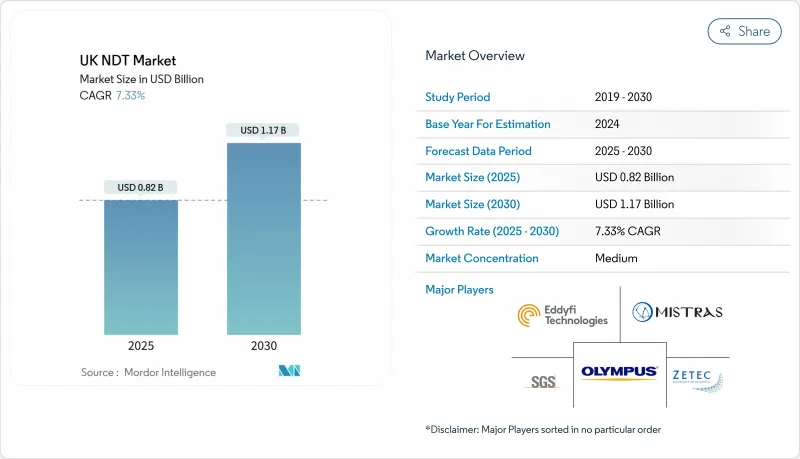
本報告按組件(設備、軟體、服務等)、偵測方法(超音波、射線照相等)、技術(傳統技術、人工智慧技術)和終端用戶產業(石油天然氣、發電、航太、國防、汽車和交通運輸、船舶和造船等)進行分類。市場預測以美元計價。
英國無損檢測 (NDT) 市場的趨勢與洞察
相位陣列超音波系統應用範圍擴大
相位陣列超音波(PAUT) 技術的日益普及正推動英國無損檢測 (NDT) 市場朝向更高解析度檢測方向發展。航太製造商越來越強制要求對複合材料零件使用 PAUT 技術,而石油和天然氣公司則利用該技術檢測複雜的焊接形狀。單一 PAUT 探頭即可取代多個傳統換能器,在不影響偵測範圍的前提下,將偵測時間縮短高達 50%。近期對壓力設備相關法規的修訂已將 PAUT 認可為射線照相檢測方法的替代方案。這消除了監管障礙,並促進了 PAUT 在其他安全至關重要的領域的應用。服務供應商正致力於透過將 PAUT 與即時數據分析平台結合,將檢測結果轉化為健康儀表板,從而提升員工技能並掌握商機。
可再生能源基礎設施的擴張
隨著該國力爭在2030年實現50吉瓦離岸風力發電裝置容量的目標,風力發電機的建設正在蓬勃發展。無損檢測(NDT)的需求已擴展到葉片製造、基礎焊接和海底電纜等領域,從而在沿海地區催生了一系列多年期的服務項目。在塔架偵測方面,無人機搭載的熱成像技術和機器人爬行器正在取代繩索作業,提高了工人的安全性和偵測的重複性。光是ScotWind的海底租賃業務就新增了超過25吉瓦的新計畫,這些項目都需要全生命週期偵測能力。因此,無損檢測(NDT)正從一項簡單的合規功能轉變為風電場營運商的策略差異化優勢。能夠提供整合葉片監測、腐蝕測繪和數位記錄管理的承包檢測方案的供應商,在贏得這些新契約具有強大的優勢。
先進輻射探測設備的高額購置成本
工業電腦斷層掃描 (CT) 平台通常造價超過 50 萬英鎊(約 62.5 萬美元),迫使中小型服務公司推遲升級或組成租賃聯盟。 X 光檢測室的合規性要求包括昂貴的屏蔽和許可,導致總擁有成本遠遠超過設備的標價。英國脫歐導致的供應鏈延誤延長了前置作業時間,降低了供應商之間的競爭,增加了資金籌措風險,可能會阻礙短期投資。因此,一些營運商正在轉向相控陣超音波檢測 (PAUT) 等替代方法來應對預算限制,但對於某些複雜形狀,射線照相檢測仍然無可取代。
細分市場分析
在英國無損檢測 (NDT) 市場,服務依然主導,預計 2024 年將佔銷售額的 78.6%。外包正在幫助資產所有者確保嚴格的合規性,尤其是在核能和航太領域,這些領域嚴重缺乏三級專家。檢測合約擴大將數據分析、基於風險的檢測計劃和監管報告納入多年框架。軟體雖然預計 2024 年僅佔銷售額的 7%,但卻是成長最快的細分市場,複合年成長率 (CAGR) 為 11.1%,這得益於雲端入口網站能夠接收原始檢測資料並將其輸入人工智慧模型,從而預測故障模式。隨著老舊的類比設備被數位 X 光檢測、相位陣列超音波和微型爬行器等設備取代,設備銷售正透過更新換代週期穩定成長。超音波耦合劑、液體滲透探傷和磁粉探傷劑等耗材持續創造售後市場收入,並有助於穩定供應商的現金流。
展望未來,服務公司正在擴大培訓設施,以增強其內部三級認證能力,而原始設備製造商(OEM)則將基於訂閱的軟體許可整合到其硬體產品包中。英國無損檢測協會(BINT)的報告顯示,2024年三級認證申請量增加了23%。預計到2027年,這群人才的湧入將略微緩解勞動力短缺問題,但先進技術的複雜性意味著高階專業人才仍然短缺,這將推動英國無損檢測市場對專業服務供應商的需求。
2024年,超音波檢測(UT)在英國無損檢測(NDT)市場中佔據27.3%的佔有率。其非放射性、便攜性和廣泛的體積檢測範圍,使得超音波檢測成為管道焊接、風力渦輪機法蘭和飛機複合材料檢測中不可或缺的工具。超音波超音波檢測(PAUT)和全矩陣採集技術的快速普及,實現了3D可視化並提高了缺陷尺寸測量的精度,進一步提升了超音波檢測的價值。電渦流檢測成長最為迅速,年複合成長率達7.9%,電動車(EV)原始設備製造商(OEM)和大型航太產業公司利用渦流檢測來檢測鋁製外殼和碳纖維層壓板。數位放射線偵測在高密度零件領域仍保持著一定的市場優勢,但安全規程和資本投入的限制限制了其發展。磁粉檢測和液體滲透探傷檢測在鑄造和鍛造件的表面缺陷檢測中仍然佔據主導地位,而熱成像技術在旋轉機械的預測性維護中正日益受到關注。
超音波(UT) 供應商正在擴展其整合系統產品線,這些系統結合了雙矩陣探頭和人工智慧分類功能,能夠即時顯示裂縫等異常情況。 2024 年,英國健康與安全局 (HSE) 擴展了其壓力設備指南,認可了超音波(UT) 的替代方法,進一步推動了超音波 (UT) 在現場的應用。因此,目前已有混合檢測軟體包,將相控相位陣列超音波用於焊接檢測,渦流陣列超音波用於熱影響區檢測,為操作人員在整合軟體環境下提供一站式解決方案。
其他好處:
- Excel格式的市場預測(ME)表
- 3個月的分析師支持
目錄
第1章:引言
- 市場分析與定義的前提條件
- 分析範圍
第2章 分析方法
第3章執行摘要
第4章 市場狀況
- 市場概覽
- 市場促進因素
- 相位陣列超音波系統的應用日益廣泛
- 可再生能源基礎設施的擴張(對風力渦輪機檢查的需求)
- 英國老舊核能發電廠的強制性檢查週期
- 政府對工業4.0數位化檢測解決方案的支持
- 由於技能差距擴大,外包給專業服務供應商
- 鮮為人知的是:氫氣管道完整性認證工作
- 市場限制因素
- 先進X光成像設備的高投資成本
- 人工智慧缺陷特徵評估標準化的局限性
- 小眾技術領域三級認證檢驗員短缺
- 未報告的問題:工業射線照相同位素的環境問題
- 產業價值鏈分析
- 宏觀經濟因素的影響
- 監理情勢
- 技術展望
- 波特五力分析
第5章:預測市場規模與成長率
- 按組件
- 裝置
- 軟體
- 服務
- 消耗品
- 透過測試方法
- 超音波檢查
- 放射檢查
- 磁粉檢測
- 液體滲透探傷
- 目視檢查
- 電渦流檢測
- 聲發射測試
- 熱成像/紅外線檢測
- 電腦斷層掃描(CT)
- 透過方法
- 傳統/傳統方法
- 人工智慧相容
- 按最終用戶行業分類
- 石油和天然氣
- 發電
- 航太
- 防禦
- 汽車和運輸機械
- 製造業/重工業
- 建築和基礎設施
- 化工/石油化工
- 海洋/造船
- 電子和半導體
- 礦業
- 醫療設備
- 其他
第6章 競爭情勢
- 市場集中度
- 策略趨勢
- 市佔率分析
- 公司簡介
- Mistras Group Ltd
- Eddyfi UK
- Olympus Europa Holding GmbH(UK branch)
- Zetec Inc(UK)
- Sonatest Ltd
- Magnaflux UK
- Ashtead Technology Ltd
- Applus UK Ltd
- Bureau Veritas UK
- Intertek Group plc
- SGS United Kingdom Ltd
- TWI Ltd
- Element Materials Technology
- ROSEN(UK)Ltd
- JME Ltd
- Phoenix Inspection Systems Ltd
- Silverwing UK
- Nexxis UK
- Eddyfi Technologies UK
- IMechE Engineering Training Solutions
- SKF Condition Monitoring
- Cygnus Instruments Ltd
- Acuren(UK operations)
- Sandvik Inspection Robotics
- G-Technologies Ultrasonic Systems
第7章 市場機會與未來展望
According to Mordor Intelligence, current estimates place the UK NDT market size at USD 0.82 billion in 2025, and the sector is forecast to reach USD 1.17 billion by 2030, translating into a 7.33% CAGR over the period.
This report is Segmented by Component (Equipment, Software, Services, and More), Testing Method (Ultrasonic Testing, Radiographic Testing, and More), Technique (Traditional/Conventional, and AI-Enabled), and End-User Industry (Oil and Gas, Power Generation, Aerospace, Defense, Automotive and Transportation, Marine and Ship Building, and More). The Market Forecasts are Provided in Terms of Value (USD).
UK NDT Market Trends and Insights
Growing Adoption of Phased-Array Ultrasonic Systems
The wider adoption of phased-array ultrasonic testing (PAUT) is driving the UK NDT market toward higher-resolution inspections. Aerospace manufacturers are increasingly mandating PAUT for composite components, while oil and gas operators are adopting it for complex weld geometries. One PAUT probe can replace multiple conventional transducers, cutting inspection time by as much as 50% without compromising volumetric coverage. Recent updates to pressure equipment regulations list PAUT as an acceptable alternative to radiographic methods, erasing regulatory obstacles and supporting adoption across other safety-critical sectors. Service providers are capitalizing on upskilling personnel and by bundling PAUT with real-time data analytics platforms that translate inspection results into integrity dashboards.
Expansion of Renewable-Energy Infrastructure
Wind turbine construction is surging as the country aims to reach 50 GW of offshore wind capacity by 2030. NDT demand spans blade manufacturing, foundation welds, and subsea cables, creating multi-year service pipelines in coastal regions. Drone-borne thermography and robotic crawlers are replacing rope access for tower inspections, improving worker safety and inspection repeatability. ScotWind seabed leasing alone adds more than 25 GW of new projects that will require lifetime inspection regimes, turning NDT from a compliance function into a strategic differentiator for wind-farm operators. Vendors offering turnkey inspection packages that integrate blade monitoring, corrosion mapping, and digital record-keeping are well-positioned to capture these new contracts.
High Capital Cost of Advanced Radiographic Equipment
Industrial computed tomography platforms often exceed GBP 500,000 (USD 625,000), pushing smaller service companies to delay upgrades or form rental consortia. Compliance in radiographic bays demands costly shielding and licensing, driving total ownership far above headline equipment prices. Supply chain delays following Brexit have extended lead times and reduced vendor competition, adding financing risk that can dampen near-term investment. Consequently, some operators switch to alternative methods such as PAUT to manage budget constraints, although radiography remains irreplaceable for certain complex geometries.
Other drivers and restraints analyzed in the detailed report include:
- Mandatory Inspection Cycles for the Aging Nuclear Fleet
- Government Incentives for Industry 4.0 Digital Inspection Solutions
- Limited Standardization for AI-Enabled Defect Characterization
For complete list of drivers and restraints, kindly check the Table Of Contents.
Segment Analysis
Services continue to dominate the UK NDT market, accounting for 78.6% of revenue in 2024. Outsourcing helps asset owners secure disciplined compliance amid acute shortages of Level III expertise, especially in nuclear and aerospace settings. Inspection contracts are increasingly bundling data analytics, risk-based inspection planning, and regulatory reporting into multi-year frameworks. Software, although accounting for just 7% of 2024 revenue, is the fastest-growing component, with a 11.1% CAGR, as cloud portals ingest raw inspection data and feed AI models that predict failure modes. Equipment sales grow steadily through replacement cycles, as aging analog devices are swapped for digital radiography, phased-array ultrasonics, and miniature crawlers. Consumables-such as ultrasonic couplants, penetrant dyes, and magnetic particles-generate recurring aftermarket revenue, helping to stabilize vendor cash flows.
Looking ahead, services firms are expanding their training academies to boost internal Level III capacity, while OEMs are embedding subscription-based software licenses within hardware packages. The British Institute of Non-Destructive Testing reported a 23% increase in Level III certification applications in 2024. This talent influx should marginally ease labor constraints by 2027, yet the complexity of advanced techniques keeps high-end expertise in short supply, reinforcing the premium placed on specialist service providers across the UK NDT market.
Ultrasonic testing (UT) retained a 27.3% share of the UK NDT market in 2024. Its non-radiographic nature, portability, and volumetric coverage make UT indispensable for pipeline welds, wind-tower flanges, and aircraft composites. The rapid adoption of PAUT and full-matrix capture enhances UT's value by adding 3D visualization and improving defect sizing accuracy. Eddy-current testing posted the quickest gains, expanding at 7.9% CAGR as electric-vehicle OEMs and aerospace primes inspect aluminum skins and carbon-fiber laminates. Digital radiography still holds a niche advantage for dense components, though safety protocols and capex barriers cap growth. Magnetic particle and liquid penetrant techniques remain staples for surface defect detection in casting and forging plants, while thermography gains traction in predictive maintenance for rotating machinery.
UT vendors are increasingly supplying integrated systems that pair dual-matrix probes with AI classification, which flags crack-like indications in live displays. In 2024, the Health and Safety Executive broadened pressure-equipment guidelines to accept UT alternatives, spurring wider field adoption. Consequently, hybrid inspection packages now combine phased-array UT for weld bodies with eddy-current arrays for heat-affected zones, giving operators a one-stop solution under a consolidated software environment.
Complete Report Scope:
- By Component
- Equipment
- Software
- Services
- Consumables
- By Testing Method
- Ultrasonic Testing
- Radiographic Testing
- Magnetic Particle Testing
- Liquid Penetrant Testing
- Visual Inspection Testing
- Eddy-Current Testing
- Acoustic Emission Testing
- Thermography / Infrared Testing
- Computed Tomography Testing
- By Technique
- Traditional / Conventional
- AI-enabled
- By End-user Industry
- Oil and Gas
- Power Generation
- Aerospace
- Defense
- Automotive and Transportation
- Manufacturing and Heavy Engineering
- Construction and Infrastructure
- Chemical and Petrochemical
- Marine and Ship Building
- Electronics and semiconductor
- Mining
- Medical Devices
- Others
List of Companies Covered in this Report:
- Mistras Group Ltd
- Eddyfi UK
- Olympus Europa Holding GmbH (UK branch)
- Zetec Inc (UK)
- Sonatest Ltd
- Magnaflux UK
- Ashtead Technology Ltd
- Applus UK Ltd
- Bureau Veritas UK
- Intertek Group plc
- SGS United Kingdom Ltd
- TWI Ltd
- Element Materials Technology
- ROSEN (UK) Ltd
- JME Ltd
- Phoenix Inspection Systems Ltd
- Silverwing UK
- Nexxis UK
- Eddyfi Technologies UK
- IMechE Engineering Training Solutions
- SKF Condition Monitoring
- Cygnus Instruments Ltd
- Acuren (UK operations)
- Sandvik Inspection Robotics
- G-Technologies Ultrasonic Systems
Additional Benefits:
- The market estimate (ME) sheet in Excel format
- 3 months of analyst support
TABLE OF CONTENTS
1 INTRODUCTION
- 1.1 Study Assumptions and Market Definition
- 1.2 Scope of the Study
2 RESEARCH METHODOLOGY
3 EXECUTIVE SUMMARY
4 MARKET LANDSCAPE
- 4.1 Market Overview
- 4.2 Market Drivers
- 4.2.1 Growing adoption of phased-array ultrasonic systems
- 4.2.2 Expansion of renewable-energy infrastructure (wind-turbine inspection demand)
- 4.2.3 Mandatory inspection cycles for aging UK nuclear fleet
- 4.2.4 Government incentives for Industry 4.0 digital inspection solutions
- 4.2.5 Rising skill-gap outsourcing to specialist service providers
- 4.2.6 Under-reported: Drive to certify hydrogen-pipeline integrity
- 4.3 Market Restraints
- 4.3.1 High capital cost of advanced radiographic equipment
- 4.3.2 Limited standardisation for AI-enabled defect characterisation
- 4.3.3 Shortage of level-III certified inspectors in niche techniques
- 4.3.4 Under-reported: Environmental concerns over industrial radiography isotopes
- 4.4 Industry Value Chain Analysis
- 4.5 Impact of Macroeconomic Factors
- 4.6 Regulatory Landscape
- 4.7 Technological Outlook
- 4.8 Porter's Five Forces Analysis
- 4.8.1 Bargaining Power of Buyers
- 4.8.2 Bargaining Power of Suppliers
- 4.8.3 Threat of New Entrants
- 4.8.4 Threat of Substitutes
- 4.8.5 Competitive Rivalry
5 MARKET SIZE AND GROWTH FORECASTS (VALUE)
- 5.1 By Component
- 5.1.1 Equipment
- 5.1.2 Software
- 5.1.3 Services
- 5.1.4 Consumables
- 5.2 By Testing Method
- 5.2.1 Ultrasonic Testing
- 5.2.2 Radiographic Testing
- 5.2.3 Magnetic Particle Testing
- 5.2.4 Liquid Penetrant Testing
- 5.2.5 Visual Inspection Testing
- 5.2.6 Eddy-Current Testing
- 5.2.7 Acoustic Emission Testing
- 5.2.8 Thermography / Infrared Testing
- 5.2.9 Computed Tomography Testing
- 5.3 By Technique
- 5.3.1 Traditional / Conventional
- 5.3.2 AI-enabled
- 5.4 By End-user Industry
- 5.4.1 Oil and Gas
- 5.4.2 Power Generation
- 5.4.3 Aerospace
- 5.4.4 Defense
- 5.4.5 Automotive and Transportation
- 5.4.6 Manufacturing and Heavy Engineering
- 5.4.7 Construction and Infrastructure
- 5.4.8 Chemical and Petrochemical
- 5.4.9 Marine and Ship Building
- 5.4.10 Electronics and semiconductor
- 5.4.11 Mining
- 5.4.12 Medical Devices
- 5.4.13 Others
6 COMPETITIVE LANDSCAPE
- 6.1 Market Concentration
- 6.2 Strategic Moves
- 6.3 Market Share Analysis
- 6.4 Company Profiles {(includes Global level Overview, Market level overview, Core Segments, Financials as available, Strategic Information, Market Rank/Share for key companies, Products and Services, and Recent Developments)}
- 6.4.1 Mistras Group Ltd
- 6.4.2 Eddyfi UK
- 6.4.3 Olympus Europa Holding GmbH (UK branch)
- 6.4.4 Zetec Inc (UK)
- 6.4.5 Sonatest Ltd
- 6.4.6 Magnaflux UK
- 6.4.7 Ashtead Technology Ltd
- 6.4.8 Applus UK Ltd
- 6.4.9 Bureau Veritas UK
- 6.4.10 Intertek Group plc
- 6.4.11 SGS United Kingdom Ltd
- 6.4.12 TWI Ltd
- 6.4.13 Element Materials Technology
- 6.4.14 ROSEN (UK) Ltd
- 6.4.15 JME Ltd
- 6.4.16 Phoenix Inspection Systems Ltd
- 6.4.17 Silverwing UK
- 6.4.18 Nexxis UK
- 6.4.19 Eddyfi Technologies UK
- 6.4.20 IMechE Engineering Training Solutions
- 6.4.21 SKF Condition Monitoring
- 6.4.22 Cygnus Instruments Ltd
- 6.4.23 Acuren (UK operations)
- 6.4.24 Sandvik Inspection Robotics
- 6.4.25 G-Technologies Ultrasonic Systems
7 MARKET OPPORTUNITIES AND FUTURE OUTLOOK
- 7.1 White-space and Unmet-need Assessment

 歐洲無損檢測:市場佔有率分析、產業趨勢與統計及成長預測(2026-2031 年)石油和天然氣行業的無損檢測 (NDT):市場佔有率分析、行業趨勢和統計數據以及成長預測 (2026-2031)歐洲無損檢測設備:市場佔有率分析、產業趨勢與統計及成長預測(2026-2031 年)航太無損檢測:市場佔有率分析、產業趨勢與統計、成長預測(2026-2031)
 無損檢測 (NDT) 設備市場:按檢測方法、設備類型、技術、產業、國家和地區分類-全球產業分析、市場規模、市場佔有率及 2026 年至 2033 年預測
 2026年全球非破壞性檢驗設備市場報告
 非破壞性檢測設備系統市場機會、成長要素、產業趨勢分析及2026-2035年預測
 非破壞性檢驗與檢驗市場:依技術、方法、服務、自動化程度、材料類型及產業分類-2026-2032年全球市場預測
 X光非破壞性檢測設備市場規模、佔有率和趨勢分析報告:按光源類型、設備類型、技術、檢測器類型、應用、最終用戶、地區和細分市場預測(2026-2033年)
 2026年無損檢測(NDT)產業十大成長機會