


 |
市場調查報告書
商品編碼
2115081
汽車用鋰離子電池:市場佔有率分析、行業趨勢和統計數據以及成長預測(2026-2031 年)Automotive Lithium Ion Battery - Market Share Analysis, Industry Trends & Statistics, Growth Forecasts (2026 - 2031) |
||||||

※ 本網頁內容可能與最新版本有所差異。詳細情況請與我們聯繫。
據 Mordor Intelligence 稱,汽車鋰離子電池市場預計到 2026 年價值將達到 750.5 億美元,高於 2025 年的 641.7 億美元,預計到 2031 年將達到 1,642.1 億美元。
預計 2026 年至 2031 年的複合年成長率為 16.95%。
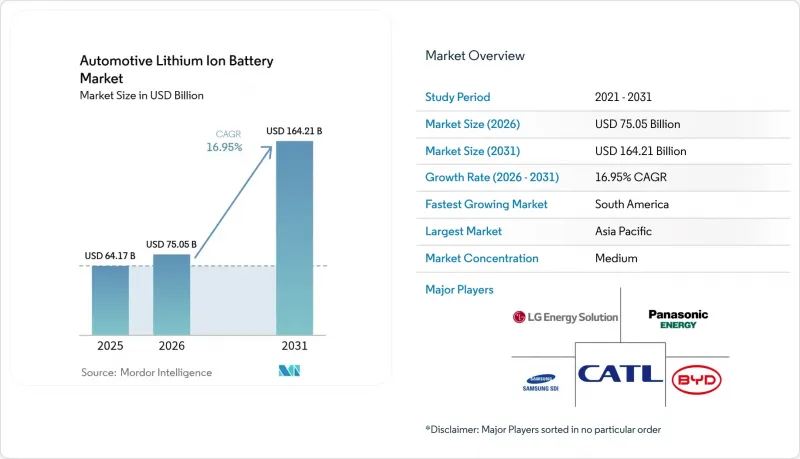
本報告按車輛類型(電池式電動車、插電式混合動力汽車、混合動力汽車)、銷售管道(OEM 和售後市場)、電池化學成分(NMC 等)、電芯形狀(圓柱形等)、容量範圍(小於 30 kWh、30-60 kWh 及其他)和地區進行細分。市場預測以美元 (USD) 為單位。
全球汽車鋰離子電池市場趨勢及洞察
至2030年,全球電動車生產義務將持續增加
歐盟設定的目標-2035年實現100%的汽車銷售為零排放汽車,以及加州要求到2030年銷售的新小型乘用車中68%必須是零排放汽車等法規,確保了電池的穩定需求,不受經濟週期的影響。預計到2024年,全球整體電動車銷量將達到約1,700萬輛,其中中國將佔1,100萬輛。汽車製造商已宣布計劃在2030年投資1.2兆美元用於電氣化,這進一步鞏固了電池的長期需求前景。由此帶來的銷售成長將推動規模經濟,加速整個汽車鋰離子電池市場的成本降低。
由於高鎳和LMFP化學成分的出現,電池電芯成本迅速下降。
預計到2024年,電池組的平均價格將年減14%,約為每千瓦時152美元。中國製造商已在最佳化的磷酸鋰鐵(LFP)生產線上提供低於每千瓦時100美元的價格,使汽車製造商能夠將中檔車型的價格降低高達6000美元。高鎳正極材料可將能量密度提高10%,而與傳統的鎳基複合材料(NMC)相比,低金屬磷酸鐵鋰(LMFP)混合材料可將材料成本降低20-30%。這種成本兩極化導致了產品線的層級構造。高鎳正極材料用於豪華車,以追求更長的續航里程,而磷酸鋰和低金屬磷酸鋰則用於大眾市場車型,提供更經濟實惠的選擇。 500瓦時/公斤固態電池原型的發布預示著能量密度主導的價格轉變,這可能會在2027年改變電池化學成分的選擇偏好。
碳酸鋰現貨價格波動
受澳洲和智利新礦供應過剩的影響,電池價格在2024年暴跌90%,從每噸8萬美元的峰值跌至約1.3萬美元。這種價格波動可能會使非垂直整合型電池製造商的預算規劃變得困難,並推遲其擴張決策。在供應過剩持續的情況下,授權延遲和地緣政治風險可能導致市場在2025年再次趨緊。像比亞迪這樣擁有上游資產的垂直整合型公司受這些價格波動的影響較小。另一方面,缺乏避險能力的中小型生產商可能會面臨利潤率風險和產業重組帶來的壓力。
細分市場分析
預計到2025年,純電動車(BEV)將佔汽車鋰離子電池銷量的63.12%,鞏固其作為汽車鋰離子電池市場核心細分市場的地位。由於長途運輸比乘用車市場能更快地透過節省燃料成本實現投資回報,純電動輕型商用車(LCV)在商用車隊中的應用正以34.20%的複合年成長率快速成長。插電式混合動力汽車在充電基礎設施不發達的農村和發展中地區保持著市場佔有率,而傳統混合動力汽車仍是一種過渡性技術。亞馬遜向Rivian訂購10萬輛汽車以及聯邦快遞的車隊更新換代案例表明,企業永續性目標正在推動大量採購。特斯拉Semi進軍重型卡車領域以及Panasonic能源與Harbinger Motors的合作表明,市場對高容量電池組和強大的溫度控管系統的需求正在不斷成長。車輛電氣化將縮短更換週期,並增加未來的售後市場需求,進一步擴大汽車鋰離子電池的市場佔有率。
長途商用車的激增推動了對能夠實現兆瓦級充電且具有卓越耐久性的電池化學系統的需求。能夠客製化稜柱形和大型圓柱形電芯以適應快速充電耐久性的供應商,最能滿足這些需求。隨著各國政府透過引進都市區排放控制區(禁止柴油貨車和卡車通行)來推動電動車轉型,經濟效益的提升已不可避免。這些監管方面的進步降低了殘值的不確定性,增強了金融機構為車隊轉型提供融資的信心。高吞吐量物流進一步推動了預測性維護平台的發展,這些平台能夠監測電池組健康狀況並安排預防性更換,從而拓展了汽車鋰離子電池市場基於服務的收入來源。
受新車上市的推動,預計到2025年,整車製造商(OEM)將佔據電池市場80.94%的收入佔有率。然而,隨著第一代電池組逐漸接近使用壽命終點,現有電動車隊將發生重大轉變。由於早期車隊營運商面臨產能下降,售後市場銷售額正以每年31.75%的速度成長。獨立服務網路和回收商正在開發診斷和翻新生產線,以從那些被認為合格動力系統但仍可用於固定式儲能的電池模組中挖掘價值。歐盟和加州的「維修權」法規迫使汽車製造商共用診斷數據,這活性化了更換和再利用領域的競爭。蔚來汽車和寧德時代推出的電池即服務(BaaS)平台模糊了電池組所有權和車輛所有權之間的界限,開啟了基於訂閱的收入來源。
專有電池管理軟體仍然是第三方維修店面臨的最大障礙。安全的數據閘道器和與車載資訊系統的整合正成為競爭優勢。考慮到循環經濟的益處,政策制定者可能會進一步放寬進入限制,尤其是在電池進口和國內回收能力仍然較低的地區。致力於模組尺寸和通訊協定標準化的聯盟可以加速向售後市場的轉型。所有這些趨勢表明,未來十年,與更換和二次利用相關的汽車鋰離子電池市場規模預計將快速成長。
區域分析
預計到2025年,亞太地區將維持48.10%的市場佔有率,這主要得益於中國在電池生產、前驅體加工和負極活性材料供應方面的主導地位。政策主導的國內需求,加上以出口為導向的超級工廠策略,使得寧德時代(CATL)和比亞迪等區域製造商能夠在規避貿易風險的同時,積極擴張業務。日本正透過Panasonic能源與斯巴魯和馬自達成立的合資企業重組其業務,旨在降低對中國進口的依賴,同時保持技術領先地位。韓國的LG能源解決方案、三星SDI和SK-ON佔了18.4%的全球市場佔有率,彌補了中國成本競爭力與西方國家本地生產需求之間的差距。
南美洲的成長速度最快,複合年成長率高達28.75%。在巴西,2024年電動車銷量達到177,358輛,比亞迪的交車量遙遙領先。這凸顯了具有成本競爭力的中國企業如何打入對價格高度敏感的市場。智利不僅是世界第二大鋰生產國,也憑藉著優惠的特許權使用費制度,吸引對當地正極材料和電池項目的投資。該地區的電動公車(比亞迪佔據了大部分市場佔有率)透過建立充電基礎設施和普及電池技術,推動了電動車的普及。巴西的「Mover」舉措等政府計畫正在實施更嚴格的排放氣體法規,並為2030年之前提供穩定的政策環境。
北美和歐洲正致力於擴大國內工廠規模,同時降低對中國的依賴。美國《通膨抑制法案》旨在2030年擴大汽車鋰離子電池市場,將該地區打造成為潛在的出口市場。在歐洲,耗資1,800億歐元的超級工廠計畫目標是在2026年實現自給自足,但高昂的能源關稅和複雜的授權程序正在減緩產能擴張的步伐。摩洛哥和阿拉伯聯合大公國等新興中心正透過強調可再生能源的優勢,吸引對正極材料和電池組的投資,顯示汽車鋰離子電池市場將日益呈現多極化的模式。
其他好處:
- Excel格式的市場預測(ME)表
- 3個月的分析師支持
目錄
第1章:引言
- 研究假設和市場定義
- 調查範圍
第2章:調查方法
第3章執行摘要
第4章 市場狀況
- 市場概覽
- 市場促進因素
- 預計到2030年,全球對電動車的需求將大幅成長。
- 由於採用了高鎳和LMFP基正極材料,電池成本迅速降低。
- 超級工廠的超額產能確保了電池組的穩定供應。
- 根據IRA和歐盟電池法規提供的本地化獎勵
- 由原始設備製造商 (OEM)主導的閉合迴路回收合作夥伴關係
- 面向車隊的V2G貨幣化模式
- 市場限制因素
- 碳酸鋰現貨價格的波動
- 與防火措施相關的召回成本正在影響房產的剩餘價值。
- 新原物料礦山許可證核准程序延誤
- 消費者對鈷的道德採購方式的擔憂
- 價值供應鏈分析
- 監理情勢
- 技術展望
- 波特五力模型
第5章 市場規模與成長預測
- 車輛類型
- 電池式電動車(BEV)
- 插電式混合動力車(PHEV)
- 混合動力電動車(HEV)
- 燃料電池電動車(FCEV)
- 按銷售管道
- OEMs
- 售後市場
- 電池化學成分
- NMC
- LFP
- NCA
- LMFP/LFMP
- LTO
- 按單元格格式
- 圓柱形
- 棱柱型
- 小袋
- 按容量範圍
- 小於 30 千瓦時
- 30~60 kWh
- 60~90 kWh
- 超過90度
- 按地區
- 北美洲
- 美國
- 加拿大
- 其他北美國家
- 南美洲
- 巴西
- 智利
- 其他南美國家
- 歐洲
- 德國
- 法國
- 英國
- 挪威
- 荷蘭
- 其他歐洲國家
- 亞太地區
- 中國
- 日本
- 韓國
- 印度
- 其他亞太國家
- 中東和非洲
- UAE
- 沙烏地阿拉伯
- 南非
- 其他中東和非洲國家
- 北美洲
第6章 競爭情勢
- 市場集中度
- 策略趨勢
- 市佔率分析
- 公司簡介
- Contemporary Amperex Technology(CATL)
- LG Energy Solution
- Panasonic Energy
- BYD Co. Ltd.
- Samsung SDI
- SK On
- CALB Group
- EVE Energy
- Farasis Energy
- Gotion High-Tech
- Envision AESC
- SVOLT Energy
- Tianjin Lishen
- GS Yuasa
- Toshiba Corp.
- Hitachi Astemo
- Optimum Nano
- Microvast
- StoreDot
- QuantumScape
第7章 市場機會與未來展望
According to Mordor Intelligence, the automotive lithium-Ion battery market size in 2026 is estimated at USD 75.05 billion, growing from 2025 value of USD 64.17 billion with 2031 projections showing USD 164.21 billion, growing at 16.95% CAGR over 2026-2031.
This report is Segmented by Vehicle Type (Battery Electric Vehicle, Plug-In Hybrid Electric Vehicle and Hybrid Electric Vehicle), Channel Sales Type (OEMs and Aftermarket), Battery Chemistry (NMC, and More), Cell Format (Cylindrical, and More), Capacity Range (Less Than 30 KWh, 30-60 KWh, and More) and Geography. The Market Forecasts are Provided in Terms of Value (USD).
Global Automotive Lithium Ion Battery Market Trends and Insights
Soaring Global EV Production Mandates by 2030
Regulations include the EU target of 100% zero-emission sales by 2035 and California's requirement that 68% of new light-duty sales be zero-emission by 2030, locking in battery demand irrespective of economic cycles. Nearly 17 million EVs are expected to be sold worldwide in 2024, with China contributing 11 million units. Automakers have announced USD 1.2 trillion in electrification spending through 2030, anchoring long-term demand visibility. The resulting volume unlocks scale economies that accelerate further cost declines across the automotive lithium-ion battery market.
Sharp Cell-Cost Decline from High-Nickel & LMFP Chemistries
Average pack prices fell 14% year-on-year to about USD 152 per kWh in 2024. Chinese producers already quote sub-USD 100 per kWh for optimised LFP lines, enabling automakers to trim vehicle list prices by up to USD 6,000 on mid-range models. High-nickel cathodes deliver 10% higher energy density, while LMFP blends cut material expense 20-30% against legacy NMC. Cost segmentation now creates a two-tier product stack: premium vehicles chase range with nickel-rich cathodes, whereas mass models choose LFP or LMFP for affordability. Announcements of 500 Wh/kg solid-state prototypes foreshadow a density-led pricing pivot that could reshape chemistry preferences by 2027.
Lithium Carbonate Spot-Price Volatility
Prices collapsed 90% from highs of USD 80,000 per tonne to around USD 13,000 in 2024 amid oversupply from new Australian and Chilean mines. Volatility complicates budget planning for non-integrated cell makers and may defer expansion decisions. While oversupply persists, permitting delays and geopolitical risks could tighten the market again by 2025. Vertically integrated firms like BYD, which hold upstream assets, remain insulated from these swings. Smaller producers without hedging capacity face margin risk and potential consolidation pressures.
Other drivers and restraints analyzed in the detailed report include:
- Gigafactory Over-Supply Securing Pack Availability
- IRA & EU Battery Regulation Localisation Incentives
- Fire-Safety Recall Costs Hitting Residual Values
For complete list of drivers and restraints, kindly check the Table Of Contents.
Segment Analysis
BEVs contributed 63.12% of 2025 revenue, confirming their status as the anchor segment of the automotive lithium-ion battery market. Commercial fleet adoption of BEV LCVs grows at 34.20% CAGR because mileage-intensive routes unlock fuel-savings payback sooner than consumer segments. Plug-in hybrids maintain a share in rural and developing regions where charging access lags, while conventional hybrids are a bridging technology. Amazon's 100,000-unit Rivian order and FedEx fleet upgrades illustrate how corporate sustainability targets catalyse bulk procurement. Heavy-duty cycles from Tesla Semi and partnerships between Panasonic Energy and Harbinger Motors point to escalating demand for higher-capacity packs and robust thermal systems. Fleet electrification shortens replacement cycles, increasing future aftermarket volumes and deepening the automotive lithium-ion battery market footprint.
The long-haul commercial wave intensifies interest in megawatt-class charging and rugged cell chemistries. Suppliers that tailor prismatic or large-format cylindrical cells for rapid-charge durability position best for these requirements. Governments add momentum through urban emission zones that exclude diesel vans and trucks, making electric alternatives economically inevitable. This regulatory push reduces residual-value uncertainty, giving financiers confidence to underwrite fleet conversions. High-throughput logistics further drive predictive maintenance platforms that monitor pack health and schedule pre-emptive replacements, expanding service-based revenue pools within the automotive lithium-ion battery market.
OEMs generated 80.94% of 2025 battery revenue as new vehicle roll-outs dominated demand. The installed EV park, however, will trigger a pronounced shift once first-generation packs reach end-of-life. Aftermarket sales are growing 31.75% annually as early fleet operators face capacity fade. Independent service networks and recyclers are preparing diagnostic and refurbishment lines to capture value from modules deemed unfit for propulsion but still viable for stationary storage. Right-to-repair statutes in the EU and California force automakers to share diagnostic data, boosting competition in replacement and repurposing. Battery-as-a-Service platforms from NIO and CATL blur boundaries by decoupling pack ownership from vehicle ownership, opening subscription-based revenue streams.
Proprietary battery management software remains the largest barrier for third-party repairers. Secure data gateways and telematics integration are becoming competitive differentiators. Policy makers weighing circular-economy benefits may further open access, especially where battery imports and domestic recycling capacity remain low. Standardisation consortia working on module dimensions and communication protocols could accelerate the aftermarket shift. As these developments converge, the automotive lithium-ion battery market size linked to replacement and second-life use cases is set to expand rapidly through the next decade.
Complete Report Scope:
- By Vehicle Type
- Battery Electric Vehicle (BEV)
- Plug-in Hybrid Electric Vehicle (PHEV)
- Hybrid Electric Vehicle (HEV)
- Fuel-Cell Electric Vehicle (FCEV)
- By Channel Sales Type
- OEMs
- Aftermarket
- By Battery Chemistry
- NMC
- LFP
- NCA
- LMFP / LFMP
- LTO
- By Cell Format
- Cylindrical
- Prismatic
- Pouch
- By Capacity Range
- Less than 30 kWh
- 30-60 kWh
- 60-90 kWh
- More than 90 kWh
- By Geography
- North America
- United States
- Canada
- Rest of North America
- South America
- Brazil
- Chile
- Rest of South America
- Europe
- Germany
- France
- United Kingdom
- Norway
- Netherlands
- Rest of Europe
- Asia-Pacific
- China
- Japan
- South Korea
- India
- Rest of Asia-Pacific
- Middle East & Africa
- UAE
- Saudi Arabia
- South Africa
- Rest of Middle East & Africa
- North America
Geography Analysis
Asia-Pacific retained a 48.10% share in 2025, anchored by China's dominance across cell production, precursor processing, and anode active material supply. Policy-driven domestic demand combines export-oriented gigafactory strategies, allowing regional producers like CATL and BYD to scale aggressively while hedging trade risks. Japan is repositioning through Panasonic Energy joint ventures with Subaru and Mazda, aiming to cut reliance on Chinese imports while preserving technology leadership. South Korea's trio of LG Energy Solution, Samsung SDI, and SK On held 18.4% global share, bridging Chinese cost leadership and Western localisation needs.
South America registers the fastest expansion at 28.75% CAGR. Brazil recorded 177,358 electrified sales in 2024, with BYD leading deliveries, highlighting how cost-competitive Chinese players penetrate value-conscious markets. Chile's status as the second-largest lithium producer, coupled with favourable royalty frameworks, draws investment in local cathode and cell projects. The region's electric bus fleets-BYD holds majority of the share-seed charging infrastructure and familiarise consumers with battery propulsion, reinforcing passenger-car adoption. Government programs like Brazil's Mover initiative enforce stricter emission norms, providing a stable policy backdrop through 2030.
North America and Europe focus on cutting Chinese exposure while scaling home-grown factories. The United States' Inflation Reduction Act fosters an automotive lithium-ion battery market size surplus by 2030, positioning the region as a potential exporter. Europe's EUR 180 billion gigafactory roster targets self-sufficiency by 2026, though high energy tariffs and complex permitting slow ramp-ups. Emerging hubs in Morocco and the United Arab Emirates market renewable power advantages to attract cathode and pack investment, signalling that the automotive lithium-ion battery market will become increasingly multipolar.
- Contemporary Amperex Technology (CATL)
- LG Energy Solution
- Panasonic Energy
- BYD Co. Ltd.
- Samsung SDI
- SK On
- CALB Group
- EVE Energy
- Farasis Energy
- Gotion High-Tech
- Envision AESC
- SVOLT Energy
- Tianjin Lishen
- GS Yuasa
- Toshiba Corp.
- Hitachi Astemo
- Optimum Nano
- Microvast
- StoreDot
- QuantumScape
Additional Benefits:
- The market estimate (ME) sheet in Excel format
- 3 months of analyst support
TABLE OF CONTENTS
1 Introduction
- 1.1 Study Assumptions & Market Definition
- 1.2 Scope of the Study
2 Research Methodology
3 Executive Summary
4 Market Landscape
- 4.1 Market Overview
- 4.2 Market Drivers
- 4.2.1 Soaring global EV production mandates by 2030
- 4.2.2 Sharp cell-cost decline from high-nickel & LMFP chemistries
- 4.2.3 Gigafactory over-supply securing pack availability
- 4.2.4 IRA & EU Battery Regulation localisation incentives
- 4.2.5 OEM-led closed-loop recycling partnerships
- 4.2.6 Vehicle-to-grid monetisation models for fleets
- 4.3 Market Restraints
- 4.3.1 Lithium carbonate spot-price volatility
- 4.3.2 Fire-safety recall costs hitting residual values
- 4.3.3 Slow-moving permitting for new raw-material mines
- 4.3.4 Consumer concern over ethical cobalt sourcing
- 4.4 Value / Supply-Chain Analysis
- 4.5 Regulatory Landscape
- 4.6 Technological Outlook
- 4.7 Porter's Five Forces
- 4.7.1 Threat of New Entrants
- 4.7.2 Bargaining Power of Buyers
- 4.7.3 Bargaining Power of Suppliers
- 4.7.4 Threat of Substitutes
- 4.7.5 Competitive Rivalry
5 Market Size & Growth Forecasts (Value (USD))
- 5.1 By Vehicle Type
- 5.1.1 Battery Electric Vehicle (BEV)
- 5.1.2 Plug-in Hybrid Electric Vehicle (PHEV)
- 5.1.3 Hybrid Electric Vehicle (HEV)
- 5.1.4 Fuel-Cell Electric Vehicle (FCEV)
- 5.2 By Channel Sales Type
- 5.2.1 OEMs
- 5.2.2 Aftermarket
- 5.3 By Battery Chemistry
- 5.3.1 NMC
- 5.3.2 LFP
- 5.3.3 NCA
- 5.3.4 LMFP / LFMP
- 5.3.5 LTO
- 5.4 By Cell Format
- 5.4.1 Cylindrical
- 5.4.2 Prismatic
- 5.4.3 Pouch
- 5.5 By Capacity Range
- 5.5.1 Less than 30 kWh
- 5.5.2 30-60 kWh
- 5.5.3 60-90 kWh
- 5.5.4 More than 90 kWh
- 5.6 By Geography
- 5.6.1 North America
- 5.6.1.1 United States
- 5.6.1.2 Canada
- 5.6.1.3 Rest of North America
- 5.6.2 South America
- 5.6.2.1 Brazil
- 5.6.2.2 Chile
- 5.6.2.3 Rest of South America
- 5.6.3 Europe
- 5.6.3.1 Germany
- 5.6.3.2 France
- 5.6.3.3 United Kingdom
- 5.6.3.4 Norway
- 5.6.3.5 Netherlands
- 5.6.3.6 Rest of Europe
- 5.6.4 Asia-Pacific
- 5.6.4.1 China
- 5.6.4.2 Japan
- 5.6.4.3 South Korea
- 5.6.4.4 India
- 5.6.4.5 Rest of Asia-Pacific
- 5.6.5 Middle East & Africa
- 5.6.5.1 UAE
- 5.6.5.2 Saudi Arabia
- 5.6.5.3 South Africa
- 5.6.5.4 Rest of Middle East & Africa
- 5.6.1 North America
6 Competitive Landscape
- 6.1 Market Concentration
- 6.2 Strategic Moves
- 6.3 Market Share Analysis
- 6.4 Company Profiles (includes Global Overview, Market Overview, Core Segments, Financials, Strategic Information, Market Rank/Share, Products & Services, Recent Developments)
- 6.4.1 Contemporary Amperex Technology (CATL)
- 6.4.2 LG Energy Solution
- 6.4.3 Panasonic Energy
- 6.4.4 BYD Co. Ltd.
- 6.4.5 Samsung SDI
- 6.4.6 SK On
- 6.4.7 CALB Group
- 6.4.8 EVE Energy
- 6.4.9 Farasis Energy
- 6.4.10 Gotion High-Tech
- 6.4.11 Envision AESC
- 6.4.12 SVOLT Energy
- 6.4.13 Tianjin Lishen
- 6.4.14 GS Yuasa
- 6.4.15 Toshiba Corp.
- 6.4.16 Hitachi Astemo
- 6.4.17 Optimum Nano
- 6.4.18 Microvast
- 6.4.19 StoreDot
- 6.4.20 QuantumScape
7 Market Opportunities & Future Outlook
- 7.1 White-space & Unmet-Need Assessment

 汽車鋰離子電池市場:電池類型、動力系統、電芯規格、容量範圍、電壓容量、車輛類型、分銷管道、最終用途—2026-2032年全球市場預測
 北美電動車鋰離子電池:市場佔有率分析、行業趨勢和統計數據以及成長預測(2026-2031 年)電動汽車用鋰離子電池:市場佔有率分析、行業趨勢和統計數據以及成長預測(2026-2031 年)
 汽車鋰離子電池市場預測至2034年-全球產品、車輛類型、類別類型、電芯類型、通路和區域分析
 汽車鋰離子電池市場規模、佔有率和成長分析(按類型、車輛類型、應用、容量和地區分類)—2026-2033年產業預測中東和非洲電動車用鋰離子電池:市場佔有率分析、產業趨勢和成長預測(2025-2030)亞太地區電動車鋰離子電池:市場佔有率分析、產業趨勢與成長預測(2025-2030)歐洲電動車鋰離子電池:市場佔有率分析、產業趨勢、成長預測(2025-2030)法國電動車用鋰離子電池市場佔有率分析、產業趨勢、成長預測(2025-2030)英國電動車鋰離子電池:市場佔有率分析、產業趨勢、成長預測(2025-2030)