


 |
市場調查報告書
商品編碼
2114271
南美洲農業噴霧器:市場佔有率分析、行業趨勢和統計數據以及成長預測(2026-2031 年)South America Agricultural Sprayers - Market Share Analysis, Industry Trends & Statistics, Growth Forecasts (2026 - 2031) |
||||||

※ 本網頁內容可能與最新版本有所差異。詳細情況請與我們聯繫。
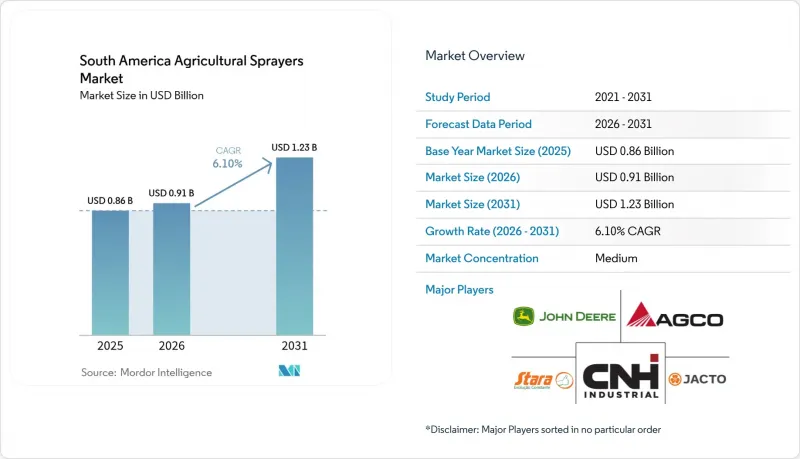
根據 Mordor Intelligence 預測,南美農業噴霧器市場規模將從 2025 年的 8.6 億美元成長到 2026 年的 9.1 億美元,到 2031 年將達到 12.3 億美元,2026 年至 2031 年的複合年成長率為 6.10%。
本報告按動力來源(手動、電池供電、太陽能供電、燃油供電)、應用領域(田間噴霧器、果園噴霧器、園藝噴霧器)、容量(超低容量、低容量、高容量)和地區(巴西、阿根廷及其他南美國家)進行細分。市場預測以美元計價。
南美洲農業噴霧器市場趨勢與洞察
農村地區勞動力短缺
隨著年輕人湧向都市區,老農退休,南美洲的農業勞動力持續減少,導致能夠執行複雜噴灑作業的熟練操作人員短缺。勞動力短缺導致工資上漲和噴灑週期縮短,迫使生產者投資於自走式或自動化機械,以便在更長時間內有效作業。集偵察和噴灑功能於一體的機器人系統正在逐步普及,從而降低了投入成本。巴西在農業自動化方面領先該地區,其次是阿根廷。這些區域勞動力結構的變化持續推動著整個南美洲農業噴霧器市場的成長。
大豆種植面積擴大及農藥使用量增加
南美洲大豆種植面積的快速擴張推動了作物保護設備需求的成長。亞洲大豆銹病等病害的出現,使得作物生長季需要多次噴藥,因此高效及時的噴藥至關重要。在有限的工作時間內管理大片土地的農民正在投資購買大容量噴霧器以提高噴藥覆蓋率。在農產品價格波動的情況下,農民尋求控制成本,這促使他們採用精準噴藥技術。這些系統在提高噴藥精度的同時,也能減少浪費。種植面積的擴大和農藥需求的成長,持續推動該地區農業噴霧器市場的成長。
農業收入不穩定,依賴大宗商品價格疲軟。
大宗商品價格波動正在影響南美洲各地農民的收入,並為農業機械投資帶來不確定性。全球糧食庫存上升往往導致價格下跌,擠壓農民升級機械的利潤空間。這些財務壓力導致農民推遲購買、貸款再融資,以及難以獲得新噴霧器的融資。即使在需求強勁時期,收益的波動也會導致市場動能放緩。這些週期性低迷影響著農業噴霧器市場的成長,而該市場又依賴農產品價格趨勢和農村生產者的財務穩定性。
細分市場分析
到2025年,燃油動力設備在南美洲農業噴霧器市場仍將佔據45.62%的佔有率。這是因為柴油技術提供了足夠的功率密度,能夠在數千公頃的大豆和玉米田間快速加油。同時,南美洲農業噴霧器市場中電池動力機型的市場規模正以7.34%的複合年成長率成長。這主要得益於大型農場主試行使用太陽能動力車隊,以降低燃料成本並獲得低碳溢價。
自主式電池動力噴霧器雖然初始成本較高,但投資回收期更短,能顯著降低除草劑成本,並緩解操作人員短缺的問題。 Jacto公司的太陽能拖車和大型充電站正在解決續航里程問題。手動和太陽能動力噴霧器仍然能夠滿足小規模農民和保守農民的特定需求,但其市場佔有率正逐漸被電動噴霧器蠶食。這種動力來源的轉變表明,南美洲農業噴霧器市場正朝著更環保和數據驅動的解決方案發展。
其他好處:
- Excel格式的市場預測(ME)表
- 三個月的分析師支持
目錄
第1章:引言
- 研究假設和市場定義
- 調查範圍
第2章:調查方法
第3章執行摘要
第4章 市場狀況
- 市場概覽
- 市場促進因素
- 農村地區勞動力短缺
- 大豆種植面積擴大及農藥使用量增加
- 政府對作物保護機械化的補貼
- GPS引導精準噴塗技術的引入
- 氣候變遷導致的病蟲害造成的損失正在迅速增加。
- 高投入效率農場的優質排碳權
- 市場限制因素
- 農民的收入會隨著軟商品價格的波動而波動。
- 自推進式單元初始成本高
- 不同地區寬頻基礎設施分佈不均阻礙了車載資訊科技的廣泛應用。
- 燃油價格上漲推高了營運成本。
- 監理情勢
- 技術展望
- 波特五力分析
第5章 市場規模與成長預測
- 透過電源
- 手動的
- 電池供電
- 太陽能供電
- 燃油驅動
- 用法
- 田間噴霧器
- 果園噴霧器
- 花園噴霧器
- 按產能
- 超低容量
- 低容量
- 高容量
- 按地區
- 巴西
- 阿根廷
- 其他南美國家
第6章 競爭情勢
- 市場集中度
- 策略趨勢
- 市佔率分析
- 公司簡介
- Deere & Company
- AGCO Corporation
- CNH Industrial NV
- Mahindra & Mahindra Limited
- Jacto SA
- Stara S/A
- LS Mtron Ltd.
- Sonalika International Tractors Ltd.(ITL)
- Kubota Corporation
- Bucher Industries AG(KUHN Group)
- EXEL Industries SA
- Guarany Industria Ltda.
- Implementos Agricolas Jan SA
- Baldan Implementos Agricolas S/A
- Andreas STIHL AG & Co. KG
第7章 市場機會與未來展望
According to Mordor Intelligence, the South America agricultural sprayers market size is expected to grow from USD 0.86 billion in 2025 to USD 0.91 billion in 2026 and is forecast to reach USD 1.23 billion by 2031 at 6.10% CAGR over 2026-2031.
This report is Segmented by Source of Power (Manual, Battery-Operated, Solar, and Fuel-Operated), by Usage (Field Sprayers, Orchard Sprayers, and Gardening Sprayers), by Mode of Capacity (Ultra-Low Volume, Low Volume, and High Volume), and by Geography (Brazil, Argentina, and the Rest of South America). The Market Forecasts are Provided in Terms of Value (USD).
South America Agricultural Sprayers Market Trends and Insights
Shrinking Rural Labor Pool
South America's agricultural labor force continues to decline as younger generations move to urban areas and older farmers retire, creating a shortage of skilled operators for complex spraying operations. This workforce reduction has led to increased wages and shorter spraying windows, compelling growers to invest in self-propelled or autonomous machines for extended, efficient operations. Robotic systems that combine scouting and spraying functions are increasing in adoption, offering reduced input costs. Brazil leads the region in agricultural automation, with Argentina following closely. This shift in the regional workforce continues to drive growth in the agricultural sprayers market across South America.
Expansion of Soybean Acreage and Agrochemical Intensity
The rapid expansion of soybean cultivation in South America has intensified the need for crop protection equipment. The presence of diseases such as Asian Soybean Rust requires multiple applications during growing seasons, making efficient and timely spraying crucial. Farmers managing larger fields with limited operational windows are investing in high-capacity sprayers to increase coverage rates. Precision spraying technologies have gained adoption as farmers seek to control costs amid variable commodity prices. These systems enhance application accuracy while reducing waste. The combination of increased acreage and agrochemical requirements continues to support market growth for agricultural sprayers in the region.
Volatile Farm Income Tied to Soft-commodity Prices
Fluctuating commodity prices affect farm income across South America, creating uncertainty in agricultural equipment investments. Rising global grain stockpiles often lead to price decreases, reducing farmers' margins for machinery upgrades. This financial pressure results in delayed purchases, loan restructuring, and limited credit access for new sprayers. Market momentum can stall even during periods of strong demand due to revenue volatility. These cyclical downturns affect the agricultural sprayers market's growth, making it dependent on commodity trends and rural producers' financial stability.
Other drivers and restraints analyzed in the detailed report include:
- Government Subsidies for Crop-protection Mechanization
- Adoption of GPS-guided Precision Spraying
- High Upfront Cost of Self-propelled Units
For complete list of drivers and restraints, kindly check the Table Of Contents.
Segment Analysis
Fuel-operated equipment retained 45.62% of the South American agricultural sprayers market share in 2025 because diesel technology offers ample power density and rapid refueling over thousands of hectares of soy and corn. The South American agricultural sprayers market size for battery models, however, is climbing at 7.34% CAGR as large growers test solar-charged fleets to cut fuel costs and qualify for low-carbon premiums.
Autonomous battery sprayers slash herbicide bills and mitigate operator shortages, sharpening their payback profile despite higher acquisition costs. Solar support trailers from Jacto and field-scale charging hubs are addressing range concerns. Manual and solar units still fill niche needs among smallholders or protected-crop growers, but are gradually conceding share to powered alternatives. The power-source mix illustrates the South American agricultural sprayers market evolution toward greener, data-ready solutions.
Complete Report Scope:
- By Source of Power
- Manual
- Battery-operated
- Solar
- Fuel-operated
- By Usage
- Field Sprayers
- Orchard Sprayers
- Gardening Sprayers
- By Mode of Capacity
- Ultra-Low Volume
- Low Volume
- High Volume
- By Geography
- Brazil
- Argentina
- Rest of South America
List of Companies Covered in this Report:
- Deere & Company
- AGCO Corporation
- CNH Industrial N.V.
- Mahindra & Mahindra Limited
- Jacto S.A.
- Stara S/A
- LS Mtron Ltd.
- Sonalika International Tractors Ltd. (ITL)
- Kubota Corporation
- Bucher Industries AG (KUHN Group)
- EXEL Industries SA
- Guarany Industria Ltda.
- Implementos Agricolas Jan S.A.
- Baldan Implementos Agricolas S/A
- Andreas STIHL AG & Co. KG
Additional Benefits:
- The market estimate (ME) sheet in Excel format
- 3 months of analyst support
TABLE OF CONTENTS
1 Introduction
- 1.1 Study Assumptions and Market Definition
- 1.2 Scope of the Study
2 Research Methodology
3 Executive Summary
4 Market Landscape
- 4.1 Market Overview
- 4.2 Market Drivers
- 4.2.1 Shrinking Rural Labor Pool
- 4.2.2 Expansion of Soybean Acreage and Agrochemical Intensity
- 4.2.3 Government Subsidies for Crop-protection Mechanization
- 4.2.4 Adoption of GPS-guided Precision Spraying
- 4.2.5 Climate-linked Pests and Diseases Pressure Spikes
- 4.2.6 Carbon-credit Premiums for Input-efficient Farms
- 4.3 Market Restraints
- 4.3.1 Volatile Farm Income Tied to Soft-commodity Prices
- 4.3.2 High Upfront Cost of Self-propelled Units
- 4.3.3 Patchy Rural Broadband Hampers Telematics
- 4.3.4 Fuel Price Inflation Raising Operating Costs
- 4.4 Regulatory Landscape
- 4.5 Technological Outlook
- 4.6 Porter's Five Forces Analysis
- 4.6.1 Bargaining Power of Suppliers
- 4.6.2 Bargaining Power of Buyers
- 4.6.3 Threat of New Entrants
- 4.6.4 Threat of Substitute Products
- 4.6.5 Intensity of Competitive Rivalry
5 Market Size and Growth Forecasts (Value)
- 5.1 By Source of Power
- 5.1.1 Manual
- 5.1.2 Battery-operated
- 5.1.3 Solar
- 5.1.4 Fuel-operated
- 5.2 By Usage
- 5.2.1 Field Sprayers
- 5.2.2 Orchard Sprayers
- 5.2.3 Gardening Sprayers
- 5.3 By Mode of Capacity
- 5.3.1 Ultra-Low Volume
- 5.3.2 Low Volume
- 5.3.3 High Volume
- 5.4 By Geography
- 5.4.1 Brazil
- 5.4.2 Argentina
- 5.4.3 Rest of South America
6 Competitive Landscape
- 6.1 Market Concentration
- 6.2 Strategic Moves
- 6.3 Market Share Analysis
- 6.4 Company Profiles (Includes Global Level Overview, Market Level Overview, Core Segments, Financials as Available, Strategic Information, Market Rank/Share for Key Companies, Products and Services, and Recent Developments)
- 6.4.1 Deere & Company
- 6.4.2 AGCO Corporation
- 6.4.3 CNH Industrial N.V.
- 6.4.4 Mahindra & Mahindra Limited
- 6.4.5 Jacto S.A.
- 6.4.6 Stara S/A
- 6.4.7 LS Mtron Ltd.
- 6.4.8 Sonalika International Tractors Ltd. (ITL)
- 6.4.9 Kubota Corporation
- 6.4.10 Bucher Industries AG (KUHN Group)
- 6.4.11 EXEL Industries SA
- 6.4.12 Guarany Industria Ltda.
- 6.4.13 Implementos Agricolas Jan S.A.
- 6.4.14 Baldan Implementos Agricolas S/A
- 6.4.15 Andreas STIHL AG & Co. KG
7 Market Opportunities and Future Outlook

 2026-2030年全球農業噴霧器市場
 2026年全球農業噴灑設備市場報告
 歐洲農業噴霧器:市場佔有率分析、行業趨勢和統計數據、成長預測(2026-2031 年)美國農業噴霧器:市場佔有率分析、行業趨勢和統計數據、成長預測(2026-2031 年)
 農業噴霧器市場:2026-2032年全球市場預測(按推進方式、類型、容量、應用、最終用戶和分銷管道分類)德國農業噴霧器:市場佔有率分析、行業趨勢和統計數據以及成長預測(2026-2031 年)農業噴霧器:市場佔有率分析、行業趨勢和統計數據、成長預測(2026-2031 年)
 農業噴霧器市場:按產品類型、動力來源、應用、噴霧能力和地區分類。
 全球電池驅動背包式噴霧器市場規模、佔有率、趨勢和成長分析報告(2026-2034)
 農業噴霧器市場規模、佔有率、趨勢和預測:按類型、動力來源、應用和地區分類,2026-2034年