


 |
市場調查報告書
商品編碼
2114269
歐洲農業噴霧器:市場佔有率分析、行業趨勢和統計數據、成長預測(2026-2031 年)Europe Agricultural Sprayer - Market Share Analysis, Industry Trends & Statistics, Growth Forecasts (2026 - 2031) |
||||||

※ 本網頁內容可能與最新版本有所差異。詳細情況請與我們聯繫。
據 Mordor Intelligence 稱,歐洲農業噴霧器市場預計在 2026 年價值 23.5 億美元,並預計將以 7.0% 的複合年成長率成長,到 2031 年達到 33 億美元。
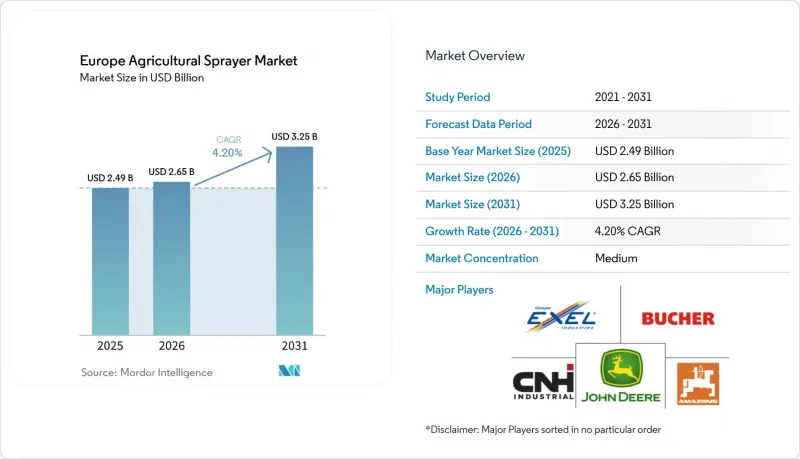
本報告按類型(自走式噴霧器、曳引機式噴霧器等)、容量(小於500公升、500至1500公升或以上)、應用(田間噴霧器、空中噴霧器等)、動力來源(手動等)、技術水準(傳統等)和地區(德國、法國等)進行分類。市場預測以美元(USD)計價。
歐洲農業噴霧器市場趨勢與洞察
歐盟「從農場到餐桌」農藥減量指令
2030年將農藥使用量減少50%這項具有法律約束力的目標正在重塑設備投資週期,因為農民必須滿足合規要求才能繼續獲得補貼。透過使用分段控制和脈衝寬度調變(PWM)噴嘴,工人可以在不影響產量的情況下減少20%至40%的農藥用量。在法國和荷蘭,只有配備GPS功能的機器才能創建數位噴灑記錄,這已成為強制性要求,實際上要求面積超過50公頃的農場升級設備。在西歐,設備更換速度的加速已將設備的使用壽命從10-12年縮短至6-8年。這項法規也促進了人工智慧(AI)驅動的定點噴灑器的發展,例如ARA平台,它可以繪製已處理雜草的分佈圖,作為審計追蹤。
GPS(全球定位系統)引導的精準噴灑技術的廣泛應用
變數噴灑技術可降低10%至30%的投入成本,每公頃穀物和油籽作物可節省15至40歐元(16.50至44美元)。德國超過60%的百公頃以上農場已安裝配備GPS的噴藥機,並採用高精度校正訊號。碳權計畫進一步縮短了3至4年的投資回收期,因為減排量可獲得補償。製造商正逐步將這項功能推廣到價格更低的機型,現在即使是中檔牽引式噴藥機,也能以低於100萬歐元(110萬美元)的價格買到配備精準噴灑套件的機型。
先進噴霧器的初始成本很高
配備GPS、地塊控制和可變噴灑量的自走式精密噴霧器售價在200萬至350萬歐元(220萬至385萬美元)之間,對於大多數50公頃以下的農場來說,這個價格難以承受。與德國和法國相比,南歐和東歐的貸款核准率低20%,這限制了資金籌措機會。雖然農業設備合作社降低了投資門檻,但也阻礙了直接銷售。售價低於5萬歐元(5.5萬美元)的牽引式噴霧器佔據了大部分市場佔有率,但它們缺乏未來監管審計所需的必要功能,導致技術差距日益擴大。
細分市場分析
由於與現有曳引機車隊相容且初始成本低於自走式噴霧器,曳引機式噴霧器仍佔據主導地位,預計到2025年將佔據歐洲農業噴霧器市場40%的佔有率。精準度的提升推動了這些機型的發展,目前售價低於100萬歐元(110萬美元)的機型均標配GPS導航和分段控制功能,使即使是中型農場也能滿足「從農場到餐桌」的數位化記錄要求。無人機式噴霧器雖然目前部署數量較少,但卻是成長最快的類型,預計2026年至2031年間的複合年成長率將達到22.0%,這主要得益於葡萄園和果園對減少農藥漂移和節省勞動力的需求。無人機式噴霧器能夠在陡坡、澇漬土壤和狹窄的行間作業,這使其在特種作物種植區的應用日益廣泛。
到2025年,自行式機械將佔據較大市場佔有率,大型農場和承包商將優先考慮高田間作業速度和24小時自主運作,以證明200萬至350萬歐元(220萬至385萬美元)的投資物有所值。手持式和背負式噴霧器將佔18%的市場佔有率,並逐漸轉向採用電子壓力調節以實現均勻液滴大小的電池驅動型號,尤其適用於溫室和高價值蔬菜生產商。剩餘的有限市場佔有率將由牽引式噴霧器佔據,對於南歐和東歐的農場來說,這是一種經濟實惠的選擇。在這些地區,可以透過安裝價格在5000至15000歐元(5500至16500美元)之間的改裝套件來增加基本的精準噴灑功能。這些型號總體上表明,在監管日益嚴格和勞動力持續短缺的情況下,生產商如何在成本、產能和合規性之間取得平衡。
到2025年,容量在500升至1500公升之間的噴霧器將佔歐洲農業噴霧器市場規模的43%,佔據最大的需求佔有率。這主要得益於歐洲多樣化且錯綜複雜的農業地景中生產力和移動性的平衡。由於合作社擁有的機型和附加的精準噴灑套件,此容量範圍的噴霧器對於中型農民來說也價格合理,預計在2026年至2031年間,其市場成長速度將最快,複合年成長率將達到8.0%。製造商不斷為這些機型配備原廠安裝的GPS和分區控制系統,使生產者無需升級到更昂貴的自走式噴霧器即可滿足「從農場到餐桌」的數位化記錄要求。電池電動馬達型的補貼資格進一步促進了其普及,尤其是在需要低噪音和低排放設備的葡萄園和郊區農場。
到2025年,500公升以下的小型噴霧器將佔據較大的市場佔有率,由於其占地面積小,可防止土壤壓實並方便作業人員接近葡萄藤,因此在果園、溫室和陡峭的葡萄園中仍將廣受歡迎。許多此類小型噴霧器正在向電池動力和電子壓力調節過渡,即使在短時間的重複噴灑循環中也能確保液滴大小的一致性。 1500公升以上的大容量噴霧器也佔據了相當大的市場佔有率,主要用戶是承包商和糧食生產商,他們優先考慮減少在大面積田地中加油的次數。這些大容量噴霧器目前正在配備柴油-電力混合動力驅動系統和自動轉向功能,但由於初始成本高昂和更嚴格的軸重規定,其成長速度與中等容量噴霧器相比受到限制。
其他好處:
- Excel格式的市場預測(ME)表
- 3個月的分析師支持
目錄
第1章:引言
- 研究假設和市場定義
- 調查範圍
第2章:調查方法
第3章執行摘要
第4章 市場狀況
- 市場概覽
- 市場促進因素
- 歐盟「從農場到餐桌」農藥減量義務
- 利用GPS(全球定位系統)進行精準噴灑的廣泛應用
- 根據通用農業政策(CAP)第二支柱,電池動力和混合動力噴霧器津貼。
- 人手不足正在加速自動噴灑機的引入。
- 為減少果園和葡萄園的花粉傳播維修工程
- 鼓勵採用可變利率的排碳權計劃
- 市場限制因素
- 先進噴霧器的初始成本相對較高。
- 歐盟各成員國無人機飛行法規的差異
- 農村地區的電池充電基礎設施有限。
- 合格校準技術人員短缺
- 波特五力分析
- 法律規範
- 物流和基礎設施
第5章 市場規模與成長預測
- 透過電源
- 手動的
- 電池供電
- 燃油驅動
- 太陽能
- 用法
- 場上球員
- 果園和葡萄園用噴霧器
- 花園和溫室用噴霧器
- 空中撒佈器
- 按產能
- 小於500公升
- 500~1,500 L
- 1500公升或以上
- 按類型
- 自走式撒佈器
- 曳引機式噴霧器
- 拖曳式噴霧器
- 手持式和背包式噴霧器
- 無人機噴灑器
- 按技術水準
- 傳統的
- 高精度和GPS導
- 人工智慧驅動的自主系統
- 地區
- 德國
- 法國
- 英國
- 西班牙
- 義大利
- 其他歐洲國家
第6章 競爭情勢
- 市場集中度
- 策略趨勢
- 市佔率分析
- 公司簡介
- Exel Industries SA
- Deere and Company
- CNH Industrial NV
- AGCO Corporation
- Kuhn Group
- Amazonen-Werke H. Dreyer GmbH & Co. KG
- HORSCH Maschinen GmbH
- Lemken GmbH & Co. KG
- Kverneland AS
- Chafer Machinery Ltd
- Knight Farm Machinery Ltd
- Grim Srl
- Bargam SpA
- Pulverizadores Fede SL
- DJI Technology Co., Ltd.
第7章 市場機會與未來展望
According to Mordor Intelligence, the Europe agricultural sprayer market size is estimated to be USD 2.35 billion in 2026 and is projected to expand at a 7.0% CAGR, reaching USD 3.30 billion by 2031.
This report is Segmented by Type (Self-Propelled Sprayers, Tractor-Mounted Sprayers and More), by Capacity (Less Than 500 L, 500 To 1, 500 L and More), by Usage (Field Sprayers, Aerial Sprayers, and More), by Source of Power (Manual, and More), by Technology Level (Conventional, and More), and by Geography (Germany, France, and More). The Market Forecasts are Provided in Terms of Value (USD).
Europe Agricultural Sprayer Market Trends and Insights
European Union (EU) Farm-to-Fork pesticide-reduction mandates
The binding 50% cut in pesticide use by 2030 is reshaping capital-spending cycles, as farms must meet compliance requirements to preserve subsidy eligibility . Section control and pulse-width modulation nozzles enable operators to reduce chemical volumes by 20% to 40% without compromising yield. France and the Netherlands now require digital spray logs that can only be supplied by Global Positioning System (GPS)-enabled machines, effectively forcing upgrades on holdings exceeding 50 hectares. Equipment lifecycles have shortened from 10-12 years to 6-8 years in Western Europe as replacement accelerates. The mandate also drives the development of artificial-intelligence spot sprayers, such as the ARA platform, which maps treated weeds for audit trails.
Rising Adoption of Global Positioning System (GPS)-Guided Precision Spraying
Variable-rate application trims input bills by 10% to 30%, translating to EUR 15 to EUR 40 (USD 16.50 to USD 44) per hectare on cereals and oilseeds. More than 60% of German farms larger than 100 hectares already run Global Positioning System (GPS)-enabled sprayers, taking advantage of high-accuracy correction signals. Three- to four-year payback periods improve further as carbon-credit programs reimburse documented reductions . Manufacturers are cascading the feature set downmarket; mid-tier trailed sprayers now bundle precision kits below EUR 1 million (USD 1.1 million).
High Upfront Cost of Advanced Sprayers
Self-propelled precision sprayers with GPS, section control, and variable-rate technology cost EUR 2 million to EUR 3.5 million (USD 2.2 million to USD 3.85 million), a level unaffordable for most farms under 50 hectares. Credit approval rates are 20% lower in Southern and Eastern Europe than in Germany and France, limiting access to financing. Shared-equipment cooperatives reduce investment barriers yet also curb direct sales. Trailed sprayers priced below EUR 50,000 (USD 55,000) dominate the volume but lack the features necessary for forthcoming regulatory audits, thereby widening the technology gap.
Other drivers and restraints analyzed in the detailed report include:
- Common Agricultural Policy (CAP) Pillar II Grants for Battery and Hybrid Sprayers
- Labor Shortages Accelerating Autonomous Sprayer Uptake
- Fragmented European Union (EU) drone-flight regulations
For complete list of drivers and restraints, kindly check the Table Of Contents.
Segment Analysis
Tractor-mounted sprayers remained the leading format, accounting for 40% of the Europe agricultural sprayer market share in 2025, due to their compatibility with existing tractor fleets and lower upfront costs compared to self-propelled rigs. Precision upgrades are propelling these units forward; factory-fit GPS guidance and section control on models priced below EUR 1 million (USD 1.1 million) now enable mid-sized farms to meet Farm-to-Fork digital-logging requirements. Drone sprayers form a smaller base today but represent the fastest-growing type, projected to register a 22.0% CAGR between 2026 and 2031 as vineyards and orchards seek drift control and labor savings. Their capacity to work on steep slopes, over waterlogged soils, and within narrow rows is widening adoption across specialty-crop belts.
Self-propelled machines held a prominent share in 2025, dominated by large estates and contractors that value higher field speeds and 24-hour autonomy to justify investments of EUR 2 million to EUR 3.5 million (USD 2.2 million to USD 3.85 million). Handheld and backpack sprayers accounted for an 18% share, and they are transitioning to battery power with electronic pressure regulation to deliver a consistent droplet size, particularly for greenhouse and high-value vegetable growers. Trailed sprayers made up the remaining limited share, providing an economical entry point for farms in Southern and Eastern Europe where retrofit kits priced EUR 5 thousand to EUR 15 thousand (USD 5.5 thousand to USD 16.5 thousand) add basic precision functions. Together, these formats illustrate a spectrum of cost, capacity, and compliance trade-offs that producers balance as regulations tighten and labor remains scarce.
Sprayers in the 500-liter to 1,500-liter band captured 43% of the Europe agricultural sprayer market size in 2025, the largest slice of demand, because they balance productivity with maneuverability on the continent's patchwork of mixed farms. This same band is also forecast to be the fastest-growing, advancing at an 8.0% CAGR from 2026 to 2031 as cooperative ownership models and retrofit precision kits make the format affordable for mid-sized operators. Manufacturers continue to roll out factory-fit Global Positioning System (GPS) and section-control packages on these units, enabling growers to meet Farm-to-Fork digital-logging requirements without upgrading to more expensive self-propelled rigs. Subsidy eligibility for battery-electric versions further boosts uptake, especially among vineyards and peri-urban holdings that need low-noise, low-emission equipment.
Units below 500 liters held a significant share in 2025 and remain popular in orchards, greenhouses, and steep vineyards where compact footprints prevent soil compaction and ease canopy access. Many of these compact sprayers are transitioning to battery propulsion with electronic pressure regulation, which delivers a steady droplet size during short, repetitive spray cycles. Large-capacity rigs above 1,500 liters accounted for a prominent share, dominated by contractors and cereal growers who value fewer refill stops across expansive fields. Hybrid diesel-electric drivetrains and autonomous steering are now being added to these high-volume machines, yet higher acquisition costs and tightening axle-weight rules temper their growth relative to the mid-range category.
Complete Report Scope:
- By Source of Power
- Manual
- Battery-Operated
- Fuel-Operated
- Solar-Powered
- By Usage
- Field Sprayers
- Orchard/Vineyard Sprayers
- Garden and Greenhouse Sprayers
- Aerial Sprayers
- By Capacity
- Less than 500 L
- 500 to 1,500 L
- More than 1,500 L
- By Type
- Self-Propelled Sprayers
- Tractor-Mounted Sprayers
- Trailed / Pull-Type Sprayers
- Handheld and Backpack Sprayers
- Drone Sprayers
- By Technology Level
- Conventional
- Precision and GPS-Guided
- AI-Enabled and Autonomous
- Geography
- Germany
- France
- United Kingdom
- Spain
- Italy
- Rest of Europe
List of Companies Covered in this Report:
- Exel Industries SA
- Deere and Company
- CNH Industrial N.V.
- AGCO Corporation
- Kuhn Group
- Amazonen-Werke H. Dreyer GmbH & Co. KG
- HORSCH Maschinen GmbH
- Lemken GmbH & Co. KG
- Kverneland AS
- Chafer Machinery Ltd
- Knight Farm Machinery Ltd
- Grim S.r.l.
- Bargam S.p.A.
- Pulverizadores Fede S.L.
- DJI Technology Co., Ltd.
Additional Benefits:
- The market estimate (ME) sheet in Excel format
- 3 months of analyst support
TABLE OF CONTENTS
1 Introduction
- 1.1 Study Assumptions and Market Definition
- 1.2 Scope of the Study
2 Research Methodology
3 Executive Summary
4 Market Landscape
- 4.1 Market Overview
- 4.2 Market Drivers
- 4.2.1 European Union (EU) Farm-to-Fork pesticide-reduction mandates
- 4.2.2 Rising Adoption of Global Positioning System (GPS)-Guided Precision Spraying
- 4.2.3 Common Agriculture Practice (CAP) Pillar-II grants for battery and hybrid sprayers
- 4.2.4 Labor shortages accelerating autonomous sprayer uptake
- 4.2.5 Orchard and vineyard drift-reduction retrofits
- 4.2.6 Carbon-credit programs rewarding variable-rate application
- 4.3 Market Restraints
- 4.3.1 High upfront cost of advanced sprayers
- 4.3.2 Fragmented European Union (EU) drone-flight regulations
- 4.3.3 Limited rural charging infrastructure for battery units
- 4.3.4 Shortage of certified calibration technicians
- 4.4 Porter's Five Forces Analysis
- 4.4.1 Bargaining Power of Suppliers
- 4.4.2 Bargaining Power of Buyers
- 4.4.3 Threat of New Entrants
- 4.4.4 Threat of Substitutes
- 4.4.5 Intensity of Competitive Rivalry
- 4.5 Regulatory Framework
- 4.6 Logistics and Infrastructure
5 Market Size and Growth Forecast (Value)
- 5.1 By Source of Power
- 5.1.1 Manual
- 5.1.2 Battery-Operated
- 5.1.3 Fuel-Operated
- 5.1.4 Solar-Powered
- 5.2 By Usage
- 5.2.1 Field Sprayers
- 5.2.2 Orchard/Vineyard Sprayers
- 5.2.3 Garden and Greenhouse Sprayers
- 5.2.4 Aerial Sprayers
- 5.3 By Capacity
- 5.3.1 Less than 500 L
- 5.3.2 500 to 1,500 L
- 5.3.3 More than 1,500 L
- 5.4 By Type
- 5.4.1 Self-Propelled Sprayers
- 5.4.2 Tractor-Mounted Sprayers
- 5.4.3 Trailed / Pull-Type Sprayers
- 5.4.4 Handheld and Backpack Sprayers
- 5.4.5 Drone Sprayers
- 5.5 By Technology Level
- 5.5.1 Conventional
- 5.5.2 Precision and GPS-Guided
- 5.5.3 AI-Enabled and Autonomous
- 5.6 Geography
- 5.6.1 Germany
- 5.6.2 France
- 5.6.3 United Kingdom
- 5.6.4 Spain
- 5.6.5 Italy
- 5.6.6 Rest of Europe
6 Competitive Landscape
- 6.1 Market Concentration
- 6.2 Strategic Moves
- 6.3 Market Share Analysis
- 6.4 Company Profiles (Includes Global level Overview, Market level overview, Core Segments, Financials as available, Strategic Information, Market Rank/Share for key companies, Products and Services, and Recent Developments)
- 6.4.1 Exel Industries SA
- 6.4.2 Deere and Company
- 6.4.3 CNH Industrial N.V.
- 6.4.4 AGCO Corporation
- 6.4.5 Kuhn Group
- 6.4.6 Amazonen-Werke H. Dreyer GmbH & Co. KG
- 6.4.7 HORSCH Maschinen GmbH
- 6.4.8 Lemken GmbH & Co. KG
- 6.4.9 Kverneland AS
- 6.4.10 Chafer Machinery Ltd
- 6.4.11 Knight Farm Machinery Ltd
- 6.4.12 Grim S.r.l.
- 6.4.13 Bargam S.p.A.
- 6.4.14 Pulverizadores Fede S.L.
- 6.4.15 DJI Technology Co., Ltd.
7 Market Opportunity and Future Outlook

 2026-2030年全球農業噴霧器市場
 2026年全球農業噴灑設備市場報告
 南美洲農業噴霧器:市場佔有率分析、行業趨勢和統計數據以及成長預測(2026-2031 年)美國農業噴霧器:市場佔有率分析、行業趨勢和統計數據、成長預測(2026-2031 年)
 農業噴霧器市場:2026-2032年全球市場預測(按推進方式、類型、容量、應用、最終用戶和分銷管道分類)德國農業噴霧器:市場佔有率分析、行業趨勢和統計數據以及成長預測(2026-2031 年)農業噴霧器:市場佔有率分析、行業趨勢和統計數據、成長預測(2026-2031 年)
 農業噴霧器市場:按產品類型、動力來源、應用、噴霧能力和地區分類。
 全球電池驅動背包式噴霧器市場規模、佔有率、趨勢和成長分析報告(2026-2034)
 農業噴霧器市場規模、佔有率、趨勢和預測:按類型、動力來源、應用和地區分類,2026-2034年