


 |
市場調查報告書
商品編碼
2073014
德國農業噴霧器:市場佔有率分析、行業趨勢和統計數據以及成長預測(2026-2031 年)Germany Agricultural Sprayers - Market Share Analysis, Industry Trends & Statistics, Growth Forecasts (2026 - 2031) |
||||||

※ 本網頁內容可能與最新版本有所差異。詳細情況請與我們聯繫。
據 Mordor Intelligence 稱,德國農業噴霧器市場預計將從 2025 年的 4.4651 億美元和 2026 年的 4.7528 億美元成長到 2031 年的 6.5021 億美元,2026 年至 2031 年的複合年成長率為 6.47%。
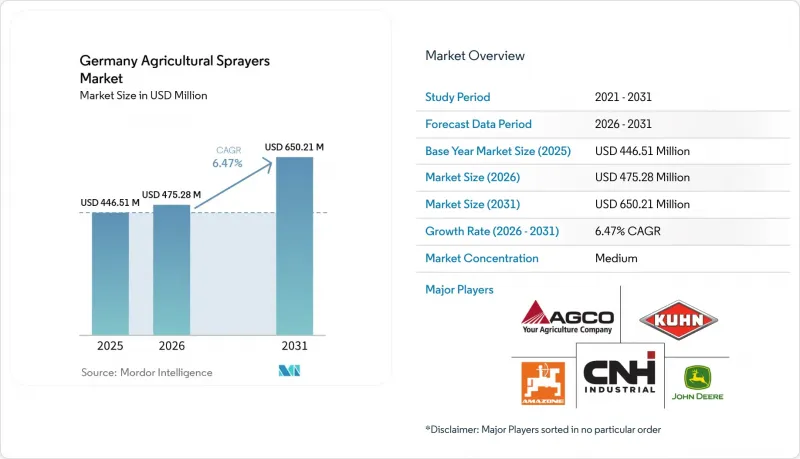
本報告按產品類型(手持式噴霧器、曳引機式噴霧器、牽引式噴霧器等)、動力來源(手動、太陽能、燃油等)、應用領域(大田作物、果園/葡萄園等)和技術水準(傳統、精準噴灑/GPS導航等)進行分類。市場預測以美元(USD)計價。
德國農業噴霧器市場趨勢與洞察
透過減少漂移和遵守緩衝區規定,強制進行精準噴灑。
德國的作物保護體系所提供的市場需求基礎是基於法規遵循,而非純粹任意的更換週期。下薩克森州植物保護局(Niedersachsen Pflanzenschutzdienst)制定了明確的漂移減少噴嘴等級、噴桿高度設定以及邊界噴嘴使用要求,這些規定直接影響著哪些機器和售後套件能夠符合田間作業要求。如果農民使用未經批准的漂移來減少噴嘴,實際上會擴大緩衝區要求,並縮小田邊可噴灑面積。這使得合規性不再只是一個技術問題,而是一個明確的經濟問題。因此,在許多市場領域,對經認證的精密噴灑設備的投資成長速度超過了通用設備的更換週期。每三年進行一次設備檢驗的要求也帶來了反覆的決策挑戰,因為老舊的傳統機器如果檢驗不合格,往往需要昂貴的維修或徹底更換才能繼續使用。因此,與其他一些農業機械類別相比,德國農業噴霧器市場的需求保持穩定。隨著政策方向日益嚴格,德國的目標是到 2030 年將植物保護劑的使用量在 2004 年至 2023 年的平均水平上減少 50%,精準噴灑系統在遵守法規和成本管理方面繼續發揮著至關重要的作用。
人手不足和合約噴灑成本上升
人手不足正推動市場對處理能力、作業速度和自動化程度的需求不斷成長。北歐和西歐的農場和承包商面臨噴灑季節縮短的挑戰,這使得每位操作員在噴灑高峰期的工作時間更加寶貴。因此,買家正在尋找噴桿和儲罐容量更大、路線效率更高、自動化功能更強大的機型,以便一名操作員一天內能夠覆蓋更多公頃的土地。這種轉變在承包商領域尤其顯著,因為對他們而言,在多個農場之間提高機械運轉率比在單一農場實現經濟效益更為重要。 2025年6月,HORSCH Maschinen GmbH 在其「Leeb PT」自走式噴灑機系列中新增了一款5000公升的入門級機型,旨在吸引更廣泛的承包商客戶。這款機型的價格略低於同類高階機型,反映了製造商對大容量機械日益成長的需求。人手不足也推動了特種作物領域自動化技術的發展。在這個領域,導航的精準性和可重複性可以彌補訓練有素的季節性工人短缺的問題。久保田第二代KFAST果園自動噴藥機已在西班牙和葡萄牙進行了田間測試,並計劃於2026年中期開始小規模商業部署,目標是在2027年面向整個歐洲市場銷售。
高精度自動噴霧器的初始成本較高
高昂的購置價格仍是德國農業噴霧器市場轉型為精密農業設備的一大限制因素。德國農業技術與結構協會的一項關於農業機械經濟性的研究發現,直噴式自走噴霧器和精密農業改造系統需要大量的初始投資,這阻礙了對成本敏感的農民的採用。在德國,大規模農場和農業服務供應商可以將這些成本分攤到更大的耕地面積上,但小規模農場通常需要依靠補貼、貸款項目或設備共用協議來證明其採用的合理性。雖然競爭有望降低無人機平台和精準噴霧改造系統等技術的入門價格,但高昂的初始投資仍然是先進農業噴霧器廣泛應用的主要障礙。
細分市場分析
到2025年,曳引機式噴霧器將佔產品銷售額的40.7%,佔據德國農業噴霧器市場最大的市場佔有率。其次是牽引式噴霧器和自行式噴霧器。同時,由於應用場景有限且部署規模較小,無人機噴霧器和手持噴霧器仍屬於小規模類別。這些機型的主導地位歸功於其與現有曳引機的廣泛兼容性、較低的擁有成本以及在德國的廣泛普及。
預計到2031年,無人機噴灑器將以9.4%的複合年成長率成長,成為該細分市場中成長最快的產品,並有望在產品類型中實現最顯著的市場規模擴張。儘管隨著承包商對更大作業面積的需求,自行式和牽引式平台正在發展,但由於其與現有農業設備的兼容性以及田間規模經濟效益,曳引機式噴灑系統仍然佔據主導地位。手持式噴灑器更多用於小規模園藝和溫室作業,而非大面積農田作業。勞動力短缺、精準噴灑的優勢以及數位農業技術的日益普及也推動了手持式噴灑器的成長。
預計到2025年,燃油動力系統將佔德國農業噴霧器市場銷售額的41.2%,成為該市場最大的動力來源細分市場。手動系統在小規模應用中仍將發揮重要作用,而太陽能動力裝置仍將保持小眾市場地位。儘管電池動力機器的技術發展勢頭強勁,但其銷售佔比仍將小規模。完善的基礎設施、久經考驗的田間作業性能以及能夠勝任高強度噴灑作業的能力,正在推動德國農業噴霧器市場的持續成長。
預計2026年至2031年預測期內,電池動力噴霧器將以7.1%的複合年成長率成長,成為市場中動力來源類別中成長率最高的產品。這一成長主要由果園機器人、溫室系統和電動特種作物平台推動,這些場景對儲罐容量和運作的要求相對較低,遠低於在大面積農田上噴灑農藥。燃油動力平台預計在整個預測期內仍將佔據主導地位,因為柴油引擎驅動的機器在大噴桿、高功率和長運作時間等需求方面仍然具有優勢。手動和太陽能動力系統預計仍將在特定作物上發揮有限作用,而非成為主流機器需求的驅動力。永續性的永續發展目標和電池效率的提升也正在推動其在特種農業應用中的普及。
其他好處:
- Excel格式的市場預測(ME)表
- 3個月的分析師支持
目錄
第1章:引言
- 研究假設和市場定義
- 調查範圍
第2章:調查方法
第3章執行摘要
第4章 市場狀況
- 市場概覽
- 市場促進因素
- 強制進行精準噴灑,以減少漂移並確保符合緩衝區規定。
- 勞動力短缺和客製化應用開發成本上升
- 針對植物保護和漂移預防的定向補貼
- 大型農場的維修以實現精密農業
- 透過直接注入和噴霧輔助裝置來減少每塊田地的農藥用量。
- 由數位化文件工作流程支援的連網噴霧器
- 市場限制因素
- 精密噴霧器和自動噴霧器的初始成本較高
- 高精度系統中操作人員專業知識的差異
- 無人機使用許可的範圍仍然有限,核准過程也很複雜。
- 文件編制、檢驗和噴嘴安裝的負擔
- 監理情勢
- 技術展望
- 波特五力分析
第5章 市場規模與成長預測
- 依產品類型
- 手持噴霧器
- 曳引機式噴霧器
- 拖曳式噴霧器
- 自走式噴霧機
- 無人機噴灑器
- 透過動力來源
- 手動的
- 太陽能
- 燃油驅動
- 電池供電
- 透過使用
- 田間作物
- 果園和葡萄園
- 溫室種植的作物
- 草坪和園藝
- 按技術水準
- 傳統的
- 高精度和GPS導
- 人工智慧賦能與自主
第6章 競爭情勢
- 市場集中度
- 策略趨勢
- 市佔率分析
- 公司簡介
- Amazonen-Werke H. Dreyer GmbH & Co. KG
- CNH Industrial NV
- Deere and Company
- AGCO Corporation
- Kuhn Group
- HORSCH Maschinen GmbH
- Lemken GmbH & Co. KG
- Kverneland AS
- Chafer Machinery Ltd
- Knight Farm Machinery Ltd
- Grim Srl
- Bargam SpA
- Pulverizadores Fede SL
- DJI Technology Co., Ltd.
第7章 市場機會與未來展望
According to Mordor Intelligence, the germany agricultural sprayers market size is estimated to increase from USD 446.51 million in 2025 and USD 475.28 million in 2026 to USD 650.21 million by 2031, growing at a CAGR of 6.47% during 2026 to 2031.
This report is Segmented by Product Type (Handheld Sprayers, Tractor-Mounted Sprayers, Trailed Sprayers, and More), by Source of Power (Manual, Solar-Powered, Fuel-Operated, and More), by Application (Field Crops, Orchards and Vineyards, and More), and by Technology Level (Conventional, Precision and GPS-Guided, and More). The Market Forecasts are Provided in Terms of Value (USD).
Germany Agricultural Sprayers Market Trends and Insights
Precision Spraying Mandates from Drift Reduction and Buffer-Zone Compliance
Germany's crop protection regime is giving the market a compliance-based demand base rather than a purely discretionary replacement cycle. The Niedersachsen Pflanzenschutzdienst has laid out clear requirements on drift-reduction nozzle classes, boom-height settings, and border-nozzle use, and those rules directly influence which machines and retrofit packages can remain compliant in the field. When a grower uses a nozzle that is not recognized for drift reduction, the practical effect is a wider buffer requirement and a smaller sprayable area at field edges, turning compliance into a clear financial issue rather than a simple technical one. That is why investment in certified precision hardware is moving faster than the typical equipment replacement cycle in many parts of the market. The three-year equipment inspection requirement also creates a recurring decision point, because older conventional machines that fail inspection often require costly repairs or a full replacement to remain in service. This makes demand in the Germany agricultural sprayers market steadier than in several other farm machinery categories. The policy direction is also becoming tighter, with Germany targeting a 50% reduction in plant protection product use by 2030 from the 2004 to 2023 average, which keeps precision application systems relevant to both compliance and cost control.
Labor Scarcity and Rising Custom-Application Costs
Labor shortages are increasing the value of capacity, speed, and automation across the market. Farms and contractors in Northern and Western Europe are working within shorter spray windows, and each operator hour now carries more value during peak treatment periods. This is pushing buyers toward larger booms, bigger tanks, better route efficiency, and more automated functions that let one operator cover more hectares in a day. The change is especially visible in the contractor segment, where machine utilization across multiple farms matters more than single-farm ownership economics. HORSCH Maschinen GmbH expanded its Leeb PT self-propelled line in June 2025 with a 5,000-liter entry-level model aimed at a broader contractor base, underscoring manufacturers' stronger demand for high-capacity machines at a slightly lower entry point than the premium end of the category. Labor scarcity is also supporting autonomous development in specialty crops, where navigation accuracy and repeatability can offset the shortage of trained seasonal operators. Kubota's second-generation KFAST autonomous orchard sprayer moved from field trials in Spain and Portugal toward a limited commercial launch in mid-2026, with full European availability targeted for 2027.
High Upfront Cost of Precision and Autonomous Sprayers
High purchase prices still limit how quickly the Germany agricultural sprayers market can move toward precision-heavy fleets. Studies conducted by the German Association for Technology and Structures in Agriculture on farm machinery economics indicate that direct-injection self-propelled sprayers and precision retrofit systems require significant upfront capital expenditure, slowing adoption among cost-sensitive farming operations. In Germany, large arable farms and agricultural service providers can spread these costs across more hectares, whereas smaller operations often rely on subsidies, financing programs, or equipment-sharing arrangements to justify adoption. Although increased competition is estimated to reduce entry-level pricing for technologies such as unmanned aerial vehicle platforms and precision retrofit systems, the substantial upfront capital requirements remain a significant barrier to the widespread adoption of advanced agricultural sprayers.
Other drivers and restraints analyzed in the detailed report include:
- Subsidies for Targeted Plant Protection and Drift Avoidance
- Precision Retrofits on Large Arable Farms
- Operator Know-How Gap for Advanced Precision Systems
For complete list of drivers and restraints, kindly check the Table Of Contents.
Segment Analysis
Tractor-mounted sprayers led product revenue with 40.7% in 2025, giving them the largest share of the Germany agricultural sprayers market. Trailed sprayers followed, then self-propelled units, while unmanned aerial vehicle sprayers and handheld models remained smaller categories shaped by narrower use cases and smaller starting bases. Their dominance is further supported by broad compatibility with existing tractors, lower ownership costs, and widespread availability across Germany.
Unmanned aerial vehicle sprayers are projected to expand at a 9.4% CAGR through 2031, giving them the fastest growth path in this segmentation and the strongest expansion in market size among product categories. Self-propelled and trailed platforms are also advancing as contractors seek higher daily coverage, while tractor-mounted systems remain central because they fit established farm fleets and field-scale economics. Handheld sprayers continue to serve smaller horticultural and greenhouse tasks rather than broad-acre field work. Growth is additionally supported by labor shortages, precision application benefits, and increasing acceptance of digital farming technologies.
Fuel-operated systems accounted for 41.2% of 2025 revenue, making them the largest power-source segment for the Germany agricultural sprayers market. Manual systems remained relevant for small-scale use, while solar-powered units remained niche, and battery-operated machines were still smaller in terms of revenue despite stronger technology momentum. Their established infrastructure, proven field performance, and ability to support intensive spraying operations continue to strengthen adoption across Germany.
Battery-operated sprayers are projected to grow at a 7.1% CAGR during the forecast period 2026-2031, the fastest rate across power-source categories in the market. This rise is supported by orchard robots, greenhouse systems, and electric specialty-crop platforms, where tank size and endurance requirements are lower than in broad-acre spraying. Fuel-operated platforms will remain central throughout the forecast period, as large booms, higher horsepower, and long working hours still favor diesel-based machines. Manual and solar-powered systems should continue to play limited, crop-specific roles rather than drive mainstream fleet demand. Increasing sustainability targets and advances in battery efficiency are also encouraging wider adoption across specialized agricultural applications.
Complete Report Scope:
- By Product Type
- Handheld Sprayers
- Tractor-Mounted Sprayers
- Trailed Sprayers
- Self-Propelled Sprayers
- Unmanned Aerial Vehicle Sprayers
- By Source of Power
- Manual
- Solar-Powered
- Fuel-Operated
- Battery-Operated
- By Application
- Field Crops
- Orchards and Vineyards
- Greenhouse Crops
- Turf and Gardening
- By Technology Level
- Conventional
- Precision and GPS-Guided
- AI-Enabled and Autonomous
List of Companies Covered in this Report:
- Amazonen-Werke H. Dreyer GmbH & Co. KG
- CNH Industrial N.V.
- Deere and Company
- AGCO Corporation
- Kuhn Group
- HORSCH Maschinen GmbH
- Lemken GmbH & Co. KG
- Kverneland AS
- Chafer Machinery Ltd
- Knight Farm Machinery Ltd
- Grim S.r.l.
- Bargam S.p.A.
- Pulverizadores Fede S.L.
- DJI Technology Co., Ltd.
Additional Benefits:
- The market estimate (ME) sheet in Excel format
- 3 months of analyst support
TABLE OF CONTENTS
1 Introduction
- 1.1 Study Assumptions and Market Definition
- 1.2 Scope of the Study
2 Research Methodology
3 Executive Summary
4 Market Landscape
- 4.1 Market Overview
- 4.2 Market Drivers
- 4.2.1 Precision spraying mandates from drift reduction and buffer-zone compliance
- 4.2.2 Labor scarcity and rising custom-application costs
- 4.2.3 Subsidies for targeted plant protection and drift avoidance
- 4.2.4 Precision retrofits on large arable farms
- 4.2.5 Site-specific pesticide savings from direct injection and application assistants
- 4.2.6 Connected sprayers supported by digital documentation workflows
- 4.3 Market Restraints
- 4.3.1 High upfront cost of precision and autonomous sprayers
- 4.3.2 Operator know-how gap for advanced precision systems
- 4.3.3 Drone-use approvals remain narrow and multi-step
- 4.3.4 Documentation, inspection, and nozzle-compliance burden
- 4.4 Regulatory Landscape
- 4.5 Technological Outlook
- 4.6 Porter's Five Forces Analysis
- 4.6.1 Bargaining Power of Suppliers
- 4.6.2 Bargaining Power of Buyers
- 4.6.3 Threat of New Entrants
- 4.6.4 Threat of Substitutes
- 4.6.5 Intensity of Competitive Rivalry
5 Market Size and Growth Forecasts (Value)
- 5.1 By Product Type
- 5.1.1 Handheld Sprayers
- 5.1.2 Tractor-Mounted Sprayers
- 5.1.3 Trailed Sprayers
- 5.1.4 Self-Propelled Sprayers
- 5.1.5 Unmanned Aerial Vehicle Sprayers
- 5.2 By Source of Power
- 5.2.1 Manual
- 5.2.2 Solar-Powered
- 5.2.3 Fuel-Operated
- 5.2.4 Battery-Operated
- 5.3 By Application
- 5.3.1 Field Crops
- 5.3.2 Orchards and Vineyards
- 5.3.3 Greenhouse Crops
- 5.3.4 Turf and Gardening
- 5.4 By Technology Level
- 5.4.1 Conventional
- 5.4.2 Precision and GPS-Guided
- 5.4.3 AI-Enabled and Autonomous
6 Competitive Landscape
- 6.1 Market Concentration
- 6.2 Strategic Moves
- 6.3 Market Share Analysis
- 6.4 Company Profiles (Includes Global-Level Overview, Market-Level Overview, Core Segments, Financials as Available, Strategic Information, Market Rank/Share for Key Companies, Products and Services, and Recent Developments)
- 6.4.1 Amazonen-Werke H. Dreyer GmbH & Co. KG
- 6.4.2 CNH Industrial N.V.
- 6.4.3 Deere and Company
- 6.4.4 AGCO Corporation
- 6.4.5 Kuhn Group
- 6.4.6 HORSCH Maschinen GmbH
- 6.4.7 Lemken GmbH & Co. KG
- 6.4.8 Kverneland AS
- 6.4.9 Chafer Machinery Ltd
- 6.4.10 Knight Farm Machinery Ltd
- 6.4.11 Grim S.r.l.
- 6.4.12 Bargam S.p.A.
- 6.4.13 Pulverizadores Fede S.L.
- 6.4.14 DJI Technology Co., Ltd.
7 Market Opportunities and Future Outlook

 2026年全球農業噴灑設備市場報告
 南美洲農業噴霧器:市場佔有率分析、行業趨勢和統計數據以及成長預測(2026-2031 年)歐洲農業噴霧器:市場佔有率分析、行業趨勢和統計數據、成長預測(2026-2031 年)美國農業噴霧器:市場佔有率分析、行業趨勢和統計數據、成長預測(2026-2031 年)中東農業噴霧器:市場佔有率分析、行業趨勢和統計數據以及成長預測(2026-2031 年)
 農業噴霧器市場:2026-2032年全球市場預測(按推進方式、類型、容量、應用、最終用戶和分銷管道分類)東南亞農業噴霧器:市場佔有率分析、行業趨勢和統計數據以及成長預測(2026-2031 年)農業噴霧:市場佔有率分析、行業趨勢和統計數據、成長預測(2026-2031 年)
 農業噴霧器市場機會、成長要素、產業趨勢分析及2026-2035年預測。農業噴霧器:市場佔有率分析、行業趨勢和統計數據、成長預測(2026-2031 年)