


 |
市場調查報告書
商品編碼
2099169
美國農業噴霧器:市場佔有率分析、行業趨勢和統計數據、成長預測(2026-2031 年)United States Agricultural Sprayers - Market Share Analysis, Industry Trends & Statistics, Growth Forecasts (2026 - 2031) |
||||||

※ 本網頁內容可能與最新版本有所差異。詳細情況請與我們聯繫。
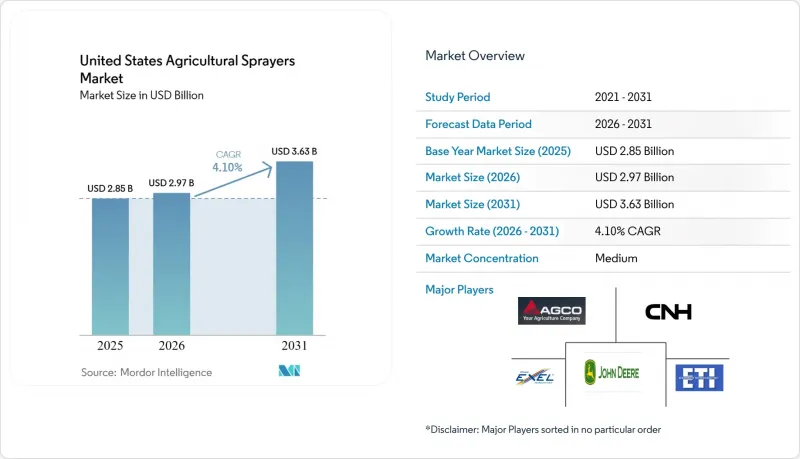
據 Mordor Intelligence 稱,2025 年美國農業噴霧器市值為 28.5 億美元,預計到 2031 年將從 2026 年的 29.7 億美元成長至 36.3 億美元,預測期(2026-2031 年)複合年成長率為 4.10%。
本報告按動力來源(手動、太陽能等)、產品類型(曳引機式等)、應用領域(農田作物、果園/葡萄園等)、噴灑能力(低容量等)、技術水準(傳統等)和泵機制(隔膜泵等)進行分類。市場預測以美元計價。
美國農業噴霧器市場趨勢與洞察
在大片農田上頻繁噴灑玉米和大豆
美國農業噴霧器市場仍然高度依賴玉米和大豆的種植規模和種植密度。在主要農業州,玉米種植面積約3,380萬公頃,大豆種植面積約3,510萬公頃,龐大且活躍的農作物種植面積持續支撐噴霧需求。如此面積的種植使得作物生長季可以反覆噴灑農藥,在高峰期,設備幾乎滿載運轉。然而,種植面積並非實際需求的唯一指標。許多農場會根據雜草損害情況和作物保護計劃,在一個生長季內多次運作農藥。這加劇了噴桿、幫浦、控制設備和導航系統的磨損,從而推動了設備的更換和升級需求。此外,雜草抗藥性管理也加劇了這一趨勢,因為雜草生長旺盛,需要更精確的噴灑時間和更高的噴灑品質。因此,即使在農民景氣低迷時期,配備大容量藥箱的自走式和牽引式噴霧器的市場需求仍然保持穩定。
透過精準施用降低成本,並提高選擇性噴灑的投資報酬率 (ROI)。
選擇性噴灑已成為美國農業噴霧器市場中最顯著的價值創造促進因素之一。約翰迪爾公司的一份報告顯示,到2025年,農民將在超過500萬英畝的農地上採用「即噴即用」技術,平均降低約50%的非持久性除草劑成本,並避免在一個種植季內使用3,100萬加侖的除草劑混合物。這些成本節約正在改變農民的購買決策,因為他們現在可以將設備升級與營運成本的直接降低聯繫起來,而不僅僅依賴人事費用的降低或產量保護。此外,精密農業系統有助於保持噴灑性能的一致性,即使在田地邊界不規則、大規模噴灑效率低下或雜草生長模式複雜的環境中也能發揮作用。隨著標籤限制的日益嚴格和文件負擔的加重,這一優勢變得更加顯著。美國環保署(EPA)關於十草畏的框架強調了減少漂移和噴灑管理的重要性,使得噴嘴級控制和噴桿自動化在日常田間作業中更有價值。因此,市場重視那些既能降低投入成本又能改善合規記錄的機器和改進方案。
機械和技術方面的初始投資成本很高。
高昂的購置成本是美國農業噴藥機市場加速普及的主要障礙。具備精密農業功能的自走式噴藥機通常比基本配置的噴藥機價格更高,這使得許多中型農戶,尤其是那些收入微薄的農戶,難以負擔。對於規模較大的農場而言,儘管選擇性噴灑具有顯著優勢,但由於資金更為緊張,這項挑戰尤為突出。此外,感測系統、機器視覺和軟體訂閱等先進技術的成本也推高了總擁有成本,加劇了成本問題。一項研究發現,儘管經銷商對技術引進意願,但在他們追蹤的簽約農地中,只有一小面積採用了機器視覺雜草檢測技術。這表明,價格阻力仍然是農場層面的主要因素。訂閱模式和附加套件有助於降低初始成本門檻,但並不能完全消除此障礙。因此,在投資報酬率高但初始投資負擔過重的情況下,市場普及速度仍然緩慢。
細分市場分析
2025年,燃油動力噴霧器占美國農業噴霧器市場56.8%的銷售量,持續維持其最大動力來源的地位。這種主導地位源自於大面積耕作的農地種植的基本需求,在這些地區,遠距離行駛、大面積藥箱和不間斷運作時間比節省燃油成本更為重要。玉米帶地區的大規模自走式噴霧器仍然依賴柴油動力,因為它們必須持續作業,而無需中途充電。手動和太陽能動力噴霧器仍在繼續使用,但在小規模農場、溫室環境和特殊應用場景中,其作用已大大降低。
預計到2031年,電池驅動系統將成為美國農業噴灑產業成長最快的動力來源,年複合成長率將達到17.9%。其中,無人機(UAV)噴灑器和溫室/果園機器人將迎來最顯著的成長,因為這些設備行程短、噪音低,電氣化成為可行的選擇。智慧電池驅動背包式噴灑器的出現也凸顯了手持設備供應商正在開發高階電池產品。然而,在廣闊的農田上實現電氣化仍然面臨挑戰,因為循環時間和充電限制與大田作物常見的密集噴灑週期並不匹配。因此,美國農業噴灑產業正朝著兩極化的模式轉變:小型高精度機型的電池驅動噴灑器將實現顯著成長,而燃油動力噴灑器在農場規模的田間噴灑中仍然發揮著核心作用。
預計到2025年,自走式噴霧器將佔產品類型銷售量的55.0%,在美國農業噴霧器市場佔有主導地位。其規模經濟效益反映了美國消費者對高離地間隙、大容量藥箱的機器的偏好,這類機器能夠在有限的噴灑時間內快速覆蓋大片農田。這個細分市場在中西部和中部平原地區仍然佔據主導地位,當地農民優先考慮的是每日噴灑面積、穩定的行駛速度以及與精密農業系統的兼容性。
無人機噴灑器是美國農業噴灑器市場中成長最快的產品類別,預計到2031年將以20.2%的複合年成長率成長。這一成長歸功於無人機噴灑器在傳統設備效率低下的領域(例如難以到達的地形、特殊作物和局部點噴應用)的高效性。然而,近期針對外國製造無人機的監管措施為供應商的發展趨勢帶來了不確定性,尤其是在某些全球品牌佔據重要地位的美國市場。雖然這一趨勢為國內製造商和替代供應商帶來了機會,但也為這個快速發展的細分市場帶來了風險。相較之下,曳引機式、牽引式和手持式噴灑器仍然至關重要,它們滿足了對穩定性和成本效益更為敏感的應用需求,而無人機噴灑器則不然。
其他好處:
- Excel格式的市場預測(ME)表
- 3個月的分析師支持
目錄
第1章:引言
- 研究假設和市場定義
- 調查範圍
第2章:調查方法
第3章執行摘要
第4章 市場狀況
- 市場概覽
- 市場促進因素
- 大面積玉米和大豆作物中農藥施用頻率
- 透過精準減少投入和選擇性分配實現投資回報率 (ROI)。
- 農業勞動力短缺和農民提高生產力的需求
- 遵守美國環保署(EPA)關於緩解措施和漂移控制的規定。
- 在果園和葡萄園引進自主技術
- 維修現有噴灑設備的經濟效益。
- 市場限制因素
- 設備和技術的前期成本很高
- 產品利潤率的波動導致更新周期延遲。
- 關稅導致零件和鋼材成本上漲
- 電池壽命和充電限制
- 監理情勢
- 技術展望
- 波特五力模型
第5章 市場規模與成長預測
- 透過電源
- 手動的
- 電池供電
- 太陽能
- 燃油驅動
- 依產品類型
- 手持式
- 聯結機式
- 拖著
- 自推進式
- 無人機噴灑器
- 透過使用
- 田間作物
- 果園和葡萄園
- 溫室種植的作物
- 草坪和園藝
- 按噴灑能力
- 超微量
- 低容量
- 大容量
- 按技術水準
- 傳統的
- 高精度和GPS導
- 配備人工智慧(AI)且自主運作
- 泵浦機構
- 隔膜泵
- 活塞泵
- 離心式幫浦
第6章 競爭情勢
- 市場集中度
- 策略趨勢
- 市佔率分析
- 公司簡介
- Deere and Company
- CNH Industrial NV
- AGCO Corporation
- EXEL Industries
- Equipment Technologies, Inc.
- HORSCH Maschinen GmbH
- Jacto SA
- Kubota Corporation
- DJI
- Ecorobotix SA
- TeeJet Technologies
- Pentair Hypro
- Niqo Robotics
- Verdant Robotics, Inc.
- CapstanAG Systems, Inc.(Nordson Precision Agriculture)
第7章 市場機會與未來趨勢
According to Mordor Intelligence, the United States agricultural sprayers market size was valued at USD 2.85 billion in 2025 and is estimated to grow from USD 2.97 billion in 2026 to reach USD 3.63 billion by 2031, at a CAGR of 4.10% during the forecast period (2026-2031).
This report is Segmented by Source of Power (Manual, Solar-Powered, and More), by Product Type (Tractor-Mounted, and More), by Application (Field Crops, Orchards and Vineyards, and More), by Spray Volume Capacity (Low Volume and More), by Technology Level (Conventional and More), and by Pump Mechanism (Diaphragm Pumps and More). The Market Forecasts are Provided in Terms of Value (USD).
United States Agricultural Sprayers Market Trends and Insights
Broad-Acre Corn and Soybean Spray Intensity
The United States agricultural sprayers market still depends heavily on the scale and intensity of corn and soybean production. A broad and active row-crop base continues to support spraying demand, with corn covering around 33.8 million hectares and soybean cultivation reaching about 35.1 million hectares across major farming states. That acreage base supports repeated in-season applications, and the equipment used in those windows often operates near full utilization during peak periods. The real demand signal is not acreage alone, because many farms still run multiple passes through a season as weed pressure and crop protection schedules require. That raises wear on booms, pumps, controls, and guidance systems, which supports both replacement demand and upgrade demand. Resistance management adds to this pattern because problem weeds increase the need for better timing and better application quality. Consequently, the market maintains a stable demand for large-tank self-propelled and trailed machines, even during periods of reduced grower confidence.
Precision Input Savings and Selective Spraying Return on Investment (ROI)
Selective spraying has become one of the clearest value drivers in the United States agricultural sprayers market. John Deere reported that growers used See and Spray technology across more than 5 million acres in 2025, with average savings of nearly 50% on non-residual herbicide costs and 31 million gallons of herbicide mix avoided during the season. Those savings change the purchase decision because growers can now tie equipment upgrades to direct operating cost reductions rather than relying solely on labor savings or yield protection. Precision systems also help maintain performance on irregular field boundaries and mixed-pressure weed environments where blanket application is less efficient. The benefit is growing because label restrictions are becoming stricter and more documentation-heavy. EPA's dicamba framework underscores the importance of drift-reduction agents and application discipline, making nozzle-level control and boom automation even more valuable in daily field practice. As a result, the market is rewarding machines and retrofits that can deliver both measurable input savings and cleaner compliance records.
High Upfront Machine and Technology Cost
High purchase costs remain a significant barrier to faster adoption in the United States agricultural sprayers market. Precision-equipped self-propelled machines often carry an additional cost compared to baseline configurations, which many mid-sized operations find challenging to afford, particularly when farm income is under pressure. This challenge is most pronounced among farms in acreage bands that could benefit substantially from selective spraying but face tighter financial constraints. The cost issue is further compounded by the expense of advanced technologies, such as sensing systems, machine vision, and software subscriptions, which increase the overall cost of ownership. A survey indicated that machine vision weed detection was implemented on only a small percentage of dealer-tracked custom acres, despite higher dealer intent to adopt the technology. This indicates that price resistance remains a significant factor at the farm level. While subscription models and retrofit kits help lower the initial cost barrier, they do not eliminate it. As a result, the market continues to experience a slower adoption rate in cases where the potential return on investment is strong, but the upfront capital requirement remains prohibitive.
Other drivers and restraints analyzed in the detailed report include:
- Farm Labor Scarcity and Operator Productivity Needs
- Environmental Protection Agency (EPA) Mitigation and Drift-Control Compliance
- Commodity-Margin Volatility Delaying Replacement Cycles
For complete list of drivers and restraints, kindly check the Table Of Contents.
Segment Analysis
Fuel-operated sprayers held 56.8% of revenue in 2025, which kept them as the largest power source in the United States agricultural sprayers market. Their lead comes from the basic needs of large-acre row-crop farming, where long range, high tank capacity, and uninterrupted operating windows matter more than fuel savings. Large self-propelled units in the Corn Belt still depend on diesel power because they must sustain coverage across large fields without stopping for recharge. Manual and solar-powered systems remain in place, but they serve much narrower roles on small holdings, in greenhouse settings, and in specialty use cases.
Battery-operated systems are projected to be the fastest-growing power source, advancing at a 17.9% CAGR through 2031 in the United States agricultural sprayers industry. Growth is strongest in Unmanned Aerial Vehicle (UAV) sprayers and in greenhouse or orchard robots, where short routes and lower noise levels make electrification practical. The emergence of smart battery-powered backpack sprayers highlights how suppliers are developing a premium battery segment even within handheld equipment. Even so, large-acre electrification still faces a hard limit because cycle time and charging constraints do not align with the tight spray windows common in row crops. The United States agricultural sprayers industry is therefore moving toward a split model where battery growth is strong in smaller and more precise formats, while fuel-powered machines remain the operating backbone for farm-scale field spraying.
Self-propelled sprayers accounted for 55.0% of product-type revenue in 2025, giving them the leading position in the United States agricultural sprayers market. Their scale advantage reflects the country's bias toward high-clearance, large-tank machines that can move quickly across broad-acre farms during narrow spray windows. The segment remains central in the Midwest and Plains, where farmers prioritize acres covered per day, consistent field speed, and compatibility with precision systems.
UAV sprayers are the fastest-growing product segment, with a 20.2% CAGR through 2031 in the United States agricultural sprayers market. Their growth is attributed to their effectiveness in hard-to-access terrain, specialty crops, and targeted spot-treatment applications, where conventional equipment proves less efficient. However, recent regulatory measures targeting foreign-manufactured drones have created uncertainty in supplier dynamics, particularly due to the significant presence of certain global brands in the United States market. This development presents opportunities for domestic manufacturers and alternative suppliers but also introduces risks to this rapidly evolving segment. In contrast, tractor-mounted, trailed, and handheld sprayers remain essential, catering to more stable and cost-sensitive applications compared to the dynamic UAV category.
Complete Report Scope:
- By Source of Power
- Manual
- Battery-Operated
- Solar-Powered
- Fuel-Operated
- By Product Type
- Handheld
- Tractor-Mounted
- Trailed
- Self-Propelled
- Unmanned Aerial Vehicle Sprayers
- By Application
- Field Crops
- Orchards and Vineyards
- Greenhouse Crops
- Turf and Gardening
- By Spray Volume Capacity
- Ultra-Low Volume
- Low Volume
- High Volume
- By Technology Level
- Conventional
- Precision and GPS-Guided
- Artificial Intelligence-Enabled and Autonomous
- By Pump Mechanism
- Diaphragm Pumps
- Piston Pumps
- Centrifugal Pumps
List of Companies Covered in this Report:
- Deere and Company
- CNH Industrial N.V.
- AGCO Corporation
- EXEL Industries
- Equipment Technologies, Inc.
- HORSCH Maschinen GmbH
- Jacto S.A.
- Kubota Corporation
- DJI
- Ecorobotix SA
- TeeJet Technologies
- Pentair Hypro
- Niqo Robotics
- Verdant Robotics, Inc.
- CapstanAG Systems, Inc. (Nordson Precision Agriculture)
Additional Benefits:
- The market estimate (ME) sheet in Excel format
- 3 months of analyst support
TABLE OF CONTENTS
1 Introduction
- 1.1 Study Assumptions and Market Definition
- 1.2 Scope of the Study
2 Research Methodology
3 Executive Summary
4 Market Landscape
- 4.1 Market Overview
- 4.2 Market Drivers
- 4.2.1 Broad-acre corn and soybean spray intensity
- 4.2.2 Precision input savings and selective spraying Return on Investment (ROI)
- 4.2.3 Farm labor scarcity and operator productivity needs
- 4.2.4 Environmental Protection Agency (EPA) mitigation and drift-control compliance
- 4.2.5 Orchard and vineyard autonomy adoption
- 4.2.6 Retrofit economics for installed sprayer fleets
- 4.3 Market Restraints
- 4.3.1 High upfront machine and technology cost
- 4.3.2 Commodity-margin volatility delaying replacement cycles
- 4.3.3 Tariff-driven component and steel cost inflation
- 4.3.4 Battery runtime and charging constraints
- 4.4 Regulatory Landscape
- 4.5 Technological Outlook
- 4.6 Porter's Five Forces
- 4.6.1 Bargaining Power of Buyers
- 4.6.2 Bargaining Power of Suppliers
- 4.6.3 Threat of New Entrants
- 4.6.4 Threat of Substitutes
- 4.6.5 Intensity of Competitive Rivalry
5 Market Size and Growth Forecasts (Value)
- 5.1 By Source of Power
- 5.1.1 Manual
- 5.1.2 Battery-Operated
- 5.1.3 Solar-Powered
- 5.1.4 Fuel-Operated
- 5.2 By Product Type
- 5.2.1 Handheld
- 5.2.2 Tractor-Mounted
- 5.2.3 Trailed
- 5.2.4 Self-Propelled
- 5.2.5 Unmanned Aerial Vehicle Sprayers
- 5.3 By Application
- 5.3.1 Field Crops
- 5.3.2 Orchards and Vineyards
- 5.3.3 Greenhouse Crops
- 5.3.4 Turf and Gardening
- 5.4 By Spray Volume Capacity
- 5.4.1 Ultra-Low Volume
- 5.4.2 Low Volume
- 5.4.3 High Volume
- 5.5 By Technology Level
- 5.5.1 Conventional
- 5.5.2 Precision and GPS-Guided
- 5.5.3 Artificial Intelligence-Enabled and Autonomous
- 5.6 By Pump Mechanism
- 5.6.1 Diaphragm Pumps
- 5.6.2 Piston Pumps
- 5.6.3 Centrifugal Pumps
6 Competitive Landscape
- 6.1 Market Concentration
- 6.2 Strategic Moves
- 6.3 Market Share Analysis
- 6.4 Company Profiles (Includes Global Level Overview, Market Level Overview, Core Segments, Financials as Available, Strategic Information, Market Rank/Share, Products and Services, and Recent Developments)
- 6.4.1 Deere and Company
- 6.4.2 CNH Industrial N.V.
- 6.4.3 AGCO Corporation
- 6.4.4 EXEL Industries
- 6.4.5 Equipment Technologies, Inc.
- 6.4.6 HORSCH Maschinen GmbH
- 6.4.7 Jacto S.A.
- 6.4.8 Kubota Corporation
- 6.4.9 DJI
- 6.4.10 Ecorobotix SA
- 6.4.11 TeeJet Technologies
- 6.4.12 Pentair Hypro
- 6.4.13 Niqo Robotics
- 6.4.14 Verdant Robotics, Inc.
- 6.4.15 CapstanAG Systems, Inc. (Nordson Precision Agriculture)
7 Market Opportunities and Future Trends

 2026年全球農業噴灑設備市場報告
 南美洲農業噴霧器:市場佔有率分析、行業趨勢和統計數據以及成長預測(2026-2031 年)歐洲農業噴霧器:市場佔有率分析、行業趨勢和統計數據、成長預測(2026-2031 年)中東農業噴霧器:市場佔有率分析、行業趨勢和統計數據以及成長預測(2026-2031 年)
 農業噴霧器市場:2026-2032年全球市場預測(按推進方式、類型、容量、應用、最終用戶和分銷管道分類)德國農業噴霧器:市場佔有率分析、行業趨勢和統計數據以及成長預測(2026-2031 年)東南亞農業噴霧器:市場佔有率分析、行業趨勢和統計數據以及成長預測(2026-2031 年)農業噴霧:市場佔有率分析、行業趨勢和統計數據、成長預測(2026-2031 年)
 農業噴霧器市場機會、成長要素、產業趨勢分析及2026-2035年預測。農業噴霧器:市場佔有率分析、行業趨勢和統計數據、成長預測(2026-2031 年)