


 |
市場調查報告書
商品編碼
2113867
銀行業雲端安全:市場佔有率分析、產業趨勢與統計及成長預測(2026-2031 年)Cloud Security In Banking Industry - Market Share Analysis, Industry Trends & Statistics, Growth Forecasts (2026 - 2031) |
||||||

※ 本網頁內容可能與最新版本有所差異。詳細情況請與我們聯繫。
據 Mordor Intelligence 稱,2025 年銀行業雲端安全市場價值為 361.7 億美元,預計到 2031 年將達到 932.7 億美元,而 2026 年為 423.5 億美元,預測期(2026-2031 年)的複合年成長率為 17.12%。
本報告按軟體類型(雲端身分和存取管理、雲端電子郵件安全性等)、部署模式(公共雲端、私有雲端、混合雲端)、保全服務(資料安全、應用程式安全等)、銀行類型(零售/消費銀行、企業和投資銀行等)以及地區進行細分。市場預測以美元計價。
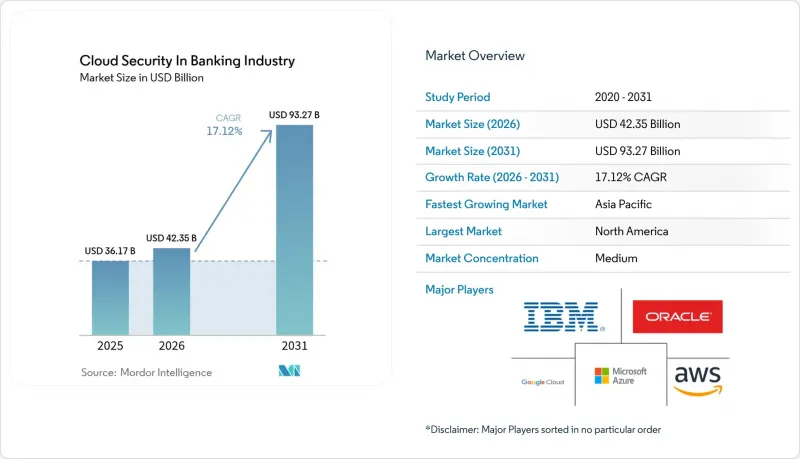
銀行業全球雲端安全趨勢及洞察
針對銀行工作負載的網路攻擊日益增多且手段日益複雜。
2024年,受勒索軟體攻擊影響的金融機構比例高達78%,是前一年的兩倍。攻擊者現在正利用API、容器配置錯誤以及第三方軟體中的漏洞。例如,一次雲端配置錯誤就危及了摩根大通約50萬客戶的安全,凸顯了一種超越傳統界限的新型威脅。由於每次事件的平均損失高達1000萬美元,因此迫切需要轉向基於行為分析的零信任控制,以檢驗所有會話和資產。領先的銀行正在將持續合規掃描和威脅搜尋整合到其DevSecOps流程中,將漏洞暴露的時間從幾天縮短到幾小時。全球最大的支付網路SWIFT正與Google雲端合作試行聯邦學習模型,以在不轉移敏感資料的情況下偵測異常交易。這表明人工智慧可以在保護隱私的同時檢測詐欺行為。隨著組織犯罪利用暗網上的被盜銀行憑證牟利,主動式雲端分段和最小權限身分與存取管理已成為董事會層級的優先事項。
即時合規自動化要求(巴塞爾協議III、DORA等)
歐盟的《資料保護條例》(DORA) 要求22,000家金融機構在24小時內報告重大網路安全事件,並與關鍵雲供應商檢驗替代方案,這迫使銀行部署自動化證據收集引擎,以便近乎即時地向監管機構提供資訊。美國監管機構也朝著類似的方向努力,財政部發布的《2025年雲端彈性報告》呼籲系統性金融機構進行持續的控制監控。雲端供應商目前正在將巴塞爾協定III、PCI DSS和GDPR的映射模板整合到其儀表板中,從而減少了40%的人工審計工作量。全球營運的銀行正在標準化統一的合規框架,使其能夠透過一套政策滿足重疊的司法管轄區要求。當客戶資料在歐盟、美國和亞洲之間流動時,這一點尤其重要。早期採用者報告稱,內建的管治消除了冗長的安全審查週期,合規性已從障礙轉變為產生收入驅動力,從而加快了產品發布速度。
資料居住要求與多租戶公共雲端之間的衝突
GDPR、中國的《雲端服務法》(CSL)和印度的《元資料保護與資料保護法》(DPDP Act)都強制要求銀行進行資料在地化,這與全球多租戶環境存在衝突。儘管超大規模資料中心業者提供的各種主權雲端方案承諾實現元資料隔離和本地金鑰管理,但它們仍然缺乏某些監管機構要求的精細化位置控制。在亞太地區小規模的市場中,經常會強制執行「國內資料中心部署」規則,這些規則會削弱規模經濟效益,迫使銀行轉向混合拓撲結構,將敏感資料集保留在本地或私人區域中。由此產生的架構複雜性增加了成本,提高了配置錯誤的風險,並阻礙了雲端的廣泛採用。政策制定者正在與業界合作,完善資料居住要求,以使網路彈性帶來的益處超過管轄權方面的擔憂,但預計這個問題要到本世紀末才能得到解決。
細分市場分析
到 2025 年,雲端身分與存取管理 (IAM) 將佔據銀行業雲端安全市場 28.85% 的佔有率。這反映了銀行正在從邊界控制轉向以身分為中心的保護,從而在毫秒時間內驗證使用者、服務和 API 的身份。隨著分散式工作模式的普及,IAM 整合了單一登入、特權存取管理和設備健康檢查,為零信任計畫奠定了基礎。供應商目前正在引入持續風險評分和無密碼身分驗證流程,以減少登入的繁瑣步驟,這對於提升消費者銀行的使用者體驗至關重要。
雲端加密是成長最快的細分市場,預計到2031年將達到17.75%的年複合成長率(CAGR)對量子威脅的日益關注以及更嚴格的資料保護法規正促使銀行採用硬體安全模組(HSM)和集中式金鑰管理。隨著支付基礎設施中抗量子演算法的普及,銀行業以加密為中心的雲端安全市場預計將進一步擴大,因為加密技術既是合規要求,也是競爭優勢。多方計算和格式保留加密技術正日益受到關注,使金融機構能夠在不解密的情況下分析資料。這代表著跨境詐欺分析和人工智慧模型訓練領域的突破性進展。
到2025年,公共雲端將佔銀行業雲端安全市場佔有率的61.55%,凸顯了人們對超大規模資料中心業者雲端服務商防禦能力、金融服務專用區域以及責任共擔模式的高度信任。 AWS和微軟等雲端服務供應商報告稱,銀行業工作負載實現了兩位數成長,這得益於PCI DSS按需審計包等工具的推出,這些工具縮短了評估時間。然而,主權雲和區域雲等變體表明,單一模式無法涵蓋所有司法管轄區,而英國監管機構對「退出策略」的檢驗凸顯了市場集中度所帶來的風險。
混合雲端的採用率正以19.45%的複合年成長率快速成長。這是因為銀行可以在滿足資料居住要求的同時,在分析處理高峰期將負載分配到公共雲端基礎設施。容器和服務網格實現了工作負載的可移植性,並允許進行“壓力測試退出”,即在數小時內將流量從受損的供應商處轉移出去。隨著監管機構對單一供應商的依賴進行嚴格審查,多重雲端工具鏈正成為衡量營運彈性的關鍵指標,加速了跨供應商安全編配抽象層的採用。
區域分析
北美在銀行業雲端安全市場佔據主導地位,預計2025年將佔據36.85%的市場。監管機構與供應商多年來的對話、成熟的公私威脅情報共用,以及摩根大通每年170億美元的技術支出,都凸顯了當地市場的強勁需求。美國財政部發布的《2025年雲端彈性研究報告》正式建議關鍵機構採用多重雲端架構,並部署即時監控管道,加速了對跨多個供應商的統一安全堆疊的需求。加拿大監管機構在其開放銀行指南中明確提及了零信任和安全API標準,這表明投資動能將進一步增強。
在亞太地區,預計2026年至2031年間,複合年成長率將達到17.35%,成為成長最快的地區,監管機構正努力在數據在地化和創新之間尋求平衡。日本一家區域性銀行聯盟採用了運作IBM和Kyndryl基礎設施的共用混合平台,展現了在成本效益和合規性方面實現安全保障的協作模式。新加坡全國範圍內的數位身分認證和馬來西亞的RMiT標準也分別推動了身分與存取管理(IAM)和即時監控技術的普及。中國的多層防護體系(MLPS 2.0)強制要求加密、持續監控和金鑰儲存於國內,促使服務供應商推出具備硬體認證功能的「僅限國內」區域。
在歐洲,隨著DORA和PSD2/PSD3的實施,這一趨勢正在加速發展。義大利銀行Credem Banca遷移到專用的安全雲端平台,該平台整合了加密和即時事件通知功能,監管報告速度提高了20%。根據泰雷茲2024年的調查,65%的歐洲公司將雲端安全列為第二重要的網路安全優先事項,顯示雲端安全在董事會層面也備受重視。多重雲端彈性演練和自主雲試點部署如今已成為合約要求,這推動了對編配層的需求,該編排層能夠強制執行策略,而無需在亞馬遜、微軟和谷歌等環境中手動重複配置規則。
其他好處:
- Excel格式的市場預測(ME)表
- 3個月的分析師支持
目錄
第1章:引言
- 研究假設和市場定義
- 調查範圍
第2章:調查方法
第3章執行摘要
第4章 市場狀況
- 市場概覽
- 市場促進因素
- 針對銀行業務工作負載的網路攻擊數量和複雜程度都在增加。
- 即時合規自動化要求(巴塞爾協議III、DORA等)
- 透過無伺服器和容器原生安全控制降低成本
- 開放銀行API的擴充正在加速零信任的採用。
- 整合到雲端安全套件中的人工智慧詐欺偵測功能
- 市場限制因素
- 資料居住要求與多租戶公共雲端相衝突。
- 銀行安全營運中心團隊缺乏雲端安全專家
- 第三方金融科技合作關係中隱藏的依賴風險
- 產業價值鏈分析
- 監理情勢
- 技術展望
- 產業吸引力—五力分析
- 新進入者的威脅
- 買方的議價能力
- 供應商的議價能力
- 替代品的威脅
- 競爭公司之間的競爭
- 宏觀經濟因素對市場的影響
第5章 市場規模與成長預測
- 軟體類型
- 雲端身分和存取管理 (IAM)
- 基於雲端的電子郵件安全
- 基於雲端的入侵偵測和防禦(IDPS)
- 雲端加密
- 雲端網路安全
- 按部署模式
- 公共雲端
- 私有雲端
- 混合雲端
- 由保全服務
- 資料安全
- 應用程式安全
- 網路安全
- 安全監控與編配(SIEM/SOAR)
- 識別、認證和詐欺分析
- 按銀行類型
- 零售/消費銀行
- 企業及投資銀行
- 卡片和支付服務供應商
- 以數位為中心/新型銀行
- 按地區
- 北美洲
- 美國
- 加拿大
- 墨西哥
- 南美洲
- 巴西
- 阿根廷
- 智利
- 其他南美國家
- 歐洲
- 德國
- 英國
- 法國
- 義大利
- 西班牙
- 俄羅斯
- 其他歐洲國家
- 亞太地區
- 中國
- 印度
- 日本
- 韓國
- 馬來西亞
- 新加坡
- 澳洲
- 其他亞太國家
- 中東和非洲
- 中東
- 阿拉伯聯合大公國
- 沙烏地阿拉伯
- 土耳其
- 其他中東國家
- 非洲
- 南非
- 奈及利亞
- 埃及
- 其他非洲國家
- 中東
- 北美洲
第6章 競爭情勢
- 市場集中度
- 策略趨勢
- 市佔率分析
- 公司簡介
- AWS(Amazon.com, Inc.)
- Google Cloud Platform(Alphabet Inc.)
- Microsoft Azure(Microsoft Corporation)
- IBM Cloud Security(IBM Corporation)
- Oracle Cloud(Oracle Corporation)
- Salesforce, Inc.
- Palo Alto Networks, Inc.
- Fortinet Inc.
- Check Point Software Technologies Ltd.
- Trend Micro Inc.
- CrowdStrike Holdings, Inc.
- Zscaler, Inc.
- Proofpoint Inc.
- Okta, Inc.
- Ping Identity Corporation
- SailPoint Technologies Holdings Inc.
- Netskope, Inc.
- Imperva, Inc.
- Qualys, Inc.
- Rapid7, Inc.
- Sophos Ltd.
- Illumio Inc.
- Akamai Technologies Inc.
- Thales Group(Vormetric)
- Temenos AG
- nCino, Inc.
第7章 市場機會與未來趨勢
- 評估閒置頻段和未滿足的需求
According to Mordor Intelligence, the cloud security in banking industry was valued at USD 36.17 billion in 2025 and estimated to grow from USD 42.35 billion in 2026 to reach USD 93.27 billion by 2031, at a CAGR of 17.12% during the forecast period (2026-2031). This report is Segmented by Software Type (Cloud Identity and Access Management, Cloud Email Security, and More), Deployment Model (Public Cloud, Private Cloud, and Hybrid Cloud), Security Service (Data Security, Application Security, and More), Banking Type (Retail/Consumer Banking, Corporate and Investment Banking, and More), and Geography. The Market Forecasts are Provided in Terms of Value (USD).
Global Cloud Security In Banking Industry Trends and Insights
Growing Volume and Sophistication of Cyber-Attacks on Banking Workloads
Financial institutions faced 78% ransomware hit rates in 2024, double the prior year. Attackers are now exploiting API abuse, container misconfigurations, and third-party software flaws, in 1 incident, a cloud misconfiguration exposed nearly 500,000 JPMorgan Chase customers, underlining the new perimeter-free threat surface. Average breach costs reach USD 10 million per incident, prompting urgent migration to behavior analytics-driven zero-trust controls that verify every session and asset. Major banks are embedding continuous compliance scanning and threat hunting into DevSecOps pipelines to reduce exposure windows from days to hours. Global payments rail SWIFT is piloting federated learning models with Google Cloud that flag anomalous transactions without moving sensitive data, demonstrating how AI can detect fraud while protecting privacy. As organized crime monetizes access to stolen banking credentials on dark-net markets, proactive cloud segmentation and least-privilege IAM have become board-level priorities.
Real-Time Compliance Automation Requirements (Basel III, DORA, etc.)
The EU's DORA obliges 22,000 financial entities to report severe cyber incidents within 24 hours and test exit plans for critical cloud suppliers, pushing banks to deploy automated evidence-collection engines that feed regulators in near real time. U.S. regulators are moving in the same direction: the Treasury's 2025 cloud resilience report urges continuous control monitoring for systemic institutions. Cloud vendors now bundle mapping templates for Basel III, PCI DSS, and GDPR into dashboards, cutting manual audit workloads by 40%. Banks with global footprints are standardizing on unified compliance fabrics so a single policy set satisfies overlapping jurisdictions-particularly valuable when customer data flows span the EU, the U.S., and Asia. Early adopters report faster product launches because embedded governance eliminates lengthy security-review cycles, turning compliance from a blocker into a revenue enabler.
Data Residency Conflicts with Multi-Tenant Public Clouds
GDPR, China's CSL, and India's DPDP Act oblige banks to localize data, conflicting with global multi-tenant setups. Sovereign-cloud variants from hyperscalers promise metadata isolation and local key custody, yet still lack the granular placement controls some regulators demand. Smaller APAC markets often enforce data-center-in-country rules that erode economies of scale, nudging banks toward hybrid topologies where sensitive datasets stay on-prem or in local private regions. Resulting architectural complexity inflates cost and elevates configuration-error risk, adding drag to widespread cloud adoption plans. Policymakers are consulting with industry to refine residency stipulations so cyber resilience benefits outweigh jurisdictional concerns, but resolution is unlikely before the end of the decade.
Other drivers and restraints analyzed in the detailed report include:
- Cost Avoidance Through Serverless and Container-Native Security Controls
- Expansion of Open-Banking APIs Driving Zero-Trust Adoption
- Shortage of Cloud-Security-Skilled Talent in Banks' SOC Teams
For complete list of drivers and restraints, kindly check the Table Of Contents.
Segment Analysis
Cloud Identity and Access Management accounted for 28.85% of the cloud security in banking industry share in 2025, reflecting banks' shift from perimeter controls to identity-centric guardrails that authenticate users, services, and APIs at a millisecond scale. As distributed work models persist, IAM consolidates single sign-on, privileged access management, and device posture checks, forming the backbone of zero-trust programs. Vendors are now embedding continuous risk scoring and passwordless flows that trim login friction-a critical user-experience factor in consumer banking.
Cloud Encryption is the fastest segment, posting an 17.75% CAGR through 2031. Quantum threat awareness and stricter data protection statutes are prompting banks to implement hardware security modules and centralized key orchestration. The cloud security market size for encryption-focused products in the banking sector is forecast to rise alongside the implementation of quantum-safe algorithms across payment rails, positioning cryptography as both a compliance must-have and a competitive differentiator. Multi-party computation and format-preserving encryption are gaining traction, letting institutions analyze data without decrypting it, a breakthrough for cross-border fraud analytics and AI model training.
Public-cloud implementations captured 61.55% of the cloud security market share in the banking industry in 2025, underscoring confidence in hyperscaler defenses, dedicated financial services regions, and shared-responsibility blueprints. Providers such as AWS and Microsoft report double-digit growth in bank workloads, aided by artifacts like PCI DSS on-demand audit packs that slice assessment times. However, the sovereign-cloud and regional-cloud variants illustrate that one model will not fit every jurisdiction, and exit-strategy testing, as demanded by U.K. supervisors, underscores residual concentration risk.
Hybrid-cloud installations are expanding at a 19.45% CAGR because they let banks meet data residency mandates while still bursting to public fabric for analytics surges. Containers and service meshes deliver workload portability, enabling stress-exit drills that shift traffic off a compromised provider within hours. As regulators scrutinize single-vendor dependencies, multi-cloud toolchains are becoming a broad metric for operational resilience, accelerating the procurement of abstraction layers that secure and orchestrate across providers.
Complete Report Scope:
- By Software Type
- Cloud Identity and Access Management (IAM)
- Cloud Email Security
- Cloud Intrusion Detection and Prevention (IDPS)
- Cloud Encryption
- Cloud Network Security
- By Deployment Model
- Public Cloud
- Private Cloud
- Hybrid Cloud
- By Security Service
- Data Security
- Application Security
- Network Security
- Security Monitoring and Orchestration (SIEM/SOAR)
- Identity, Authentication and Fraud Analytics
- By Banking Type
- Retail/Consumer Banking
- Corporate and Investment Banking
- Card and Payment Service Providers
- Digital-Only/Neobanks
- By Geography
- North America
- United States
- Canada
- Mexico
- South America
- Brazil
- Argentina
- Chile
- Rest of South America
- Europe
- Germany
- United Kingdom
- France
- Italy
- Spain
- Russia
- Rest of Europe
- Asia-Pacific
- China
- India
- Japan
- South Korea
- Malaysia
- Singapore
- Australia
- Rest of Asia-Pacific
- Middle East and Africa
- Middle East
- United Arab Emirates
- Saudi Arabia
- Turkey
- Rest of Middle East
- Africa
- South Africa
- Nigeria
- Egypt
- Rest of Africa
- Middle East
- North America
Geography Analysis
North America dominated the cloud security market in banking industry, with a 36.85% share in 2025. A long-standing regulator-vendor dialogue, mature private-public threat-sharing, and USD 17 billion in annual tech spending at JPMorgan Chase underscore the depth of local demand. The U.S. Treasury's 2025 cloud-resilience study formally encourages critical institutions to adopt a multi-cloud approach while implementing real-time monitoring pipelines, thereby accelerating orders for unified security stacks that can span multiple providers. Canadian regulators now explicitly reference zero-trust and secure-API norms in their open-banking guidance, signaling further momentum in investment.
The Asia-Pacific region is expected to deliver the fastest CAGR of 17.35% from 2026 to 2031, as regulators balance data localization with innovation. Japan's consortium of regional banks adopted a shared hybrid platform running on IBM and Kyndryl infrastructure, illustrating collaborative approaches to cost-effective yet compliant security. Singapore's national digital ID roll-out and Malaysia's RMiT standard also drive the adoption of IAM and real-time monitoring, respectively. China's multi-level protection scheme (MLPS 2.0) compels encryption, continuous monitoring, and onshore key custody, prompting providers to launch local-only regions with hardware attestation.
Europe is accelerating due to DORA and PSD2/PSD3. Italian bank Credem Banca migrated to a specialist security cloud that embeds encryption and real-time incident notification, achieving 20% faster regulatory reporting. The Thales 2024 study notes that 65% of European firms rank cloud security as their second-largest cybersecurity priority, indicating a board-level focus. Multi-cloud resilience drills and sovereign-cloud pilots are now contractual requirements, spurring demand for orchestration layers that enforce policies across Amazon, Microsoft, and Google environments without manual rule duplication.
- AWS (Amazon.com, Inc.)
- Google Cloud Platform (Alphabet Inc.)
- Microsoft Azure (Microsoft Corporation)
- IBM Cloud Security (IBM Corporation)
- Oracle Cloud (Oracle Corporation)
- Salesforce, Inc.
- Palo Alto Networks, Inc.
- Fortinet Inc.
- Check Point Software Technologies Ltd.
- Trend Micro Inc.
- CrowdStrike Holdings, Inc.
- Zscaler, Inc.
- Proofpoint Inc.
- Okta, Inc.
- Ping Identity Corporation
- SailPoint Technologies Holdings Inc.
- Netskope, Inc.
- Imperva, Inc.
- Qualys, Inc.
- Rapid7, Inc.
- Sophos Ltd.
- Illumio Inc.
- Akamai Technologies Inc.
- Thales Group (Vormetric)
- Temenos AG
- nCino, Inc.
Additional Benefits:
- The market estimate (ME) sheet in Excel format
- 3 months of analyst support
TABLE OF CONTENTS
1 INTRODUCTION
- 1.1 Study Assumptions and Market Definition
- 1.2 Scope of the Study
2 RESEARCH METHODOLOGY
3 EXECUTIVE SUMMARY
4 MARKET LANDSCAPE
- 4.1 Market Overview
- 4.2 Market Drivers
- 4.2.1 Growing volume and sophistication of cyber-attacks on banking workloads
- 4.2.2 Real-time compliance automation requirements (Basel III, DORA, etc.)
- 4.2.3 Cost avoidance through serverless and container-native security controls
- 4.2.4 Expansion of open-banking APIs driving zero-trust adoption
- 4.2.5 AI-powered fraud detection bundled with cloud security suites
- 4.3 Market Restraints
- 4.3.1 Data residency conflicts with multi-tenant public clouds
- 4.3.2 Shortage of cloud-security-skilled talent in banks' SOC teams
- 4.3.3 Hidden dependency risk in third-party fintech integrations
- 4.4 Industry Value Chain Analysis
- 4.5 Regulatory Landscape
- 4.6 Technological Outlook
- 4.7 Industry Attractiveness - Porter's Five Forces Analysis
- 4.7.1 Threat of New Entrants
- 4.7.2 Bargaining Power of Buyers
- 4.7.3 Bargaining Power of Suppliers
- 4.7.4 Threat of Substitutes
- 4.7.5 Intensity of Competitive Rivalry
- 4.8 Impact of Macroeconomic Factors on the Market
5 MARKET SIZE AND GROWTH FORECASTS (VALUES)
- 5.1 By Software Type
- 5.1.1 Cloud Identity and Access Management (IAM)
- 5.1.2 Cloud Email Security
- 5.1.3 Cloud Intrusion Detection and Prevention (IDPS)
- 5.1.4 Cloud Encryption
- 5.1.5 Cloud Network Security
- 5.2 By Deployment Model
- 5.2.1 Public Cloud
- 5.2.2 Private Cloud
- 5.2.3 Hybrid Cloud
- 5.3 By Security Service
- 5.3.1 Data Security
- 5.3.2 Application Security
- 5.3.3 Network Security
- 5.3.4 Security Monitoring and Orchestration (SIEM/SOAR)
- 5.3.5 Identity, Authentication and Fraud Analytics
- 5.4 By Banking Type
- 5.4.1 Retail/Consumer Banking
- 5.4.2 Corporate and Investment Banking
- 5.4.3 Card and Payment Service Providers
- 5.4.4 Digital-Only/Neobanks
- 5.5 By Geography
- 5.5.1 North America
- 5.5.1.1 United States
- 5.5.1.2 Canada
- 5.5.1.3 Mexico
- 5.5.2 South America
- 5.5.2.1 Brazil
- 5.5.2.2 Argentina
- 5.5.2.3 Chile
- 5.5.2.4 Rest of South America
- 5.5.3 Europe
- 5.5.3.1 Germany
- 5.5.3.2 United Kingdom
- 5.5.3.3 France
- 5.5.3.4 Italy
- 5.5.3.5 Spain
- 5.5.3.6 Russia
- 5.5.3.7 Rest of Europe
- 5.5.4 Asia-Pacific
- 5.5.4.1 China
- 5.5.4.2 India
- 5.5.4.3 Japan
- 5.5.4.4 South Korea
- 5.5.4.5 Malaysia
- 5.5.4.6 Singapore
- 5.5.4.7 Australia
- 5.5.4.8 Rest of Asia-Pacific
- 5.5.5 Middle East and Africa
- 5.5.5.1 Middle East
- 5.5.5.1.1 United Arab Emirates
- 5.5.5.1.2 Saudi Arabia
- 5.5.5.1.3 Turkey
- 5.5.5.1.4 Rest of Middle East
- 5.5.5.2 Africa
- 5.5.5.2.1 South Africa
- 5.5.5.2.2 Nigeria
- 5.5.5.2.3 Egypt
- 5.5.5.2.4 Rest of Africa
- 5.5.5.1 Middle East
- 5.5.1 North America
6 COMPETITIVE LANDSCAPE
- 6.1 Market Concentration
- 6.2 Strategic Moves
- 6.3 Market Share Analysis
- 6.4 Company Profiles (includes Global level Overview, Market level overview, Core Segments, Financials as available, Strategic Information, Market Rank/Share for key companies, Products and Services, and Recent Developments)
- 6.4.1 AWS (Amazon.com, Inc.)
- 6.4.2 Google Cloud Platform (Alphabet Inc.)
- 6.4.3 Microsoft Azure (Microsoft Corporation)
- 6.4.4 IBM Cloud Security (IBM Corporation)
- 6.4.5 Oracle Cloud (Oracle Corporation)
- 6.4.6 Salesforce, Inc.
- 6.4.7 Palo Alto Networks, Inc.
- 6.4.8 Fortinet Inc.
- 6.4.9 Check Point Software Technologies Ltd.
- 6.4.10 Trend Micro Inc.
- 6.4.11 CrowdStrike Holdings, Inc.
- 6.4.12 Zscaler, Inc.
- 6.4.13 Proofpoint Inc.
- 6.4.14 Okta, Inc.
- 6.4.15 Ping Identity Corporation
- 6.4.16 SailPoint Technologies Holdings Inc.
- 6.4.17 Netskope, Inc.
- 6.4.18 Imperva, Inc.
- 6.4.19 Qualys, Inc.
- 6.4.20 Rapid7, Inc.
- 6.4.21 Sophos Ltd.
- 6.4.22 Illumio Inc.
- 6.4.23 Akamai Technologies Inc.
- 6.4.24 Thales Group (Vormetric)
- 6.4.25 Temenos AG
- 6.4.26 nCino, Inc.
7 MARKET OPPORTUNITIES AND FUTURE TRENDS
- 7.1 White-Space and Unmet-Need Assessment

 2026年全球國防雲市場報告
 雲端安全軟體:市場佔有率分析、產業趨勢與統計、成長預測(2026-2031)製造業雲端安全:市場佔有率分析、產業趨勢與統計及成長預測(2026-2031 年)
 雲端安全市場預測至 2034 年—按組件、部署模式、組織規模、安全類型、產業和地區分類的全球分析
 雲端安全市場:2026-2032年全球市場預測(依產品、服務模式、安全類型、部署模式、產業及組織規模分類)
 2026-2034年全球雲端安全市場規模、佔有率、趨勢和成長分析報告
 雲端安全市場規模、佔有率和趨勢分析報告:按組件、部署類型、企業規模、最終用途、地區和細分市場預測(2026-2033 年)能源產業雲端安全:市場佔有率分析、產業趨勢與統計及成長預測(2026-2031 年)
 雲端原生安全平台市場:按組件、組織規模、應用、安全類型、國家及地區分類-全球產業分析、市場規模、市場佔有率及2026年至2033年預測
 全球雲端安全市場(至 2031 年):按類型(CNAPP(CWPP、CSPM、CIEM、CDR、KSPM、IAC 安全)、CASB、分析與監控)、部署類型(私人、公有、混合)和產業(醫療保健、零售與電子商務、媒體與娛樂)分類