


 |
市場調查報告書
商品編碼
2066436
能源產業雲端安全:市場佔有率分析、產業趨勢與統計及成長預測(2026-2031 年)Cloud Security In Energy - Market Share Analysis, Industry Trends & Statistics, Growth Forecasts (2026 - 2031) |
||||||

※ 本網頁內容可能與最新版本有所差異。詳細情況請與我們聯繫。
根據 Mordor Intelligence 稱,能源產業雲端安全市場規模預計將從 2025 年的 47.3 億美元成長到 2026 年的 54.3 億美元,到 2031 年達到 108.3 億美元,預計 2026 年至 2031 年的複合年成長率為 14.82%。
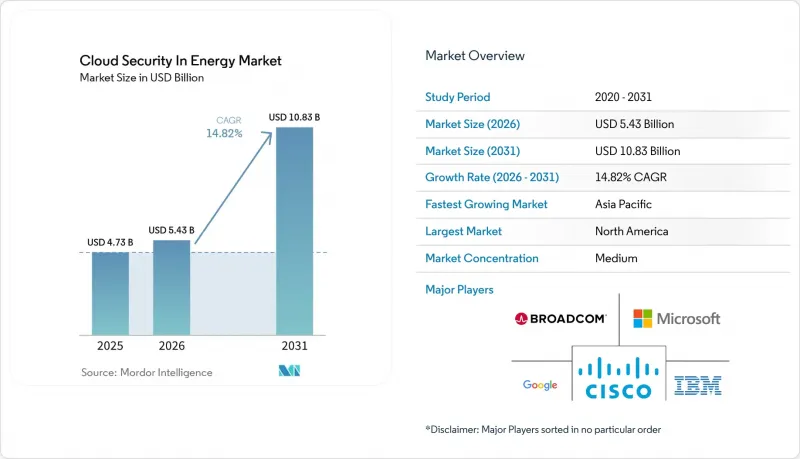
本報告按解決方案類型(例如身分和存取管理、預防資料外泄)、安全性類型(例如應用程式安全)、服務模式(例如基礎設施即服務、平台即服務、軟體即服務)、部署類型(例如公共雲端、私有雲端、混合雲端)和地區進行細分。市場預測以美元計價。
全球雲端安全市場趨勢及能源產業洞察
網路威脅日益增加
2024年,勒索軟體和國家支持的網路攻擊激增,北美公共產業和管道遭受了47起重大攻擊事件,年增38%。攻擊者利用了傳統SCADA資產和雲端分析平台之間的漏洞,因為許多終端仍然缺乏多因素身份驗證。網路安全和基礎設施安全局(CISA)等機構報告了一些持續多年的入侵事件,例如“Volt Typhoon”,這些事件在關鍵基礎設施中長達五年都未被發現。公共產業現在優先部署能夠收集營運技術(OT)遙測資料並將其與身分資料交叉比對的平台,以便在物理損壞發生之前偵測到異常斷路器指令。這種需求正在推動安全資訊和事件管理(SIEM)的普及,將平均回應時間從數小時縮短到數分鐘。
在整個供應鏈中擴大物聯網的應用
根據國際能源總署 (IEA) 的數據,到 2024 年,全球能源領域將有 25 億台連網設備運作,預計到 2028 年這一數字將超過 40 億。管道、變壓器和海上風力發電機等設備會持續產生遙測數據,這些數據必須透過公共網路安全傳輸。每個未受管理的感測器都會增加一個新的攻擊面。例如,2024 年的 Mirai 變種病毒就曾在分散式阻斷服務 (DDoS) 攻擊中導致超過 18 萬台能源相關設備癱瘓。營運商現在強制要求對設備進行身份驗證、對傳輸中的資料進行加密,並在網路邊緣執行策略,同時投資於能夠大規模部署和保護數百萬個現場感測器的雲端平台。這些控制措施也有助於預測性維護計畫的實施,從而提高運作並減少現場維護次數。
OT領域缺乏熟練的雲端安全專業人員
根據美國能源局,截至2024年,68%的美國公用事業公司缺乏同時精通工業協議和雲端控制的人員。這種人才短缺導致公用事業公司更加依賴託管服務供應商,但許多外部團隊缺乏實現零停機環境所需的營運經驗。亞太地區也面臨類似的人才短缺問題。光是在印度,到2030年就需要新增15,000名營運技術(OT)安全專業人員。雖然公用事業公司正在增加檢測和回應操作的外包,但第三方存取權限會擴大信任鏈,並需要嚴格的合約監管,最終在短期內限制部署速度。
細分市場分析
該細分市場展現出最強勁的成長前景,其中安全資訊和事件管理 (SIEM) 工具預計將以 15.96% 的複合年成長率 (CAGR) 成長。這一成長速度反映了該產業正從獨立防火牆轉向整合防火牆日誌、監控與資料擷取 (SCADA) 警報和身分訊號的分析解決方案。即使到了 2025 年,身分和存取管理 (IAM) 仍將佔據 24.78% 的收入佔有率,凸顯了對基礎憑證管理的持續需求。隨著公用事業公司採用現成的關聯分析套件來偵測未經授權的斷路器跳脫和渦輪機停機指令,預計到 2031 年,能源產業安全資訊和事件管理 (SIEM) 解決方案的雲端安全市場規模將翻倍。 Splunk 和 IBM 等供應商透過整合能源產業特有的規則,將事件調查週期縮短至幾分鐘。
對預防資料外泄(DLP)、入侵偵測系統 (IDS) 和加密的安全投資完善了整個解決方案體系。在上游油氣產業,DLP 保護著價值數十億美元的地震探勘模型,並防止因儲存桶配置錯誤而導致的意外預防資料外泄外洩。基於營運技術的 IDS 現在可以檢查 Modbus 和 DNP3 流量,以偵測對暫存器的異常寫入。從邊緣到雲端的加密仍然至關重要,公共產業正在更新其庫,以符合 2024 年制定的後量子密碼標準。總而言之,這些工具支援多層防禦,能夠在不增加人員的情況下應對不斷升級的威脅。
隨著公共產業將其單體式監控與資料擷取 (SCADA) 人機介面升級為微服務架構,應用安全預計將成長 17.28%。網路安全在 2025 年將保持 34.68% 的市場佔有率,但隨著安全措施的重點從邊界轉向應用程式介面 (API) 閘道器和服務網格,其佔有率將會下降。應用安全在能源產業的雲端安全市場中佔有率正在不斷擴大。這是因為所有分散式能源資源聚合器都透過應用程式介面 (API) 呼叫進行連接,而速率限制、輸入清理和 OAuth 身份驗證是強制性的。開放式 Web 應用程式安全專案 (OWASP) 已將物件級身分驗證漏洞確定為 2024 年的最大風險,這對於在動態端點上分配電力的電網營運商來說是一個嚴重的問題。
資料庫、終端和電子郵件控制措施完善了這項進展。資料庫安全保護交易平台,因為毫秒級的延遲可能意味著盈虧之別;而令牌化和字段級加密則保護著敏感的競標資訊。終端的增強型偵測與回應 (EDR) 功能可在資料外洩發生之前偵測到現場技術人員的異常行為。電子郵件閘道可阻止魚叉式網路釣魚攻擊,根據網路安全和基礎設施安全局 (CISA) 估計,到 2024 年,此類攻擊將佔資料外洩事件的 62%。這些層層防護共同強化了圍繞所有資產、身分和工作負荷的零信任邊界。
區域分析
預計到2025年,北美將佔據39.72%的市場。這主要得益於北美電力可靠性公司(NERC)的關鍵基礎設施保護條例和聯邦政府的撥款。 2024年,美國能源局撥款35億美元用於電網現代化改造,但前提是必須採取先進的網路安全措施。加拿大也發布了類似的指南,而在墨西哥,市場自由化促使新計畫從一開始就採用零信任架構。該地區的電力運營商高度依賴安全資訊和事件管理(SIEM)以及識別及存取管理(IAM)解決方案來滿足審計標準,而超大規模資料中心的出現正在加速這些技術的應用。儘管該地區網路安全技術已高度成熟,但仍容易受到勒索軟體的攻擊,這也持續推動該地區的大量投資。
亞太地區預計將以16.32%的速度成長,成為各區域中成長最快的。中國計劃在2030年實現1,200吉瓦可再生能源裝置容量,這項目標正在推動雲端運算的廣泛應用,例如國家電網計畫於2024年部署雲端運算服務,涵蓋11億用戶。印度的「智慧電網計畫」和日本的韌性策略正在提升對混合雲端的需求,這種混合雲能夠將本地部署的自主性和突發容量相結合。在澳大利亞,所有市場參與企業都必須採用多因素身份驗證和加密通訊,這進一步增加了安全預算。然而,技能短缺阻礙了這一進程,迫使公共產業轉向託管服務。
其餘地區包括歐洲、南美洲以及中東和非洲。在歐洲,NIS2 和《網路彈性法案》實施了最嚴格的合規框架,強制公共產業實施持續監控。德國的能源轉型(Energiewende)正在創造超過 200 萬個分散式能源資源,這需要安全的接觸。巴西 2024 年的決議強制要求每年穿透測試並實施安全資訊和事件管理 (SIEM)。在中東,沙烏地阿拉伯的 NEOM 等大型企劃從設計階段就要求雲端原生營運技術的安全性。非洲國家正在部署具有整合控制功能的太陽能微電網,從而避免傳統的技術債務,並為雲端優先架構鋪平道路。
其他好處:
- Excel格式的市場預測(ME)表
- 3個月的分析師支持
目錄
第1章:引言
- 研究假設和市場定義
- 調查範圍
第2章:調查方法
第3章執行摘要
第4章 市場狀況
- 市場概覽
- 市場促進因素
- 在整個供應鏈中擴大物聯網的應用
- 網路威脅日益增加
- 智慧電網與分散式能源資源融合進展
- 加強對關鍵基礎設施中零信任架構的監管要求。
- 專注於能源領域的雲端原生OT安全平台的興起
- 降低由 5G 專用網路支援的安全邊緣到雲端連接解決方案的成本。
- 市場限制因素
- 與現有架構的整合
- 營運技術領域缺乏熟練的雲端安全專業人員
- 對主權雲端合規性和資料居住要求的限制
- 維持持續的雲端安全態勢成本高昂,這是一個公認的問題。
- 產業價值鏈分析
- 監理情勢
- 技術展望
- 波特五力分析
- 宏觀經濟因素對市場的影響
第5章 市場規模與成長預測
- 按解決方案類型
- 身分和存取管理
- 預防資料外泄
- IDS 或 IPS
- 安全資訊和事件管理
- 加密
- 其他解決方案類型
- 按安全類型
- 應用程式安全
- 資料庫安全
- 端點安全
- 網路安全
- 網路和電子郵件安全
- 其他安全類型
- 按服務模式
- Infrastructure-as-a-Service
- Platform-as-a-Service
- Software-as-a-Service
- 依部署類型
- 公共雲端
- 私有雲端
- 混合雲端
- 按地區
- 北美洲
- 美國
- 加拿大
- 墨西哥
- 南美洲
- 巴西
- 阿根廷
- 其他南美國家
- 歐洲
- 英國
- 德國
- 法國
- 義大利
- 西班牙
- 俄羅斯
- 其他歐洲國家
- 亞太地區
- 中國
- 日本
- 印度
- 韓國
- 澳洲
- 其他亞太國家
- 中東
- 沙烏地阿拉伯
- 阿拉伯聯合大公國
- 土耳其
- 其他中東國家
- 非洲
- 南非
- 奈及利亞
- 埃及
- 其他非洲國家
- 北美洲
第6章 競爭情勢
- 市場集中度
- 策略趨勢
- 市佔率分析
- 公司簡介
- Amazon Web Services Inc.
- Microsoft Corporation
- IBM Corporation
- Cisco Systems Inc.
- Palo Alto Networks Inc.
- Fortinet Inc.
- Check Point Software Technologies Ltd.
- Trend Micro Incorporated
- McAfee Corp.
- Broadcom Inc.
- Google LLC
- Dell Technologies Inc.
- Zscaler Inc.
- Tenable Holdings Inc.
- Qualys Inc.
- Rapid7 Inc.
- Netskope Inc.
- CrowdStrike Holdings Inc.
- Okta Inc.
- Imperva Inc.
- Darktrace plc
- Nozomi Networks Inc.
- Dragos Inc.
- Claroty Ltd.
- Schneider Electric SE
- Siemens AG
第7章 市場機會與未來展望
According to Mordor Intelligence, the cloud security in energy market size is expected to increase from USD 4.73 billion in 2025 to USD 5.43 billion in 2026 and reach USD 10.83 billion by 2031, growing at a CAGR of 14.82% over 2026-2031.
This report is Segmented by Solution Type (Identity and Access Management, Data Loss Prevention, and More), Security Type (Application Security, and More), Service Model (Infrastructure-As-A-Service, Platform-As-A-Service, and Software-As-A-Service), Deployment Type (Public Cloud, Private Cloud, and Hybrid Cloud), and Geography. Market Forecasts are Provided in Terms of Value (USD).
Global Cloud Security In Energy Market Trends and Insights
Increasing Number of Cyber Threats
Ransomware and state-sponsored campaigns surged in 2024, with 47 major incidents targeting North American utilities and pipelines, a 38% jump from the prior year. Attackers exploit gaps between legacy supervisory control and data acquisition assets and cloud analytics platforms, a seam where multi-factor authentication is still absent on many endpoints. Agencies such as the Cybersecurity and Infrastructure Security Agency have documented multi-year intrusions, like Volt Typhoon, that remained undetected in critical infrastructure for up to five years. Utilities now prioritize platforms that ingest operational technology telemetry, correlate it with identity data, and spot anomalous breaker commands before physical damage occurs. This demand is driving the adoption of Security Information and Event Management, reducing the mean time to detect and respond from hours to minutes.
Increasing Adoption of IoT Across the Supply Chain
The International Energy Agency reported 2.5 billion connected devices in global energy operations as of 2024, and the total is expected to exceed 4 billion by 2028. Pipelines, transformers, and offshore turbines generate constant telemetry that must be transmitted securely over public networks. Each unmanaged sensor introduces a new attack surface, as illustrated by the 2024 Mirai variant, which co-opted 180,000 energy devices in a distributed denial-of-service attack. Operators now insist on device attestation, encrypted data-in-transit, and policy enforcement at the edge, channeling funds toward cloud platforms capable of onboarding and securing millions of field sensors at scale. These controls also support predictive maintenance programs that boost uptime and reduce truck rolls.
Shortage of Skilled Cloud Security Professionals in Operational Technology
In 2024, 68% of U.S. electric utilities lacked personnel fluent in both industrial protocols and cloud controls, according to the Department of Energy. The talent gap necessitates a heavier reliance on managed service providers, yet many external teams lack the operational experience necessary for zero-downtime environments. Asia Pacific faces similar deficits: India alone needs 15,000 additional operational technology security specialists by 2030. Utilities increasingly outsource detection and response, but third-party access expands the chain of trust and mandates rigorous contract oversight, ultimately constraining near-term adoption velocity.
Other drivers and restraints analyzed in the detailed report include:
- Rising Integration of Smart Grid and Distributed Energy Resources
- Growing Regulatory Mandates for Zero-Trust Architectures in Critical Infrastructure
- Sovereign Cloud Compliance and Data Residency Constraints
For complete list of drivers and restraints, kindly check the Table Of Contents.
Segment Analysis
The segment generated the strongest growth outlook, with Security Information and Event Management tools forecast to expand at a 15.96% CAGR. This pace reflects the sector's shift from standalone firewalls to analytics that integrate firewall logs, supervisory control and data acquisition alarms, and identity signals. Identity and Access Management still held 24.78% revenue share in 2025, underscoring the continuing need for foundational credential controls. The cloud security in energy market size for Security Information and Event Management solutions is set to double by 2031 as utilities adopt pre-built correlation packs that flag unauthorized breaker trips or turbine shutdown commands. Vendors such as Splunk and IBM integrate energy-specific rules, compressing incident investigation cycles to minutes.
Security spending on Data Loss Prevention, Intrusion Detection Systems, and Encryption rounds out the solution stack. In upstream oil and gas, Data Loss Prevention protects seismic models valued at billions, preventing inadvertent exposure via misconfigured storage buckets. Operational technology-aware Intrusion Detection Systems now inspect Modbus and DNP3 traffic for abnormal register writes. Encryption remains mandatory for edge-to-cloud pathways: utilities are refreshing libraries to align with post-quantum standards finalized in 2024. Collectively, these tools underpin a defense-in-depth posture that can handle the heightened threat tempo without increasing headcount.
Application Security is projected to grow at 17.28% as utilities modernize monolithic supervisory control and data acquisition human-machine interfaces into microservices. While Network Security retained a 34.68% share in 2025, its share is being diluted as enforcement shifts from the perimeter to application programming interface (API) gateways and service meshes. The cloud security in energy sector market share for Application Security is widening because every distributed energy resource aggregator connects through application programming interface (API) calls that must be rate-limited, input-sanitized, and OAuth-authenticated. The Open Web Application Security Project ranked broken object-level authorization as the top risk for 2024, an acute concern for grid operators that dispatch power across dynamic endpoints.
Database, Endpoint, and Email controls complement this progression. Database Security protects trading desks where millisecond latency drives profit; tokenization and field-level encryption defend sensitive bids. Extended detection and response on endpoints detects anomalous field engineer behavior before data exfiltration occurs. Email gateways block spear-phishing campaigns, which, according to the Cybersecurity and Infrastructure Security Agency, accounted for 62% of breaches in 2024. Together, these layers tighten the zero-trust perimeter around every asset, identity, and workload.
Geography Analysis
North America held a 39.72% share in 2025, propelled by the North American Electric Reliability Corporation's Critical Infrastructure Protection regulations and federal funding. The U.S. Department of Energy allocated USD 3.5 billion in 2024 for grid modernization, stipulating advanced cybersecurity controls. Canada followed with a similar mandate, and Mexico's market liberalization led to greenfield deployments that adopted zero-trust from day one. Utilities in the region heavily rely on Security Information and Event Management (SIEM) and Identity and Access Management (IAM) solutions to meet audit benchmarks, and the presence of hyperscale data centers accelerates the adoption of these technologies. Despite its maturity, the region remains vulnerable to ransomware, which continues to drive high investment levels.
Asia Pacific is forecast to grow at 16.32%, the fastest regional pace. China's plan to achieve 1,200 gigawatts of renewable energy by 2030 drives massive cloud adoption, exemplified by State Grid's 2024 deployment, which covers 1.1 billion customers. India's Smart Grid Mission and Japan's resilience agenda are bolstering demand for hybrid cloud, which combines on-premises sovereignty with burst capacity. Australia mandates multi-factor authentication and encrypted links for all market participants, further lifting security budgets. Skills shortages, however, pose a brake, pushing utilities toward managed services.
Europe, South America, the Middle East, and Africa form the remainder. Europe enforces the toughest compliance regime under the NIS2 and the Cyber Resilience Act, prompting utilities to adopt continuous monitoring. Germany's Energiewende created over 2 million distributed energy resources, demanding secure onboarding. Brazil's 2024 resolution requires annual penetration tests and the deployment of Security Information and Event Management (SIEM). In the Middle East, megaprojects such as NEOM in Saudi Arabia specify cloud-native operational technology security from the blueprint stage. African nations are deploying solar mini-grids with embedded controls, thereby bypassing legacy technical debt and opening direct paths to cloud-first architectures.
- Amazon Web Services Inc.
- Microsoft Corporation
- IBM Corporation
- Cisco Systems Inc.
- Palo Alto Networks Inc.
- Fortinet Inc.
- Check Point Software Technologies Ltd.
- Trend Micro Incorporated
- McAfee Corp.
- Broadcom Inc.
- Google LLC
- Dell Technologies Inc.
- Zscaler Inc.
- Tenable Holdings Inc.
- Qualys Inc.
- Rapid7 Inc.
- Netskope Inc.
- CrowdStrike Holdings Inc.
- Okta Inc.
- Imperva Inc.
- Darktrace plc
- Nozomi Networks Inc.
- Dragos Inc.
- Claroty Ltd.
- Schneider Electric SE
- Siemens AG
Additional Benefits:
- The market estimate (ME) sheet in Excel format
- 3 months of analyst support
TABLE OF CONTENTS
1 INTRODUCTION
- 1.1 Study Assumptions and Market Definition
- 1.2 Scope of the Study
2 RESEARCH METHODOLOGY
3 EXECUTIVE SUMMARY
4 MARKET LANDSCAPE
- 4.1 Market Overview
- 4.2 Market Drivers
- 4.2.1 Increasing Adoption of IoT Across the Supply Chain
- 4.2.2 Increasing Number of Cyber Threats
- 4.2.3 Rising Integration of Smart Grid and Distributed Energy Resources
- 4.2.4 Growing Regulatory Mandates for Zero-Trust Architectures in Critical Infrastructure
- 4.2.5 Emergence of Cloud-Native Operational Technology Security Platforms Specific to Energy
- 4.2.6 Declining Costs of Edge-to-Cloud Secure Connectivity Solutions Enabled by 5G Private Networks
- 4.3 Market Restraints
- 4.3.1 Integration with Existing Architecture
- 4.3.2 Shortage of Skilled Cloud Security Professionals in Operational Technology
- 4.3.3 Sovereign Cloud Compliance and Data Residency Constraints
- 4.3.4 High Perceived Cost of Continuous Cloud Security Posture Management
- 4.4 Industry Value Chain Analysis
- 4.5 Regulatory Landscape
- 4.6 Technological Outlook
- 4.7 Porter's Five Forces Analysis
- 4.7.1 Threat of New Entrants
- 4.7.2 Bargaining Power of Buyers or Consumers
- 4.7.3 Bargaining Power of Suppliers
- 4.7.4 Threat of Substitute Products
- 4.7.5 Intensity of Competitive Rivalry
- 4.8 Impact of Macroeconomic Factors on the Market
5 MARKET SIZE AND GROWTH FORECASTS (VALUE)
- 5.1 By Solution Type
- 5.1.1 Identity and Access Management
- 5.1.2 Data Loss Prevention
- 5.1.3 IDS or IPS
- 5.1.4 Security Information and Event Management
- 5.1.5 Encryption
- 5.1.6 Other Solution Type
- 5.2 By Security Type
- 5.2.1 Application Security
- 5.2.2 Database Security
- 5.2.3 Endpoint Security
- 5.2.4 Network Security
- 5.2.5 Web and Email Security
- 5.2.6 Other Security Type
- 5.3 By Service Model
- 5.3.1 Infrastructure-as-a-Service
- 5.3.2 Platform-as-a-Service
- 5.3.3 Software-as-a-Service
- 5.4 By Deployment Type
- 5.4.1 Public Cloud
- 5.4.2 Private Cloud
- 5.4.3 Hybrid Cloud
- 5.5 By Geography
- 5.5.1 North America
- 5.5.1.1 United States
- 5.5.1.2 Canada
- 5.5.1.3 Mexico
- 5.5.2 South America
- 5.5.2.1 Brazil
- 5.5.2.2 Argentina
- 5.5.2.3 Rest of South America
- 5.5.3 Europe
- 5.5.3.1 United Kingdom
- 5.5.3.2 Germany
- 5.5.3.3 France
- 5.5.3.4 Italy
- 5.5.3.5 Spain
- 5.5.3.6 Russia
- 5.5.3.7 Rest of Europe
- 5.5.4 Asia Pacific
- 5.5.4.1 China
- 5.5.4.2 Japan
- 5.5.4.3 India
- 5.5.4.4 South Korea
- 5.5.4.5 Australia
- 5.5.4.6 Rest of Asia Pacific
- 5.5.5 Middle East
- 5.5.5.1 Saudi Arabia
- 5.5.5.2 United Arab Emirates
- 5.5.5.3 Turkey
- 5.5.5.4 Rest of Middle East
- 5.5.6 Africa
- 5.5.6.1 South Africa
- 5.5.6.2 Nigeria
- 5.5.6.3 Egypt
- 5.5.6.4 Rest of Africa
- 5.5.1 North America
6 COMPETITIVE LANDSCAPE
- 6.1 Market Concentration
- 6.2 Strategic Moves
- 6.3 Market Share Analysis
- 6.4 Company Profiles (includes Global Level Overview, Market Level Overview, Core Segments, Financials as Available, Strategic Information, Market Rank or Share for Key Companies, Products and Services, and Recent Developments)
- 6.4.1 Amazon Web Services Inc.
- 6.4.2 Microsoft Corporation
- 6.4.3 IBM Corporation
- 6.4.4 Cisco Systems Inc.
- 6.4.5 Palo Alto Networks Inc.
- 6.4.6 Fortinet Inc.
- 6.4.7 Check Point Software Technologies Ltd.
- 6.4.8 Trend Micro Incorporated
- 6.4.9 McAfee Corp.
- 6.4.10 Broadcom Inc.
- 6.4.11 Google LLC
- 6.4.12 Dell Technologies Inc.
- 6.4.13 Zscaler Inc.
- 6.4.14 Tenable Holdings Inc.
- 6.4.15 Qualys Inc.
- 6.4.16 Rapid7 Inc.
- 6.4.17 Netskope Inc.
- 6.4.18 CrowdStrike Holdings Inc.
- 6.4.19 Okta Inc.
- 6.4.20 Imperva Inc.
- 6.4.21 Darktrace plc
- 6.4.22 Nozomi Networks Inc.
- 6.4.23 Dragos Inc.
- 6.4.24 Claroty Ltd.
- 6.4.25 Schneider Electric SE
- 6.4.26 Siemens AG
7 MARKET OPPORTUNITIES AND FUTURE OUTLOOK
- 7.1 White-Space and Unmet-Need Assessment

 2026年全球國防雲市場報告
 銀行業雲端安全:市場佔有率分析、產業趨勢與統計及成長預測(2026-2031 年)雲端安全軟體:市場佔有率分析、產業趨勢與統計、成長預測(2026-2031)製造業雲端安全:市場佔有率分析、產業趨勢與統計及成長預測(2026-2031 年)
 雲端安全市場預測至 2034 年—按組件、部署模式、組織規模、安全類型、產業和地區分類的全球分析
 雲端安全市場:2026-2032年全球市場預測(依產品、服務模式、安全類型、部署模式、產業及組織規模分類)
 2026-2034年全球雲端安全市場規模、佔有率、趨勢和成長分析報告
 雲端安全市場規模、佔有率和趨勢分析報告:按組件、部署類型、企業規模、最終用途、地區和細分市場預測(2026-2033 年)
 雲端原生安全平台市場:按組件、組織規模、應用、安全類型、國家及地區分類-全球產業分析、市場規模、市場佔有率及2026年至2033年預測
 全球雲端安全市場(至 2031 年):按類型(CNAPP(CWPP、CSPM、CIEM、CDR、KSPM、IAC 安全)、CASB、分析與監控)、部署類型(私人、公有、混合)和產業(醫療保健、零售與電子商務、媒體與娛樂)分類