


 |
市場調查報告書
商品編碼
2113313
製造業雲端安全:市場佔有率分析、產業趨勢與統計及成長預測(2026-2031 年)Cloud Security In Manufacturing Industry - Market Share Analysis, Industry Trends & Statistics, Growth Forecasts (2026 - 2031) |
||||||

※ 本網頁內容可能與最新版本有所差異。詳細情況請與我們聯繫。
預計製造業雲端安全市場規模將從 2025 年的 24.2 億美元成長到 2026 年的 27.1 億美元,然後在 2031 年達到 48.2 億美元,2026 年至 2031 年的複合年成長率為 12.18%。
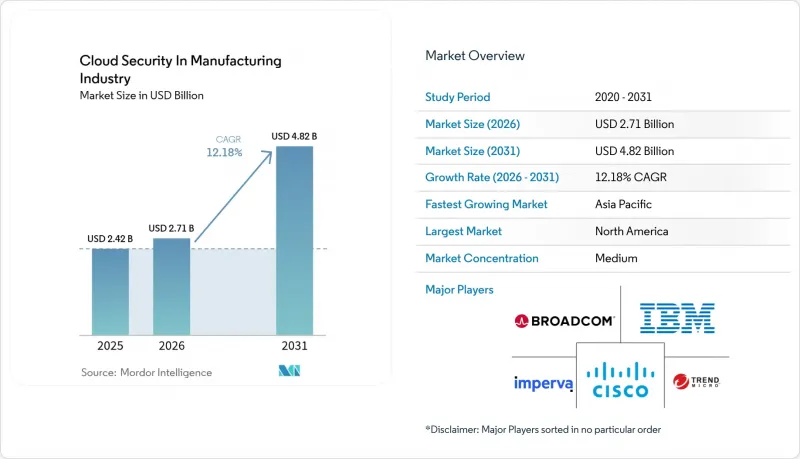
本報告按解決方案(例如身分和存取管理 (IAM))、安全類型(例如應用安全)、服務模式(例如 SaaS 安全)、部署模式(例如公共雲端)、組織規模(大型企業和中小企業)以及地區(例如北美)進行分類。市場預測以美元計價。
製造業雲端安全趨勢與洞察
多重雲端環境的複雜性迅速增加,正在擴大攻擊面。
目前,製造商普遍使用AWS、Azure和Google Cloud三大雲端平台,其中95%的製造商至少使用兩家雲端服務供應商。將這些環境與傳統現場系統連接起來,會增加威脅入口,並使合規性更加複雜。大量預算正被投入到能夠解讀IT和OT遙測資料的整合式雲端安全平台。市場對無需代理、運行時感知的控制功能的需求日益成長,這些功能能夠在不中斷生產的情況下保護可程式邏輯控制器(PLC)。能夠簡化跨異質環境策略編配的供應商正在獲得明顯的優勢。
監管要求正在加速安保支出。
歐盟NIS2指令和美國CMMC二級要求的實施,即時需要對監控、事件報告和供應鏈保障進行升級。製造商正在投資FedRAMP認證服務和自動化合規工具,以避免合約條款中的例外。印度和日本的類似法規增加了複雜性,並推動了區域託管主權雲的採用,以實現敏感資料的在地化。由於實施週期短,合規性正從管治挑戰轉變為預算分配的主要促進因素。
未管理的機器 ID 導致的“ID 責任”
儘管工廠環境中物聯網感測器、機器人和邊緣閘道的數量如今已超過人員數量,但75%的企業仍缺乏身分驗證生命週期管理。過期的憑證和硬編碼的密鑰會成為攻擊者的隱藏入口。將零信任擴展到數百萬非人類身分需要自動化的偵測、輪調和撤銷工作流程,而許多工廠仍然缺乏這些流程,這阻礙了先進雲端服務的即時普及。
細分市場分析
到2025年,身分與存取管理(IAM)將佔製造業雲端安全市場37.10%的佔有率,這反映出對所有使用者和機器的會話進行嚴格管理的迫切需求。製造商正在將特權存取控制庫與零信任分段結合,以遏制橫向移動。現代IAM架構整合了機器人和積層製造印表機的憑證授權機構,從而統一了IT和OT領域的策略。預防資料外泄(DLP)正以12.37%的複合年成長率成長,隨著受出口管制的設計文件在CAD系統和合約組裝之間交換,其重要性日益凸顯。進階DLP能夠對設計圖面進行分類,並防止因異常高峰導致的資料洩露,從而應對日益嚴重的智慧財產權(IP)竊盜問題。
微隔離功能透過將動態策略綁定到 Kubernetes 叢集中為生產線提供資料的工作負載,增強了身分識別和存取管理 (IAM) 能力。利用即時風險評分的條件存取機制,可在懷疑系統遭到入侵時限制憑證的使用,從而提高抵禦勒索軟體攻擊的能力。同時,隨著量子運算演算法進入試點階段,加密和金鑰管理模組的重要性日益凸顯。這些趨勢共同推動製造業雲端安全繼續專注於以身分為中心的控制措施,這些措施能夠擴展到數百萬個終端,同時確保運作。
至2025年,應用安全將佔製造業雲端安全市場的37.75%。這主要是由於製造業將其MES和PLM工作負載遷移到託管在公共雲端上的容器中。運行時保護、軟體配置分析和API閘道器構成了核心防禦層。網路安全預計將以每年12.62%的速度成長,這主要得益於對透過SD-WAN連結進出雲端資料湖的OT流量進行東西向偵測。製造商正在應用針對Modbus和OPC UA協議最佳化的深層封包檢測,以防止命令欺騙。
利用 5G 專用網路的邊緣部署進一步提升了對微型防火牆和零信任網路存取的需求。雖然資料庫、終端和電子郵件安全部署正在穩步推進,但額外的投資正集中於網路偵測和回應引擎,這些引擎能夠將流量異常與應用程式日誌關聯起來。這一趨勢凸顯了製造業雲端安全如何日益將應用層和網路層視為由單一策略引擎管理的統一架構。
區域分析
到2025年,北美將佔據製造業雲端安全市場38.20%的佔有率。這主要得益於國防承包商對CMMC的嚴格執行,以及數十億美元的聯邦項目,例如耗資56億美元的「任務夥伴環境」(Mission Partner Environment)。美國汽車和航太產業的領導者要求一級供應商證明其零信任架構的實施,這正在推動平台標準化。加拿大CPCSC將於2025年冬季開始推出符合NIST標準的跨國組件認證,進一步鞏固其區域領先地位。
在歐洲,NIS2 指令正在加速這一進程,該指令強制要求製造企業在 2025 年前實施事件監控、風險管理和供應鏈安全。德國、法國和英國正在大力投資由本地電信業者管理的獨立雲端區域,以符合 GDPR 的資料管治規定和即將訂定的《人工智慧法案》。隨著企業適應各國不同的指南,對能夠提供跨國工廠風險可視性的整合式儀錶板的需求日益成長。
亞太地區以12.88%的複合年成長率 (CAGR) 領跑,這主要得益於各國「工業4.0」舉措的推進以及在引人注目的運營技術 (OT) 攻擊事件後人們安全意識的提高。在中國、印度和日本,智慧工廠補貼和更嚴格的資料在地化要求正在推動混合架構的普及,這些架構將遙測資料保留在國內。該地區的製造商對人工智慧驅動的威脅狩獵表現出濃厚的興趣。 77%的製造商在其數位化藍圖中優先考慮網路安全,67%的製造商將雲端平台安全列為三大投資項目之一。針對多語言員工群體量身定做的「主權雲」和「責任共擔」指導方針,正在幫助供應商在亞太市場脫穎而出,贏得市場佔有率。
其他好處:
- Excel格式的市場預測(ME)表
- 3個月的分析師支持
目錄
第1章:引言
- 研究假設和市場定義
- 調查範圍
第2章:調查方法
第3章執行摘要
第4章 市場狀況
- 市場概覽
- 市場促進因素
- 多重雲端環境日益複雜,攻擊面也迅速擴大。
- 監管義務正在加速安保相關支出。
- 利用人工智慧進行自主維修可以縮短平均修復時間。
- 雲端原生應用程式防護平台(CNAPP)整合浪潮
- API帶來的經濟影響正在推高安全預算。
- 在超大規模資料中心業者試點實施抗量子加密
- 市場限制因素
- 因未管理的機器 ID 而產生的身份相關責任
- 具備雲端技術專長的安全工程師短缺
- 跨境資料主權方面的摩擦導致實施進程延誤。
- 隱藏的出口流量費用正在推高安全雲端架構的總擁有成本。
- 產業價值鏈分析
- 監理情勢
- 技術展望
- 波特五力分析
- 評估宏觀經濟趨勢對市場的影響
第5章 市場規模與成長預測
- 透過解決方案
- 身分和存取管理 (IAM)
- 預防資料外泄(DLP)
- 安全資訊和事件管理 (SIEM)
- 加密和金鑰管理
- 其他解決方案
- 按安全類型
- 應用程式安全
- 資料庫安全
- 端點安全
- 網路安全
- 網路和電子郵件安全
- 按服務模式
- SaaS 安全
- PaaS 安全性
- IaaS 安全
- 按部署模式
- 公共雲端
- 私有雲端
- 混合/多重雲端
- 按組織規模
- 大公司
- 中小企業
- 按地區
- 北美洲
- 美國
- 加拿大
- 墨西哥
- 歐洲
- 德國
- 英國
- 法國
- 義大利
- 西班牙
- 其他歐洲國家
- 亞太地區
- 中國
- 日本
- 印度
- 韓國
- 澳洲
- 其他亞太國家
- 南美洲
- 巴西
- 阿根廷
- 其他南美國家
- 中東和非洲
- 中東
- 沙烏地阿拉伯
- 阿拉伯聯合大公國
- 土耳其
- 其他中東國家
- 非洲
- 南非
- 埃及
- 奈及利亞
- 其他非洲國家
- 中東
- 北美洲
第6章 競爭情勢
- 市場集中度
- 策略趨勢
- 市佔率分析
- 公司簡介
- Palo Alto Networks Inc.
- Microsoft Corp.
- Cisco Systems Inc.
- Fortinet Inc.
- Check Point Software Tech. Ltd.
- Trend Micro Inc.
- IBM Corp.
- Broadcom Inc.(Symantec)
- Zscaler Inc.
- CrowdStrike Holdings Inc.
- Imperva Inc.
- McAfee LLC
- Sophos Ltd.
- Qualys Inc.
- Amazon Web Services(AWS)
- Google Cloud Security
- Cloudflare Inc.
- Okta Inc.
- Wiz Inc.
- Oracle Corp.
第7章 市場機會與未來展望
According to Mordor Intelligence, the cloud security in manufacturing industry market size is expected to grow from USD 2.42 billion in 2025 to USD 2.71 billion in 2026 and is forecast to reach USD 4.82 billion by 2031 at 12.18% CAGR over 2026-2031.
This report is Segmented by Solution (Identity and Access Management (IAM), and More), Security Type (Application Security, and More), Service Model (SaaS Security, and More), Deployment Model (Public Cloud, and More), Organization Size (Large Enterprises and Small and Medium Enterprises), and Geography (North America, and More). The Market Forecasts are Provided in Terms of Value (USD).
Global Cloud Security In Manufacturing Industry Trends and Insights
Surging Multi-Cloud Complexity Elevating Attack Surface
Manufacturers now operate across AWS, Azure and Google Cloud, with 95% using at least two providers. Connecting these environments to legacy shop-floor systems multiplies threat entry points and complicates compliance alignment. Unified cloud security platforms that interpret both IT and OT telemetry command premium budgets. Demand is acute for agentless, runtime-aware controls that safeguard programmable logic controllers without disrupting production. Vendors that simplify policy orchestration across heterogeneous estates gain clear advantage.
Regulatory Mandates Accelerate Security Spend
Implementation of the EU NIS2 Directive and U.S. CMMC Level 2 obligations forces immediate upgrades to monitoring, incident reporting and supply-chain assurance. Manufacturers invest in FedRAMP-authorized services and automated compliance tooling to avoid contract exclusion. Similar rules in India and Japan magnify complexity, spurring adoption of regionally hosted sovereign clouds to localize sensitive data. Short deployment windows turn compliance from a governance task into a primary budget catalyst.
Identity Debt from Unmanaged Machine Identities
IoT sensors, robots and edge gateways outnumber humans on the factory floor, yet 75% of firms lack lifecycle oversight for their credentials. Stale certificates and hard-coded keys provide covert persistence paths for attackers. Scaling zero-trust to millions of non-human identities demands automated discovery, rotation and revocation workflows that many plants still lack, constraining immediate uptake of advanced cloud services.
Other drivers and restraints analyzed in the detailed report include:
- AI-Driven Autonomous Remediation Cutting MTTR
- Cloud-Native Application Protection Platform (CNAPP) Consolidation Wave
- Shortage of Cloud-Literate Security Engineers
For complete list of drivers and restraints, kindly check the Table Of Contents.
Segment Analysis
Identity and Access Management commanded 37.10% of the cloud security in manufacturing industry in 2025, reflecting the urgent need to gate every user and machine session. Manufacturers integrate privileged-access vaults with zero-trust segmentation to curb lateral movement. Modern IAM stacks embed certificate authorities for robots and additive printers, unifying policy across IT and OT. Data Loss Prevention, growing at a 12.37% CAGR, gains traction as export-controlled design files are exchanged between CAD systems and contract assemblers. Advanced DLP that classifies engineering blueprints and blocks exfiltration by anomaly peaks addresses rising IP theft.
Micro-segmentation features bolster IAM by binding dynamic policies to workloads in Kubernetes clusters that feed production lines. Conditional access using real-time risk scores throttles credentials during suspected compromise, lifting resilience against ransomware. Meanwhile, encryption and key-management modules gain relevance as quantum-ready algorithms enter pilots. Collectively, these trends keep the cloud security in manufacturing industry focused on identity-centric controls that can scale to millions of endpoints without impairing uptime.
Application Security held a 37.75% share of the cloud security in manufacturing industry in 2025 as industrial firms re-platform MES and PLM workloads into containers hosted in public clouds. Runtime protection, software-composition analysis and API gateways form core defense layers. Network Security is projected to grow 12.62% annually, driven by east-west inspection for OT traffic traversing SD-WAN links to cloud data lakes. Manufacturers apply deep-packet inspection tuned for Modbus and OPC UA protocols to thwart command spoofing.
Edge rollouts that leverage 5G private networks further elevate demand for micro-firewalls and zero-trust network access. Database, endpoint and email security maintain steady uptake, yet incremental spending converges on network detection-and-response engines that correlate traffic anomalies with application logs. This convergence underscores how the cloud security in manufacturing industry is increasingly treating the application and network layers as a single, unified fabric governed by a single policy engine.
Complete Report Scope:
- By Solution
- Identity and Access Management (IAM)
- Data Loss Prevention (DLP)
- Security Information and Event Management (SIEM)
- Encryption and Key Management
- Other Solutions
- By Security Type
- Application Security
- Database Security
- Endpoint Security
- Network Security
- Web and Email Security
- By Service Model
- SaaS Security
- PaaS Security
- IaaS Security
- By Deployment Model
- Public Cloud
- Private Cloud
- Hybrid / Multi-Cloud
- By Organization Size
- Large Enterprises
- Small and Medium Enterprises (SMEs)
- By Geography
- North America
- United States
- Canada
- Mexico
- Europe
- Germany
- United Kingdom
- France
- Italy
- Spain
- Rest of Europe
- Asia-Pacific
- China
- Japan
- India
- South Korea
- Australia
- Rest of Asia-Pacific
- South America
- Brazil
- Argentina
- Rest of South America
- Middle East and Africa
- Middle East
- Saudi Arabia
- United Arab Emirates
- Turkey
- Rest of Middle East
- Africa
- South Africa
- Egypt
- Nigeria
- Rest of Africa
- Middle East
- North America
Geography Analysis
North America held 38.20% of the cloud security in manufacturing industry in 2025 due to strict CMMC enforcement on defense contractors and multi-billion-dollar federal programs such as the USD 5.6 billion Mission Partner Environment. U.S. automotive and aerospace primes demand proof of zero-trust adoption from tier-one suppliers, spurring platform standardization. Canada's CPCSC, effective winter 2025, introduces NIST-aligned certification for cross-border components, further reinforcing its regional leadership.
Europe accelerates on the back of the NIS2 Directive, compelling manufacturing firms to deploy incident monitoring, risk management, and supply-chain security by 2025. Germany, France, and the United Kingdom invest heavily in sovereign cloud zones managed by local telcos to comply with GDPR and upcoming AI Act data-governance clauses. Unified dashboards that map exposure across multinational plants are in demand as firms juggle varied national guidance.
Asia-Pacific records the fastest 12.88% CAGR, fuelled by national Industry 4.0 initiatives and rising awareness after headline OT attacks. China, India, and Japan combine smart-factory subsidies with stricter data-localization mandates, prompting hybrid architectures that keep telemetry onshore. Regional manufacturers show strong interest in AI-enabled threat hunting: 77% prioritise cybersecurity in digital roadmaps and 67% place cloud platform security among the top three investments. Sovereign clouds and shared-responsibility guidance tailored to multilingual workforces differentiate vendors seeking APAC market share.
- Palo Alto Networks Inc.
- Microsoft Corp.
- Cisco Systems Inc.
- Fortinet Inc.
- Check Point Software Tech. Ltd.
- Trend Micro Inc.
- IBM Corp.
- Broadcom Inc. (Symantec)
- Zscaler Inc.
- CrowdStrike Holdings Inc.
- Imperva Inc.
- McAfee LLC
- Sophos Ltd.
- Qualys Inc.
- Amazon Web Services (AWS)
- Google Cloud Security
- Cloudflare Inc.
- Okta Inc.
- Wiz Inc.
- Oracle Corp.
Additional Benefits:
- The market estimate (ME) sheet in Excel format
- 3 months of analyst support
TABLE OF CONTENTS
1 INTRODUCTION
- 1.1 Study Assumptions and Market Definition
- 1.2 Scope of the Study
2 RESEARCH METHODOLOGY
3 EXECUTIVE SUMMARY
4 MARKET LANDSCAPE
- 4.1 Market Overview
- 4.2 Market Drivers
- 4.2.1 Surging Multi-Cloud Complexity Elevating Attack Surface
- 4.2.2 Regulatory Mandates Accelerate Security Spend
- 4.2.3 AI-Driven Autonomous Remediation Cutting MTTR
- 4.2.4 Cloud-Native Application Protection Platform (CNAPP) Consolidation Wave
- 4.2.5 API Economy Exposure Driving Security Budgets
- 4.2.6 Quantum-Safe Encryption Pilots in Hyperscalers
- 4.3 Market Restraints
- 4.3.1 Identity Debt from Unmanaged Machine Identities
- 4.3.2 Shortage of Cloud-Literate Security Engineers
- 4.3.3 Cross-Border Data-Sovereignty Frictions Slow Roll-Outs
- 4.3.4 Hidden Egress Fees Inflate TCO of Secure Cloud Architectures
- 4.4 Industry Value Chain Analysis
- 4.5 Regulatory Landscape
- 4.6 Technological Outlook
- 4.7 Porter's Five Forces Analysis
- 4.7.1 Bargaining Power of Suppliers
- 4.7.2 Bargaining Power of Consumers
- 4.7.3 Threat of New Entrants
- 4.7.4 Threat of Substitute Products
- 4.7.5 Intensity of Competitive Rivalry
- 4.8 Assessment of the Impact of Macroeconomic Trends on the Market
5 MARKET SIZE AND GROWTH FORECASTS (VALUE)
- 5.1 By Solution
- 5.1.1 Identity and Access Management (IAM)
- 5.1.2 Data Loss Prevention (DLP)
- 5.1.3 Security Information and Event Management (SIEM)
- 5.1.4 Encryption and Key Management
- 5.1.5 Other Solutions
- 5.2 By Security Type
- 5.2.1 Application Security
- 5.2.2 Database Security
- 5.2.3 Endpoint Security
- 5.2.4 Network Security
- 5.2.5 Web and Email Security
- 5.3 By Service Model
- 5.3.1 SaaS Security
- 5.3.2 PaaS Security
- 5.3.3 IaaS Security
- 5.4 By Deployment Model
- 5.4.1 Public Cloud
- 5.4.2 Private Cloud
- 5.4.3 Hybrid / Multi-Cloud
- 5.5 By Organization Size
- 5.5.1 Large Enterprises
- 5.5.2 Small and Medium Enterprises (SMEs)
- 5.6 By Geography
- 5.6.1 North America
- 5.6.1.1 United States
- 5.6.1.2 Canada
- 5.6.1.3 Mexico
- 5.6.2 Europe
- 5.6.2.1 Germany
- 5.6.2.2 United Kingdom
- 5.6.2.3 France
- 5.6.2.4 Italy
- 5.6.2.5 Spain
- 5.6.2.6 Rest of Europe
- 5.6.3 Asia-Pacific
- 5.6.3.1 China
- 5.6.3.2 Japan
- 5.6.3.3 India
- 5.6.3.4 South Korea
- 5.6.3.5 Australia
- 5.6.3.6 Rest of Asia-Pacific
- 5.6.4 South America
- 5.6.4.1 Brazil
- 5.6.4.2 Argentina
- 5.6.4.3 Rest of South America
- 5.6.5 Middle East and Africa
- 5.6.5.1 Middle East
- 5.6.5.1.1 Saudi Arabia
- 5.6.5.1.2 United Arab Emirates
- 5.6.5.1.3 Turkey
- 5.6.5.1.4 Rest of Middle East
- 5.6.5.2 Africa
- 5.6.5.2.1 South Africa
- 5.6.5.2.2 Egypt
- 5.6.5.2.3 Nigeria
- 5.6.5.2.4 Rest of Africa
- 5.6.5.1 Middle East
- 5.6.1 North America
6 COMPETITIVE LANDSCAPE
- 6.1 Market Concentration
- 6.2 Strategic Moves
- 6.3 Market Share Analysis
- 6.4 Company Profiles (includes Global level Overview, Market level overview, Core Segments, Financials as available, Strategic Information, Market Rank/Share, Products and Services, Recent Developments)
- 6.4.1 Palo Alto Networks Inc.
- 6.4.2 Microsoft Corp.
- 6.4.3 Cisco Systems Inc.
- 6.4.4 Fortinet Inc.
- 6.4.5 Check Point Software Tech. Ltd.
- 6.4.6 Trend Micro Inc.
- 6.4.7 IBM Corp.
- 6.4.8 Broadcom Inc. (Symantec)
- 6.4.9 Zscaler Inc.
- 6.4.10 CrowdStrike Holdings Inc.
- 6.4.11 Imperva Inc.
- 6.4.12 McAfee LLC
- 6.4.13 Sophos Ltd.
- 6.4.14 Qualys Inc.
- 6.4.15 Amazon Web Services (AWS)
- 6.4.16 Google Cloud Security
- 6.4.17 Cloudflare Inc.
- 6.4.18 Okta Inc.
- 6.4.19 Wiz Inc.
- 6.4.20 Oracle Corp.
7 MARKET OPPORTUNITIES AND FUTURE OUTLOOK
- 7.1 White-Space and Unmet-Need Assessment

 2026年全球國防雲市場報告
 銀行業雲端安全:市場佔有率分析、產業趨勢與統計及成長預測(2026-2031 年)雲端安全軟體:市場佔有率分析、產業趨勢與統計、成長預測(2026-2031)
 雲端安全市場預測至 2034 年—按組件、部署模式、組織規模、安全類型、產業和地區分類的全球分析
 雲端安全市場:2026-2032年全球市場預測(依產品、服務模式、安全類型、部署模式、產業及組織規模分類)
 2026-2034年全球雲端安全市場規模、佔有率、趨勢和成長分析報告
 雲端安全市場規模、佔有率和趨勢分析報告:按組件、部署類型、企業規模、最終用途、地區和細分市場預測(2026-2033 年)能源產業雲端安全:市場佔有率分析、產業趨勢與統計及成長預測(2026-2031 年)
 雲端原生安全平台市場:按組件、組織規模、應用、安全類型、國家及地區分類-全球產業分析、市場規模、市場佔有率及2026年至2033年預測
 全球雲端安全市場(至 2031 年):按類型(CNAPP(CWPP、CSPM、CIEM、CDR、KSPM、IAC 安全)、CASB、分析與監控)、部署類型(私人、公有、混合)和產業(醫療保健、零售與電子商務、媒體與娛樂)分類