


 |
市場調查報告書
商品編碼
2038240
全球雲端安全市場(至 2031 年):按類型(CNAPP(CWPP、CSPM、CIEM、CDR、KSPM、IAC 安全)、CASB、分析與監控)、部署類型(私人、公有、混合)和產業(醫療保健、零售與電子商務、媒體與娛樂)分類Cloud Security Market by Type (CNAPP [CWPP, CSPM, CIEM, CDR, KSPM, IAC Security], CASB, Analytics and Monitoring), Deployment Mode (Private, Public, Hybrid), Vertical (Healthcare, Retail & E-commerce, Media & Entertainment) - Global Forecast to 2031 |
||||||


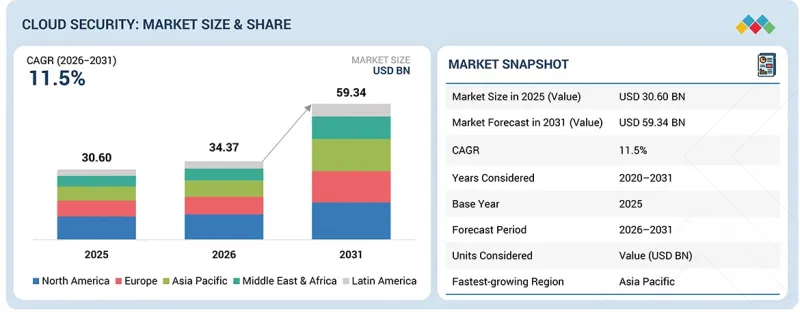
雲端安全市場預計將從 2026 年的 343.7 億美元成長到 2031 年的 593.4 億美元,複合年成長率為 11.5%。
隨著 DevSecOps 和雲端原生開發方法的興起,安全性被更早融入應用程式生命週期中,這增加了對能夠提供持續監控、自動化測試和即時糾正措施的工具的需求。
| 調查範圍 | |
|---|---|
| 調查期 | 2020-2031 |
| 基準年 | 2025 |
| 預測期 | 2026-2031 |
| 單元 | 金額(美元) |
| 部分 | 交付類別、類型、部署方式、組織規模、產業 |
| 目標區域 | 北美洲、歐洲、亞太地區、中東和非洲、拉丁美洲 |
同時,多重雲端和混合雲端環境的日益普及,推動了對統一安全平台的更大需求,以確保一致的可見性和策略執行。這些因素正在加速對統一雲端安全解決方案的投資,這些解決方案能夠保護動態工作負載並支援快速、可擴展的應用開發。
以服務產品細分市場來看,預計服務區隔市場在預測期內將錄得最高的成長率。
隨著企業越來越依賴外部專家來管理複雜多元的多重雲端環境和不斷變化的安全威脅情勢,雲端安全市場中的服務領域正蓬勃發展。企業正在尋求諮詢、整合和資安管理服務,以部署和最佳化 CNAPP、零信任和人工智慧驅動的安全解決方案等先進平台。
據 Palo Alto Networks 稱,預計到 2025 年,其相當一部分大型企業客戶將利用專業服務來加速採用 Prisma Cloud 和 Cortex 平台。 2024 年,IBM 強調了對資安管理服務日益成長的需求,因為各組織都在尋求解決技能差距並提高營運效率。
服務在協調組織的安全策略與監管要求和業務目標方面發揮著至關重要的作用。隨著混合雲和多重雲端環境日益複雜,持續監控、事件回應和合規管理至關重要,但許多公司更傾向於將這些工作外包。供應商正在擴展其服務範圍,將人工智慧驅動的威脅分析、自動化和主動風險管理納入其中。隨著網路威脅日益複雜,組織面臨熟練專業人員短缺的問題,對雲端保全服務的需求預計將保持強勁,從而推動先進安全平台的長期應用。
“按部署模式分類,預計到 2026 年,私有雲端細分市場將佔據最大的市場佔有率。”
私有雲端領域在雲端安全市場中仍然佔據重要佔有率,尤其是在監管嚴格的行業,因為企業優先考慮控制權、資料主權和合規性。處理敏感資料的公司通常依賴私有雲端環境與公共雲端服務整合,以實現可擴展性,同時確保嚴格的管治和安全控制。思科預測,到 2025 年,許多公司將繼續營運私有雲或混合雲端環境,凸顯了安全本地基礎架構的重要性。微軟在 2024 年指出,許多組織在私有環境中維護關鍵工作負載,同時將功能擴展到公共雲端。
採用私有雲端使企業能夠實施客製化的安全策略、直接管理其基礎架構並滿足監管要求。安全廠商正在不斷改進解決方案,以實現私有雲端和公共雲端環境之間的無縫整合,從而確保一致的可見性和威脅偵測能力。隨著企業尋求在柔軟性和控制力之間取得平衡,混合架構的興起進一步凸顯了私有雲端安全的重要性。鑑於監管壓力和資料保護要求的不斷演變,私有雲端環境仍然是企業雲端策略的關鍵組成部分。
“按行業分類,預計到 2026 年,銀行、金融服務和保險 (BFSI) 行業將佔據最大的市場佔有率。”
由於金融數據的高度敏感性以及針對金融機構的網路攻擊日益頻繁,銀行、金融服務和保險(BFSI)行業在雲端安全市場中佔據主導地位。銀行和金融服務供應商正在投資先進的雲端安全解決方案,以保護其數位銀行平台、支付系統和客戶資料。
Zscaler預測,到2025年,其企業級應用的主要驅動力將是銀行、金融服務和保險(BFSI)客戶採用零信任架構來保護分散式營運。微軟在2024年指出,金融機構是重點關注的產業之一,推動了統一安全平台在威脅偵測和合規方面的應用。
數位銀行、金融科技創新以及向即時支付系統的轉變正在擴大攻擊面,因此需要強大的身份安全、資料保護和持續監控。監管要求和合規框架也在推動對安全雲端環境的投資。供應商正在提供客製化解決方案,以應對銀行、金融服務和保險(BFSI)行業特有的風險,包括詐欺偵測、身分驗證和安全存取管理。隨著金融機構對其基礎設施進行現代化改造,雲端安全仍然是確保系統韌性和信任的關鍵優先事項。
本報告考察了全球雲端安全市場,提供了概述、影響市場成長的各種因素分析、技術和專利趨勢、法律制度、案例研究、市場規模趨勢和預測、按各個細分市場和地區/主要國家/地區進行的詳細分析、競爭格局以及主要公司的概況。
目錄
第1章:引言
第2章執行摘要
第3章重要考察
第4章 市場概覽
- 市場動態
- 促進因素
- 抑制因子
- 機會
- 任務
- 未滿足的需求和閒置頻段
- 與相關市場和不同產業相關的跨領域機遇
- 一級/二級/三級公司的策略性舉措
第5章 產業趨勢
- 波特五力分析
- 總體經濟指標
- GDP趨勢與預測
- 全球資訊通訊技術產業趨勢
- 全球網路安全產業趨勢
- 價值鏈分析
- 生態系統
- 價格分析
- 重要會議和活動
- 影響客戶業務的趨勢和顛覆性因素
- 投資和資金籌措場景
- 案例研究分析
- 美國關稅對2025年雲端安全市場的影響
第6章:技術進步、人工智慧的影響、專利、創新與未來應用
- 技術分析
- 主要新興技術
- 互補技術
- 鄰近技術
- 技術藍圖
- 短期(2026-2027年)基礎建設與初步商業化
- 中期計畫(2027-2030 年):規模擴大、資訊化和生態系統擴展。
- 長期(2030-2035 年及以後)自主、即時、自適應安全
- 專利分析
- 未來應用
- 自主與人工智慧驅動的雲端安全平台
- 以數據為中心的安全與預測風險分析
- 身分優先與零信任安全模型
- 跨邊緣、雲端和無伺服器環境的整合安全。
- 保密性和分散式安全框架
- 人工智慧/生成式人工智慧對雲端安全市場的影響
- 成功案例和實際應用
第7章 監理情勢
- 當地法規和合規性
第8章:消費者狀況與購買行為
- 決策流程
- 採購相關人員和採購評估標準
- 實施障礙和內部挑戰
- 各個終端用戶產業中尚未滿足的需求
第9章 雲端安全市場:依產品類別分類
- 平台/解決方案
- 服務
- 專業服務
- 託管服務
第10章 雲端安全市場:按類型分類
- 雲端原生應用程式保護平台(CNAPP)
- CWPP
- CSPM
- CIEM
- CDR
- KSPM
- IaC Security
- 其他(DSPM、API 安全整合、SAST、SCA、攻擊路徑分析)
- 雲端存取安全仲介(CASB)
- 分析與監測
第11章 雲端安全市場:依部署方式分類
- 私有雲端
- 公共雲端
- 混合雲端
第12章 雲端安全市場:依組織規模分類
- 大公司
- 小型企業
第13章 雲端安全市場:依產業分類
- 銀行、金融服務和保險(BFSI)
- 醫療保健與生命科學
- IT/通訊
- 政府/國防
- 零售與電子商務
- 製造業
- 能源與公共產業
- 媒體與娛樂
- 運輸/物流
- 旅遊和酒店
- 其他
第14章 雲端安全市場:依地區分類
- 北美洲
- 市場促進因素
- 美國
- 加拿大
- 歐洲
- 市場促進因素
- 英國
- 德國
- 法國
- 義大利
- 其他
- 亞太地區
- 市場促進因素
- 中國
- 日本
- 印度
- 澳洲
- 其他
- 中東和非洲
- 市場促進因素
- GCC
- 南非
- 其他
- 拉丁美洲
- 市場促進因素
- 巴西
- 墨西哥
- 其他
第15章 競爭格局
- 主要參與企業的策略/優勢
- 收入分析
- 市佔率分析
- 品牌對比
- 企業估值和財務指標
- 企業估值矩陣:主要公司
- 公司估值矩陣:新創企業/中小企業
- 競爭格局與趨勢
第16章:公司簡介
- 大公司
- MICROSOFT
- AWS
- PALO ALTO NETWORKS
- CISCO
- ZSCALER
- IBM
- CHECK POINT
- NETSKOPE
- AKAMAI
- WIZ
- FORTINET
- CLOUDFLARE
- CROWDSTRIKE
- SENTINELONE
- TREND MICRO
- 其他公司
- ORCA SECURITY
- SYSDIG
- QUALYS
- TENABLE
- RAPID7
- MENLO SECURITY
- AQUA SECURITY
- SECPOD
- PLEXICUS
- UPWIND SECURITY
第17章調查方法
第18章附錄
The cloud security market is projected to grow from USD 34.37 billion in 2026 to USD 59.34 billion by 2031, at a compound annual growth rate (CAGR) of 11.5%. The growth of DevSecOps and cloud-native development practices is embedding security earlier in the application lifecycle, driving demand for tools that provide continuous monitoring, automated testing, and real-time remediation.
| Scope of the Report | |
|---|---|
| Years Considered for the Study | 2020-2031 |
| Base Year | 2025 |
| Forecast Period | 2026-2031 |
| Units Considered | Value (USD Billion) |
| Segments | By Offering, By Type, By Deployment Mode, By Organization Size, By Vertical |
| Regions covered | North America, Europe, Asia Pacific, Middle East & Africa, Latin America |
At the same time, increasing adoption of multi-cloud and hybrid cloud environments is creating the need for unified security platforms that ensure consistent visibility and policy enforcement. These factors are accelerating investments in integrated cloud security solutions that can protect dynamic workloads and support rapid, scalable application development.
By offering, the services segment is expected to record the fastest growth rate during the forecast period.
The services segment is gaining momentum in the cloud security market as organizations increasingly rely on external expertise to manage complex, multicloud environments and evolving threat landscapes. Enterprises are seeking consulting, integration, and managed security services to deploy and optimize advanced platforms, including CNAPP, zero trust, and AI-driven security solutions. According to Palo Alto Networks, in 2025, a significant share of its large enterprise customers will engage with professional services to accelerate adoption of the Prisma Cloud and Cortex platforms. IBM highlighted in 2024 that managed security services are experiencing growing demand as organizations seek to address skill shortages and improve operational efficiency. Services play a critical role in enabling organizations to align security strategies with regulatory requirements and business objectives. The growing complexity of hybrid and multi-cloud environments requires continuous monitoring, incident response, and compliance management, which many enterprises prefer to outsource. Vendors are expanding their service offerings to include AI-driven threat analysis, automation, and proactive risk management. As cyber threats become more sophisticated and organizations face a shortage of skilled professionals, the demand for cloud security services is expected to remain strong, supporting long-term adoption of advanced security platforms.
"By deployment mode, the private cloud segment is expected to hold the largest market share in 2026. "
The private cloud segment continues to hold a significant share of the cloud security market as organizations prioritize control, data sovereignty, and compliance, especially in regulated industries. Enterprises handling sensitive data often rely on private cloud environments to ensure strict governance and security controls while integrating with public cloud services for scalability. According to Cisco, in 2025, a large proportion of enterprises will continue to operate private or hybrid cloud environments, highlighting the importance of secure on-premises infrastructure. Microsoft noted in 2024 that many organizations maintain critical workloads in private environments while extending capabilities to the public cloud. Private cloud deployments allow organizations to implement customized security policies, maintain direct oversight of infrastructure, and meet regulatory requirements. Security vendors are enhancing solutions to provide seamless integration between private and public cloud environments, ensuring consistent visibility and threat detection. The rise of hybrid architectures reinforces the relevance of private cloud security, as enterprises seek to balance flexibility with control. As regulatory pressures and data protection requirements continue to evolve, private cloud environments remain a critical component of enterprise cloud strategies.
"By vertical, the BFSI segment is projected to hold the largest market share in 2026."
The BFSI segment holds a dominant position in the cloud security market due to the highly sensitive nature of financial data and the increasing frequency of cyberattacks targeting financial institutions. Banks and financial service providers are investing in advanced cloud security solutions to protect digital banking platforms, payment systems, and customer data. According to Zscaler, in 2025, a significant portion of its enterprise deployments will be driven by BFSI customers adopting zero-trust architectures to secure distributed operations. Microsoft highlighted in 2024 that financial institutions are among the most targeted sectors, driving adoption of integrated security platforms for threat detection and compliance. The shift toward digital banking, fintech innovation, and real-time payment systems is expanding the attack surface and requiring robust identity security, data protection, and continuous monitoring capabilities. Regulatory requirements and compliance frameworks are also driving investment in secure cloud environments. Vendors are offering tailored solutions to address BFSI-specific risks, including fraud detection, identity verification, and secure access management. As financial institutions continue to modernize their infrastructure, cloud security remains a critical priority for ensuring resilience and trust.
Breakdown of Primaries
The study draws insights from a range of industry experts, including component suppliers, Tier 1 companies, and OEMs. The breakdown of the primaries is as follows:
- By Company Type: Tier 1 - 25%, Tier 2 - 30%, and Tier 3 - 45%
- By Designation: C-level - 40%, Managerial & Other Levels - 60%
- By Region: North America - 35%, Europe - 25%, Asia Pacific - 35%, Middle East and Africa - 5%, Latin America - 5%
Major vendors in the cloud security market include Microsoft (US), Palo Alto Networks (US), AWS (US), Wiz (US), Zscaler (US), Fortinet (US), Akamai (US), Cloudflare (US), IBM (US), CrowdStrike (US), SentinelOne (US), Check Point (Israel), Trend Micro (Japan), Cisco (US), Netskope (US), Qualys (US), Tenable (US), Rapid7 (US), Orca Security (US), Sysdig (US), Menlo Security (US), Aqua Security (US), SecPod (India), Plexicus (Spain), and Upwind Security (US).
The study includes an in-depth competitive analysis of the key players in the cloud security market, their company profiles, recent developments, and key market strategies.
Research Coverage
The report segments the cloud security market and forecasts its size based on offerings ( platforms/solutions, services), types (CNAPP, CASB, analytics & monitoring) deployment modes (private cloud, public cloud, hybrid cloud), organization sizes (large enterprises, SMEs), verticals (BFSI, government & defense, IT & telecommunications, healthcare & life sciences, retail & ecommerce, manufacturing, energy & utilities, transportation and logistics, travel & hospitality, media & entertainment, other verticals), and regions (North America, Europe, Asia Pacific, Middle East & Africa, and Latin America).
The study also includes an in-depth competitive analysis of the market's key players, their company profiles, key observations related to product and business offerings, recent developments, and key market strategies.
Key Benefits of Buying the Report
The report will help market leaders/new entrants with information on the closest approximations of revenue numbers for the overall cloud security market and its subsegments. This report will help stakeholders understand the competitive landscape and gain valuable insights to position their businesses better and plan suitable go-to-market strategies. The report also helps stakeholders understand the market pulse and provides information on key market drivers, restraints, challenges, and opportunities.
The report provides insights into the following pointers:
- Analysis of critical drivers (Increasing adoption of multicloud and hybrid cloud environments, growth of DevSecOps and cloud-native development practices, rising frequency and sophistication of cyber threats, stringent regulatory and data protection requirements), restraints (Complexity in managing multicloud security environments, high implementation and operational costs), opportunities (Expansion of cloud computing and digital transformation initiatives, growth of mobile computing and remote workforce models, increasing adoption of IoT and connected devices, shift toward zero trust and identity-first security models, adoption of AI-driven and automated cloud security solutions), and challenges (Shortage of skilled cloud security professionals, limited visibility and control across distributed cloud environments)
- Product Development/Innovation: Detailed insights on upcoming technologies, research development activities, new products, and service launches in the cloud security market
- Market Development: Comprehensive information about lucrative markets (The report analyses the cloud security market across varied regions.)
- Market Diversification: Exhaustive information about new products and services, untapped geographies, recent developments, and investments in the cloud security market
- Competitive Assessment: In-depth assessment of market shares, growth strategies, and service offerings of leading players Microsoft (US), Palo Alto Networks (US), AWS (US), Wiz (US), Zscaler (US), Fortinet (US), Akamai (US), Cloudflare (US), IBM (US), CrowdStrike (US), SentinelOne (US), Check Point (Israel), Trend Micro (Japan), Cisco (US), Netskope (US), Qualys (US), Tenable (US), and Rapid7 (US), among others, in the cloud security market.
TABLE OF CONTENTS
1 INTRODUCTION
- 1.1 STUDY OBJECTIVES
- 1.2 MARKET DEFINITION
- 1.3 STUDY SCOPE AND SEGMENTATION
- 1.3.1 MARKET SEGMENTATION
- 1.3.2 INCLUSIONS AND EXCLUSIONS
- 1.4 YEARS CONSIDERED
- 1.5 CURRENCY CONSIDERED
- 1.6 STAKEHOLDERS
- 1.7 SUMMARY OF CHANGES
2 EXECUTIVE SUMMARY
- 2.1 MARKET HIGHLIGHTS AND KEY INSIGHTS
- 2.2 KEY MARKET PARTICIPANTS: MAPPING OF STRATEGIC DEVELOPMENTS
- 2.3 DISRUPTIVE TRENDS SHAPING MARKET
- 2.4 HIGH-GROWTH SEGMENTS & EMERGING FRONTIERS
- 2.5 SNAPSHOT: GLOBAL MARKET SIZE, GROWTH RATE, AND FORECAST
3 PREMIUM INSIGHTS
- 3.1 ATTRACTIVE OPPORTUNITIES FOR PLAYERS IN CLOUD SECURITY MARKET
- 3.2 CLOUD SECURITY MARKET, BY OFFERING
- 3.3 CLOUD SECURITY MARKET, BY SERVICE
- 3.4 CLOUD SECURITY MARKET, BY PROFESSIONAL SERVICE
- 3.5 CLOUD SECURITY MARKET, BY TYPE
- 3.6 CLOUD SECURITY MARKET, BY DEPLOYMENT MODE
- 3.7 CLOUD SECURITY MARKET, BY ORGANIZATION SIZE
- 3.8 CLOUD SECURITY MARKET, BY VERTICAL
- 3.9 CLOUD SECURITY MARKET, BY REGION
4 MARKET OVERVIEW
- 4.1 INTRODUCTION
- 4.2 MARKET DYNAMICS
- 4.2.1 DRIVERS
- 4.2.1.1 Increasing adoption of multi-cloud and hybrid cloud environments
- 4.2.1.2 Growth of DevSecOps and cloud-native development practices
- 4.2.1.3 Rising frequency and sophistication of cyber threats
- 4.2.1.4 Stringent regulatory and data protection requirements
- 4.2.2 RESTRAINTS
- 4.2.2.1 Complexity in managing multi-cloud security environments
- 4.2.2.2 High implementation and operational costs
- 4.2.3 OPPORTUNITIES
- 4.2.3.1 Expansion of cloud computing and digital transformation initiatives
- 4.2.3.2 Growth of mobile computing and remote workforce models
- 4.2.3.3 Growth of mobile computing and remote workforce model
- 4.2.3.4 Increasing adoption of IoT and connected devices
- 4.2.3.5 Shift toward zero trust and identity-first security models
- 4.2.4 CHALLENGES
- 4.2.4.1 Shortage of skilled cloud security professionals
- 4.2.4.2 Limited visibility and control across distributed cloud environments
- 4.2.1 DRIVERS
- 4.3 UNMET NEEDS AND WHITE SPACES
- 4.4 INTERCONNECTED MARKETS AND CROSS-SECTOR OPPORTUNITIES
- 4.4.1 INTERCONNECTED MARKETS
- 4.4.2 CROSS-SECTOR OPPORTUNITIES
- 4.5 STRATEGIC MOVES BY TIER-1/2/3 PLAYERS
- 4.5.1 CROSS-TIER STRATEGIC PATTERNS
- 4.5.2 STRATEGIC TRENDS
- 4.5.2.1 Adoption of Zero Trust and Identity-centric Security
- 4.5.2.2 AI- and ML-driven Cloud Security
- 4.5.2.3 Growth of Cloud-native and Continuous Security
5 INDUSTRY TRENDS
- 5.1 PORTER'S FIVE FORCES ANALYSIS
- 5.1.1 THREAT OF NEW ENTRANTS
- 5.1.2 THREAT OF SUBSTITUTES
- 5.1.3 BARGAINING POWER OF SUPPLIERS
- 5.1.4 BARGAINING POWER OF BUYERS
- 5.1.5 INTENSITY OF COMPETITIVE RIVALRY
- 5.2 MACROECONOMIC INDICATORS
- 5.2.1 INTRODUCTION
- 5.2.2 GDP TRENDS AND FORECAST
- 5.2.3 TRENDS IN GLOBAL ICT INDUSTRY
- 5.2.4 TRENDS IN GLOBAL CYBERSECURITY INDUSTRY
- 5.3 VALUE CHAIN ANALYSIS
- 5.4 ECOSYSTEM
- 5.5 PRICING ANALYSIS
- 5.5.1 AVERAGE SELLING PRICE OF KEY PLAYERS, BY PLATFORM/ SOLUTION, 2025
- 5.5.2 INDICATIVE PRICING ANALYSIS, BY VENDOR (2025)
- 5.6 KEY CONFERENCES AND EVENTS IN 2026-2027
- 5.7 TRENDS AND DISRUPTIONS IMPACTING CUSTOMER BUSINESS
- 5.8 INVESTMENT AND FUNDING SCENARIO
- 5.9 CASE STUDY ANALYSIS
- 5.9.1 AWS ENHANCED MULTI-CLOUD SECURITY POSTURE FOR CAPITAL ONE USING CLOUD-NATIVE SECURITY SERVICES
- 5.9.2 MICROSOFT SECURED ENTERPRISE WORKLOADS FOR HEINEKEN WITH AZURE SECURITY PLATFORM
- 5.9.3 PALO ALTO NETWORKS ENABLED ZERO TRUST SECURITY FOR BMW GROUP
- 5.9.4 CROWDSTRIKE PROTECTED CLOUD WORKLOADS FOR SHOPIFY USING FALCON PLATFORM
- 5.9.5 ZSCALER ENABLED SECURE REMOTE ACCESS FOR SIEMENS WITH SASE PLATFORM
- 5.10 IMPACT OF 2025 US TARIFF - CLOUD SECURITY MARKET
- 5.10.1 INTRODUCTION
- 5.10.2 KEY TARIFF RATES
- 5.10.3 PRICE IMPACT ANALYSIS
- 5.10.4 IMPACT ON COUNTRY/REGION
- 5.10.4.1 North America
- 5.10.4.2 Europe
- 5.10.4.3 Asia Pacific
- 5.10.5 IMPACT ON END-USE INDUSTRIES
6 TECHNOLOGICAL ADVANCEMENTS, AI-DRIVEN IMPACT, PATENTS, INNOVATIONS, AND FUTURE APPLICATIONS
- 6.1 TECHNOLOGY ANALYSIS
- 6.1.1 KEY EMERGING TECHNOLOGIES
- 6.1.1.1 Encryption
- 6.1.1.2 Multi-factor Authentication (MFA)
- 6.1.1.3 Role-based Access Control (RBAC)
- 6.1.1.4 Microsegmentation
- 6.1.2 COMPLEMENTARY TECHNOLOGIES
- 6.1.2.1 AI/ML
- 6.1.2.2 User and Entity Behavior Analytics (UEBA)
- 6.1.2.3 Security Orchestration, Automation, and Response (SOAR)
- 6.1.2.4 Serverless Computing
- 6.1.3 ADJACENT TECHNOLOGIES
- 6.1.3.1 Secure Access Service Edge (SASE)
- 6.1.3.2 Edge Computing
- 6.1.3.3 Confidential Computing
- 6.1.3.4 Blockchain
- 6.1.1 KEY EMERGING TECHNOLOGIES
- 6.2 TECHNOLOGY ROADMAP
- 6.2.1 SHORT-TERM (2026-2027) | FOUNDATION & EARLY COMMERCIALIZATION
- 6.2.2 MID-TERM (2027-2030) SCALING, INTELLIGENCE & ECOSYSTEM EXPANSION
- 6.2.3 LONG-TERM (2030-2035+) | AUTONOMOUS, REAL-TIME & ADAPTIVE SECURITY
- 6.3 PATENT ANALYSIS
- 6.4 FUTURE APPLICATIONS
- 6.4.1 AUTONOMOUS AND AI-DRIVEN CLOUD SECURITY PLATFORMS
- 6.4.2 DATA-CENTRIC SECURITY AND PREDICTIVE RISK ANALYTICS
- 6.4.3 IDENTITY-FIRST AND ZERO TRUST SECURITY MODELS
- 6.4.4 UNIFIED SECURITY ACROSS EDGE, CLOUD, AND SERVERLESS ENVIRONMENTS
- 6.4.5 CONFIDENTIAL AND DECENTRALIZED SECURITY FRAMEWORKS
- 6.5 IMPACT OF AI/GEN AI ON CLOUD SECURITY MARKET
- 6.5.1 BEST PRACTICES IN CLOUD SECURITY MARKET
- 6.5.2 CASE STUDIES OF AI IMPLEMENTATION IN CLOUD SECURITY MARKET
- 6.5.3 INTERCONNECTED ADJACENT ECOSYSTEM AND IMPACT ON MARKET PLAYERS
- 6.5.4 CLIENTS' READINESS TO ADOPT GENERATIVE AI IN CLOUD SECURITY MARKET
- 6.6 SUCCESS STORIES AND REAL-WORLD APPLICATIONS
- 6.6.1 MICROSOFT: AI-DRIVEN CLOUD SECURITY TRANSFORMATION FOR GLOBAL ENTERPRISE
- 6.6.2 WIZ: CONTEXTUAL CLOUD RISK MANAGEMENT FOR GLOBAL ENTERPRISE
7 REGULATORY LANDSCAPE
- 7.1 REGIONAL REGULATIONS AND COMPLIANCE
- 7.1.1 REGULATORY BODIES, GOVERNMENT AGENCIES, AND OTHER ORGANIZATIONS
- 7.1.2 INDUSTRY STANDARDS
8 CONSUMER LANDSCAPE & BUYER BEHAVIOR
- 8.1 DECISION-MAKING PROCESS
- 8.2 BUYER STAKEHOLDERS AND BUYING EVALUATION CRITERIA
- 8.2.1 KEY STAKEHOLDERS IN BUYING PROCESS
- 8.2.2 BUYING CRITERIA
- 8.3 ADOPTION BARRIERS & INTERNAL CHALLENGES
- 8.4 UNMET NEEDS IN VARIOUS END-USE INDUSTRIES
- 8.4.1 REVENUE POTENTIAL
- 8.4.2 COST DYNAMICS
- 8.4.3 MARGIN OPPORTUNITIES IN KEY APPLICATIONS
9 CLOUD SECURITY MARKET, BY OFFERING
- 9.1 INTRODUCTION
- 9.1.1 OFFERING: CLOUD SECURITY MARKET DRIVERS
- 9.2 PLATFORMS/SOLUTIONS
- 9.2.1 INCREASING ADOPTION OF CLOUD-NATIVE AND PLATFORM-BASED SECURITY SOLUTIONS TO PROTECT MULTI-CLOUD ENVIRONMENTS AND CLOUD WORKLOADS
- 9.3 SERVICES
- 9.3.1 INCREASING RELIANCE ON MANAGED AND PROFESSIONAL CLOUD SECURITY SERVICES TO ADDRESS SKILL GAPS AND COMPLEX SECURITY REQUIREMENTS
- 9.3.2 PROFESSIONAL SERVICES
- 9.3.2.1 Consulting & Advisory
- 9.3.2.2 Integration & Deployment
- 9.3.2.3 Training & education
- 9.3.2.4 Support & maintenance
- 9.3.3 MANAGED SERVICES
10 CLOUD SECURITY MARKET, BY TYPE
- 10.1 INTRODUCTION
- 10.1.1 TYPE: CLOUD SECURITY MARKET DRIVERS
- 10.2 CLOUD-NATIVE APPLICATION PROTECTION PLATFORMS (CNAPP)
- 10.2.1 INCREASING ADOPTION OF CNAPP SOLUTIONS TO SECURE CLOUD WORKLOADS, CONFIGURATIONS, AND ENTITLEMENTS ACROSS MULTI-CLOUD ENVIRONMENTS
- 10.2.2 CWPP
- 10.2.3 CSPM
- 10.2.4 CIEM
- 10.2.5 CDR
- 10.2.6 KSPM
- 10.2.7 IAC SECURITY
- 10.2.8 OTHERS (DSPM, API SECURITY INTEGRATION, SAST, SCA, ATTACK PATH ANALYSIS)
- 10.3 CLOUD ACCESS SECURITY BROKER (CASB)
- 10.3.1 INCREASING ADOPTION OF CASB SOLUTIONS TO ENABLE SECURE ACCESS TO CLOUD APPLICATIONS AND SUPPORT ZERO-TRUST ARCHITECTURES
- 10.4 ANALYTICS & MONITORING
- 10.4.1 INCREASING ADOPTION OF CLOUD-NATIVE SECURITY ANALYTICS AND MONITORING SOLUTIONS TO ENABLE REAL-TIME THREAT DETECTION AND RESPONSE
11 CLOUD SECURITY MARKET, BY DEPLOYMENT MODE
- 11.1 INTRODUCTION
- 11.1.1 DEPLOYMENT MODE: CLOUD SECURITY MARKET DRIVERS
- 11.2 PRIVATE CLOUD
- 11.2.1 INCREASING ADOPTION OF PRIVATE CLOUD SECURITY SOLUTIONS TO ENABLE GREATER CONTROL AND COMPLIANCE FOR SENSITIVE WORKLOADS
- 11.3 PUBLIC CLOUD
- 11.3.1 INCREASING ADOPTION OF PUBLIC CLOUD SECURITY SOLUTIONS TO PROTECT SCALABLE AND DYNAMIC CLOUD ENVIRONMENTS
- 11.4 HYBRID CLOUD
- 11.4.1 INCREASING ADOPTION OF HYBRID CLOUD SECURITY SOLUTIONS TO ENABLE UNIFIED SECURITY ACROSS DISTRIBUTED CLOUD ENVIRONMENTS
12 CLOUD SECURITY MARKET, BY ORGANIZATION SIZE
- 12.1 INTRODUCTION
- 12.1.1 ORGANIZATION SIZE: CLOUD SECURITY MARKET DRIVERS
- 12.2 LARGE ENTERPRISES
- 12.2.1 INCREASING ADOPTION OF ADVANCED AND INTEGRATED CLOUD SECURITY PLATFORMS TO SECURE COMPLEX MULTI-CLOUD ENVIRONMENTS
- 12.3 SMALL & MEDIUM-SIZED ENTERPRISES
- 12.3.1 INCREASING ADOPTION OF CLOUD-BASED AND MANAGED SECURITY SOLUTIONS TO ENABLE COST-EFFECTIVE PROTECTION FOR SMES
13 CLOUD SECURITY MARKET, BY VERTICAL
- 13.1 INTRODUCTION
- 13.1.1 VERTICAL: CLOUD SECURITY MARKET DRIVERS
- 13.2 BANKING, FINANCIAL SERVICES, AND INSURANCE (BFSI)
- 13.2.1 STRINGENT REGULATORY ENVIRONMENTS AND HIGH-VALUE DATA DRIVING ADVANCED CLOUD SECURITY ADOPTION IN BFSI
- 13.3 HEALTHCARE & LIFE SCIENCES
- 13.3.1 PROTECTION OF SENSITIVE PATIENT DATA AND SECURE DATA SHARING DRIVING CLOUD SECURITY INVESTMENTS IN HEALTHCARE
- 13.4 IT & TELECOMMUNICATIONS
- 13.4.1 CLOUD-NATIVE ARCHITECTURES AND HIGH API EXPOSURE DRIVING ADVANCED SECURITY REQUIREMENTS IN IT & TELECOM
- 13.5 GOVERNMENT & DEFENSE
- 13.5.1 NATIONAL SECURITY PRIORITIES AND CRITICAL INFRASTRUCTURE PROTECTION SHAPING CLOUD SECURITY ADOPTION IN GOVERNMENT SECTOR
- 13.6 RETAIL & E-COMMERCE
- 13.6.1 DIGITAL COMMERCE EXPANSION AND CUSTOMER DATA PROTECTION DRIVING CLOUD SECURITY DEMAND IN RETAIL
- 13.7 MANUFACTURING
- 13.7.1 CONVERGENCE OF IT, OT, AND CLOUD SYSTEMS EXPANDING ATTACK SURFACE IN MANUFACTURING ENVIRONMENTS
- 13.8 ENERGY & UTILITIES
- 13.8.1 PROTECTION OF CRITICAL INFRASTRUCTURE AND CLOUD-ENABLED GRID SYSTEMS DRIVING SECURITY INVESTMENTS
- 13.9 MEDIA & ENTERTAINMENT
- 13.9.1 CONTENT PROTECTION, DIGITAL RIGHTS MANAGEMENT, AND HIGH-VOLUME USER TRAFFIC SHAPING CLOUD SECURITY REQUIREMENTS
- 13.10 TRANSPORTATION & LOGISTICS
- 13.10.1 DIGITALIZATION OF SUPPLY CHAINS AND CONNECTED TRANSPORT SYSTEMS INTRODUCING NEW CLOUD SECURITY RISKS
- 13.11 TRAVEL & HOSPITALITY
- 13.11.1 HIGH CUSTOMER DATA EXPOSURE AND DIGITAL BOOKING ECOSYSTEMS DRIVING SECURITY PRIORITIES IN TRAVEL INDUSTRY
- 13.12 OTHER VERTICALS
14 CLOUD SECURITY MARKET, BY REGION
- 14.1 INTRODUCTION
- 14.2 NORTH AMERICA
- 14.2.1 NORTH AMERICA: CLOUD SECURITY MARKET DRIVERS
- 14.2.2 US
- 14.2.2.1 Rising national security concerns, AI adoption, and federal investments driving cloud security market growth in US
- 14.2.3 CANADA
- 14.2.3.1 Strengthening cyber resilience amid geopolitical risks and data protection mandates driving cloud security adoption in Canada
- 14.3 EUROPE
- 14.3.1 EUROPE: CLOUD SECURITY MARKET DRIVERS
- 14.3.2 UK
- 14.3.2.1 Advancing national cyber resilience and secure cloud adoption through regulatory frameworks and AI-driven security investments in the UK
- 14.3.3 GERMANY
- 14.3.3.1 Data sovereignty, industrial digitalization, and critical infrastructure protection driving cloud security demand in Germany
- 14.3.4 FRANCE
- 14.3.4.1 Government-backed sovereign cloud initiatives and national cybersecurity investments accelerating cloud security adoption in France
- 14.3.5 ITALY
- 14.3.5.1 Increasing digital transformation initiatives and rising cyber threats driving cloud security demand in Italy
- 14.3.6 REST OF EUROPE
- 14.4 ASIA PACIFIC
- 14.4.1 ASIA PACIFIC: CLOUD SECURITY MARKET DRIVERS
- 14.4.2 CHINA
- 14.4.2.1 Cyber sovereignty, domestic cloud dominance, and AI-driven surveillance shaping cloud security architecture in China
- 14.4.3 JAPAN
- 14.4.3.1 Mature enterprise cloud adoption, regulatory compliance, and supply chain security concerns driving cloud security investments in Japan
- 14.4.4 INDIA
- 14.4.4.1 Explosive digital growth, hyperscaler expansion, and rising cybercrime driving cloud security market acceleration in India
- 14.4.5 AUSTRALIA
- 14.4.5.1 National cybersecurity strategies, critical infrastructure protection, and cloud-first policies driving security investments in Australia
- 14.4.6 REST OF ASIA PACIFIC
- 14.5 MIDDLE EAST & AFRICA
- 14.5.1 MIDDLE EAST & AFRICA: CLOUD SECURITY MARKET DRIVERS
- 14.5.2 GCC
- 14.5.2.1 Strong national cybersecurity strategies, sovereign cloud investments, and critical infrastructure protection accelerating cloud security demand in GCC countries
- 14.5.2.2 KSA
- 14.5.2.3 UAE
- 14.5.2.4 Rest of GCC countries
- 14.5.3 SOUTH AFRICA
- 14.5.3.1 Increasing cybercrime, financial sector digitization, and enterprise cloud adoption driving cloud security demand in South Africa
- 14.5.4 REST OF MIDDLE EAST & AFRICA
- 14.6 LATIN AMERICA
- 14.6.1 LATIN AMERICA: CLOUD SECURITY MARKET DRIVERS
- 14.6.2 BRAZIL
- 14.6.2.1 Rapid fintech growth, regulatory enforcement, and rising cyber threats driving cloud security demand in Brazil
- 14.6.3 MEXICO
- 14.6.3.1 Expanding digital economy, cross-border cloud adoption, and increasing cyber risks driving cloud security growth in Mexico
- 14.6.4 REST OF LATIN AMERICA
15 COMPETITIVE LANDSCAPE
- 15.1 KEY PLAYER STRATEGIES/RIGHT TO WIN, 2023-2026
- 15.2 REVENUE ANALYSIS, 2021-2025
- 15.3 MARKET SHARE ANALYSIS, 2025
- 15.4 BRAND COMPARISON
- 15.5 COMPANY VALUATION AND FINANCIAL METRICS
- 15.5.1 COMPANY VALUATION, 2026
- 15.5.2 FINANCIAL METRICS USING EV/EBIDTA, 2026
- 15.6 COMPANY EVALUATION MATRIX: KEY PLAYERS, 2025
- 15.6.1 STARS
- 15.6.2 EMERGING LEADERS
- 15.6.3 PERVASIVE PLAYERS
- 15.6.4 PARTICIPANTS
- 15.6.5 COMPANY FOOTPRINT: KEY PLAYERS, 2025
- 15.6.5.1 Company footprint
- 15.6.5.2 Offering footprint
- 15.6.5.3 Deployment mode footprint
- 15.6.5.4 Vertical footprint
- 15.6.5.5 Regional footprint
- 15.7 COMPANY EVALUATION MATRIX: STARTUPS/SMES, 2025
- 15.7.1 PROGRESSIVE COMPANIES
- 15.7.2 RESPONSIVE COMPANIES
- 15.7.3 DYNAMIC COMPANIES
- 15.7.4 STARTING BLOCKS
- 15.7.5 COMPETITIVE BENCHMARKING: STARTUPS/SMES, 2025
- 15.7.5.1 Key startups/SMEs
- 15.7.5.2 Competitive benchmarking of key startups/SMEs
- 15.8 COMPETITIVE SCENARIO AND TRENDS
- 15.8.1 PRODUCT LAUNCHES AND ENHANCEMENTS
- 15.8.2 DEALS
16 COMPANY PROFILES
- 16.1 KEY PLAYERS
- 16.1.1 MICROSOFT
- 16.1.1.1 Business overview
- 16.1.1.2 Products/Solutions/Services offered
- 16.1.1.3 Recent developments
- 16.1.1.3.1 Product launches/developments
- 16.1.1.3.2 Deals
- 16.1.1.4 MnM view
- 16.1.1.4.1 Key strengths
- 16.1.1.4.2 Strategic choices
- 16.1.1.4.3 Weaknesses and competitive threats
- 16.1.2 AWS
- 16.1.2.1 Business overview
- 16.1.2.2 Products/Solutions/Services offered
- 16.1.2.3 Recent developments
- 16.1.2.3.1 Product launches/developments
- 16.1.2.3.2 Deals
- 16.1.2.4 MnM view
- 16.1.2.4.1 Key strengths
- 16.1.2.4.2 Strategic choices
- 16.1.2.4.3 Weaknesses and competitive threats
- 16.1.3 PALO ALTO NETWORKS
- 16.1.3.1 Business overview
- 16.1.3.2 Products/Solutions/Services offered
- 16.1.3.3 Recent developments
- 16.1.3.3.1 Product launches/developments
- 16.1.3.3.2 Deals
- 16.1.3.4 MnM view
- 16.1.3.4.1 Key strengths
- 16.1.3.4.2 Strategic choices
- 16.1.3.4.3 Weaknesses and competitive threats
- 16.1.4 CISCO
- 16.1.4.1 Business overview
- 16.1.4.2 Products/Solutions/Services offered
- 16.1.4.3 Recent developments
- 16.1.4.3.1 Product launches/developments
- 16.1.4.3.2 Deals
- 16.1.4.4 MnM view
- 16.1.4.4.1 Key strengths
- 16.1.4.4.2 Strategic choices
- 16.1.4.4.3 Weaknesses and competitive threats
- 16.1.5 ZSCALER
- 16.1.5.1 Business overview
- 16.1.5.2 Products/Solutions/Services offered
- 16.1.5.3 Recent developments
- 16.1.5.3.1 Product launches/developments
- 16.1.5.3.2 Deals
- 16.1.5.4 MnM view
- 16.1.5.4.1 Key strengths
- 16.1.5.4.2 Strategic choices
- 16.1.5.4.3 Weaknesses and competitive threats
- 16.1.6 IBM
- 16.1.6.1 Business overview
- 16.1.6.2 Products/Solutions/Services offered
- 16.1.6.3 Recent developments
- 16.1.6.3.1 Product launches/developments
- 16.1.6.3.2 Deals
- 16.1.7 CHECK POINT
- 16.1.7.1 Business overview
- 16.1.7.2 Products/Solutions/Services offered
- 16.1.7.3 Recent developments
- 16.1.7.3.1 Product launches/developments
- 16.1.7.3.2 Deals
- 16.1.8 NETSKOPE
- 16.1.8.1 Business overview
- 16.1.8.2 Products/Solutions/Services offered
- 16.1.8.3 Recent developments
- 16.1.8.3.1 Product launches/developments
- 16.1.8.3.2 Deals
- 16.1.9 AKAMAI
- 16.1.9.1 Business overview
- 16.1.9.2 Products/Solutions/Services offered
- 16.1.9.3 Recent developments
- 16.1.9.3.1 Product launches/developments
- 16.1.9.3.2 Deals
- 16.1.10 WIZ
- 16.1.10.1 Business overview
- 16.1.10.2 Products/Solutions/Services offered
- 16.1.10.3 Recent developments
- 16.1.10.3.1 Product launches/developments
- 16.1.10.3.2 Deals
- 16.1.11 FORTINET
- 16.1.11.1 Business overview
- 16.1.11.2 Products/Solutions/Services offered
- 16.1.11.3 Recent developments
- 16.1.11.3.1 Product launches/developments
- 16.1.11.3.2 Deals
- 16.1.12 CLOUDFLARE
- 16.1.12.1 Business overview
- 16.1.12.2 Products/Solutions/Services offered
- 16.1.12.3 Recent developments
- 16.1.12.3.1 Product launches/developments
- 16.1.12.3.2 Deals
- 16.1.13 CROWDSTRIKE
- 16.1.13.1 Business overview
- 16.1.13.2 Products/Solutions/Services offered
- 16.1.13.3 Recent developments
- 16.1.13.3.1 Product launches/developments
- 16.1.13.3.2 Deals
- 16.1.14 SENTINELONE
- 16.1.14.1 Business overview
- 16.1.14.2 Products/Solutions/Services offered
- 16.1.14.3 Recent developments
- 16.1.14.3.1 Product launches/developments
- 16.1.14.3.2 Deals
- 16.1.15 TREND MICRO
- 16.1.15.1 Business overview
- 16.1.15.2 Products/Solutions/Services offered
- 16.1.15.3 Recent developments
- 16.1.15.3.1 Product launches/developments
- 16.1.15.3.2 Deals
- 16.1.1 MICROSOFT
- 16.2 OTHER KEY PLAYERS
- 16.2.1 ORCA SECURITY
- 16.2.2 SYSDIG
- 16.2.3 QUALYS
- 16.2.4 TENABLE
- 16.2.5 RAPID7
- 16.2.6 MENLO SECURITY
- 16.2.7 AQUA SECURITY
- 16.2.8 SECPOD
- 16.2.9 PLEXICUS
- 16.2.10 UPWIND SECURITY
17 RESEARCH METHODOLOGY
- 17.1 RESEARCH DATA
- 17.1.1 SECONDARY DATA
- 17.1.2 PRIMARY DATA
- 17.1.2.1 Breakup of primary profiles
- 17.1.2.2 Key industry insights
- 17.2 DATA TRIANGULATION
- 17.3 MARKET SIZE ESTIMATION
- 17.3.1 TOP-DOWN APPROACH
- 17.3.2 BOTTOM-UP APPROACH
- 17.4 MARKET FORECAST
- 17.5 RESEARCH ASSUMPTIONS
- 17.6 RESEARCH LIMITATIONS
18 APPENDIX
- 18.1 DISCUSSION GUIDE
- 18.2 KNOWLEDGESTORE: MARKETSANDMARKETS' SUBSCRIPTION PORTAL
- 18.3 AUTHOR DETAILS
List of Tables
- TABLE 1 INCLUSIONS AND EXCLUSIONS
- TABLE 2 USD EXCHANGE RATES, 2021-2025
- TABLE 3 UNMET NEEDS AND WHITE SPACES IN CLOUD SECURITY MARKET
- TABLE 4 STRATEGIC MOVES BY PLAYERS IN CLOUD SECURITY MARKET
- TABLE 5 CROSS-TIER STRATEGIC PATTERNS OF VENDORS
- TABLE 6 PORTER'S FIVE FORCES' IMPACT ON CLOUD SECURITY MARKET
- TABLE 7 GDP PERCENTAGE CHANGE, BY KEY COUNTRY, 2021-2030
- TABLE 8 CLOUD SECURITY MARKET: ECOSYSTEM
- TABLE 9 AVERAGE SELLING PRICES OF KEY PLAYERS FOR TOP TWO PLATFORMS/SOLUTIONS (USD)
- TABLE 10 INDICATIVE PRICING LEVELS OF CLOUD SECURITY PLATFORM/SOLUTIONS (2025)
- TABLE 11 CLOUD SECURITY MARKET: DETAILED LIST OF CONFERENCES AND EVENTS, 2026-2027
- TABLE 12 KEY TARIFF RATES
- TABLE 13 LIST OF TOP PATENTS IN CLOUD SECURITY MARKET, 2023-2026
- TABLE 14 TOP USE CASES AND MARKET POTENTIAL
- TABLE 15 BEST PRACTICES: COMPANIES IMPLEMENTING USE CASES
- TABLE 16 CLOUD SECURITY MARKET: CASE STUDIES RELATED TO GEN AI IMPLEMENTATION
- TABLE 17 INTERCONNECTED ADJACENT ECOSYSTEM AND IMPACT ON MARKET PLAYERS
- TABLE 18 NORTH AMERICA: LIST OF REGULATORY BODIES, GOVERNMENT AGENCIES, AND OTHER ORGANIZATIONS
- TABLE 19 EUROPE: LIST OF REGULATORY BODIES, GOVERNMENT AGENCIES, AND OTHER ORGANIZATIONS
- TABLE 20 ASIA PACIFIC: LIST OF REGULATORY BODIES, GOVERNMENT AGENCIES, AND OTHER ORGANIZATIONS
- TABLE 21 MIDDLE EAST & AFRICA: LIST OF REGULATORY BODIES, GOVERNMENT AGENCIES, AND OTHER ORGANIZATIONS
- TABLE 22 LATIN AMERICA: LIST OF REGULATORY BODIES, GOVERNMENT AGENCIES, AND OTHER ORGANIZATIONS
- TABLE 23 GLOBAL INDUSTRY STANDARDS IN CLOUD SECURITY MARKET
- TABLE 24 INFLUENCE OF STAKEHOLDERS ON BUYING PROCESS FOR TOP THREE VERTICALS (%)
- TABLE 25 KEY BUYING CRITERIA FOR TOP THREE VERTICALS
- TABLE 26 UNMET NEEDS IN CLOUD SECURITY MARKET, BY END-USE INDUSTRY
- TABLE 27 CLOUD SECURITY MARKET, BY OFFERING, 2020-2025 (USD MILLION)
- TABLE 28 CLOUD SECURITY MARKET, BY OFFERING, 2026-2031 (USD MILLION)
- TABLE 29 PLATFORMS/SOLUTIONS: CLOUD SECURITY MARKET, BY REGION, 2020-2025 (USD MILLION)
- TABLE 30 PLATFORMS/SOLUTIONS: CLOUD SECURITY MARKET, BY REGION, 2026-2031 (USD MILLION)
- TABLE 31 CLOUD SECURITY MARKET, BY SERVICE, 2020-2025 (USD MILLION)
- TABLE 32 CLOUD SECURITY MARKET, BY SERVICE, 2026-2031 (USD MILLION)
- TABLE 33 SERVICES: CLOUD SECURITY MARKET, BY REGION, 2020-2025 (USD MILLION)
- TABLE 34 SERVICES: CLOUD SECURITY MARKET, BY REGION, 2026-2031 (USD MILLION)
- TABLE 35 CLOUD SECURITY MARKET, BY PROFESSIONAL SERVICE, 2020-2025 (USD MILLION)
- TABLE 36 CLOUD SECURITY MARKET, BY PROFESSIONAL SERVICE, 2026-2031 (USD MILLION)
- TABLE 37 PROFESSIONAL SERVICES: CLOUD SECURITY MARKET, BY REGION, 2020-2025 (USD MILLION)
- TABLE 38 PROFESSIONAL SERVICES: CLOUD SECURITY MARKET, BY REGION, 2026-2031 (USD MILLION)
- TABLE 39 CONSULTING & ADVISORY: CLOUD SECURITY MARKET, BY REGION, 2020-2025 (USD MILLION)
- TABLE 40 CONSULTING & ADVISORY: CLOUD SECURITY MARKET, BY REGION, 2026-2031 (USD MILLION)
- TABLE 41 INTEGRATION & DEPLOYMENT: CLOUD SECURITY MARKET, BY REGION, 2020-2025 (USD MILLION)
- TABLE 42 INTEGRATION & DEPLOYMENT: CLOUD SECURITY MARKET, BY REGION, 2026-2031 (USD MILLION)
- TABLE 43 TRAINING & EDUCATION: CLOUD SECURITY MARKET, BY REGION, 2020-2025 (USD MILLION)
- TABLE 44 TRAINING & EDUCATION: CLOUD SECURITY MARKET, BY REGION, 2026-2031 (USD MILLION)
- TABLE 45 SUPPORT & MAINTENANCE: CLOUD SECURITY MARKET, BY REGION, 2020-2025 (USD MILLION)
- TABLE 46 SUPPORT AND MAINTENANCE: CLOUD SECURITY MARKET, BY REGION, 2026-2031 (USD MILLION)
- TABLE 47 MANAGED SERVICES: CLOUD SECURITY MARKET, BY REGION, 2020-2025 (USD MILLION)
- TABLE 48 MANAGED SERVICES: CLOUD SECURITY MARKET, BY REGION, 2026-2031 (USD MILLION)
- TABLE 49 CLOUD SECURITY MARKET, BY TYPE, 2020-2025 (USD MILLION)
- TABLE 50 CLOUD SECURITY MARKET, BY TYPE, 2026-2031 (USD MILLION)
- TABLE 51 CLOUD SECURITY MARKET, BY CNAPP, 2020-2025 (USD MILLION)
- TABLE 52 CLOUD SECURITY MARKET, BY CNAPP, 2026-2031 (USD MILLION)
- TABLE 53 CWPP: CLOUD SECURITY MARKET, BY REGION, 2020-2025 (USD MILLION)
- TABLE 54 CWPP: CLOUD SECURITY MARKET, BY REGION, 2026-2031 (USD MILLION)
- TABLE 55 CSPM: CLOUD SECURITY MARKET, BY REGION, 2020-2025 (USD MILLION)
- TABLE 56 CSPM: CLOUD SECURITY MARKET, BY REGION, 2026-2031 (USD MILLION)
- TABLE 57 CIEM: CLOUD SECURITY MARKET, BY REGION, 2020-2025 (USD MILLION)
- TABLE 58 CIEM: CLOUD SECURITY MARKET, BY REGION, 2026-2031 (USD MILLION)
- TABLE 59 CDR: CLOUD SECURITY MARKET, BY REGION, 2020-2025 (USD MILLION)
- TABLE 60 CDR: CLOUD SECURITY MARKET, BY REGION, 2026-2031 (USD MILLION)
- TABLE 61 KSPM: CLOUD SECURITY MARKET, BY REGION, 2020-2025 (USD MILLION)
- TABLE 62 KSPM: CLOUD SECURITY MARKET, BY REGION, 2026-2031 (USD MILLION)
- TABLE 63 IAC SECURITY: CLOUD SECURITY MARKET, BY REGION, 2020-2025 (USD MILLION)
- TABLE 64 IAC SECURITY: CLOUD SECURITY MARKET, BY REGION, 2026-2031 (USD MILLION)
- TABLE 65 OTHERS: CLOUD SECURITY MARKET, BY REGION, 2020-2025 (USD MILLION)
- TABLE 66 OTHERS: CLOUD SECURITY MARKET, BY REGION, 2026-2031 (USD MILLION)
- TABLE 67 CASB: CLOUD SECURITY MARKET, BY REGION, 2020-2025 (USD MILLION)
- TABLE 68 CASB: CLOUD SECURITY MARKET, BY REGION, 2026-2031 (USD MILLION)
- TABLE 69 ANALYTICS & MONITORING: CLOUD SECURITY MARKET, BY REGION, 2020-2025 (USD MILLION)
- TABLE 70 ANALYTICS & MONITORING: CLOUD SECURITY MARKET, BY REGION, 2026-2031 (USD MILLION)
- TABLE 71 CLOUD SECURITY MARKET, BY DEPLOYMENT MODE, 2020-2025 (USD MILLION)
- TABLE 72 CLOUD SECURITY MARKET, BY DEPLOYMENT MODE, 2026-2031 (USD MILLION)
- TABLE 73 PRIVATE CLOUD: CLOUD SECURITY MARKET, BY REGION, 2020-2025 (USD MILLION)
- TABLE 74 PRIVATE CLOUD: CLOUD SECURITY MARKET, BY REGION, 2026-2031 (USD MILLION)
- TABLE 75 PUBLIC CLOUD: CLOUD SECURITY MARKET, BY REGION, 2020-2025 (USD MILLION)
- TABLE 76 PUBLIC CLOUD: CLOUD SECURITY MARKET, BY REGION, 2026-2031 (USD MILLION)
- TABLE 77 HYBRID CLOUD: CLOUD SECURITY MARKET, BY REGION, 2020-2025 (USD MILLION)
- TABLE 78 HYBRID CLOUD: CLOUD SECURITY MARKET, BY REGION, 2026-2031 (USD MILLION)
- TABLE 79 CLOUD SECURITY MARKET, BY ORGANIZATION SIZE, 2020-2025 (USD MILLION)
- TABLE 80 CLOUD SECURITY MARKET, BY ORGANIZATION SIZE, 2026-2031 (USD MILLION)
- TABLE 81 LARGE ENTERPRISES: CLOUD SECURITY MARKET, BY REGION, 2020-2025 (USD MILLION)
- TABLE 82 LARGE ENTERPRISES: CLOUD SECURITY MARKET, BY REGION, 2026-2031 (USD MILLION)
- TABLE 83 SMES: CLOUD SECURITY MARKET, BY REGION, 2020-2025 (USD MILLION)
- TABLE 84 SMES: CLOUD SECURITY MARKET, BY REGION, 2026-2031 (USD MILLION)
- TABLE 85 CLOUD SECURITY MARKET, BY VERTICAL, 2020-2025 (USD MILLION)
- TABLE 86 CLOUD SECURITY MARKET, BY VERTICAL, 2026-2031 (USD MILLION)
- TABLE 87 BFSI: CLOUD SECURITY MARKET, BY REGION, 2020-2025 (USD MILLION)
- TABLE 88 BFSI: CLOUD SECURITY MARKET, BY REGION, 2026-2031 (USD MILLION)
- TABLE 89 HEALTHCARE & LIFE SCIENCES: CLOUD SECURITY MARKET, BY REGION, 2020-2025 (USD MILLION)
- TABLE 90 HEALTHCARE & LIFE SCIENCES: CLOUD SECURITY MARKET, BY REGION, 2026-2031 (USD MILLION)
- TABLE 91 IT & TELECOMMUNICATIONS: CLOUD SECURITY MARKET, BY REGION, 2020-2025 (USD MILLION)
- TABLE 92 IT & TELECOMMUNICATIONS: CLOUD SECURITY MARKET, BY REGION, 2026-2031 (USD MILLION)
- TABLE 93 GOVERNMENT & DEFENSE: CLOUD SECURITY MARKET, BY REGION, 2020-2025 (USD MILLION)
- TABLE 94 GOVERNMENT & DEFENSE: CLOUD SECURITY MARKET, BY REGION, 2026-2031 (USD MILLION)
- TABLE 95 RETAIL & E-COMMERCE: CLOUD SECURITY MARKET, BY REGION, 2020-2025 (USD MILLION)
- TABLE 96 RETAIL & E-COMMERCE: CLOUD SECURITY MARKET, BY REGION, 2026-2031 (USD MILLION)
- TABLE 97 MANUFACTURING: CLOUD SECURITY MARKET, BY REGION, 2020-2025 (USD MILLION)
- TABLE 98 MANUFACTURING: CLOUD SECURITY MARKET, BY REGION, 2026-2031 (USD MILLION)
- TABLE 99 ENERGY & UTILITIES: CLOUD SECURITY MARKET, BY REGION, 2020-2025 (USD MILLION)
- TABLE 100 ENERGY & UTILITIES: CLOUD SECURITY MARKET, BY REGION, 2026-2031 (USD MILLION)
- TABLE 101 MEDIA & ENTERTAINMENT: CLOUD SECURITY MARKET, BY REGION, 2020-2025 (USD MILLION)
- TABLE 102 MEDIA & ENTERTAINMENT: CLOUD SECURITY MARKET, BY REGION, 2026-2031 (USD MILLION)
- TABLE 103 TRANSPORTATION & LOGISTICS: CLOUD SECURITY MARKET, BY REGION, 2020-2025 (USD MILLION)
- TABLE 104 TRANSPORTATION & LOGISTICS: CLOUD SECURITY MARKET, BY REGION, 2026-2031 (USD MILLION)
- TABLE 105 TRAVEL & HOSPITALITY: CLOUD SECURITY MARKET, BY REGION, 2020-2025 (USD MILLION)
- TABLE 106 TRAVEL & HOSPITALITY: CLOUD SECURITY MARKET, BY REGION, 2026-2031 (USD MILLION)
- TABLE 107 OTHER VERTICALS: CLOUD SECURITY MARKET, BY REGION, 2020-2025 (USD MILLION)
- TABLE 108 OTHER VERTICALS: CLOUD SECURITY MARKET, BY REGION, 2026-2031 (USD MILLION)
- TABLE 109 CLOUD SECURITY MARKET, BY REGION, 2020-2025 (USD MILLION)
- TABLE 110 CLOUD SECURITY MARKET, BY REGION, 2026-2031 (USD MILLION)
- TABLE 111 NORTH AMERICA: CLOUD SECURITY MARKET, BY OFFERING, 2020-2025 (USD MILLION)
- TABLE 112 NORTH AMERICA: CLOUD SECURITY MARKET, BY OFFERING, 2026-2031 (USD MILLION)
- TABLE 113 NORTH AMERICA: CLOUD SECURITY MARKET, BY SERVICE, 2020-2025 (USD MILLION)
- TABLE 114 NORTH AMERICA: CLOUD SECURITY MARKET, BY SERVICE, 2026-2031 (USD MILLION)
- TABLE 115 NORTH AMERICA: CLOUD SECURITY MARKET, BY PROFESSIONAL SERVICE, 2020-2025 (USD MILLION)
- TABLE 116 NORTH AMERICA: CLOUD SECURITY MARKET, BY PROFESSIONAL SERVICE, 2026-2031 (USD MILLION)
- TABLE 117 NORTH AMERICA: CLOUD SECURITY MARKET, BY TYPE, 2020-2025 (USD MILLION)
- TABLE 118 NORTH AMERICA: CLOUD SECURITY MARKET, BY TYPE, 2026-2031 (USD MILLION)
- TABLE 119 NORTH AMERICA: CLOUD SECURITY MARKET, BY CNAPP, 2020-2025 (USD MILLION)
- TABLE 120 NORTH AMERICA: CLOUD SECURITY MARKET, BY CNAPP, 2026-2031 (USD MILLION)
- TABLE 121 NORTH AMERICA: CLOUD SECURITY MARKET, BY DEPLOYMENT MODE, 2020-2025 (USD MILLION)
- TABLE 122 NORTH AMERICA: CLOUD SECURITY MARKET, BY DEPLOYMENT MODE, 2026-2031 (USD MILLION)
- TABLE 123 NORTH AMERICA: CLOUD SECURITY MARKET, BY ORGANIZATION SIZE, 2020-2025 (USD MILLION)
- TABLE 124 NORTH AMERICA: CLOUD SECURITY MARKET, BY ORGANIZATION SIZE, 2026-2031 (USD MILLION)
- TABLE 125 NORTH AMERICA: CLOUD SECURITY MARKET, BY VERTICAL, 2020-2025 (USD MILLION)
- TABLE 126 NORTH AMERICA: CLOUD SECURITY MARKET, BY VERTICAL, 2026-2031 (USD MILLION)
- TABLE 127 NORTH AMERICA: CLOUD SECURITY MARKET, BY COUNTRY, 2020-2025 (USD MILLION)
- TABLE 128 NORTH AMERICA: CLOUD SECURITY MARKET, BY COUNTRY, 2026-2031 (USD MILLION)
- TABLE 129 US: CLOUD SECURITY MARKET, BY OFFERING, 2020-2025 (USD MILLION)
- TABLE 130 US: CLOUD SECURITY MARKET, BY OFFERING, 2026-2031 (USD MILLION)
- TABLE 131 US: CLOUD SECURITY MARKET, BY SERVICE, 2020-2025 (USD MILLION)
- TABLE 132 US: CLOUD SECURITY MARKET, BY SERVICE, 2026-2031 (USD MILLION)
- TABLE 133 US: CLOUD SECURITY MARKET, BY PROFESSIONAL SERVICE, 2020-2025 (USD MILLION)
- TABLE 134 US: CLOUD SECURITY MARKET, BY PROFESSIONAL SERVICE, 2026-2031 (USD MILLION)
- TABLE 135 US: CLOUD SECURITY MARKET, BY TYPE, 2020-2025 (USD MILLION)
- TABLE 136 US: CLOUD SECURITY MARKET, BY TYPE, 2026-2031 (USD MILLION)
- TABLE 137 US: CLOUD SECURITY MARKET, BY DEPLOYMENT MODE, 2020-2025 (USD MILLION)
- TABLE 138 US: CLOUD SECURITY MARKET, BY DEPLOYMENT MODE, 2026-2031 (USD MILLION)
- TABLE 139 US: CLOUD SECURITY MARKET, BY ORGANIZATION SIZE, 2020-2025 (USD MILLION)
- TABLE 140 US: CLOUD SECURITY MARKET, BY ORGANIZATION SIZE, 2026-2031 (USD MILLION)
- TABLE 141 US: CLOUD SECURITY MARKET, BY VERTICAL, 2020-2025 (USD MILLION)
- TABLE 142 US: CLOUD SECURITY MARKET, BY VERTICAL, 2026-2031 (USD MILLION)
- TABLE 143 CANADA: CLOUD SECURITY MARKET, BY OFFERING, 2020-2025 (USD MILLION)
- TABLE 144 CANADA: CLOUD SECURITY MARKET, BY OFFERING, 2026-2031 (USD MILLION)
- TABLE 145 CANADA: CLOUD SECURITY MARKET, BY SERVICE, 2020-2025 (USD MILLION)
- TABLE 146 CANADA: CLOUD SECURITY MARKET, BY SERVICE, 2026-2031 (USD MILLION)
- TABLE 147 CANADA: CLOUD SECURITY MARKET, BY PROFESSIONAL SERVICE, 2020-2025 (USD MILLION)
- TABLE 148 CANADA: CLOUD SECURITY MARKET, BY PROFESSIONAL SERVICE, 2026-2031 (USD MILLION)
- TABLE 149 CANADA: CLOUD SECURITY MARKET, BY TYPE, 2020-2025 (USD MILLION)
- TABLE 150 CANADA: CLOUD SECURITY MARKET, BY TYPE, 2026-2031 (USD MILLION)
- TABLE 151 CANADA: CLOUD SECURITY MARKET, BY DEPLOYMENT MODE, 2020-2025 (USD MILLION)
- TABLE 152 CANADA: CLOUD SECURITY MARKET, BY DEPLOYMENT MODE, 2026-2031 (USD MILLION)
- TABLE 153 CANADA: CLOUD SECURITY MARKET, BY ORGANIZATION SIZE, 2020-2025 (USD MILLION)
- TABLE 154 CANADA: CLOUD SECURITY MARKET, BY ORGANIZATION SIZE, 2026-2031 (USD MILLION)
- TABLE 155 CANADA: CLOUD SECURITY MARKET, BY VERTICAL, 2020-2025 (USD MILLION)
- TABLE 156 CANADA: CLOUD SECURITY MARKET, BY VERTICAL, 2026-2031 (USD MILLION)
- TABLE 157 EUROPE: CLOUD SECURITY MARKET, BY OFFERING, 2020-2025 (USD MILLION)
- TABLE 158 EUROPE: CLOUD SECURITY MARKET, BY OFFERING, 2026-2031 (USD MILLION)
- TABLE 159 EUROPE: CLOUD SECURITY MARKET, BY SERVICE, 2020-2025 (USD MILLION)
- TABLE 160 EUROPE: CLOUD SECURITY MARKET, BY SERVICE, 2026-2031 (USD MILLION)
- TABLE 161 EUROPE: CLOUD SECURITY MARKET, BY PROFESSIONAL SERVICE, 2020-2025 (USD MILLION)
- TABLE 162 EUROPE: CLOUD SECURITY MARKET, BY PROFESSIONAL SERVICE, 2026-2031 (USD MILLION)
- TABLE 163 EUROPE: CLOUD SECURITY MARKET, BY TYPE, 2020-2025 (USD MILLION)
- TABLE 164 EUROPE: CLOUD SECURITY MARKET, BY TYPE, 2026-2031 (USD MILLION)
- TABLE 165 EUROPE: CLOUD SECURITY MARKET, BY CNAPP, 2020-2025 (USD MILLION)
- TABLE 166 EUROPE: CLOUD SECURITY MARKET, BY CNAPP, 2026-2031 (USD MILLION)
- TABLE 167 EUROPE: CLOUD SECURITY MARKET, BY DEPLOYMENT MODE, 2020-2025 (USD MILLION)
- TABLE 168 EUROPE: CLOUD SECURITY MARKET, BY DEPLOYMENT MODE, 2026-2031 (USD MILLION)
- TABLE 169 EUROPE: CLOUD SECURITY MARKET, BY ORGANIZATION SIZE, 2020-2025 (USD MILLION)
- TABLE 170 EUROPE: CLOUD SECURITY MARKET, BY ORGANIZATION SIZE, 2026-2031 (USD MILLION)
- TABLE 171 EUROPE: CLOUD SECURITY MARKET, BY VERTICAL, 2020-2025 (USD MILLION)
- TABLE 172 EUROPE: CLOUD SECURITY MARKET, BY VERTICAL, 2026-2031 (USD MILLION)
- TABLE 173 EUROPE: CLOUD SECURITY MARKET, BY COUNTRY, 2020-2025 (USD MILLION)
- TABLE 174 EUROPE: CLOUD SECURITY MARKET, BY COUNTRY, 2026-2031 (USD MILLION)
- TABLE 175 UK: CLOUD SECURITY MARKET, BY OFFERING, 2020-2025 (USD MILLION)
- TABLE 176 UK: CLOUD SECURITY MARKET, BY OFFERING, 2026-2031 (USD MILLION)
- TABLE 177 UK: CLOUD SECURITY MARKET, BY SERVICE, 2020-2025 (USD MILLION)
- TABLE 178 UK: CLOUD SECURITY MARKET, BY SERVICE, 2026-2031 (USD MILLION)
- TABLE 179 UK: CLOUD SECURITY MARKET, BY PROFESSIONAL SERVICE, 2020-2025 (USD MILLION)
- TABLE 180 UK: CLOUD SECURITY MARKET, BY PROFESSIONAL SERVICE, 2026-2031 (USD MILLION)
- TABLE 181 UK: CLOUD SECURITY MARKET, BY TYPE, 2020-2025 (USD MILLION)
- TABLE 182 UK: CLOUD SECURITY MARKET, BY TYPE, 2026-2031 (USD MILLION)
- TABLE 183 UK: CLOUD SECURITY MARKET, BY DEPLOYMENT MODE, 2020-2025 (USD MILLION)
- TABLE 184 UK: CLOUD SECURITY MARKET, BY DEPLOYMENT MODE, 2026-2031 (USD MILLION)
- TABLE 185 UK: CLOUD SECURITY MARKET, BY ORGANIZATION SIZE, 2020-2025 (USD MILLION)
- TABLE 186 UK: CLOUD SECURITY MARKET, BY ORGANIZATION SIZE, 2026-2031 (USD MILLION)
- TABLE 187 UK: CLOUD SECURITY MARKET, BY VERTICAL, 2020-2025 (USD MILLION)
- TABLE 188 UK: CLOUD SECURITY MARKET, BY VERTICAL, 2026-2031 (USD MILLION)
- TABLE 189 GERMANY: CLOUD SECURITY MARKET, BY OFFERING, 2020-2025 (USD MILLION)
- TABLE 190 GERMANY: CLOUD SECURITY MARKET, BY OFFERING, 2026-2031 (USD MILLION)
- TABLE 191 GERMANY: CLOUD SECURITY MARKET, BY SERVICE, 2020-2025 (USD MILLION)
- TABLE 192 GERMANY: CLOUD SECURITY MARKET, BY SERVICE, 2026-2031 (USD MILLION)
- TABLE 193 GERMANY: CLOUD SECURITY MARKET, BY PROFESSIONAL SERVICE, 2020-2025 (USD MILLION)
- TABLE 194 GERMANY: CLOUD SECURITY MARKET, BY PROFESSIONAL SERVICE, 2026-2031 (USD MILLION)
- TABLE 195 GERMANY: CLOUD SECURITY MARKET, BY TYPE, 2020-2025 (USD MILLION)
- TABLE 196 GERMANY: CLOUD SECURITY MARKET, BY TYPE, 2026-2031 (USD MILLION)
- TABLE 197 GERMANY: CLOUD SECURITY MARKET, BY DEPLOYMENT MODE, 2020-2025 (USD MILLION)
- TABLE 198 GERMANY: CLOUD SECURITY MARKET, BY DEPLOYMENT MODE, 2026-2031 (USD MILLION)
- TABLE 199 GERMANY: CLOUD SECURITY MARKET, BY ORGANIZATION SIZE, 2020-2025 (USD MILLION)
- TABLE 200 GERMANY: CLOUD SECURITY MARKET, BY ORGANIZATION SIZE, 2026-2031 (USD MILLION)
- TABLE 201 GERMANY: CLOUD SECURITY MARKET, BY VERTICAL, 2020-2025 (USD MILLION)
- TABLE 202 GERMANY: CLOUD SECURITY MARKET, BY VERTICAL, 2026-2031 (USD MILLION)
- TABLE 203 FRANCE: CLOUD SECURITY MARKET, BY OFFERING, 2020-2025 (USD MILLION)
- TABLE 204 FRANCE: CLOUD SECURITY MARKET, BY OFFERING, 2026-2031 (USD MILLION)
- TABLE 205 FRANCE: CLOUD SECURITY MARKET, BY SERVICE, 2020-2025 (USD MILLION)
- TABLE 206 FRANCE: CLOUD SECURITY MARKET, BY SERVICE, 2026-2031 (USD MILLION)
- TABLE 207 FRANCE: CLOUD SECURITY MARKET, BY PROFESSIONAL SERVICE, 2020-2025 (USD MILLION)
- TABLE 208 FRANCE: CLOUD SECURITY MARKET, BY PROFESSIONAL SERVICE, 2026-2031 (USD MILLION)
- TABLE 209 FRANCE: CLOUD SECURITY MARKET, BY TYPE, 2020-2025 (USD MILLION)
- TABLE 210 FRANCE: CLOUD SECURITY MARKET, BY TYPE, 2026-2031 (USD MILLION)
- TABLE 211 FRANCE: CLOUD SECURITY MARKET, BY DEPLOYMENT MODE, 2020-2025 (USD MILLION)
- TABLE 212 FRANCE: CLOUD SECURITY MARKET, BY DEPLOYMENT MODE, 2026-2031 (USD MILLION)
- TABLE 213 FRANCE: CLOUD SECURITY MARKET, BY ORGANIZATION SIZE, 2020-2025 (USD MILLION)
- TABLE 214 FRANCE: CLOUD SECURITY MARKET, BY ORGANIZATION SIZE, 2026-2031 (USD MILLION)
- TABLE 215 FRANCE: CLOUD SECURITY MARKET, BY VERTICAL, 2020-2025 (USD MILLION)
- TABLE 216 FRANCE: CLOUD SECURITY MARKET, BY VERTICAL, 2026-2031 (USD MILLION)
- TABLE 217 ITALY: CLOUD SECURITY MARKET, BY OFFERING, 2020-2025 (USD MILLION)
- TABLE 218 ITALY: CLOUD SECURITY MARKET, BY OFFERING, 2026-2031 (USD MILLION)
- TABLE 219 ITALY: CLOUD SECURITY MARKET, BY SERVICE, 2020-2025 (USD MILLION)
- TABLE 220 ITALY: CLOUD SECURITY MARKET, BY SERVICE, 2026-2031 (USD MILLION)
- TABLE 221 ITALY: CLOUD SECURITY MARKET, BY PROFESSIONAL SERVICE, 2020-2025 (USD MILLION)
- TABLE 222 ITALY: CLOUD SECURITY MARKET, BY PROFESSIONAL SERVICE, 2026-2031 (USD MILLION)
- TABLE 223 ITALY: CLOUD SECURITY MARKET, BY TYPE, 2020-2025 (USD MILLION)
- TABLE 224 ITALY: CLOUD SECURITY MARKET, BY TYPE, 2026-2031 (USD MILLION)
- TABLE 225 ITALY: CLOUD SECURITY MARKET, BY DEPLOYMENT MODE, 2020-2025 (USD MILLION)
- TABLE 226 ITALY: CLOUD SECURITY MARKET, BY DEPLOYMENT MODE, 2026-2031 (USD MILLION)
- TABLE 227 ITALY: CLOUD SECURITY MARKET, BY ORGANIZATION SIZE, 2020-2025 (USD MILLION)
- TABLE 228 ITALY: CLOUD SECURITY MARKET, BY ORGANIZATION SIZE, 2026-2031 (USD MILLION)
- TABLE 229 ITALY: CLOUD SECURITY MARKET, BY VERTICAL, 2020-2025 (USD MILLION)
- TABLE 230 ITALY: CLOUD SECURITY MARKET, BY VERTICAL, 2026-2031 (USD MILLION)
- TABLE 231 REST OF EUROPE: CLOUD SECURITY MARKET, BY OFFERING, 2020-2025 (USD MILLION)
- TABLE 232 REST OF EUROPE: CLOUD SECURITY MARKET, BY OFFERING, 2026-2031 (USD MILLION)
- TABLE 233 REST OF EUROPE: CLOUD SECURITY MARKET, BY SERVICE, 2020-2025 (USD MILLION)
- TABLE 234 REST OF EUROPE: CLOUD SECURITY MARKET, BY SERVICE, 2026-2031 (USD MILLION)
- TABLE 235 REST OF EUROPE: CLOUD SECURITY MARKET, BY PROFESSIONAL SERVICE, 2020-2025 (USD MILLION)
- TABLE 236 REST OF EUROPE: CLOUD SECURITY MARKET, BY PROFESSIONAL SERVICE, 2026-2031 (USD MILLION)
- TABLE 237 REST OF EUROPE: CLOUD SECURITY MARKET, BY TYPE, 2020-2025 (USD MILLION)
- TABLE 238 REST OF EUROPE: CLOUD SECURITY MARKET, BY TYPE, 2026-2031 (USD MILLION)
- TABLE 239 REST OF EUROPE: CLOUD SECURITY MARKET, BY DEPLOYMENT MODE, 2020-2025 (USD MILLION)
- TABLE 240 REST OF EUROPE: CLOUD SECURITY MARKET, BY DEPLOYMENT MODE, 2026-2031 (USD MILLION)
- TABLE 241 REST OF EUROPE: CLOUD SECURITY MARKET, BY ORGANIZATION SIZE, 2020-2025 (USD MILLION)
- TABLE 242 REST OF EUROPE: CLOUD SECURITY MARKET, BY ORGANIZATION SIZE, 2026-2031 (USD MILLION)
- TABLE 243 REST OF EUROPE: CLOUD SECURITY MARKET, BY VERTICAL, 2020-2025 (USD MILLION)
- TABLE 244 REST OF EUROPE: CLOUD SECURITY MARKET, BY VERTICAL, 2026-2031 (USD MILLION)
- TABLE 245 ASIA PACIFIC: CLOUD SECURITY MARKET, BY OFFERING, 2020-2025 (USD MILLION)
- TABLE 246 ASIA PACIFIC: CLOUD SECURITY MARKET, BY OFFERING, 2026-2031 (USD MILLION)
- TABLE 247 ASIA PACIFIC: CLOUD SECURITY MARKET, BY SERVICE, 2020-2025 (USD MILLION)
- TABLE 248 ASIA PACIFIC: CLOUD SECURITY MARKET, BY SERVICE, 2026-2031 (USD MILLION)
- TABLE 249 ASIA PACIFIC: CLOUD SECURITY MARKET, BY PROFESSIONAL SERVICE, 2020-2025 (USD MILLION)
- TABLE 250 ASIA PACIFIC: CLOUD SECURITY MARKET, BY PROFESSIONAL SERVICE, 2026-2031 (USD MILLION)
- TABLE 251 ASIA PACIFIC: CLOUD SECURITY MARKET, BY TYPE, 2020-2025 (USD MILLION)
- TABLE 252 ASIA PACIFIC: CLOUD SECURITY MARKET, BY TYPE, 2026-2031 (USD MILLION)
- TABLE 253 ASIA PACIFIC: CLOUD SECURITY MARKET, BY CNAPP, 2020-2025 (USD MILLION)
- TABLE 254 ASIA PACIFIC: CLOUD SECURITY MARKET, BY CNAPP, 2026-2031 (USD MILLION)
- TABLE 255 ASIA PACIFIC: CLOUD SECURITY MARKET, BY DEPLOYMENT MODE, 2020-2025 (USD MILLION)
- TABLE 256 ASIA PACIFIC: CLOUD SECURITY MARKET, BY DEPLOYMENT MODE, 2026-2031 (USD MILLION)
- TABLE 257 ASIA PACIFIC: CLOUD SECURITY MARKET, BY ORGANIZATION SIZE, 2020-2025 (USD MILLION)
- TABLE 258 ASIA PACIFIC: CLOUD SECURITY MARKET, BY ORGANIZATION SIZE, 2026-2031 (USD MILLION)
- TABLE 259 ASIA PACIFIC: CLOUD SECURITY MARKET, BY VERTICAL, 2020-2025 (USD MILLION)
- TABLE 260 ASIA PACIFIC: CLOUD SECURITY MARKET, BY VERTICAL, 2026-2031 (USD MILLION)
- TABLE 261 ASIA PACIFIC: CLOUD SECURITY MARKET, BY COUNTRY, 2020-2025 (USD MILLION)
- TABLE 262 ASIA PACIFIC: CLOUD SECURITY MARKET, BY COUNTRY, 2026-2031 (USD MILLION)
- TABLE 263 CHINA: CLOUD SECURITY MARKET, BY OFFERING, 2020-2025 (USD MILLION)
- TABLE 264 CHINA: CLOUD SECURITY MARKET, BY OFFERING, 2026-2031 (USD MILLION)
- TABLE 265 CHINA: CLOUD SECURITY MARKET, BY SERVICE, 2020-2025 (USD MILLION)
- TABLE 266 CHINA: CLOUD SECURITY MARKET, BY SERVICE, 2026-2031 (USD MILLION)
- TABLE 267 CHINA: CLOUD SECURITY MARKET, BY PROFESSIONAL SERVICE, 2020-2025 (USD MILLION)
- TABLE 268 CHINA: CLOUD SECURITY MARKET, BY PROFESSIONAL SERVICE, 2026-2031 (USD MILLION)
- TABLE 269 CHINA: CLOUD SECURITY MARKET, BY TYPE, 2020-2025 (USD MILLION)
- TABLE 270 CHINA: CLOUD SECURITY MARKET, BY TYPE, 2026-2031 (USD MILLION)
- TABLE 271 CHINA: CLOUD SECURITY MARKET, BY DEPLOYMENT MODE, 2020-2025 (USD MILLION)
- TABLE 272 CHINA: CLOUD SECURITY MARKET, BY DEPLOYMENT MODE, 2026-2031 (USD MILLION)
- TABLE 273 CHINA: CLOUD SECURITY MARKET, BY ORGANIZATION SIZE, 2020-2025 (USD MILLION)
- TABLE 274 CHINA: CLOUD SECURITY MARKET, BY ORGANIZATION SIZE, 2026-2031 (USD MILLION)
- TABLE 275 CHINA: CLOUD SECURITY MARKET, BY VERTICAL, 2020-2025 (USD MILLION)
- TABLE 276 CHINA: CLOUD SECURITY MARKET, BY VERTICAL, 2026-2031 (USD MILLION)
- TABLE 277 JAPAN: CLOUD SECURITY MARKET, BY OFFERING, 2020-2025 (USD MILLION)
- TABLE 278 JAPAN: CLOUD SECURITY MARKET, BY OFFERING, 2026-2031 (USD MILLION)
- TABLE 279 JAPAN: CLOUD SECURITY MARKET, BY SERVICE, 2020-2025 (USD MILLION)
- TABLE 280 JAPAN: CLOUD SECURITY MARKET, BY SERVICE, 2026-2031 (USD MILLION)
- TABLE 281 JAPAN: CLOUD SECURITY MARKET, BY PROFESSIONAL SERVICE, 2020-2025 (USD MILLION)
- TABLE 282 JAPAN: CLOUD SECURITY MARKET, BY PROFESSIONAL SERVICE, 2026-2031 (USD MILLION)
- TABLE 283 JAPAN: CLOUD SECURITY MARKET, BY TYPE, 2020-2025 (USD MILLION)
- TABLE 284 JAPAN: CLOUD SECURITY MARKET, BY TYPE, 2026-2031 (USD MILLION)
- TABLE 285 JAPAN: CLOUD SECURITY MARKET, BY DEPLOYMENT MODE, 2020-2025 (USD MILLION)
- TABLE 286 JAPAN: CLOUD SECURITY MARKET, BY DEPLOYMENT MODE, 2026-2031 (USD MILLION)
- TABLE 287 JAPAN: CLOUD SECURITY MARKET, BY ORGANIZATION SIZE, 2020-2025 (USD MILLION)
- TABLE 288 JAPAN: CLOUD SECURITY MARKET, BY ORGANIZATION SIZE, 2026-2031 (USD MILLION)
- TABLE 289 JAPAN: CLOUD SECURITY MARKET, BY VERTICAL, 2020-2025 (USD MILLION)
- TABLE 290 JAPAN: CLOUD SECURITY MARKET, BY VERTICAL, 2026-2031 (USD MILLION)
- TABLE 291 INDIA: CLOUD SECURITY MARKET, BY OFFERING, 2020-2025 (USD MILLION)
- TABLE 292 INDIA: CLOUD SECURITY MARKET, BY OFFERING, 2026-2031 (USD MILLION)
- TABLE 293 INDIA: CLOUD SECURITY MARKET, BY SERVICE, 2020-2025 (USD MILLION)
- TABLE 294 INDIA: CLOUD SECURITY MARKET, BY SERVICE, 2026-2031 (USD MILLION)
- TABLE 295 INDIA: CLOUD SECURITY MARKET, BY PROFESSIONAL SERVICE, 2020-2025 (USD MILLION)
- TABLE 296 INDIA: CLOUD SECURITY MARKET, BY PROFESSIONAL SERVICE, 2026-2031 (USD MILLION)
- TABLE 297 INDIA: CLOUD SECURITY MARKET, BY TYPE, 2020-2025 (USD MILLION)
- TABLE 298 INDIA: CLOUD SECURITY MARKET, BY TYPE, 2026-2031 (USD MILLION)
- TABLE 299 INDIA: CLOUD SECURITY MARKET, BY DEPLOYMENT MODE, 2020-2025 (USD MILLION)
- TABLE 300 INDIA: CLOUD SECURITY MARKET, BY DEPLOYMENT MODE, 2026-2031 (USD MILLION)
- TABLE 301 INDIA: CLOUD SECURITY MARKET, BY ORGANIZATION SIZE, 2020-2025 (USD MILLION)
- TABLE 302 INDIA: CLOUD SECURITY MARKET, BY ORGANIZATION SIZE, 2026-2031 (USD MILLION)
- TABLE 303 INDIA: CLOUD SECURITY MARKET, BY VERTICAL, 2020-2025 (USD MILLION)
- TABLE 304 INDIA: CLOUD SECURITY MARKET, BY VERTICAL, 2026-2031 (USD MILLION)
- TABLE 305 AUSTRALIA: CLOUD SECURITY MARKET, BY OFFERING, 2020-2025 (USD MILLION)
- TABLE 306 AUSTRALIA: CLOUD SECURITY MARKET, BY OFFERING, 2026-2031 (USD MILLION)
- TABLE 307 AUSTRALIA: CLOUD SECURITY MARKET, BY SERVICE, 2020-2025 (USD MILLION)
- TABLE 308 AUSTRALIA: CLOUD SECURITY MARKET, BY SERVICE, 2026-2031 (USD MILLION)
- TABLE 309 AUSTRALIA: CLOUD SECURITY MARKET, BY PROFESSIONAL SERVICE, 2020-2025 (USD MILLION)
- TABLE 310 AUSTRALIA: CLOUD SECURITY MARKET, BY PROFESSIONAL SERVICE, 2026-2031 (USD MILLION)
- TABLE 311 AUSTRALIA: CLOUD SECURITY MARKET, BY TYPE, 2020-2025 (USD MILLION)
- TABLE 312 AUSTRALIA: CLOUD SECURITY MARKET, BY TYPE, 2026-2031 (USD MILLION)
- TABLE 313 AUSTRALIA: CLOUD SECURITY MARKET, BY DEPLOYMENT MODE, 2020-2025 (USD MILLION)
- TABLE 314 AUSTRALIA: CLOUD SECURITY MARKET, BY DEPLOYMENT MODE, 2026-2031 (USD MILLION)
- TABLE 315 AUSTRALIA: CLOUD SECURITY MARKET, BY ORGANIZATION SIZE, 2020-2025 (USD MILLION)
- TABLE 316 AUSTRALIA: CLOUD SECURITY MARKET, BY ORGANIZATION SIZE, 2026-2031 (USD MILLION)
- TABLE 317 AUSTRALIA: CLOUD SECURITY MARKET, BY VERTICAL, 2020-2025 (USD MILLION)
- TABLE 318 AUSTRALIA: CLOUD SECURITY MARKET, BY VERTICAL, 2026-2031 (USD MILLION)
- TABLE 319 REST OF ASIA PACIFIC: CLOUD SECURITY MARKET, BY OFFERING, 2020-2025 (USD MILLION)
- TABLE 320 REST OF ASIA PACIFIC: CLOUD SECURITY MARKET, BY OFFERING, 2026-2031 (USD MILLION)
- TABLE 321 REST OF ASIA PACIFIC: CLOUD SECURITY MARKET, BY SERVICE, 2020-2025 (USD MILLION)
- TABLE 322 REST OF ASIA PACIFIC: CLOUD SECURITY MARKET, BY SERVICE, 2026-2031 (USD MILLION)
- TABLE 323 REST OF ASIA PACIFIC: CLOUD SECURITY MARKET, BY PROFESSIONAL SERVICE, 2020-2025 (USD MILLION)
- TABLE 324 REST OF ASIA PACIFIC: CLOUD SECURITY MARKET, BY PROFESSIONAL SERVICE, 2026-2031 (USD MILLION)
- TABLE 325 REST OF ASIA PACIFIC: CLOUD SECURITY MARKET, BY TYPE, 2020-2025 (USD MILLION)
- TABLE 326 REST OF ASIA PACIFIC: CLOUD SECURITY MARKET, BY TYPE, 2026-2031 (USD MILLION)
- TABLE 327 REST OF ASIA PACIFIC: CLOUD SECURITY MARKET, BY DEPLOYMENT MODE, 2020-2025 (USD MILLION)
- TABLE 328 REST OF ASIA PACIFIC: CLOUD SECURITY MARKET, BY DEPLOYMENT MODE, 2026-2031 (USD MILLION)
- TABLE 329 REST OF ASIA PACIFIC: CLOUD SECURITY MARKET, BY ORGANIZATION SIZE, 2020-2025 (USD MILLION)
- TABLE 330 REST OF ASIA PACIFIC: CLOUD SECURITY MARKET, BY ORGANIZATION SIZE, 2026-2031 (USD MILLION)
- TABLE 331 REST OF ASIA PACIFIC: CLOUD SECURITY MARKET, BY VERTICAL, 2020-2025 (USD MILLION)
- TABLE 332 REST OF ASIA PACIFIC: CLOUD SECURITY MARKET, BY VERTICAL, 2026-2031 (USD MILLION)
- TABLE 333 MIDDLE EAST & AFRICA: CLOUD SECURITY MARKET, BY OFFERING, 2020-2025 (USD MILLION)
- TABLE 334 MIDDLE EAST & AFRICA: CLOUD SECURITY MARKET, BY OFFERING, 2026-2031 (USD MILLION)
- TABLE 335 MIDDLE EAST & AFRICA: CLOUD SECURITY MARKET, BY SERVICE, 2020-2025 (USD MILLION)
- TABLE 336 MIDDLE EAST & AFRICA: CLOUD SECURITY MARKET, BY SERVICE, 2026-2031 (USD MILLION)
- TABLE 337 MIDDLE EAST & AFRICA: CLOUD SECURITY MARKET, BY PROFESSIONAL SERVICE, 2020-2025 (USD MILLION)
- TABLE 338 MIDDLE EAST & AFRICA: CLOUD SECURITY MARKET, BY PROFESSIONAL SERVICE, 2026-2031 (USD MILLION)
- TABLE 339 MIDDLE EAST & AFRICA: CLOUD SECURITY MARKET, BY TYPE, 2020-2025 (USD MILLION)
- TABLE 340 MIDDLE EAST & AFRICA: CLOUD SECURITY MARKET, BY TYPE, 2026-2031 (USD MILLION)
- TABLE 341 MIDDLE EAST & AFRICA: CLOUD SECURITY MARKET, BY CNAPP, 2020-2025 (USD MILLION)
- TABLE 342 MIDDLE EAST & AFRICA: CLOUD SECURITY MARKET, BY CNAPP, 2026-2031 (USD MILLION)
- TABLE 343 MIDDLE EAST & AFRICA: CLOUD SECURITY MARKET, BY DEPLOYMENT MODE, 2020-2025 (USD MILLION)
- TABLE 344 MIDDLE EAST & AFRICA: CLOUD SECURITY MARKET, BY DEPLOYMENT MODE, 2026-2031 (USD MILLION)
- TABLE 345 MIDDLE EAST & AFRICA: CLOUD SECURITY MARKET, BY ORGANIZATION SIZE, 2020-2025 (USD MILLION)
- TABLE 346 MIDDLE EAST & AFRICA: CLOUD SECURITY MARKET, BY ORGANIZATION SIZE, 2026-2031 (USD MILLION)
- TABLE 347 MIDDLE EAST & AFRICA: CLOUD SECURITY MARKET, BY VERTICAL, 2020-2025 (USD MILLION)
- TABLE 348 MIDDLE EAST & AFRICA: CLOUD SECURITY MARKET, BY VERTICAL, 2026-2031 (USD MILLION)
- TABLE 349 MIDDLE EAST & AFRICA: CLOUD SECURITY MARKET, BY REGION, 2020-2025 (USD MILLION)
- TABLE 350 MIDDLE EAST & AFRICA: CLOUD SECURITY MARKET, BY REGION, 2026-2031 (USD MILLION)
- TABLE 351 GCC: CLOUD SECURITY MARKET, BY OFFERING, 2020-2025 (USD MILLION)
- TABLE 352 GCC: CLOUD SECURITY MARKET, BY OFFERING, 2026-2031 (USD MILLION)
- TABLE 353 GCC: CLOUD SECURITY MARKET, BY SERVICE, 2020-2025 (USD MILLION)
- TABLE 354 GCC: CLOUD SECURITY MARKET, BY SERVICE, 2026-2031 (USD MILLION)
- TABLE 355 GCC: CLOUD SECURITY MARKET, BY PROFESSIONAL SERVICE, 2020-2025 (USD MILLION)
- TABLE 356 GCC: CLOUD SECURITY MARKET, BY PROFESSIONAL SERVICE, 2026-2031 (USD MILLION)
- TABLE 357 GCC: CLOUD SECURITY MARKET, BY TYPE, 2020-2025 (USD MILLION)
- TABLE 358 GCC: CLOUD SECURITY MARKET, BY TYPE, 2026-2031 (USD MILLION)
- TABLE 359 GCC: CLOUD SECURITY MARKET, BY DEPLOYMENT MODE, 2020-2025 (USD MILLION)
- TABLE 360 GCC: CLOUD SECURITY MARKET, BY DEPLOYMENT MODE, 2026-2031 (USD MILLION)
- TABLE 361 GCC: CLOUD SECURITY MARKET, BY ORGANIZATION SIZE, 2020-2025 (USD MILLION)
- TABLE 362 GCC: CLOUD SECURITY MARKET, BY ORGANIZATION SIZE, 2026-2031 (USD MILLION)
- TABLE 363 GCC: CLOUD SECURITY MARKET, BY VERTICAL, 2020-2025 (USD MILLION)
- TABLE 364 GCC: CLOUD SECURITY MARKET, BY VERTICAL, 2026-2031 (USD MILLION)
- TABLE 365 GCC: CLOUD SECURITY MARKET, BY COUNTRY, 2020-2025 (USD MILLION)
- TABLE 366 GCC: CLOUD SECURITY MARKET, BY COUNTRY, 2026-2031 (USD MILLION)
- TABLE 367 KSA: CLOUD SECURITY MARKET, BY OFFERING, 2020-2025 (USD MILLION)
- TABLE 368 KSA: CLOUD SECURITY MARKET, BY OFFERING, 2026-2031 (USD MILLION)
- TABLE 369 KSA: CLOUD SECURITY MARKET, BY SERVICE, 2020-2025 (USD MILLION)
- TABLE 370 KSA: CLOUD SECURITY MARKET, BY SERVICE, 2026-2031 (USD MILLION)
- TABLE 371 KSA: CLOUD SECURITY MARKET, BY PROFESSIONAL SERVICE, 2020-2025 (USD MILLION)
- TABLE 372 KSA: CLOUD SECURITY MARKET, BY PROFESSIONAL SERVICE, 2026-2031 (USD MILLION)
- TABLE 373 KSA: CLOUD SECURITY MARKET, BY TYPE, 2020-2025 (USD MILLION)
- TABLE 374 KSA: CLOUD SECURITY MARKET, BY TYPE, 2026-2031 (USD MILLION)
- TABLE 375 KSA: CLOUD SECURITY MARKET, BY DEPLOYMENT MODE, 2020-2025 (USD MILLION)
- TABLE 376 KSA: CLOUD SECURITY MARKET, BY DEPLOYMENT MODE, 2026-2031 (USD MILLION)
- TABLE 377 KSA: CLOUD SECURITY MARKET, BY ORGANIZATION SIZE, 2020-2025 (USD MILLION)
- TABLE 378 KSA: CLOUD SECURITY MARKET, BY ORGANIZATION SIZE, 2026-2031 (USD MILLION)
- TABLE 379 KSA: CLOUD SECURITY MARKET, BY VERTICAL, 2020-2025 (USD MILLION)
- TABLE 380 KSA: CLOUD SECURITY MARKET, BY VERTICAL, 2026-2031 (USD MILLION)
- TABLE 381 UAE: CLOUD SECURITY MARKET, BY OFFERING, 2020-2025 (USD MILLION)
- TABLE 382 UAE: CLOUD SECURITY MARKET, BY OFFERING, 2026-2031 (USD MILLION)
- TABLE 383 UAE: CLOUD SECURITY MARKET, BY SERVICE, 2020-2025 (USD MILLION)
- TABLE 384 UAE: CLOUD SECURITY MARKET, BY SERVICE, 2026-2031 (USD MILLION)
- TABLE 385 UAE: CLOUD SECURITY MARKET, BY PROFESSIONAL SERVICE, 2020-2025 (USD MILLION)
- TABLE 386 UAE: CLOUD SECURITY MARKET, BY PROFESSIONAL SERVICE, 2026-2031 (USD MILLION)
- TABLE 387 UAE: CLOUD SECURITY MARKET, BY TYPE, 2020-2025 (USD MILLION)
- TABLE 388 UAE: CLOUD SECURITY MARKET, BY TYPE, 2026-2031 (USD MILLION)
- TABLE 389 UAE: CLOUD SECURITY MARKET, BY DEPLOYMENT MODE, 2020-2025 (USD MILLION)
- TABLE 390 UAE: CLOUD SECURITY MARKET, BY DEPLOYMENT MODE, 2026-2031 (USD MILLION)
- TABLE 391 UAE: CLOUD SECURITY MARKET, BY ORGANIZATION SIZE, 2020-2025 (USD MILLION)
- TABLE 392 UAE: CLOUD SECURITY MARKET, BY ORGANIZATION SIZE, 2026-2031 (USD MILLION)
- TABLE 393 UAE: CLOUD SECURITY MARKET, BY VERTICAL, 2020-2025 (USD MILLION)
- TABLE 394 UAE: CLOUD SECURITY MARKET, BY VERTICAL, 2026-2031 (USD MILLION)
- TABLE 395 REST OF GCC: CLOUD SECURITY MARKET, BY OFFERING, 2020-2025 (USD MILLION)
- TABLE 396 REST OF GCC: CLOUD SECURITY MARKET, BY OFFERING, 2026-2031 (USD MILLION)
- TABLE 397 REST OF GCC: CLOUD SECURITY MARKET, BY SERVICE, 2020-2025 (USD MILLION)
- TABLE 398 REST OF GCC: CLOUD SECURITY MARKET, BY SERVICE, 2026-2031 (USD MILLION)
- TABLE 399 REST OF GCC: CLOUD SECURITY MARKET, BY PROFESSIONAL SERVICE, 2020-2025 (USD MILLION)
- TABLE 400 REST OF GCC: CLOUD SECURITY MARKET, BY PROFESSIONAL SERVICE, 2026-2031 (USD MILLION)
- TABLE 401 REST OF GCC: CLOUD SECURITY MARKET, BY TYPE, 2020-2025 (USD MILLION)
- TABLE 402 REST OF GCC: CLOUD SECURITY MARKET, BY TYPE, 2026-2031 (USD MILLION)
- TABLE 403 REST OF GCC: CLOUD SECURITY MARKET, BY DEPLOYMENT MODE, 2020-2025 (USD MILLION)
- TABLE 404 REST OF GCC: CLOUD SECURITY MARKET, BY DEPLOYMENT MODE, 2026-2031 (USD MILLION)
- TABLE 405 REST OF GCC: CLOUD SECURITY MARKET, BY ORGANIZATION SIZE, 2020-2025 (USD MILLION)
- TABLE 406 REST OF GCC: CLOUD SECURITY MARKET, BY ORGANIZATION SIZE, 2026-2031 (USD MILLION)
- TABLE 407 REST OF GCC: CLOUD SECURITY MARKET, BY VERTICAL, 2020-2025 (USD MILLION)
- TABLE 408 REST OF GCC: CLOUD SECURITY MARKET, BY VERTICAL, 2026-2031 (USD MILLION)
- TABLE 409 SOUTH AFRICA: CLOUD SECURITY MARKET, BY OFFERING, 2020-2025 (USD MILLION)
- TABLE 410 SOUTH AFRICA: CLOUD SECURITY MARKET, BY OFFERING, 2026-2031 (USD MILLION)
- TABLE 411 SOUTH AFRICA: CLOUD SECURITY MARKET, BY SERVICE, 2020-2025 (USD MILLION)
- TABLE 412 SOUTH AFRICA: CLOUD SECURITY MARKET, BY SERVICE, 2026-2031 (USD MILLION)
- TABLE 413 SOUTH AFRICA: CLOUD SECURITY MARKET, BY PROFESSIONAL SERVICE, 2020-2025 (USD MILLION)
- TABLE 414 SOUTH AFRICA: CLOUD SECURITY MARKET, BY PROFESSIONAL SERVICE, 2026-2031 (USD MILLION)
- TABLE 415 SOUTH AFRICA: CLOUD SECURITY MARKET, BY TYPE, 2020-2025 (USD MILLION)
- TABLE 416 SOUTH AFRICA: CLOUD SECURITY MARKET, BY TYPE, 2026-2031 (USD MILLION)
- TABLE 417 SOUTH AFRICA: CLOUD SECURITY MARKET, BY DEPLOYMENT MODE, 2020-2025 (USD MILLION)
- TABLE 418 SOUTH AFRICA: CLOUD SECURITY MARKET, BY DEPLOYMENT MODE, 2026-2031 (USD MILLION)
- TABLE 419 SOUTH AFRICA: CLOUD SECURITY MARKET, BY ORGANIZATION SIZE, 2020-2025 (USD MILLION)
- TABLE 420 SOUTH AFRICA: CLOUD SECURITY MARKET, BY ORGANIZATION SIZE, 2026-2031 (USD MILLION)
- TABLE 421 SOUTH AFRICA: CLOUD SECURITY MARKET, BY VERTICAL, 2020-2025 (USD MILLION)
- TABLE 422 SOUTH AFRICA: CLOUD SECURITY MARKET, BY VERTICAL, 2026-2031 (USD MILLION)
- TABLE 423 REST OF MIDDLE EAST & AFRICA: CLOUD SECURITY MARKET, BY OFFERING, 2020-2025 (USD MILLION)
- TABLE 424 REST OF MIDDLE EAST & AFRICA: CLOUD SECURITY MARKET, BY OFFERING, 2026-2031 (USD MILLION)
- TABLE 425 REST OF MIDDLE EAST & AFRICA: CLOUD SECURITY MARKET, BY SERVICE, 2020-2025 (USD MILLION)
- TABLE 426 REST OF MIDDLE EAST & AFRICA: CLOUD SECURITY MARKET, BY SERVICE, 2026-2031 (USD MILLION)
- TABLE 427 REST OF MIDDLE EAST & AFRICA: CLOUD SECURITY MARKET, BY PROFESSIONAL SERVICE, 2020-2025 (USD MILLION)
- TABLE 428 REST OF MIDDLE EAST & AFRICA: CLOUD SECURITY MARKET, BY PROFESSIONAL SERVICE, 2026-2031 (USD MILLION)
- TABLE 429 REST OF MIDDLE EAST & AFRICA: CLOUD SECURITY MARKET, BY TYPE, 2020-2025 (USD MILLION)
- TABLE 430 REST OF MIDDLE EAST & AFRICA: CLOUD SECURITY MARKET, BY TYPE, 2026-2031 (USD MILLION)
- TABLE 431 REST OF MIDDLE EAST & AFRICA: CLOUD SECURITY MARKET, BY DEPLOYMENT MODE, 2020-2025 (USD MILLION)
- TABLE 432 REST OF MIDDLE EAST & AFRICA: CLOUD SECURITY MARKET, BY DEPLOYMENT MODE, 2026-2031 (USD MILLION)
- TABLE 433 REST OF MIDDLE EAST & AFRICA: CLOUD SECURITY MARKET, BY ORGANIZATION SIZE, 2020-2025 (USD MILLION)
- TABLE 434 REST OF MIDDLE EAST & AFRICA: CLOUD SECURITY MARKET, BY ORGANIZATION SIZE, 2026-2031 (USD MILLION)
- TABLE 435 REST OF MIDDLE EAST & AFRICA: CLOUD SECURITY MARKET, BY VERTICAL, 2020-2025 (USD MILLION)
- TABLE 436 REST OF MIDDLE EAST & AFRICA: CLOUD SECURITY MARKET, BY VERTICAL, 2026-2031 (USD MILLION)
- TABLE 437 LATIN AMERICA: CLOUD SECURITY MARKET, BY OFFERING, 2020-2025 (USD MILLION)
- TABLE 438 LATIN AMERICA: CLOUD SECURITY MARKET, BY OFFERING, 2026-2031 (USD MILLION)
- TABLE 439 LATIN AMERICA: CLOUD SECURITY MARKET, BY SERVICE, 2020-2025 (USD MILLION)
- TABLE 440 LATIN AMERICA: CLOUD SECURITY MARKET, BY SERVICE, 2026-2031 (USD MILLION)
- TABLE 441 LATIN AMERICA: CLOUD SECURITY MARKET, BY PROFESSIONAL SERVICE, 2020-2025 (USD MILLION)
- TABLE 442 LATIN AMERICA: CLOUD SECURITY MARKET, BY PROFESSIONAL SERVICE, 2026-2031 (USD MILLION)
- TABLE 443 LATIN AMERICA: CLOUD SECURITY MARKET, BY TYPE, 2020-2025 (USD MILLION)
- TABLE 444 LATIN AMERICA: CLOUD SECURITY MARKET, BY TYPE, 2026-2031 (USD MILLION)
- TABLE 445 LATIN AMERICA: CLOUD SECURITY MARKET, BY CNAPP, 2020-2025 (USD MILLION)
- TABLE 446 LATIN AMERICA: CLOUD SECURITY MARKET, BY CNAPP, 2026-2031 (USD MILLION)
- TABLE 447 LATIN AMERICA: CLOUD SECURITY MARKET, BY DEPLOYMENT MODE, 2020-2025 (USD MILLION)
- TABLE 448 LATIN AMERICA: CLOUD SECURITY MARKET, BY DEPLOYMENT MODE, 2026-2031 (USD MILLION)
- TABLE 449 LATIN AMERICA: CLOUD SECURITY MARKET, BY ORGANIZATION SIZE, 2020-2025 (USD MILLION)
- TABLE 450 LATIN AMERICA: CLOUD SECURITY MARKET, BY ORGANIZATION SIZE, 2026-2031 (USD MILLION)
- TABLE 451 LATIN AMERICA: CLOUD SECURITY MARKET, BY VERTICAL, 2020-2025 (USD MILLION)
- TABLE 452 LATIN AMERICA: CLOUD SECURITY MARKET, BY VERTICAL, 2026-2031 (USD MILLION)
- TABLE 453 LATIN AMERICA: CLOUD SECURITY MARKET, BY COUNTRY, 2020-2025 (USD MILLION)
- TABLE 454 LATIN AMERICA: CLOUD SECURITY MARKET, BY COUNTRY, 2026-2031 (USD MILLION)
- TABLE 455 BRAZIL: CLOUD SECURITY MARKET, BY OFFERING, 2020-2025 (USD MILLION)
- TABLE 456 BRAZIL: CLOUD SECURITY MARKET, BY OFFERING, 2026-2031 (USD MILLION)
- TABLE 457 BRAZIL: CLOUD SECURITY MARKET, BY SERVICE, 2020-2025 (USD MILLION)
- TABLE 458 BRAZIL: CLOUD SECURITY MARKET, BY SERVICE, 2026-2031 (USD MILLION)
- TABLE 459 BRAZIL: CLOUD SECURITY MARKET, BY PROFESSIONAL SERVICE, 2020-2025 (USD MILLION)
- TABLE 460 BRAZIL: CLOUD SECURITY MARKET, BY PROFESSIONAL SERVICE, 2026-2031 (USD MILLION)
- TABLE 461 BRAZIL: CLOUD SECURITY MARKET, BY TYPE, 2020-2025 (USD MILLION)
- TABLE 462 BRAZIL: CLOUD SECURITY MARKET, BY TYPE, 2026-2031 (USD MILLION)
- TABLE 463 BRAZIL: CLOUD SECURITY MARKET, BY DEPLOYMENT MODE, 2020-2025 (USD MILLION)
- TABLE 464 BRAZIL: CLOUD SECURITY MARKET, BY DEPLOYMENT MODE, 2026-2031 (USD MILLION)
- TABLE 465 BRAZIL: CLOUD SECURITY MARKET, BY ORGANIZATION SIZE, 2020-2025 (USD MILLION)
- TABLE 466 BRAZIL: CLOUD SECURITY MARKET, BY ORGANIZATION SIZE, 2026-2031 (USD MILLION)
- TABLE 467 BRAZIL: CLOUD SECURITY MARKET, BY VERTICAL, 2020-2025 (USD MILLION)
- TABLE 468 BRAZIL: CLOUD SECURITY MARKET, BY VERTICAL, 2026-2031 (USD MILLION)
- TABLE 469 MEXICO: CLOUD SECURITY MARKET, BY OFFERING, 2020-2025 (USD MILLION)
- TABLE 470 MEXICO: CLOUD SECURITY MARKET, BY OFFERING, 2026-2031 (USD MILLION)
- TABLE 471 MEXICO: CLOUD SECURITY MARKET, BY SERVICE, 2020-2025 (USD MILLION)
- TABLE 472 MEXICO: CLOUD SECURITY MARKET, BY SERVICE, 2026-2031 (USD MILLION)
- TABLE 473 MEXICO: CLOUD SECURITY MARKET, BY PROFESSIONAL SERVICE, 2020-2025 (USD MILLION)
- TABLE 474 MEXICO: CLOUD SECURITY MARKET, BY PROFESSIONAL SERVICE, 2026-2031 (USD MILLION)
- TABLE 475 MEXICO: CLOUD SECURITY MARKET, BY TYPE, 2020-2025 (USD MILLION)
- TABLE 476 MEXICO: CLOUD SECURITY MARKET, BY TYPE, 2026-2031 (USD MILLION)
- TABLE 477 MEXICO: CLOUD SECURITY MARKET, BY DEPLOYMENT MODE, 2020-2025 (USD MILLION)
- TABLE 478 MEXICO: CLOUD SECURITY MARKET, BY DEPLOYMENT MODE, 2026-2031 (USD MILLION)
- TABLE 479 MEXICO: CLOUD SECURITY MARKET, BY ORGANIZATION SIZE, 2020-2025 (USD MILLION)
- TABLE 480 MEXICO: CLOUD SECURITY MARKET, BY ORGANIZATION SIZE, 2026-2031 (USD MILLION)
- TABLE 481 MEXICO: CLOUD SECURITY MARKET, BY VERTICAL, 2020-2025 (USD MILLION)
- TABLE 482 MEXICO: CLOUD SECURITY MARKET, BY VERTICAL, 2026-2031 (USD MILLION)
- TABLE 483 REST OF LATIN AMERICA: CLOUD SECURITY MARKET, BY OFFERING, 2020-2025 (USD MILLION)
- TABLE 484 REST OF LATIN AMERICA: CLOUD SECURITY MARKET, BY OFFERING, 2026-2031 (USD MILLION)
- TABLE 485 REST OF LATIN AMERICA: CLOUD SECURITY MARKET, BY SERVICE, 2020-2025 (USD MILLION)
- TABLE 486 REST OF LATIN AMERICA: CLOUD SECURITY MARKET, BY SERVICE, 2026-2031 (USD MILLION)
- TABLE 487 REST OF LATIN AMERICA: CLOUD SECURITY MARKET, BY PROFESSIONAL SERVICE, 2020-2025 (USD MILLION)
- TABLE 488 REST OF LATIN AMERICA: CLOUD SECURITY MARKET, BY PROFESSIONAL SERVICE, 2026-2031 (USD MILLION)
- TABLE 489 REST OF LATIN AMERICA: CLOUD SECURITY MARKET, BY TYPE, 2020-2025 (USD MILLION)
- TABLE 490 REST OF LATIN AMERICA: CLOUD SECURITY MARKET, BY TYPE, 2026-2031 (USD MILLION)
- TABLE 491 REST OF LATIN AMERICA: CLOUD SECURITY MARKET, BY DEPLOYMENT MODE, 2020-2025 (USD MILLION)
- TABLE 492 REST OF LATIN AMERICA: CLOUD SECURITY MARKET, BY DEPLOYMENT MODE, 2026-2031 (USD MILLION)
- TABLE 493 REST OF LATIN AMERICA: CLOUD SECURITY MARKET, BY ORGANIZATION SIZE, 2020-2025 (USD MILLION)
- TABLE 494 REST OF LATIN AMERICA: CLOUD SECURITY MARKET, BY ORGANIZATION SIZE, 2026-2031 (USD MILLION)
- TABLE 495 REST OF LATIN AMERICA: CLOUD SECURITY MARKET, BY VERTICAL, 2020-2025 (USD MILLION)
- TABLE 496 REST OF LATIN AMERICA: CLOUD SECURITY MARKET, BY VERTICAL, 2026-2031 (USD MILLION)
- TABLE 497 OVERVIEW OF STRATEGIES ADOPTED BY KEY CLOUD SECURITY VENDORS, 2023-2026
- TABLE 498 CLOUD SECURITY MARKET: DEGREE OF COMPETITION
- TABLE 499 CLOUD SECURITY MARKET: OFFERING FOOTPRINT
- TABLE 500 CLOUD SECURITY MARKET: DEPLOYMENT MODE FOOTPRINT
- TABLE 501 CLOUD SECURITY MARKET: VERTICAL FOOTPRINT
- TABLE 502 CLOUD SECURITY MARKET: REGIONAL FOOTPRINT
- TABLE 503 CLOUD SECURITY MARKET: KEY STARTUPS/SMES
- TABLE 504 CLOUD SECURITY MARKET: COMPETITIVE BENCHMARKING OF KEY STARTUPS/SMES, BY OFFERING
- TABLE 505 CLOUD SECURITY MARKET: COMPETITIVE BENCHMARKING OF KEY STARTUPS/SMES, BY DEPLOYMENT MODE
- TABLE 506 CLOUD SECURITY MARKET: COMPETITIVE BENCHMARKING OF KEY STARTUPS/SMES, BY VERTICAL
- TABLE 507 CLOUD SECURITY MARKET: COMPETITIVE BENCHMARKING OF KEY STARTUPS/SMES, BY REGION
- TABLE 508 CLOUD SECURITY MARKET: PRODUCT LAUNCHES AND ENHANCEMENTS, JANUARY 2024-APRIL 2026
- TABLE 509 CLOUD SECURITY MARKET: DEALS, JANUARY 2024-APRIL 2026
- TABLE 510 MICROSOFT: COMPANY OVERVIEW
- TABLE 511 MICROSOFT: PRODUCTS/SOLUTIONS/SERVICES OFFERED
- TABLE 512 MICROSOFT: PRODUCT LAUNCHES/DEVELOPMENTS, JANUARY 2024-APRIL 2026
- TABLE 513 MICROSOFT: DEALS, JANUARY 2024-APRIL 2026
- TABLE 514 AWS: COMPANY OVERVIEW
- TABLE 515 AWS: PRODUCTS/SOLUTIONS/SERVICES OFFERED
- TABLE 516 AWS: PRODUCT LAUNCHES/DEVELOPMENTS, JANUARY 2024-APRIL 2026
- TABLE 517 AWS: DEALS, JANUARY 2024-APRIL 2026
- TABLE 518 PALO ALTO NETWORKS: COMPANY OVERVIEW
- TABLE 519 PALO ALTO NETWORKS: PRODUCTS/SOLUTIONS/SERVICES OFFERED
- TABLE 520 PALO ALTO NETWORKS: PRODUCT LAUNCHES/DEVELOPMENTS, JANUARY 2024-APRIL 2026
- TABLE 521 PALO ALTO NETWORKS: DEALS, JANUARY 2024-APRIL 2026
- TABLE 522 CISCO: COMPANY OVERVIEW
- TABLE 523 CISCO: PRODUCTS/SOLUTIONS/SERVICES OFFERED
- TABLE 524 CISCO: PRODUCT LAUNCHES/DEVELOPMENTS, JANUARY 2024-APRIL 2026
- TABLE 525 CISCO: DEALS, JANUARY 2024-APRIL 2026
- TABLE 526 ZSCALER: COMPANY OVERVIEW
- TABLE 527 ZSCALER: PRODUCTS/SOLUTIONS/SERVICES OFFERED
- TABLE 528 ZSCALER: PRODUCT LAUNCHES/DEVELOPMENTS, JANUARY 2024-APRIL 2026
- TABLE 529 ZSCALER: DEALS, JANUARY 2024-APRIL 2026
- TABLE 530 IBM: COMPANY OVERVIEW
- TABLE 531 IBM: PRODUCTS/SOLUTIONS/SERVICES OFFERED
- TABLE 532 IBM: PRODUCT LAUNCHES/DEVELOPMENTS, JANUARY 2024-APRIL 2026
- TABLE 533 IBM: DEALS, JANUARY 2024-APRIL 2026
- TABLE 534 CHECK POINT: COMPANY OVERVIEW
- TABLE 535 CHECK POINT: PRODUCTS/SOLUTIONS/SERVICES OFFERED
- TABLE 536 CHECK POINT: PRODUCT LAUNCHES/DEVELOPMENTS, JANUARY 2024-APRIL 2026
- TABLE 537 CHECK POINT: DEALS, JANUARY 2024-APRIL 2026
- TABLE 538 NETSKOPE: COMPANY OVERVIEW
- TABLE 539 NETSKOPE: PRODUCTS/SOLUTIONS/SERVICES OFFERED
- TABLE 540 NETSKOPE: PRODUCT LAUNCHES/DEVELOPMENTS, JANUARY 2024-APRIL 2026
- TABLE 541 NETSKOPE: DEALS, JANUARY 2024-APRIL 2026
- TABLE 542 AKAMAI: COMPANY OVERVIEW
- TABLE 543 AKAMAI: PRODUCTS/SOLUTIONS/SERVICES OFFERED
- TABLE 544 AKAMAI : PRODUCT LAUNCHES/DEVELOPMENTS, JANUARY 2024-APRIL 2026
- TABLE 545 AKAMAI TECHNOLOGIES: DEALS, JANUARY 2024-APRIL 2026
- TABLE 546 WIZ: COMPANY OVERVIEW
- TABLE 547 WIZ: PRODUCTS/SOLUTIONS/SERVICES OFFERED
- TABLE 548 WIZ: PRODUCT LAUNCHES/DEVELOPMENTS, JANUARY 2024-APRIL 2026
- TABLE 549 WIZ: DEALS, JANUARY 2024-APRIL 2026
- TABLE 550 FORTINET: COMPANY OVERVIEW
- TABLE 551 FORTINET: PRODUCTS/SOLUTIONS/SERVICES OFFERED
- TABLE 552 FORTINET: PRODUCT LAUNCHES/DEVELOPMENTS, JANUARY 2024-APRIL 2026
- TABLE 553 FORTINET: DEALS, JANUARY 2024-APRIL 2026
- TABLE 554 CLOUDFLARE: COMPANY OVERVIEW
- TABLE 555 CLOUDFLARE: PRODUCTS/SOLUTIONS/SERVICES OFFERED
- TABLE 556 CLOUDFLARE: PRODUCT LAUNCHES/DEVELOPMENTS, JANUARY 2024-APRIL 2026
- TABLE 557 CLOUDFLARE: DEALS, JANUARY 2024-APRIL 2026
- TABLE 558 CROWDSTRIKE: COMPANY OVERVIEW
- TABLE 559 CROWDSTRIKE: PRODUCTS/SOLUTIONS/SERVICES OFFERED
- TABLE 560 CROWDSTRIKE: PRODUCT LAUNCHES/DEVELOPMENTS, JANUARY 2024-APRIL 2026
- TABLE 561 CROWDSTRIKE: DEALS, JANUARY 2024-APRIL 2026
- TABLE 562 SENTINELONE: COMPANY OVERVIEW
- TABLE 563 SENTINELONE: PRODUCTS/SOLUTIONS/SERVICES OFFERED
- TABLE 564 SENTINELONE: PRODUCT LAUNCHES/DEVELOPMENTS, JANUARY 2024-APRIL 2026
- TABLE 565 SENTINELONE: DEALS, JANUARY 2024-APRIL 2026
- TABLE 566 TREND MICRO: COMPANY OVERVIEW
- TABLE 567 TREND MICRO: PRODUCTS/SOLUTIONS/SERVICES OFFERED
- TABLE 568 TREND MICRO: PRODUCT LAUNCHES/DEVELOPMENTS, JANUARY 2024-APRIL 2026
- TABLE 569 TREND MICRO: DEALS, JANUARY 2024-APRIL 2026
- TABLE 570 FACTOR ANALYSIS
List of Figures
- FIGURE 1 CLOUD SECURITY MARKET SEGMENTATION
- FIGURE 2 YEARS CONSIDERED
- FIGURE 3 MARKET SCENARIO
- FIGURE 4 GLOBAL CLOUD SECURITY MARKET, 2020-2031
- FIGURE 5 MAJOR STRATEGIES ADOPTED BY KEY PLAYERS IN CLOUD SECURITY MARKET, 2021-2026
- FIGURE 6 DISRUPTIVE TRENDS IMPACTING GROWTH OF CLOUD SECURITY MARKET
- FIGURE 7 HIGH-GROWTH SEGMENTS & EMERGING FRONTIERS IN CLOUD SECURITY MARKET, 2026
- FIGURE 8 ASIA PACIFIC TO REGISTER FASTEST GROWTH DURING FORECAST PERIOD
- FIGURE 9 INCREASING ADOPTION OF MULTI-CLOUD AND HYBRID CLOUD ENVIRONMENTS TO DRIVE DEMAND FOR CLOUD SECURITY
- FIGURE 10 PLATFORMS/SOLUTIONS SEGMENT TO ACCOUNT FOR LARGER MARKET SHARE
- FIGURE 11 PROFESSIONAL SERVICES SEGMENT TO ACCOUNT FOR LARGER MARKET SHARE
- FIGURE 12 CONSULTING & ADVISORY SEGMENT TO ACCOUNT FOR LARGEST MARKET SHARE
- FIGURE 13 CNAPP SEGMENT TO ACCOUNT FOR LARGEST MARKET SHARE
- FIGURE 14 PRIVATE CLOUD SEGMENT TO ACCOUNT FOR LARGEST MARKET SHARE
- FIGURE 15 LARGE ENTERPRISES SEGMENT TO ACCOUNT FOR LARGER MARKET SHARE
- FIGURE 16 BFSI TO ACCOUNT FOR LARGEST MARKET SHARE
- FIGURE 17 ASIA PACIFIC TO EMERGE AS BEST MARKET FOR INVESTMENT IN NEXT FIVE YEARS
- FIGURE 18 CLOUD SECURITY MARKET: DRIVERS, RESTRAINTS, OPPORTUNITIES, AND CHALLENGES
- FIGURE 19 PORTER'S FIVE FORCES ANALYSIS: CLOUD SECURITY MARKET
- FIGURE 20 CLOUD SECURITY MARKET: VALUE CHAIN ANALYSIS
- FIGURE 21 KEY PLAYERS IN CLOUD SECURITY MARKET ECOSYSTEM
- FIGURE 22 AVERAGE SELLING PRICES OF KEY PLAYERS FOR TOP TWO PLATFORMS/ SOLUTIONS (USD), 2025
- FIGURE 23 TRENDS/DISRUPTIONS IMPACTING CUSTOMERS' BUSINESSES
- FIGURE 24 LEADING GLOBAL CLOUD SECURITY STARTUPS AND SMALL AND MEDIUM-SIZED ENTERPRISES, BY NUMBER OF INVESTORS AND FUNDING ROUNDS, 2021-2025
- FIGURE 25 NUMBER OF PATENTS GRANTED FOR CLOUD SECURITY MARKET, 2016-2026
- FIGURE 26 REGIONAL ANALYSIS OF PATENTS GRANTED FOR CLOUD SECURITY MARKET, 2026
- FIGURE 27 FUTURE APPLICATIONS OF CLOUD SECURITY
- FIGURE 28 CLOUD SECURITY MARKET: DECISION-MAKING FACTORS
- FIGURE 29 INFLUENCE OF STAKEHOLDERS ON BUYING PROCESS FOR TOP THREE VERTICALS
- FIGURE 30 KEY BUYING CRITERIA FOR TOP THREE VERTICALS
- FIGURE 31 ADOPTION BARRIERS AND INTERNAL CHALLENGES
- FIGURE 32 PLATFORMS/SOLUTIONS SEGMENT TO ACCOUNT FOR LARGER MARKET
- FIGURE 33 PROFESSIONAL SERVICES SEGMENT TO ACCOUNT FOR LARGEST MARKET
- FIGURE 34 CONSULTING & ADVISORY SEGMENT TO ACCOUNT FOR LARGEST MARKET
- FIGURE 35 CNAPP SEGMENT TO ACCOUNT FOR LARGEST MARKET SIZE
- FIGURE 36 CWPP SEGMENT TO ACCOUNT FOR LARGEST MARKET
- FIGURE 37 PRIVATE CLOUD SEGMENT TO ACCOUNT FOR LARGEST MARKET
- FIGURE 38 LARGE ENTERPRISES SEGMENT TO ACCOUNT FOR LARGER MARKET
- FIGURE 39 HEALTHCARE & LIFE SCIENCES VERTICAL TO ACCOUNT FOR HIGHEST GROWTH RATE DURING FORECAST PERIOD
- FIGURE 40 ASIA PACIFIC TO GROW AT HIGHEST CAGR DURING FORECAST PERIOD
- FIGURE 41 NORTH AMERICA: MARKET SNAPSHOT
- FIGURE 42 ASIA PACIFIC: MARKET SNAPSHOT
- FIGURE 43 TOP FIVE PLAYERS DOMINATING MARKET IN LAST FIVE YEARS, 2021-2025 (USD MILLION)
- FIGURE 44 SHARE OF LEADING COMPANIES IN CLOUD SECURITY MARKET, 2025
- FIGURE 45 BRAND COMPARISON
- FIGURE 46 CLOUD SECURITY MARKET: COMPANY VALUATION OF KEY VENDORS (USD BILLION)
- FIGURE 47 CLOUD SECURITY MARKET: FINANCIAL METRICS OF KEY VENDORS
- FIGURE 48 CLOUD SECURITY MARKET: COMPANY EVALUATION MATRIX (KEY PLAYERS), 2025
- FIGURE 49 CLOUD SECURITY MARKET: COMPANY FOOTPRINT
- FIGURE 50 CLOUD SECURITY MARKET: COMPANY EVALUATION MATRIX (STARTUPS/SMES), 2025
- FIGURE 51 MICROSOFT: COMPANY SNAPSHOT
- FIGURE 52 AWS: COMPANY SNAPSHOT
- FIGURE 53 PALO ALTO NETWORKS: COMPANY SNAPSHOT
- FIGURE 54 CISCO: COMPANY SNAPSHOT
- FIGURE 55 ZSCALER: COMPANY SNAPSHOT
- FIGURE 56 IBM: COMPANY SNAPSHOT
- FIGURE 57 CHECK POINT: COMPANY SNAPSHOT
- FIGURE 58 AKAMAI: COMPANY SNAPSHOT
- FIGURE 59 FORTINET: COMPANY SNAPSHOT
- FIGURE 60 CLOUDFLARE: COMPANY SNAPSHOT
- FIGURE 61 CROWDSTRIKE: COMPANY SNAPSHOT
- FIGURE 62 SENTINELONE: COMPANY SNAPSHOT
- FIGURE 63 TREND MICRO: COMPANY SNAPSHOT
- FIGURE 64 CLOUD SECURITY MARKET: RESEARCH DESIGN
- FIGURE 65 BREAKUP OF PRIMARY PROFILES, BY COMPANY TYPE, DESIGNATION, AND REGION
- FIGURE 66 KEY INSIGHTS FROM INDUSTRY EXPERTS
- FIGURE 67 DATA TRIANGULATION
- FIGURE 68 APPROACH 1 (SUPPLY SIDE): REVENUE OF CLOUD SECURITY SOLUTIONS AND SERVICES FROM VENDORS
- FIGURE 69 APPROACH 1 (SUPPLY SIDE) ANALYSIS
- FIGURE 70 CLOUD SECURITY MARKET ESTIMATION: RESEARCH FLOW
- FIGURE 71 APPROACH 2: BOTTOM-UP (DEMAND SIDE) - PLATFORMS/SOLUTIONS/ SERVICES

 2026年全球國防雲市場報告
 銀行業雲端安全:市場佔有率分析、產業趨勢與統計及成長預測(2026-2031 年)雲端安全軟體:市場佔有率分析、產業趨勢與統計、成長預測(2026-2031)製造業雲端安全:市場佔有率分析、產業趨勢與統計及成長預測(2026-2031 年)
 雲端安全市場預測至 2034 年—按組件、部署模式、組織規模、安全類型、產業和地區分類的全球分析
 雲端安全市場:2026-2032年全球市場預測(依產品、服務模式、安全類型、部署模式、產業及組織規模分類)
 2026-2034年全球雲端安全市場規模、佔有率、趨勢和成長分析報告
 雲端安全市場規模、佔有率和趨勢分析報告:按組件、部署類型、企業規模、最終用途、地區和細分市場預測(2026-2033 年)能源產業雲端安全:市場佔有率分析、產業趨勢與統計及成長預測(2026-2031 年)
 雲端原生安全平台市場:按組件、組織規模、應用、安全類型、國家及地區分類-全球產業分析、市場規模、市場佔有率及2026年至2033年預測