


 |
市場調查報告書
商品編碼
2113834
中東和非洲數位電子看板市場:市場佔有率分析、行業趨勢和統計數據以及成長預測(2026-2031 年)Middle East And Africa Digital Signage - Market Share Analysis, Industry Trends & Statistics, Growth Forecasts (2026 - 2031) |
||||||

※ 本網頁內容可能與最新版本有所差異。詳細情況請與我們聯繫。
根據 Mordor Intelligence 預測,中東和非洲的數位電子看板市場規模將從 2025 年的 18.7 億美元成長到 2026 年的 20.6 億美元,然後在 2031 年達到 33.7 億美元,2026 年至 2031 年的複合年成長率為 10.32%。
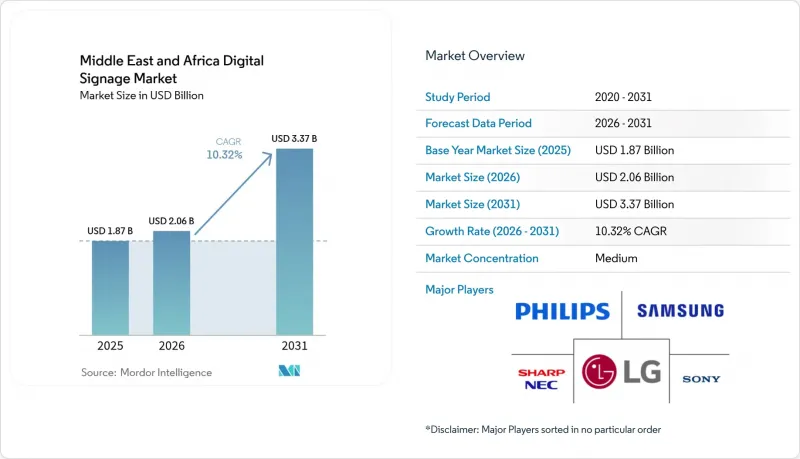
本報告按產品(自助服務終端、菜單板、廣告看板等)、類型(硬體、軟體、服務)、應用(商業、工業、公共機構等)、顯示技術(LCD、LED、OLED、電子紙)和地區(中東和非洲)進行細分。市場預測以美元計價。
中東和非洲數位電子看板市場的趨勢和洞察
零售業快速採用大型LED和OLED螢幕
沿岸地區的零售連鎖店正不斷以高亮度LED幕牆取代靜態海報,這些顯示器能夠承受高達攝氏50度C的日間高溫而不褪色。賽百味在杜拜購物中心引入了自助點餐機和變形螢幕,將顧客等待時間縮短了40%,並使每家門市每年的菜單重印成本降低了100至200美元。隨著中型顯示器價格在2024年下降15%,大型顯示器對於先前因資金密集型設備升級而猶豫不決的專賣店來說變得更加經濟實惠。海灣合作理事會(GCC)的開發商計劃到2028年新建390萬平方米的零售空間,這將持續推動對可顯示阿拉伯語和英語訊息的螢幕的需求。非洲的超級市場也正在透過引進節能型LED菜單板來進一步推動這一趨勢,這些菜單板可降低20%的電力成本,並可在三年內收回投資。
政府智慧城市數位基礎建設計劃
沙烏地阿拉伯、阿拉伯聯合大公國(阿拉伯聯合大公國)和卡達正將數位電子看板定位為連接交通資訊、緊急廣播和旅遊資訊的核心城市基礎設施。沙烏地阿拉伯王國已累計1.18兆美元用於開發綜合交通和酒店走廊,將戶外顯示器整合到道路沿線、地鐵站和朝聖路線上。埃及的「國家智慧城市戰略」正在其新的行政首都引入一個綜合內容網路,而南非正在試點配備顯示器的公車站,以簡化向通勤者提供及時資訊的過程。在肯亞的孔扎科技城,商業顯示器的本地化降低了物流成本和海關延誤,從而能夠更快地為非洲買家提供服務。這些政府計畫催生了亮度、網路安全和阿拉伯語字體的新標準,這些標準正在影響供應商的產品藍圖。
高昂的初始資本投入、易受天氣條件影響以及所有權成本
由於室外機採用密封鋁製機殼、高流明LED燈和強化防碎玻璃,其價格比同類室內產品高出40%至60%。非洲買家還面臨電力系統不穩定和寬頻覆蓋範圍有限等額外挑戰,這增加了發電機和行動電話數據機的成本。三星針對CVE-2024-7399漏洞發布的公告指出,新的網路安全修補程式會帶來沉重的負擔,延長預算緊張的市政當局的投資回收期。在沙漠地區,風扇過濾器會在幾個月內堵塞,需要每季進行檢查,這使得維護合約成本增加了25%。雖然託管服務租賃模式有助於分攤成本,但卻無法抵消奈及利亞和坦尚尼亞高昂的初始安裝許可費和硬體進口關稅。
細分市場分析
2025年,廣告看板在中東和非洲數位電子看板市場規模中佔36.02%。這反映出海灣合作理事會(GCC)國家高速公路沿線以及北非主要城市道路對戶外媒體的強勁需求。同時,隨著零售商和交通樞紐轉向非接觸式自助服務,預計到2031年,自助服務終端的複合年成長率將達到12.48%。這將降低人事費用並實現雙語引導。隨著感測器價格的下降,預計中東和非洲與自助服務終端應用相關的數位電子看板市場規模將穩定成長。這一趨勢在沙烏地阿拉伯的購物中心尤其明顯,人工智慧引擎正在推動朝覲相關商品的提升銷售,使人均消費額成長了15%。
為了應對疫情期間日益成長的衛生問題,採用這些解決方案的公司選擇使用抗菌玻璃和手勢控制。軟體介面整合了忠誠度計畫和電子錢包,鼓勵顧客重複光顧。非洲的小規模機場正在部署多語言資訊亭,無需更新紙質標牌,從而簡化了旅客流動。本地內容創作工作室透過製作具有文化意識的虛擬形象來拓展業務,這些虛擬形象可以用阿拉伯語、斯瓦希里語和阿姆哈拉語問候用戶——這種細微差別往往被全球模板供應商忽略。
到2025年,硬體銷售額將佔總銷售額的66.12%,但其成長速度落後於服務訂閱,後者正以每年11.35%的速度成長。區域買家擴大選擇租賃包含託管內容、預測性維護和人工智慧分析等服務的螢幕。中東和非洲的數位電子看板市場正受益於這一轉變,因為中小型零售商推遲了前期的大筆投資。三星的「SmartThings Pro」將顯示器整合到更廣泛的物聯網平台中,並透過遠端調光功能實現了15%的節能。
媒體播放機採用系統晶片(SoC) 設計,降低了安裝難度,並最大限度地減少了潛在故障點。同時,軟體供應商預先安裝了阿拉伯語字體和從右到左的 UX 庫,顯著減輕了本地化負擔。非洲經銷商以月租價格提供數據 SIM 卡、太陽能供電套件和防破壞外殼,以滿足當地市政預算緊張的需求。這些服務將業務機會從高階購物中心擴展到中小城鎮和當地公車站,從而擴大了中東和非洲數位電子看板市場的覆蓋範圍。
其他好處:
- Excel格式的市場預測(ME)表
- 3個月的分析師支持
目錄
第1章:引言
- 研究假設和市場定義
- 調查範圍
第2章:調查方法
第3章執行摘要
第4章 市場狀況
- 市場概覽
- 市場促進因素
- 零售商店迅速採用大型LED和OLED螢幕
- 政府主導的智慧城市數位基礎建設發展項目
- 顯示器的每像素成本(以美元計)正在下降。
- 品牌擁有者正在轉向數據豐富的數位戶外宣傳活動。
- 與麥加和麥地那朝聖相關的需求激增
- 阿拉伯語地區的AI驅動型受眾分析平台
- 市場限制因素
- 戶外網路的初始資本投資和總擁有成本 (TCO) 較高。
- 各地標準和內容規定不盡相同
- 公共螢幕上的網路安全和破壞風險
- 極端高溫和灰塵推高了維護成本。
- 產業價值鏈分析
- 監理情勢
- 宏觀經濟因素的影響
- 技術展望
- 波特五力分析
第5章 市場規模與成長預測
- 依產品
- 亭
- 選單板
- 廣告看板
- 招牌
- 其他產品
- 按類型
- 硬體
- 顯示器(LCD/LED、OLED)
- 投影設備
- 媒體播放機
- 其他硬體
- 軟體
- 服務
- 硬體
- 透過使用
- 商業
- 產業
- 對機構而言
- 基礎設施
- 其他用途
- 顯示技術
- LCD
- LED
- OLED
- e-Paper
- 按地區
- 中東
- 沙烏地阿拉伯
- 阿拉伯聯合大公國
- 卡達
- 科威特
- 其他中東國家
- 非洲
- 南非
- 埃及
- 奈及利亞
- 其他非洲國家
- 中東
第6章 競爭情勢
- 市場集中度
- 策略趨勢
- 市佔率分析
- 公司簡介
- Samsung Electronics Co., Ltd.
- LG Electronics Inc.
- Sharp NEC Display Solutions, Ltd.
- Sony Group Corporation
- Koninklijke Philips NV(Philips Professional Displays)
- Daktronics, Inc.
- STRATACACHE, Inc.(Scala)
- MMD-Mitsubishi Electric Visual Solutions FZE
- Absen Optoelectronic Co., Ltd.
- MindSpace Digital Signage LLC
- Pixcom Technologies LLC
- Vector Digital Systems LLC
- Advanced Interactive Media Solutions FZE
- SSS Publicity LLC(Sahara)
- LEDMAN Optoelectronic Co., Ltd.
- Unilumin Group Co., Ltd.
- Broadsign International, LLC
- Intuiface SAS
- Visix, Inc.
- Rise Vision, Inc.
第7章 市場機會與未來展望
According to Mordor Intelligence, the middle east and Africa digital signage market size is expected to grow from USD 1.87 billion in 2025 to USD 2.06 billion in 2026 and is forecast to reach USD 3.37 billion by 2031 at 10.32% CAGR over 2026-2031.
This report is Segmented by Product (Kiosks, Menu Boards, Billboards, and More), Type (Hardware, Software, and Services), Application (Commercial, Industrial, Institutional, and More), Display Technology (LCD, LED, OLED, and E-Paper), and Region (Middle East and Africa). The Market Forecasts are Provided in Terms of Value (USD).
Middle East And Africa Digital Signage Market Trends and Insights
Rapid Retail Roll-out of Large-Format LED and OLED Screens
Retail chains across the Gulf continuously replace static posters with high-brightness LED walls that withstand daytime temperatures of up to 50 °C without color washout. Subway introduced self-order kiosks and an anamorphic screen at Dubai Mall, trimming queue time by 40% and cutting yearly menu-reprint costs by USD 100-200 per outlet. Mid-sized panel prices fell 15% in 2024, making large-format displays more affordable for specialty stores that had previously shied away from capital-intensive upgrades. GCC developers plan to create 3.9 million m2 of new retail space by 2028, generating persistent demand for content-ready screens optimized for Arabic and English messaging. African supermarkets further the trend by adopting energy-efficient LED menu boards that slice power bills by 20% and recoup investments in under three years.
Government Smart-City Digital Infrastructure Programs
Saudi Arabia, the UAE, and Qatar designate digital signage as core city infrastructure connecting traffic alerts, emergency broadcasts, and tourism information. The Kingdom budgets USD 1.18 trillion for integrated transport and hospitality corridors that embed outdoor-rated displays into roadsides, metro stations, and pilgrimage routes. Egypt's National Strategy for Smart Cities installs unified content networks in new administrative capitals, while South Africa pilots display-equipped bus shelters to streamline commuter updates. Kenya's Konza Technopolis hosts a local assembly of commercial panels, reducing logistics costs and customs delays, and providing African buyers with faster service turnarounds. Emerging standards for brightness, cybersecurity, and Arabic typography flow from these state programs and now shape vendor product roadmaps.
High Initial Capex, Weather Exposure, and Ownership Costs
Outdoor-rated units cost 40-60% more than indoor equivalents because they integrate sealed aluminum housings, high-lumen LED, and reinforced anti-vandal glass. African buyers face additional hurdles due to patchy grid power and limited broadband coverage, which increases the costs of generators and cellular modems. Samsung's CVE-2024-7399 advisory highlights new cyber-patch workloads that extend the payback cycles for budget-strapped municipalities. In desert belts, fan filters clog within months, forcing quarterly service visits that elevate maintenance contracts by 25%. Managed service leasing models spread the burden, but cannot offset the steep upfront installation permits and import duties on hardware in Nigeria or Tanzania.
Other drivers and restraints analyzed in the detailed report include:
- Pilgrimage-Driven Demand Spikes in Mecca and Medina
- AI-Enabled Arabic Audience Analytics Platforms
- Fragmented Standards, Content Regulation, and Security Vulnerabilities
For complete list of drivers and restraints, kindly check the Table Of Contents.
Segment Analysis
Billboards accounted for 36.02% of the Middle East and Africa digital signage market value in 2025, reflecting the entrenched demand for outdoor media along GCC expressways and North African city arteries. Kiosks, however, are projected to post a 12.48% CAGR through 2031 as retailers and transport hubs pivot to touchless self-service, which cuts staffing costs and delivers bilingual guidance. The Middle East and Africa digital signage market size associated with kiosk deployments is projected to increase steadily as sensor prices decline. Momentum is particularly strong in Saudi malls where AI engines upsell pilgrimage merchandise, lifting basket sizes by 15%.
Adopters favor antimicrobial glass and gesture control to address hygiene concerns that have been amplified during the pandemic years. Software overlays integrate loyalty programs and digital wallets, boosting repeat visits. Smaller African airports are introducing multilingual way-finding kiosks that eliminate the need for printed signage refreshes and streamline passenger flow. Local content studios gain business by crafting culturally sensitive avatars that greet users in Arabic, Swahili, or Amharic, a nuance that global template vendors often overlook.
Hardware delivered 66.12% of the revenue in 2025, yet its growth pace lags behind service subscriptions, which expand at an annual rate of 11.35%. Regional buyers are increasingly leasing screens that come bundled with managed content, predictive maintenance, and AI analytics. The Middle East and Africa digital signage market benefits from this shift as smaller retailers defer hefty upfront investment. Samsung's SmartThings Pro plugs display into wider IoT stacks, allowing energy savings of 15% through remote dimming.
Media players adopt system-on-chip designs that reduce installation labor and minimize failure points. Meanwhile, software vendors preload Arabic fonts and right-to-left UX libraries, slashing localization overhead. African resellers package data SIMs, solar-ready power kits, and vandal-proof housings under monthly fees that align with tight municipal budgets. These offerings expand the addressable opportunities beyond premium malls to secondary cities and rural bus stations, broadening the footprint of the Middle East and Africa digital signage market.
Complete Report Scope:
- By Product
- Kiosks
- Menu Boards
- Billboards
- Sign Boards
- Other Products
- By Type
- Hardware
- Displays (LCD/LED, OLED)
- Projection Equipment
- Media Players
- Other Hardware
- Software
- Services
- Hardware
- By Application
- Commercial
- Industrial
- Institutional
- Infrastructure
- Other Applications
- By Display Technology
- LCD
- LED
- OLED
- e-Paper
- By Region
- Middle East
- Saudi Arabia
- United Arab Emirates
- Qatar
- Kuwait
- Rest of Middle East
- Africa
- South Africa
- Egypt
- Nigeria
- Rest of Africa
- Middle East
List of Companies Covered in this Report:
- Samsung Electronics Co., Ltd.
- LG Electronics Inc.
- Sharp NEC Display Solutions, Ltd.
- Sony Group Corporation
- Koninklijke Philips N.V. (Philips Professional Displays)
- Daktronics, Inc.
- STRATACACHE, Inc. (Scala)
- MMD-Mitsubishi Electric Visual Solutions FZE
- Absen Optoelectronic Co., Ltd.
- MindSpace Digital Signage LLC
- Pixcom Technologies LLC
- Vector Digital Systems LLC
- Advanced Interactive Media Solutions FZE
- SSS Publicity LLC (Sahara)
- LEDMAN Optoelectronic Co., Ltd.
- Unilumin Group Co., Ltd.
- Broadsign International, LLC
- Intuiface SAS
- Visix, Inc.
- Rise Vision, Inc.
Additional Benefits:
- The market estimate (ME) sheet in Excel format
- 3 months of analyst support
TABLE OF CONTENTS
1 INTRODUCTION
- 1.1 Study Assumptions and Market Definition
- 1.2 Scope of the Study
2 RESEARCH METHODOLOGY
3 EXECUTIVE SUMMARY
4 MARKET LANDSCAPE
- 4.1 Market Overview
- 4.2 Market Drivers
- 4.2.1 Rapid retail roll-out of large-format LED and OLED screens
- 4.2.2 Government smart-city digital infrastructure programs
- 4.2.3 Falling display pixel-USD cost
- 4.2.4 Brand owners' shift to data-rich DOOH campaigns
- 4.2.5 Pilgrimage-driven demand spikes in Mecca and Medina
- 4.2.6 AI-enabled Arabic audience analytics platforms
- 4.3 Market Restraints
- 4.3.1 High initial capex and TCO for outdoor networks
- 4.3.2 Fragmented regional standards and content rules
- 4.3.3 Cyber-security and vandalism risks for public screens
- 4.3.4 Extreme heat and dust driving maintenance costs
- 4.4 Industry Value Chain Analysis
- 4.5 Regulatory Landscape
- 4.6 Impact of Macroeconomic Factors
- 4.7 Technological Outlook
- 4.8 Porter's Five Forces Analysis
- 4.8.1 Threat of New Entrants
- 4.8.2 Bargaining Power of Suppliers
- 4.8.3 Bargaining Power of Consumers
- 4.8.4 Threat of Substitutes
- 4.8.5 Intensity of Competitive Rivalry
5 MARKET SIZE AND GROWTH FORECASTS (VALUE)
- 5.1 By Product
- 5.1.1 Kiosks
- 5.1.2 Menu Boards
- 5.1.3 Billboards
- 5.1.4 Sign Boards
- 5.1.5 Other Products
- 5.2 By Type
- 5.2.1 Hardware
- 5.2.1.1 Displays (LCD/LED, OLED)
- 5.2.1.2 Projection Equipment
- 5.2.1.3 Media Players
- 5.2.1.4 Other Hardware
- 5.2.2 Software
- 5.2.3 Services
- 5.2.1 Hardware
- 5.3 By Application
- 5.3.1 Commercial
- 5.3.2 Industrial
- 5.3.3 Institutional
- 5.3.4 Infrastructure
- 5.3.5 Other Applications
- 5.4 By Display Technology
- 5.4.1 LCD
- 5.4.2 LED
- 5.4.3 OLED
- 5.4.4 e-Paper
- 5.5 By Region
- 5.5.1 Middle East
- 5.5.1.1 Saudi Arabia
- 5.5.1.2 United Arab Emirates
- 5.5.1.3 Qatar
- 5.5.1.4 Kuwait
- 5.5.1.5 Rest of Middle East
- 5.5.2 Africa
- 5.5.2.1 South Africa
- 5.5.2.2 Egypt
- 5.5.2.3 Nigeria
- 5.5.2.4 Rest of Africa
- 5.5.1 Middle East
6 COMPETITIVE LANDSCAPE
- 6.1 Market Concentration
- 6.2 Strategic Moves
- 6.3 Market Share Analysis
- 6.4 Company Profiles (includes Global level Overview, Market level overview, Core Segments, Financials as available, Strategic Information, Market Rank/Share for key companies, Products and Services, and Recent Developments)
- 6.4.1 Samsung Electronics Co., Ltd.
- 6.4.2 LG Electronics Inc.
- 6.4.3 Sharp NEC Display Solutions, Ltd.
- 6.4.4 Sony Group Corporation
- 6.4.5 Koninklijke Philips N.V. (Philips Professional Displays)
- 6.4.6 Daktronics, Inc.
- 6.4.7 STRATACACHE, Inc. (Scala)
- 6.4.8 MMD-Mitsubishi Electric Visual Solutions FZE
- 6.4.9 Absen Optoelectronic Co., Ltd.
- 6.4.10 MindSpace Digital Signage LLC
- 6.4.11 Pixcom Technologies LLC
- 6.4.12 Vector Digital Systems LLC
- 6.4.13 Advanced Interactive Media Solutions FZE
- 6.4.14 SSS Publicity LLC (Sahara)
- 6.4.15 LEDMAN Optoelectronic Co., Ltd.
- 6.4.16 Unilumin Group Co., Ltd.
- 6.4.17 Broadsign International, LLC
- 6.4.18 Intuiface SAS
- 6.4.19 Visix, Inc.
- 6.4.20 Rise Vision, Inc.
7 MARKET OPPORTUNITIES AND FUTURE OUTLOOK
- 7.1 White-space and Unmet-need assessment

 美國數位電子看板:市場佔有率分析、產業趨勢與統計及成長預測(2026-2031 年)越南數位電子看板市場:市場佔有率分析、產業趨勢與統計及成長預測(2026-2031)
 LED指示牌市場-全球市場預測(2026-2032年)數位電子看板:市場佔有率分析、產業趨勢與統計、成長預測(2026-2031)北美數位電子看板市場:市場佔有率分析、產業趨勢與統計及成長預測(2026-2031 年)數位電子看板市場:2026-2032年全球市場預測(按組件、顯示技術、內容類型、解析度、螢幕大小、連接方式、應用、安裝位置和部署模式分類)數位電子看板服務:市場佔有率分析、產業趨勢與統計、成長預測(2026-2031)
 透明數位電子看板冷卻器市場規模、佔有率和成長分析:按產品類型、顯示技術、容量、應用、最終用戶、分銷管道和地區分類-2026-2033年產業預測
 智慧LED室內指示牌市場報告:螢幕大小、最終用戶和地區分類(2026-2034年)
 2026-2030年全球商用大尺寸顯示指示牌市場