


 |
市場調查報告書
商品編碼
2099998
美國專案物流:市場佔有率分析、產業趨勢與統計、成長預測(2026-2031 年)United States Project Logistics - Market Share Analysis, Industry Trends & Statistics, Growth Forecasts (2026 - 2031) |
||||||

※ 本網頁內容可能與最新版本有所差異。詳細情況請與我們聯繫。
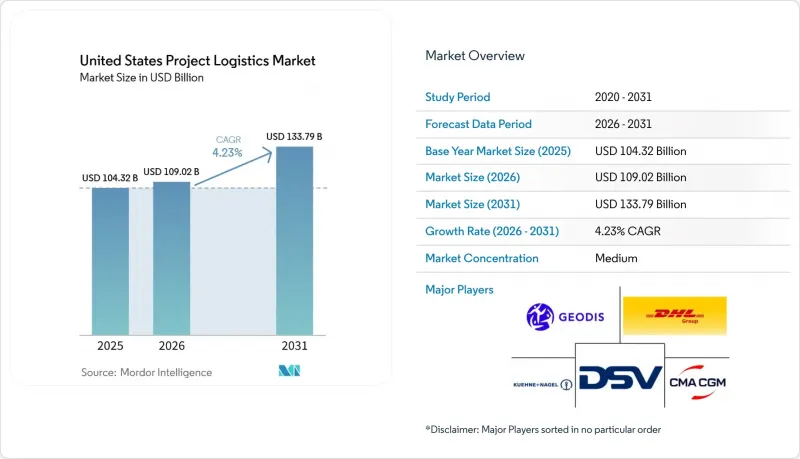
據 Mordor Intelligence 稱,2025 年美國項目物流市場價值為 1043.2 億美元,預計到 2031 年將達到 1337.9 億美元,而 2026 年為 1090.2 億美元,2026 年至 2031 年預測期內的複合成長率為 4.23%。
美國專案物流市場的成長主要得益於資本投資向可再生能源、液化天然氣基礎設施、半導體製造和人工智慧主導的資料中心建設等領域的顯著轉移。本報告按服務類型(運輸、倉儲、附加價值服務及其他)、貨物類型(超大件和非標貨物、重型貨物、散裝貨物及其他)、終端用戶行業(石油天然氣、發電、建築、製造、航太與國防及其他)以及地區(東北部、西南部、西部、東南部和中西部)進行細分。市場預測以美元計價。
美國項目物流市場趨勢與洞察
在《通膨控制法》(IRA) 的支持下,公用事業規模的可再生能源項目激增,而《通膨控制法》(IRA) 的興起正是推動這一成長的動力。
大規模風能和太陽能發電廠需要指定交付機艙、變壓器組、塔筒段和其他無法透過可再生卡車運輸網路運輸的重型零件,因此持續為美國專案物流市場帶來穩定的貨運量。這種貨物構成有利於那些能夠提前獲得許可、將設備部署在專案現場附近,並在現場作業達到交付期之前安排好護送、吊裝和起重機支援的供應商。 Landstar報告稱,其重型貨物運輸收入在2025年第四季將達到約1.7億美元,比2024年第四季成長23%,風能和太陽能客戶的需求成長推動了這一成長。此外,可再生能源零件尺寸的不斷增大,使得越來越多的專案需要基於SPMT(自行式模組運輸車)的運輸和專門的起重方案,這提高了缺乏專業資產和路線經驗的小規模營運商的准入門檻。 2026年,Sullenz完成了維吉尼亞海岸附近一個離岸風力發電專案的陸上作業的最後階段。該公司已完成740次SPMT作業和382次重型起重作業,充分展現了可再生能源專案目前所需的規模。隨著專案工期在場地準備、併網和施工流程順序等方面的要求日益嚴格,可再生能源專案進一步提升了美國專案物流市場對整合工程、倉儲和配送協調服務的需求。
墨西哥灣沿岸液化天然氣出口碼頭和石化廠的擴建
液化天然氣和石化工廠的建設為美國專案物流市場提供了源源不絕的重型、超大型且需要大量許可證的模組、低溫設備、壓力容器、渦輪機和預組裝組件。美國第十個液化天然氣出口終端-金隘口(Golden Pass)於2026年4月從其首條生產線發出了首批貨物,與此同時,隨著第二條和第三條生產線繼續進行試運行,墨西哥灣沿岸地區的貨運活動依然活躍。切尼爾能源公司(Cheniere Energy)的科珀斯克里斯蒂三期項目於2026年3月完成了第五條生產線的建設,為墨西哥灣沿岸走廊的工業貨物運輸提供了持續支持。同樣在2026年5月,切尼爾合作夥伴公司(Cheniere Partners)與貝克特爾公司(Bechtel)簽署了薩賓隘口擴建項目一期工程(第七條生產線及相關基礎設施)的承包承包契約,確保每年新增超過600萬噸的液化天然氣產能。此外,格倫芬的德克薩斯液化天然氣公司(德克薩斯 LNG)和基威特公司(Kiewit)於2026年3月簽署了一份類似的EPC契約,將在布朗斯維爾港建造一座年處理能力400萬噸的設施。這使得該運輸路線上又增加了一個大規模項目。由於多個大型建設項目同時進行,美國項目物流市場正面臨船舶運力趨緊、勞動力過剩減少以及墨西哥灣沿岸重型貨物運輸航線價格支撐增強的局面。
各州對運輸法規和橋樑重量限制的規定各不相同。
由於美國50個州至今仍缺乏統一的超大超重貨物運輸國家框架,逐州申請許可證仍然是美國計畫物流市場運作的一大限制因素。聯邦公路管理局規定州際公路的車輛重量上限為8萬磅。然而,許多項目貨物的運輸重量都超過了這一基準值,因此需要針對特定路線進行核准、技術檢驗和特殊指定。在東北部和中西部部分地區,橋樑狀況進一步加劇了問題的複雜性,老化的基礎設施限制了能夠運輸最重型設備的可用通道數量。這導致需要選擇更長的路線、部署更多運輸車輛,以及加強道路運輸承運商、鐵路連接和現場團隊之間的協調,增加了成本和工期風險。各州不同的尺寸法規、審查週期和路線條件,使得缺乏內部許可證申請專業知識的業者處於不利地位。液化天然氣、可再生能源、半導體和公共基礎設施項目同時運營,進一步限制了美國項目物流市場可用的路線網路。
細分市場分析
到2025年,運輸業將占美國項目物流市場佔有率的60.12%,證實了實體運輸仍是重型和超大型貨物運輸項目的主要收入來源。重型貨物的公路運輸發揮至關重要的作用,連接製造廠、海上碼頭、傳輸點以及鐵路或駁船運輸無法完成最後一段路程的偏遠施工現場。因此,平板車、多軸拖車和SPMT(自行式模組化運輸機)等運輸方式在能源、製造、國防和基礎設施等產業的貨物運輸中繼續扮演核心角色。在長途運輸中,由於橋樑限制、公路限高或都市區交通限制等因素導致陸路運輸效率降低,鐵路和海運/駁船運輸仍具有顯著的路線優勢。 Landstar報告稱,2026年第一季的重型貨物運輸收入達到1.34億美元,較去年同期成長18%,客戶涵蓋資料中心、能源、政府、航太和國防等產業。
預計到2031年,附加價值服務和其他服務將以5.68%的複合年成長率成長,成為美國專案物流市場成長最快的服務領域。這一成長反映了買家傾向於選擇能夠集中管理可行性評估、海關協調、吊裝支援、倉儲和貨物可視性的單一供應商,而不是將同一項目外包給多家公司。倉儲、配送和庫存管理的重要性也在不斷提升,因為從製造完成到專案現場投入使用之間通常存在時間差。 DHL計劃在2026年在北美部署10個資料中心物流倉庫,這表明主要供應商正在圍繞貨物的集散、處理和準時交付來建立業務,而不僅僅是追求數量。因此,美國專案物流市場的服務結構正在向「捆綁式執行」模式轉變,工程支援和進度管理對客戶價值的影響日益增強。
其他好處:
- Excel格式的市場預測(ME)表
- 3個月的分析師支持
目錄
第1章:引言
- 研究假設和市場定義
- 調查範圍
第2章:調查方法
第3章執行摘要
第4章 市場狀況
- 市場概覽
- 市場促進因素
- 通貨膨脹控制法案(IRA)為大規模可再生能源項目的激增提供了支持。
- 墨西哥灣沿岸液化天然氣出口碼頭和石化廠的擴建
- 超大規模資料中心和人工智慧基礎設施的建設正在加速。
- 聯邦基礎設施投資(IIJA)旨在改善港口、鐵路和公路的連通性。
- 回流計劃和半導體製造廠(晶圓廠)建設(晶片法)
- 專業多模態重型貨物運輸解決方案的需求日益成長
- 市場限制因素
- 各州對交通運輸法規和橋樑重量限制的規定各不相同。
- 專業且經驗豐富的重型起重機駕駛員長期短缺。
- 專業重型貨物裝運船隻車隊的高昂資本投入與維護成本
- 設備成本波動以及跨多個州管轄區的協調挑戰。
- 價值供應鏈分析
- 監理情勢
- 技術展望
- 波特五力分析
- 地緣政治事件對市場的影響
第5章 市場規模與成長預測
- 按服務
- 運輸
- 路
- 鐵路
- 航空
- 海事/內河航道
- 倉儲、物流和庫存管理
- 附加價值服務及其他
- 運輸
- 貨物類型
- 超大貨物(非標準貨物)
- 重型貨物
- 普通貨物
- 其他
- 按最終用戶行業分類
- 石油和天然氣、採礦和採石
- 發電和輸電
- 建築和基礎設施
- 製造和工業工廠
- 航太/國防
- 其他(海事、造船、通訊等)
- 按地區
- 東北
- 西南
- 西方
- 東南
- 中西部
第6章 競爭情勢
- 市場集中度
- 策略趨勢
- 市佔率分析
- 公司簡介
- Kuehne+Nagel
- DHL Group
- DSV A/S
- CMA CGM Group
- GEODIS
- Expeditors International of Washington, Inc.
- CH Robinson Worldwide, Inc.
- Crane Worldwide Logistics LLC
- Mammoet USA South Inc.
- Sarens USA Inc.
- BNSF Logistics, LLC
- Anderson Trucking Service, Inc.
- Landstar System, Inc.
- Emmert Industrial Corp.
- deugro(USA)Inc.
- Fagioli Inc.
- Rhenus Logistics
- Hellmann Worldwide Logistics
- NYK Line
- AIT Worldwide Logistics, Inc.
- EMO Trans, Inc.
- FLS Transportation Services, Inc.
- NMT Projects Inc.
- Rohlig Logistics GmbH & Co. KG
- SF Holding Co., Ltd.(Including KLN Logistics Group Limited)
第7章 市場機會與未來展望
According to Mordor Intelligence, the United States project logistics market size was valued at USD 104.32 billion in 2025 and estimated to grow from USD 109.02 billion in 2026 to reach USD 133.79 billion by 2031, at a CAGR of 4.23% during the forecast period 2026-2031.
Growth in the United States project logistics market is being shaped by a visible shift in capital spending toward renewable energy, LNG infrastructure, semiconductor manufacturing, and AI-led data center construction. This report is Segmented by Service (Transportation, Warehousing, Value-Added Services and Others), by Cargo Type (Oversized/Out-of-Gauge, Heavy-Lift, Breakbulk, Others), by End-User Industry (Oil and Gas, Energy Generation, Construction, Manufacturing, Aerospace and Defense, Others), and by Geography (Northeast, Southwest, West, Southeast, Midwest). The Market Forecasts are in Terms of Value (USD).
United States Project Logistics Market Trends and Insights
Surge in Utility-Scale Renewable Energy Projects Supported by the Inflation Reduction Act (IRA)
Renewable energy projects continue to add steady volume to the United States project logistics market because large wind and solar sites depend on timed delivery of nacelles, transformer banks, tower sections, and other heavy components that cannot move through ordinary truckload networks. This cargo mix favors providers that can secure permits early, stage equipment near project sites, and line up escort, rigging, and crane support before field work reaches its peak delivery phase. Landstar reported heavy-haul revenue of nearly USD 170 million in Q4 2025, up 23% from Q4 2024, with wind and solar customers contributing to that acceleration in demand. Larger renewable energy components are also pushing more projects toward SPMT-led transport and engineered lift planning, which raises barriers for smaller operators without specialized assets or route expertise. Sarens completed the final onshore scope for the Coastal Virginia Offshore Wind project in 2026, after carrying out 740 SPMT operations and 382 heavy lifts, demonstrating the scale that renewable energy work now requires. As project schedules tighten around site readiness, grid connection, and construction sequencing, renewable energy work is driving stronger demand for bundled engineering, storage, and delivery coordination across the United States project logistics market.
Expansion of Gulf Coast LNG Export Terminals and Petrochemical Installations
LNG and petrochemical construction is supplying the United States project logistics market with a steady stream of modules, cryogenic equipment, pressure vessels, turbines, and fabricated assemblies that are heavy, oversized, and permit-intensive. Golden Pass, the 10th United States LNG export terminal, shipped its first cargo from Train 1 in April 2026, while Trains 2 and 3 remained scheduled for later commissioning phases, which kept Gulf Coast cargo activity elevated. Cheniere Energy's Corpus Christi Stage 3 project reached substantial completion of Train 5 in March 2026, which supported continued movement of industrial cargo through Gulf Coast corridors. Cheniere Partners also signed a lump-sum, turnkey EPC contract with Bechtel in May 2026 for the first phase of the Sabine Pass expansion, covering Train 7 and supporting infrastructure, providing more than 6 million tons per annum of additional LNG capacity. Glenfarne's Texas LNG and Kiewit executed a similar EPC contract in March 2026 for a 4-million-ton-per-annum facility at the Port of Brownsville, which added another large project to the same corridor. With multiple large builds progressing at once, the United States project logistics market is seeing tighter vessel availability, narrower labor buffers, and stronger pricing support in Gulf Coast heavy-lift lanes.
Stringent State-By-State Transport Regulations and Bridge Weight Limitations
State permitting remains a major operating restraint for the United States project logistics market because oversize and overweight transport still lacks a uniform national framework across all 50 states. The Federal Highway Administration sets an interstate legal vehicle weight limit of 80,000 pounds. At the same time, many project cargo superloads exceed that threshold and require route-specific approvals, engineering checks, and special designations. Bridge conditions in parts of the Northeast and Midwest make the issue harder because older infrastructure reduces the number of viable corridors for the heaviest equipment moves. That often forces longer routes, more escorts, and tighter sequencing between road carriers, rail links, and site teams, which increases costs and schedule risk. Operators without in-house permitting expertise are at a disadvantage because every state can apply different dimensional rules, review times, and routing conditions. When LNG, renewable energy, semiconductor, and public infrastructure projects run concurrently, the available route network within the United States project logistics market becomes even more constrained.
Other drivers and restraints analyzed in the detailed report include:
- Accelerated Construction of Hyperscale Data Centers and AI Infrastructure
- Reshoring Initiatives and Semiconductor Fabrication Plant Construction Under the CHIPS Act
- Persistent Shortages of Specialized Labor and Experienced Heavy-Haul Drivers
For complete list of drivers and restraints, kindly check the Table Of Contents.
Segment Analysis
Transportation held 60.12% of the United States project logistics market share in 2025, confirming that physical movement remains the core revenue engine for heavy and oversized-cargo programs. Road-based heavy haul plays the largest role because it links fabrication yards, marine terminals, intermodal transfer points, and remote construction sites where rail or barge cannot complete the final leg. Flatbeds, multi-axle trailers, and SPMT configurations, therefore, remained central to execution across energy, manufacturing, defense, and infrastructure cargo flows. Rail and sea or barge modes still offered important corridor advantages on longer routes where bridge limits, highway height restrictions, or urban access constraints made over-road transport less efficient. Landstar reported USD 134 million in heavy-haul revenue in Q1 2026, up 18% year over year, with customers spanning data centers, energy, government, aerospace, and defense.
Value-added services and other services are projected to expand at a 5.68% CAGR through 2031, making them the fastest-growing service lines within the United States project logistics market. That growth reflects a buyer preference for a single provider that can manage feasibility reviews, customs coordination, rigging support, warehousing, and cargo visibility, rather than handing the same project to multiple firms. Warehousing, distribution, and inventory management are also becoming more important because project sites often face timing gaps between fabrication completion and field readiness. DHL's 2026 rollout of 10 dedicated North American data center logistics warehouses shows how larger providers are building around staging, handling, and scheduled site delivery rather than only transport volume. The service mix in the United States project logistics market is therefore moving toward bundled execution, where engineering support and schedule control increasingly shape customer value.
Complete Report Scope:
- By Service
- Transportation
- Road
- Rail
- Air
- Sea/Barge
- Warehousing, Distribution and Inventory Management
- Value-added Services and Others
- Transportation
- By Cargo Type
- Oversized (Out-of-Gauge) Cargo
- Heavy-Lift Cargo
- Breakbulk Cargo
- Others
- By End-User Industry
- Oil and Gas, Mining and Quarrying
- Energy Generation and Transmission (Includes Renewable Energy)
- Construction and Infrastructure
- Manufacturing and Industrial Plants
- Aerospace and Defense
- Others (Maritime and Shipbuilding, Telecommunications, etc.)
- By Geography
- Northeast
- Southwest
- West
- Southeast
- Midwest
List of Companies Covered in this Report:
- Kuehne+Nagel
- DHL Group
- DSV A/S
- CMA CGM Group
- GEODIS
- Expeditors International of Washington, Inc.
- C.H. Robinson Worldwide, Inc.
- Crane Worldwide Logistics LLC
- Mammoet USA South Inc.
- Sarens USA Inc.
- BNSF Logistics, LLC
- Anderson Trucking Service, Inc.
- Landstar System, Inc.
- Emmert Industrial Corp.
- deugro (USA) Inc.
- Fagioli Inc.
- Rhenus Logistics
- Hellmann Worldwide Logistics
- NYK Line
- AIT Worldwide Logistics, Inc.
- EMO Trans, Inc.
- FLS Transportation Services, Inc.
- NMT Projects Inc.
- Rohlig Logistics GmbH & Co. KG
- S.F. Holding Co., Ltd. (Including KLN Logistics Group Limited)
Additional Benefits:
- The market estimate (ME) sheet in Excel format
- 3 months of analyst support
TABLE OF CONTENTS
1 Introduction
- 1.1 Study Assumptions and Market Definition
- 1.2 Scope of the Study
2 Research Methodology
3 Executive Summary
4 Market Landscape
- 4.1 Market Overview
- 4.2 Market Drivers
- 4.2.1 Surge in Utility-Scale Renewable Energy Projects Supported by the Inflation Reduction Act (IRA)
- 4.2.2 Expansion of Gulf Coast LNG Export Terminals and Petrochemical Installations
- 4.2.3 Accelerated Construction of Hyperscale Data Centers and AI Infrastructure
- 4.2.4 Federal Infrastructure Investments Upgrading Port, Rail, and Highway Connectivity (IIJA)
- 4.2.5 Reshoring Initiatives and Semiconductor Fabrication Plant (Fab) Construction (CHIPS Act)
- 4.2.6 Increasing Demand for Specialized Multimodal Heavy-Lift Transport Solutions
- 4.3 Market Restraints
- 4.3.1 Stringent State-by-State Transport Regulations and Bridge Weight Limitations
- 4.3.2 Persistent Shortages of Specialized Labor and Experienced Heavy-Haul Drivers
- 4.3.3 High Capital Expenditure and Maintenance Costs for Specialized Heavy-Lift Fleets
- 4.3.4 Volatile Equipment Costs and Coordination Challenges Across Multi-State Jurisdictions
- 4.4 Value / Supply-Chain Analysis
- 4.5 Regulatory Landscape
- 4.6 Technological Outlook
- 4.7 Porter's Five Forces Analysis
- 4.7.1 Bargaining Power of Suppliers
- 4.7.2 Bargaining Power of Buyers
- 4.7.3 Threat of New Entrants
- 4.7.4 Threat of Substitutes
- 4.7.5 Industry Rivalry
- 4.8 Impact of Geopolitical Events on the Market
5 Market Size and Growth Forecasts (Value, USD)
- 5.1 By Service
- 5.1.1 Transportation
- 5.1.1.1 Road
- 5.1.1.2 Rail
- 5.1.1.3 Air
- 5.1.1.4 Sea/Barge
- 5.1.2 Warehousing, Distribution and Inventory Management
- 5.1.3 Value-added Services and Others
- 5.1.1 Transportation
- 5.2 By Cargo Type
- 5.2.1 Oversized (Out-of-Gauge) Cargo
- 5.2.2 Heavy-Lift Cargo
- 5.2.3 Breakbulk Cargo
- 5.2.4 Others
- 5.3 By End-User Industry
- 5.3.1 Oil and Gas, Mining and Quarrying
- 5.3.2 Energy Generation and Transmission (Includes Renewable Energy)
- 5.3.3 Construction and Infrastructure
- 5.3.4 Manufacturing and Industrial Plants
- 5.3.5 Aerospace and Defense
- 5.3.6 Others (Maritime and Shipbuilding, Telecommunications, etc.)
- 5.4 By Geography
- 5.4.1 Northeast
- 5.4.2 Southwest
- 5.4.3 West
- 5.4.4 Southeast
- 5.4.5 Midwest
6 Competitive Landscape
- 6.1 Market Concentration
- 6.2 Strategic Moves
- 6.3 Market Share Analysis
- 6.4 Company Profiles (includes Global Level Overview, Market Level Overview, Core Segments, Financials as available, Strategic Information, Market Rank/Share, Products and Services, Recent Developments)
- 6.4.1 Kuehne+Nagel
- 6.4.2 DHL Group
- 6.4.3 DSV A/S
- 6.4.4 CMA CGM Group
- 6.4.5 GEODIS
- 6.4.6 Expeditors International of Washington, Inc.
- 6.4.7 C.H. Robinson Worldwide, Inc.
- 6.4.8 Crane Worldwide Logistics LLC
- 6.4.9 Mammoet USA South Inc.
- 6.4.10 Sarens USA Inc.
- 6.4.11 BNSF Logistics, LLC
- 6.4.12 Anderson Trucking Service, Inc.
- 6.4.13 Landstar System, Inc.
- 6.4.14 Emmert Industrial Corp.
- 6.4.15 deugro (USA) Inc.
- 6.4.16 Fagioli Inc.
- 6.4.17 Rhenus Logistics
- 6.4.18 Hellmann Worldwide Logistics
- 6.4.19 NYK Line
- 6.4.20 AIT Worldwide Logistics, Inc.
- 6.4.21 EMO Trans, Inc.
- 6.4.22 FLS Transportation Services, Inc.
- 6.4.23 NMT Projects Inc.
- 6.4.24 Rohlig Logistics GmbH & Co. KG
- 6.4.25 S.F. Holding Co., Ltd. (Including KLN Logistics Group Limited)
7 Market Opportunities and Future Outlook
- 7.1 White-Space and Unmet-Need Assessment

 印度專案物流:市場佔有率分析、產業趨勢與統計及成長預測(2026-2031)
 專案物流市場機會、成長要素、產業趨勢分析及2026-2035年預測
 計劃物流市場:依服務類型、運輸方式、服務模式、貨物類型及最終用戶產業分類-2026-2032年全球預測按服務類型、運輸方式、供應商類型和最終用戶產業分類的端到端物流服務市場-2026-2032年全球預測計劃物流:市場佔有率分析、產業趨勢與統計、成長預測(2026-2031)
 全球計劃物流市場規模、佔有率、產業分析報告:2025 年至 2032 年按模式、服務、最終用途產業和地區分類的展望與預測
 計劃物流市場規模、佔有率和趨勢分析報告:按服務、運輸方式、最終用途產業、地區和細分市場預測,2025-2033 年
 計劃物流,全球市場 2025-2029中國計劃物流:市場佔有率分析、產業趨勢與統計、成長預測(2025-2030)