


 |
市場調查報告書
商品編碼
2038673
專案物流市場機會、成長要素、產業趨勢分析及2026-2035年預測Project Logistics Market Opportunity, Growth Drivers, Industry Trend Analysis, and Forecast 2026 - 2035 |
||||||

2025年全球專案物流市場價值為688億美元,預計2035年將以5.8%的複合年成長率成長至1,201億美元。
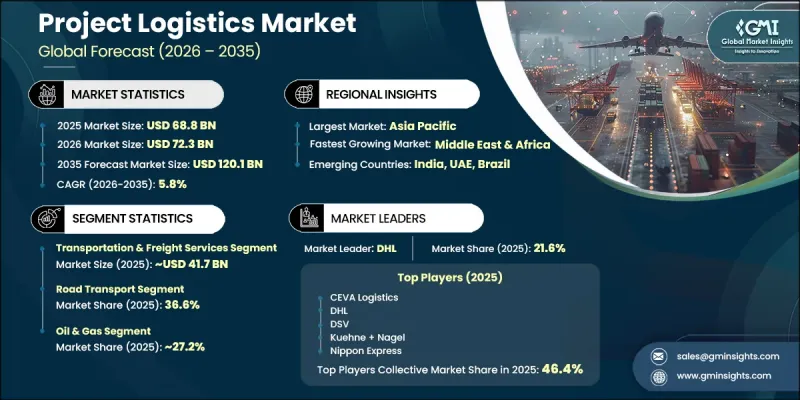
市場動態與全球工業發展的速度和規模密切相關,日益複雜的基礎建設和能源專案需要高度專業化的物流解決方案。隨著專案規模和營運需求的日益複雜,企業正將運輸、倉儲和供應鏈執行的高效協調放在首位。貨物裝卸的複雜性不斷增加,尤其是超大型和高價值設備的裝卸,進一步凸顯了綜合物流規劃的重要性。此外,大規模工業和能源開發的持續擴張也推動了對先進物流能力的需求。市場參與企業致力於提高營運效率、加強風險管理並確保專案按時完成。這種變化反映出物流體係正朝著更完善的方向發展,以支援大規模、多階段項目,同時在不同地域維持成本效益和營運精準性。
| 市場範圍 | |
|---|---|
| 開始年份 | 2025 |
| 預測期 | 2026-2035 |
| 上市時的市場規模 | 688億美元 |
| 預測金額 | 1201億美元 |
| 複合年成長率 | 5.8% |
策略整合活動,例如併購,在鞏固市場地位和拓展地域覆蓋方面發揮核心作用。企業正利用這些策略來提升基礎設施能力,並確保獲得執行複雜專案所需的專業技術。可再生能源發展的強勁勢頭顯著推動了市場需求,而大規模能源舉措投資的增加也為此提供了有力支撐。世界各國政府正在加速推動基礎設施和能源項目,這些項目需要高度協調的物流服務。隨著關注點轉向大規模設施和跨境開發,對可靠的專案物流解決方案的需求進一步成長。服務供應商不斷調整自身能力以適應不斷變化的行業需求和全球項目的擴張,這一趨勢正在創造長期成長機會。
運輸和貨運服務領域佔據60.6%的市場佔有率,預計到2025年市場規模將達到417億美元。這個領域之所以佔據主導地位,是因為重型和超大貨物的運輸需要專用設備和操作技術,而這些成本本身就高成本。專案貨物運輸需要客製化的物流解決方案,包括專為滿足複雜的尺寸和重量要求而設計的專用運輸系統。因此,運輸服務構成了專案物流運作的基礎。大規模工業項目數量的不斷成長持續推動著對高效貨物裝卸解決方案的需求,鞏固了該領域在市場中的主導地位。
到2025年,道路運輸將佔據36.6%的市場佔有率,市場規模將達到252億美元。公路運輸在確保「最後一公里」配送方面發揮著至關重要的作用,尤其是在其他運輸基礎設施有限或缺失的地區。其適應性和柔軟性使其成為在各種地形上運輸重型和超大貨物的必要手段。公路物流解決方案之所以被廣泛應用,是因為它們能夠直接通往專案現場,並確保無縫交付。此外,公路運輸還能支援各種工業應用,這進一步凸顯了其重要性,使其成為整個專案物流生態系統的關鍵組成部分。
美國專案物流市場預計到2025年將達到94億美元,並在2026年至2035年間以5.7%的複合年成長率成長。市場成長主要得益於基礎建設的持續投資、工業擴張以及能源開發舉措。政府主導的旨在改善交通網路的資金籌措項目正在提升物流運營效率,尤其是在大型複雜貨物的運輸方面。交通基礎設施的持續發展也為大型貨物的處理提供了便利,這對於大規模工業和能源項目至關重要。這些因素共同推動了對先進專案物流服務的持續需求,預計該市場在整個預測期內將保持穩定成長。
目錄
第1章:調查方法
第2章執行摘要
第3章業界考察
- 生態系分析
- 供應商情況
- 利潤率
- 成本結構
- 每個階段增加的價值
- 影響價值鏈的因素
- 中斷
- 影響產業的因素
- 促進因素
- 全球基礎設施投資激增,大型企劃儲備不斷擴大。
- 能源轉型專案推動了對專業物流的需求
- 工業設備的日益複雜化和模組化趨勢
- 擴大可再生能源和離岸風力發電項目
- 產業潛在風險與挑戰
- 專業設備和基礎設施需要大量資金投入。
- 地緣政治不確定性影響跨境項目
- 市場機遇
- 亞洲和非洲新興市場的基礎建設發展
- 實施綠色物流與永續運輸解決方案
- 石油和天然氣行業的拆除項目正在創造對逆向物流的需求。
- 促進因素
- 成長潛力分析
- 監理情勢
- 北美洲
- 美國聯邦機動車輛運輸安全管理局
- 加拿大 - 加拿大運輸部
- 歐洲
- 德國聯邦數位化與交通部
- 英國- 駕駛員和車輛標準局
- 亞太地區
- 中國 - 中華人民共和國交通運輸部
- 印度 - 公路運輸與公路部
- 拉丁美洲
- 巴西 - 國家陸上運輸局
- 阿根廷 -運輸部
- 中東和非洲
- 阿拉伯聯合大公國聯邦交通管理局 - 陸路和海事運輸
- 沙烏地阿拉伯 - 沙烏地阿拉伯港務局
- 北美洲
- 波特五力分析
- PESTEL 分析
- 科技與創新趨勢
- 目前技術
- 運輸管理系統(TMS)
- 倉庫管理系統(WMS)
- 全球定位系統(GPS)追蹤
- 新興技術
- 區塊鏈在物流領域的應用
- 人工智慧(AI)和機器學習(ML)
- 數位雙胞胎技術
- 目前技術
- 價格分析(基於初步調查)
- 對過去價格趨勢的分析
- 按業務類型分類的定價策略(溢價/價值/成本加成)
- 專利趨勢(基於初步調查)
- 永續性和環境方面
- 永續計劃
- 減少廢棄物策略
- 生產中的能源效率
- 具有環保意識的舉措
- 關於碳足跡的考量
- 貿易數據分析(基於付費資料庫)
- 進出口量及進口額趨勢
- 主要貿易走廊和關稅的影響
- 人工智慧和生成式人工智慧對市場的影響
- 利用人工智慧改造現有經營模式
- GenAI 各細分市場的應用案例與部署藍圖
- 風險、限制和監管考量
- 成本細分分析
- 跨境業務和國際夥伴關係
- 國際貿易與海關合規
- 國際合作夥伴的選擇與評估
- 跨境風險管理
- 多模態和基礎設施的協調
- 預測假設和情境分析(基於初步研究)
- 基本案例-驅動複合年成長率的關鍵宏觀經濟與產業變量
- 樂觀情境-宏觀經濟與產業的順風
- 悲觀情景-宏觀經濟放緩或產業逆風
第4章 競爭情勢
- 介紹
- 企業市佔率分析
- 北美洲
- 歐洲
- 亞太地區
- 拉丁美洲
- 中東和非洲(MEA)
- 主要市場公司的競爭分析
- 競爭定位矩陣
- 主要進展
- 併購
- 夥伴關係和聯盟
- 新產品發布
- 業務拓展計劃及資金籌措
- 企業級分層基準測試
- 層級分類標準與選擇標準
- 按收入、地區和創新能力分類的層級定位矩陣。
第5章 市場估計與預測:依服務業分類,2022-2035年
- 運輸和貨運服務
- 重型貨物運輸
- 散貨物流
- 海關清關和合規服務
- 包裝、木箱包裝和貨物搬運。
- 倉儲和儲存解決方案
- 安裝和試運行支持
- 專案管理與協調
- 其他
第6章 市場估計與預測:依運輸方式分類,2022-2035年
- 多式聯運
- 道路運輸
- 海上運輸
- 空運
- 鐵路貨運
第7章 市場估計與預測:依最終用途產業分類,2022-2035年
- 石油和天然氣
- 上游項目
- 中游基礎設施
- 下游設施
- 液化天然氣和天然氣處理廠
- 電力/公共產業
- 建築和基礎設施
- 採礦和金屬
- 製造業
- 其他
第8章 市場估計與預測:依地區分類,2022-2035年
- 北美洲
- 美國
- 加拿大
- 歐洲
- 德國
- 英國
- 法國
- 義大利
- 西班牙
- 波蘭
- 荷蘭
- 挪威
- 亞太地區
- 中國
- 印度
- 日本
- 韓國
- 澳洲
- 新加坡
- 馬來西亞
- 越南
- 拉丁美洲
- 巴西
- 墨西哥
- 阿根廷
- 哥倫比亞
- 中東和非洲(MEA)
- 南非
- 沙烏地阿拉伯
- 阿拉伯聯合大公國
第9章:公司簡介
- 世界公司
- Kuehne+Nagel
- DHL
- DSV
- CH Robinson
- Nippon Express
- Agility Logistics
- Maersk
- Rhenus Logistics
- CEVA Logistics
- Geodis
- 本地球員
- Mainfreight
- Kerry Logistics
- GAC Internationale
- Sinotrans
- Yusen Logistics
- Logwin
- 新興企業
- Ludwig Haberle
- Fracht
- Crane Worldwide
- Deugro
The Global Project Logistics Market was valued at USD 68.8 billion in 2025 and is estimated to grow at a CAGR of 5.8% to reach USD 120.1 billion by 2035.
Market dynamics are closely tied to the pace and scale of global industrial development, where increasingly complex infrastructure and energy projects demand highly specialized logistics solutions. As project sizes grow and operational requirements become more intricate, companies are prioritizing efficient coordination of transportation, storage, and supply chain execution. The rising complexity of cargo handling, particularly for oversized and high-value equipment, is reinforcing the importance of integrated logistics planning. Additionally, the continuous expansion of large-scale industrial and energy developments is driving demand for advanced logistics capabilities. Market participants are focusing on enhancing operational efficiency, improving risk management, and ensuring timely project delivery. This evolving landscape reflects a shift toward more sophisticated logistics frameworks that can support large, multi-phase projects while maintaining cost efficiency and operational precision across diverse geographic regions.
| Market Scope | |
|---|---|
| Start Year | 2025 |
| Forecast Year | 2026-2035 |
| Start Value | $68.8 Billion |
| Forecast Value | $120.1 Billion |
| CAGR | 5.8% |
Strategic consolidation activities such as mergers and acquisitions play a central role in strengthening market presence and expanding geographic reach. Companies are leveraging these strategies to enhance infrastructure capabilities and access skilled expertise required for complex project execution. Strong momentum in renewable energy development is contributing significantly to demand, supported by increasing investments in large-scale energy initiatives. Governments across multiple regions are accelerating infrastructure and energy projects, which require highly coordinated logistics services. The growing emphasis on large-scale installations and cross-border developments is further intensifying the need for reliable project logistics solutions. This trend is fostering long-term growth opportunities, as service providers continue to align their capabilities with evolving industrial requirements and global project expansion.
The transportation and freight services segment held a 60.6% share, generating USD 41.7 billion in 2025. This segment leads due to the inherently high costs associated with transporting heavy and oversized cargo, which requires specialized equipment and operational expertise. The movement of project cargo demands customized logistics solutions, including dedicated transport systems designed to handle complex dimensions and weight requirements. As a result, transportation services form the backbone of project logistics operations. The increasing volume of large-scale industrial projects continues to drive demand for efficient freight handling solutions, reinforcing the segment's leading position in the market.
The road transport segment held a 36.6% share in 2025 generating USD 25.2 billion. This segment plays a critical role in ensuring last-mile connectivity, particularly in areas where alternative transport infrastructure is limited or unavailable. Its adaptability and flexibility make it essential for delivering heavy and oversized cargo across varied terrains. Road-based logistics solutions are widely utilized due to their ability to provide direct access to project sites, ensuring seamless delivery operations. The segment's importance is further amplified by its capability to support diverse industrial applications, making it a key component of the overall project logistics ecosystem.
United States Project Logistics Market accounted for USD 9.4 billion in 2025 and is expected to grow at a CAGR of 5.7% between 2026 and 2035. Market growth is supported by ongoing investments in infrastructure, industrial expansion, and energy development initiatives. Government-led funding programs aimed at improving transportation networks are enhancing the efficiency of logistics operations, particularly for large and complex cargo movements. Continuous development of transport infrastructure is enabling smoother handling of oversized shipments, which is critical for large-scale industrial and energy projects. These factors collectively contribute to sustained demand for advanced project logistics services, positioning the market for steady growth over the forecast period.
Major players operating in the Global Project Logistics Industry include Agility Logistics, C.H. Robinson, CEVA Logistics, DHL, DSV, Geodis, Kuehne + Nagel, Maersk, Nippon Express, and Rhenus Logistics. Companies operating in the Global Project Logistics Market are adopting a range of strategic initiatives to strengthen their competitive position and expand their market footprint. Key approaches include forming strategic partnerships, investing in advanced logistics technologies, and expanding global networks to enhance service capabilities. Businesses are focusing on digital transformation to improve operational visibility, optimize route planning, and enhance real-time tracking systems. In addition, companies are prioritizing capacity expansion through infrastructure development and fleet modernization to handle complex cargo requirements more efficiently. Mergers and acquisitions are widely used to enter new markets and gain access to specialized expertise. Firms are also emphasizing customized service offerings and integrated logistics solutions to meet specific project demands. Sustainability initiatives, including the adoption of energy-efficient transportation methods, are further helping companies differentiate their services and align with evolving industry standards.
Table of Contents
Chapter 1 Methodology
- 1.1 Research approach
- 1.2 Quality Commitments
- 1.2.1 GMI AI policy & data integrity commitment
- 1.3 Research Trail & Confidence Scoring
- 1.3.1 Research Trail Components
- 1.3.2 Scoring Components
- 1.4 Data Collection
- 1.5 Data mining sources
- 1.5.1 Paid sources
- 1.6 Base estimates and calculations
- 1.6.1 Base year calculation for any one approach
- 1.7 Forecast
- 1.7.1 Quantified market impact analysis
- 1.8 Research transparency addendum
- 1.8.1 Source attribution framework
- 1.8.2 Quality assurance metrics
- 1.8.3 Our commitment to trust
Chapter 2 Executive Summary
- 2.1 Industry 360° synopsis
- 2.2 Key market trends
- 2.2.1 Regional
- 2.2.2 Service
- 2.2.3 Transport Mode
- 2.2.4 End Use Industry
- 2.3 TAM analysis, 2026-2035
- 2.4 CXO perspectives: Strategic imperatives
Chapter 3 Industry Insights
- 3.1 Industry ecosystem analysis
- 3.1.1 Supplier landscape
- 3.1.2 Profit margin
- 3.1.3 Cost structure
- 3.1.4 Value addition at each stage
- 3.1.5 Factor affecting the value chain
- 3.1.6 Disruptions
- 3.2 Industry impact forces
- 3.2.1 Growth drivers
- 3.2.1.1 Global infrastructure investment surge & megaproject pipeline growth
- 3.2.1.2 Energy transition projects driving demand for specialized logistics
- 3.2.1.3 Increasing complexity of industrial equipment & modularization trends
- 3.2.1.4 Expansion of renewable energy & offshore wind projects
- 3.2.2 Industry pitfalls and challenges
- 3.2.2.1 High capital requirements for specialized equipment & infrastructure
- 3.2.2.2 Geopolitical uncertainties impacting cross-border projects
- 3.2.3 Market opportunities
- 3.2.3.1 Emerging markets infrastructure development in asia & africa
- 3.2.3.2 Green logistics & sustainable transport solutions adoption
- 3.2.3.3 Decommissioning projects in oil & gas creating reverse logistics demand
- 3.2.1 Growth drivers
- 3.3 Growth potential analysis
- 3.4 Regulatory landscape
- 3.4.1 North America
- 3.4.1.1 U.S. - Federal Motor Carrier Safety Administration
- 3.4.1.2 Canada - Transport Canada
- 3.4.2 Europe
- 3.4.2.1 Germany - Federal Ministry for Digital and Transport
- 3.4.2.2 UK - Driver and Vehicle Standards Agency
- 3.4.3 Asia Pacific
- 3.4.3.1 China - Ministry of Transport of the People's Republic of China
- 3.4.3.2 India - Ministry of Road Transport and Highways
- 3.4.4 Latin America
- 3.4.4.1 Brazil - Agencia Nacional de Transportes Terrestres
- 3.4.4.2 Argentina - Ministerio de Transporte
- 3.4.5 Middle East & Africa
- 3.4.5.1 UAE - Federal Transport Authority - Land and Maritime
- 3.4.5.2 Saudi Arabia - Saudi Ports Authority
- 3.4.1 North America
- 3.5 Porter's analysis
- 3.6 PESTEL analysis
- 3.7 Technology and innovation landscape
- 3.7.1 Current technologies
- 3.7.1.1 Transport Management Systems (TMS)
- 3.7.1.2 Warehouse Management Systems (WMS)
- 3.7.1.3 Global Positioning System (GPS) Tracking
- 3.7.2 Emerging technologies
- 3.7.2.1 Blockchain in Logistics
- 3.7.2.2 Artificial Intelligence (AI) & Machine Learning (ML)
- 3.7.2.3 Digital Twin Technology
- 3.7.1 Current technologies
- 3.8 Pricing analysis (Driven by Primary Research)
- 3.8.1 Historical Price Trend Analysis
- 3.8.2 Pricing Strategy by Player Type (Premium / Value / Cost-plus)
- 3.9 Patent landscape (Driven by Primary Research)
- 3.10 Sustainability and environmental aspects
- 3.10.1 Sustainable practices
- 3.10.2 Waste reduction strategies
- 3.10.3 Energy efficiency in production
- 3.10.4 Eco-friendly Initiatives
- 3.10.5 Carbon footprint considerations
- 3.11 Trade Data Analysis (Driven by Paid Database)
- 3.11.1 Import/Export Volume & Value Trends
- 3.11.2 Key Trade Corridors & Tariff Impact
- 3.12 Impact of AI & Generative AI on the Market
- 3.12.1 AI-driven disruption of existing business models
- 3.12.2 GenAI use cases & adoption roadmap by segment
- 3.12.3 Risks, limitations & regulatory considerations
- 3.13 Cost breakdown analysis
- 3.14 Cross-border operations and international partnerships
- 3.14.1 International trade and customs compliance
- 3.14.2 International partner selection and evaluation
- 3.14.3 Cross-border risk management
- 3.14.4 Multimodal transportation & infrastructure coordination
- 3.15 Forecast assumptions & scenario analysis (Driven by Primary Research)
- 3.15.1 Base Case - key macro & industry variables driving CAGR
- 3.15.2 Optimistic Scenarios - Favorable macro and industry tailwinds
- 3.15.3 Pessimistic Scenario - Macroeconomic slowdown or industry headwinds
Chapter 4 Competitive Landscape, 2025
- 4.1 Introduction
- 4.2 Company market share analysis
- 4.2.1 North America
- 4.2.2 Europe
- 4.2.3 Asia Pacific
- 4.2.4 LATAM
- 4.2.5 MEA
- 4.3 Competitive analysis of major market players
- 4.4 Competitive positioning matrix
- 4.5 Key developments
- 4.5.1 Mergers & acquisitions
- 4.5.2 Partnerships & collaborations
- 4.5.3 New product launches
- 4.5.4 Expansion plans and funding
- 4.6 Company tier benchmarking
- 4.6.1 Tier classification criteria & qualifying thresholds
- 4.6.2 Tier positioning matrix by revenue, geography & innovation
Chapter 5 Market Estimates & Forecast, By Service, 2022 - 2035 ($Mn)
- 5.1 Key trends
- 5.2 Transportation & freight services
- 5.2.1 Heavy lift transportation
- 5.2.2 Breakbulk logistics
- 5.3 Customs & compliance services
- 5.4 Packing, crating & cargo handling
- 5.5 Warehousing & storage solutions
- 5.6 Installation & commissioning support
- 5.7 Project management & coordination
- 5.8 Others
Chapter 6 Market Estimates & Forecast, By Transport Mode, 2022 - 2035 ($Mn, 000, tons)
- 6.1 Key trends
- 6.2 Multimodal
- 6.3 Road transport
- 6.4 Sea freight
- 6.5 Air freight
- 6.6 Rail freight
Chapter 7 Market Estimates & Forecast, By End Use Industry, 2022 - 2035 ($Mn, 000, tons)
- 7.1 Key trends
- 7.2 Oil & gas
- 7.2.1 Upstream projects
- 7.2.2 Midstream infrastructure
- 7.2.3 Downstream facilities
- 7.2.4 LNG & gas processing plants
- 7.3 Power & utilities
- 7.4 Construction & infrastructure
- 7.5 Mining & metals
- 7.6 Manufacturing
- 7.7 Others
Chapter 8 Market Estimates & Forecast, By Region, 2022 - 2035 ($Mn, 000, tons)
- 8.1 Key trends
- 8.2 North America
- 8.2.1 US
- 8.2.2 Canada
- 8.3 Europe
- 8.3.1 Germany
- 8.3.2 UK
- 8.3.3 France
- 8.3.4 Italy
- 8.3.5 Spain
- 8.3.6 Poland
- 8.3.7 Netherlands
- 8.3.8 Norway
- 8.4 Asia Pacific
- 8.4.1 China
- 8.4.2 India
- 8.4.3 Japan
- 8.4.4 South Korea
- 8.4.5 Australia
- 8.4.6 Singapore
- 8.4.7 Malaysia
- 8.4.8 Vietnam
- 8.5 Latin America
- 8.5.1 Brazil
- 8.5.2 Mexico
- 8.5.3 Argentina
- 8.5.4 Colombia
- 8.6 MEA
- 8.6.1 South Africa
- 8.6.2 Saudi Arabia
- 8.6.3 UAE
Chapter 9 Company Profiles
- 9.1 Global players
- 9.1.1 Kuehne + Nagel
- 9.1.2 DHL
- 9.1.3 DSV
- 9.1.4 C.H. Robinson
- 9.1.5 Nippon Express
- 9.1.6 Agility Logistics
- 9.1.7 Maersk
- 9.1.8 Rhenus Logistics
- 9.1.9 CEVA Logistics
- 9.1.10 Geodis
- 9.2 Regional players
- 9.2.1 Mainfreight
- 9.2.2 Kerry Logistics
- 9.2.3 GAC Internationale
- 9.2.4 Sinotrans
- 9.2.5 Yusen Logistics
- 9.2.6 Logwin
- 9.3 Emerging players
- 9.3.1 Ludwig Haberle
- 9.3.2 Fracht
- 9.3.3 Crane Worldwide
- 9.3.4 Deugro

 印度專案物流:市場佔有率分析、產業趨勢與統計及成長預測(2026-2031)美國專案物流:市場佔有率分析、產業趨勢與統計、成長預測(2026-2031 年)
 計劃物流市場:依服務類型、運輸方式、服務模式、貨物類型及最終用戶產業分類-2026-2032年全球預測按服務類型、運輸方式、供應商類型和最終用戶產業分類的端到端物流服務市場-2026-2032年全球預測計劃物流:市場佔有率分析、產業趨勢與統計、成長預測(2026-2031)
 全球計劃物流市場規模、佔有率、產業分析報告:2025 年至 2032 年按模式、服務、最終用途產業和地區分類的展望與預測
 計劃物流市場規模、佔有率和趨勢分析報告:按服務、運輸方式、最終用途產業、地區和細分市場預測,2025-2033 年
 計劃物流,全球市場 2025-2029中國計劃物流:市場佔有率分析、產業趨勢與統計、成長預測(2025-2030)