


 |
市場調查報告書
商品編碼
2099976
歐洲飼料香精和甜味劑:市場佔有率分析、行業趨勢和統計數據以及成長預測(2026-2031 年)Europe Feed Flavors and Sweeteners - Market Share Analysis, Industry Trends & Statistics, Growth Forecasts (2026 - 2031) |
||||||

※ 本網頁內容可能與最新版本有所差異。詳細情況請與我們聯繫。
歐洲飼料香精和甜味劑市場預計到 2025 年將達到 2.4 億美元,到 2026 年將達到 2.5 億美元,到 2031 年將達到 3.1 億美元,複合年成長率為 4.40%。
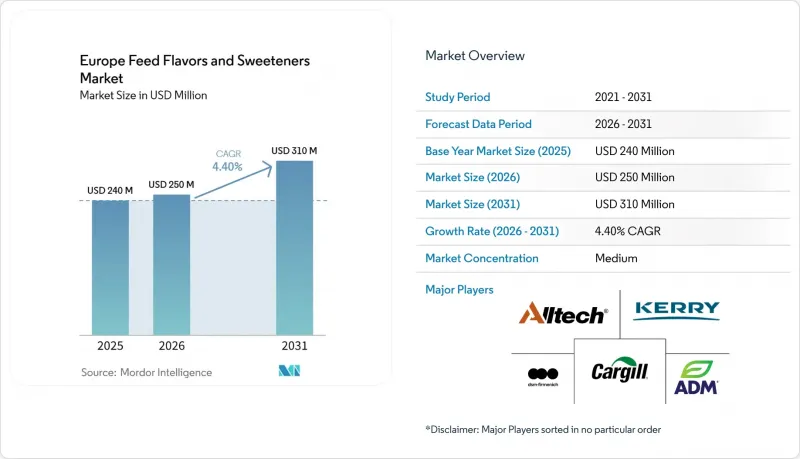
本報告按輔料(香料和甜味劑)、目標動物(反芻動物、豬等)和地區(法國、德國、義大利、荷蘭、俄羅斯、西班牙、土耳其、英國等)進行細分。市場預測以價值(美元)和數量(公噸)表示。
歐洲飼料風味劑和甜味劑市場的趨勢和洞察。
為了提高採食量和生產效率,人們對偏好飼料的需求日益成長。
在商業性畜牧養殖系統中,自發性飼料量仍是影響生長效率和飼料轉換率的關鍵因素。根據2025年發布的《默克獸醫手冊》,泌乳乳牛需要在產後迅速提高採食量,以減輕負能源平衡的嚴重性和持續時間;採食量長期下降會對母牛的身體狀況和繁殖性能產生負面影響。這項臨床原理有助於解釋歐洲飼料香料和甜味劑市場在飼料持續的重要性,因為採食量下降導致的生產力降低是可以立即衡量的。 Adiseo Europe在2025年指出,仔豬斷奶後的食慾不振,如果不在飼料轉換期透過改善偏好來控制,可能會延緩其生長並影響其終生生產力。 Norell Animal Nutrition也在2025年報告稱,在育肥飼料中添加特定的風味化合物可使母豬的發情恢復時間縮短0.5天。該公司還在第十六屆國際豬消化生理學研討會上報告了仔豬糞便硬度的改善情況以及飼料轉換率的變化趨勢。這些結果支持了一種更廣泛的趨勢,即採用已被證實能夠提高生產性能的風味成分,而不是隨意使用添加劑。
過渡到無抗生素和潔淨標示飼料配方
歐洲飼料香料和甜味劑市場也因飼料配方中逐漸減少藥理生長促進劑的使用而得到推動。根據2026年1月發表在《抗生素》(Antibiotics)雜誌上的一篇綜述,歐洲畜牧業政策透過限制抗生素生長促進劑的使用並加強對其預防性使用的監管,引導生產者轉向營養替代方案。 2025年,GMP+國際組織宣布,其良好生產規範(GMP)TS2.2「無抗生素飼料」標準已從荷蘭國家框架擴展為全球適用的認證標準。這為買家提供了更清晰的證據,以檢驗有關無抗生素供應鏈的說法。 2025年3月,歐洲藥品管理局(EMA)報告稱,經過12年的自願努力,歐盟獸用抗生素的銷量下降了50%,這證實了減少對抗生素的依賴已在商業環境中確立。隨著抗生素使用量的下降,透過營養管理來維持採食量和支持生產力,提高偏好的解決方案變得越來越重要。因此,歐洲飼料香精和甜味劑市場在既需要潔淨標示定位又需要商業績效的配方中變得越來越重要。
香精和甜味劑原料價格波動
天然成分仍然是歐洲飼料香精和甜味劑市場面臨的重大成本風險。 2024年,Symrise公司指出,氣候不穩定和地緣政治動盪導致天然成分供應鏈供不應求和成本上漲,與前一年相比,情況更為嚴重。因此,該公司製定了一項針對植物來源成分和其他天然萃取物的多來源採購計劃。這對於旨在轉向更天然定位或擺脫傳統低成本合成成分的飼料配方至關重要。中型供應商缺乏全球性公司所具備的採購規模和柔軟性,因此難以承受原物料價格波動加劇的影響。因此,歐洲飼料香精和甜味劑市場的成本結構可能會進一步擴大大型供應商與小型專業公司之間的差距。隨著成分複雜性的增加,即使在需求旺盛的情況下,利潤率壓力也會成為一個重要的阻礙因素。
細分市場分析
到2025年,香精將佔歐洲飼料香精和甜味劑市場51.7%的佔有率,成為最大的添加劑子類別。香精的優點在於其廣泛的應用,涵蓋泌乳飼料、育肥飼料和牛幼畜飼料等多種用途,比許多僅限於特定用途的成分應用範圍更廣。這種多功能性支撐了香精在歐洲飼料香精和甜味劑市場的規模。採購者可以利用單一平台,適用於多種動物群體,同時解決採食量、氣味掩蔽和配方接受度等挑戰。此外,香精非常適合那些優先考慮飼料穩定性而非短期配方調整的系統。因此,就目標動物種類和操作方面而言,香精在該類別中代表著更成熟的領域。
甜味劑市場基數小規模,預計2026年至2031年將以4.6%的複合年成長率成長,但隨著配方日益專業化,單位價值也不斷提升。歐洲飼料香精和甜味劑市場的甜味劑需求受益飼料的需求。在這些領域,由於採食反應迅速,低適口性會直接影響生產成本。 Adiseo在2025年指出,Optisweet和Krave等產品體現了從通用效能聲明到經過驗證的、針對特定應用的解決方案的轉變。實際上,這意味著甜味劑正變得越來越重要,即使銷售量香精。該品類正朝著高價值混合物、更可靠的實證數據以及與壓力敏感型飼餵應用更緊密結合的方向發展。
其他好處:
- Excel格式的市場預測(ME)表
- 3個月的分析師支持
目錄
第1章:引言
- 研究假設和市場定義
- 調查範圍
第2章:調查方法
第3章執行摘要
第4章 市場狀況
- 市場概覽
- 市場促進因素
- 為了提高採食量和生產效率,人們對偏好好的飼料的需求日益成長。
- 擴大畜牧養殖規模及整合商業農業
- 過渡到無抗生素和潔淨標示飼料配方
- 高附加價值乳牛和肉牛生產系統中特種營養產品的成長
- 增加飼料香精的使用,以掩蓋功能性食品添加劑的異味
- 針對幼齡動物和易受壓力動物的優質化飼料。
- 市場限制因素
- 香料和甜味劑原料成本的波動
- 監管機構對飼料添加劑的核准和功效聲明的審查
- 牲畜產品在價格波動較大的領域中,其價值感知有限。
- 不同動物飼料及其用量需求的複雜度。
- 技術展望
- 監理情勢
- 波特五力分析
第5章 市場規模與成長預測
- 透過亞加性
- 味道
- 甜味劑
- 動物
- 反芻動物
- 肉牛
- 乳牛
- 其他反芻動物
- 豬
- 其他動物
- 反芻動物
- 按地區
- 法國
- 德國
- 義大利
- 荷蘭
- 俄羅斯
- 西班牙
- 土耳其
- 英國
- 其他歐洲國家
第6章 競爭情勢
- 市場集中度
- 策略趨勢
- 市佔率分析
- 公司簡介
- Alltech, Inc.
- Archer Daniels Midland Company
- Adisseo
- Lucta SA
- Biovet JSC
- Cargill, Incorporated
- DSM-Firmenich AG
- Kemin Industries, Inc.
- Kerry Group plc
- Lallemand Inc.
- Lesaffre Group
- Phode Animal Care
- Nutreco NV
- Norel SA
- Novus International, Inc.
第7章 市場機會與未來展望
According to Mordor Intelligence, the Europe feed flavors and sweeteners market size stood at USD 240 million in 2025 and is projected to reach USD 250 million in 2026 and USD 310 million by 2031, at a compound annual growth rate (CAGR) of 4.40%.
This report is Segmented by Sub Additive (Flavors and Sweeteners), by Animal (Ruminants, Swine, and More), and by Geography (France, Germany, Italy, Netherlands, Russia, Spain, Turkey, United Kingdom, and More). The Market Forecasts are Provided in Terms of Value (USD) and Volume (Metric Tons).
Europe Feed Flavors and Sweeteners Market Trends and Insights
Rising Demand for Palatable Feed to Improve Intake and Performance
Voluntary feed intake remains a basic driver of growth efficiency and feed conversion across commercial livestock systems. The Merck Veterinary Manual, accessed in 2025, states that lactating dairy cows must maximize intake quickly after calving to reduce the severity and duration of negative energy balance, and that prolonged intake depression harms body condition and reproductive performance. That clinical principle helps explain why the Europe feed flavors and sweeteners market continues to gain relevance in diets where performance losses from weak intake can be immediate and measurable. Adisseo Europe wrote in 2025 that post-weaning anorexia in piglets can delay development and affect lifetime performance when diet transition stress is not managed through palatability support. Norel Animal Nutrition also reported in 2025 that targeted flavoring compounds in nursery diets improved sow return-to-estrus timing by 0.5 days. The company also reported improved piglet fecal consistency and feed efficiency trends at the 16th International Symposium on Digestive Physiology of Pigs. These results support a broader move toward performance-backed flavor inclusion rather than discretionary additive use.
Shift Toward Antibiotic-Free and Clean-Label Feed Formulations
The Europe feed flavors and sweeteners market is also gaining support from the shift away from pharmacological growth support in feed programs. A January 2026 review in Antibiotics stated that European livestock policy has pushed producers toward nutritional alternatives by restricting antibiotic growth promoters and tightening prophylactic use rules. GMP+ International announced in 2025 that the Good Manufacturing Practice TS2.2 Antibiotic-Free Feed standard expanded from a Dutch national framework into a globally applicable certification standard, which gives buyers a clearer basis to verify antibiotic-free supply chain claims. The European Medicines Agency reported in March 2025 that a 12-year voluntary effort reduced European Union veterinary antibiotic sales by 50% , confirming that lower antibiotic dependency is already embedded in the operating environment. As antibiotic use recedes, palatability solutions become more important in maintaining intake and supporting performance through nutritional management. That makes the Europe feed flavors and sweeteners market more relevant in formulations where clean-label positioning and operational performance must work together.
Volatility in Raw Material Costs for Flavor and Sweetener Inputs
Natural inputs remain a real cost risk for the Europe feed flavors and sweeteners market. Symrise stated in 2024 that natural ingredient supply chains face year-on-year shortages and cost increases because of climate instability and geopolitical disruption, which is why the company has built multi-origin sourcing programs for botanicals and other natural extractives. This matters for feed formulations moving toward a more natural positioning or away from older, low-cost synthetic inputs. Higher raw material volatility is harder for mid-tier suppliers to absorb, as they lack the same procurement scale or sourcing flexibility as global players. The Europe feed flavors and sweeteners market, therefore, shows a cost structure that can widen the gap between large suppliers and smaller specialists. As input complexity rises, margin pressure becomes a practical restraint even when demand conditions remain favorable.
Other drivers and restraints analyzed in the detailed report include:
- Growth in Specialty Nutrition for High-Value Dairy and Beef Systems
- Premiumization of Feed for Young Animal and Stress-Prone Diets
- Regulatory Scrutiny on Feed Additive Approval and Claims
For complete list of drivers and restraints, kindly check the Table Of Contents.
Segment Analysis
Flavors held 51.7% of the Europe feed flavors and sweeteners market share in 2025, making them the largest sub-additive category. Their strength comes from broad use across lactation diets, finisher rations, and calf starters, which gives them wider application than many narrowly targeted inputs. The Europe feed flavors and sweeteners market size for flavors remains supported by this versatility, because buyers can use one platform across several animal groups while still addressing intake, masking, and formulation acceptance. Flavors also fit well into systems that prioritize stable feed behavior rather than short-term ration adjustment. That makes them the more established side of the category in both species coverage and operational use.
Sweeteners are growing from a smaller base, with a projected CAGR of 4.6% during 2026-2031, but their value per unit is rising as formulations become more specialized. The Europe feed flavors and sweeteners market size for sweeteners is benefiting from demand in young animal diets and transition feeding, where intake response matters quickly and poor acceptance has visible production costs. Adisseo stated in 2025 that products such as Optisweet and Krave reflect a move toward documented, application-specific solutions rather than generic performance claims. In practice, this means sweeteners are becoming more strategic even where volumes are lower than flavors. The category is moving toward higher-value blends, stronger documentation, and tighter alignment with stress-prone feeding applications.
Complete Report Scope:
- By Sub Additive
- Flavors
- Sweeteners
- By Animal
- Ruminants
- Beef Cattle
- Dairy Cattle
- Other Ruminants
- Swine
- Other Animals
- Ruminants
- By Geography
- France
- Germany
- Italy
- Netherlands
- Russia
- Spain
- Turkey
- United Kingdom
- Rest of Europe
List of Companies Covered in this Report:
- Alltech, Inc.
- Archer Daniels Midland Company
- Adisseo
- Lucta S.A.
- Biovet JSC
- Cargill, Incorporated
- DSM-Firmenich AG
- Kemin Industries, Inc.
- Kerry Group plc
- Lallemand Inc.
- Lesaffre Group
- Phode Animal Care
- Nutreco N.V.
- Norel S.A.
- Novus International, Inc.
Additional Benefits:
- The market estimate (ME) sheet in Excel format
- 3 months of analyst support
TABLE OF CONTENTS
1 INTRODUCTION
- 1.1 Study Assumptions and Market Definition
- 1.2 Scope of the Study
2 RESEARCH METHODOLOGY
3 EXECUTIVE SUMMARY
4 MARKET LANDSCAPE
- 4.1 Market Overview
- 4.2 Market Drivers
- 4.2.1 Rising Demand for Palatable Feed to Improve Intake and Performance
- 4.2.2 Expansion of Livestock Production and Intensification of Commercial Farming
- 4.2.3 Shift Toward Antibiotic-Free and Clean-Label Feed Formulations
- 4.2.4 Growth in Specialty Nutrition for High-Value Dairy and Beef Systems
- 4.2.5 Increased Use of Feed Flavors to Mask Off-Notes in Functional Additives
- 4.2.6 Premiumization of Feed for Young Animal and Stress-Prone Diets
- 4.3 Market Restraints
- 4.3.1 Volatility in Raw Material Costs for Flavor and Sweetener Inputs
- 4.3.2 Regulatory Scrutiny on Feed Additive Approval and Claims
- 4.3.3 Limited Perceived Value in Price-Sensitive Commodity Livestock Segments
- 4.3.4 Reformulation Complexity Across Diverse Animal Diets and Dosage Needs
- 4.4 Technological Outlook
- 4.5 Regulatory Landscape
- 4.6 Porter's Five Forces Analysis
- 4.6.1 Bargaining Power of Suppliers
- 4.6.2 Bargaining Power of Buyers
- 4.6.3 Threat of New Entrants
- 4.6.4 Threat of Substitutes
- 4.6.5 Intensity of Competitive Rivalry
5 MARKET SIZE AND GROWTH FORECASTS (VALUE AND VOLUME)
- 5.1 By Sub Additive
- 5.1.1 Flavors
- 5.1.2 Sweeteners
- 5.2 By Animal
- 5.2.1 Ruminants
- 5.2.1.1 Beef Cattle
- 5.2.1.2 Dairy Cattle
- 5.2.1.3 Other Ruminants
- 5.2.2 Swine
- 5.2.3 Other Animals
- 5.2.1 Ruminants
- 5.3 By Geography
- 5.3.1 France
- 5.3.2 Germany
- 5.3.3 Italy
- 5.3.4 Netherlands
- 5.3.5 Russia
- 5.3.6 Spain
- 5.3.7 Turkey
- 5.3.8 United Kingdom
- 5.3.9 Rest of Europe
6 COMPETITIVE LANDSCAPE
- 6.1 Market Concentration
- 6.2 Strategic Moves
- 6.3 Market Share Analysis
- 6.4 Company Profiles (Includes Global Level Overview, Market Level Overview, Core Segments, Financials as Available, Strategic Information, Market Rank/Share, Products and Services, Recent Developments)
- 6.4.1 Alltech, Inc.
- 6.4.2 Archer Daniels Midland Company
- 6.4.3 Adisseo
- 6.4.4 Lucta S.A.
- 6.4.5 Biovet JSC
- 6.4.6 Cargill, Incorporated
- 6.4.7 DSM-Firmenich AG
- 6.4.8 Kemin Industries, Inc.
- 6.4.9 Kerry Group plc
- 6.4.10 Lallemand Inc.
- 6.4.11 Lesaffre Group
- 6.4.12 Phode Animal Care
- 6.4.13 Nutreco N.V.
- 6.4.14 Norel S.A.
- 6.4.15 Novus International, Inc.
7 MARKET OPPORTUNITIES AND FUTURE OUTLOOK

 飼料香精和甜味劑市場:2026-2032年全球市場預測(按甜味劑類型、成分、形態、分銷管道和最終用戶分類)
 北美飼料香精和甜味劑:市場佔有率分析、行業趨勢和統計數據以及成長預測(2026-2031 年)非洲飼料香精和甜味劑:市場佔有率分析、行業趨勢和統計數據以及成長預測(2026-2031 年)中東飼料香精和甜味劑:市場佔有率分析、行業趨勢和統計數據以及成長預測(2026-2031 年)南美洲飼料香精和甜味劑:市場佔有率分析、行業趨勢和統計數據以及成長預測(2026-2031 年)
 飼料調味劑和甜味劑市場規模、佔有率和成長分析(按產品類型、成分、牲畜類型、形態、通路和地區分類)-2026-2033年產業預測
 飼料調味劑和甜味劑市場 - 全球規模、佔有率、趨勢分析、機會、預測,2019-2030 年